
Part 1:
My name was Matilda Halloway. I was thirty-four years old the night my marriage ended, and if anyone had told me even a week earlier that I would be effectively separated from my husband before I fully understood how broken my life already was, I would have laughed in their face.
Not because Jasper and I were wildly in love.
We were not.
Maybe we had not been for longer than I wanted to admit, but we were established. Functional. Polished in that dangerous way long relationships often become when the people inside them grow skilled at pretending everything is normal.
We had a tidy brick house on a quiet street in the northern suburbs outside Des Moines. We had a kitchen with soft-close cabinets I had chosen myself, a shared calendar color-coded according to who needed the car, and a marriage that looked like a life.
At 2:47 that Tuesday morning, laughter was the last thing left in me.
I had fallen asleep downstairs on the couch with the television on mute. Some ridiculous overnight infomercial cast a pale silver glow across the living room.
Jasper was supposed to be in Las Vegas for a work conference.
He had kissed me on the cheek before leaving that morning, grabbed the carry-on I had reminded him three separate times not to overpack, and said, “Don’t wait up if my flight gets in weird.”
It was such an ordinary sentence.
Exactly the kind married people say every day.
And if there had been something slightly wrong in his tone, I either missed it or felt it and dismissed it because women are taught early to distrust their instincts when the truth would be inconvenient.
My neck was stiff from sleeping sideways against the armrest. One sock had half-slid off my heel.
An empty mug sat on the coffee table beside a stack of unopened mail and the candle I kept meaning to throw away, even though it had burned down to a wax stub two months earlier.
The house was so quiet that when my phone buzzed against the glass tabletop, the sound sliced through the room.
I reached for it lazily, still sticky with sleep, expecting something ordinary.
Maybe Jasper telling me he had landed.
Maybe a coworker asking about an early meeting.
Then I saw his name.
Then I saw the text.
He had written:
“Just married Margot. Been sleeping with her for eight months. You are pathetic by the way. Your boring energy made this easy. Enjoy your sad little life.”
I read it once.
Then again.
Then a third time.
My brain refused to believe those words belonged to the same universe as the room around me.
The half-burned candle.
The mug on the table.
The framed wedding photograph still hanging in the hallway.
The bottle of his aftershave upstairs in the bathroom.
I did not scream.
I did not cry.
I did not throw the phone.
People like to imagine betrayal arrives as an explosion.
Sometimes it does.
But sometimes it arrives as a freezing.
The body goes still before it understands why.
My breathing flattened. My pulse seemed to slow. The entire world narrowed until all that existed was the glow of the screen and the grain of the wooden floor beneath my bare feet.
Thirty seconds passed.
Maybe more.
Time became strange.
Then I typed one word back.
“Cool.”
The phone buzzed again almost instantly.
I did not look.
Something inside me had already shifted.
It had not shattered exactly.
It had sharpened.
Like a blade being pulled cleanly through fabric.
If Jasper thought he had destroyed me with a Las Vegas wedding chapel and one vicious text message, he had forgotten something fundamental about the life he was leaving behind.
I knew how to organize a disaster.
And I knew exactly what needed to be done.
Part 2:
At 3:15 a.m., I was moving through my own house with the ruthless calm of a woman closing accounts after an audit.
The first thing I did was open the banking app on my phone.
Jasper had always been reckless with money in the soft, socially acceptable way that made some men look spontaneous when what they really were was irresponsible.
He forgot due dates.
Overordered at restaurants.
Booked upgrades “for the experience.”
Bought gadgets he did not need.
And assumed there would always be enough because, in his mind, there always had been enough.
There had been enough because I made sure there was.
I tracked renewals. Watched statements. Refinanced at the right time. Knew the mortgage dates, utility drafts, card balances, checking reserves, savings floor, and investment timing.
I knew exactly how much of our day-to-day life rested on systems I had built so carefully that Jasper barely noticed them.
So I noticed for both of us.
Not anymore.
I canceled the cards where I was the account holder and removed Jasper as an authorized user from the accounts I controlled. I changed passwords on the accounts that belonged solely to me. I removed his access from shared streaming services, shopping accounts, cloud services, delivery accounts, security systems, and other digital accounts tied to my house and my personal information.
“Click. Remove. Confirm. Done.”
The deed to the house had always been mine.
I had bought it three years before I met Jasper, after seven brutal years climbing through a consulting job I hated. Later, I had used that experience to move into a better position at a healthcare operations firm, where I learned how to negotiate, budget, and stop apologizing for being competent.
Jasper had moved into a life I had already built.
The mortgage was in my name.
The title was in my name.
The insurance and tax records were in my name.
The house belonged to me.
Our finances had never been equally owned either. I had kept my primary accounts in my own name. Jasper had access to certain household funds and authorized cards because we were married, but access was not ownership.
I removed what I was legally entitled to remove.
At 3:30, I called a twenty-four-hour locksmith.
The man who answered sounded as though I had dragged him awake by the ankle.
“Emergency lock change?” he asked.
“Yes.”
“This late?”
“Yes.”
“We can do early morning.”
“I’ll pay double if you come now.”
There was a pause.
The kind of pause that belonged to a man doing quick math in the dark.
“I’ll need the address,” he finally said.
By four o’clock, his headlights washed across my front windows.
He was in his late fifties, with a gray mustache and a thermal hoodie underneath his work jacket. He wore the expression of someone who had seen enough late-night human collapse to know better than to ask too many questions.
He hauled his equipment up the walk while I stood in the doorway barefoot, wearing an old college sweatshirt and leggings, my hair still tangled from sleeping on the couch.
“Long night?” he asked.
Instead of answering, I held up my phone.
He read the message.
His eyebrows rose.
Then he let out a slow whistle that managed to be sympathetic without becoming dramatic.
“Well,” he said, “that’s one way to find out you need new locks.”
It was exactly the level of humor I could tolerate.
It steadied me.
He worked quickly.
He changed the front door, back door, side entrance, garage keypad, and gate.
New deadbolts.
New keys.
New codes.
While he worked, I reset the Wi-Fi, changed the security passwords, updated the alarm system, and logged Jasper’s devices out of the systems that belonged to me.
By five in the morning, the house was sealed.
Jasper Halloway, newly married—or so he claimed—to his coworker Margot in Las Vegas, no longer had automatic access to the home he had been living in.
When the locksmith finished, he handed me two sets of keys.
“Want a third copy?” he asked.
I looked down at the metal in my hand.
“No.”
He nodded like he understood that my answer had nothing to do with the number of keys.
When he drove away, dawn had begun to break in that reluctant blue-gray way Midwestern mornings often do.
The birds in the hedges had started singing.
The streetlights still glowed.
I stood in the foyer holding the keys in one hand and my phone in the other.
For the first time since the text arrived, I did not feel better.
Or safe.
Or vindicated.
I simply felt in control.
That mattered.
I went upstairs, stripped the bed because I could still smell Jasper’s cologne on the pillowcase, threw the sheets onto the floor, and crawled onto one side of the bare mattress without making it again.
I slept for two solid hours.
At 8:00 a.m. sharp, someone started pounding on the front door.
It was not tentative.
It was not embarrassed.
It was the pounding of someone who still believed access was his by right.
I sat upright, disoriented for one ugly second until memory slammed back into place.
Las Vegas.
The text.
The locksmith.
The new locks.
The new life.
The pounding came again.
Then a male voice.
Official.
I dragged on the first robe I found and went downstairs.
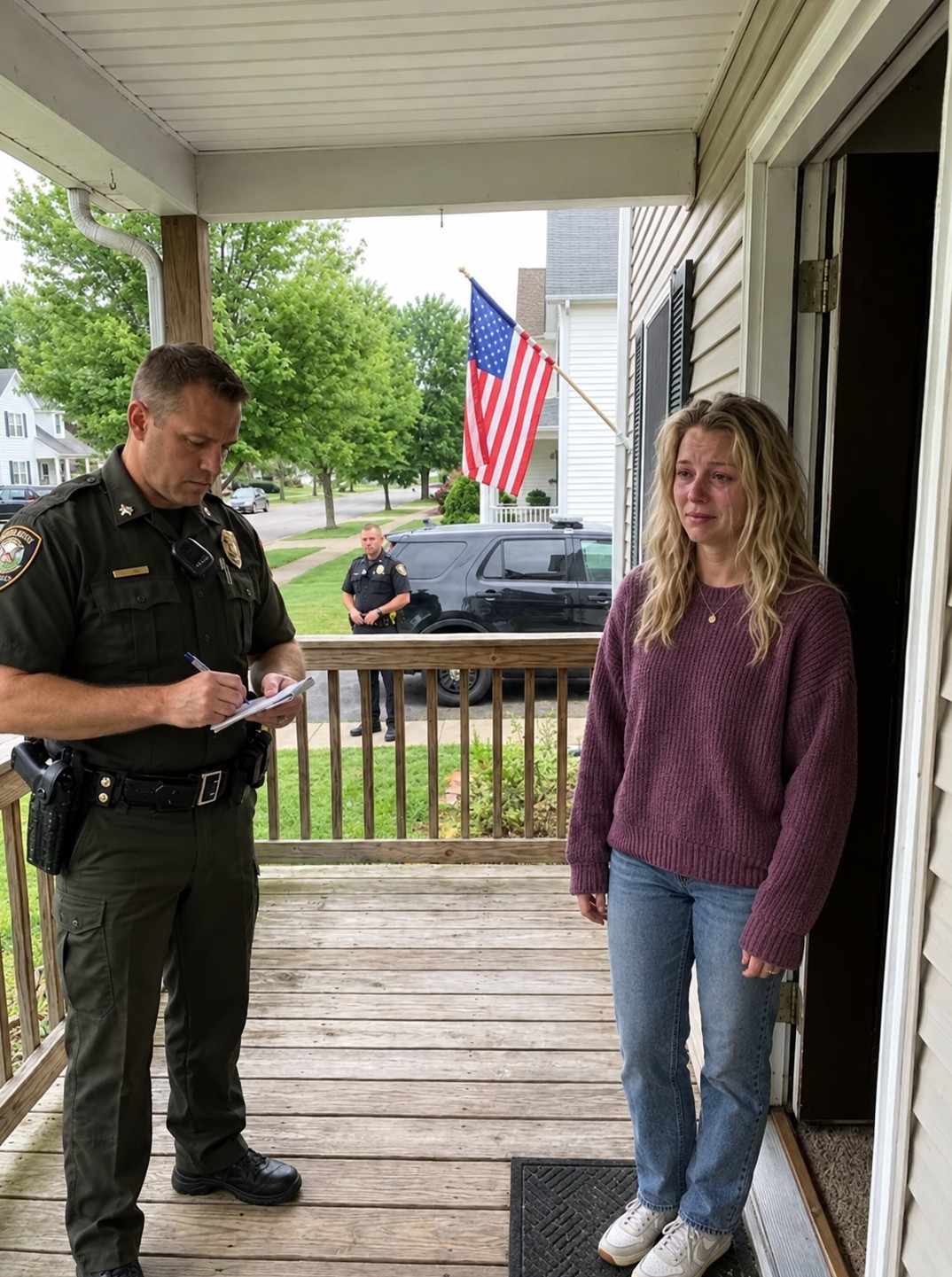
Through the peephole, I saw two police officers on the porch. One was older, one younger, and both wore the tired expressions of men who had already been handed too much of someone else’s nonsense and it was not even breakfast yet.
I opened the door with the chain still latched.
The older officer cleared his throat.
“Ma’am, we received a call about a domestic dispute. Your husband says you locked him out of his home.”
Your husband.
The phrase landed like something rotten.
Without saying a word, I lifted my phone and held the screen toward him through the narrow opening.
The Las Vegas message glowed in the morning light.
He read it once.
Then leaned slightly closer and read it again.
The younger officer bit down hard on the inside of his cheek. I thought he might actually hurt himself trying not to react.
The older officer looked up.
“Is this real?”
“As far as I know,” I said. “He sent it at 2:47 this morning from Las Vegas, after apparently marrying another woman.”
The radio on the officer’s shoulder crackled.
Then a shrill female voice burst through the static.
I did not need an introduction.
It was Constance, Jasper’s mother.
Her voice lived somewhere between offended grande dame and air-raid siren. Even distorted by static, it was impossible to mistake.
“Ma’am,” the officer said into the radio, already exhausted, “this is not a police matter. He married someone else. We cannot make her let him back into a home she says belongs to her.”
The radio screeched again.
He turned the volume down with the expression of a man who had children and therefore worshipped silence.
The younger officer shifted.
“She says you stole his things.”
“I have not touched them,” I said. “His personal belongings are still here. The house was purchased before the marriage and is in my name. His cards were authorized-user cards, not joint ownership. He can collect his belongings.”
The older officer looked past me into the entryway.
Maybe he was checking for smashed furniture, blood, or any evidence this was the kind of domestic dispute police training actually prepared them for.
Instead, he saw what the house always looked like in the morning.
Umbrella stand.
Bench.
Polished table.
Framed prints.
One of Jasper’s shoes half-under the entry bench because he never put anything away unless I reminded him.
“Just don’t destroy anything,” he said. “If he wants his belongings, keep them accessible. Other than that, he has no right to force his way inside.”
“Of course,” I said.
They left, shaking their heads.
I shut the door, leaned back against it, and let out a breath that felt as though it came from somewhere low and old in my body.
So that was how the day was going to be.
Part 3:
I showered, got dressed, tied my hair back, and went into the guest-room closet for moving boxes.
Then I packed Jasper’s belongings with the same precision I once brought to quarterly operations reports.
Clothes folded.
Books stacked.
Electronics wrapped.
Toiletries bagged.
Shoes paired.
Everything was labeled clearly in black marker.
Clothes.
Books.
Office.
Electronics.
Miscellaneous.
If Jasper later claimed I had damaged anything, he would have to make that argument against a level of order he had never once brought to our shared life.
While I packed, memories kept surfacing in flashes.
Jasper laughing at dinner parties.
Jasper kissing me in grocery-store aisles while I held the shopping list.
Jasper dropping onto the couch at the end of the day while I finished the dishes and telling myself it was fine because he had had a stressful week.
Then another memory surfaced.
Jasper saying Margot’s name months earlier in some work story, his face turned away while he opened the refrigerator.
Margot.
Of course she was a Margot.
There is always a Margot in stories like this.
Smooth hair.
Younger by a handful of years.
Office-insider energy.
The kind of bright laugh women like me are supposed to dismiss as harmless right up until it is standing in the ruins of our own life in a white dress.
I knew who she was in the vague, peripheral way one knows a husband’s coworker.
Marketing.
Younger.
Too loud at holiday parties.
Once, she had complimented my earrings and then spent the rest of the evening orbiting Jasper with that practiced kind of innocence some women use when they want to be noticed but never accused of wanting to be noticed.
By 1:30 p.m., every trace of Jasper I could reasonably remove from the house was boxed and stacked in the garage.
I left the wedding album untouched in the linen closet upstairs.
He had not yet earned the right to make me touch it.
At 2:00 p.m., the doorbell rang.
I had been expecting him.
Men like Jasper rarely believe the first consequence is the real one.
They assume every locked door is still a negotiation.
They think if they show up in person with the right face—injured, reasonable, wounded, offended—some older version of the woman on the other side will reappear and rescue them from the mess they made.
I moved to the front window and lifted one slat of the blind.
There he was.
Not alone.
Margot stood beside him in a cheap white sundress that looked as though it had been purchased in a hurry from a clearance rack in a beach-town boutique. It was already wrinkled in all the wrong places.
Her lipstick was too pink.
Her face looked drawn.
There was still a visible tan line where a different ring must have sat until recently.
Behind them stood Constance, dressed as though she were attending a tribunal at which she intended to be personally offended by everyone present.
And Blair, Jasper’s younger sister, wearing spite the way some women wear jewelry.
The sight of them all together—new wife, mother, sister—was so absurd it nearly made me laugh.
Instead of opening the front door and giving them the dignity of a threshold, I hit the garage-door opener.
The door rolled up with a metallic groan.
Sunlight poured over the neatly stacked boxes inside.
Jasper stopped when he saw them.
“Wow,” he said. “Efficient. Didn’t even wait for me to get back.”
“You didn’t come back,” I said. “You got married.”
Margot looked at the floor.
Constance surged forward immediately.
“This is outrageous, Matilda. A wife does not throw her husband’s things into the garage like garbage.”
“I’m not his wife anymore,” I said. “And nothing here is garbage. It’s every last thing he owns. Packed carefully. You’re welcome.”
Blair let out a short, sharp laugh.
“You’re such a control freak, Matilda. Always have been. You’re just mad Jasper finally found someone who makes him happy.”
Even Margot flinched at the word happy.
That told me more than enough about how secure their honeymoon bubble really was.
Jasper planted his feet, squared his shoulders, and dropped into that familiar reasonable-man posture he had spent years perfecting.
Hands on hips.
Voice low.
Expression injured.
He had always known how to make women around him look emotional by comparison.
“Look,” he said, “I get that you’re hurt, but you can’t just shut me out. This house is—”
“This house,” I interrupted, “was purchased three years before I met you. Your name has never been on the deed.”
He went pale for half a heartbeat.
Then flushed hard from the collar upward.
Constance hissed as though I had insulted her bloodline.
“We will call the police again. You cannot erase a marriage in one night.”
“Funny,” I said. “That’s exactly what Jasper tried to do.”
Blair rolled her eyes.
“So dramatic.”
Margot stood there fidgeting with the rental-truck keys.
That was when I noticed something.
She was not standing there in strength.
She was beginning, in real time, to understand what she had actually married.
Not some brave romantic hero escaping a loveless wife.
Not a truth-teller who had finally chosen passion.
Just a sloppy man who thought cruelty was power and logistics were something women existed to handle for him.
A rental-company driver waited near the curb, already looking as though he regretted this route.
Margot stepped forward and swiped a card through the handheld reader.
Declined.
She frowned and tried again.
Declined.
She pulled another card from her purse and swiped that one.
Declined.
The driver coughed politely.
“Ma’am, if the balance isn’t covered—”
Jasper yanked his wallet out and thrust his card toward the machine.
“Use mine.”
Margot turned toward him.
“I thought—”
“Shut up,” he snapped.
There it was.
The first visible crack in the fantasy.
The new wife blinking in the July heat while the old patterns emerged the second reality asked for payment.
I crossed my arms.
“Looks like the Las Vegas glow wore off pretty fast.”
Blair snapped, “You think you’re so smart, Matilda. But you’re bitter, alone, thirty-four. What do you even have left?”
I stepped close enough that some of her bravado disappeared under direct eye contact.
“What do I have left?” I said softly. “My house. My career. My freedom. And I don’t have Jasper. Honestly, that’s the best part.”
Jasper flinched.
Only slightly.
Most people would have missed it.
Margot turned toward him.
“Did you know she canceled all your cards?”
Panic flashed across his face before anger rushed in to cover it.
I let the moment breathe.
Let her see him.
Let him know I saw that she saw him.
Then I said, almost sweetly, “Oh, and Margot? Your new husband’s company has a strict no-fraternization policy. I wonder how human resources will feel about a Las Vegas marriage between coworkers.”
Her head snapped toward him.
“You said it wouldn’t matter.”
“Margot,” he said through his teeth, “shut up.”
The air in the garage thickened.
Constance made one last attempt to seize control through volume alone.
“You’re vindictive, Matilda. This is exactly why Jasper left. You always had to be in charge. Always making everyone feel small.”
I almost admired how smoothly she could step around a son who had cheated on his wife, married his mistress while still legally married, and sent his wife a cruel message—and still make me the problem.
“You know what?” I said. “You’re right about one thing. I do like being in charge of my own house.”
I looked at Jasper.
“You have one hour to load up and leave. After that, anything remaining will be boxed and placed in storage under your name.”
They argued, naturally.
Constance called me cold.
Blair called me pathetic.
Jasper muttered vague threats about lawyers he could not afford.
Margot stood in the middle of it all with her wrinkled white dress and failing certainty, learning too late that she had not stepped into a love story.
She had stepped into a liquidation.
But they packed.
Box after box came down the driveway while the summer heat pressed against the pavement and the neighborhood pretended not to watch.
Constance kept issuing commands no one followed.
Blair sneered at every load she had to lift.
Margot became increasingly silent.
Jasper sweated through the back of his shirt by the third trip and looked steadily less like a newly married man and more like someone dragging the full weight of his own stupidity uphill.
I stood in the garage doorway with the remote in one hand and watched.
Let them carry it, I thought.
Every lie.
Every fantasy.
Every convenience they had built by hollowing out my life from the inside.
I did not have to carry it anymore.
When the truck finally drove away and the street settled back into afternoon stillness, the house did something unexpected.
It exhaled.
The furniture had not moved.
The rooms looked the same.
The refrigerator still chimed if the door did not seal all the way.
The clock still ticked upstairs.
But some invisible pressure had lifted.
The kind you do not realize you are carrying until it is suddenly gone.
I should have known peace would not last.
It rarely does when wounded egos still have internet access.
Part 4:
Two mornings later, I woke to my phone vibrating so hard on the nightstand that it sounded like panic.
Not one notification.
Not a few.
A flood.
Texts.
Tags.
Missed calls.
Facebook mentions.
Instagram alerts.
Even LinkedIn, which should be protected by law from family drama and somehow never is.
For one disoriented second, I thought someone must have died.
In a way, someone had.
Jasper’s public dignity, maybe.
By the time I opened the first post, I understood exactly what had happened.
Jasper had gone to war.
Digital war.
Which was really just old-fashioned character assassination with better lighting and more audience participation.
And he had brought Constance and Blair with him like backup singers in a pathetic little opera.
They were everywhere.
Facebook first, because Constance liked an audience broad enough to include distant acquaintances and people from church who still believed tears meant truth.
Instagram next, because Blair never saw a chance to perform that she did not seize.
LinkedIn after that, because apparently no platform was too inappropriate when your family’s need for public sympathy became desperate enough.
Their story was absurd, coordinated, and polished just enough to fool people who never paused before taking sides.
Matilda Halloway was abusive.
She had trapped Jasper in a loveless marriage.
She controlled him.
Manipulated him financially.
Humiliated him for years.
He had finally escaped.
He had finally found real love.
Constance posted a tearful selfie with some nonsense about praying for sons who suffered in silence.
Blair uploaded a photo of herself with Margot and captioned it as though she were protecting a wounded family member from toxicity.
And Jasper posted the centerpiece.
He and Margot under a filtered desert sunset, smiling stiffly, with some variation of:
“Finally found peace.”
The lies themselves did not hurt me.
What hurt were the comments.
People I knew.
People who had eaten in my home.
People who had toasted us at New Year’s parties and asked me where I bought my flowers.
One comment read:
“Wow, I always thought something was off about Matilda. She did seem controlling. Good for you, Jasper. Everyone deserves happiness. Proud of you for getting out.”
My hands shook so badly I had to set the phone down on the comforter before I dropped it.
It was not just gossip.
It was a campaign.
And for a few hours, if I am honest, it worked on me.
Not because I believed any of it.
But because public lies still have a way of invading the body.
I got hot.
Then sick.
Then so furious that I had to sit on the bedroom floor and breathe through it.
Not because strangers thought badly of me.
Because Jasper was trying to erase what he had done by replacing it with a cleaner story in which I was the villain and he was the brave man who had finally chosen joy.
He had always hated facts.
That afternoon, I called Quentin.
Every woman should have at least one friend whose brain is so technical and so morally uncomplicated that when you say, “Someone is lying about me online,” his first response is not, “Ignore it.”
It is:
“Let’s see what proof they forgot to hide.”
Quentin had known both Jasper and me for years.
He was the kind of man who could fix a router with a paper clip, despised fuzzy thinking, and once rebuilt my home-office network after Jasper spilled beer into the modem and suggested maybe the house wiring was the problem.
He was also completely immune to charm.
Jasper had never quite known how to manage him.
Quentin answered on the second ring.
“Hey. You okay? I’ve seen some things.”
“They’re everywhere,” I said, and heard my own voice shake. “He’s turning people against me.”
“You start,” Quentin said, “by not panicking. Then you start by fighting back. I think I know how.”
By evening, he was sitting at my kitchen table with a laptop open, his glasses halfway down his nose, fingers moving quickly over the keyboard.
He muttered to himself while he worked, a mix of irritated engineer and opportunistic detective.
“Jasper thinks he’s clever,” he said. “But he’s careless. Always has been.”
I looked at him.
“What are you doing?”
“I’m checking the information and account records you already have legitimate access to. I’m not breaking into anything.”
That distinction mattered.
Quentin had access to some shared digital records from years of helping us with household technology, and I still had access to the cloud backup and account information that belonged to me or had been shared with me.
He searched through the records we could legally access.
Then he stopped.
“Jackpot.”
He turned the screen toward me.
There they were.
Messages between Jasper and Margot that had been automatically preserved in a shared backup.
A year’s worth.
At first, it was the sheer volume that hit me.
Then the words.
“She is so stupid. Been siphoning money from her grocery account for months. Almost saved enough for our dream wedding, babe.”
Another message.
“You think she’ll notice the missing cash?”
Jasper replied:
“Nah. Matilda is too boring to check.”
Another.
“She’s basically funding our escape and doesn’t even know it. That’s kind of hilarious.”
And another.
“When this blows up, play victim. Your mom will back you.”
I gripped the edge of the table so hard it hurt.
Quentin kept scrolling.
Hotels.
Gift purchases.
Plans.
Petty jokes about my habits and routines.
References to my work hours.
Which accounts I used most.
How easy it was to skim small amounts without me noticing immediately.
I did not cry.
Later, that would surprise me.
But some betrayals are so ugly they skip grief and go straight to clarity.
Jasper had not simply cheated.
He had used me as infrastructure for the affair.
My labor.
My steadiness.
My discipline.
My boring, reliable competence.
Everything he mocked had been the invisible platform underneath his fantasy.
Quentin looked at the screen, then at me.
“This is gold,” he said, then winced. “Bad wording.”
“No,” I said. “It’s accurate.”
“You want me to organize it?”
I nodded.
An hour later, I had a clean folder of screenshots.
Timestamps intact.
Names visible.
Context preserved.
No dramatic captions.
No emotional essays.
Just proof.
Proof never needs much makeup.
I posted them with no commentary at all.
No speech.
No personal statement.
No lesson in female survival.
Just the images, one after another, like evidence under bright fluorescent light.
The internet flipped.
It happened almost instantly.
Comments calling me controlling disappeared.
New ones appeared.
“Wait, he was stealing from her grocery account? This is vile.”
Another read:
“So he funded the wedding by taking money from his wife? Margot married a clown.”
Constance’s post disappeared before midnight.
Blair’s vanished not long after.
Jasper’s desert-sunset peace photo lasted a little longer, collecting increasingly hostile comments until it too disappeared sometime after 1:00 a.m.
People who had rushed to pity him started messaging me privately, eager to reposition themselves on the right side of the truth.
I answered almost none of them.
I had no appetite for loyalty that changed direction based on whichever screenshot had been posted most recently.
For the first time since that text message, I exhaled.
Not because it was over.
Men like Jasper never knew when they had lost.
But because he had chosen public perception as his battlefield, and I had answered with his own words.
Part 5:
Desperation made him sloppier.
First came the phone call from his father, Victor.
If Constance specialized in elegantly shrill emotional warfare, Victor preferred sheer volume.
He was the kind of man who had spent decades sounding aggrieved in the booming voice of someone who believed his age and gender ought to exempt him from consequences.
He left a voicemail for my boss claiming I was stalking Jasper, harassing his new wife, and creating an unsafe environment for the family.
I found out because my boss, Fiona, called me into her office the next morning.
Fiona was one of those women whose competence was so complete it looked almost effortless.
She never raised her voice.
Never rushed.
And had the rare gift of making one sentence do the work of an entire lecture.
She closed the office door, opened her laptop, and said:
“You should hear this.”
Then she hit play.
Victor’s voice thundered through the speaker.
“Emotionally unstable, trying to ruin his career because she can’t accept that he moved on. If you have any integrity at all, you will rein her in.”
Fiona muted it halfway through and looked at me over the top of the screen.
“Your former in-laws,” she said dryly, “have apparently decided this is a feudal dispute.”
I laughed before I could stop myself.
“Sorry.”
“Don’t apologize,” she said. “It was the correct reaction.”
Then came the attempted break-in.
Three nights after the social-media collapse, my security app pinged at 11:18 p.m.
Motion detected.
Rear entry.
I opened the live feed.
There he was.
Jasper.
His face was lit brightly under the porch light as he yanked the back-door handle and whisper-shouted into his phone.
“She locked me out! My stuff is still in there!”
Every second was recorded.
He rattled the knob again.
Then bent toward the glass as if trying to peer inside.
Like the house itself had betrayed him by forgetting his shape.
I stood in the dark upstairs hallway watching the feed and felt no fear.
Only contempt.
I forwarded the clip to Diane, my attorney.
Her reply came less than ten minutes later.
“Noted.”
That was all.
But when the woman handling your divorce can reduce attempted trespass to one word and make it sound like the lid closing on a coffin, it has a calming effect.
Then came the rumors.
He told people I had killed his cat.
At first I laughed because we had never owned a cat.
I am severely allergic.
Once, years earlier, Jasper had insisted we consider fostering a kitten because he thought it would make the house feel warmer. I had spent twenty minutes sneezing in a pet-store parking lot just from standing near the adoption booth.
The idea that I had secretly murdered a feline that had never existed should have ended his credibility on the spot.
Some people still believed him.
That was the exhausting part.
Not the stupidity of the lie.
The willingness of people to accept anything if it helped preserve the version of a charming man they preferred.
When outrage, slander, and trespass failed, Jasper reached for the oldest weapon men like him know.
Pity.
He called my mother.
I was sitting beside her on the couch when her phone rang.
She had come over with soup, fresh bread, and the kind of quiet maternal presence that does not crowd your pain but refuses to let it isolate you.
My mother, Irene, had always had a way of making rooms feel sturdier.
She frowned at the unknown number and answered anyway.
By the second sentence, I knew it was him.
“Mrs. Halloway,” he said, his voice cracked and miserable, “I made a mistake. Margot means nothing. Matilda is my life.”
My mother’s face changed in slow, beautiful stages.
Surprise first.
Then disgust.
Then something colder.
I took the phone gently from her hand, set it on speaker, and waited.
“Mrs. Halloway?” he said again, actually sounding hopeful.
My mother leaned toward the phone.
“You should have thought of that before sleeping with Margot for eight months.”
Then she hung up.
I laughed so hard I nearly cried.
And for the first time since all of this began, the tears that came did not feel like grief.
They felt like pressure leaving the body.
She patted my knee.
“You’re stronger than he ever deserved.”
The next day, I got another call.
Unknown number.
Female voice.
Polite.
Strained.
Faintly desperate.
“Hi, is this Matilda? I’m Janet. Margot’s mother.”
I nearly choked on my coffee.
“Yes?”
She sighed like a woman already tired of cleaning up her daughter’s choices but not ready to admit that was what she was doing.
“Look. Jasper made a mistake. Young men do stupid things. He can’t afford a wife right now. Could you maybe take him back? Just until he gets on his feet?”
There are some sentences so absurd that the brain rejects them before laughter catches up.
“You’re asking me,” I said slowly, “to take back the man who cheated on me, stole from me, married your daughter while he was still married to me, and slandered me online, so your daughter doesn’t have to deal with him?”
“Well,” she said, instantly defensive, “when you put it that way, you sound selfish. Marriage is about forgiveness.”
I leaned against the counter and looked out at my backyard, where I had once imagined growing tomatoes and maybe, someday, something more permanent than this.
A kind of calm settled over me.
So complete it almost felt holy.
“Marriage is about respect,” I said. “And your daughter married a man who has none.”
Then I hung up.
That night, Jasper called from a blocked number.
I should not have answered.
I knew that.
But there is a point in every implosion when you want to hear the final thread snap with your own ears.
So I picked up.
His voice came through ragged and venomous.
“You ruined my life, Matilda. I hope you’re happy.”
My answer came automatically, as if it had been waiting all day.
“I am, actually. Thanks for asking.”
Then I hung up and blocked the number.
The silence afterward was no longer frightening.
It was clean.
Part 6:
By the time the divorce hearing arrived, I had already burned through anger and reached something much more useful.
Precision.
The courthouse smelled like paper, disinfectant, and institutional endings.
It was the kind of place where marriages, property disputes, and lifelong bad decisions had been sweating into the walls for decades.
I arrived early in a simple navy dress.
My hair was smooth.
My shoes were practical and sharp.
Diane was already waiting in the lobby, immaculate and faintly amused, like life kept handing her increasingly absurd stories and she kept billing them accurately.
“You ready?” she asked.
“I’ve been ready since 2:47 a.m. on Tuesday,” I said.
One corner of her mouth tilted.
When Jasper walked in, I barely recognized him.
Not because he looked broken.
He did not.
Men like Jasper rarely break in ways that produce tragedy.
They simply diminish.
He had lost weight in that sloppy way people do when they are living on adrenaline, takeout, and self-pity.
His suit did not fit properly anymore.
Margot followed behind him, pale and pinched.
Constance and Blair came last, both dressed as though outrage had a formal dress code.
Jasper tried to meet my eyes.
I looked through him.
The judge was a silver-haired man with the expression of someone who had seen every possible form of human stupidity and no longer found any of it surprising.
We stood.
Sat.
And began.
Jasper’s lawyer opened with a face that told me he hated this case already.
He looked like a man who had been handed a leaking bag and told to present it as a portfolio.
“Your Honor,” he began, “my client contests the validity of the Las Vegas marriage ceremony. He was under emotional distress and claims he was not fully aware of the legal consequences when he signed the documents.”
The judge lifted one eyebrow.
“Was he legally married to the petitioner at the time?”
“Yes, Your Honor,” Diane said.
The judge looked at Jasper.
“Then the validity of the second ceremony is a separate issue from the dissolution of the first marriage.”
Diane stood.
“Your Honor, we have seventy-three pages of Facebook messages, text records, security footage, financial statements, hotel receipts, and other documentation showing that Mr. Halloway planned this affair for over a year, used money taken from my client to finance portions of it, and knowingly entered a second marriage ceremony while he was still legally married to her.”
She dropped a thick folder onto the table.
The sound was satisfying.
The judge flipped through the pages.
Then more.
His eyebrows climbed higher.
He stopped.
Read one line aloud.
“Cannot wait to see her stupid face when she realizes I took her for everything.”
He looked over his glasses at Jasper.
“Did you write this?”
Jasper swallowed.
“That’s out of context.”
The judge stared at him.
“What context makes that sound better?”
Silence.
Margot shifted in her seat.
Constance stopped moving altogether.
Blair’s jaw worked with helpless fury.
Diane laid everything out piece by piece.
The affair timeline.
The grocery-account siphoning.
The hotel receipts.
The Las Vegas marriage certificate.
The company records showing Jasper and Margot worked under the same reporting structure.
The security footage from my back door.
The social-media smear campaign.
The archived messages coordinating the stories.
Each time Jasper’s lawyer tried to soften the facts into emotional confusion, Diane answered with documentation so exact it felt surgical.
“Mr. Halloway did not simply make a mistake,” she said. “He maintained a relationship with another woman for eight months, diverted money from marital household resources for that relationship, publicly accused my client of abuse after she refused to give him continued access to her property, and participated in a second marriage ceremony while his first marriage remained legally intact.”
The judge nodded slowly.
“Whether criminal charges arise from the second ceremony is not for this hearing,” he said. “But the evidence concerning the circumstances is certainly relevant to the credibility of the parties.”
Jasper’s lawyer tried one last weak maneuver.
“My client believed his marriage was effectively over.”
The judge looked directly at him.
“Belief does not dissolve a legal marriage.”
No one spoke.
Then came the ruling.
The divorce was granted.
The house and the property I had brought into the marriage remained mine.
Jasper was entitled only to property legally belonging to him and was responsible for his vehicle and its associated financial obligations.
The court also considered the professional certification program I had paid for during the marriage. Jasper had completed two years of coursework with my financial support and later used that certification to increase his income.
After considering the finances, the court ordered him to pay six months of modest support at five hundred dollars per month.
Not because I needed it.
Because the financial consequences of a marriage were not erased simply because he had decided he wanted another life.
The judge signed the final order.
The gavel cracked.
Final.
Clean.
Official.
Relief moved through me so quickly it almost felt like dizziness.
Across the room, Jasper looked hollowed out.
Margot buried her face in her hands.
Constance clutched her pearls with such devotion to type that if she had collapsed onto the floor, I would not have been shocked.
Blair looked at me with the kind of rage people feel when cruelty has failed them publicly.
But the real chaos happened outside.
We had barely stepped onto the courthouse steps before Constance exploded.
“This is theft!” she screamed. “You stole from my baby!”
Her voice rang across the plaza so loudly that two women near the fountain turned in unison.
Janet, Margot’s mother, was there too, inexplicably holding an iced coffee and looking as though she had shown up hoping reality might still be renegotiated.
Then Blair flung her drink.
She missed me.
The coffee hit Janet square across the blouse in a brown splash so perfectly timed that it seemed to silence the entire courthouse entrance.
Janet screamed.
“You idiot!”
“Watch your tone, tramp!” Constance shouted back.
Apparently, in their universe, every family dispute eventually transformed into a regional theater production.
What followed was the most humiliating caffeine-fueled gladiator match I had ever witnessed outside reality television.
Two mothers shrieking.
Coffee running down silk.
Blair trying to escalate things and only making them worse.
Security guards hurried over with the exhausted expressions of men whose lunch break had just been canceled by suburban madness.
Diane leaned toward me.
“I’ve handled bankruptcies with less spectacle.”
I laughed so hard I had to hold the courthouse railing.
Jasper had already slipped away by then, shoulders hunched.
Margot stumbled after him.
He never looked back.
Part 7:
Later, I heard Jasper found comfort in the arms of a twenty-two-year-old bartender that same night.
If that was true, Margot had lost that particular gamble before the chips had even settled.
Then human resources did exactly what I suspected they would.
The company’s no-fraternization policy, which Jasper and Margot had ignored while the affair still felt romantic, turned out to be very real when the company finally had reason to enforce it.
Both were fired within the week.
Constance got herself banned from a coffee shop after screaming at a barista who vaguely resembled me.
Blair posted increasingly vague things about toxic bloodlines and spiritual warfare.
Janet threatened to sue Jasper for emotional damages on Margot’s behalf and was laughed out of the first lawyer’s office she called.
The whole family folded like wet paper.
Meanwhile, my life exhaled.
I sold the house.
Beautiful as it was, I no longer wanted to live in a museum of my own ambush.
The kitchen still looked like itself.
The garage still smelled like cardboard in summer heat.
The back door still brought back the image of Jasper rattling the handle in the security footage.
I did not want to spend years stepping around those ghosts.
The market was strong.
I accepted an offer well above asking and walked away with enough profit that it felt less like closure and more like acceleration.
Then I bought a condo downtown.
Smaller.
Brighter.
Mine.
Floor-to-ceiling windows.
Exposed concrete.
Morning sun in the bedroom.
A balcony overlooking city lights.
A kitchen compact enough that nothing inside it could disappear into neglect.
I slept the first few nights with the balcony door cracked open just enough to hear the city below.
Not because it was romantic.
Because it reminded me that I was living inside motion again.
Not memory.
That was where my life began to feel like my own.
Jasper’s name came up less and less.
When news drifted my way, it only confirmed what I already suspected.
He was unraveling.
Not in a dramatic, cinematic way that invited pity.
Just steadily.
Stupidly.
Exactly as men like him do when the systems cushioning their recklessness are finally removed.
He missed deadlines.
Lost jobs.
Borrowed money unwisely.
Told contradictory versions of the divorce depending on the audience.
Margot moved in with her mother, then moved out again after an explosive argument involving borrowed jewelry and a maxed-out card.
I did not chase the updates.
But I did not resist them either.
There is nothing morally wrong with appreciating the weather report from a storm you survived.
The gym became my quiet rebuild.
That surprised me.
I had always exercised in bursts.
Three inspired weeks followed by a month of excuses.
But after the divorce, I needed somewhere to put the voltage still living inside my body.
The gym near my condo opened at 5:30 a.m.
If I got there early enough, the place smelled like clean rubber mats, metal, and possibility.
That was where I met Julian.
He was not the kind of man who would have attracted the younger version of me who once married Jasper.
There was nothing theatrical about him.
No dangerous charm.
No room-temperature seduction disguised as confidence.
He was steady.
Funny in a quiet, observant way.
He reracked weights.
Wiped down machines.
Held doors without turning it into a personality trait.
The first real thing he said to me came after a workout when I was wrestling with the lid on my protein shaker and losing badly.
“If that bottle wins,” he said, “you legally have to leave the gym.”
I laughed and handed it to him.
He opened it in one easy twist and handed it back as if he had not rescued me at all.
As if he were simply participating in a universe where small things did not need to become dramatic.
We started talking in fragments after that.
Gym banter at first.
Then longer conversations near the coffee bar downstairs.
Then a Saturday walk to the farmer’s market that somehow became lunch, which somehow became three full hours and the easiest silence I had experienced in years.
He knew pieces of my story because gossip travels.
Especially when there is a Las Vegas wedding, a courthouse coffee fight, and a public implosion at human resources.
But he never mined it for entertainment.
He never asked for the spectacle.
He let me tell it only in fragments.
Only when I chose to.
He did not treat my past like something wounded he needed to fix.
He did not admire my pain.
He simply let me be a person.
One morning, after I had mentioned Jasper’s name only once in two weeks—and only as part of a joke about how peaceful life was without unexplained sneaker piles in the hallway—Julian handed me a coffee.
Written on the cup in black marker were two words.
“Not Jasper.”
I laughed so hard I nearly spilled it.
For the first time in years, I felt light in a way that had nothing to do with proving I was resilient.
I was not performing survival anymore.
I was actually living.
Part 8:
At my final meeting with Diane, after the last signatures, final transfer confirmations, and remaining administrative details had been filed and closed, she handed me a flat, gift-wrapped package.
“What is this?” I asked.
“Open it.”
Inside was a simple black frame.
Mounted neatly under glass was a copy of the Las Vegas marriage certificate.
Jasper and Margot’s names were sprawled beneath a tacky neon chapel logo like a monument to impulsive stupidity.
I looked up at her.
“Easiest case of my career,” she said. “Thought you might want a souvenir.”
I laughed until my eyes watered.
I hung it in the condo.
But not in the living room, where guests might misunderstand it as obsession.
I hung it in the hallway just before the bedroom, where only people I trusted ever went.
Not as a wound.
As a trophy.
Months later, I was browsing in a bookstore downtown when an old acquaintance from the neighborhood spotted me between the history shelves.
She leaned close and whispered with obvious delight:
“Did you hear? Jasper’s mother called Margot a gold-digging succubus at book club.”
I laughed right there between biographies and military history.
My head went back.
The sound came out loud enough to turn nearby faces.
I did not care.
Poetic justice tastes best when somebody else serves it with coffee and public humiliation.
Sometimes, late at night, I still think about that text.
“Just married Margot. Been sleeping with her for eight months. You are pathetic by the way.”
Once, those words haunted me.
Not because I believed them.
Because cruelty from someone who knows the layout of your life can hit with surgical precision.
Jasper knew I valued steadiness.
He knew I loved quiet mornings.
Routines.
Order.
The private dignity of a life that worked.
He called it boring energy because men like Jasper mistake peace for dullness when what they really fear is the mirror it holds up to their own chaos.
Now those words are nothing but a punch line.
Because here is what I learned.
People like Jasper often author their own downfall.
Sometimes all you have to do is stop editing for them.
For years, I had been smoothing.
Budgeting around his spending.
Softening his lateness.
Translating selfishness into stress.
Irresponsibility into confusion.
Carelessness into charm.
I thought I was protecting the marriage.
What I was actually protecting was the version of him that benefited from never having to meet the full weight of his own behavior.
The moment I stopped—truly stopped—his life folded under the pressure of what he had built.
Not because I destroyed it.
Because I refused to keep holding it together.
That is a distinction I wish more women were taught sooner.
We are so often accused of ruining men the moment we stop buffering them from themselves.
But it was never us.
It was gravity.
Part 9:
These days, my life is simple in ways that feel almost luxurious.
I wake early.
I make coffee in a kitchen designed for exactly one adult and therefore perfect.
I work hard.
I leave books open without anyone using them as coasters.
I keep flowers when I want them.
I go to the gym.
I walk downtown at dusk.
I let Julian make me laugh.
I let my mother come by without worrying that some man will sulk through dinner.
I answer my phone without bracing for Constance’s voice.
Peace, I learned, is not boring.
Peace is expensive.
Rare.
And worth defending with screenshots, new locks, and court filings if necessary.
Nearly a year after the divorce, I stood on my balcony with a glass of wine while the city flickered below me in gold.
Somewhere down on the street, someone laughed.
A siren wailed in the distance.
Music drifted from another building.
The air smelled like rain on concrete and restaurant kitchens.
Inside, the framed Las Vegas certificate waited in the hallway like a private joke with the universe.
I thought of the woman I had been on that couch at 2:47 a.m.
Half asleep.
Phone glowing.
Life splitting open.
I wanted to reach back through time and tell her the truth.
“He is not taking your future. He is only removing himself from it.
“The house will go. The marriage will go. The lies will rise and rot. The people who rush to judge without facts will reveal themselves.
“You will learn exactly how fast a locksmith can arrive if the motivation is strong enough.
“You will discover that courts prefer documentation over drama.
“You will find out that humiliation bounces strangely off women who have already looked directly at the worst and kept moving.
“You will laugh again.
“Not all at once.
“Not neatly.
“But truly.
“And one day, when someone says Jasper’s name, your first feeling will not be pain.
“It will be gratitude that he was foolish enough to announce himself so clearly.”
I raised my glass toward the skyline.
“To stupid games,” I said softly.
Then, after a beat, I smiled.
“And even stupider prizes.”
The city continued moving below me.
I stood there for another moment, listening to the sounds of a life that had nothing to do with Jasper.
And I realized the best revenge had never been the courthouse.
It had not been the screenshots.
It had not been the social collapse.
It had not even been the framed certificate hanging in my hallway.
The best revenge was this.
I kept the part of me he never understood.
The calm.
The competence.
The willingness to act while others performed.
The ability to let the truth stand on its own feet.
He thought my boring energy made betrayal easy.
What it actually did was make recovery devastatingly efficient.
I had always been steering the ship.
The night he jumped overboard, he simply assumed the ocean would part for him.
Instead, it swallowed the man who mistook sabotage for freedom and cruelty for power.
And me?
I sailed on.
THE END.
