
Part 1: The Glass-Walled Tomb
I used to believe silence was the sound of peace.
In the high-pressure world of international corporate acquisitions, I spent my days surrounded by noise.
Boardrooms were filled with arguments. Phones rang constantly. Lawyers demanded answers. Executives fought over millions and sometimes billions of dollars.
That world made sense to me.
Numbers either added up or they didn’t.
Contracts either protected you or they didn’t.
A deal was either profitable or it was a disaster waiting to happen.
I had built my entire career around finding problems before they became disasters.
Then I would return to my twelve-million-dollar home in the hills of Aspen Ridge.
The house had enormous glass walls, beautiful gardens, expensive furniture, and every comfort money could buy.
I thought of it as my sanctuary.
A place where I could escape the noise of the business world.
A place where my wife, Sophie, and I could raise our son, Julian, safely.
Julian was four months old.
He had been born healthy, and the first few weeks of his life had been filled with the normal chaos of having a baby.
Crying.
Feeding.
Sleepless nights.
Tiny clothes everywhere.
Sophie had been exhausted, but she had also been happy.
She was an architect, brilliant and strong-minded. Her designs were bold, modern, and impossible to ignore.
She was the kind of woman who could walk into a room full of powerful men and make them listen.
But after Julian was born, something changed.
At first, I thought it was simply exhaustion.
Then my mother moved in.
Penelope Sterlington claimed she wanted to help us.
She said Sophie needed rest.
She said I needed to concentrate on my work.
She said she could help with Julian while we adjusted to being parents.
I believed her.
That was my first great mistake.
My mother was the matriarch of the Sterlington family.
She had spent decades protecting our name, our reputation, and our social position.
To Penelope, weakness was almost a personal insult.
She dressed perfectly every morning.
She wore strings of pearls around her neck.
Her expensive perfume filled the rooms before she even entered them.
And she had a habit of speaking softly when she wanted to hurt someone.
One afternoon, she stopped me in the hallway.
“Sophie is quite fragile, Nicholas,” she whispered.
I looked toward the nursery.
“What do you mean?”
My mother gave me a sympathetic smile.
“Some women simply aren’t built for the pressure of our family name. Motherhood can be a real test.”
“She just had a baby,” I said.
“I know.”
She touched my arm.
“That is why I’m here.”
She smiled.
“To keep this house from falling apart while you’re out conquering the world.”
I wanted to believe her.
So I did.
Over the next few months, Sophie became quieter.
She apologized constantly.
She stopped arguing.
She stopped laughing.
Her eyes began to look tired all the time.
She told me she wasn’t sleeping well.
I thought that was normal.
Julian was only a few months old.
But then I noticed other things.
Sophie began flinching whenever my mother entered a room.
Her hands sometimes trembled when she reached for a glass of water.
She stopped eating meals with us.
And whenever Penelope spoke to her, Sophie immediately became smaller.
One evening, I found Sophie standing alone in the kitchen.
“Are you okay?” I asked.
She quickly wiped her eyes.
“Yes.”
“You don’t look okay.”
“I am just tired.”
I stepped closer.
“Sophie, talk to me.”
She looked toward the hallway.
My mother was somewhere nearby.
Then Sophie whispered, “Please don’t make things worse.”
“What?”
She shook her head.
“Nothing.”
I reached for her hand.
She pulled away.
“I am fine, Nicholas. Please just go to work.”
Those words hurt.
But I didn’t understand them.
I didn’t know she was afraid of what would happen if she told me the truth.
I didn’t know my mother had already begun telling her that I was tired of her.
That I regretted marrying her.
That I thought she was a bad mother.
I didn’t know any of it.
All I knew was that my wife was changing.
And then there was Julian.
Every morning when I left the house, he cried.
Not the ordinary cry of a baby who wanted his father.
His crying became frantic.
Almost rhythmic.
It happened so often that I started feeling uneasy every time I walked toward the front door.
One morning, I stopped beside my car and looked back at the house.
My mother was standing at the nursery window.
She wasn’t waving goodbye.
She was smiling.
It was a strange smile.
Cold.
Satisfied.
Then she reached for the curtains and pulled them shut.
Something about the moment made my stomach tighten.
That morning, I decided to install a security camera in the nursery.
I called it the Sentinel Eye.
It was a small, high-definition camera with audio, hidden inside a hand-carved wooden owl on the nursery bookshelf.
I told myself I was installing it for Sophie’s protection.
If she was exhausted, I could check on her and Julian while I was working.
If something happened, I would know.
I had no idea that the camera was about to show me what had been happening inside my own home.
Part 2: The Predator’s Theater
The executive parking lot at Horizon Global was usually my favorite place to arrive.
It meant another day of negotiations, strategy, and deals.
That morning, however, I remained inside my car.
The engine was running.
My hands were gripping the steering wheel.
I couldn’t shake the feeling that something was wrong.
Then my phone buzzed.
A high-priority motion alert had come from the Sentinel Eye.
I opened it.
At first, I expected something ordinary.
Maybe Sophie feeding Julian.
Maybe my mother checking on the baby.
Instead, the nursery door suddenly flew open.
Penelope had entered.
She looked furious.
Sophie was sitting in the rocking chair with Julian in her arms.
Julian was crying.
Sophie looked exhausted.
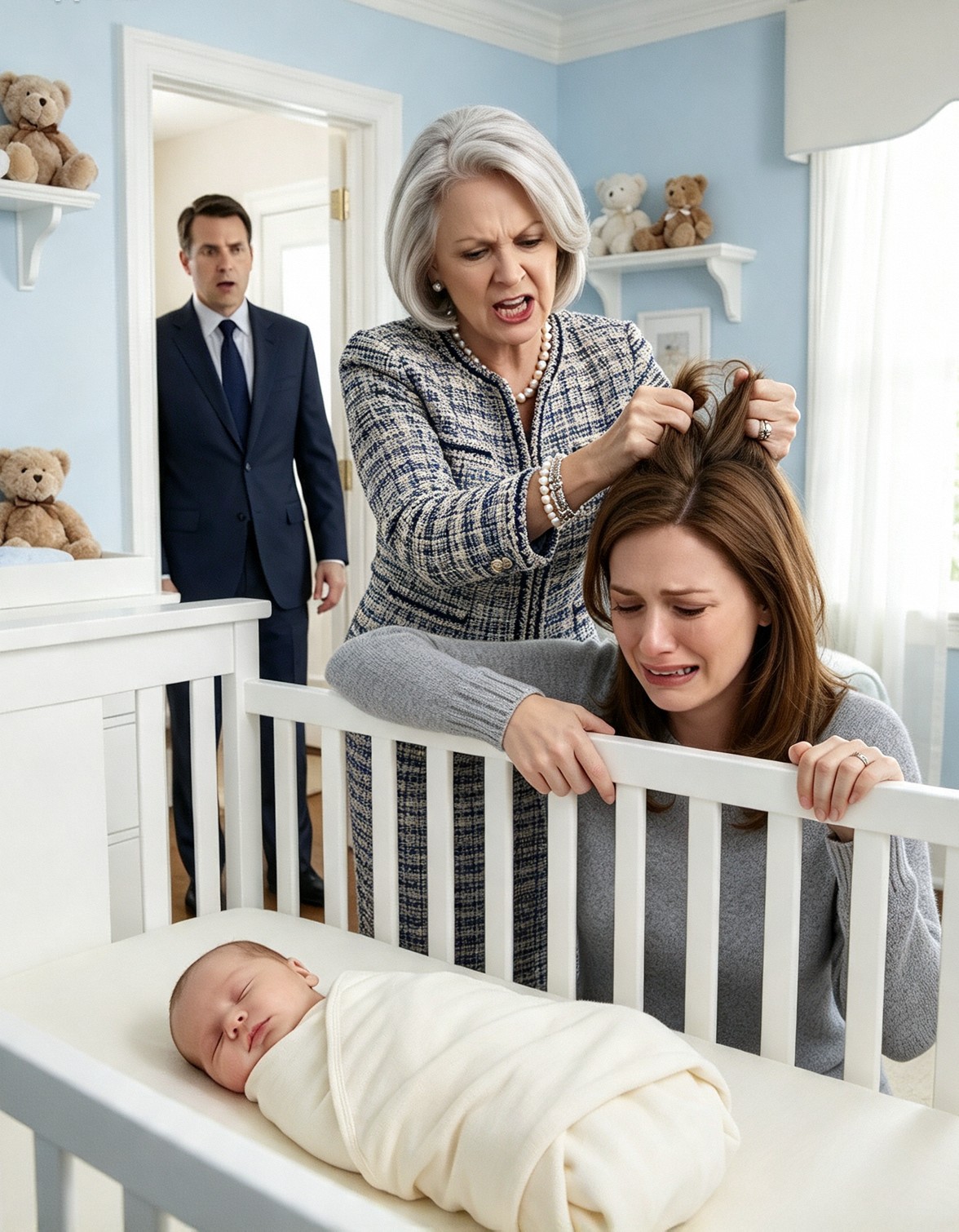
“You are a parasite, Sophie,” my mother said.
I turned the volume up.
“You live in this house. You wear the jewelry my son bought with his hard work. You spend the money he earns, and you still have the nerve to sit there and say you’re tired?”
Sophie looked frightened.
“He has been crying for hours, Penelope,” she whispered.
“I think he may have a fever. Please let me call his pediatrician.”
“You will call no one!”
My mother stepped closer.
“You are incompetent. You are weak. You are a pathetic excuse for a woman.”
Sophie lowered her eyes.
“If Nicholas knew how useless you really were, he would have left you months ago.”
“That isn’t true.”
Sophie was crying now.
“He loves me.”
My mother laughed.
“He only stays because of the baby.”
“Please stop.”
“I just want to take care of my son.”
“I am the only reason Nicholas hasn’t realized he married a broken toy.”
Then my mother grabbed her.
Her fingers twisted into Sophie’s hair.
She pulled hard.
Sophie cried out.
Julian screamed.
I felt as if someone had punched me in the chest.
I had never seen my mother behave like this.
Sophie didn’t fight back.
She simply closed her eyes.
A tear ran down her cheek.
Her body went still.
It wasn’t surrender.
It was fear.
She had learned that resisting my mother only made things worse.
“Look at me when I’m talking to you,” Penelope said.
She pulled her hair tighter.
“You live off my son, and you still complain.”
Then she smiled.
“Maybe today is the day I show Nicholas the medical records I’ve been preparing.”
My blood went cold.
“What medical records?” I whispered.
Penelope reached into her pocket and pulled out a small pill bottle.
She glanced toward the wooden owl.
She didn’t know it was recording.
“Time for your afternoon rest,” she said.
“Let’s see how Nicholas likes finding his wife too exhausted to take care of her own child.”
I immediately ended the call.
The Harrington merger was supposed to begin in less than an hour.
I didn’t care.
Billions of dollars could wait.
My wife and son couldn’t.
I drove away from Horizon Global.
But instead of going straight home, I stopped at a quiet park three miles away.
I needed to know exactly what I was dealing with.
One recording could be explained away.
I needed the whole truth.
Part 3: The Audit of Souls
I parked beneath a large oak tree and opened the Sentinel Eye’s cloud archive.
Then I began going backward.
The recordings covered several months, but I focused first on the most recent seventy-two hours.
What I saw made me sick.
My mother had not suddenly become cruel.
She had been doing this for weeks.
Maybe longer.
On Tuesday night, while I was at what I believed was an important business dinner, Penelope entered the nursery.
Julian was almost asleep.
Instead of comforting him, she stood beside his crib.
She suddenly clapped her hands.
Julian startled awake.
He began crying.
Penelope waited.
When he finally became sleepy again, she clapped loudly a second time.
Then a third.
She was deliberately keeping him awake.
She was creating exhaustion.
And she knew exactly what she was doing.
Later that night, she walked into our bedroom.
“You are too lazy to keep the baby quiet while Nicholas is working,” she told Sophie.
Sophie looked exhausted.
Then came the recording from Wednesday morning.
My mother stood over Sophie.
“Nicholas told me he is staying late because he can’t stand the sight of you anymore.”
Sophie stared at her.
“That isn’t true.”
“He said you’ve become a burden to the family.”
“He would never say that.”
“He is only staying because of the boy.”
Sophie began crying.
Then my mother leaned closer.
“If you tell him a word of this, I will make sure the court sees the psychiatric history I have been building on you.”
Sophie froze.
“I have friends who will listen to me,” Penelope continued. “One phone call, and people will start questioning whether you are capable of raising your son.”
My mother had been creating a false story.
She wanted me to believe Sophie was mentally unstable.
She had planted empty pill bottles in the bathroom trash.
She had deliberately kept Julian awake.
She had made Sophie exhausted.
Then she used that exhaustion as evidence that Sophie couldn’t care for her own child.
But the worst recording was still waiting.
I watched my mother walk into the kitchen after I had left.
She opened her purse.
She removed two white tablets.
She crushed them with a spoon.
Then she mixed the powder into Sophie’s water.
My stomach turned.
My mother looked at the glass.
“Sleep,” she whispered.
“Sleep so Nicholas can see how helpless you are.”
Then she walked away.
I sat completely still.
My mother was drugging my wife.
And because Sophie was already exhausted from caring for a four-month-old baby, the sedative made her even less alert and less able to defend herself.
That explained so much.
The strange sleepiness.
The confusion.
The days when Sophie couldn’t remember parts of conversations.
The way she had sometimes looked as though she were fighting to keep her eyes open.
I had blamed exhaustion.
My mother had caused it.
I didn’t touch the recording or try to alter anything.
Instead, I preserved the original footage exactly as it had been stored.
I downloaded copies and made encrypted backups.
One went to my private cloud.
One went to my attorney.
Another went to a senior contact in the District Attorney’s office.
Then I called emergency medical services and explained that I believed my wife had been secretly given a sedative and was currently at home with our four-month-old son.
I also told them that I had video evidence showing the suspected administration of the tablets.
I wanted Sophie medically evaluated immediately.
At 2:45 p.m., I started driving.
I was no longer thinking like a businessman.
I was thinking like a husband and father.
Then I noticed a white van parked across the street from our house.
A man inside was holding a camera with a long lens.
The camera was pointed directly at our front door.
I understood immediately.
My mother had hired someone to photograph Sophie.
She was creating evidence to make my wife look negligent.
The entire thing had been planned.
She would drug Sophie.
She would exhaust her.
She would make Julian cry.
Then she would photograph the result.
And she would show those photographs to a court.
My mother had created the evidence she intended to use against Sophie.
But now I had the evidence against her.
Part 4: The Homecoming of the Storm
I drove home without speeding.
I wasn’t interested in revenge.
I wanted Sophie safe.
I wanted Julian safe.
And I wanted my mother stopped.
When I entered the house, the familiar silence surrounded me.
But it felt different now.
I knew what was hiding behind it.
The smell of lilies filled the living room.
Normally, Penelope loved those flowers.
That afternoon, the scent made the house feel like a funeral.
Then my mother appeared.
“Nicholas!” she said brightly.
“You’re home early.”
She smiled.
“Is everything all right with the merger?”
I said nothing.
“Sophie is having another difficult afternoon,” she continued. “She’s quite out of it again.”
“I see.”
“I’ve had to take over with Julian.”
She sighed.
“It is becoming a tragedy.”
I walked past her.
“We may need to discuss long-term care for Sophie,” she called after me.
I stopped.
But I didn’t turn around.
Instead, I walked to the huge television on the living room wall.
“Nicholas?”
My mother sounded nervous.
“What are you doing?”
I connected my phone to the television.
“You look pale,” she said.
“Sit down. I’ll make you some tea.”
“I don’t want your tea, Mother.”
My voice was quiet.
“I want you to watch something.”
Her face changed.
“What?”
“Our legacy in action.”
I pressed play.
The television filled with the image of my mother grabbing Sophie’s hair.
Her voice echoed through the room.
“You are a parasite.”
Penelope went pale.
The next recording began.
Her hands clapping beside Julian’s crib.
The baby waking and screaming.
Then another recording.
Penelope threatening Sophie with psychiatric confinement.
Then the final recording.
My mother crushing the tablets.
Mixing them into Sophie’s water.
Penelope stared at the screen.
“It isn’t what it looks like!”
I looked at her.
“She provoked me!”
She was talking faster now.
“She is mentally ill! I was protecting you!”
“You can’t trust recordings,” she said desperately. “They can be edited. They can be fake. It could be AI.”
“The original files are stored in multiple places,” I said.
“And the original camera archive is still preserved.”
I stepped closer.
“I saw you drug my wife.”
Her face tightened.
“I saw you assault her.”
She began shaking.
“And I saw you deliberately torment my son.”
“You don’t understand!”
“I understand perfectly.”
My voice became colder.
“You didn’t protect our family.”
“You tried to destroy my wife so you could control our home.”
Then I heard something behind me.
I turned.
Sophie was standing in the hallway.
She was leaning against the doorframe.
Her face was pale.
Her movements were slow.
She was still affected by the sedative.
But she was awake.
She could see the television.
She saw my mother exposed.
Sophie covered her mouth.
A broken sob escaped her.
I immediately walked toward her.
“Sophie.”
She looked at me.
“I didn’t know,” she whispered.
“I know.”
“I tried to tell you.”
“I know.”
Her eyes filled with tears.
“I thought you hated me.”
I felt something break inside me.
“I never hated you.”
Then there was a knock at the front door.
Everyone froze.
Penelope’s face changed.
She suddenly remembered something.
“The photographs,” she whispered.
She hurried toward the door.
It was the private investigator.
Earlier that afternoon, after photographing the house from across the street, he had called Penelope and told her the photographs were ready.
She had instructed him to bring the printed folder inside.
She had expected Nicholas to be away at the merger and Sophie to be too drugged and exhausted to understand what was happening.
Penelope opened the door.
The investigator stepped inside.
“Mrs. Sterlington,” he said, holding up the manila folder, “I have the photographs you requested.”
Then he saw me.
His expression changed immediately.
“Nicholas?”
Penelope stood frozen beside him.
For the first time, she looked trapped.
Part 5: The Evidence Trap
Penelope grabbed the folder from the investigator.
“See!” she shouted.
She threw the photographs onto the table.
“Look at her!”
She pointed toward Sophie.
“Look at her sitting there! Look at her ignoring the baby!”
She turned toward me.
“These are the proofs!”
Her voice became frantic.
“The court will see these!”
I picked up the photographs.
They showed exactly what my mother wanted them to show.
Sophie exhausted.
Sophie sitting down.
Sophie holding her head.
Sophie struggling to stay awake.
But now I knew what had caused those images.
The photographs weren’t evidence of neglect.
They were evidence of my mother’s plan.
I handed the folder back to the investigator.
“You were hired to document a false story.”
The man looked uncomfortable.
“I didn’t know what was happening.”
“You know now.”
He nodded.
Then I looked at the photographs again.
“And you’re going to give these to the police.”
The investigator swallowed.
“Yes.”
“Good.”
I turned back to my mother.
“You were so sure these photographs would prove Sophie was neglecting Julian.”
I pointed toward the television.
“But you forgot about the camera.”
Penelope’s face hardened.
“Nicholas—”
“And you forgot about the tablets.”
Her expression changed.
“What tablets?”
“The ones you crushed.”
The investigator looked from me to Penelope.
“What are you talking about?”
I looked at him.
“Call the police.”
He immediately took out his phone.
Penelope stepped toward him.
“No!”
But it was too late.
The evidence was already moving beyond her control.
I had preserved the original video files.
The tablets Penelope had handled were still in the house.
And the glass she had prepared for Sophie had not yet been washed.
I pointed them out to the investigator.
“Don’t touch anything.”
He stepped back.
When the police arrived, they photographed the scene before collecting the physical evidence.
The pill bottle, the remaining tablets, the spoon, and the glass were all documented and secured.
Sophie was taken to the hospital.
Because I had video showing Penelope crushing and mixing the tablets, the doctors knew exactly what they were looking for.
They took blood and urine samples as soon as possible.
The toxicology results were consistent with exposure to a sedating medication, although the doctors explained that the amount detectable in her body would depend on how long before the sample was taken and how quickly her body processed it.
But the case did not depend on the laboratory result alone.
The police had the video.
They had the physical tablets.
They had the pill bottle.
They had the spoon and glass.
They had photographs showing the effects of Sophie’s exhaustion.
And they had the investigator, who could confirm that Penelope had hired him to document what she called Sophie’s “neglect.”
Most importantly, the original recording showed Penelope preparing the substance herself and deliberately giving it to Sophie.
The evidence formed a chain.
One piece supported another.
It was no longer my word against my mother’s.
It was my mother’s own actions recorded and preserved.
Penelope turned toward me.
“Nicholas, please.”
Her voice cracked.
“I did it for you.”
“No.”
“For the family!”
“No.”
“She isn’t one of us!”
Her eyes were wild.
“She is weak! I was trying to make you understand that you deserve a queen, not a broken architect!”
“You didn’t do it for me.”
I looked directly at her.
“You did it because you wanted control.”
She began crying.
“I am your mother.”
“And Sophie is my wife.”
I pointed toward the hallway.
“And Julian is my son.”
I walked to Sophie.
She was barely steady.
I carefully helped her sit down.
“I’ve called an ambulance,” I told her.
She nodded weakly.
“I don’t want to go anywhere without you.”
“You won’t.”
I held her hand.
“I am going with you.”
The paramedics arrived.
They examined Sophie and took her to the hospital.
Julian stayed safely with a trusted caregiver.
The police remained at the house with Penelope.
She was no longer in control of anything.
Part 6: The Fall of the Matriarch
Sophie spent the night in the hospital.
The doctors monitored her until they were satisfied that the sedative was wearing off and that she was medically stable.
By the following morning, she was much more alert.
She still felt weak.
Her head hurt.
And emotionally, she was shaken.
But she was herself again.
A doctor explained that the immediate effects of the medication had passed and that Sophie could recover at home with follow-up care.
Before we left, Sophie looked at me.
“Did I really look that bad?”
I sat beside her.
“You were being drugged.”
She looked down.
“I thought I was losing my mind.”
“You weren’t.”
She began crying.
“I thought maybe your mother was right.”
I took her hand.
“She was lying to you.”
The doctors also documented the injuries to her scalp and neck from the assault.
Fortunately, there was no serious permanent injury.
The physical effects of the sedative faded quickly once she stopped receiving it.
The emotional damage was different.
That would take much longer.
The police arrested Penelope after reviewing the recordings and the physical evidence.
The investigator gave them the photographs and explained exactly what Penelope had hired him to do.
The medical records documented Sophie’s condition.
The laboratory evidence helped establish that she had been exposed to a sedating substance.
And the recordings showed Penelope preparing and administering it.
There was no longer any believable way to explain the situation as a misunderstanding.
As officers led Penelope away, she looked back at me.
“You think you won, Nicholas?”
I didn’t answer.
She smiled strangely.
“Check the safe in the basement.”
I stared at her.
“I wasn’t the only one recording things in that house.”
Then she said:
“Ask Sophie about the Architect’s Secret from before the wedding.”
The police car door closed.
I watched her disappear.
But this time, I didn’t let her words control me.
Part 7: The Recovery
Sophie did not suddenly become her old self the day my mother was arrested.
That would have been too easy.
The sedative had left her system, but the fear my mother had created did not disappear with it.
For the first few weeks, Sophie had trouble sleeping.
Sometimes she woke up frightened.
Sometimes she apologized for things that weren’t her fault.
If she heard a door slam, she would freeze.
If someone raised their voice, her body would tense.
And sometimes she would look at a glass of water for several seconds before drinking from it.
She no longer trusted what people put in front of her.
I understood.
We worked through it slowly.
She had regular medical follow-ups.
She also began working with a therapist who specialized in trauma and abuse.
I changed my work schedule.
For the first time in my career, I turned down several major deals.
Money could wait.
My family couldn’t.
I took care of Julian while Sophie rested.
We rebuilt our daily life one small step at a time.
There was no pressure on Sophie to suddenly become cheerful.
No one told her to “move on.”
We simply gave her time.
Months passed.
The nightmares became less frequent.
She started sleeping through the night again.
She began drinking water without checking the glass first.
She started laughing.
Then one morning, something small happened.
Sophie walked into the nursery.
She stood beside Julian’s crib.
Julian looked up at her and smiled.
Sophie smiled back.
She picked him up.
Then she began crying.
But this time, they were not tears of fear.
They were tears of relief.
“I missed this,” she whispered.
I stood in the doorway.
“You’re getting it back.”
She nodded.
“I know.”
Her confidence returned slowly.
Then one day, she opened her old architecture portfolio.
She had avoided it since Julian was born.
She looked through the drawings.
Then she smiled.
“I think I want to work again.”
I smiled.
“I think you should.”
She eventually returned to architecture.
Not because she needed to prove anything.
Because she loved it.
She began designing a new children’s hospital wing.
She called the project The Sanctuary.
She said she wanted every family who entered it to feel safe.
I understood exactly why.
Part 8: The Light in the Nursery
One year and eight months after the day Penelope was arrested, our house was filled with sunlight.
Julian was two years old.
The baby who had once screamed every time I left the house was now running through the garden with a toy airplane in his hand.
“Daddy! Look!”
He threw it.
The airplane flew about three feet before crashing into the grass.
Julian laughed.
I laughed too.
Sophie stood beside me.
She looked radiant.
The hollow expression was gone.
Her confidence was back.
She had recently completed the first stage of The Sanctuary project, and her career was moving forward again.
But more importantly, she was happy.
The Sentinel Eye was gone.
We had removed it months earlier.
We didn’t need secret cameras anymore.
We didn’t need to watch each other.
Our home was built on trust now.
My mother’s estate had been sold.
I donated the proceeds to a foundation supporting mothers who had experienced domestic and psychological abuse.
Penelope was serving her sentence in a secure psychiatric facility.
It was comfortable, but closely monitored.
She had no household to control.
No servants to command.
No family members to manipulate.
No social circle to impress.
She sent letters.
I rarely read them.
And I never answered.
Eventually, I did open one.
She asked to see Julian.
I closed it.
Some boundaries exist for a reason.
As for the secret she had mentioned before her arrest, I checked the basement safe that same night.
Inside were my father’s old architectural blueprints.
There were some family documents.
And one unexpected treasure.
A love letter Sophie had written to me years before our wedding.
There was no secret.
No hidden affair.
No conspiracy.
No shocking revelation.
My mother had simply tried to leave one final doubt in my mind.
It was the last weapon she had.
And it failed.
One afternoon, I sat on the floor in the nursery while Sophie played with Julian.
The room was bright.
The curtains were open.
The wooden owl was gone.
There was no camera watching from the shelf.
No one was hiding.
For the first time, the silence in that room felt completely different.
It was peaceful.
I received another letter from my mother’s lawyer that morning.
Another request.
Another plea.
Another attempt to return to our lives.
I didn’t even open it.
I placed it in the fireplace.
The expensive cream-colored paper curled into black ash.
I watched it burn.
Then I looked at Sophie and Julian.
“Legacies are important,” I thought.
“But they aren’t built on fear.”
They aren’t built on cruelty.
They aren’t built on lies.
They aren’t built by controlling the people you claim to love.
A real legacy is built by protecting people.
By telling the truth.
By having the courage to stand against evil, even when that evil comes from your own family.
Sophie looked up.
She caught me watching her.
She smiled.
A real smile.
The kind that reached her eyes.
“Ready for the party, Nicholas?” she asked.
“The guests will be here soon.”
I walked over and offered her my hand.
“Always.”
She took it.
I helped her to her feet.
The woman my mother had called a parasite was gone.
The woman she had called a broken toy had found herself again.
She wasn’t broken.
She was stronger.
Outside, our garden was filled with laughter.
Julian ran between the tables.
Family and friends arrived.
The house was alive.
Then I noticed something on the porch.
A small, hand-painted wooden box.
It had been left there by a woman Sophie had helped through The Sanctuary project.
I opened it.
Inside was a simple note.
It said:
“Because you listened when the world was silent.”
I read it twice.
Then I closed the box.
I tucked it under my arm and walked back toward my family.
The audit was over.
The books were finally balanced.
And I had learned the most important lesson of my life.
Silence itself had never been the enemy.
The lies had been.
The fear had been.
The people who used silence to hide cruelty had been.
Now our house was quiet again.
But this time, I knew what the silence meant.
It meant Julian was sleeping safely.
It meant Sophie was laughing in the garden.
It meant no one was afraid.
It meant there were no secrets waiting behind closed doors.
The glass walls of our house no longer felt like a prison.
They let the sunlight in.
And for the first time in my life, the silence of my home was finally, truly, peace.
THE END.
