
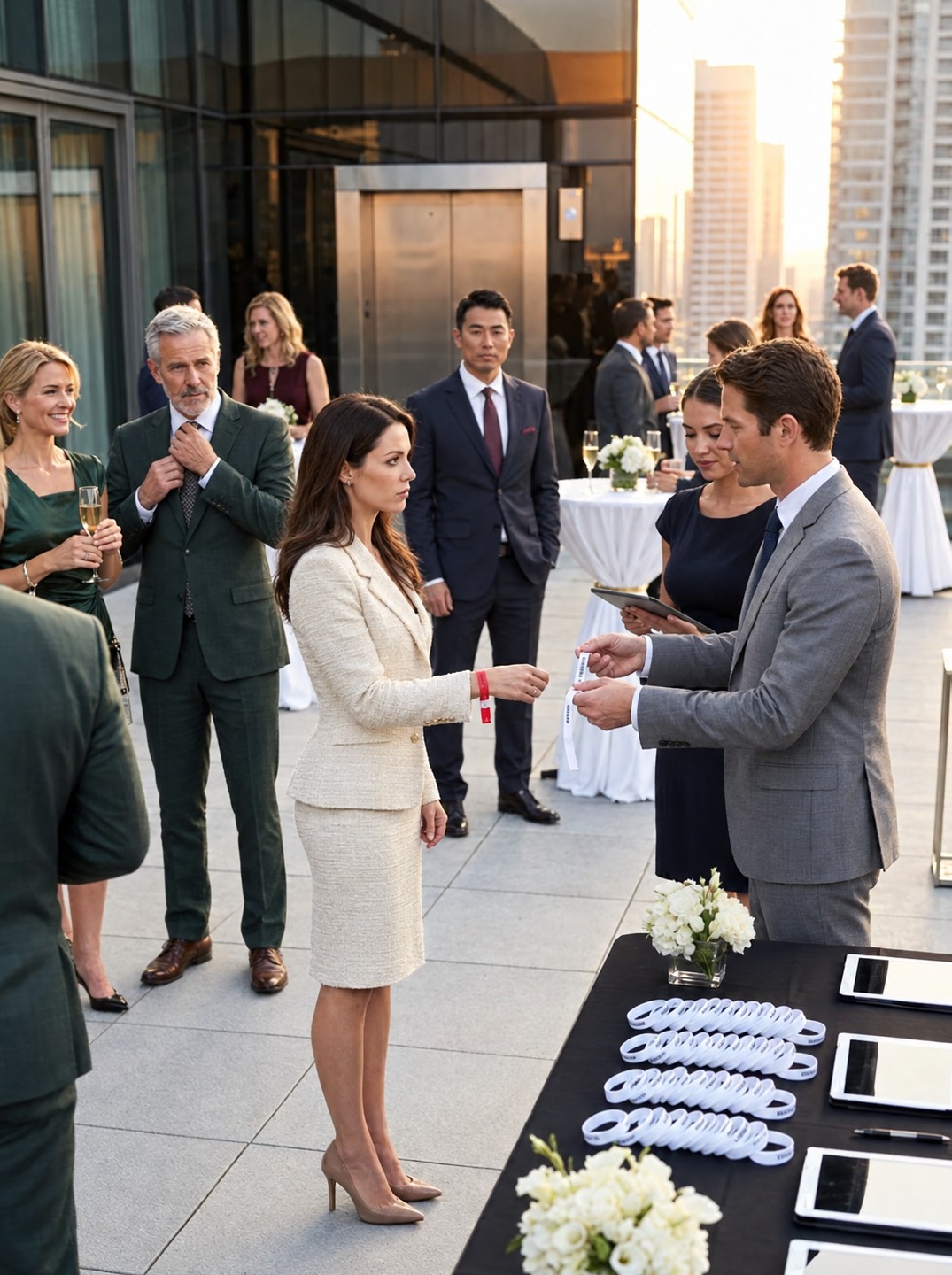
Part 1:
The red wristband made a small, cheap snapping sound when my brother fastened it around my wrist.
It was such a tiny sound.
But somehow, it cut through everything.
It cut through the soft jazz playing from hidden rooftop speakers. It cut through the polished laughter of people holding champagne glasses. It cut through the clinking of silver tongs against trays of seared scallops. Even the city wind, blowing gently against the glass railings twelve stories above downtown Portland, seemed to disappear for a moment.
That little plastic snap was all I could hear.
It should have meant nothing.
It was just a wristband.
Just another party detail at an event that was supposed to celebrate someone else.
But the instant it closed around my wrist, I felt twenty-nine years of being pushed aside tighten with it.
My brother, Kyle, did not even look uncomfortable.
He stood behind the check-in table in his navy suit, his hair perfectly styled, looking like he had stepped out of a business school brochure. One hand held his phone while the other was already reaching for another white wristband.
“Security needs to know who does not belong here,” he said casually.
He said it as if he were explaining where the coats should be left.
A few people standing behind me went quiet.
Only for a second.
But it was long enough for his words to sink in.
And in that silence, I finally understood something with absolute clarity.
My family had not invited me to celebrate Kyle.
They had invited me so everyone could see where I belonged.
I looked down at the wristband.
It was bright red against the sleeve of my charcoal suit.
Red.
The color people used for warnings.
Restrictions.
Emergency exits.
Danger.
Unpaid bills.
And apparently, me.
Around me, guests were being handed white wristbands with gold lettering. Their names were being checked off on a glossy tablet by a young woman Kyle had hired to make the evening feel important and exclusive.
White meant VIP.
White meant important.
White meant family, professional contacts, mentors, professors, investors, and anyone else Kyle believed could make him look more impressive simply by standing near him.
Red, apparently, meant me.
I was Kyle’s older sister, Sarah Jane.
Twenty-nine years old.
Related, but not included.
Present, but not honored.
Visible only when humiliation required an audience.
I could have taken the wristband off.
I could have told Kyle exactly who owned the floor beneath his polished shoes.
The bar behind him.
The elevator that had brought his guests upstairs.
The rooftop beneath our feet.
The building itself.
The entire Summit Plaza, from the retail lobby on the ground floor to the HVAC units above us.
Instead, I fastened the red band a little tighter.
Then I smiled and stepped aside.
Kyle had no idea that I had purchased the Summit Plaza eight months earlier for $3.1 million in cash.
He had no idea that the supposed cancellation my mother had been so thrilled about was not really a cancellation at all. I had quietly arranged for the rooftop to become available on June 8 after hearing my mother complain during Sunday dinner that no venue in the city was good enough for her son’s graduation celebration.
He had no idea that every check my parents had written for the party had passed through my company before being paid to the vendors.
Every wire transfer.
Every deposit.
Every premium catering upgrade.
Every floral arrangement.
Every bottle behind the bar.
All of it.
My mother had spent months praising the building as if fate itself had arranged Kyle’s perfect evening.
She never imagined that the daughter she called practical, quiet, and not particularly ambitious in the traditional sense was the woman who had signed the ownership documents.
My father had proudly told relatives that he had secured the most exclusive rooftop in the city.
He never bothered to ask who owned it.
He never wondered why the management team had suddenly become so accommodating.
And Kyle—precious Kyle—had built an entire social hierarchy out of wristbands inside a building that belonged to the one person he had spent his entire life dismissing.
That was the strange thing about being invisible.
People revealed themselves around you because they forgot you could see.
My parents had been doing it since I was old enough to understand the difference between discipline and neglect.
When I was seven years old, I brought home a report card filled with A’s.
I placed it carefully beside my father’s plate at dinner.
I had spent the entire day imagining that moment.
I smoothed the paper with both hands.
My father glanced at it for maybe three seconds.
Then he said, “Good. That’s what we expect from you.”
He picked up his newspaper again.
That was it.
Three years later, Kyle came home with a report card containing two B’s and a note from his teacher saying that he talked too much in class.
My mother cried with pride.
“Our boy is trying so hard,” she said.
She ordered pizza to celebrate.
Kyle’s report card went on the refrigerator with a trophy-shaped magnet.
Mine had been pushed into a kitchen drawer beside warranty manuals and expired coupons.
That was the beginning.
Back then, I did not have the words to explain what was happening.
I only knew that achievement did not make me feel loved.
It simply made my parents raise the bar higher.
Then they walked away.
By the time I became a teenager, our family had developed its own private weather system.
Kyle was always the sun.
Every room became warmer when he entered.
Every conversation moved toward him.
Everything was rearranged around his mood, his appetite, his schedule, and his needs.
If Kyle had a game, everyone went.
If Kyle had a cold, my mother made soup and whispered in the hallway as if he were recovering from surgery.
If Kyle forgot a school project, my father drove him to the craft store at ten at night and stayed up cutting poster board while Kyle played video games.
When I needed help studying for my advanced placement exams, my mother told me I was independent enough to handle it.
When I asked my father to attend the academic awards ceremony where I was receiving a scholarship, he said he had already promised to take Kyle to look at used cars.
“You know these ceremonies are all the same,” he told me. “Just send us a picture.”
I did send a picture.
No one asked to see the certificate when I came home.
The unfairness became so normal that, for years, I mistook it for the natural structure of our family.
I was the capable one.
The responsible one.
The one who did not need help.
Mostly because I had learned not to expect any.
Kyle was the gifted one.
The promising one.
The one whose smallest mistake was treated as proof that he needed more support.
When I was accepted into a good college with a partial scholarship, my mother clapped politely.
Then she asked whether I had looked into student loans.
“It will teach you responsibility,” she said while folding laundry.
Kyle’s shirts went into one neat pile.
Mine went into another.
My father agreed.
“You’ll appreciate your education more if you pay for it yourself.”
So I did.
I graduated with $67,000 in student debt, two stress ulcers, and the habit of calculating grocery prices down to the ounce.
Three years later, Kyle got into a less selective college without a scholarship.
My parents paid every cent of his tuition.
They bought him a car.
They leased him an apartment.
They furnished it.
They stocked his refrigerator.
And they told the family that Kyle needed freedom so he could focus on his potential.
Potential.
That was the word they used like holy scripture.
Kyle had potential when he failed a class because the professor supposedly did not understand his learning style.
Kyle had potential when he quit an internship after two weeks because the work was repetitive.
Kyle had potential when he spent my father’s money on expensive watches, designer sneakers, and dinners with friends he called networking.
I had results.
But results were somehow less exciting.
Results were expected.
Results were what responsible daughters were supposed to produce quietly.
Without praise.
Without rescue.
Without anyone asking whether they were tired.
When I graduated with honors and accepted a job at a technology startup paying $52,000 a year, my parents barely reacted.
“That is nice, dear,” my mother said.
She used the same tone she might have used if a neighbor had mentioned buying new patio furniture.
When Kyle got an entry-level job through one of my father’s golf friends, he made less money than I did.
My mother still posted about it online three times.
She told everyone at church.
She told the grocery store cashier.
She told the woman at the dry cleaner.
Her son had officially entered the business world.
For a while, I tried to convince myself that their indifference had made me stronger.
It was a comforting lie.
Because it turned abandonment into training.
I worked three jobs while I was in college.
I answered emails for professors.
I tutored freshmen.
I waited tables.
I learned how to make one rotisserie chicken stretch across five meals.
And I built spreadsheets for everything.
Numbers did not lie just to make you feel worse.
Rent was rent.
Interest was interest.
Debt was debt.
Hours worked became dollars.
Dollars became payments.
Payments became survival.
I learned how to sleep in four-hour blocks.
I learned how to smile while exhausted.
And most importantly, I learned that no one was coming to save me.
That sounds tragic.
Until you realize that it can also become a kind of freedom.
If no one was coming, I did not have to wait.
Part 2:
The technology startup that hired me when I was twenty-two was chaotic, underfunded, brilliant, and badly managed in exactly the way young companies often are.
On my first day, I received a laptop with a sticky spacebar, a desk near the supply closet, and a manager who forgot my name twice before lunch.
The product was good.
The process was a disaster.
Different teams kept doing the same work because nobody tracked important decisions. Engineers spent hours fixing problems that customer support had already documented weeks earlier.
Sales promised features the product team had not even built.
Leadership held meetings about productivity while ignoring the systems that were wasting everyone’s time.
I noticed.
Noticing had always been one of my survival skills.
Invisible people see everything.
Within six months, I had created a detailed proposal showing how the company could reduce development delays, improve customer feedback, and save millions of dollars over two years.
I expected to be ignored.
That was what I knew.
Instead, the founders read it.
Then they called me into a conference room.
“Why has nobody else noticed this?” one of them asked.
I didn’t know what to say.
That was the first time professional recognition felt almost dangerous.
I didn’t know what to do with people who actually listened.
I sat at the long conference table with the city blurred beyond the windows and explained my proposal point by point.
My voice stayed steady.
My hands trembled beneath the table.
The founders asked difficult questions.
I answered them.
They challenged my assumptions.
I showed them the data.
By the end of the meeting, the CEO leaned back in his chair and laughed.
Not at me.
He laughed with the stunned excitement of someone who had just discovered money hidden inside a wall.
Three months later, I was promoted.
By twenty-three, I was product director and had equity in the company.
I didn’t tell my parents everything.
Partly because I was afraid they would dismiss it.
But partly because some private part of me still wanted them to ask.
I wanted one dinner where my mother would turn away from Kyle’s latest story and say:
“Sarah Jane, how is your work really going?”
She never did.
When the company was acquired three years later, my equity payout came to $2.8 million.
The number appeared in my bank account with such blunt finality that I sat on the bathroom floor of my apartment and stared at my phone until the screen went dark.
I was twenty-six years old.
Barefoot.
Sitting on cracked tile.
Wearing a college sweatshirt.
Holding proof that my life had just changed.
I laughed first.
Then I cried.
Then I laughed again because neither reaction seemed big enough.
I paid off my student loans in one transfer.
I paid off the credit card debt I had taken on for emergency dental work.
I opened investment accounts.
I hired financial advisors.
I learned about tax strategy.
I studied commercial real estate.
And I started turning one victory into a foundation.
I did not buy a sports car.
I did not buy a mansion.
I did not buy anything flashy that would suddenly make my parents look at me and ask questions.
I bought something much more valuable.
Time.
Ownership.
Leverage.
And silence.
Most people think silence is empty.
Mine was filling with assets.
I told my family about the acquisition, but I made the mistake of explaining it gently.
Almost apologetically.
I still had not learned how to take up space in front of them.
My mother nodded while carving roast chicken.
“That is good, honey,” she said. “So does that mean you’re still working in computers?”
Before I could answer, Kyle interrupted.
He wanted to tell everyone that he had been asked to present a quarterly summary at work.
My father immediately put down his fork as if Kyle had just announced that he was negotiating an international peace treaty.
“That is leadership,” my father said proudly. “That is exactly the kind of thing executives notice.”
I sat there with millions quietly sitting behind my ribs.
And I realized something.
My parents could watch me carry gold into the room and still ask whether Kyle needed a spotlight.
That should have freed me sooner.
Instead, it made me work harder.
Not for them anymore.
But against the old belief that their attention was the final proof that I mattered.
Over the next three years, I built my life in deliberate layers.
I invested in startups where I understood the product better than the pitch deck.
I consulted for companies that paid me more for a single strategic overhaul than my old annual salary.
Then I bought my first commercial property.
It was an aging office building with stained ceiling tiles and tenants who were tired of being ignored by the previous owner.
I renovated it.
I renegotiated leases fairly.
I added fiber internet.
I modernized the lobby.
I turned a neglected property into a profitable one.
Then I bought another.
Then another.
And with every building, I discovered that I loved physical ownership in a way that surprised me.
Software was elegant.
But buildings were honest.
They had foundations.
Plumbing.
Pressure points.
Hidden damage.
And potential if you knew where to look.
Perhaps I understood buildings because I understood what it meant to be underestimated from the outside.
By the time I was twenty-eight, my portfolio was worth approximately $8.7 million.
I had a downtown penthouse with wide windows.
A closet full of tailored clothes.
A quiet morning routine.
And a calendar filled with negotiations that people twice my age prepared for nervously.
I had become the kind of woman my parents claimed to admire whenever they read business magazines.
Except they still believed I did vague technology work in some cubicle somewhere.
At family dinners, they continued asking questions that proved they had not listened to a word I had said in years.
“Are you still at that startup?” my father asked one evening while passing Kyle the mashed potatoes.
“No,” I said. “I’ve been consulting for four years.”
He nodded vaguely.
“Good. Good.”
Then he turned toward Kyle and asked about a lunch meeting with someone named Brad.
My success did not fit the family story.
So they simply left it outside.
Like a coat nobody wanted to hang up.
Part 3:
The Summit Plaza came to me through a commercial real estate broker who seemed convinced that I was too young to understand what I was looking at.
That happened often.
Men would slide documents across tables with careful smiles and explain basic terms slowly.
Then I would ask one question that made them sit up straighter.
The Summit Plaza was twelve stories tall and located downtown.
It was a mixed-use property.
Elegant, but under-optimized.
Retail occupied the ground floor.
Offices filled the middle floors.
There was an event space on the eleventh floor.
And above it all was a rooftop venue with a view that could make people stop talking when they stepped out of the elevator.
The numbers worked if the building was managed properly.
The location was strong.
The previous ownership group was overextended and wanted cash quickly.
I walked through the building twice with Thomas Chin, the property manager.
Thomas had worked there for twelve years.
He knew every maintenance closet.
Every tenant complaint.
Every structural quirk.
Every employee who kept the building running.
He watched me inspect the loading dock access, kitchen ventilation, elevator timing, event bookings, lease expiration dates, and roof drainage.
By the end of the tour, he had stopped treating me like a visitor.
Thomas was in his early fifties.
He was calm, precise, and observant.
I respected him immediately.
He had the kind of professionalism that did not need a performance.
When I asked what the building needed most, he did not flatter me.
He also did not insult the previous owners.
He simply gave me a list.
Security upgrades.
Better vendor contracts.
Renovated bathrooms on the event floors.
A stronger booking strategy for corporate clients.
And staff retention bonuses because the people who kept the building running were underpaid and tired.
I listened.
I took notes.
And I included most of his suggestions in my acquisition plan.
When I bought the Summit Plaza for $3.1 million in cash, I kept Thomas and the existing management team.
Loyalty, I had learned, was not something you demanded after neglecting people.
It was something you earned by seeing them before you needed them.
Owning the Summit Plaza felt different from owning my other properties.
It was not my largest asset for long.
But it was the one that carried the most symbolic weight.
I could not explain why at first.
Maybe it was the rooftop.
The wide view of the city.
The glass railings catching the sunset like fire.
Maybe it was because people booked that space for moments they wanted remembered.
Weddings.
Anniversaries.
Product launches.
Promotions.
Celebrations.
Moments when people wanted to feel that they had arrived somewhere important in life.
Maybe I simply liked standing there after an event had ended, when the staff had cleared the tables and the city lights blinked below.
There was something deeply satisfying about owning a place where other people came to feel important.
I never imagined my family would want it.
Then Kyle announced that he was getting his master’s degree in business.
And my mother began searching for a venue worthy of what she called his “next chapter.”
The announcement happened at Sunday dinner.
Important Kyle news always required an audience.
And carbohydrates.
My mother had made pot roast, Kyle’s favorite, even though he arrived twenty minutes late and spent the first half of dinner texting beneath the table.
My father raised his glass.
“To our graduate.”
The ceremony was still several weeks away.
Kyle smiled with the lazy confidence of someone who had grown accustomed to applause arriving before the effort.
He had completed his degree with my parents paying for his tuition, rent, books, parking, and what my mother called “professional lifestyle support.”
Apparently, that included tailored suits, restaurant bills, and a luxury gym membership.
I congratulated him.
Earning a degree was still an achievement, even if the road had been paved for him with other people’s money.
He barely looked at me.
“Thanks.”
Then he turned toward my father and started discussing the graduation party.
For the next month, every family gathering became an event-planning meeting.
My mother carried around a folder stuffed with venue brochures, catering menus, and floral samples.
She rejected hotel ballrooms because they were too generic.
Restaurants were too cramped.
Country clubs were too predictable.
Private estates were too far from downtown.
Then one evening, she sighed dramatically over her wine.
“The Summit Plaza rooftop would be perfect.”
I kept my face neutral.
“It has the views, the prestige, the right atmosphere,” she continued. “But it’s impossible to get. They’re booked six months out. I’ve called twelve times.”
I cut a piece of chicken smaller than necessary.
“That is too bad,” I said.
My mother did not notice the way my mouth almost curved.
My father said they would find something else.
Kyle said he deserved something memorable after all the work he had put in.
I looked at my brother.
He had never once asked where I worked.
Then I made a decision.
The Summit Plaza rooftop would be available on June 8.
The next morning, I called Thomas into my office.
I explained the situation without embellishing it.
To his credit, he did not laugh.
Although one eyebrow rose when I explained that my family had no idea I owned the building.
“You want us to accept the booking without revealing the ownership?” he asked.
“Exactly.”
He thought about it.
“That is easy enough. The operating entity is listed on the event contract. Your personal name does not need to appear unless they specifically ask.”
“They won’t,” I said.
Thomas looked at me.
“They don’t ask questions about me.”
Something in my voice must have told him more than I had said.
His expression softened slightly.
“Understood, Ms. Jane.”
Three weeks later, my mother called me screaming with happiness.
“The Summit Plaza had a cancellation!”
She sounded as if she had won the lottery.
She told me it felt like fate.
I agreed.
“Maybe it was meant to be.”
The party grew larger and more extravagant every week.
My parents booked premium catering.
They upgraded the bar.
They hired a DJ.
They arranged professional photography.
They ordered flowers.
They paid for custom signs.
They wired deposit after deposit.
The final cost of Kyle’s graduation party came to $87,000.
That amount would have been excessive even if my parents had not already been funding Kyle’s entire lifestyle.
Then they added another $40,000 deposit to reserve the same venue for Kyle’s future wedding reception.
Kyle was not engaged.
His girlfriend, Claire, had once quietly told me that she was not ready to marry a man who still let his mother schedule his dentist appointments.
My parents did not see the irony.
They saw destiny.
Their son would graduate.
Then he would network.
Rise.
Marry.
Prosper.
And continue the family story they had always preferred.
I was invited, of course.
But only because excluding me completely would have looked too deliberate.
The day before the party, I attended Kyle’s graduation ceremony.
I sat in the back row alone.
My parents sat near the front.
They held their phones up and filmed almost every step as if Kyle were crossing a stage built exclusively for him.
When his name was called, my mother sobbed.
My father stood.
Kyle accepted his diploma folder, shook the dean’s hand, and gave the practiced grin he used whenever he wanted people to see confidence instead of calculation.
I clapped.
And strangely enough, I meant it.
Resentment had not made me incapable of recognizing effort.
But when I watched my parents embrace him afterward, my mother holding his face between both hands as if he had just returned from war, I felt the old ache move through me.
It was familiar.
It knew exactly where to knock.
It simply no longer controlled me.
After the ceremony, my mother pulled me aside near a row of ornamental trees outside the auditorium.
She wore cream-colored linen and pearls.
Her smile was tense.
It was the smile she used when she was preparing to insult me politely.
“Sarah Jane, we need to talk about tomorrow.”
My father joined us before I could answer.
One hand rested proudly on Kyle’s shoulder.
Kyle was scrolling through his phone, physically present but emotionally somewhere else.
“We have spent a considerable amount of money making this perfect,” my mother said. “This is Kyle’s day. His achievement. His professional moment. We need everything to go smoothly.”
“Complications,” my father added.
He said the word as if it explained everything.
I looked from one parent to the other.
“What kind of complications are you expecting from me?”
My mother’s smile tightened.
“Don’t be sensitive. We’re only saying that you should be supportive and not draw attention to yourself.”
Kyle finally looked up.
Perhaps making me smaller was one of the few family activities that still interested him.
“Just don’t embarrass me, Sarah Jane,” he said.
“There are going to be important people there. Business contacts, potential employers, investors, professors. People who matter.”
He paused.
“You are kind of…”
He searched for the word.
Then he said it.
“You don’t really fit with that crowd.”
My father did not correct him.
My mother actually nodded.
She looked relieved that Kyle had said the impolite part for her.
“You’re still doing tech support or consulting or whatever, right?” Kyle asked.
I could have told him that one of the potential employers on his guest list had paid me six figures for a product restructuring engagement the previous year.
I could have told him that two of the investors attending his party had toured buildings I owned.
Instead, I said:
“Something like that.”
My mother squeezed my arm.
“Exactly. So just stay pleasant, stay in the background, and remember this is not about you.”
The next morning, at 9:17 a.m., Kyle texted me.
Party starts at six. Don’t be late. Dress appropriately. Business formal. Try not to look poor.
I read the message while standing in my closet.
I was surrounded by clothes that cost more than the monthly rent on Kyle’s first apartment.
At first, I felt nothing.
That was usually how anger arrived in me now.
Not as heat.
Not as tears.
As a clean, white stillness.
Then I laughed once.
Softly.
Try not to look poor.
There were insults that hurt because they struck the truth.
And there were insults so wildly disconnected from reality that they became evidence.
I chose my outfit carefully.
A tailored charcoal suit that fit as if it had been drawn onto me.
Understated black heels.
Diamond studs.
A watch elegant enough to be recognized by people who knew watches and ignored by people who did not.
I looked successful.
Composed.
Impossible to categorize.
I looked like a woman who did not need permission to enter any room.
Part 4:
I arrived at the Summit Plaza at 5:45 p.m.
Fifteen minutes before the party officially began.
The lobby smelled faintly of lilies and polished stone.
Staff members moved efficiently around me, carrying trays, adjusting signs, and speaking into headsets.
Thomas stood near the elevator bank with a clipboard.
The instant he saw me, he looked up.
For one brief second, something like concern crossed his face.
I gave the smallest shake of my head.
Not yet.
He nodded once.
Then he returned immediately to professional neutrality.
That was one of the many things I valued about Thomas.
He understood timing.
The elevator carried me upward in mirrored silence.
My reflection appeared again and again on every side.
My wrist was still bare.
My breathing was steady.
By the time the doors opened onto the rooftop level, the sunset had begun turning the skyline gold.
My mother had created a beautiful party.
I would give her that.
String lights crossed overhead in elegant arcs.
White floral arrangements stood on tall glass columns near the railings.
The bar gleamed with bottles my parents had selected to impress people who would know the difference between expensive and desperate.
Cocktail tables were covered in ivory linen.
The catering stations were arranged with obsessive symmetry.
A photographer was testing the lighting near the entrance.
The DJ was adjusting his equipment in one corner.
The city stretched in every direction beyond the glass.
It glowed with the expensive promise of early summer.
My mother stood near the center of it all, directing staff as though she personally owned the sky.
When she saw me, her eyes moved over my suit.
Then my earrings.
My watch.
My shoes.
My face.
Disappointment crossed her expression so quickly that another person might have missed it.
She had expected me to look inadequate.
I had robbed her of that comfort.
“Sarah Jane,” she said, drawing my name out. “You’re early.”
“I thought I might help if you needed anything.”
“How thoughtful.”
Her tone made it clear that she considered my usefulness theoretical.
Then she glanced toward the entrance.
Kyle stood behind a check-in table beside a young woman holding a tablet.
Several boxes of wristbands sat on the table.
“Actually,” my mother said, “Kyle has created a very professional system for tonight. He’s treating this like a networking event, which is smart.”
She gestured toward the table.
“Go get your wristband so security can identify everyone properly.”
“Wristband?”
I already knew the answer.
I could see the white bands stacked in neat rows.
“Everyone gets one,” my mother said. “It helps with guest categories.”
There it was.
The soft beginning of a public arrangement.
Categories.
My mother loved any system that allowed her to pretend cruelty was simply organization.
I joined the check-in line behind a middle-aged man in an expensive blazer and a woman with a perfectly polished smile.
Kyle greeted them warmly.
He checked their names.
Then he handed each of them a white wristband with gold lettering.
“So glad you could make it,” he told the man. “We really need to talk about that venture fund.”
Then he turned to the woman.
“Professor Callahan, I’m honored.”
He had rehearsed this version of himself.
Polished.
Ambitious.
Grateful to powerful people.
Charming to anyone who might become useful.
Then I stepped forward.
He did not look up.
“Name?”
“Kyle, it’s me.”
The people behind me shifted slightly.
He kept his eyes on the tablet.
“Name?”
I held his gaze when he finally looked up.
“Sarah Jane.”
The young woman beside him searched the tablet.
She frowned slightly.
“I don’t see a Sarah Jane on the VIP list.”
Kyle suddenly acted as though he had remembered something.
“Right. Sarah Jane. You’re on the alternate list.”
He reached underneath the table.
Then he pulled out a red wristband.
I watched his hand.
I watched the corner of his mouth twitch with the smallest hint of satisfaction.
The red band looked cheaper than the white ones.
It was thinner.
Less flexible.
Instead of gold lettering, it had plain black letters marking it as general attendance.
I stared at it.
“What is this?”
“Your wristband,” he said.
“Everyone gets one. Security needs to know who is who.”
“And who am I?”
His eyes moved past me toward the line.
“You’re here to support me. You’re not really part of the professional networking aspect.”
He held up the red band.
“White is for VIPs, business contacts, important guests, and family involved in the event.”
Then he held up the red one.
“Red is for general attendance.”
“Family involved in the event,” I repeated.
Then I looked directly at him.
“Kyle, I’m your sister.”
He shrugged.
“Don’t make this weird. You’re holding up the line.”
Then he leaned slightly closer.
His voice dropped just enough to make the insult feel private while still allowing the people nearby to hear it.
“Tonight is important. Please don’t turn it into one of your things.”
One of my things.
The phrase landed in a room full of old ghosts.
My things had included asking why Kyle got a car while I got student loans.
My things had included asking why my graduation dinner had been canceled because Kyle had a baseball game.
My things had included asking why my mother told relatives I was doing fine on my own while I worked fifty hours a week and attended college.
My things were the moments when reality slipped out of the family script.
And every time that happened, everyone punished me for noticing.
I took the wristband from him.
It felt stiff between my fingers.
For one second, I imagined refusing it.
I imagined placing it back on the table.
Walking away.
Leaving before the evening even began.
Then I thought about the contract.
The deposit.
The clause Thomas had highlighted.
The security cameras.
The witnesses.
And all the years I had been told to swallow humiliation in private so everyone else could remain comfortable in public.
I fastened the red wristband around my wrist.
Then I smiled.
“Of course,” I said.
“Wouldn’t want security confused.”
Part 5:
By 6:30 p.m., the rooftop was full.
I counted the guests because numbers calmed me.
One hundred and fourteen people.
Relatives.
Professors.
Classmates.
Business contacts.
Neighbors.
Family friends.
People Kyle had probably met once near a coffee station and decided might be useful.
One hundred and fourteen white wristbands flashed in the evening light whenever someone lifted a glass or shook a hand.
One red wristband existed in the entire crowd.
Mine.
I stood near the windows with a glass of champagne I had no intention of drinking.
I watched the party move around Kyle like water flowing around a fountain.
My parents glowed with borrowed importance.
My mother introduced Kyle using phrases like:
“Strategic mind.”
“Natural leader.”
“Born for executive work.”
My father placed a heavy hand on Kyle’s shoulder whenever someone impressive approached.
It was as though he physically wanted to connect himself to the investment he had made.
Kyle performed gratitude beautifully.
He thanked people for coming.
He laughed at their jokes.
He talked about his ambitions with just enough humility to sound rehearsed.
And he never once looked toward me unless he needed to make sure I remained outside the circle.
My Aunt Rachel found me first.
She was my mother’s younger sister.
She was also one of the few relatives who had occasionally seemed to notice that something in our family was tilted.
When I graduated from college, she had sent me twenty dollars in a card.
She had written that every graduate deserved a dinner that did not come from a vending machine.
At the time, I had cried harder over that twenty-dollar bill than I had over my diploma.
Now she approached me with a glass of wine in one hand and a confused crease between her eyebrows.
“Honey,” she said, touching my elbow, “why is your wristband red?”
Before I could answer, my mother appeared.
Almost as if she had been summoned by the threat of honesty.
“It is just Kyle’s organizational system,” my mother said brightly. “Very professional. Different categories for different guest access.”
Aunt Rachel looked down at her own white wristband.
“What category am I?”
“VIP family, of course.”
My mother’s smile tightened.
“The white bands are for important guests.”
Rachel slowly looked from my wrist to my mother’s face.
“And Sarah Jane isn’t VIP family?”
My mother laughed.
Too high.
Too quickly.
“Don’t be dramatic. Sarah Jane understands.”
I did understand.
Perfectly.
That was the problem.
I understood when my mother guided Aunt Rachel away before she could say anything else.
I understood when Kyle introduced three of our cousins to a venture capitalist as “my family” while I stood close enough to hear him but far enough away to be ignored.
I understood when a photographer passed near me, paused as if considering taking a candid photograph, then noticed my red wristband and moved on.
I understood when the young woman working check-in whispered something to another staff member.
Both women looked at me.
Not with contempt.
With discomfort.
They knew something was wrong.
Strangers often noticed what families called normal.
I kept my posture relaxed.
My expression stayed neutral.
My phone remained tucked inside my pocket.
Timing mattered.
The party needed to reveal itself completely before I intervened.
At seven o’clock, my father clapped his hands.
“Family photos!”
People began turning toward him.
Then he announced loudly:
“Everyone with a white wristband who is actual family, gather around Kyle.”
He said it jovially.
As if he had not just turned blood into a seating chart.
People began moving.
Aunts.
Uncles.
Cousins.
Spouses.
My parents.
Kyle.
Even Kyle’s girlfriend, Claire, who looked uncomfortable but followed the group because social momentum can be powerful.
I stepped forward with them.
My father’s face changed instantly.
“Sarah Jane, what are you doing?”
Conversation around us became quieter.
“Family photo,” I said.
He looked at my wrist.
Then at the photographer.
Then back at me.
“Red wristbands are not in this shot.”
He paused.
“This is for VIP family only. Kyle specifically requested it.”
The words did not surprise me.
But hearing them spoken publicly still cut.
Kyle adjusted his cuff and stared toward the skyline.
My mother gestured toward a spot several feet away.
“You can stand over there. You’ll still be here. Just not in the photo.”
There are humiliations that make you want to disappear.
And then there are humiliations so complete that they make disappearing impossible.
I walked to the spot my mother had indicated.
Then I stood outside the frame.
My family gathered around Kyle.
The photographer raised his camera.
The first flash went off.
My mother tilted her head toward Kyle’s shoulder.
Flash.
My father lifted his chin proudly.
Flash.
Claire smiled with her mouth, but not with her eyes.
Flash.
My cousins leaned inward.
Their white wristbands were clearly visible.
Flash.
And I stood outside the picture.
Wearing red.
Watching my family create a photograph of the family I had always been told I belonged to.
Part 6:
The photographer adjusted his camera.
“Everyone, squeeze in a little closer.”
People moved toward Kyle.
He took more photographs.
Vertical shots.
Horizontal shots.
Laughing shots.
Serious shots.
Proud-parent shots.
I counted because counting helped me keep my face still.
Forty-seven photographs.
Forty-seven different versions of a family without me.
Around us, guests began whispering.
“Is that his sister?”
“Why isn’t she in the photo?”
“The red band,” someone else murmured. “I guess she’s not important.”
Another voice answered quietly.
“That is harsh.”
The speaker sounded fascinated and uncomfortable at the same time.
It was the kind of discomfort people feel when they witness cruelty and are relieved it is not aimed at them.
After the family photographs came VIP guest photographs.
Then business school friends.
Then mentors.
Then professors.
Then what Kyle called his “future leadership circle.”
Even one of his professors winced at that phrase.
I was not included in any of the photographs.
Not one.
My mother occasionally looked in my direction.
She did not look guilty.
She looked irritated.
It was as though my silent presence made her behavior visible.
Kyle, meanwhile, was radiant.
He moved from group to group, smiling wider each time another camera pointed at him.
My father joked that Kyle would need a publicist soon.
Someone laughed.
I looked out over the city.
And something ancient inside me finally stopped reaching.
It was not dramatic.
Nothing shattered.
There was no sudden explosion of emotion.
It simply unclenched.
For twenty-nine years, some stubborn little version of me had believed that if I became undeniable enough, my family would eventually turn around and see me.
If I succeeded enough.
If I worked hard enough.
If I became successful enough.
If I became impressive enough.
Maybe then they would finally understand that I had always been worthy of their attention.
But standing outside those photographs, wearing that red wristband inside a building I owned, I finally understood the truth.
They could see me perfectly.
They had simply chosen not to.
And that realization hurt.
But strangely, it also felt like freedom.
At 7:45 p.m., Kyle gave his speech.
He tapped a spoon against a glass and waited for the rooftop to become quiet.
Then he stepped onto a small riser near the bar.
The skyline behind him made the moment look cinematic.
I was sure he loved that.
He thanked our parents first.
His voice became thick with carefully practiced emotion.
“Mom and Dad, none of this would be possible without your support, your belief, and your investment in my education.”
My mother placed one hand against her chest.
My father blinked rapidly.
Kyle continued.
“I want to thank my professors, my mentors, my classmates, my colleagues, my friends, and everyone here who has contributed to the man I am becoming.”
He joked about late nights spent studying.
I suspected some of the people who had actually studied with him might have disagreed with how much studying he had done, but nobody challenged him.
He spoke about ambition.
Gratitude.
Leadership.
Building a future worthy of the opportunities he had been given.
He spoke confidently about everything ahead of him.
But he did not mention me.
Not once.
Not as his sister.
Not as family.
Not even as someone who had bothered to attend.
In his version of the story, I did not exist.
Maybe that should have been the moment I finally intervened.
But I waited.
I wanted the night to give them one final chance to surprise me.
It didn’t.
At 8:00 p.m., my mother stood near a group of family friends, showing photographs on her phone and explaining them as if she were leading a museum tour.
“Look at this one,” she said. “Our whole family around Kyle. Isn’t it beautiful?”
I could see the photograph from where I stood.
My shoulder was barely visible at the edge of the frame.
A dark blur.
Almost completely cropped out.
One of my mother’s friends, a woman named Marjorie who had known me since childhood, looked from the photograph toward me.
“Is Sarah Jane not in the family pictures?”
My mother waved one hand dismissively.
“Oh, Sarah Jane is here somewhere. She’s more of a supportive presence tonight.”
Marjorie frowned.
“Supportive presence?”
“You know what I mean,” my mother said.
She lowered her voice.
But not enough.
“Some family members are leaders and achievers. Others are just there. Sarah Jane has always been more of the ‘just there’ type.”
She smiled faintly.
“Background family.”
Background family.
The phrase was so perfectly cruel that, for one second, I almost admired how efficiently it reduced an entire life.
Twenty-nine years of obedience.
Twenty-nine years of work.
Twenty-nine years of achievements.
Twenty-nine years of restraint.
Twenty-nine years of longing.
All reduced to furniture.
Background family.
A chair in the corner.
A shadow near the wall.
A body useful only because its silence made other people look generous.
I looked at my watch.
9:00 p.m.
Exactly three hours since the party had begun.
Exactly three hours since my brother had told me that security needed to know who did not belong.
Exactly three hours of evidence.
Evidence witnessed by 114 people.
Evidence captured by professional cameras.
Evidence recorded on dozens of phones.
I reached into my pocket and took out my phone.
Then I sent Thomas the message we had agreed on before the party.
It is time.
His reply came before I had even put the phone away.
On my way up.
I took a slow breath.
Then I walked toward the DJ booth.
The DJ was a young man with kind eyes and headphones resting around his neck.
He looked surprised when I approached.
“Can you cut the music for a moment?” I asked.
He glanced toward Kyle.
“Uh, I think Mr. Marsh has the schedule.”
“I am the owner of the building,” I said quietly.
His expression changed immediately.
He did not ask for proof.
Something in my voice must have been enough.
The music faded in the middle of a song.
The sudden silence felt enormous.
People turned.
Kyle frowned.
He looked annoyed before he looked afraid.
My mother turned sharply.
Her expression said she was already preparing to scold me for ruining the atmosphere.
I stepped into the open space near the bar.
Then I raised my voice.
“Excuse me, everyone. I apologize for the interruption.”
The rooftop became completely silent.
“My name is Sarah Jane. Most of you know me as Kyle’s older sister.”
I lifted my wrist.
“The one with the red wristband.”
A ripple moved through the crowd.
People looked at my wrist.
Then at Kyle.
Then at my parents.
The silence deepened.
There was something almost hungry about it.
The room could sense that something was about to happen.
Kyle moved toward me.
“Sarah Jane, what are you doing?”
“I’ll just be a moment,” I said.
I kept my eyes on the crowd.
“Tonight has been very educational. When this party was booked, the venue team did not mention one important detail to my family.”
I paused.
“And I think it is time to clarify that detail.”
At that exact moment, the elevator doors opened.
Thomas stepped onto the rooftop.
Perfect timing.
He carried a leather folder in one hand.
He walked directly toward me.
Professional.
Calm.
Impossible to dismiss.
My mother’s expression changed from anger to confusion.
My father lowered his drink.
Kyle stopped moving.
Thomas handed me the folder.
Then he turned toward the guests.
“Good evening.”
I opened the folder.
“This is Thomas Chin, property manager of the Summit Plaza. Thomas has worked here for twelve years.”
I looked at him.
“Thomas, would you please explain who owns the property we are standing on?”
Thomas gave the crowd a polite nod.
“Certainly, Ms. Jane.”
He paused.
“The Summit Plaza was acquired eight months ago by a private buyer.”
The murmuring began immediately.
Thomas continued.
“That buyer is present tonight.”
I opened the folder and removed a certified copy of the deed.
The official stamps were visible to the people closest to me.
The cameras would capture them even better.
“I purchased this building on October 15 of last year for $3.1 million in cash,” I said.
The rooftop became silent again.
“That purchase includes the ground-floor retail space, the office floors, the event venue below us, this rooftop, the elevators, the lobby, the service corridors, and every other part of this property.”
I looked around.
“I am the sole owner of the Summit Plaza.”
If silence had weight, that silence dropped through the rooftop like a stone.
Kyle’s face drained first.
My mother’s hand moved to her throat.
My father stared at me as if I had suddenly started speaking a language he had never believed I could learn.
I continued.
“When my parents booked this venue for Kyle’s graduation party, they paid through the Summit Plaza’s management company without knowing that I owned the property.”
I looked toward the tables filled with flowers and expensive food.
“The total cost of tonight’s event was $87,000.”
Several people exchanged looks.
“My parents also paid a $40,000 deposit to reserve this venue for Kyle’s future wedding reception.”
I paused.
“That brings the total amount paid under their event contracts to $127,000.”
Phones were coming out now.
Guests who had spent the entire evening pretending not to notice my exclusion were recording everything.
I lifted my wrist again.
“Tonight, when I arrived, I was given this red wristband.”
I looked directly at Kyle.
“My brother explained that security needed to know who did not belong.”
Nobody moved.
“I was excluded from every family photograph because I was not considered VIP family.”
My eyes moved toward my mother.
“My mother described me to her friends as ‘background family.’”
A few guests visibly winced.
“And my brother gave a speech thanking everyone who contributed to his future while standing inside a building owned by the sister he had just publicly humiliated.”
“Sarah Jane.”
My mother’s voice was low.
“Hissed.”
She looked furious.
But her voice no longer carried the authority it had earlier.
Authority depends on the room accepting it.
And the room had shifted.
I turned toward Kyle.
“Earlier, you told me not to embarrass you.”
His face had gone pale.
“You told me I did not fit with the crowd you were trying to impress.”
I paused.
“I thought about that carefully.”
Then I smiled slightly.
“And I decided to solve the problem.”
Kyle’s mouth opened.
Nothing came out.
“This party is over.”
The words landed harder than I expected.
“Effective immediately. Everyone has thirty minutes to collect their belongings and leave the building.”
I turned toward Thomas.
“Please initiate the venue shutdown.”
Thomas did not hesitate.
“Of course, Ms. Jane.”
He signaled the security team.
They had been standing near the entrance, waiting with the patient stillness of people who had been instructed to act only when necessary.
The first sound after that was my mother’s sharp, disbelieving laugh.
“Stop this right now.”
She moved toward me with both hands slightly raised, as though she could physically gather the evening back together.
“You cannot do this. Everyone is here. This is Kyle’s graduation party.”
“Everyone was here,” I said.
I looked at my watch.
“Now everyone is leaving.”
I smiled politely.
“You have twenty-nine minutes.”
Part 7:
Kyle finally found his voice.
“Are you insane?”
His panic had made his voice thinner.
“Do you know what this looks like? My classmates are here. Professors are here. Potential employers are here.”
“Yes,” I said.
“That was the point of inviting them, wasn’t it?”
His eyes darted toward a man standing near the bar.
Then toward a group of his classmates.
They were whispering openly now.
“You are ruining my life,” Kyle said.
“No, Kyle.”
I kept my voice calm.
“I am enforcing the venue’s policies after you chose to humiliate the owner.”
The word owner hit him harder than any insult could have.
My father stepped forward.
His face had darkened into the expression he usually wore when bills, waiters, or women disagreed with him.
“Enough,” he said. “We paid for this venue. We have a contract.”
“You do.”
I turned toward Thomas.
“Please explain the relevant clause.”
Thomas opened his tablet.
His movements were calm and efficient.
“Clause 17, subsection C,” he said.
Then he read:
“The venue reserves the right to terminate an event immediately in cases involving harassment, discrimination, abusive conduct, or behavior that creates a hostile environment toward staff, guests, management, or ownership.”
He paused.
“In such cases, deposits and fees are forfeited, and no refunds will be issued.”
My father’s jaw tightened.
“That is ridiculous. We did not harass anyone.”
I held up my wrist.
“You used a color-coded system to identify me as lesser than the rest of my family.”
I looked around the rooftop.
“You excluded me publicly from family photographs.”
Then I looked at my mother.
“Your wife called me background family.”
Finally, I looked at Kyle.
“And your son made it clear to everyone here that I was not considered important enough to stand beside my own brother.”
I lowered my wrist.
“That meets the standard.”
Thomas added calmly:
“Our legal counsel reviewed the venue’s terms before this event was accepted.”
That statement was enough.
My father understood contracts well enough to know uncertainty when he heard it.
His confidence cracked.
Guests began moving toward the exits in groups.
Some whispered.
Some texted.
Some looked embarrassed.
Some looked judgmental.
And some were clearly trying to pretend they were above the drama while secretly filming it from waist level.
Kyle hurried after one man in a gray suit.
“Mr. Ashford.”
The man stopped.
Kyle forced a smile.
“Please. This is a family misunderstanding.”
Jonathan Ashford, whom Kyle had greeted earlier as if he were royalty, looked at him with open disgust.
“You humiliated your own sister at a venue she owns.”
Kyle froze.
Jonathan continued.
“That is not a misunderstanding.”
His expression hardened.
“That is character.”
Then he walked away.
I watched Kyle absorb those words like a physical blow.
My mother started crying.
I could not tell whether the tears came from shame, anger, or fear over the money.
“Sarah Jane, please.”
Her voice had changed.
It was softer now.
She had lowered it because the room no longer belonged to her.
“Think about what you are doing to Kyle. His future is at stake.”
“You should have thought about what you were teaching him.”
She stared at me.
“You trained him to believe other people existed in categories beneath him.”
I looked at Kyle.
“Tonight, he believed you.”
“We were trying to make the night special,” my mother whispered.
“You made it honest.”
She flinched.
Perhaps some part of her knew exactly what I meant.
My father was already on his phone.
He was probably looking for legal help.
But the way his voice dropped told me that the first person he called had not given him the answer he wanted.
Then Claire approached Kyle.
She whispered something I could not hear.
Kyle turned toward her.
Claire reached up and removed her white wristband.
She placed it on the check-in table.
Then she walked away.
Kyle stared at the wristband as if she had slapped him.
Aunt Rachel came toward me on her way out.
Her face was pale.
Her eyes were wet.
But she was not disappointed in me.
She looked devastated.
Devastated by recognition.
“Sarah Jane,” she said softly, “I am so sorry.”
I looked at her.
“I knew they favored him.”
She swallowed.
“I didn’t know it was like this.”
“It was always like this.”
I looked around the rooftop.
“Tonight just had better lighting.”
Aunt Rachel gave a small, painful laugh.
Then she squeezed my arm.
“For what it’s worth,” she said quietly, “they deserved worse.”
Then she walked away.
For the first time that evening, something close to grief pierced the clean structure of my anger.
Not because I regretted what I had done.
I didn’t.
It was because someone had finally said aloud what I had needed to hear as a child.
They deserved worse.
And maybe I had deserved better.
Part 8:
Security moved efficiently and respectfully.
There was no shouting.
No unnecessary confrontation.
The bar closed.
The catering staff began packing the food.
The DJ disconnected his equipment while trying very hard not to smile.
Guests moved toward the elevators and stairwell under Thomas’s supervision.
At 9:27 p.m., Thomas approached me.
“Ms. Jane, all guests except your immediate family have exited.”
I looked at my watch.
“Efficient.”
My father turned toward me.
“You think this is funny?”
“No.”
I looked directly at him.
“I think it is overdue.”
Kyle finally looked directly at me.
For once, there was no smirk.
No dismissal.
No lazy superiority.
There was fear.
Raw and humiliating.
“I hope you’re proud of yourself,” he said.
I looked around the rooftop.
At the staff I paid fairly.
At the building I owned.
At the city I had survived long enough to rise above.
“I am.”
I took a breath.
“I am very proud of what I’ve built.”
Then I looked at him.
“It is a shame none of you ever cared enough to ask about it.”
The elevator doors opened.
My parents and Kyle stepped inside.
The doors closed on their faces.
And the silence left behind was different from the one before.
This silence did not erase me.
It held space for me.
I stayed on the rooftop for nearly an hour after they left.
I did not help because the staff did not need me to perform guilt as labor.
Thomas supervised the shutdown.
The cleaning crew cleared the flowers.
They folded the linens.
They gathered abandoned napkins.
They restored order with practiced hands.
The city below kept moving.
Indifferent.
Bright.
My red wristband was still on my wrist.
I could have removed it immediately.
But I didn’t.
I stood at the glass railing and let it remain there a little longer.
It was no longer a mark of exclusion.
Now it was evidence.
And some symbols lose their power when you survive them in public.
At 10:36 p.m., I finally checked my phone.
There were sixty-seven missed calls.
Then seventy-one as I watched another call arrive.
Text messages were stacked across my screen.
My mother:
Call me immediately. We need to fix this. Kyle is devastated.
My father:
Your behavior is unacceptable. Lawyers will be involved.
Kyle:
You ruined everything. Everyone saw. My career is over because of you.
Then came messages from relatives.
What happened?
Are you really the owner?
Did they know?
Are you okay?
Was that legal?
One cousin sent only:
Holy hell, Sarah Jane.
I stared at the screen.
Not because I felt guilty.
Because I recognized the pattern.
The family machine had activated.
Their pain was urgent.
Mine had always been background noise.
I blocked my parents and Kyle before I could be tempted to explain myself to people who were committed to misunderstanding me.
Then I sent one message to the extended family:
Tonight was the result of years of mistreatment. I will not be discussing it further. Please respect my decision.
Then I put my phone down.
For the first time in years, I did not feel the need to defend myself.
Part 9:
By morning, the story had escaped the rooftop.
I woke after only three hours of sleep.
When I turned my phone back on, the notifications flooded the screen so quickly that my phone froze.
Videos had been posted from multiple angles.
Kyle handing me the red wristband.
My father excluding me from the family photographs.
My announcement with Thomas standing beside me.
My mother trying to stop me.
Jonathan Ashford saying the word “character” like it was a verdict.
One video had already reached hundreds of thousands of views.
The caption read:
I watched a graduation party implode after the graduate gave his millionaire sister a red “not family” wristband—then discovered she owned the building.
Another video showed Kyle saying:
“Security needs to know who does not belong here.”
Someone had added subtitles.
The internet understood exactly what kind of story it had found.
By noon, strangers had turned my humiliation into clips, reaction videos, memes, arguments, praise, criticism, and jokes.
And then came the hashtag:
#RedWristbandRevenge
Virality is a strange kind of public weather.
It arrives all at once.
Suddenly, everyone has an opinion about how you should have dressed for the storm.
Some people called me iconic.
Some called me petty.
Some said I should have revealed my ownership privately and spared Kyle the professional embarrassment.
Others said I had shown remarkable restraint by waiting three hours.
Business accounts posted lessons about leadership, character, and due diligence.
Family-drama pages analyzed my mother’s body language.
Someone found photographs my mother had uploaded during the party and placed them beside the video of me holding the deed.
The contrast was brutal.
My family smiling in carefully arranged unity.
Me standing outside the frame.
Then me standing at the center of the room with the deed in my hand.
The side-by-side images spread faster than anything else.
My mother deleted her photographs.
That only made people share screenshots more aggressively.
For three days, I barely left my apartment except for early-morning walks before the city fully woke.
I worked from home.
I answered only essential business emails.
And I let Thomas handle venue inquiries with his usual professionalism.
The demand for the Summit Plaza rooftop increased almost immediately.
It was absurd.
And strangely fitting.
On the second day, Thomas called me.
“We have seven new requests specifically mentioning the red wristband video.”
His voice was completely dry.
“One couple asked whether we could guarantee there would be no toxic relatives at their event.”
I laughed.
“Can we?”
“Not legally,” he said. “But we can offer security.”
I laughed again.
A real laugh.
It startled me.
Laughter after a major rupture can feel almost disloyal.
Until you remember that joy is not a betrayal of pain.
It is proof that pain did not win completely.
Part 10:
On the fourth morning, my doorbell rang at 7:02 a.m.
I checked the security camera.
Kyle was standing in the hallway of my building.
He looked terrible.
Unshaven.
Pale.
He wore a wrinkled button-down shirt.
And he had the expression of a man who had finally discovered that consequences were not theoretical.
For several minutes, I did nothing.
He rang again.
Then he stopped.
He looked directly into the security camera.
It was almost as if he finally understood that access could be denied to him too.
Against my better judgment—or perhaps because some part of me wanted to know whether reality had finally reached him—I opened the door.
I did not invite him inside.
He looked smaller in the hallway than he had on the rooftop.
Without the crowd.
Without the suit.
Without the lights.
Without the carefully arranged choreography of importance.
He was simply my younger brother.
His eyes were red.
His hands kept moving because he did not seem to know where to put them.
“What do you want, Kyle?”
“I need to talk to you.”
His voice was hoarse.
“Please.”
“You have five minutes.”
He swallowed.
Then he glanced past me into my apartment.
His eyes widened slightly when he saw the view, the art, and the quiet evidence of a life he had never imagined for me.
That small reaction hurt more than it should have.
Not because I wanted his admiration.
Because it confirmed just how little he had ever known about me.
“Everyone is talking about it,” he said.
“Yes.”
“The videos are everywhere.”
I said nothing.
“My classmates saw them. Professors saw them. Companies I interviewed with saw them.”
“Yes.”
He looked down.
“Three job offers were rescinded.”
He said it like an accusation.
Then his voice cracked.
“One company said they couldn’t employ someone who demonstrated such poor judgment in personal relationships.”
He swallowed.
“Another said the role required emotional intelligence.”
Then he looked at me with sudden anger.
“Are you happy?”
“No.”
“You destroyed my reputation.”
“No.”
I shook my head.
“You revealed your character. There is a difference.”
“It was a wristband.”
His desperation sharpened.
“Okay? It was one stupid party detail.”
“It was a system.”
I kept my voice calm.
“You created categories.”
I held his gaze.
“You decided I belonged in the lowest one.”
“You told guests security needed to know who did not belong.”
“You excluded me from family photographs.”
“You let Mom call me background family.”
I paused.
“It wasn’t one detail.”
“It was a public demonstration of how you saw me.”
Kyle’s face twisted.
Not with remorse.
Not yet.
With frustration.
His excuses were not working.
“I wanted the night to be perfect,” he said.
“You don’t understand the pressure I was under.”
I stared at him.
“The pressure of what?”
He said nothing.
“Being fully funded?”
His jaw tightened.
“Being celebrated?”
He looked away.
“Having your parents build an entire stage around you?”
He flinched.
“The pressure of being handed everything and still being afraid it wouldn’t be enough?”
His expression hardened.
“You don’t understand.”
“I understand more than you think.”
Then he said something that made me stop.
“They can’t afford this.”
I frowned.
“Who?”
“Mom and Dad.”
His voice dropped.
“They can’t afford what they did.”
I stared at him.
“They took out a second mortgage.”
The hallway seemed suddenly quieter.
“For school,” he continued.
“For the party.”
“For some of my expenses.”
He rubbed his face.
“They thought it would pay off when I got a great job.”
There it was.
The hidden foundation beneath the polished marble floor.
My parents had not simply favored Kyle emotionally.
They had financed the myth of him until it threatened to swallow them.
“And you came here to ask me for money,” I said.
“No.”
The answer came too quickly.
Then his shoulders sank.
“Yes.”
He looked ashamed.
“Not for me.”
“For them.”
He took a breath.
“Can you refund some of the money?”
I stared at him.
“The party deposit.”
“The wedding deposit.”
“Anything.”
His voice became desperate.
“They might lose the house.”
I felt something shift inside me.
Not shock.
Something closer to grim recognition.
When I had been drowning in student debt, responsibility had been a lesson.
When Kyle’s celebration had put my parents’ home at risk, suddenly my money had become a family obligation.
“No.”
Kyle stared at me.
The word seemed almost impossible for him to understand.
“Sarah Jane, please.”
“No.”
“They’re your parents.”
“They were my parents when I took out student loans.”
I spoke slowly.
“They were my parents when I worked three jobs.”
“They were my parents when they bought you a car and told me hardship would build character.”
“They were my parents when they watched you put that wristband on me.”
Kyle’s eyes filled with tears.
“I didn’t know you owned the building.”
I looked at him.
“That is not the defense you think it is.”
He lowered his head.
For the first time, silence settled between us without him trying to dominate it.
“We’re still family,” he said weakly.
I took a breath.
The old child inside me stirred.
Then it became quiet again.
“Family doesn’t make you prove you belong with a wristband.”
I looked directly at him.
“Family doesn’t turn your absence from a photograph into a rule.”
“Family doesn’t remember you only when your money can save them.”
Kyle wiped his face.
He was angry at the tears.
Humiliated by them.
Perhaps frightened by the unfamiliar experience of asking for something and not receiving it.
“What am I supposed to do now?” he asked.
It was the most honest question he had ever asked me.
“The same thing I did.”
I opened the door slightly wider.
“Figure it out without expecting anyone to rescue you.”
He looked at me.
And beneath his resentment, I saw something else trying to surface.
Maybe comprehension.
Maybe shame.
Maybe the beginning of remorse.
But remorse requires accepting the pain you caused without making your own suffering the center of the story.
Kyle was not there yet.
Maybe he never would be.
I closed the door gently.
Not because he deserved gentleness.
But because I no longer needed to slam anything to be understood.
Part 11:
The fallout continued for months.
The intensity slowly changed, but it never disappeared completely.
My parents did lose their house.
Aunt Rachel was the one who told me.
They moved into a small rental apartment across town.
According to my mother, the move was my fault.
According to my father, I had deliberately destroyed their financial stability.
They spoke as if I had personally packed their belongings into boxes.
But the truth was much more complicated.
My father’s business had been struggling for longer than anyone admitted.
My parents had accumulated debt.
They had taken out a second mortgage.
They had spent enormous amounts of money supporting Kyle.
And the $87,000 graduation party had been followed by another $40,000 commitment for a wedding that did not even have a bride or groom ready to marry.
But none of that fit their version of the story.
So they blamed me.
In their version, I had waited in the shadows.
Bought a building.
Then destroyed my family because I was jealous.
It would have been funny if it had not been so familiar.
They could not imagine that my success had nothing to do with them.
So they turned my success into revenge.
Kyle’s life did not end.
He seemed disappointed to discover that humiliation was survivable.
The canceled job offers hurt him badly.
But after the story faded from the center of public attention, he found a position at a smaller company.
The salary was much lower than he had expected.
Aunt Rachel later told me he had started therapy.
She tried to say it neutrally.
She failed.
We both laughed.
Then she became serious.
“He is processing other things too,” she said.
“I think.”
Claire broke up with him two weeks after the party.
She had watched the videos repeatedly.
Then she told him:
“I can’t marry someone who needs an audience to humiliate his own sister.”
The $40,000 wedding deposit remained exactly where the contract said it would remain.
With me.
As for the Summit Plaza, business improved.
That was the part nobody in my family could understand.
The venue did not suffer because of the scandal.
It gained a story.
Couples, companies, and private clients started asking about the rooftop where the red wristband incident had happened.
Some joked about it in their inquiries.
Others sent thoughtful messages saying they admired how the venue protected its owner from harassment.
That was not exactly how I would have described the night.
But I appreciated the sentiment.
I used part of the forfeited event funds to create an emergency assistance program for Summit Plaza employees.
Another portion went toward upgrading the building’s security systems.
The rest went into operating reserves.
Thomas approved.
“Symbolically satisfying,” he said.
Then he added:
“And financially prudent.”
That became one of my favorite descriptions of the entire incident.
Something else changed too.
Slowly.
Without any announcement.
I stopped explaining myself in rooms where people were committed to misunderstanding me.
I stopped attending family events out of obligation.
I stopped answering messages that began with accusations disguised as concern.
I spent more time with people who asked questions and actually listened to the answers.
Thomas and his wife invited me to dinner.
I accepted.
Their home was warm and loud.
There was food everywhere.
People interrupted one another.
Someone laughed from the kitchen.
Someone else shouted about a football game.
It was ordinary.
It was affectionate.
And it was so different from my childhood home that I almost did not know how to behave.
I had once believed that kind of family existed only in other people’s houses.
I began mentoring three young women who were interested in commercial real estate.
They were sharp.
Underestimated.
Hungry to learn.
The first time one of them thanked me for taking her seriously, I had to excuse myself for a few minutes.
The sentence had found an old bruise.
Becoming the person I had needed when I was twenty-two felt better than proving anything to my parents ever had.
Part 12:
Six months after the party, a letter arrived in my mailbox.
I recognized the handwriting on the envelope immediately.
Kyle’s.
I remembered it from the birthday cards he signed only when my mother reminded him.
For two days, I left the envelope unopened on my kitchen counter.
It sat beside a bowl of green apples.
It looked almost harmless.
But I knew better.
On the third evening, I came home after a long meeting about acquiring a boutique hotel.
I made tea.
Sat beside the window.
And finally opened the letter.
It was seven pages long.
Handwritten.
Uneven.
Nothing like the short, angry messages he had sent after the party.
The first line said:
I understand if you never want to speak to me again.
I stopped there.
I read that sentence several times.
Because it contained something I had never heard from Kyle before.
A boundary that belonged to me.
I continued reading.
The letter was not perfect.
But it was specific.
He wrote about the report cards on the refrigerator.
He remembered my academic awards ceremony.
The one our parents skipped because he was looking at used cars.
He admitted that even as a child, he knew he received more than I did.
And he admitted that he had said nothing because the arrangement benefited him.
He wrote about college.
The car.
The apartment.
The money.
He wrote about hearing our parents describe me as “independent.”
He finally understood what they had actually meant.
Unsupported.
He wrote that the red wristband had not been an accident.
It had not been a joke.
It had not been one stupid party detail.
It was an expression of a belief he had absorbed for years.
The belief that I was less central.
Less impressive.
Less important.
Less worthy of careful treatment.
He did not ask me for money.
He did not ask me to talk to our parents.
He did not ask me to repair his reputation.
And he did not ask me to forgive him.
The final line said:
I am sorry I never saw you, and I am more sorry that being forced to see you happened only after I made you bleed in public.
I cried.
Unexpectedly.
And with great irritation.
Not because the letter fixed anything.
It didn’t.
Not because an apology could erase what had happened.
It couldn’t.
I cried because some part of me had waited twenty-nine years for someone in my family to describe the truth without making me carry it alone.
The letter was late.
It was insufficient.
But it was real.
I folded it carefully.
I placed it inside my desk drawer.
Not in the trash.
Not in a frame.
That felt right.
Some apologies deserve neither destruction nor display.
They deserve time.
I have not answered Kyle yet.
I may someday.
I may not.
Forgiveness, I have learned, is not a performance owed to the person who finally understands that they hurt you.
It is not a family reunion.
It is not a holiday photograph.
It is not a forced hug in a rented apartment while everyone pretends the past was simply complicated.
Sometimes forgiveness is simply removing your hand from the hot stove of resentment because you have better things to build.
Sometimes it means keeping a letter because truth matters, even when reconciliation does not follow.
Sometimes it means admitting that you still love people who failed you while refusing to give them new opportunities to fail you in the same way.
I still do not know which version will become mine.
I only know one thing.
I am no longer willing to disappear so other people can feel innocent.
My parents still send messages through relatives from time to time.
They say life is hard now.
They say Kyle is struggling.
They say the family has suffered enough.
They say I should remember where I came from.
As if I could forget.
I came from a house where love was rationed according to usefulness.
I came from dinners where my achievements were side dishes while Kyle’s smallest updates were the main course.
I came from debt.
Silence.
Dismissal.
And the particular loneliness of standing in rooms where everyone knew your name but no one knew your life.
But I also came from myself.
From the girl who worked three jobs and kept going.
From the young woman who saw inefficiency where everyone else saw chaos.
From the investor who bought overlooked buildings and made them valuable.
From the sister who wore the red wristband long enough for everyone to understand exactly what it meant.
Part 13:
Tonight, the Summit Plaza rooftop is booked for an anniversary party.
I stopped by before the guests arrived.
I walked past the bar.
Past the flowers.
Past the glass railings.
The city unfolded below in blue and silver.
The staff moved with easy confidence.
Thomas reviewed the details near the elevator.
Nobody needed me.
And strangely, that was one of the finest forms of leadership I had ever experienced.
When you build something well, it can function without you standing over everyone.
I stood for a moment in the same place where I had held up the deed months earlier.
The air was cool.
It carried the faint smell of rain and expensive perfume from floral arrangements waiting to be admired.
My wrist was bare.
No red band.
No white band.
No category assigned by anyone else.
Just skin.
A pulse.
And the quiet certainty of a life I had made mine.
People love to call what happened revenge.
Revenge is easy to understand.
It has a shape.
A beginning.
An ending.
A villain embarrassed in front of an audience.
A crowd gasping.
A video shared until strangers feel satisfied.
But that night was never really about revenge.
Revenge would mean my family remained the center of my story.
It would mean I built everything with their faces in mind.
Every dollar would be a response.
Every acquisition would be a rebuttal.
Every success would be an argument I hoped they would finally hear.
Maybe that had been true once.
When I was younger.
When I was still hungry for a seat at their table.
But it was not true anymore.
The real victory was not watching them leave my building.
The real victory was realizing that I owned the door.
The floor.
The view.
The silence afterward.
And the right to decide who deserved access to me.
My name is Sarah Jane.
I am twenty-nine years old.
I own more than eleven million dollars in commercial real estate, a growing investment portfolio, a company that pays people fairly, and a life filled with relationships I chose carefully rather than relationships I inherited blindly.
I was once the girl outside the photograph.
The daughter praised only for needing nothing.
The sister marked red so security could know who did not belong.
I cannot change that history.
And I no longer need to.
Some stories do not end when the people who hurt you apologize.
They do not end when those people lose.
They do not end when they suffer.
And they do not necessarily end when they finally understand.
Some stories end when you stop standing at the edge of the frame.
When you stop waiting for someone else to make room for you.
When you walk into the life you built while they were too busy looking elsewhere.
I have not worn a wristband I did not choose since that night.
And honestly?
I have never felt more like I belong.
THE END.
