
Part 1:
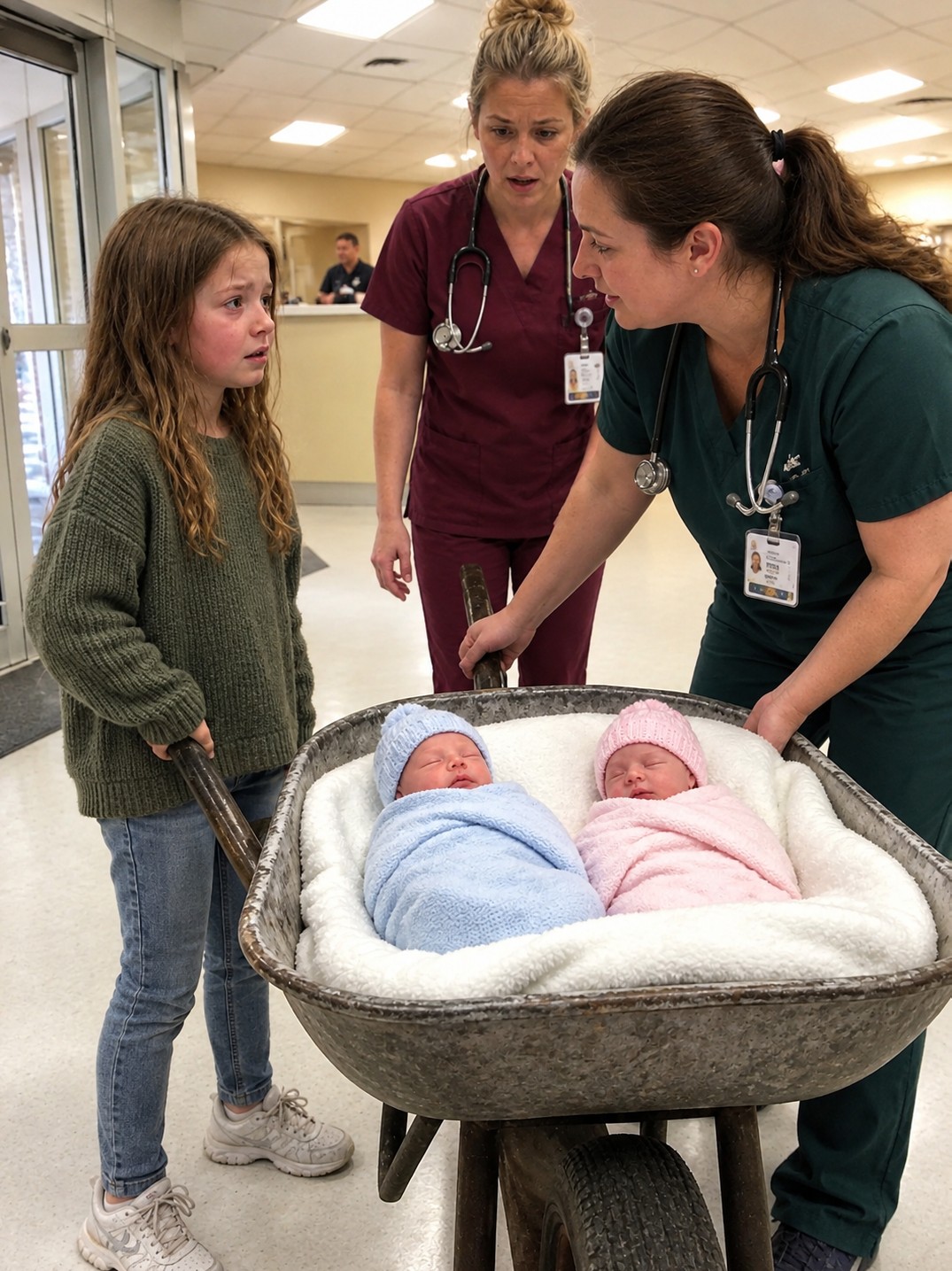
When the emergency room receptionist heard a wheelbarrow squeak through the hospital doors, she looked up, expecting to see a child pushing a toy.
The squeak came again.
Then she saw the little girl.
Her small hands were wrapped tightly around the metal handles. Two tiny bundles were tucked inside the wheelbarrow beneath mismatched towels.
One baby whimpered.
The other barely moved.
The girl wore worn-out sneakers and a sweatshirt that was much too big for her. Her face was flushed from the long walk, and strands of hair stuck to her forehead.
But she wasn’t crying.
She simply stood there, breathing hard, as if she had finally reached the one place she believed could help.
The receptionist immediately pushed her chair back.
“Where’s your mom, sweetheart?”
The girl swallowed.
“At home. I couldn’t wake her.”
A triage nurse was already coming around the desk.
“How long has she been asleep?”
The girl slowly raised three fingers.
“Three days.”
The receptionist froze.
A second nurse rushed to open the emergency doors wider while another crouched beside the wheelbarrow.
“Can I pick up the babies?” she asked gently.
The little girl’s fingers tightened around the handles.
“Both?”
“Both,” the nurse promised. “We’ll keep them together.”
Only then did the girl let go.
The nurses lifted the babies carefully from the wheelbarrow.
Both infants were breathing, but the staff could immediately see that something was wrong. One baby was crying weakly. The other was unusually quiet and difficult to rouse.
Warm blankets appeared.
A pediatric nurse was called.
A doctor hurried over.
Someone brought a small chair for the girl.
Another nurse asked, “Is there another adult at home?”
The girl shook her head.
“Just Mommy.”
The nurse knelt until they were at eye level.
“Did somebody drive you here?”
“No.”
“You walked?”
The girl glanced at the wheelbarrow.
“I pushed.”
The nurse looked at the receptionist.
That single sentence changed the entire situation.
While the twins were taken into the treatment area, the receptionist stayed beside the little girl.
“What is your name?”
“Chloe.”
“And how old are you, Chloe?”
“Six.”
Chloe kept staring toward the doors where her brothers had disappeared.
The receptionist noticed that Chloe was rubbing her palms against her sweatshirt.
Her hands were red.
She had blisters across both palms.
“How did you get here?” the receptionist asked.
Chloe explained in the simple words of a six-year-old.
Her mother had been sick.
At first, Clara had only seemed tired.
She had complained of feeling dizzy several times and had told Chloe that she needed to lie down.
Then one morning, Clara had stopped responding normally.
Chloe tried waking her with water.
Then she brought her cereal.
Then she shook her mother’s shoulder.
Nothing worked.
She didn’t know the word “unresponsive.”
She only knew that Mommy had been sleeping for much longer than nighttime was supposed to last.
For two days, Chloe had stayed in the house with her mother and her newborn brothers.
She tried to keep the babies warm.
She watched them.
She cried when she became scared.
She waited for her mother to wake up.
But on the third day, one of the twins became so quiet that Chloe became terrified.
She knew she couldn’t wait anymore.
She found the old metal wheelbarrow outside.
She wrapped both babies as carefully as she could, placed them inside, and began pushing.
She didn’t know the hospital’s name.
She didn’t know the address.
She only knew that hospitals were where sick people went.
So she pushed.
She walked along the road.
She pushed over gravel.
She pushed over pavement.
She stopped several times to rest.
Then she pushed again.
By the time she reached the emergency room, her arms were shaking and her palms were badly scraped.
But she had not stopped.
The receptionist gently touched Chloe’s shoulder.
“Do you know where your house is?”
Chloe nodded.
She didn’t know the street number.
But she knew the road.
She described a mailbox near the road, a long gravel driveway, a large tree, and several turns she remembered.
The hospital immediately contacted emergency dispatch and gave them every detail Chloe could provide.
The dispatcher began working with the medical team to identify the road and possible property.
Then Chloe suddenly reached beneath the collar of her sweatshirt.
Something small and brass appeared.
A house key hung from a piece of string around her neck.
“Mommy says I can’t lose this,” she whispered.
A paramedic who had just arrived at the emergency entrance crouched in front of her.
His name was James.
He held out his hand.
“Can I borrow it so we can go help your mom?”
Chloe stared at the key.
Then she looked toward the treatment area where her brothers had disappeared.
Her eyes filled with fear.
“Bring Mommy too.”
James nodded.
“We will.”
Chloe slowly pulled the string over her head.
She placed the key in his hand.
James closed his fingers around it.
Then he stood and hurried toward the ambulance bay.
The hospital had the babies.
Now the ambulance crew had to find their mother.
Part 2:
James and the other responders received the location information while they were still preparing the ambulance.
Chloe’s description had given them the road, the mailbox, the long driveway, and the nearby landmarks.
The dispatcher also confirmed a property that matched those details.
James placed the little brass key inside a secure zipped pocket on his uniform.
Then the ambulance left the hospital.
They weren’t driving blindly.
They had a probable address.
And now they had a way inside.
When they reached the road Chloe had described, they slowed down.
There was the mailbox.
Behind it was a long gravel driveway.
At the end stood a small house beneath a large tree.
James immediately recognized the details Chloe had given them.
The crew hurried to the front door.
James tried the handle.
Locked.
He pulled out the little brass key.
It fit.
The door opened.
“EMS!” James called. “Is anyone here?”
There was no answer.
The responders moved quickly through the house.
They found the bedroom.
Clara Reynolds was lying beside the bed.
She was alive, but barely responsive.
A responder checked her breathing and pulse while James called for additional medical support.
“She’s breathing,” he said. “Very weak. We need transport immediately.”
They began treating Clara at once.
Fluids were started.
Her vital signs were checked repeatedly.
The crew also searched the room for medication, medical information, or anything that might explain what had happened.
That was when James noticed a piece of paper lying near the bed.
He picked it up.
The note began with five words that changed the shape of the emergency.
“I’ve been blacking out again.”
James read the rest quickly.
Clara had written that the twins’ papers were inside the diaper bag.
She had written that the house key stayed with Chloe.
And if she could not wake up, the babies needed help first.
The final line was simple.
“Please keep them together.”
James read it again.
Until then, the first responders had known only what six-year-old Chloe had been able to explain.
Her mother had been unconscious for days.
The babies were getting weaker.
There was nobody else in the house.
Now they understood something important.
Clara had known something was wrong before she lost consciousness.
She had experienced previous episodes of fainting.
She had tried to leave instructions in case she became unable to care for her children.
But she had not remained conscious long enough to get help.
James immediately radioed the hospital.
“We found the mother,” he reported. “She’s alive but critically weak. We’re transporting her now. We also found a note from her identifying the twins and asking that they remain together.”
A responder found the diaper bag exactly where Clara had said it would be.
Inside were ordinary newborn supplies and documents identifying the babies as Oliver and Lucas.
The papers also confirmed that Clara Reynolds was their mother.
Nothing else in the house suggested that Clara had abandoned her children.
In fact, the opposite was obvious.
The house looked as if someone had expected to get up again.
A half-finished glass of water sat beside the bed.
Laundry waited in a basket.
Newborn blankets were folded on a chair.
A few groceries were still sitting on the kitchen counter.
The entire house looked normal.
Except for the woman who could no longer get out of bed.
The responders carefully moved Clara onto a stretcher.
As they carried her outside, James touched the pocket where Chloe’s brass key was secured.
He had promised the little girl.
He was bringing her mother back.
Part 3:
Back at the hospital, Chloe sat as close as the nurses would allow to the hallway leading toward the treatment rooms.
The twins were being cared for by the pediatric team.
They were receiving warmth and fluids and were being monitored closely.
Chloe had been given water.
A sandwich sat beside her.
She barely touched it.
Every time a nurse walked through the hallway, Chloe looked up.
Finally, a nurse noticed her hands.
“Do your palms hurt?”
Chloe looked down.
The skin was red and blistered from pushing the heavy wheelbarrow for so long.
“A little,” she admitted.
The nurse brought a cool cloth and gently wrapped it around Chloe’s hands.
Chloe allowed the nurse to help her for less than a minute.
Then she looked up.
“Did they find Mommy?”
“They found her,” the nurse said.
“Is she coming?”
“Yes.”
That answer changed Chloe’s entire posture.
For the first time since she had arrived, she leaned back against the chair.
Then the distant sound of an ambulance arriving outside echoed through the emergency department.
Chloe stood so quickly that the sandwich slid from her lap.
A few moments later, James appeared at the end of the hallway.
He walked straight toward her.
Then he reached into his secure pocket and pulled out the little brass house key.
“We found your mom,” he told her.
Chloe stared at him.
“She came?”
“She came with us.”
James held out the key.
“And I brought this back too.”
Chloe took it with both hands.
“Did it work?”
James smiled gently.
“It worked.”
She immediately placed the string back around her neck.
Then her expression changed.
“Did Mommy wake up?”
James crouched down.
“Not yet. But she’s alive, Chloe. The doctors are treating her right now.”
The doctors had found that Clara was severely dehydrated and suffering from a dangerous postpartum complication involving severe anemia and infection.
Her condition had become much worse after days without proper food, water, or medical care.
The combination had caused her to become dangerously weak and lose consciousness.
But she was now receiving fluids, medication, oxygen, and close monitoring.
For the first time in days, she was surrounded by people who could help her.
The nurse knelt beside Chloe.
“Your mommy is getting treatment now.”
Chloe nodded.
She understood one word more than anything else.
Alive.
That was enough.
The next twenty-four hours brought small pieces of good news.
Oliver and Lucas responded to treatment.
Their body temperatures stabilized.
They became more alert.
Their breathing improved.
The hospital staff kept the twins together in adjacent bassinets, honoring both Clara’s written request and Chloe’s desperate wish.
Clara remained seriously ill, but her condition slowly began to improve.
The doctors were finally able to control the infection and treat her severe anemia.
She needed time.
But she was getting stronger.
Then, the following morning, Clara opened her eyes.
Her first words were barely more than a whisper.
“The babies…”
She swallowed.
“My daughter…”
A nurse leaned closer.
“They’re all here.”
Clara closed her eyes.
Tears slipped down her cheeks.
“Chloe?”
“She’s here.”
A short time later, the medical team allowed Chloe into the room.
The six-year-old walked in slowly.
For the first time since she had arrived at the hospital, she looked unsure.
Clara lifted one weak hand.
“Chloe…”
Her daughter crossed the room.
She pressed herself against the side of the hospital bed.
Clara reached out and touched the back of Chloe’s sweatshirt.
Tears streamed silently down her face.
“I took the babies, Mommy,” Chloe whispered.
Her lower lip trembled.
“I left the house.”
She looked up.
“Are you mad at me?”
Clara shook her head immediately.
“No, baby.”
She pulled Chloe as close as her strength allowed.
“No. Never.”
Chloe started crying.
Clara kissed the top of her head.
“You saved us,” she whispered.
“You saved all of us.”
Chloe reached down and touched the brass key hanging around her neck.
“The ambulance man gave it back.”
Clara closed her eyes.
She held her daughter tightly.
The note Clara had written had helped the rescuers.
It had told them where to look and what they needed to know.
But it had not been the thing that brought the babies to safety.
That had been Chloe.
A six-year-old girl who had been terrified.
A little girl who didn’t know what an emergency was supposed to look like.
A child who only knew that her brothers were getting sick and that her mother wouldn’t wake up.
So she had done the only thing she could think of.
She had pushed.
Part 4:
The weeks that followed were filled with recovery.
Clara gradually regained her strength.
The infection was brought under control.
Her blood levels improved with treatment.
She was eventually able to stand and walk without assistance.
Oliver and Lucas grew stronger every day.
Their tiny bodies filled out.
Their cries became louder.
Their eyes became brighter.
And soon, they began acting like healthy newborns.
Social services also became involved, but not because the family was being taken apart.
Their role was to make sure Clara had the support she needed after the medical crisis.
A local community organization arranged postpartum home-care assistance.
A visiting nurse checked on Clara and the babies.
Neighbors brought meals.
Friends helped with groceries and household chores.
Everyone agreed on one thing.
Chloe could never again be expected to carry an adult’s responsibilities.
She was six years old.
She was supposed to play.
She was supposed to read books.
She was supposed to make messes.
She was supposed to ask endless questions.
She was supposed to be a child.
Not a caretaker.
Not a rescuer.
Not the person responsible for keeping an entire family alive.
The old wheelbarrow eventually came home too.
James returned it himself.
He had found it outside the emergency room after Chloe arrived.
The hospital staff had kept it safe while the little girl was being treated for her sore hands.
When the time came for the family to return home, James loaded the wheelbarrow into his vehicle and brought it back.
He placed it beside the porch.
For a long time, neither Clara nor Chloe went near it.
It carried too many memories.
Then, one warm afternoon, several weeks later, Clara walked onto the porch.
She stopped.
Chloe was standing beside the house.
Both hands were resting on the wheelbarrow handles.
Clara’s breath caught.
For one second, she remembered that terrifying night.
Her six-year-old daughter.
Two newborn babies.
A long road.
A squeaking wheel.
Then Clara looked inside the wheelbarrow.
There were no babies.
No towels.
No frightened little faces.
Instead, there was a bag of potting soil, a small pair of yellow gardening gloves, and a plastic watering can.
Chloe looked up.
“Can I use it, Mommy?”
She smiled.
“It’s easier than carrying the dirt.”
Clara felt the lump rise in her throat.
Then she smiled.
“Go right ahead, sweetheart.”
Chloe pushed the wheelbarrow across the lawn.
The old wheel squeaked once.
But this time, the sound meant something different.
It wasn’t fear.
It wasn’t desperation.
It was just a wheelbarrow.
The brass key no longer hung from a string around Chloe’s neck.
Instead, Clara placed it on a low wooden peg inside the front door where it could be easily reached by an adult.
The key belonged on the hook.
The wheelbarrow belonged in the garden.
And Chloe belonged in childhood.
At last, she was free to simply be six years old.
Part 5:
Five years later, the autumn sun cast long golden shadows across the lawn of the Reynolds home.
Chloe was now eleven.
Oliver and Lucas were five.
The ages were easy to remember because Clara never forgot the year her family had nearly been lost.
The wooden house had a fresh coat of butter-yellow paint.
White hydrangeas grew thickly along the porch.
The long gravel driveway was no longer a place Clara associated only with fear.
Now it was covered with colorful chalk drawings.
There were suns.
Flowers.
Stick figures.
Race cars.
And a huge purple butterfly.
Clara stood on the porch with a steaming mug of coffee between her hands.
She wore a soft knit sweater.
Her face was healthy and peaceful.
The hollow cheeks, gray complexion, and terrifying weakness of five years earlier were now distant memories.
Down in the yard, Oliver and Lucas were playing tag.
The two boys were healthy, energetic five-year-olds.
It was almost impossible to imagine the fragile newborns who had once been carried into the emergency room.
Oliver, the twin who had once been frighteningly quiet, was now running around the large oak tree while roaring like a dinosaur.
Lucas ducked behind a bush.
Then he laughed so hard that he fell onto the grass.
Clara smiled.
Every day she watched her sons run, breathe, laugh, and grow, she felt a deep wave of gratitude.
Sometimes that gratitude still made her eyes sting.
“Boys!” a clear voice called from the other side of the shed.
“Keep it on the grass!”
Chloe stepped into view.
At eleven years old, she had grown tall.
Her dark hair was pulled into a neat braid that swung against her back.
She wore denim overalls covered with small patches of garden soil and canvas sneakers.
In her right hand was a large wooden-handled spade.
“Oliver,” she called, “if you step in Mommy’s flowerbed again, you’re helping me pull weeds all afternoon!”
Oliver immediately stopped.
“Sorry, Chloe!”
He turned away from the flowerbed and ran after Lucas.
Clara watched her oldest daughter with quiet pride.
The fierce protective instinct that had once saved the family had never disappeared.
But it had changed.
It was no longer the desperate responsibility of a frightened six-year-old.
It had become confidence.
Kindness.
Leadership.
Chloe was an excellent student.
She loved reading.
She played soccer at school.
She spent hours in the garden.
And she loved teasing her little brothers almost as much as she loved protecting them.
Most importantly, she was no longer carrying the weight of the world.
She was simply Chloe.
An eleven-year-old girl with schoolwork, friends, hobbies, dreams, and a very annoying pair of little brothers.
Then the sound of tires crunching over gravel made the boys stop.
A familiar white-and-red ambulance pulled into the driveway.
This time, it wasn’t responding to an emergency.
James was off duty.
He had come for a Saturday afternoon barbecue.
He stepped out wearing a navy polo shirt and jeans.
A large cooler hung from one hand.
The boys recognized him immediately.
“Uncle James!”
Oliver and Lucas abandoned their game and sprinted across the lawn.
They crashed into his legs.
James laughed and carefully balanced the cooler while ruffling both boys’ hair.
“Hey, lightning!” he said. “You two getting taller every time I see you?”
“I’m taller than Oliver by a whole inch!” Lucas announced.
“Are not!” Oliver protested.
“Are too!”
“All right, all right,” James laughed. “Save some energy for the backyard.”
Clara walked toward them.
“Thanks for coming, James.”
She gave him a warm hug.
“You know you didn’t have to bring that huge cooler.”
“When Chloe tells me she’s making homemade lemonade, I bring enough ice for a crowd,” James replied.
Then he looked toward Chloe.
His expression softened.
There was still a special respect in his eyes whenever he looked at her.
He had never forgotten the six-year-old girl who had placed a brass key in his hand and said:
“Bring Mommy too.”
“Hey there, Captain,” he said.
Chloe smiled.
“Hi, James.”
She wiped a streak of dirt from her forehead.
“I just finished turning the soil in the garden.”
“Good,” James said.
“Because after lunch, you and I have a basketball game.”
He pointed toward the hoop beside the garage.
“I hear you’ve been practicing your layups.”
“You’re going to lose,” Chloe replied immediately.
James laughed.
“We’ll see.”
Clara shook her head.
“Go wash up, everyone. Burgers will be on the grill in twenty minutes.”
The boys raced up the porch steps.
They pushed through the front door, already arguing about who was faster.
Their laughter echoed through the house.
James picked up the cooler and followed them inside.
Chloe remained on the porch.
For a moment, she simply looked across the yard.
Her eyes eventually settled on the side of the house.
There, beneath the shade of a weeping willow, stood the garden shed.
Beside it sat the old wheelbarrow.
It wasn’t rusted anymore.
It wasn’t gray.
Two summers earlier, Clara and Chloe had sanded it together.
Then they had painted it a bright, cheerful sky-blue.
Now it was a permanent planter.
Bright red geraniums spilled over the edges.
Yellow marigolds filled the center.
Trailing ivy curled down toward the grass.
The old wheelbarrow had become beautiful.
Chloe walked down the porch steps.
She crossed the lawn.
Then she reached out and placed one hand on the cool painted metal handle.
For years, the wheelbarrow had been connected to the most frightening day of her childhood.
But now the memory no longer frightened her.
There was no phantom weight in her palms.
No sound of a squeaking wheel echoing through hospital doors.
No fear.
It was simply a garden tool.
A reminder of what had happened.
And a reminder that her family had survived.
Clara stepped off the porch.
She walked over and placed a warm hand on Chloe’s shoulder.
“You okay, sweetie?” she asked.
Chloe looked at her mother.
Her brown eyes were bright and peaceful.
“I’m great, Mom.”
She squeezed Clara’s hand.
From inside the house came the sound of Oliver and Lucas laughing.
James laughed too.
The smell of coffee and charcoal smoke floated through the open kitchen window.
Chloe looked at the wheelbarrow one last time.
Then she let go of the handle.
She took her mother’s hand.
Together, they walked toward the front door.
Behind them, the wheelbarrow remained in the garden, filled with flowers and glowing in the afternoon sunlight.
Five years earlier, that old wheelbarrow had carried two fragile newborns toward the only place Chloe believed could save them.
It had carried them through fear.
Through exhaustion.
Through the longest journey of a six-year-old girl’s life.
But now it carried flowers.
Her mother was healthy.
Her brothers were laughing inside.
The brass key was safely on the hook.
And Chloe was finally living the childhood she had once been forced to put aside.
She wasn’t a little rescuer anymore.
She was a daughter.
A sister.
A student.
A friend.
A girl with a whole future ahead of her.
And, at last, she was home.
The End.
