
PART 1:
The funeral for my daughter, Sarah, was the most painful day of my entire life.
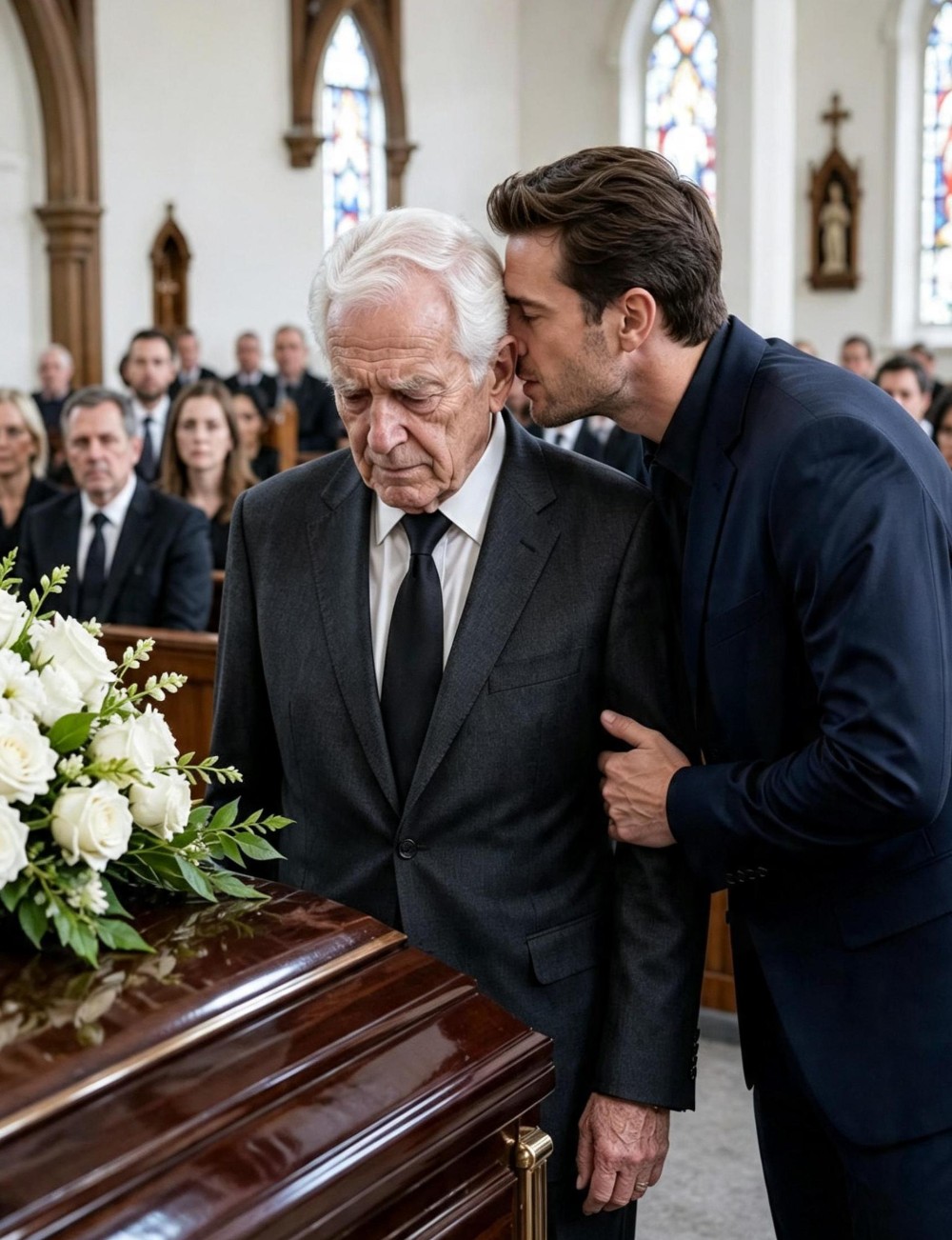
I was an old man, and I had already lived through more than my share of loss, but nothing had ever prepared me for standing inside that small stone chapel in Oakridge and watching my daughter’s casket sit at the front.
The chapel was packed.
Business associates had come. Old neighbors had come. Distant cousins I had not seen in years had traveled to Oakridge to say goodbye. Everyone spoke in low voices, as if speaking too loudly might somehow make the terrible truth more real.
Rows of white roses and lilies covered the area around the altar. Their strong, heavy smell filled the chapel until it almost felt difficult to breathe.
Near the back, the old organist played a slow, sad melody. Every note seemed to reach inside my chest and pull at my heart.
I stood near the front of the chapel, but I barely felt like I was there.
It was as if I were floating alone in a huge, silent ocean.
My hands were tightly clasped in front of me while I stared at the polished wooden casket.
Inside was my little girl.
My Sarah.
I swallowed hard and whispered, “Please, Sarah. Just wake up and tell me this is all a mistake.”
For one foolish second, I waited.
Of course, there was no answer.
Death was a wall no one could climb over.
Sarah had been the center of my world from the moment she was born. After her mother died, Sarah became the one reason I continued moving forward.
I remembered her as a little girl, when she would crawl into my arms and tuck her head beneath my chin. She had always made me feel like I was the strongest man alive, even when I knew I was struggling just to survive.
After her mother’s funeral, Sarah had looked up at me with tears in her eyes.
“We will take care of each other, Daddy,” she had promised.
Those words stayed with me for the rest of my life.
I took that promise seriously.
I worked three different jobs because I wanted to make sure Sarah never went without the things she needed. My hands became rough from years of manual labor, but I never complained.
I learned to cook her favorite meals.
I learned how to fix her hair, even though I was terrible at it at first.
I went to school meetings, helped with homework, and did everything I could to give her a better life than the one I had known.
Then, after years of hard work, Sarah was accepted into a prestigious university.
I still remembered the night I found out.
I had sat alone in our kitchen, exhausted after work, and cried.
They were tears of pride, relief, and exhaustion all mixed together.
I looked at Sarah’s photograph on the mantle and whispered, “You did it, Sarah. You are going to change the world.”
And I truly believed she would.
Then Sarah met Jackson.
After that, things slowly began to change.
Standing in the chapel, I looked across the room at my son-in-law.
Jackson wore an expensive black suit that probably cost more than my first house.
He was surrounded by local politicians and important business people, accepting their condolences with a serious expression.
But something about him made my stomach turn.
He looked less like a grieving husband and more like a man playing a part in front of an audience.
I watched him shake hands.
He nodded at people at exactly the right moments.
He lowered his head whenever someone offered sympathy.
Everything seemed perfectly rehearsed.
An old neighbor named Mrs. Higgins eventually walked over to me.
She gently touched my arm.
“I am so incredibly sorry for your loss, Thomas,” she said softly. “Sarah was such a bright light in this community.”
I forced myself to nod.
“Thank you,” I replied. “Sarah loved this neighborhood very much.”
Mrs. Higgins squeezed my arm before walking away.
I turned my attention back to Jackson.
He was already moving to another group of people.
He shook another hand.
Another nod.
Another solemn expression.
Watching him made my skin crawl.
He did not look like a man whose wife had just died.
He looked like a man already planning what he would do next.
Finally, the funeral service ended.
People slowly began leaving the chapel.
Some stopped to offer me another hug. Others gave me sympathetic looks before heading toward their cars.
I remained near the large oak doors, barely aware of what was happening around me.
Then Jackson walked toward me.
His expression had changed completely.
There was no sadness in his eyes.
His face was cold.
“Thomas,” he said, “we need to have a very serious conversation about the future.”
He did not even look directly at me.
A chill went down my spine.
I stared at him.
“Can it not wait until we have had some time to process all of this?” I asked.
Jackson shook his head.
He stepped closer and lowered his voice so the few remaining guests would not hear.
“The house is legally in my name,” he said firmly. “And I have decided that I need some space to move forward with my life. I am giving you twenty-four hours to pack your things and find somewhere else to live.”
For several seconds, I could not speak.
I honestly wondered if I had misunderstood him.
My daughter had just been buried.
I had just watched my child’s funeral.
And this man was throwing me out of the house.
“Are you kicking me out on the day of my daughter’s funeral, Jackson?” I finally asked.
My voice shook with both grief and anger.
Jackson straightened his expensive tie.
Then he looked past me toward the parking lot.
“It is my house,” he said. “And I think it is best for everyone if we make a clean break starting tomorrow morning.”
I stared at him.
I could have shouted.
I could have begged.
I could have demanded an explanation.
But I did none of those things.
Because at that moment, I understood something.
I finally saw the man Jackson had become beneath all those expensive suits, polished manners, and carefully controlled expressions.
“I understand exactly what you are doing,” I said quietly.
Then I turned away before he could see the tears filling my eyes.
That night, I walked through the silent house.
Only a short time earlier, the rooms had been filled with Sarah’s laughter and memories.
Now they felt like an abandoned museum.
I slowly walked into Sarah’s old bedroom.
I sat on the edge of her bed and ran my hand across the soft quilt her grandmother had made for her.
For a moment, I could almost hear Sarah’s voice.
“Don’t let him get to you, Dad. You are stronger than he knows.”
I closed my eyes.
Then I opened them and began packing.
I took only the things I truly needed.
A few clothes.
Basic necessities.
And some photographs.
I found one photograph of Sarah when she was five years old.
She was sitting on a swing, laughing as she looked toward the sky.
I held the photograph against my chest for a moment.
Then I carefully placed it inside the side pocket of my suitcase.
When I reached the kitchen, I took the spare key from my pocket.
I placed it on the granite counter.
The small metal sound echoed through the empty house.
Clink.
It sounded like a final goodbye.
I picked up my suitcase and walked out.
That night, I stayed in a small, dusty hostel near the train station in Riverside.
The bed was uncomfortable.
The room was cold.
The walls looked as though they had not been cleaned in years.
But I did not care.
My body was tired, but my mind was already focused on one thing.
There was a phone call I needed to make.
And I had been waiting years to make it.
PART 2:
The next morning, I sat alone in a small diner.
I ordered a black coffee and watched the clock above the counter.
I waited until it reached nine.
Then I pulled out my phone.
There was one number in my contacts that I had kept saved for many years.
I dialed it.
A polite voice answered.
“Good morning. This is the law office of Mr. Cooper.”
I took a slow breath.
“This is Thomas,” I said. “I need to speak with the senior partner immediately regarding my daughter’s estate and the company shares.”
There was a short pause.
“Of course, Mr. Davis. Please hold.”
A few minutes later, Mr. Cooper himself came on the line.
His voice was warm and sincere.
“Thomas, I am so deeply sorry about Sarah,” he said. “She was a wonderful woman.”
“Thank you,” I replied.
I looked through the diner window.
Rain was running down the glass in long, crooked lines.
“But I am calling because Jackson has forced my hand.”
Mr. Cooper was silent for a moment.
I continued.
“I think it is time we reveal the true ownership structure of the firm to my son-in-law.”
A week passed.
I moved into a modest apartment while the lawyers began working quietly behind the scenes.
I knew Jackson probably believed everything had gone exactly as he wanted.
He probably sat behind his large desk in his corner office, looking out over the city and feeling like the king of the world.
He thought he owned the house.
He thought he controlled the company.
He thought I was just an old grieving man who had nowhere to go.
He was wrong.
For more than a decade, the company’s primary investors had been reporting back to me.
Jackson had never known.
He had no idea how closely I had been watching the business.
Then, one afternoon, his phone rang.
The call came from the legal team representing the majority shareholder.
“Mr. Jackson,” the lawyer said, “we are calling to inform you of a mandatory board meeting regarding the restructuring of the company.”
Jackson probably leaned back in his chair, annoyed.
“I own this company,” he replied. “So I do not see why a meeting is necessary right now.”
The lawyer cleared his throat.
Then came the sentence that completely destroyed Jackson’s confidence.
“Actually, our records show that Mr. Thomas Davis owns eighty-four percent of the voting shares, making him your primary employer.”
There must have been complete silence on the other end.
Jackson had spent years believing he was the man in control.
He had no idea that most of the power had never belonged to him.
Ten minutes later, my phone rang.
It was Jackson.
His voice was completely different from the cold, arrogant voice I had heard outside the chapel.
“Thomas,” he stammered, “there must be some kind of misunderstanding with the paperwork.”
I leaned back in my chair.
“There is no mistake, Jackson,” I told him. “So I suggest you meet me at the office on Main Street at two o’clock.”
When Jackson arrived, I barely recognized him.
He looked as though he had aged ten years in a single week.
His expensive suit was wrinkled.
His hair was messy.
And the confident swagger he normally carried was completely gone.
He slowly entered the meeting room and sat across from me.
“How is this even possible?” he asked.
I looked directly into his eyes.
“You forgot something important,” I said. “I was the one who funded your first three years when no bank would even talk to you.”
Jackson stared at me.
“I thought that was a gift for Sarah,” he whispered.
His hands shook as he gripped the edge of the table.
I slowly shook my head.
“It was an investment in her future,” I explained. “And I made sure the contracts protected that investment.”
Jackson looked around the room.
“You have been watching me this whole time?”
“Yes,” I said.
He swallowed.
I continued.
“I watched you treat my daughter like an accessory. I watched you treat employees as if they were beneath you.”
Jackson lowered his eyes.
I opened my briefcase and removed a thick stack of documents.
I placed them on the table and pushed them toward him.
“These are the new terms of your employment,” I said. “And they are not up for negotiation.”
Jackson picked up the papers.
As he read them, the color slowly disappeared from his face.
His power was gone.
He would remain with the company, but only as a figurehead.
He would have no real authority.
No control over the major decisions.
No ability to use the company as his personal kingdom.
He looked up at me.
“You are keeping me on?”
There was genuine confusion in his voice.
“Yes,” I answered.
“Why?”
I looked down at the papers for a moment before answering.
“Because Sarah believed you had potential. And I will honor her memory by giving you one last chance to become a decent man.”
Jackson stared at the table.
His voice became almost a whisper.
“I am so sorry for what I said at the chapel, Thomas.”
I did not raise my voice.
I simply looked at him.
“Apologies are just words, Jackson. I am interested in seeing whether you can actually change your actions.”
He had nothing to say to that.
The months that followed changed the company completely.
The local business community was shocked by what happened.
I removed managers who had used fear to control their employees.
In their place, I brought in people who believed in kindness, responsibility, and hard work.
I wanted the company to become a place where people were respected instead of intimidated.
I spent my days walking through the offices.
I talked to the employees.
I listened to their problems.
I asked what was working and what was not.
For the first time, the people at the company felt that someone at the top actually cared about them.
Then one morning, I met a young woman named Riley.
She worked in the design department.
I had noticed that she stayed late almost every night.
One evening, I stopped beside her desk.
“Is everything all right, Riley?” I asked.
She looked up at me.
Her eyes were tired.
“I just want to make sure this project is perfect,” she said. “My father sacrificed his retirement to pay for my portfolio school.”
I looked toward the lobby.
An older man was sitting there quietly with a book resting in his lap.
“That must be your father,” I said.
Riley smiled.
“Yes. His name is Samuel.”
I looked at him again.
“He must be very proud of you.”
Riley’s smile became even warmer.
“He is the best man I know,” she said. “I just want to prove that his sacrifice was worth it.”
Her words struck something deep inside me.
I knew exactly what she meant.
I had sacrificed for Sarah.
Samuel had sacrificed for Riley.
Parents like us gave pieces of our lives so our children could have opportunities we never had.
As I watched Samuel waiting patiently for his daughter, I realized what I wanted to do next.
I wanted Sarah’s legacy to become something bigger than a company.
PART 3:
I used a portion of the company’s profits to create a foundation.
Its purpose was simple.
I wanted to help parents like Samuel.
Parents who sacrificed their savings, their comfort, and sometimes their entire future to give their children a chance.
I also wanted to help young people who were trying to build better lives but did not have enough support.
I named the organization The Sarah Foundation.
I made sure the name was carved clearly into the front of the building.
It would be impossible for anyone entering the building to miss it.
At the opening ceremony, employees, community members, families, and business leaders gathered outside.
I stood in front of them and looked at the name above the entrance.
Then I spoke.
“We are here to protect the people who give everything to build the dreams of others.”
The crowd became quiet.
I looked at the people standing before me.
“These parents work behind the scenes. They sacrifice quietly. They often give up things they need so their children can have opportunities. Sarah understood that kind of love. I understood it too. And that is why this foundation exists.”
When I finished, everyone applauded.
I noticed Jackson standing near the back of the crowd.
He was not smiling.
He was simply watching.
For the first time, I saw something different in his eyes.
Reflection.
Maybe even regret.
Over time, Jackson began volunteering at the foundation.
He used his business knowledge to help young entrepreneurs understand the legal side of starting a company.
He taught them about contracts, ownership, and the mistakes that could destroy a new business.
Our relationship never became warm.
Too much had happened between us.
But the anger slowly disappeared.
In its place came something quieter.
Mutual respect.
Jackson had finally begun changing his behavior instead of simply apologizing for it.
One Sunday afternoon, I drove to the cemetery on the edge of Oakridge.
The cemetery was quiet.
The trees moved gently in the wind.
I carried a bouquet of Sarah’s favorite wildflowers.
When I reached her grave, I sat down in the grass beside the headstone.
For a while, I said nothing.
I simply looked at her name.
Then I smiled sadly.
“The foundation is doing well, Sarah,” I whispered.
The wind moved through the trees.
“We helped a father yesterday,” I continued. “He was about to lose his home because he had used his savings to pay his son’s medical bills.”
I paused.
“I wish you could have seen his face when we told him he would not lose his home.”
For the first time since Sarah’s funeral, I felt something I had almost forgotten.
Peace.
Not happiness.
I would never call it happiness.
But peace.
I believed Sarah would have been proud.
Proud of the foundation.
Proud of the people we were helping.
And perhaps even proud of me.
I slowly stood and brushed the grass from my clothes.
As I walked toward my car, something caught my attention.
A few rows away, I saw Jackson.
He was standing beside his own small memorial ritual for Sarah.
He had come alone.
For a moment, neither of us spoke.
Then Jackson raised one hand in a silent greeting.
I stopped.
I raised my hand back.
Then I continued walking toward my car.
I drove away from the cemetery and headed back toward Oakridge.
As the road stretched ahead of me, I thought about everything that had happened.
The funeral.
The house.
Jackson throwing me out.
The company.
The documents.
The foundation.
And Sarah.
I finally understood something.
Power was never about having the biggest office.
It was never about owning the largest house.
And it certainly was not about having enough money to throw a grieving father out onto the street.
Real power was something else.
Real power was taking the worst tragedy of your life and finding a way to turn it into hope for someone else.
I am an old man now.
My own time is slowly moving toward its natural end.
I know that.
But I am no longer afraid of it.
Because when the day finally comes when I see Sarah again, I know exactly what I will tell her.
I will look into my daughter’s eyes and tell her that I kept my promise.
The promise we made after her mother’s funeral.
The promise that we would always take care of each other.
Every morning, I drink my coffee in my quiet apartment.
On the wall is a photograph of Sarah sitting on my shoulders.
She is smiling.
I look at that picture every day.
Sometimes I still wish I could hear her laugh.
Sometimes I still wish I could walk through the front door and hear her call, “Daddy!”
But I know I cannot bring her back.
What I can do is keep her memory alive.
I am still here.
And because of the work we do, a part of Sarah is still here too.
The world continues turning.
New families wake up every morning.
New dreams are created every day.
New stories begin inside homes, offices, hospitals, schools, and small businesses throughout the city.
And in the heart of Oakridge stands a building with Sarah’s name on the door.
It reminds everyone who walks through those doors of something I learned through the greatest pain of my life:
Love is the strongest foundation of all.
And as long as I am alive, I will keep building on it.
THE END.
