
PART 1:
When my son got married, I never told him that I had inherited my late husband’s ranch.
And looking back, I am grateful every single day that I kept that secret.
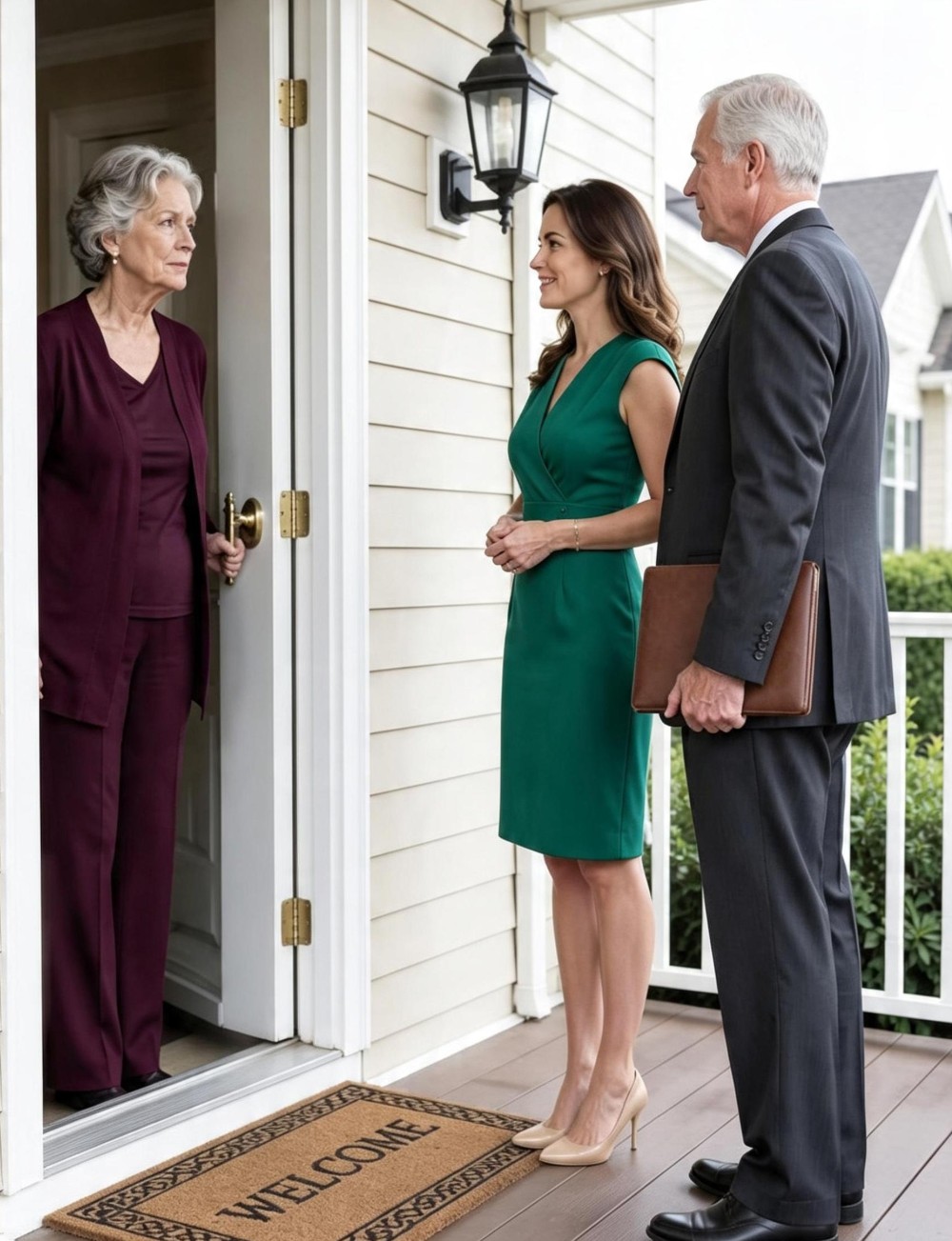
Only one week after the wedding, my new daughter-in-law, Allison Reed, appeared at my front door in Seattle. Her heels tapped sharply against the porch as she walked toward me. She wore a perfectly pressed silk blouse, and beside her stood a sharply dressed man holding a leather briefcase as if he already owned a piece of my life.
“Mom, this is Peter Lang,” Allison said with a polished smile. “He’s a notary. We came to help you sort out some paperwork for the house.”
My heart sank.
There was something about the way she said it that made everything suddenly clear.
I already knew why they were there.
What they did not know was how much I had prepared.
After my husband died and left me nearly five hundred acres of land in eastern Washington, I learned something very important.
Sometimes silence can protect you better than words ever could.
My name is Susan Harperfield. I am sixty-nine years old.
For three decades, I had been a wife and mother living in a modest home outside Seattle. I worked part-time jobs, saved every dollar I could, and stretched meals whenever money was tight so my family would always have enough.
My son, Andrew, was my whole world.
When he decided to marry Allison, I wanted nothing more than for him to be happy.
I sold some of my jewelry to help him pay his student loans. When he was sick, I brought him food and medicine. Over the years, I quietly wrote checks to help him whenever he needed money.
Nobody thanked me.
I never expected them to.
I did it because I was his mother.
When Allison entered our lives, I tried my best to welcome her like a daughter.
I cleaned every corner of my house before she came over. I cooked Andrew’s favorite childhood meals. I even wore my nicest dress because I wanted to make a good impression.
I wanted her to feel comfortable in my home.
Instead, she barely looked at me.
She greeted me with her fingertips resting briefly on my shoulders, avoided eye contact, and called me “ma’am” as if I were a complete stranger.
During dinner, I asked her questions about her childhood, her work, her family, and the things she enjoyed.
She answered quickly.
There was no warmth in her voice.
She barely touched the food I had spent hours preparing.
Finally, she looked at her plate and said, “I usually prefer proper restaurants.”
She said it softly, but the meaning was clear.
My kitchen was not good enough for her.
I told myself she was nervous.
Maybe she needed time.
Maybe once she became part of the family, she would soften.
But the wedding showed me that I had been wrong.
Very wrong.
At the wedding, Allison placed me in the fifth row, behind coworkers and people I had never even met.
When she introduced me, she simply said, “This is Andrew’s mom.”
There was no pride in her voice.
No warmth.
Nothing.
I had even offered to bake the family wedding cake.
She laughed lightly before shaking her head.
“Oh no, Mom. I don’t want anything homemade,” she said with a smile that felt colder than her words. “We hired a professional pastry chef. It will look like something from a magazine.”
I forced a smile.
“Of course,” I said.
But inside, something hurt.
When the speeches began, I sat quietly with my notes in my hands.
I had written down memories of Andrew as a little boy.
I wanted to tell everyone about the child who used to fall asleep on my shoulder, the boy who once brought me a flower from the neighbor’s garden because he thought I looked sad, and the young man I had watched grow into an adult.
I had so much love in those pages.
But Allison called almost everyone else before finally giving me a moment.
I stood.
I had barely started telling one of my favorite childhood stories when Allison suddenly began clapping loudly.
Others followed her.
Soon, the room was filled with applause.
My words disappeared beneath the noise.
I stopped speaking.
I sat down.
For the rest of the evening, I watched my son celebrate his wedding without me.
I felt invisible in a room that should have felt like family.
Eventually, I decided to leave.
I found Andrew and told him I was going home.
He hugged me quickly.
“Thanks for everything, Mom. Love you,” he said.
Then he turned away and started talking to someone else.
I walked outside alone.
The drive home was quiet.
The city lights passed across my windshield, but I barely noticed them.
Instead, I remembered my husband’s final days.
He had been lying in a quiet hospital room, surrounded by machines and the soft sounds of people trying to keep him alive.
We both knew the end was near.
Before he died, he had looked directly into my eyes and said something I never forgot.
“If anything happens to me, don’t let anyone walk over you. You’re stronger than you think, and you have more than you realize.”
At the time, I thought he was talking about money.
I was wrong.
The next morning, I opened the safe.
I pulled out an old folder.
Inside was the deed that changed everything.
Nearly five hundred acres of land in eastern Washington.
There were cattle.
A large farmhouse.
Several rental cottages.
And every piece of it was legally mine.
The property was worth more than four million dollars.
I had never told Andrew.
My husband had inherited the ranch years earlier, and we had always planned to give it to Andrew someday.
That had been our dream.
But after meeting Allison and seeing how she treated me, something inside me changed.
The secret was no longer simply something I kept for protection.
It had become necessary.
PART 2:
Three days after the wedding, Andrew called me.
His voice sounded strange.
Careful.
Almost rehearsed.
“Mom, have you thought about downsizing?” he asked. “That house is a lot for one person.”
I stared out the kitchen window.
“I’m sixty-nine, not ninety,” I replied. “And I like my home.”
There was a pause.
Then he continued.
He talked about safety.
He talked about maintenance.
He talked about how difficult things could become if I stayed there alone.
Then he mentioned assisted living.
I refused every suggestion.
“I’m not leaving my home,” I said calmly.
Two days later, Allison called.
She gave me the exact same advice, but she wrapped it in a much prettier package.
She spoke about my future.
She talked about selling the house.
She suggested investing the money.
She said it would make my life easier.
“I’m not selling my house,” I told her firmly.
The calls did not stop.
Sometimes Andrew called.
Sometimes Allison called.
Then her father started offering advice.
That was when I finally understood.
They were testing me.
They wanted to know how far they could push me.
So I contacted an attorney.
Her name was Laura Chen, a specialist in elder law. A friend from church had recommended her.
I sat across from Laura and told her everything.
I left nothing out.
She listened quietly for a long time.
When I finished, she leaned back in her chair.
“This sounds like early financial exploitation,” Laura said. “And it often comes from family members who believe they are entitled to someone else’s money.”
The words made my stomach tighten.
“What should I do?” I asked.
“We prepare before they make their next move.”
And that was exactly what we did.
For hours, Laura and I worked on a legal shield around my life.
We created a trust.
We assigned power of attorney to my trusted friend Nancy Collins.
We documented every conversation and every suspicious interaction.
Laura made sure every important document was protected.
Then she looked directly at me.
“If they bring you any documents, call me immediately,” she warned.
“I will,” I promised.
So when Allison arrived at my front door with Peter Lang and his leather briefcase, I already knew what was happening.
Allison stepped inside as if she were doing me a favor.
Peter placed a thick stack of documents on my table.
Allison pushed them toward me.
“We made this easy, Mom,” she said. “The buyer is ready, and you’ll get eight hundred fifty thousand dollars.”
I looked at the papers.
They were not simply about selling my house.
Buried among the pages were documents that would give them control over my finances.
There were also papers involving my healthcare.
They were trying to take control of my entire life.
I kept my face calm.
“Where would I go?” I asked softly.
I was playing the role they expected.
Allison smiled.
“We found a lovely assisted living place.”
She sounded pleased with herself.
I slowly picked up the pen.
I watched her face.
She was satisfied.
She believed she had already won.
Then the doorbell rang.
Allison immediately frowned.
“Ignore it,” she said.
I looked at her.
Then I stood.
I walked toward the front door.
The bell rang again.
I opened it.
Laura Chen was standing there.
Two police officers stood beside her.
“Hello, Susan,” Laura said calmly. “I believe we have some documents to review.”
Everything changed in an instant.
The officers stepped forward.
They explained that they were investigating a report of attempted financial exploitation.
Peter Lang suddenly looked nervous.
Very nervous.
He gathered his things and quickly headed for the door.
Allison remained frozen.
Then she started talking.
She claimed she was only trying to help.
She said she was worried about me.
She said everything had been done because she cared about the family.
But Laura was ready.
She took apart Allison’s argument piece by piece.
She explained the legal problems with the documents.
She explained the pressure Allison had placed on me.
She explained the coercion.
There was no longer any room for excuses.
Then Andrew walked into the house.
He looked confused.
“What is going on?” he asked.
He looked at the officers.
Then at Laura.
Then at Allison.
Finally, he looked at the documents sitting on my table.
Laura picked them up.
“These papers would give you total control over your mother’s life,” she said firmly.
Andrew’s face changed.
He stared at Allison.
“I didn’t know,” he said in shock.
I looked at my son.
“You were planning your future with my money,” I told him quietly.
He opened his mouth, but no words came out.
The officers asked me whether I wanted to press charges.
I thought about everything.
I thought about my son.
I thought about the years I had spent helping him.
In the end, I chose not to press charges.
But I pointed toward the door.
“I want them out of my home,” I said.
They left.
When the house finally became quiet again, Laura sat beside me.
She looked at me carefully.
“Susan,” she said, “it’s time to talk about your ranch.”
PART 3:
The next day, I asked Andrew to come to my house alone.
No Allison.
No lawyers.
No one else.
Just my son and me.
When he arrived, he looked exhausted.
He sat across from me at the kitchen table.
For a moment, neither of us spoke.
Then I opened the folder.
I placed the deed on the table.
Andrew stared at it.
At first, he looked confused.
Then his eyes widened.
He read the papers again.
And again.
Finally, he looked at me.
“You own all of this?” he whispered.
“Yes.”
He stared at the deed.
“The ranch?”
“Yes.”
“The land in eastern Washington?”
“Yes.”
“All of it?”
“All of it.”
He sat back in his chair.
I could almost see his mind trying to understand what he had just learned.
I told him the truth.
His father had inherited the property.
We had kept it quiet.
We had planned to give it to him someday.
But after his marriage to Allison, I no longer felt safe giving anyone access to it.
“We planned to give it to you someday,” I said. “But I needed to protect it first.”
Andrew lowered his head.
“I’m sorry, Mom.”
His voice was broken.
“I should have listened to you. I should have seen what was happening.”
I did not answer immediately.
There was too much pain between us.
Finally, I said, “You need to make a choice about your marriage.”
He looked at me.
“What do you mean?”
“You need to decide what kind of man you want to be.”
Three weeks later, Andrew filed for divorce.
The legal battles that followed were long and difficult.
But they also confirmed everything I had feared about Allison’s intentions.
The documents.
The pressure.
The conversations.
The attempts to gain control.
Piece by piece, the truth came out.
Allison had not simply been worried about my future.
She had been looking at what I owned.
And once she discovered what she believed she could get, she had started making plans.
Andrew eventually understood that.
But understanding did not erase the damage.
For months, he worked to rebuild his life.
And slowly, carefully, he began rebuilding our relationship too.
This time, there were no secrets between us.
No pretending.
No pressure.
Just honesty.
I also made a decision about the ranch.
I placed the property into a trust.
Andrew would inherit it only after I passed away.
There were strict conditions attached.
He would have to treat the property responsibly.
He would have to respect the agreements protecting it.
And no spouse, partner, or future family member would be able to simply take control of it.
I had spent too many years protecting the people I loved to let someone destroy what my husband had worked so hard to build.
Months later, I moved between my Seattle home and the ranch.
But the ranch became the place where I felt most at peace.
And eventually, Andrew began spending more time there too.
One summer afternoon, I sat on the porch of the farmhouse in eastern Washington.
The land stretched endlessly beneath the bright sky.
Cattle moved slowly across the fields.
The wind passed through the grass.
Andrew was nearby repairing a section of fence.
He stopped for a moment and looked around.
“I never imagined this place,” he said quietly.
I smiled.
“Your father always loved it here.”
Andrew looked toward the fields.
“I wish I had known him better.”
“So do I,” I said.
For a while, we simply sat in silence.
Then Andrew looked at me.
“Thank you for not giving up on me, Mom.”
My eyes filled with tears.
“I almost did,” I admitted. “But you finally chose to do the right thing.”
He nodded.
“I’m sorry it took me so long.”
“I forgive you.”
I meant it.
Forgiveness does not mean pretending nothing happened.
It means recognizing when someone has truly changed.
Andrew had earned his second chance.
As the sun began to set over the ranch, the sky turned gold.
The same land my husband had loved was still there.
The same fields.
The same farmhouse.
The same quiet roads.
And suddenly, I remembered his final words.
You’re stronger than you think, and you have more than you realize.
He had been right.
I had been stronger than I believed.
I had far more than I ever needed.
But the greatest thing I had gained was not the ranch.
It was the wisdom to understand that love should never require you to surrender your dignity.
Family should never mean allowing someone to control you.
And helping the people you love should never mean destroying yourself in the process.
I looked across the fields and watched my son continue repairing the fence.
For the first time in years, I felt completely at peace.
My husband had left me more than five hundred acres of land.
He had left me security.
He had left me a future.
But most importantly, he had left me one final lesson.
Protect what matters.
Stand up for yourself.
And never mistake love for surrender.
The End.
