
Part 1:
Just one hour after my wife’s funeral service ended, my seven-year-old son grabbed my hand and whispered something that made my blood run cold.
“Daddy, Mommy is calling my name. We have to go back to her.”
Everyone around us believed Lucas was overwhelmed by grief. They thought he was struggling to accept that his mother was gone. But the way he spoke, with such certainty and fear in his eyes, made it impossible for me to dismiss his words.
I had already spent three days trying to accept the worst loss of my life. Now, my little boy was asking me to question everything the doctors had told us.
And when the cemetery staff and emergency responders finally examined my wife’s burial vault, they made a discovery that left our entire family speechless.
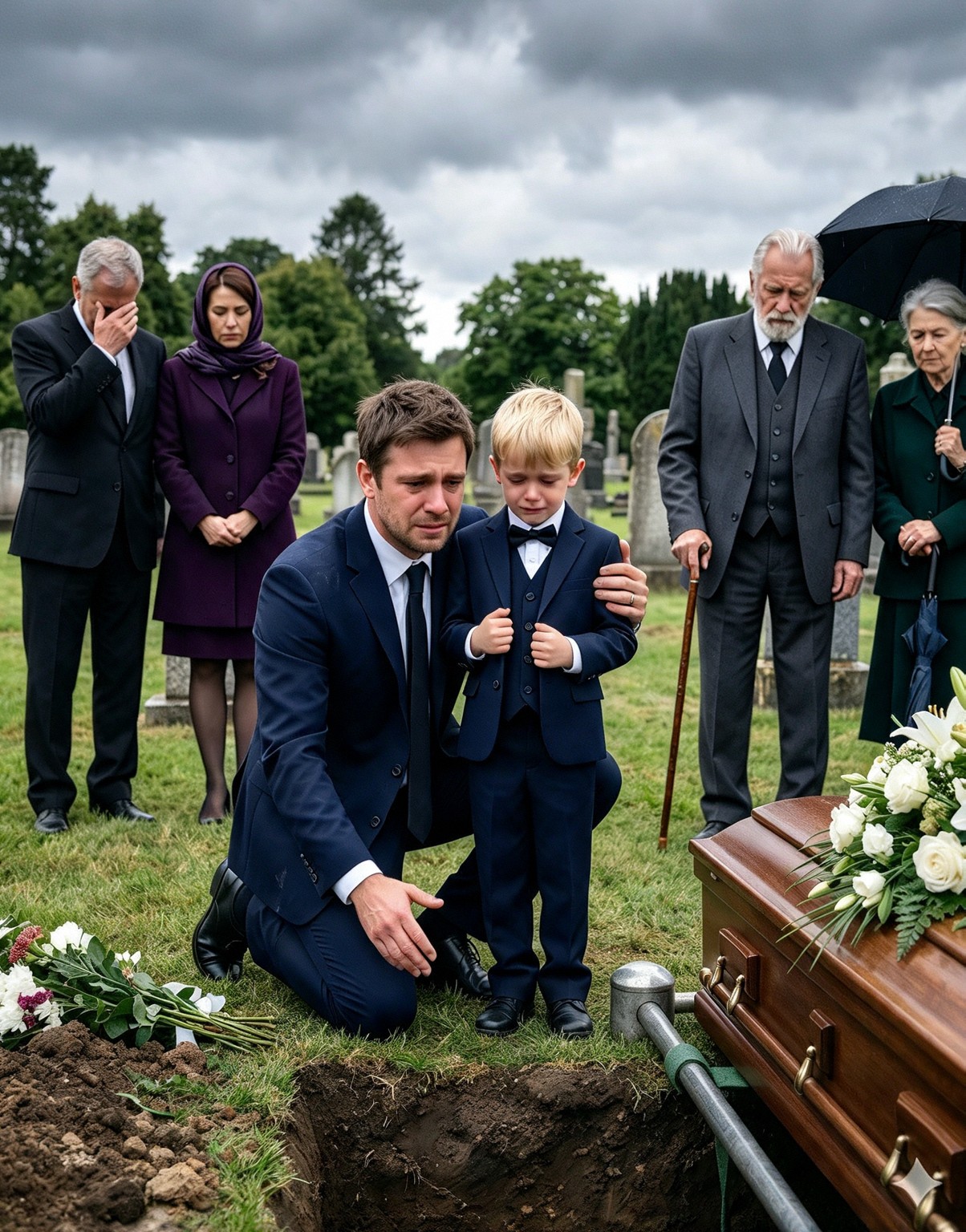
We had been standing near Rachel’s freshly buried grave for almost an hour when Lucas tugged at the sleeve of my dark wool coat.
“Daddy, please listen to me,” he cried softly, tears running down his pale cheeks. “We need to check on Mommy right now. I heard her calling my name from inside. I know I’m not making it up.”
The family members still gathered beneath their black umbrellas exchanged worried looks.
Above Whispering Pines Cemetery in Rapid River, Michigan, the afternoon sky had turned a dark, gloomy gray. Cold autumn rain fell steadily over the graves, soaking the grass and collecting along the edges of the freshly disturbed earth.
My name is Brian Cooper. I was thirty-eight years old, worked as a residential construction supervisor, and had lost my beloved wife, Rachel, just three days earlier.
According to the emergency room staff, she had suffered a sudden heart malfunction while sleeping. She was only thirty-six years old, and until that terrible morning, I had believed we had many wonderful years ahead of us.
Now, my only child was asking me to challenge the death certificate that had shattered our world.
“Lucas, look at me, buddy,” I whispered.
I knelt in the wet grass until we were looking directly into each other’s eyes.
“I know how much you miss Mommy. I miss her too. But the doctors told us that her heart stopped beating three nights ago.”
Lucas shook his head firmly. His small hands tightened around my wrists.
“No, Daddy! You have to believe me. I heard her during the closing prayer. She was calling my name!”
His voice broke as he began to sob again.
“I know what my own mother sounds like. She needs our help!”
Even Mr. Thomas, the funeral home director, stopped walking toward his black sedan. He turned around and watched us with genuine concern, although I could not tell whether he was worried about Lucas or about what I was beginning to suspect.
I pulled my son into a hug, trying to calm him. But an uncomfortable chill crept down my spine.
Lucas did not sound confused. He did not sound as though he were simply imagining things because he missed his mother.
He sounded certain that something was terribly wrong.
And suddenly, I remembered something from the viewing service earlier that morning.
I had stood alone beside Rachel’s open mahogany casket. Before saying my final goodbye, I had reached out and touched her hand.
Her skin had felt surprisingly warm.
At the time, I had been so overwhelmed by grief that I barely knew what to think. When I mentioned it to Mr. Thomas before the chapel doors opened, he had calmly explained that preservation procedures and indoor temperature controls could sometimes create unusual sensations.
His professional manner had reassured me enough to stop asking questions.
But now, standing beside my son in the cold rain, I could no longer ignore that memory.
I released Lucas and turned toward the funeral director.
“Mr. Thomas, is there any possibility that someone’s vital signs could be missed before a body is transferred to a funeral home?”
His expression became more serious.
“Mr. Cooper, a licensed county medical examiner officially certified your wife’s death before our staff transported her,” he replied. “All the required state procedures were followed.”
“But I need you to check everything again,” I insisted. My voice trembled despite my efforts to control it. “I need someone to make absolutely certain.”
Mr. Thomas sighed.
“Brian, I understand that this is an extremely difficult time, but—”
Before he could finish, Lucas stepped closer to the grave. He looked down at the flowers covering the fresh earth.
“Mommy, don’t be scared,” he whispered. “I’m right here.”
Those simple words destroyed the last of my hesitation.
I reached into my coat, pulled out my phone, and dialed 911.
“County emergency dispatch. What is the location of your emergency?” a woman asked.
“My name is Brian Cooper. I’m at Whispering Pines Cemetery in Rapid River, Michigan. My wife was buried here less than an hour ago, and my son insists he heard her calling for help from inside the burial vault.”
I took a shaky breath before continuing.
“Her hands also felt warm when I touched them during the viewing this morning. I know how this sounds, but I have serious concerns that her death might have been certified incorrectly. I need emergency personnel to check her immediately.”
There was a brief silence on the line.
Then the dispatcher’s voice changed. She sounded more alert.
“Sir, are you reporting that someone inside the casket may still be alive?”
“Yes,” I answered firmly. “I am asking for paramedics and law enforcement to come here right now.”
She assured me that emergency responders and police officers were being dispatched to the cemetery.
While we waited, Mr. Thomas remained nearby, repeatedly suggesting that children experiencing profound grief could sometimes believe they heard the voices of deceased loved ones.
But I could no longer accept that explanation without an independent medical examination.
Rachel’s older brother, Kyle, finally stepped out from beneath his umbrella and placed a hand on my shoulder.
“If Brian genuinely believes something went wrong, we cannot leave without allowing the authorities to investigate,” he told Mr. Thomas.
I looked at Kyle, surprised by his sudden support. For a moment, I thought his words meant we were finally working together to protect Rachel’s dignity.
I had no idea how much I would come to regret trusting him.
Within fifteen minutes, cemetery administrators arrived alongside local emergency coordinators. Deputies began speaking with the funeral director and the cemetery superintendent while other staff members examined the burial records.
What had begun as a quiet family farewell had turned into an extraordinary emergency beneath the falling rain.
Lucas stood beside me, holding both my hands. Water dripped from the brim of his coat, but he seemed to have forgotten the cold.
He had stopped crying and was watching the adults speak in hurried whispers around the grave.
After urgent consultations with the county medical examiner and cemetery authorities, permission was granted for an immediate examination under official supervision. The exact procedure would be determined by the medical team and the authorities responsible for the burial site.
Mr. Thomas walked toward his company vehicle to make several phone calls.
Rachel’s mother, Joanne, huddled beneath a large golf umbrella. Her face was pale as she stared at the grave.
“Brian, perhaps you should take Lucas to the family lounge,” my sister-in-law suggested gently. “He doesn’t need to watch them move the equipment around.”
I turned toward my son.
“Lucas, do you want to sit in the office vehicle? It’s dry and warm in there.”
He shook his head immediately.
“No, Daddy. I want to stay here. Mommy really called me.”
I crouched beside him and brushed the wet hair away from his forehead.
“Alright, buddy. We’ll stay together. The professionals are going to check everything.”
The cemetery crew began working carefully under the deputies’ supervision. Heavy equipment was brought along the gravel lane, and every movement was made according to the instructions of the authorities.
The minutes seemed to stretch endlessly.
Eventually, the supervising deputy approached me and explained that Rachel’s burial vault would be moved to a sheltered inspection area on the cemetery grounds. This would allow the medical team to examine her privately and respectfully, away from the public.
I nodded, although my entire body felt as if it had gone numb.
For three days, I had forced myself to accept that my eleven-year marriage was over. I had chosen Rachel’s favorite pale blue dress, helped select the hymns, and tried to explain to our son that his mother would never walk through our front door again.
I had believed there was nothing left to do except learn how to live without her.
Now, I stood beneath a gray sky, waiting for strangers to determine whether the woman I loved was truly gone.
“Mr. Cooper,” Mr. Thomas said quietly, “please prepare yourself. This examination will be emotionally difficult, whatever the outcome.”
I kept my eyes fixed on the sheltered area.
“I can handle whatever happens,” I replied. “Just make sure they examine her thoroughly.”
The medical team entered the enclosure carrying diagnostic equipment and emergency bags. Family members gathered beneath a nearby shelter, where Joanne sat beside Lucas and gently stroked his wet hair while whispering prayers.
For several minutes, nothing interrupted the steady drumming of rain against the canvas roof.
My shoulders began to slump.
Perhaps everyone had been right. Perhaps Lucas had heard what he desperately wanted to hear. Perhaps I had allowed my own grief to take control, dragging my son and our entire family into an impossible situation.
I looked down at him, wondering how I would explain everything if the doctors found nothing.
How could I tell a seven-year-old boy that the mother he believed he had heard was still gone?
Then Lucas suddenly lifted his head and stared toward the entrance of the enclosure.
“Daddy,” he whispered, his eyes widening. “Mommy is trying to speak again.”
Before I could respond, a loud gasp came from inside the tent.
“Hold everything! Everyone, step back!” a man shouted.
The quiet atmosphere shattered instantly.
A second technician rushed into the enclosure carrying a portable defibrillator and additional diagnostic equipment. Someone called for more medical supplies, while another person hurried toward the ambulance.
“Get the advanced life-support team over here immediately!” a voice shouted.
Mr. Thomas stumbled backward into the rain. The color had drained from his face.
My heart hammered against my ribs as I gripped Lucas’s shoulders.
“What happened?” I shouted toward the enclosure. “What did you find?”
A paramedic emerged into the drizzle. He pushed up his medical visor, and I could see the shock in his expression.
“Mr. Cooper, we have detected physiological activity that requires immediate resuscitation and hospital treatment.”
For a moment, I could not understand what he was saying.
“What does that mean?” I demanded, stepping toward him through the mud. “What is happening to my wife?”
The paramedic looked directly at me.
“Your wife is showing signs of life. We need to stabilize her immediately.”
My knees nearly gave way.
Behind me, Lucas began to cry again, but this time his tears were mixed with joy.
“I told you, Daddy!” he whispered. “I told you Mommy was talking to me!”
Everyone fell silent beneath the pouring rain.
Rachel Cooper, the woman we had mourned and buried less than an hour earlier, was somehow still alive.
And none of us yet understood how that could possibly be true.
Part 2:
Rachel’s right fingers suddenly flexed against the white satin lining of the casket.
For one astonishing moment, the paramedics and technicians seemed unable to believe what they were seeing. Then training took over.
One paramedic immediately checked the side of her neck while another prepared oxygen and ventilation equipment.
“I can feel a faint, rapid pulse in her carotid artery!” the first paramedic announced. “We need oxygen and airway support now!”
Behind me, Lucas let out a cry of pure joy.
“I told you! I told everybody she was alive!”
The sheltered enclosure erupted into urgent activity. The medical team carefully lifted Rachel onto a portable stretcher, secured her airway, and covered her with thermal blankets.
They worked quickly to support her breathing and circulation while preparing her for immediate transport.
I ran beside the stretcher, gripping the metal rail and staring at my wife’s face.
Her skin was still pale, but I could see the slightest movement in her chest as the medical team assisted her breathing.
“Rachel, please hold on,” I whispered. “Please, sweetheart. You have to come back to us.”
The ambulance doors closed, and within moments, we were racing toward Rapid River Memorial Hospital under flashing red lights and screaming sirens.
The wet streets blurred past the windows.
I could barely hear anything over the sound of the siren and the pounding of my heart. Every few seconds, I looked toward Rachel, terrified that the paramedics would suddenly tell me they had lost her again.
Lucas remained with his grandmother and the other family members, who were being helped by the authorities. I wanted him beside me, but I also knew he needed a safe adult to stay with him while the emergency team worked.
At the hospital, doctors rushed Rachel into the trauma bay. They continued resuscitation efforts, performed urgent tests, and transferred her to intensive care once her condition had been stabilized enough for the move.
I was left waiting in a sterile hallway, my clothes still damp from the rain.
My mind raced through the same questions again and again.
How could the doctors have declared her dead?
Why had her body remained warm?
And why had no one noticed anything until Lucas insisted that his mother was calling him?
I expected the medical team to question me about Rachel’s medical history and the circumstances of her supposed heart failure.
Instead, an older attending physician emerged from the intensive care unit carrying Rachel’s medical file.
His expression was serious.
“Mr. Cooper?”
I stood up immediately.
“Yes. How is my wife?”
“We are doing everything we can to keep her stable,” he replied. “But before I explain more, I need to ask you something important.”
He glanced down at the medical file.
“Who told you that your wife had undergone embalming or other preservation procedures at the funeral home?”
I stared at him, confused.
“Mr. Thomas, the funeral director, told me that everything had been handled according to standard procedure. Why?”
The physician’s expression tightened.
“Because our initial examination has revealed no evidence of embalming chemicals in her vascular system.”
I felt a chill spread through my body.
“What does that mean?”
“It means we need to establish exactly what happened to your wife between the time she was pronounced dead and the moment she arrived here,” he explained. “The absence of those chemicals does not, by itself, tell us why she was mistakenly believed to be dead. But it raises serious questions about the procedures followed at the funeral home.”
He lowered his voice.
“Your wife is receiving emergency treatment, and law enforcement needs to investigate the circumstances immediately. We cannot assume that this was simply a medical mistake.”
I gripped the back of a chair.
For three days, I had trusted the doctors, the funeral director, and the people who claimed they were helping my family through an unbearable tragedy.
Now my wife was alive, and the physician standing in front of me was telling me that something about the entire process did not make sense.
I could no longer ignore the possibility that Rachel’s death had not been a simple medical tragedy.
Someone might have done something to her.
And if that was true, I needed to know who.
Part 3:
A violent tremor swept through my body as the physician’s words sank in.
Suddenly, every strange detail from the past three days came rushing back.
Rachel’s unexpectedly warm skin during the viewing.
The rushed funeral arrangements.
Kyle’s insistence that we should not request a full autopsy.
And the look on his face when Lucas demanded that we check the grave.
I remembered something else, too.
During the viewing that morning, I had bent down to kiss Rachel’s cheek. For one brief moment, I thought I felt a faint movement near her fingers.
I had been so overwhelmed by grief that I convinced myself I was imagining it.
But now, standing in the hospital hallway, I could no longer dismiss that memory.
My son had heard his mother calling for help. I had felt that something was wrong. And somehow, Rachel had survived long enough for us to discover the truth.
I sat down heavily, trying to steady my breathing.
Then I remembered Lucas’s desperate words at the cemetery.
“Daddy, please tell them to hurry,” he had begged earlier. “Mommy is so cold down there.”
At the time, I had thought he was frightened by the idea of his mother being buried underground.
Now those words made my stomach twist.
Had Rachel really been trying to reach us while we stood above her grave?
Had she been fighting for her life while we mourned her?
I pressed my hands against my face.
I wanted to believe that everything had happened because of a terrible medical error. It was a frightening possibility, but it was easier to accept than the thought that someone might have deliberately put my wife through such an ordeal.
Yet the more I remembered, the more suspicious the circumstances became.
At the cemetery, Mr. Thomas had repeatedly tried to persuade me that Lucas was imagining things.
“Mr. Cooper, children sometimes believe they can hear loved ones after a devastating loss,” he had told me, forcing an uneasy smile. “Their minds are trying to make sense of something they cannot understand.”
But I had refused to accept that explanation.
“Then explain why the burial was arranged so quickly,” I had demanded. “Why were we told to proceed before a complete post-mortem examination had been carried out?”
Mr. Thomas had opened his mouth, but no answer came.
That was when Kyle approached from the tree line, his jaw clenched.
“Brian, you’re turning this into a public spectacle,” he had said in a harsh whisper. “You’re only making things harder for Lucas. Rachel is gone, and you need to let her rest with dignity.”
I had stared at him in disbelief.
“Lucas believes he heard his mother calling for help. I’m not walking away until someone checks.”
Kyle shook his head impatiently.
“You’re letting grief control you.”
Then Lucas stepped forward, his small face twisted with fear.
“Mommy is down there, and she’s scared of the dark!” he shouted at his uncle.
The sound of my son’s voice changed something inside me.
I looked at him, then at the freshly disturbed ground covering the burial vault.
For three days, I had been a grieving husband, barely able to think clearly or make decisions. But at that moment, I stopped behaving like a man paralyzed by sorrow.
I became a father who would do whatever it took to protect his child and find out what had happened to his wife.
I called the police.
When Kyle grabbed my sleeve and tried to pull my phone away, I shoved his arm aside.
“Why are you so afraid of letting trained medical professionals examine her?” I snapped.
Kyle froze.
He refused to meet my eyes. His hands trembled inside his pockets, and his face had gone pale.
I had never seen him look so frightened.
His silence scared me more than any supernatural explanation ever could.
Because if he truly believed Rachel was dead, why was he so desperate to stop us from checking?
Only seventy-two hours earlier, our life in Rapid River had been ordinary, peaceful, and full of small moments of happiness.
We were not wealthy, but we had a comfortable brick house, my construction work was steady, and Rachel loved her job as a pediatric nurse at the local valley clinic.
She had a special gift for calming frightened children.
Toddlers who screamed at the sight of needles often settled down when she spoke to them. Even children who were terrified of medical equipment would eventually relax when she held their hands and explained what was happening.
Whenever Rachel walked through our front door, her laughter filled the house.
She usually carried the fresh scent of garden soil and lavender because she loved spending time in our backyard.
Every spring, she planted tall sunflowers along the wooden fence. She took great pride in watching them grow, and Lucas loved helping her water them.
She also had a habit of hiding little handwritten notes for us.
Sometimes, I found one tucked into my lunchbox. Other times, a folded piece of paper appeared inside my leather work boots on a cold morning.
One note read, “Remember to eat a proper lunch today, sweetheart.”
Another said, “Drive carefully across the river bridge tonight.”
The last note I had saved in my wallet read, “You are the best father our little boy could ever have.”
Those little messages had always made me smile.
They were Rachel’s way of reminding us that she loved us, even when she was busy or tired.
That was why her behavior on the evening before her supposed death had seemed so unusual.
We had been sitting around the kitchen table, eating dinner, when her mobile phone rang on the counter.
Rachel glanced at the screen. Her expression changed instantly.
Without answering, she turned the phone facedown.
I noticed the movement and looked at her.
“Is something wrong at the pediatric clinic?” I asked as I spooned potatoes onto Lucas’s plate.
She forced a smile.
“No, sweetheart. It’s nothing you need to worry about. Just some internal administrative business at the clinic.”
Her answer sounded rehearsed, as though she had prepared it in advance.
I wanted to ask more questions, but Lucas was telling us an excited story about something that had happened at school. Rachel smiled at him and listened, although I noticed that her attention kept drifting toward the phone.
Later that evening, Lucas went upstairs to brush his teeth before bed.
When I returned to the kitchen, I found Rachel standing by the window, staring out into the darkness.
She was holding her phone so tightly that her knuckles had turned almost white.
I walked up behind her and wrapped my arms around her waist.
“Rachel, honey, talk to me,” I said softly. “What’s going on?”
She turned in my arms.
For a brief moment, I saw genuine terror in her hazel eyes. Then she buried her face against my shoulder.
“Brian, I need you to promise me something,” she whispered urgently.
Her fear made my stomach tighten.
“You’re starting to scare me. Just tell me what’s happening.”
She pulled back enough to look at me.
“If anything strange happens to me, don’t let anyone convince you that what you see with your own eyes isn’t real.”
I stared at her.
“What does that mean? Rachel, are you in trouble?”
She opened her mouth, but before she could answer, Lucas came running into the kitchen in his green dinosaur pajamas.
He was waving his bedtime storybook and asking his mother to read it to him.
Rachel immediately wiped her eyes and smiled at him.
She kissed my cheek before taking our son upstairs.
“We’ll talk about everything tomorrow,” she promised.
I watched her leave, unsettled by the conversation but still believing we had time to work through whatever was troubling her.
We never had that conversation.
At five the next morning, my alarm sounded beside the bed.
I turned toward Rachel, expecting to find her sleeping peacefully.
Instead, she lay completely motionless.
Her skin felt cool, and her lips had taken on a faint bluish color.
“Rachel?” I whispered, touching her shoulder.
She did not respond.
I shook her gently, then more urgently.
“Rachel, wake up. Honey, please wake up!”
Nothing happened.
Panic took over. I called 911 while trying desperately to get a response from her.
The local paramedics arrived within seven minutes. They took over immediately, performing emergency resuscitation and checking her vital signs.
I stood beside the bedroom doorway, watching them work.
I wanted to believe they would save her. I wanted someone to tell me that she had simply fainted or suffered some temporary medical problem.
But eventually, the first responder approached me.
“Mr. Cooper, I’m very sorry,” he said with practiced sympathy. “We have been unable to revive your wife. Based on the signs available to us, this appears to be a sudden cardiac event.”
I could barely understand his words.
Rachel was only thirty-six. She was a nurse who understood the importance of medical care. She had been healthy enough to work, care for our son, and spend hours in the garden.
How could she be gone without warning?
The paramedics and the authorities began the process of documenting her death and arranging for the appropriate medical examination.
I was too devastated to think clearly.
I could barely answer questions, let alone make decisions about funeral arrangements.
That was when Kyle arrived.
He came to our house within two hours of the announcement and immediately took charge of the paperwork.
Because he worked as a senior compliance director for a private regional medical supply network, I assumed he understood the complicated administrative procedures better than I did.
I was grateful when he offered to help.
“Brian, your only responsibility right now is taking care of Lucas,” he told me gently. “Let me handle the funeral home, the paperwork, and the county certificates.”
I nodded, unable to imagine how I could manage everything alone.
But when I asked about a comprehensive autopsy, Kyle’s attitude changed.
I wanted to know why a healthy thirty-six-year-old woman had apparently died in her sleep. I needed an explanation that went beyond the possibility of a sudden cardiac event.
Kyle’s expression hardened.
“The emergency doctor has already explained what happened,” he insisted. “Putting Rachel through an invasive post-mortem examination will only add to our family’s trauma.”
I hesitated.
“But shouldn’t we know exactly why she died?”
“Brian, there is nothing to be gained by prolonging this,” he replied firmly. “We need to focus on saying goodbye.”
I was exhausted, overwhelmed, and desperate to believe that someone in the family knew what to do.
So I listened to him.
Kyle selected Thomas Family Mortuary, coordinated with the county registrar, and arranged the funeral service for the following morning.
The speed of the arrangements surprised me, but he had an explanation for everything.
“Rachel always said she wanted a swift, private farewell,” he told me. “She wouldn’t have wanted us to drag this out.”
I wanted to believe him.
I wanted to believe that he was helping me honor his sister’s wishes.
But now, after everything that had happened, his actions looked very different.
During the viewing, I had approached Rachel’s open casket and touched her folded hands.
Her skin felt strangely warm.
I stood there for several seconds, trying to understand why.
Then Kyle appeared beside me and tapped my shoulder.
“Brian, there are other people waiting to pay their respects,” he said quietly.
I stepped aside.
At the time, I thought he was simply trying to keep the service moving.
Now I wondered whether he had been trying to prevent me from noticing something.
Back at the cemetery, I had watched Kyle turn away from the grave as though he wanted to leave as quickly as possible.
That image would stay with me for the rest of my life.
By the time the emergency responders arrived, the police were already gathering statements.
Deputy Ross stepped in front of Kyle near the parking path.
“Sir, I need you to remain here while we collect information from everyone involved.”
Kyle stopped abruptly.
His shoulders trembled as he turned toward the deputy.
“My sister had a documented heart condition,” he stammered. “This entire exhumation is an outrage to her memory!”
Deputy Ross did not move.
“We have confirmed signs of life from certified paramedics. This is now an active medical and criminal investigation. Nobody leaves until the county detectives have spoken with the relevant people.”
Kyle’s face tightened.
For the first time, I saw something in his expression that looked very much like fear.
And I began to understand that the truth might be far more terrible than I had imagined.
Part 4:
Back at Rapid River Memorial Hospital, I sat beside Rachel’s bed in the intensive care unit.
The steady beeping of the cardiac monitor filled the room. A ventilator supported her breathing while the medical team continued monitoring her circulation and other vital signs.
Her cheeks were slowly regaining some color.
I watched her chest rise and fall, afraid to look away for even a second.
I had spent three days believing I would never see her alive again. Now she was lying only a few feet away from me, surrounded by machines that were helping her body recover.
I wanted to hold her hand, tell her how much I loved her, and ask her what had happened.
But she was still unconscious, and the doctors had warned me that she remained critically ill.
I had to wait.
A few minutes later, Detective Adams from the county sheriff’s department entered the room.
He carried a sealed evidence pouch containing two small pharmaceutical vials.
“Mr. Cooper, may I sit down?” he asked.
I nodded, my eyes moving immediately to the evidence in his hand.
“What is that?”
“We have been investigating the circumstances surrounding your wife’s apparent death,” he explained. “During an emergency search of your brother-in-law’s vehicle at the cemetery, officers found these vials hidden inside his briefcase.”
My stomach tightened.
“What was in them?”
“Our forensic team is examining the substances. Preliminary information suggests they may be potent neuromuscular blocking agents.”
I stared at him.
“I don’t understand. What do those drugs do?”
Detective Adams placed the evidence pouch carefully on the table beside him.
“Certain drugs in this category can cause profound muscle paralysis. Depending on the substance and circumstances, they can prevent a person from moving or breathing without appropriate support. Their effects can make someone appear lifeless if the situation is not properly assessed.”
He paused before continuing.
“They do not, by themselves, explain every finding in your wife’s case. We need laboratory testing, medical records, and expert examination before we can determine exactly what happened.”
I felt sick.
“Are you saying someone gave Rachel those drugs?”
“We are investigating that possibility,” he replied. “We have also found evidence that Kyle paid a mortuary assistant five thousand dollars in cash. According to the information we have gathered so far, the payment was connected to an agreement to delay certain preservation procedures until after the burial.”
I looked at the vials again.
The room seemed to tilt around me.
“Why would he do that? Why would Rachel’s own brother do something like this to her?”
Detective Adams took a slow breath.
“We have reason to believe your wife discovered serious misconduct involving medical devices distributed through Kyle’s company. She worked at a pediatric clinic, so she may have had access to records that raised questions about the safety of certain products.”
I remembered Rachel’s frightened expression the night before she collapsed.
Her phone.
Her trembling hands.
Her warning that I should never allow anyone to convince me that what I saw with my own eyes was not real.
I gripped the edge of the bed.
“What kind of misconduct?”
“Falsified safety audits,” Detective Adams answered. “We are examining records suggesting that Kyle may have altered reports involving experimental medical devices. We have also learned that Rachel had arranged to meet with federal investigators that afternoon.”
My throat went dry.
“She was going to report him?”
“That is one of the possibilities we are investigating. We need to verify the details, but the timing is concerning.”
I looked at Rachel.
For three days, I had thought her sudden death was a terrible accident.
Now, I was beginning to understand why she had been so frightened.
She had known something was wrong. She had tried to warn me, but I had not understood her words in time.
And if Detective Adams was right, someone might have tried to silence her before she could reveal what she knew.
My hands curled into fists.
“I trusted him,” I whispered. “I let him handle everything because I thought he was helping us.”
Detective Adams leaned forward.
“You were grieving, Mr. Cooper. You had no reason to assume your own family was involved in something like this. The investigation will establish what happened and who was responsible.”
I swallowed hard, struggling to control my anger.
Then a faint sound came from Rachel’s bed.
It was so quiet that I thought I had imagined it.
I turned toward her.
Her eyelids fluttered.
“Rachel?”
I jumped to my feet and leaned over the bed.
Her eyes opened slightly beneath the harsh hospital lights. At first, her gaze wandered across the ceiling as though she did not know where she was.
Then she looked directly at me.
“Brian,” she whispered through the oxygen mask.
The sound of my name in her voice nearly broke me.
“I’m here, sweetheart,” I cried, taking her hand carefully. “I’m right here. You’re safe in the hospital. You’re going to be alright.”
Tears streamed down my face as I kissed her forehead.
She was warm.
She was alive.
And she was looking at me.
I had imagined this moment a thousand times during the past three days, but I had never believed it could really happen.
Rachel’s fingers slowly curled around mine.
“Lucas?” she whispered.
“He’s safe,” I assured her immediately. “He’s with your mother just outside. He’s the reason we found you.”
Her eyes filled with tears.
I gently brushed a strand of hair away from her forehead.
“He heard you calling him from the grave,” I explained. “He refused to let me walk away. He kept telling me that you were still there.”
Rachel closed her eyes for a moment, and a tear slipped down her cheek.
“I remember hearing his footsteps on the grass,” she whispered weakly. “I was trying so hard to scream his name.”
I leaned closer, barely able to breathe.
“You could hear us?”
She gave the faintest nod.
“I couldn’t move properly. I couldn’t make my voice loud enough. But I could hear people talking above me, and I kept trying to reach you.”
Her hand tightened around mine.
“I knew Lucas would recognize my voice. I just needed him to hear me.”
I pressed her hand against my cheek.
“You’re here now,” I whispered. “That’s all that matters. You’re here.”
The door opened quietly.
Lucas stood in the doorway, holding his grandmother’s hand. His eyes widened when he saw his mother awake.
For a second, he remained completely still, as though he was afraid the sight might disappear if he moved too quickly.
Then Rachel turned her head toward him.
“Lucas,” she whispered.
He let go of Joanne’s hand and hurried toward the bed.
“Mommy!”
Rachel slowly opened her arms as far as her condition allowed, and Lucas carefully leaned against her.
“You came back!” he cried, burying his face against her shoulder.
Rachel kissed the top of his head, tears running down her cheeks.
“I’m here, my darling,” she whispered. “I’m right here.”
I stood beside them, holding Rachel’s hand while our son clung to her.
Three days earlier, I had believed our family had been destroyed forever.
An hour after her funeral, I had feared that my son was losing himself to grief.
Now I understood that Lucas had been the one person who refused to accept an answer that did not make sense.
His determination had forced us to question what everyone else had accepted.
It had brought emergency responders to the cemetery.
It had given Rachel another chance.
As I watched my wife hold our son, I thought about the warning she had whispered to me the night before everything happened.
*Don’t let anyone convince you that what you see with your own eyes isn’t real.*
I finally understood what she had meant.
The investigation into Kyle and the medical supply company would continue. The authorities still had to establish exactly what had been done to Rachel, how she had been declared dead, and who else might have been involved.
There would be difficult days ahead, and Rachel’s recovery would take time.
But those questions could wait for the moment.
For now, my wife was alive, my son was holding her, and our family had been given something I had thought we had lost forever.
A second chance.
THE END.
