
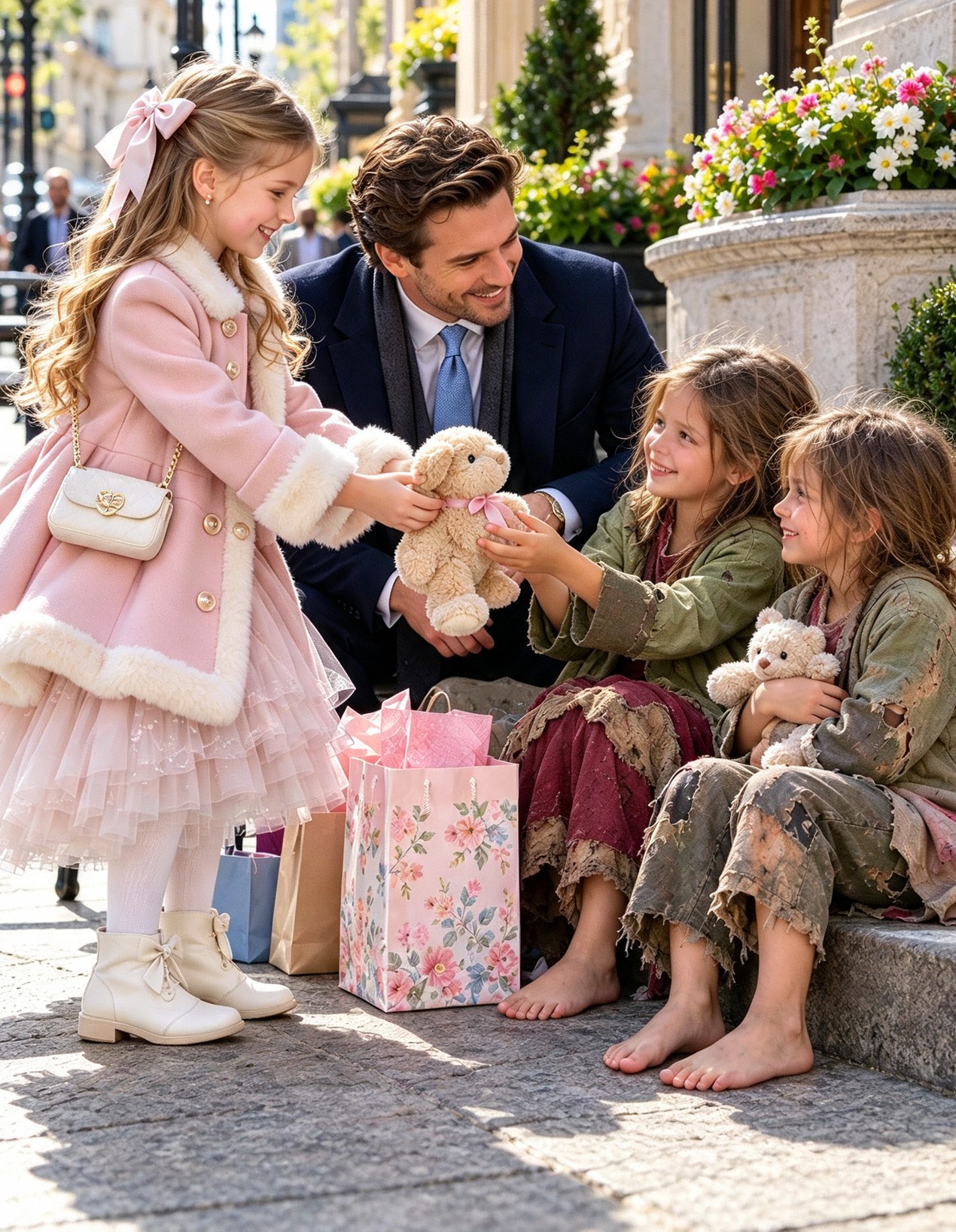
Both girls looked exactly like my daughter, but then I noticed something that made my blood run cold…
Part 1:
“Daddy, brake! There are two girls with my face lying next to the trash!”
My daughter Valerie screamed so loudly that I slammed on the brakes before I even understood what she was saying.
It was almost nine o’clock at night, and rain was pouring down over the Lower East Side of Manhattan. We were returning from a visit to a hotel my company was renovating. My mind had been busy with contracts, budgets, and deadlines. Meanwhile, from the back seat, my daughter had spotted something that would change my life forever.
Under the awning of a closed print shop, two little girls were huddled together on a piece of soaked cardboard.
They were barefoot, their clothes were dirty, and their faces were pale from the cold. One girl was trying to protect the other with her sweater, even though she was shaking so badly that she could barely keep her arms around her sister.
“Daddy, look at them!” Valerie cried, pressing her nose against the window. “They look just like me!”
I opened the car door and stepped into the rain without even reaching for an umbrella.
My name is Brett Calder. I was thirty-nine years old, and I had built a successful company that owned and renovated hotels and commercial buildings. My face had appeared in business magazines, and people often described me as a man who had everything.
I had money, a beautiful home, a thriving business, and a daughter I loved more than anything in the world.
After losing my wife five years earlier, I had convinced myself that money was good for at least one thing: keeping my family safe.
That night, I discovered just how wrong I had been.
The older girl lifted her head when she saw me approaching.
She had the same dark curls as Valerie, the same cleft in her chin, and a small birthmark beside her left ear.
Then the younger girl opened her eyes.
They were green with tiny flecks of gold.
My heart seemed to stop beating.
Those were Lena’s eyes.
My wife Lena’s eyes.
The same woman I had buried five years earlier.
I stood there in the rain, unable to move. For a moment, I wondered whether grief had finally broken something inside my mind.
The girl with the dark curls quickly stood up and stepped in front of her sister, trying to protect her from me.
“We didn’t take anything, mister,” she said nervously. “We’re leaving.”
Her voice was weak, but there was something heartbreaking about the way she tried to sound brave.
“Nobody is accusing you of anything,” I told her, lowering myself to her level. “I’m not here to hurt you. Are you two alone?”
Before I could say anything else, Valerie climbed out of the car with her kindergarten backpack.
“Valerie, wait!” I called.
But she had already pulled out a small bag of crackers.
“Here,” she said, holding it toward the girls. “I still have some left for tomorrow.”
The younger girl reached for a cracker, broke it into two pieces, and handed the larger piece to her sister.
That tiny gesture hurt me more than I could explain.
These children were hungry enough to fight for every bite, yet the first thing the younger one did was make sure her sister got more food.
I had spent years making sure Valerie never went without anything. Meanwhile, these two girls had been left to survive on the streets.
“What are your names?” I asked gently.
The older girl hesitated before answering.
“I’m Vera. She’s Violet.”
The names hit me like a punch to the chest.
When Lena and I learned that she was expecting triplets, we had sat together one evening and written three names on a napkin.
Valerie.
Vera.
Violet.
We had laughed about how difficult our lives would become with three little girls running around the house. Lena had insisted that we would manage somehow.
She had kept that napkin in her purse until the day she went into labor.
That day had begun with an unexpected hemorrhage and ended with me sitting alone in a hospital waiting room, unable to understand what was happening.
My mother-in-law, Eunice, had eventually emerged from the operating room with tears running down her face.
She told me that Lena had died.
She also told me that only one of our three babies had survived.
The doctor, Dr. Tillman, spoke about irreversible complications. He explained everything in a calm, professional voice, using medical terms I barely understood.
I was too devastated to ask the questions I should have asked.
I never saw the other two girls.
I never even saw my wife’s body.
Eunice told me that Lena’s body had been cremated because of the complications and the arrangements she had made with the hospital. She handed me an urn while I struggled to learn how to feed and care for Valerie with hands that wouldn’t stop shaking.
For five years, I had believed every word she told me.
Now two little girls stood in front of me, carrying the names Lena and I had chosen for our missing daughters.
I forced myself to breathe.
“Where is your mother?” I asked.
Vera pressed her lips together and looked down at the wet pavement.
“We don’t have a mom,” she whispered. “Aunt Marnie takes care of us.”
Marnie.
Lena’s younger sister.
I hadn’t heard from Marnie in years. She had disappeared after Lena’s funeral, and Eunice had told me that the loss had affected her so badly that she wanted nothing more to do with our family.
I had accepted that explanation, too.
“And where is your aunt now?” I asked.
Vera glanced toward the street.
“She told us to wait here, near the big hotel. She said she was going to talk to a man.”
“When was that?”
“Two nights ago.”
My stomach tightened.
“She hasn’t come back?”
Vera shook her head.
“The lady from the print shop gave us water yesterday,” Violet added quietly. “But today she didn’t open the shop.”
I looked toward the hotel standing half a block away.
It belonged to my company.
I knew the construction schedule, the staff, and the security arrangements. I also knew that Marnie knew I visited the property on Thursdays.
This was Thursday.
The timing was too strange to ignore.
I took out my phone and called 911, explaining that two young children had been abandoned outside in dangerous weather.
Then I called the hotel’s security manager and ordered him to bring dry blankets and warm clothing. I told him not to let a crowd gather around the girls or frighten them.
While we waited for help to arrive, Valerie crouched in front of her newfound look-alikes.
“Look,” she said, pushing her curls away from her ear. “I have a little mark behind my ear, too.”
Vera and Violet leaned closer.
All three girls had almost the same small birthmark in nearly the same place.
I remembered Lena laughing during her pregnancy and telling me that our daughters would carry a tiny constellation hidden on their bodies.
Back then, I had thought it was simply one of her sweet, sentimental comments.
Now I felt as if the past had reached out and grabbed me by the throat.
“Daddy,” Valerie whispered, looking from her own hands to the two girls beside her. “Why do they have my face?”
I had no answer that wouldn’t frighten her.
Before I could speak, Violet reached beneath her wet T-shirt and pulled out a tiny locket hanging from a black thread.
“Aunt Marnie said this belonged to our mom,” she explained. “She told us never to lose it.”
I recognized the locket immediately.
I had given it to Lena on our first wedding anniversary. We had taken it with us on a trip to Vermont, where it had fallen onto a stone floor and developed a small dent in one corner.
There was no mistaking it.
“May I see it?” I asked, my voice trembling.
Violet carefully opened the locket.
Inside was a small photograph of Lena smiling, one hand resting on her pregnant belly.
For several seconds, I could do nothing but stare at her face.
Then I noticed the writing on the back of the photograph.
It was in Lena’s handwriting, tiny and slanted, exactly as I remembered.
I had never seen those words before.
“If we’re ever separated, let all three of them know they were wanted.”
Beneath the sentence was the exact date Valerie had been born.
My knees nearly gave way.
Lena had written about all three of our daughters.
Not one.
All three.
And she had made sure that message stayed with them.
I looked at Vera and Violet, who were watching me with frightened, uncertain eyes.
For five years, I had mourned two children I believed had never survived their birth.
Now they were standing in front of me, cold, hungry, and abandoned.
And someone had gone to extraordinary lengths to make sure I never found them.
Part 2:
I couldn’t stop staring at the sentence inside the locket.
*If we’re ever separated, let all three of them know they were wanted.*
Those words were proof that Lena had known something could happen to separate her from our daughters. I didn’t know what she had feared or why she had written that message, but I knew it couldn’t be dismissed as a coincidence.
The girls looked too much like Valerie.
They had Lena’s eyes.
And they carried a piece of jewelry I had given my wife.
I had spent five years believing that two of my daughters had died during childbirth. Now every memory of that terrible day was suddenly filled with questions.
When the police arrived, child welfare workers came with them.
I explained what had happened, gave them my contact information, and showed them the locket without taking it away from Violet.
I told them about Lena, the triplets, and the story Eunice had given me after the delivery.
They listened carefully, but they couldn’t simply hand the girls over to me because I believed they were my daughters.
The Administration for Children’s Services needed to investigate, establish their identities, and make sure they were safe.
I understood that.
Still, nothing prepared me for the moment Vera realized the girls might have to leave with the caseworkers.
“Are they going to separate us again?” she asked, her voice trembling.
The question cut straight through me.
“I’m not going to disappear,” I promised her. “Tomorrow, you’ll know where to find me.”
She studied my face as if she wanted to believe me but had learned long ago that adults could not always be trusted.
Valerie started crying when the girls were taken to the caseworkers’ vehicle.
“Daddy, please don’t let them go!”
I knelt beside her and wiped the tears from her cheeks.
“I know you want them to stay with us, sweetheart. I want to help them, too. But we have to make sure they’re safe, and that means doing things the right way.”
I wasn’t sure whether I was explaining the situation to my daughter or trying to convince myself that I still had some control over what was happening.
That night, I barely slept.
At seven the next morning, I was sitting in the office of Jenna Ross, the attorney who handled legal matters for my family and company.
I had brought a photograph of the three girls, the locket’s details, and every document I had kept from the day Lena gave birth.
Jenna listened without interrupting as I described what I had discovered.
When I finished, she examined the papers carefully.
One document supposedly authorized the cremation of Lena’s body. My signature appeared at the bottom.
At first glance, it looked convincing.
But something about it bothered me.
The way the last loop of my surname was drawn was wrong. I had never signed my name that way.
Jenna studied it for several minutes.
“This could be a forgery,” she said. “But we can’t prove that just by looking at it. We need the original document and a professional handwriting analysis.”
“What about the other two babies?” I asked. “Where are their death certificates?”
Jenna looked at me.
“You don’t have them?”
“I never saw them.”
We went through the folder Eunice had given me after the funeral. It contained a medical statement with no official document number and an invoice from a funeral home issued in my mother-in-law’s name.
There were no death certificates for Vera or Violet.
There were no transfer records.
There was nothing proving that my two daughters had ever died.
I had kept everything connected to Valerie’s birth, including her tiny newborn footprints. Yet I had not a single official document belonging to her sisters.
Jenna leaned back in her chair.
“Someone decided what you were allowed to know,” she said. “And they took advantage of the fact that you were grieving and in no condition to challenge them.”
The words made me feel sick.
I had always considered myself a careful businessman. I checked contracts, investigated partners, and questioned expenses that didn’t make sense.
But when it came to my own family, I had trusted the wrong person without asking enough questions.
Jenna helped me begin the legal process immediately.
We requested that the hospital preserve all original medical records and filed a complaint with the District Attorney’s office concerning possible forgery, concealment of minors, and other potential crimes.
We also requested genetic testing through the proper legal channels, with the relevant authorities involved.
I didn’t want to obtain evidence secretly and risk creating problems that could hurt the girls later.
While Jenna prepared the necessary filings, I returned home and began searching through old emails from the days surrounding Lena’s delivery.
During that period, I had been heavily sedated, barely sleeping, and struggling to understand what the doctors were telling me. Eunice had answered several hospital messages in my name, claiming she was helping me manage everything.
I had never questioned it.
Then I found an email from Sylvia Rhodes, the head nurse who had been on duty the night Lena gave birth.
The subject line read:
“Pending delivery: three-birth record sheet.”
My hands began to shake as I opened it.
There was no reply from me.
Instead, Eunice had responded on my behalf.
“Mr. Calder does not wish to receive any more information. Everything must go through me.”
I read the message several times.
I had never told anyone that I didn’t want information about my own children.
I had been desperate to know whether Lena would survive. I had begged the doctors to tell me what was happening.
Why would I suddenly refuse to hear about two of my babies?
I printed the email and took it with me to the private hospital where Valerie had been born.
The hospital director received me in a polished office and offered the sort of courtesy that made me feel as though I were being managed rather than helped.
“These are very old records, Mr. Calder,” he explained. “We would need to review the procedures followed at the time.”
“Then review them,” I replied. “And explain why my mother-in-law was answering emails on my behalf.”
I placed the printed message on his desk.
His eyes moved across the page.
For a moment, he said nothing.
Then he cleared his throat and repeated that the hospital would need time to investigate.
I left without a clear answer.
As I approached the exit, a gray-haired woman standing near the front desk stepped toward me.
“Mr. Calder?”
I turned.
“My name is Sylvia Rhodes. I was the head nurse on duty the night your wife gave birth. I retired a year ago.”
I stared at her.
“You sent that email?”
“Yes,” she replied. “I recognized your name when I heard you had asked about me.”
She glanced toward the reception area before lowering her voice.
“I wanted to speak to you that night. Dr. Tillman forbade me from entering your waiting room.”
My heart began to pound.
“Why?”
“Because I had questions about what was happening to your wife and your babies.”
Sylvia agreed to meet me at a coffee shop nearby.
She didn’t bring any of the hospital’s confidential files or hand me documents she wasn’t authorized to release. Instead, she showed me a photograph of an entry from her personal shift notebook.
She had kept the notebook because she reported irregularities during her employment and was later transferred to another unit.
Under Lena’s name, the entry read:
“Multiple birth. Three girls with vital signs. Neonatal transfer authorized by Tillman.”
I read it twice.
“Three girls with vital signs,” I whispered. “What does that mean?”
“It means all three babies were alive when they were born,” Sylvia answered.
I struggled to breathe.
“Where were Vera and Violet taken?”
Sylvia shook her head.
“Only Valerie went to the incubator you visited. The other two were taken out through the vendor entrance. When I reported what I had seen, I was told they had died.”
“But you didn’t believe that.”
“No. I had seen them breathing.”
She explained that Lena had suffered a severe lack of oxygen during the operation. Dr. Tillman had arranged for her to be taken out of the hospital while she was still connected to a ventilator.
According to the official record, Lena was already dead.
I felt nauseated.
Until that moment, I had believed the first lie concerned the two babies.
Now I began to wonder whether the entire story of Lena’s death had been fabricated.
Perhaps my wife had never been dead at all.
That evening, the authorities allowed me to attend a supervised meeting with Vera and Violet.
The girls had been placed together in a shelter space, and I was relieved to learn that they had not been separated.
When I entered the room, Vera was sitting at a small table with a box of colored pencils. Violet was beside her, holding a sheet of paper.
Vera looked up cautiously.
“You came back.”
“I told you I would.”
She didn’t smile, but some of the tension in her face seemed to ease.
Then she showed me her drawing.
It depicted three little girls holding hands in front of a yellow house.
“That’s us,” she explained.
I sat down beside her.
“It’s beautiful.”
Vera hesitated before speaking again.
“Marnie says we’re three sisters. But she also says we can’t tell Grandma Eunice where we live.”
My entire body went cold.
“You know Eunice?”
Vera nodded.
“One time she came with a man in a white coat. Aunt Marnie shut the door and hid us under the bed.”
I wanted to ask a hundred questions.
When had Eunice visited them? Who was the man? Why had Marnie hidden the girls?
But before I could ask anything else, the social worker gently reminded me that our meeting was over.
She was right to stop us.
I was too shaken to think clearly, and the girls needed a calm environment more than they needed to hear my questions.
I thanked them for speaking to me and promised I would return.
As I walked down the hallway, my phone rang.
The number was unfamiliar.
I almost ignored it, but something made me answer.
“Hello?”
For several seconds, all I heard was faint breathing.
Then a weak female voice whispered my name.
“Brett, don’t take the girls to Eunice.”
I stopped walking.
“Who is this?”
“Don’t take them to her. Not Valerie, either. Please, you have to listen to me.”
I grabbed the wall to steady myself.
There was something familiar about the voice, something that reached into a part of my heart I had spent five years trying to protect.
“Who are you?” I demanded, barely able to speak.
The woman took a shaky breath.
“It’s Lena.”
My wife.
For five years, I had imagined hearing her voice one last time. I had dreamed of seeing her walk through our front door, of hearing her laugh, and of telling her all the things I had never managed to say before she died.
But I had never imagined that her first words to me would be a warning.
“Lena?” I whispered. “Where are you? Are you really alive?”
Her voice broke.
“Your mother-in-law knows I’m still alive. And she just found out you found our daughters.”
Then the call ended.
I stared at the screen, unable to move.
For five years, I had mourned my wife.
For five years, I had believed two of my daughters were dead.
Now I knew that someone had lied to me about all of it.
And whoever had done it was still trying to control my family.
Part 3:
I called the number back immediately.
The phone was switched off.
I tried again.
And again.
Each time, I heard the same message telling me that the number was unavailable.
I was still standing in the hallway when Jenna arrived. She had come to the shelter to discuss the next steps with the caseworkers.
When she saw my face, she stopped.
“What happened?”
I told her everything, including the woman’s voice and the name she had given me.
Jenna listened carefully before taking the phone out of my trembling hand.
“If Lena is alive, the worst thing we can do is warn the person who may have hidden her,” she said. “We need to protect the girls, verify the call, and involve the authorities before making any sudden moves.”
I hated the thought of waiting, but I knew she was right.
We reported the call to the District Attorney’s office and asked for additional protective measures for all three girls.
The next morning, a message arrived from another unfamiliar number.
“Oakridge Care Center, outside Poughkeepsie. Ask for Laurie Mason. I’m Ada, a nurse. Don’t come alone.”
I saved the message and showed it to the investigators.
For the first time in five years, Lena’s name led me toward a real place rather than a cemetery.
I wanted to leave immediately, but the authorities needed to establish whether the information was genuine and arrange a safe visit. While they worked on that, I tried to continue with my business, though I could barely concentrate.
Then Eunice appeared at my office without warning.
She was impeccably dressed, as always, and wore the same controlled expression she had used whenever she wanted to manage my grief.
“I hear you’ve picked up two girls from the street,” she said, sitting down without waiting for an invitation. “Brett, you need to think about Valerie.”
I stared at her.
“Their names are Vera and Violet.”
Her expression changed for the briefest moment.
Then she recovered.
“Lena had chosen those names. Anyone in the family could have told you.”
“Did anyone else in the family have her locket? And why don’t the girls have death certificates?”
Eunice folded her hands.
“Don’t reopen wounds that have already closed.”
“They weren’t closed,” I replied. “You covered them up.”
Her jaw tightened.
I leaned forward.
“Is Lena alive?”
For a moment, she looked genuinely frightened.
Then she shook her head.
“Your wife is dead, Brett. You need to accept that.”
“What about Oakridge Care Center?”
The reaction was immediate.
Eunice rose so quickly that her chair tipped backward and struck the floor.
“You have no idea what you’re doing!” she shouted.
“Then explain it to me.”
She didn’t answer.
Instead, she straightened her jacket, picked up her purse, and headed for the door.
“Stay away from those strangers,” she warned. “If you bring them near Valerie, I will make sure you regret it.”
I watched her leave, feeling a cold certainty settle inside me.
She knew something.
Perhaps she knew everything.
Jenna had witnessed the confrontation and documented what had happened. On her advice, I also made it clear to Valerie’s school that Eunice was no longer authorized to collect my daughter.
Two days later, we traveled to Oakridge Care Center, near Poughkeepsie.
The visit had been arranged through the authorities, and we had obtained the necessary authorization to meet the patient identified by the nurse as Laurie Mason.
An escort accompanied us to make sure the visit was conducted properly.
According to the available records, Laurie had been admitted five years earlier after suffering brain damage following an obstetric hemorrhage. Eunice had paid for her care, controlled her visitors, and handled the administrative arrangements.
The more I learned, the harder it became to believe that any of it had been accidental.
A nurse led us down a quiet corridor to a room overlooking the grounds.
And there, sitting beside the window in a wheelchair, was Lena.
For a moment, I forgot how to breathe.
Her hair was short now. A scar marked her temple, and one of her hands rested stiffly against the arm of her wheelchair.
She looked older than the woman I remembered, and the years had changed her face.
But she was unmistakably my wife.
She pressed her lips together and lifted her chin, just as she used to do when she was trying not to cry.
“Brett,” she said slowly.
My knees felt weak.
I stepped toward her, then stopped, afraid that touching her would somehow make the moment disappear.
“I thought you were dead,” I whispered.
Lena looked at me with exhausted eyes.
“And I thought you had abandoned me.”
The words hurt because I could hear how deeply she believed them.
I wanted to take her into my arms, but she raised her good hand slightly, asking me to wait.
Then, after a few seconds, she reached toward me.
I took her hand in mine.
Her fingers closed around mine, weakly but deliberately.
For the first time in five years, I was holding my wife again.
Ada, the nurse who had sent the message, explained what had happened.
Lena had suffered a severe lack of oxygen during childbirth, causing brain damage that affected her movement, speech, and ability to respond to others.
For years, she had shown only minimal signs of awareness. She needed extensive care and could not reliably communicate what she wanted.
Only a few months earlier had her ability to speak and understand others improved enough for her to express herself clearly.
During those years, Eunice had controlled much of the information reaching Lena.
She told Lena that I had rebuilt my life without her and that all three of our daughters had died.
She also controlled the visits and phone calls that might have allowed Lena to learn the truth.
The institution had accepted the paperwork and payment arrangements provided to it, while staff members followed the restrictions placed on her contact with the outside world.
When Jenna asked the administrator why Lena’s identity had not been independently verified earlier, he lowered his eyes.
He admitted that the records and decisions made by others had shaped how her case was handled.
Lena looked at me.
“Not until Ada showed me a photograph of you with Valerie,” she murmured. “My girl was alive. I knew it was all a lie.”
I squeezed her hand.
“What happened to Marnie?”
Lena closed her eyes briefly, gathering her strength.
“She came three weeks ago. She showed me pictures of Vera and Violet. She said she was going to find you.”
“What happened after that?”
“She stopped answering my calls. I thought something had happened to her.”
Lena looked directly at me.
“Mother knew I was getting better. She told me that if I tried to leave, I would lose my children again.”
I felt anger rising inside me, but I forced myself to stay calm.
Lena had spent five years trapped in a situation she could barely understand. She didn’t need me to lose control. She needed me to listen.
Ada had preserved requests for help signed by Lena, along with records showing restrictions on her visits.
Jenna asked that the documents be secured and included in the investigation. She also arranged for an independent medical evaluation so Lena could make informed decisions about her future care.
I wanted to take my wife home that very day.
I wanted to bring her back to the house where we had planned to raise our daughters, put her in her own bed, and promise that no one would ever separate us again.
But Lena spoke before I could make any promises.
“I don’t want anyone deciding for me ever again,” she said. “Not even you.”
I looked into her eyes.
“I won’t,” I answered. “You decide what happens next. I’ll help you however I can.”
For the first time since arriving at Oakridge, I saw something close to relief on her face.
We had found each other again, but finding each other did not erase the five years we had lost.
We still had to discover what had happened to Marnie, prove what Eunice had done, and protect our daughters from the people who had already stolen so much from them.
And we had to do it without taking away Lena’s right to make her own choices.
Part 4:
The first major breakthrough came when the District Attorney’s office reviewed exterior security footage from the hotel where Vera and Violet had been waiting.
Investigators were looking for Marnie, who had disappeared after leaving the girls near the hotel.
The footage showed two men approaching her near the entrance.
They spoke briefly, then grabbed her and forced her into a gray car.
Marnie struggled and looked toward the awning where the girls had been waiting, but the men pushed her inside and drove away.
The hotel’s security manager recognized the vehicle.
It belonged to a private security company hired by Eunice.
The discovery explained why Marnie had never returned to the girls.
They hadn’t been abandoned because their aunt had forgotten them.
She had been taken away.
For two nights, Vera and Violet had waited in the rain, believing that the only adult they trusted had left them behind.
Meanwhile, Marnie had been held against her will.
Investigators spent four days tracing the vehicle and locating the property where she was being kept. It was a house belonging to one of the security guards.
When they finally found her, Marnie was frightened and exhausted. She was taken for medical care and gave her statement with the help of a psychologist.
The truth she revealed was worse than anything I had imagined.
Marnie had been only twenty-two when the triplets were born.
She remembered the day clearly.
She had been at the hospital when Dr. Tillman ordered two of the newborn girls to be transferred elsewhere.
She had overheard him discussing a couple who would pay to receive the babies without their origins being recorded.
At first, Marnie hadn’t understood what was happening. She assumed the hospital was arranging some kind of special medical transfer.
But then she heard more.
The babies were being moved outside the normal hospital system, and the payments were being disguised through Eunice’s charitable foundation as donations for incubators and neonatal equipment.
Marnie also revealed that Lena had discovered suspicious financial transactions in the weeks before the birth.
Lena had threatened to report them.
She believed the foundation’s money was being misused and that someone was hiding the true purpose of certain payments.
At the time, Marnie had assumed her mother would listen to Lena and help resolve the problem.
“I thought Mother had listened to her,” Marnie told the investigators. “I never imagined she was part of it.”
Sylvia Rhodes had later told Marnie that all three girls had been alive at birth.
Determined to find the missing babies, Marnie followed the vehicle that had transported Vera and Violet. She eventually reached the house where the girls had been taken.
With help from a caregiver who was disturbed by the arrangement, Marnie managed to recover both newborns.
She took them away and tried to protect them.
But she had no proper birth certificates, no reliable legal documents, and no safe way to explain where the children had come from without risking their return to the people who had arranged the transfer.
Then Eunice produced a document supposedly signed by me.
It claimed that I had authorized the girls’ transfer.
Marnie knew I had never signed it, but she was terrified of what Eunice could do with the false paperwork.
Eunice threatened to accuse her of kidnapping the babies and stealing them from their rightful guardians.
Marnie was young, frightened, and completely overwhelmed.
“I should have looked for you,” she admitted when we finally spoke. “But I had two newborns with no documents, and my mother kept telling me that you had sold them. She said you had agreed to give them away because you couldn’t handle three children.”
I stared at her in disbelief.
“She told you I sold my own daughters?”
Marnie nodded, tears running down her cheeks.
“She showed me the authorization. I didn’t know what to believe anymore. I hid because I was afraid she’d take the girls away. Then the years passed, and I became more frightened of telling you the truth.”
I was angry with her.
I wanted to ask why she hadn’t contacted me sooner, why she had allowed the girls to grow up without proper medical care and legal identities, and why she had waited until they were left on the street before trying to reach me.
But I also understood that Eunice had deliberately created a situation in which everyone who knew the truth was frightened of one another.
Marnie had spent years cleaning houses and moving from place to place, trying to keep the girls safe while avoiding anyone connected to her mother.
The girls grew up without the stability, education, and regular access to services that every child deserves.
They learned to be cautious around adults because they had been taught that the wrong person could take them away.
Months earlier, Sylvia had finally told Marnie that Lena was alive and staying at Oakridge Care Center.
Marnie visited her, showed her photographs of the girls, and promised to find me.
She then decided to go to the hotel I owned because she knew I sometimes visited the property.
But Eunice had been monitoring her calls and keeping track of her movements.
Marnie had left two messages for me at the hotel’s front desk.
The first was filed as correspondence without a named recipient.
The second reached Eunice because she had previously asked the staff to tell her if her younger daughter appeared.
Eunice had learned that Marnie was trying to contact me.
She had arranged for her to be intercepted before she could tell me the truth.
When Marnie finally finished explaining everything, she looked at me with tears in her eyes.
“I’m not asking you to forgive me,” she said. “I know I made mistakes. I only need you to understand that I didn’t leave them for money. I never wanted anything from you. I was trying to keep them alive.”
I couldn’t forgive her on behalf of Vera and Violet.
They had suffered too much, and their pain could not be erased by an explanation.
But I also couldn’t ignore the fact that Marnie had taken the babies away from the people who intended to conceal their identities. She had protected them when almost everyone else had failed.
I told her I needed the complete truth, without anything hidden or softened.
She agreed to cooperate fully with the investigation.
Over the following weeks, the District Attorney’s office obtained the original hospital records, transfer documents, and financial records from Eunice’s foundation.
The evidence began to form a clear pattern.
A transfer of $50,000 had been recorded as a donation on the day the triplets were born. Investigators traced the payment to an intermediary connected to the arrangement Marnie had described.
A professional handwriting analysis concluded that the signature on the authorization bearing my name was forged.
Oakridge’s records also confirmed that Lena had been admitted alive on the day she was officially declared dead.
The false death certificate had allowed her case to be closed without a proper investigation into the circumstances surrounding her condition.
It had also made it easier for the hospital to avoid answering questions about why two babies who had been born alive had disappeared from the records.
Sylvia’s testimony was important, but it wasn’t the only evidence.
The caregiver who had helped Marnie recover Vera and Violet also provided a statement. Her account helped investigators reconstruct how the babies had been moved and how Marnie had taken them away.
The financial records, forged documents, medical files, and witness statements supported one another.
What had once seemed like an impossible collection of lies was becoming a case that could be presented in court.
Part 5:
The genetic testing took place under court supervision.
For the first time, I had a chance to learn the truth without relying on anyone’s promises.
When the results finally arrived, Jenna called me into her office.
She placed the report on the desk between us.
“The testing confirms that all three girls are your biological daughters,” she said. “And Lena is their biological mother.”
I stared at the document.
There it was.
The truth I had been searching for since the night I found Vera and Violet beneath the awning.
They were my daughters.
All three of them.
For five years, I had believed I had lost two children before I had even had the chance to hold them.
Now I knew they had been alive all along.
I had missed their first steps, their first words, their birthdays, and every ordinary moment that makes up a childhood.
I had not been allowed to watch them grow.
Instead, they had grown up frightened and uncertain, moving through life without the security and recognition every child deserves.
I couldn’t bring back those years.
But I could make sure no one took any more of them away.
The legal process to correct Lena’s false death record and establish proper identities for Vera and Violet began immediately.
It required court filings, medical documentation, and further review of the records. Nothing was corrected in a single afternoon.
Still, every completed step brought us closer to rebuilding our family.
One morning, investigators asked me to identify personal belongings Lena had left at the hospital.
Among them was her purse.
Inside it, I found the old napkin on which we had written the names of our three daughters.
The paper was worn at the edges, and a coffee stain covered one corner. Lena’s slanted handwriting was still clear enough to read.
Valerie.
Vera.
Violet.
I held it for a long time.
I remembered sitting beside Lena, joking about the chaos three babies would bring into our home. I remembered her smiling as she wrote each name, pausing between them to ask whether I liked the sound of all three together.
We had been happy.
We had been excited.
We had imagined a future filled with ordinary family problems, noisy breakfasts, school projects, and bedtime stories.
We had never imagined that someone would tear our family apart before it had even begun.
I kept the napkin, not because it proved a crime, but because it reminded me of something no forged document could change.
All three of our daughters had been wanted from the very beginning.
Meanwhile, the investigation continued.
Eunice eventually asked to speak with Lena outside a hearing.
Lena agreed, but only with her attorney and me present.
We met in a private room at the courthouse.
Eunice looked older than I remembered. Her usual confidence seemed to have disappeared, and her hands trembled as she sat down.
For a moment, she simply stared at Lena.
Then she began to speak.
“Everything got out of hand,” she said. “Tillman assured me you wouldn’t survive. By the time you started responding, it was too late to tell the truth.”
Lena listened without interrupting.
When Eunice finished, my wife took a slow breath.
“For you, it was too late,” she said quietly. “For me, there was still a life left. You stole five years with my children.”
Eunice began to cry.
“I paid for your treatments.”
Lena’s expression hardened.
“With money from the foundation you used to hide me.”
Eunice looked down.
For years, she had controlled the story everyone else was allowed to hear. She had decided who was dead, who was alive, which children were ours, and who was allowed to know the truth.
Now, for the first time, she had no explanation that could undo what she had done.
She reached toward Lena, but my wife moved her hand away.
Eunice began to sob harder.
Lena did not comfort her.
I watched my wife closely. She was still recovering physically, and even a short conversation could leave her exhausted.
When she said she wanted to end the meeting, we stood up and left.
I didn’t ask her whether she felt better afterward.
There was no reason to expect that confronting Eunice would bring immediate relief. Some wounds take longer to heal than others, especially when the person who caused them is someone you once trusted.
Months later, Eunice and Dr. Tillman were indicted on charges that included forgery and unlawful imprisonment. The investigation into the possible unlawful transfer of newborns continued.
A judge imposed restrictions preventing Eunice from approaching Lena and the girls.
At that stage, there had been no conviction. The accusations still had to be proven in court, and the legal process would take time.
But for the first time, Eunice could no longer control every part of our lives.
The authorities were examining the evidence, witnesses were giving statements, and the documents she had used to conceal the truth were being challenged.
For me, that was an important beginning.
Still, the legal case was only one part of what we faced.
Vera and Violet needed medical checkups, psychological support, and help adjusting to a world that had suddenly changed around them.
They had spent years living without the stability most children take for granted. They needed time to understand that they would not be abandoned simply because an adult made a promise.
Even after the genetic results confirmed their parentage, the authorities had to complete the necessary evaluations before deciding where they should live.
I cooperated with the caseworkers and followed every requirement.
Eventually, I obtained temporary custody of Vera and Violet.
Bringing them home should have been the happiest moment of my life.
Instead, I learned that safety was not something I could simply hand them along with a bedroom and a warm meal.
It had to be built slowly, one day at a time.
For several nights, Vera slept with her backpack packed beside her bed.
She said she liked knowing she could leave quickly if she needed to.
Violet hid pieces of bread beneath her pillow.
The first time I discovered it, I felt a painful mixture of sadness and anger. We had a full kitchen, a refrigerator stocked with food, and enough money to provide anything they needed.
Yet she was still afraid that tomorrow there might be nothing to eat.
I gently explained that there would always be food in the house.
She nodded but continued hiding bread for several more days.
I eventually understood that my words couldn’t erase years of fear.
I had to keep showing her that she was safe.
One night, Vera came to me while I was reading in the living room.
“Can I close my bedroom door from the inside?” she asked.
I looked up from my book.
“Of course you can.”
She hesitated.
“You won’t get angry?”
“Never. It’s your room, Vera. You can close the door whenever you want.”
She thought about that for a moment.
Then she asked whether she could keep a small light on at night.
“Absolutely,” I told her.
She walked away without another word.
I sat there for a long time, thinking about how something as simple as closing a bedroom door had become a frightening decision for a child.
I didn’t hug her or ask her to explain what she was feeling. I had learned that she needed to make those choices herself.
Being safe and feeling safe were not always the same thing.
And no amount of money could force one to become the other.
Part 6:
While Vera and Violet slowly adjusted to life at home, Lena made a decision about her rehabilitation.
She wanted to continue treatment close to us, where she could see the girls and rebuild her independence without being forced into decisions she wasn’t ready to make.
I supported her choice.
I helped arrange the practical details, but I let her and her medical team decide what care she needed and how quickly she wanted to move forward.
For the first time in years, Lena was able to make decisions about her own life without Eunice standing between her and the people she loved.
The girls began visiting her gradually.
At first, they were quiet around her. They knew she was their mother, but knowing something and feeling it were two different things.
They had spent their lives believing that their mother was gone. Now they were expected to build a relationship with a woman they barely remembered, while also trying to understand why so many adults had lied to them.
Lena understood that they needed time.
She never demanded that they call her Mom or hug her before they were ready.
Instead, she welcomed them whenever they came and let them decide how close they wanted to sit.
During one visit, Violet brought the little locket she had worn around her neck on the night I found them.
She sat beside Lena and opened it carefully.
“Did you think about us all those years?” she asked.
Lena’s eyes filled with tears.
“Every day,” she answered. “Even when I couldn’t say your names.”
Violet looked down at the photograph.
Then she leaned against Lena’s arm.
My wife closed her eyes and rested her cheek against her daughter’s hair.
It was a small moment, but it meant more than any grand reunion could have.
For the first time, they were beginning to build a relationship based on their own experiences rather than the lies other people had told them.
Marnie remained in contact with the girls, too.
She didn’t demand forgiveness or expect them to forget what had happened. She understood that she had made mistakes, even though she had also tried to protect them.
Our relationship was more complicated.
I was grateful that she had saved Vera and Violet when they were babies, but I was still angry that she had stayed away for so long.
She had allowed fear to keep her silent, and the girls had paid the price.
We agreed that rebuilding trust would take time.
There would be no more secrets, no more false documents, and no more decisions made behind the girls’ backs.
If Marnie wanted to remain part of their lives, she would have to accept that they had the right to ask questions and decide what kind of relationship they wanted with her.
She agreed.
For once, the adults in our family were learning to put the children’s needs ahead of their own guilt, fear, and pride.
It wasn’t easy, but it was necessary.
One afternoon, several months after I had found Vera and Violet, the three sisters sat around the dining table coloring pictures.
Valerie was drawing a yellow house. Vera was adding flowers around the windows, while Violet concentrated on making the roof as bright as possible.
Lena sat nearby, leaning on her cane as she watched them.
I stood in the doorway, listening to their conversation.
For the first time, the sound of three little girls laughing together filled our home.
Then Valerie suddenly looked up.
“Daddy, did Grandma Eunice ever love us?”
The question caught me off guard.
I looked toward Lena.
She had heard it, too.
My wife remained quiet, giving me the chance to answer.
I thought about Eunice’s tears at the hospital, her insistence that she had protected us, and the way she had used money and influence to control our family.
I thought about the years Lena had spent believing her husband had abandoned her, the years Vera and Violet had spent hiding from the people who should have protected them, and the five years I had spent grieving a wife who was still alive.
I couldn’t tell Valerie that Eunice had never loved us.
I didn’t know what Eunice felt in her heart.
But I knew that whatever she called love had not stopped her from hurting the people she claimed to care about.
“Maybe she loved us in her own way,” I said carefully. “But love doesn’t give anyone the right to lock someone up, tell lies, or decide which children their parents deserve to know.”
Valerie considered my answer for a moment.
Then she returned to her drawing.
I watched the three girls coloring together and felt something shift inside me.
For years, I had believed that protecting my family meant earning enough money to give them a comfortable life.
I had built a successful company, bought a beautiful home, and made sure Valerie never lacked anything she needed.
But I had trusted Eunice without asking the questions that mattered. I had accepted official-looking documents without demanding proof. I had allowed other people to make decisions about my family because I was too broken to imagine that someone might be lying to me.
My wealth had given me opportunities, but it had not made me wise enough to recognize the danger standing right in front of me.
And it had not protected my wife or my daughters from the people who wanted to control them.
The drawing on the table was finished a few minutes later.
Valerie held it up proudly.
It showed three girls standing in front of a yellow house. A woman stood in the doorway, leaning on a cane, while a man held an umbrella beside the garden.
The three sisters were holding hands.
There were flowers around the windows and a bright sun above the roof.
I recognized the house immediately.
It was the same one Vera had drawn during our first supervised meeting at the shelter.
But this time, the picture was different.
The girls were no longer alone.
Their mother was waiting for them.
Their father was standing beside them.
And they had a home where they could finally begin to feel safe.
I don’t know whether I will ever be able to forgive Eunice.
Some things cannot be repaired simply because the person responsible eventually admits what happened.
Five years of our lives were taken from us. My daughters lost their childhoods as we had imagined them, and Lena lost years she should have spent raising them.
Nothing can give us those years back.
But I know what I will do with the time we have left.
I will listen to my wife.
I will protect my daughters without trying to control every part of their lives.
I will give Vera and Violet the patience they need to learn that home is not a place they must be afraid of losing.
And I will never again confuse buying safety with actually protecting the people I love.
Because real love is not about money, power, or control.
It is about telling the truth, respecting the choices of the people you care about, and standing beside them when they need you most.
For five years, I believed my family had been destroyed by a tragedy no one could have prevented.
Now I understand that the real tragedy was not only what happened in that hospital.
It was how easily the people I trusted convinced me to stop asking questions.
And I will never make that mistake again.
The End.
