
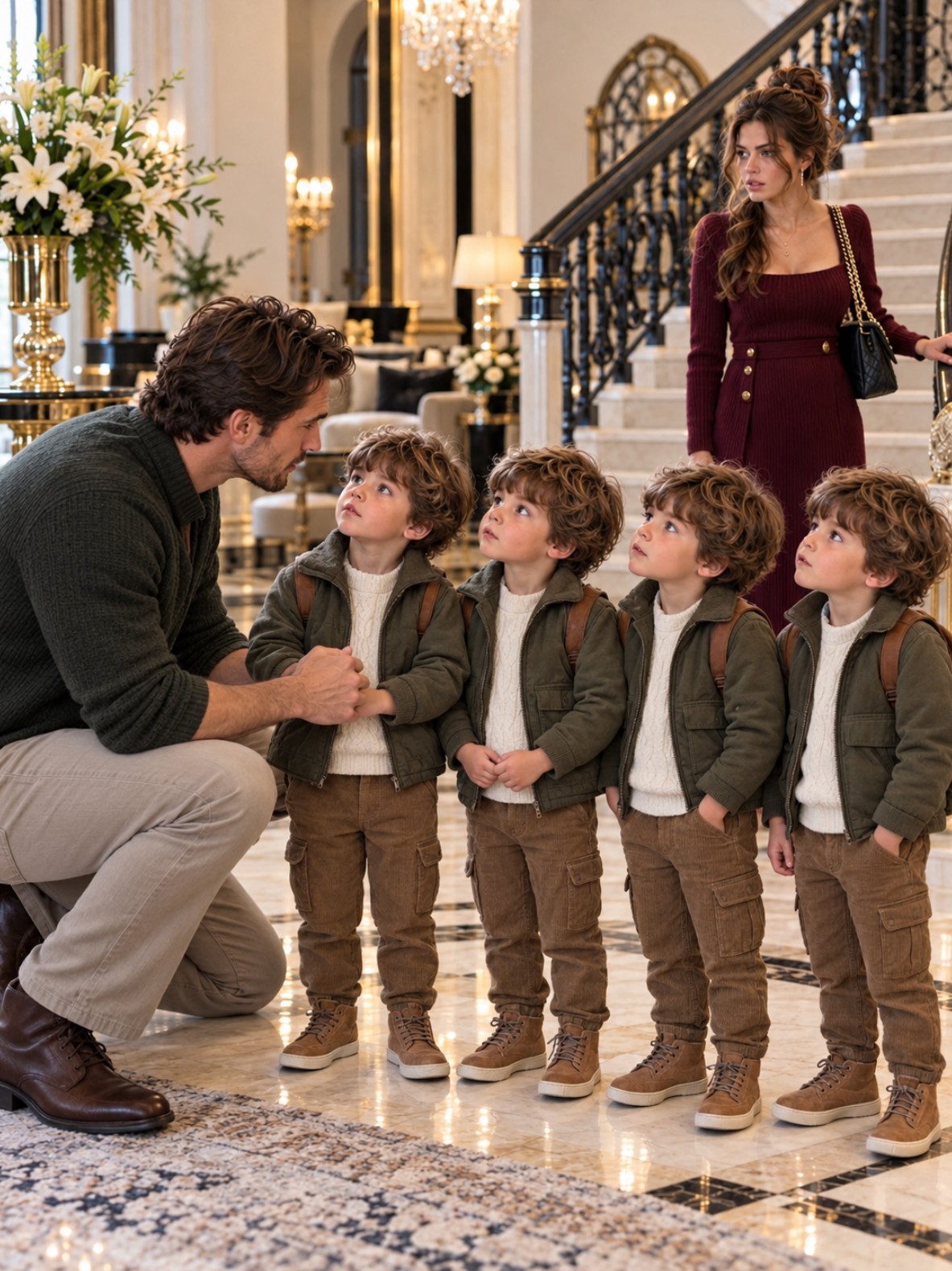
Then I found an old message from my own mother: “Never contact me again.” I called off the engagement that same night, but a $4 million transfer exposed a secret far more horrifying than I could have imagined.
Part 1:
At 7:30 p.m., I was supposed to propose to Blair Whitmore in front of nearly 150 guests. But at 6:42 p.m., I was locked inside the bathroom of a Manhattan restaurant, staring at four six-year-old boys who looked exactly like me.
They were wearing navy-blue sweaters and arguing about who had spent the longest washing his hands. One of them absentmindedly rubbed the back of his neck with his left hand.
I stopped breathing for a moment.
I had done the exact same thing since I was a little boy.
“How old are you?” I asked.
The tallest boy answered without the slightest fear.
“Six.”
The number hit me like a punch to the chest. It brought back a memory I had spent years trying to bury.
Six years earlier, I had been in love with a woman named Lauren Ferris.
Ours had never been some elegant affair between two powerful families. Lauren was an interior designer and the daughter of a Charleston antiques restorer. She was independent, brutally honest, and completely unfamiliar with the power games played by the Ashfords, my family.
She was the only woman I had ever considered giving up the family business empire for.
She was also the woman who had disappeared from my life without saying goodbye.
Suddenly, a woman’s voice came from the hallway.
“Mason! Henry! Theo! Wyatt! Does it take a committee meeting to get out of the bathroom?”
I knew that voice.
The boys opened the door, and Lauren appeared on the other side.
For several seconds, neither of us moved.
She had changed. She was thinner, her hair was pulled back, and there was a strange calmness in her eyes. But she still pressed her lips together when she was nervous, just as she had always done.
The moment she saw me, all the color drained from her face.
Wyatt, the youngest of the four boys, looked at me, then turned toward his mother.
“Mom, why does this man look like the man in the picture in your box?”
Lauren closed her eyes.
“Wyatt…”
“The picture from the beach,” he continued. “The one where you’re hugging him.”
The other three boys immediately started comparing our faces.
“He has Mason’s nose,” Henry said.
“No,” Theo protested. “Mason has his own nose.”
I felt as if the floor had disappeared beneath my feet.
“Lauren.”
She quickly gathered the boys’ coats.
“We’re leaving.”
“Are they mine?”
She stopped moving.
“Not here.”
“Then just tell me one thing. Are they my sons?”
Tears filled her eyes, but when she spoke, her voice remained steady.
“You have no right to show up after six years and start asking questions as if you’ve been looking for us all this time.”
I stared at her in disbelief.
“Looking for you? You’re the one who disappeared!”
Her expression changed.
“Is that what they told you?”
Before I could answer, she took the boys by their hands.
Mason turned to look at me.
“Mom… is he our father?”
Lauren didn’t answer.
She didn’t need to.
Her silence told me more than words ever could.
At that moment, my phone started vibrating in my pocket.
My mother.
Blair.
My uncle Walter.
The event planner.
At the Ashford family estate in Greenwich, nearly 150 guests were waiting for me. Photographers, business executives, retired politicians, and friends of both families had gathered to celebrate my engagement. A diamond ring sat inside a velvet box, worth more than most people’s homes.
I slipped my hand into my pocket and touched the box.
Then I watched Lauren walk away with four boys who had my eyes, my gestures, and even my way of walking.
At 7:02 p.m., I called Blair.
“I’m not coming.”
Silence followed.
“What does that mean?”
“Cancel the celebration.”
“Carter, both our families are here.”
“I know.”
“Is there another woman?”
I looked through the window and watched Lauren buckle the boys into a car.
“Yes.”
Blair was silent for several seconds.
“Lauren Ferris.”
A chill ran down my spine.
“How do you know that name?”
Her answer was worse than anything I could have imagined.
“Because everyone in your family knows it.”
That night, I realized something that changed everything I thought I knew about my past.
Perhaps Lauren had never abandoned me.
Perhaps someone very close to me had spent six years making sure that both of us believed the exact opposite.
And if four boys really were my sons, then I had just discovered that the family I thought I understood had stolen six years of their lives from me.
But I had no idea how deep the lie went.
Part 2:
I arrived at Lauren’s house in Brooklyn without bodyguards, lawyers, or expensive gifts.
I hadn’t even brought the velvet ring box. For once, I didn’t want money or status to speak for me.
Before I could knock, Lauren came outside and closed the door behind her.
“You are not going to barge in there and turn their lives upside down,” she warned me.
“I just need the truth.”
She stood a few feet away, keeping her distance.
I swallowed hard and asked the question again.
“Are all four of them mine?”
This time, she answered.
“Yes.”
One word. That was all it took to bring six years of my life crashing down around me.
Lauren explained that she had discovered she was pregnant two weeks after leaving me. At nine weeks, she learned she was expecting four babies.
“I tried to come back,” she said. “I came to New York because I wanted to talk to you.”
“You never came.”
“I did, Carter. Your mother met with me.”
My stomach tightened.
For six years, I had believed a simple story. Lauren had accepted $4 million to disappear from my life. There was a bank transfer to her father’s former company, a signed agreement, and a letter in which she supposedly explained that she didn’t want to raise a family inside the Ashford world.
I had believed every word of it.
Lauren looked at me as if she couldn’t believe what she was hearing.
“I never received that money. And I never signed any agreement.”
I stood there, struggling to process her words.
For years, I had thought she had chosen money over me. Now she was telling me that the money had never been hers and that the agreement I had trusted was a lie.
That same night, I returned to the Ashford family residence.
My mother, Constance, was sitting in the living room with Walter, my late father’s brother.
Neither of them looked surprised to see me.
“Did you know Lauren was pregnant?” I demanded.
My mother immediately tried to deny it.
But then I said the boys’ names.
“Mason. Henry. Theo. Wyatt.”
The room fell silent.
That silence told me everything.
“We didn’t know there were four,” she finally admitted.
I felt sick.
Lauren had returned to New York while pregnant and had asked to see me. My own mother had stood between us.
She had told Lauren that if I left the family business group, I would lose my position, my shares, and a large part of my fortune.
Then she had made an even crueler threat.
If Lauren tried to use the pregnancy to pull me away from the Ashford family, we had enough lawyers, money, and influence to drag her into a custody battle.
Lauren had been only 26 years old. She had recently lost her father, and she was facing the prospect of raising four babies without the man she loved.
She had been frightened and alone.
So she had run.
But the betrayal went much deeper than I had imagined.
The $4 million transfer had passed through the old design company belonging to Lauren’s father. It had remained there for only 48 hours before moving through several shell companies and eventually returning to a financial structure controlled by my mother.
The money had been arranged to make it look as if Lauren had accepted payment to leave me.
The letter was fake, too.
A later forensic handwriting analysis confirmed that the signature had been forged.
I stared at my mother.
“You made me believe she sold me for money.”
Constance lifted her chin.
“I did what I thought was necessary to protect this family.”
“Protect it from what? Four innocent children?”
She didn’t answer.
I left before I said something I could never take back.
Then I returned to Lauren’s house with the evidence.
When I showed her what I had discovered, she began to cry.
“So you thought I sold you for money,” she whispered.
“Yes.”
She wiped her face.
“And I thought you knew you had children and simply didn’t want to meet them.”
I looked up at her.
She went inside and returned with an old phone.
“When the babies were two months old, I sent photographs to your mother,” she explained.
The pictures showed four tiny babies lying in blankets. Lauren had written messages explaining how difficult the first weeks had been.
Mason had been hospitalized because of a breathing complication. Henry barely slept. Theo struggled to gain weight. Wyatt cried for hours at a time.
She had never asked my mother for money.
She had only wanted me to know that my children existed.
Lauren opened the old messages and showed me the reply she had received.
“Carter knows the situation. He has decided not to have contact. Don’t write again.”
I had to sit down.
I had never seen those photographs. I had never read those messages. I had never known my sons had been born.
For six years, I had believed Lauren had abandoned me, while she had spent those same years believing I had rejected our children.
And my mother had made sure neither of us ever learned the truth.
“I never saw this,” I whispered.
“I know that now,” Lauren replied. “But back then, I had to believe it.”
My mind immediately filled with plans. Lawyers. Criminal charges. Public accusations. I wanted everyone to know what my mother had done.
But Lauren stopped me before I could turn my anger into another war.
“Our children are not going to become pieces in another family battle.”
I looked at her.
She was right.
The boys had already lost six years with their father. They didn’t deserve to spend the rest of their childhood caught between two powerful families fighting over who had the right to control their lives.
“Then tell me what I can do,” I said.
Lauren took a long time to answer.
“Nothing spectacular. Show up. Follow through. Listen. And accept that being their biological father doesn’t mean you’re already their dad.”
I nodded, even though I didn’t fully understand what she meant yet.
I had thought discovering the truth would be the hardest part.
I was wrong.
Confronting my entire family was nothing compared to the challenge of earning a place in the lives of four little boys who had grown up believing their father didn’t want them.
And this time, there would be no money, power, or family name that could make them trust me.
I would have to earn that trust one day at a time.
Part 3:
Lauren’s first step was to consult a child psychologist in Manhattan named Dr. Marlene Sutter.
I went into the meeting expecting her to give me some kind of formula that would help me make up for the lost years as quickly as possible.
Dr. Sutter destroyed that idea in less than ten minutes.
“You can’t get six years back,” she told me.
I sat quietly, unsure what to say.
“But you can build the next ones,” she added.
That Saturday, Lauren and I prepared to talk to the boys together.
She spoke to them first while I waited at a nearby coffee shop. I stared at my phone, wondering what four six-year-olds would think of a father who had suddenly appeared in their lives.
Then a message arrived.
“You can come.”
I walked to Lauren’s house and found all four boys sitting on the couch.
Mason had his arms crossed.
Henry looked as though he had been crying.
Theo was holding a notebook.
Wyatt was eating cookies.
Mason asked the first question.
“Mom says you’re our father.”
“Yes,” I answered.
“Did you know we existed?”
“No.”
“Why not?”
I had promised myself that I wouldn’t burden four six-year-olds with every mistake the adults in their lives had made.
“Because some people kept your mother and me from talking to each other. When you’re older, you’ll understand more about what happened.”
Mason frowned.
“I don’t like that answer.”
“Neither do I.”
Henry looked down at his hands before asking his question in an almost inaudible voice.
“Are you going to disappear again?”
That question hurt more than any accusation could have.
“No.”
He raised his eyes to mine.
“Are you sure?”
I took a deep breath.
“I can’t promise that I’ll never make a mistake. But I can promise that I won’t disappear without telling you where I am.”
Theo raised his hand.
“I want a DNA test.”
Lauren sighed.
“Theo, this isn’t school.”
“I want data,” he insisted.
For the first time that morning, I almost smiled.
“All right. We’ll do it.”
Wyatt finished his cookie and looked at me thoughtfully.
“Are you rich?”
“Wyatt…”
“You said we could ask questions, Mom.”
Lauren shook her head, but I answered him anyway.
“Yes.”
“A lot?”
“Quite a bit.”
He considered that for a moment.
“More than Batman?”
I decided that correcting his understanding of wealth could wait.
We arranged the DNA test, and the results confirmed with virtually absolute certainty that I was the biological father of all four boys.
Theo studied the report carefully before finally accepting it.
“Okay,” he said.
I stared at him.
“Is that it?”
“Now we have data.”
That was how my new life began.
There were no mansions handed over to the boys. No private vacations the following week. No expensive gifts meant to buy their affection.
Instead, there were two-hour afternoons.
Games in the park.
Homework.
Snacks.
Arguments over video games.
I began learning the little things that made each boy different.
Mason needed a small night-light to fall asleep.
Henry liked to draw whenever he felt worried.
Theo asked so many questions that he could exhaust an entire room full of adults.
Wyatt turned every room into an experiment.
One afternoon, I found Wyatt trying to put cereal inside a toaster.
“What exactly are you doing?” I asked.
“Theo said heat transforms matter.”
I stared at the toaster.
“That doesn’t mean you can transform breakfast into a house fire.”
I immediately unplugged it.
Wyatt looked at me with deep disappointment.
“Dad ruined it.”
I froze.
Dad.
He had called me Dad.
Wyatt continued talking as if nothing unusual had happened, but I could barely hear him anymore.
I walked into the bathroom, closed the door, and sat on the edge of the bathtub. Then I cried for several minutes.
It wasn’t because of the toaster or the cereal.
It was because one of my sons had called me Dad without hesitation, even though I had missed the first six years of his life.
I never demanded that the other three use that word.
Henry needed months before he felt comfortable saying it.
Theo initially saved it for moments when he wanted something.
Mason took almost a year.
Eventually, I understood what Lauren had meant when she told me that being their biological father didn’t automatically make me their dad.
Fatherhood didn’t begin with a genetic test.
It began with showing up on Tuesday after showing up on Monday.
It meant being there even when nobody thanked me. It meant remembering what mattered to them, keeping my promises, and accepting that trust couldn’t be rushed.
Meanwhile, the Ashford family was beginning to fall apart.
My mother demanded to meet her grandchildren.
I refused.
“They’re my family,” she argued.
“Being related to them doesn’t give you automatic access to their lives.”
“I’m their grandmother!”
“And you’re also the person who kept their father from knowing they existed.”
She threatened to involve lawyers.
This time, I was ready.
I placed copies of the fraudulent bank transfer, the handwriting analysis, and the messages sent to Lauren on the table.
“Go ahead,” I told her. “But if you do, all of this stops being private.”
For the first time, my mother seemed to understand that I was serious.
She had spent decades believing that money, influence, and the Ashford name could solve every problem. She had never expected those same things to become useless against her own son.
My uncle Walter reacted differently.
He asked Lauren if he could apologize for his part in what had happened.
She refused.
Walter accepted her decision without arguing or trying to persuade her.
For me, that small difference said everything.
Walter was beginning to understand that asking for forgiveness didn’t mean someone was obligated to grant it. My mother, on the other hand, still confused being part of a family with having ownership over it.
Blair also deserved a conversation.
Three days after I canceled the proposal, she came to see me.
She didn’t shout or cry. She simply sat across from me and asked a question.
“Do you love her?”
I took too long to answer.
Blair gave me a sad smile.
“That’s answer enough.”
“I don’t know who Lauren is now,” I admitted.
“That isn’t what I asked.”
I looked down at my hands.
“I never stopped loving her in a way that could become something more.”
Blair nodded slowly.
She also admitted that she had agreed to our future marriage because the union between the Whitmore and Ashford families looked perfect on paper.
“We were going to marry last names, not people,” she said.
I had no answer to that.
Blair left without making a scene. In time, she established her own investment firm, far away from her father’s decisions, and we maintained a cordial relationship.
Lauren, however, didn’t come back to me.
Not at first.
For almost two years, we were simply the parents of the same four children.
I began therapy and started examining the life I had built.
For years, I had justified my decisions by telling myself that I was protecting the family business. I had accepted questionable practices because that was how things had always been done.
Now I started making changes.
I sold my stakes in businesses I could no longer defend. I shut down operations that weren’t transparent and stopped using the Ashford name as an excuse to avoid responsibility for my choices.
Lauren eventually learned about the changes through the business press.
When we spoke about it, she looked at me carefully.
“Don’t change your life to impress me.”
“I’m not doing it for you.”
She frowned.
“Then why are you doing it?”
“I’m doing it for them. And for me.”
I didn’t ask her to reward me for changing. I didn’t expect her to fall back in love with me simply because I was trying to become a better man.
I kept showing up for the boys.
And that was exactly what slowly began to convince her.
The first time Lauren and I kissed again was after Mason broke his arm while playing soccer.
It wasn’t a serious injury, but Lauren spent several hours terrified. Even after the doctors confirmed that Mason would recover, she couldn’t stop thinking about everything that might have gone wrong.
When we returned home from the hospital, the boys were exhausted and eventually fell asleep.
Lauren stayed in the kitchen with me.
“I know he’s fine,” she said quietly. “But for a few seconds, I thought about everything that could have happened.”
I moved closer and put my arms around her.
She didn’t pull away.
When she raised her face, we both knew what was about to happen.
We kissed.
It lasted only a few seconds before she stepped back.
“We can’t pretend six years disappeared,” she told me.
“I don’t want to.”
“And I’m not going to step into your family again.”
“Then don’t step in.”
She stared at me, confused.
I took her hands.
“Let’s build our own.”
We didn’t get back together immediately.
There were conditions, and I understood why every single one mattered.
Lauren would not give up her home.
There would be no security detail following her without her permission.
My mother would have no contact with the boys unless they wanted it.
We would make educational decisions together.
And I would never demand that the boys change their surname from Ferris.
For the first time in my life, I truly understood something I should have learned years earlier.
Loving someone didn’t give me the right to control the conditions under which that person felt safe.
If Lauren was ever going to trust me again, she needed to know that I respected her independence and her boundaries.
So I respected them.
And slowly, we began building a life that belonged to us.
Part 4:
By the time the boys were nine, our family had found a rhythm that felt natural.
We weren’t perfect, but we were happy.
Then one afternoon, Mason discovered some old photographs.
He was looking through them when he suddenly asked Lauren and me a question.
“Does Dad have a mom?”
Lauren and I exchanged a glance.
We both knew the time had come.
We sat down with the boys and explained what had happened in a way they could understand.
We told them that their grandmother had made terrible decisions because she believed she was protecting her family. Those decisions had kept their parents apart for years, and they had prevented me from knowing my own children.
We didn’t give the boys every painful detail, but we didn’t lie to them either.
Mason listened carefully before asking his next question.
“Is she sorry?”
Neither Lauren nor I knew how to answer that.
My mother had expressed regret about the consequences of her actions, but it was difficult to know whether she truly understood the damage she had caused.
After discussing it with Lauren, we agreed to allow Constance one visit.
Just one.
She arrived without gifts because I had specifically asked her not to bring any. This wasn’t an occasion for expensive toys or grand gestures. If she wanted a relationship with the boys, she would have to begin by treating them as people whose feelings mattered.
Mason spoke first.
“Why didn’t you let Dad get to know us?”
My mother took a deep breath.
“Because I thought I knew what was best for him.”
Mason didn’t look impressed.
“Did you?”
“No.”
“Then why did you decide for everyone?”
For decades, my mother had run boardrooms, negotiated deals, and made decisions that affected thousands of people. She had always been able to find a clever answer to a difficult question.
But this time, she couldn’t.
“Because I was too used to people doing what I said,” she finally admitted.
Henry looked at her with a different kind of sadness.
“Didn’t you love us?”
My mother began to cry.
“I didn’t know you,” she whispered.
Henry’s answer was simple.
“But you knew we existed.”
She lowered her head.
Nobody rushed to comfort her.
For once, she had to sit with the consequences of her own decisions without anyone trying to make the situation easier for her.
At the end of the visit, Mason looked at her and said something that seemed to hurt her more than anything else.
“I still don’t know if I want to call you Grandma.”
My mother wiped her eyes.
“That’s all right.”
It was probably the first time in her life that she had accepted a boundary without trying to negotiate it.
The relationship between Constance and the boys took years to develop. It was never perfect, and there were moments when old habits threatened to return.
But she slowly learned that being their grandmother didn’t mean she could make decisions for them.
She had to earn their trust, just as I had.
And the boys were free to decide how much of a relationship they wanted with her.
That was the difference between the family I had grown up in and the family Lauren and I were building.
In the Ashford world, power decided everything.
In our home, people did.
When the boys turned ten, Lauren and I were sitting together one afternoon while they played in the garden.
She looked at me thoughtfully.
“I think I could marry you now without feeling like I’m joining the Ashfords.”
I turned toward her.
“What does that mean?”
She smiled.
“It means we could build something of our own.”
I tried not to look too excited.
“Does that mean…?”
“Don’t make me say it twice.”
I laughed.
But I didn’t rush out to buy another expensive ring or arrange a celebration involving hundreds of guests.
This time, the proposal happened in our kitchen.
Mason had prepared a speech.
Henry had drawn a card.
Theo had written a list titled *Reasonable Risks of Marriage*.
And Wyatt had managed to lose the ring for forty minutes.
We eventually found it inside a cereal box.
Of course we did.
By the time I finally got down on one knee, Lauren was already crying from laughter.
I looked at her and took her hand.
“Years ago, I thought loving you meant asking you to come into my world,” I began. “Then I let other people decide which world I should keep. Now I don’t want you to come into mine. I want to keep building this one with you.”
Lauren looked at the four boys standing around us.
Then she looked at the ring.
“It’s quite a bit smaller than the one you bought for Blair.”
My eyes widened.
“You cannot say that now!”
Theo immediately joined the conversation.
“Technically, it has a better quality-to-price ratio.”
“Theo!”
Lauren burst out laughing.
Then she looked at me.
“Yes.”
I blinked.
“Yes to the ring?”
“Yes to you, you idiot.”
The boys cheered, and Wyatt immediately asked whether this meant there would be cake.
It was nothing like the engagement I had planned six years earlier.
There were no photographers, no politicians, no executives, and no carefully arranged speeches designed to impress powerful people.
There was just the woman I loved, four boys who had changed my life, and a kitchen full of laughter.
It was everything I had never known I needed.
Part 5:
Years passed, and our four sons grew into very different men.
Mason studied law.
Henry turned his talent for drawing into a career.
Theo went into scientific research.
Wyatt opened several restaurants. He insisted that the decision made perfect sense because, as he put it, “The family really started in one.”
None of them was forced to carry the Ashford name.
Some kept Ferris. Others chose to combine the two family names in their own way.
We let them decide for themselves.
I also stopped measuring success by the number of companies I acquired or the number of meetings I controlled.
Instead, I measured it by the dinners I arrived at on time, the games I never missed, and the nights when one of my children knew he could call me if he was sick, frightened, or simply needed someone to listen.
Those were the things that mattered.
Many years later, when Lauren and I celebrated thirty years of marriage, Wyatt reserved a private room at the same Manhattan restaurant where everything had begun.
All four of our sons were there.
Their partners had come, too, along with several grandchildren.
Even my old driver attended. He had retired years earlier, but Wyatt had insisted that he was part of the family story and deserved a place at the table.
We spent the evening eating, laughing, and remembering the strange way our family had come together.
Then Lauren mentioned a detail she had never told me before.
“That day, I had already decided to move back to Charleston with the boys,” she said.
I slowly put down my glass.
“When?”
“After lunch.”
I stared at her.
“So if I hadn’t met you at the restaurant, you would have left New York the next day?”
“Probably.”
Wyatt leaned back in his chair with a grin.
“The story just got a lot better.”
Theo immediately began calculating the odds of our paths crossing.
“Don’t even think about calculating probabilities,” I warned him.
Everyone laughed.
But I couldn’t stop thinking about what Lauren had said.
If I had arrived at the restaurant a little later, if the boys hadn’t needed the bathroom at that exact moment, or if Lauren had decided to leave a few minutes earlier, our lives might have taken a completely different path.
I might have married Blair.
Lauren might have returned to Charleston.
And four boys might have grown up without ever knowing their father.
Later that evening, I went to the bathroom.
As I washed my hands, I looked at my reflection in the mirror and remembered the thirty-seven-year-old man who had walked into that same room decades earlier.
I had carried a ring for a woman I didn’t truly love. I believed I controlled every detail of my life, from my future marriage to the family empire I was expected to inherit.
Then four little boys had walked into the bathroom, arguing among themselves.
This time, they were my grandsons.
One had Lauren’s eyes.
Another rubbed the back of his neck exactly the way I did.
One of them tugged at my sleeve.
“Grandpa, we can’t reach the soap.”
I smiled and helped them.
Nothing extraordinary happened.
There was only water, soap, and four small pairs of hands.
Yet I felt something in my chest that I couldn’t quite explain.
For years, I had believed that the most important moments in life had to be grand. I thought they required expensive celebrations, powerful connections, and carefully planned events.
But the moments I treasured most had never looked like that.
They were the quiet moments.
The ordinary ones.
The moments when someone needed me and I was there.
When I came out of the bathroom, Lauren was waiting by the door.
Just as she had been that first night.
“Did you take long?” she asked.
I stood there looking at her, remembering everything that had happened between us.
She understood immediately.
“Don’t start crying.”
“I’m not crying.”
“Your eyes are red.”
“Must be the soap.”
“Of course.”
The grandsons ran off toward the dining room, and Lauren took my hand.
For years, I had believed that a delay, a restaurant, and four little boys had changed my destiny.
Eventually, I understood something different.
Chance had only opened a door.
Everything that followed had been a choice.
Lauren had chosen to let me come closer, little by little, even though she had every reason to protect herself.
The boys had chosen what kind of relationship they wanted to build with me.
I had chosen to stop using power to demand what could only be earned with time, patience, and love.
Even my mother, much too late, had learned that loving a family didn’t mean owning it.
I never got back the first six years of my sons’ lives.
I didn’t see their first steps.
I didn’t hear their first words.
I wasn’t there for their first birthdays or their early childhood discoveries.
No amount of money could buy those days back.
For a long time, that truth hurt more than anything else.
But eventually, I learned something that decades of business deals, expensive possessions, and a powerful family name had never managed to teach me.
Lost time cannot be recovered.
You have to build new time.
You have to show up today, even when you regret yesterday.
You have to keep your promises, even when nobody is watching.
And you have to understand that love isn’t something you can demand simply because you have the right name, the right money, or the right bloodline.
It had all started in front of four sinks, when four boys who looked exactly like me walked out of a bathroom.
One of them had looked at his mother and asked why a stranger resembled the man she had hidden in an old photograph.
That night, I never got to propose to Blair.
I lost the alliance between two powerful families.
I uncovered a lie that had lasted six years.
And I found four sons I hadn’t even known existed.
But the greatest thing I gained wasn’t the chance to become a father.
It was the chance to become a better man.
Much later, I understood that it had been the best defeat of my entire life.
Because losing the life other people had designed for me was exactly what allowed me to begin building my own.
The End.
