
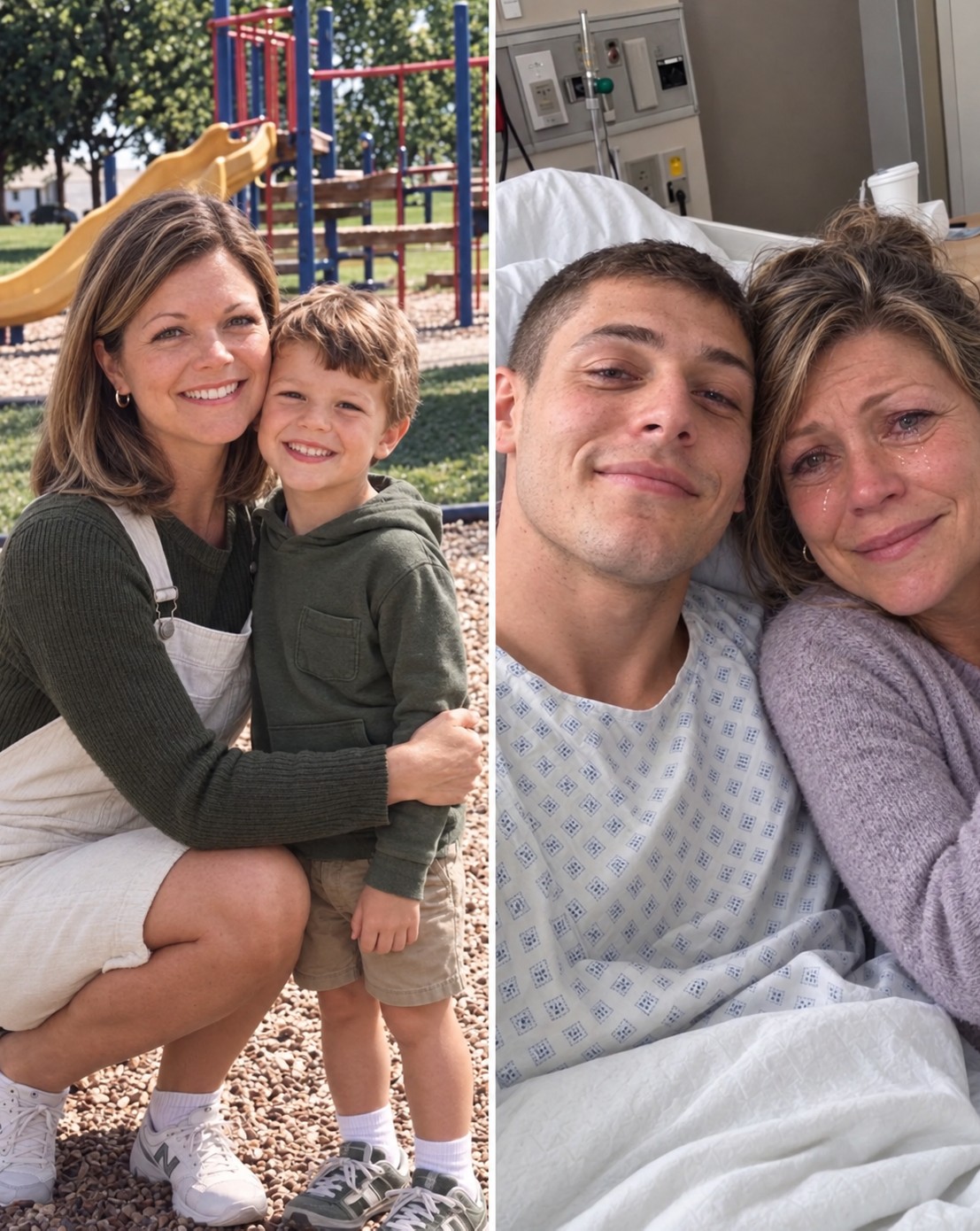
Part 1:
My husband died years ago, so I raised our son, Caleb, alone.
He was all I had left.
For nineteen years, it had been just the two of us. I watched him grow from a little boy who slept against my chest into a kind, creative young man who dreamed about building a life of his own.
A year earlier, Caleb had been perfectly healthy.
Then, one afternoon, everything changed.
He suddenly became dizzy.
Before I could reach him, he collapsed.
I rushed him to the hospital, terrified that something had happened to his heart. But the doctors quickly discovered that the problem was much more complicated.
There were tests.
Then more tests.
Then specialists.
For weeks, doctors searched for an answer while Caleb became weaker.
Finally, one doctor sat across from me with a serious expression.
He told me that Caleb had a rare, progressive neurological disease.
There was no cure.
I refused to accept it.
I sold my car.
I sold the family gold I had kept for years.
I spent almost everything I had on specialists, experimental treatments, medications, and anything else that gave me even the smallest reason to hope.
Nothing worked.
Caleb continued getting weaker.
I watched the boy I had raised alone slowly lose the strength in his body, and I couldn’t understand how I was supposed to lose him too.
I had already buried my husband.
Now I was being told that I might have to bury my son and be left with no one.
I had imagined Caleb growing older.
I had imagined him falling in love, getting married, and building a family of his own.
I wanted to become a grandmother.
I wanted to see him succeed.
Instead, I found myself sitting beside his hospital bed, wondering how much time we had left.
One evening, Caleb reached for my hand.
His fingers were weak, but his voice was calm.
“Mom, I want to do something useful.”
I looked at him through my tears.
“What do you mean?”
He swallowed.
“If I can, I want to donate my organs. Especially my heart. I want it to go to someone who needs it.”
I stared at him.
“Caleb, don’t talk like that.”
“Please, Mom.”
His eyes filled with tears.
“If I’m really going to heaven, let this be my last wish. I already talked to the doctor, and they said I can become an organ donor.”
I shook my head as tears rolled down my cheeks.
I wanted to tell him there would be another treatment.
Another doctor.
Another miracle.
But somewhere inside, I knew my son understood what I was still refusing to accept.
Eventually, I nodded.
“Okay,” I whispered. “I’ll respect your wish.”
Caleb smiled.
“Thank you, Mom.”
Not long afterward, Caleb died.
My world went silent.
His heart was donated through the transplant system and eventually went to an eighteen-year-old girl named Maya, who had been suffering from severe heart failure.
I didn’t know her.
I had never heard her name.
I didn’t even know where she lived.
At Caleb’s funeral, while I stood near his grave, a woman I had never seen before approached me.
She looked exhausted, as though she had barely slept in weeks.
“My daughter received your son’s heart,” she said.
I stared at her.
“My name is Sarah.”
Then she handed me a sealed envelope.
“He asked me to give you this.”
My hands immediately began to tremble.
I recognized Caleb’s handwriting.
I opened the envelope.
The first line stopped my heart.
“Mom, there’s something you need to know about her.”
Part 2:
Tears streamed down my face as I stared at the faint blue ink on the hospital paper.
My hands shook so badly that the sheet nearly slipped from my fingers.
I sat down on a wooden bench outside the chapel and took a deep breath.
Then I continued reading my son’s final words.
“Mom, there’s something you need to know about her.
“Her name is Maya. She’s eighteen, and she’s been in the cardiac ICU for months. I met her when I was still able to leave my room in my wheelchair.
“I saw her through the glass. She was sitting near the window, drawing pictures of the ocean.
“She had the softest smile I’d ever seen, but her heart was failing badly.
“The doctors said she might only have days left unless a suitable donor heart became available.
“I knew my own time was running out, Mom.
“My body was shutting down, but my heart was still strong.
“I asked the doctors whether my heart could possibly help someone like her. They explained that they couldn’t promise where my organs would go because the transplant system had strict rules and the final recipient was determined through the medical allocation process.
“But they told me there was a chance my heart could be suitable for someone on the waiting list.
“I didn’t tell you everything because I knew you would break down.
“I was afraid you would think another person was somehow taking me away from you.
“But Mom, she didn’t steal me from you.
“If my heart can help someone live, then a part of me gets to keep going.
“Please don’t be angry at her.
“If you ever meet her, be kind to her.
“Let my heart tell you how much I love you.”
I pressed the letter against my chest and sobbed.
For several minutes, I couldn’t speak.
Sarah sat down beside me.
She placed a gentle hand on my shoulder.
“Caleb wrote that letter before he died,” she whispered.
I looked at her.
“How long before?”
“Three days.”
“Why didn’t you give it to me earlier?”
Sarah’s eyes filled with tears.
“He asked me to wait until after the funeral. He didn’t want anything to take your attention away from saying goodbye to him.”
I wiped my face.
“Is she… is Maya okay?”
Sarah smiled through her tears.
“The surgery was successful. She’s recovering.”
She took a shaky breath.
“Her doctors say the new heart is working well.”
Then she looked at me.
“She wants to meet you.”
Two days later, I gathered every bit of courage I had and walked into the cardiology wing of the city hospital.
When I opened the door to Room 512, a young girl with long dark hair turned toward me.
She was pale and thin.
But her eyes were bright.
Alive.
The moment she saw me, her breath caught.
“Mrs. Vance?”
I couldn’t answer.
I slowly walked toward her bed.
Maya’s eyes filled with tears.
She reached for my hand.
Then she gently placed my hand over the center of her chest.
Underneath her hospital gown and the surgical bandages, I felt it.
Thump.
Thump.
Thump.
A strong, steady rhythm.
I knew that rhythm.
It was the same heartbeat I had listened to when Caleb was a baby sleeping against my chest.
The same heartbeat that had filled my home for nineteen years.
I broke down.
“He’s still here,” I whispered.
I sank into the chair beside her bed.
“My boy is still here.”
Maya wiped away a tear.
“He told me about you.”
I looked at her.
“He did?”
She nodded.
“He told me you sold almost everything you owned trying to save him.”
Her voice trembled.
“He said you were the bravest woman in the world.”
For the first time since Caleb died, I felt something other than grief.
I felt warmth.
For the next three months, Maya became a light in my dark world.
I visited her every week as she recovered.
I brought her home-cooked meals.
I helped her with physical therapy.
I listened while she talked about her dream of attending art school.
She loved painting oceans.
She loved drawing people.
And slowly, without either of us realizing it, she became part of my life.
Caring for Maya didn’t erase the pain of losing Caleb.
But it helped me survive it.
She was sweet, grateful, and full of life.
Yet after several months, something began bothering me.
It started with small details.
Things that didn’t seem important at first.
But together, they made me uncomfortable.
Something wasn’t adding up.
Part 3:
One afternoon, I was sitting in Maya’s room when I noticed an old leather-bound sketchbook inside her backpack.
She pulled it out and placed it beside her.
I saw the name written inside the cover.
Caleb Vance.
My heart stopped.
“Maya,” I said slowly. “Why do you have Caleb’s high school sketchbook?”
She froze.
For a moment, nervousness flashed across her face.
Then she smiled.
“Oh, that?”
She looked down at the sketchbook.
“Caleb gave it to me when we met in the hospital. He said he wanted me to have some of his old drawings.”
I stared at her.
I wanted to believe her.
But something felt wrong.
Caleb had always been protective of his artwork.
His old sketchbooks were private.
He rarely allowed anyone to look through them.
And I had never heard him mention giving one away.
Still, I said nothing.
I didn’t want to accuse a young woman who had just survived a life-threatening illness.
A week later, I went home and began cleaning Caleb’s bedroom.
I was finally preparing to donate some of his clothes.
It was painful, but I knew I couldn’t leave everything untouched forever.
While moving things from beneath his bed, I discovered something I had never seen before.
His private journal.
I sat on his bed and opened it.
The pages contained his thoughts from his final months.
He wrote about his pain.
He wrote about his fear.
He wrote about me.
He wrote about dying.
I turned page after page, searching for one name.
Maya.
Nothing.
There was no mention of her.
Not once.
I checked the entries from the time period when the letter claimed Caleb had met Maya.
Still nothing.
Then I found an entry dated October 12, exactly two weeks before his death.
I read it slowly.
“October 12: The doctor told me today that my heart is still healthy, even though my nervous system is failing. I told Mom I want to become an organ donor. I don’t know who will receive my heart. The transplant coordinator explained that the recipient is determined through the transplant system. I hope whoever receives it lives a long and happy life.”
I dropped the journal onto the floor.
My blood ran cold.
Caleb didn’t know who would receive his heart.
He had never written that he had chosen Maya.
He had never written that he had asked for his heart to go specifically to her.
And, according to the hospital records, donor and recipient identities were kept confidential.
So why did the letter make it sound as though Caleb had personally chosen Maya?
Why did it claim he had spent time talking to her?
Why did it say he knew exactly who would receive his heart?
I pulled the letter from my purse.
I placed it beside Caleb’s journal.
Then I studied the handwriting.
At first, it looked perfect.
But when I compared it carefully with Caleb’s journal, I noticed tiny differences.
The angle of the letters.
The way the “t” was crossed.
The loops in certain words.
My stomach twisted.
Someone had copied Caleb’s handwriting.
The letter was a forgery.
A nearly perfect forgery.
But still a forgery.
I stared at it in horror.
Who had written it?
Why?
And why had Sarah been given it?
I needed answers.
The next morning, I drove straight to the hospital.
I demanded to speak with Dr. Harrison, the senior physician who had been involved in Caleb’s case.
When I entered his office, I placed the forged letter and Caleb’s journal on his desk.
“My son didn’t write this,” I said.
My voice shook.
“He didn’t choose Maya. He didn’t know who would receive his heart. So who wrote this letter?”
Dr. Harrison stared at the papers.
His face became pale.
He slowly removed his glasses.
“Mrs. Vance,” he said quietly, “I was hoping you would never have to find out about this.”
My heart pounded.
“What truth?”
He leaned forward.
“Sarah didn’t forge that letter.”
I stared at him.
“She didn’t?”
“No.”
“Then who did?”
Dr. Harrison closed his eyes.
“The person who forged that letter was your late husband.”
My entire body went cold.
“Richard?”
Dr. Harrison nodded.
Part 4:
The room became completely silent.
I couldn’t breathe.
“Richard died seven years ago,” I whispered.
Dr. Harrison looked at me with sadness.
“Richard didn’t die seven years ago.”
I stared at him.
“What?”
“He faked his death.”
The words made no sense.
My husband had been dead for seven years.
I had mourned him.
I had buried the life we once had.
I had raised Caleb alone because I believed Richard was gone.
But now Dr. Harrison was telling me that everything I believed was a lie.
He opened a confidential file.
“Seven years ago, Richard was involved in serious financial crimes,” he explained. “He had been stealing money from the company he worked for. When federal investigators began closing in, he staged a drowning accident.”
My hands began trembling.
“He created the appearance that he had died,” Dr. Harrison continued. “Then he disappeared under a false identity.”
I could barely speak.
“You’re telling me my husband has been alive this entire time?”
“Yes.”
My chest tightened.
“But why?”
Dr. Harrison hesitated.
“There is something else you need to know.”
He turned another page.
“Before Richard disappeared, he had another child with another woman.”
I stared at him.
“Another child?”
Dr. Harrison nodded.
“Maya.”
I stopped breathing.
“Maya is Richard’s biological daughter.”
I covered my mouth.
“And Caleb?”
“Caleb was Richard’s biological son.”
The room seemed to tilt around me.
Maya was Caleb’s half-sister.
The girl whose chest carried my son’s heart was the daughter of the husband I believed had died seven years earlier.
I began crying.
“How?”
Dr. Harrison explained what had happened.
About nineteen months earlier, Richard had secretly returned to the United States under his false identity.
Maya had developed severe heart failure and was desperately waiting for a transplant.
Her blood and tissue characteristics made finding a suitable donor difficult.
Richard learned that she was seriously ill.
Then, several months later, he discovered that Caleb—the son he had abandoned—was suffering from a terminal neurological disease.
Richard realized that Caleb could potentially be a suitable donor for Maya.
But there was one enormous problem.
He couldn’t simply step forward.
Legally, he was supposed to be dead.
He was also wanted by federal authorities.
If he revealed himself, he would be arrested.
“So what did he do?” I whispered.
Dr. Harrison looked down.
“Richard found someone inside the hospital system who was willing to break the rules.”
My stomach turned.
“He obtained confidential information about Maya’s medical status and Caleb’s condition. He also learned that Maya was already high on the transplant waiting list.”
“But he couldn’t legally choose her,” I said.
“No,” Dr. Harrison replied. “He couldn’t. The transplant allocation system determined the recipient based on medical criteria. Richard could not simply order that Caleb’s heart be given to Maya.”
I looked at the letter.
“Then how did Maya get his heart?”
“Because she was medically eligible and already waiting for a suitable organ. Caleb’s heart became available at the right time, and the transplant system selected her through the normal medical process.”
I swallowed hard.
“So Richard didn’t officially choose her.”
“No.”
“Then why did he forge the letter?”
Dr. Harrison looked at me sadly.
“Because he knew what would happen after Caleb died.”
I stared at him.
“He knew you would be alone.”
My eyes filled with tears.
“He had watched you and Caleb from a distance for years. He knew how close you were. He knew that losing Caleb might destroy you.”
“Then why didn’t he come home?”
Dr. Harrison didn’t answer immediately.
“Fear,” he finally said. “Shame. And the consequences of what he had done.”
I felt anger rising inside me.
“He abandoned us.”
“Yes.”
“He let me believe he was dead.”
“Yes.”
“He let me raise his son alone.”
Dr. Harrison lowered his eyes.
“Yes.”
I looked down at the letter.
“So he forged this?”
“He copied Caleb’s handwriting and created a story that made it appear Caleb had personally chosen Maya.”
“Why?”
“Because Richard wanted you to meet her.”
I stared at him.
“He wanted his daughter to have someone who loved her.”
I shook my head.
“And he wanted me to have someone after Caleb died.”
Dr. Harrison nodded.
“He believed that if you met Maya, you might find a reason to keep living.”
I couldn’t stop the tears.
The whole thing was cruel.
It was selfish.
It was unforgivable.
But somehow, buried beneath all the lies, there had also been something painfully human.
Richard had abandoned us.
Yet in the end, he had tried to make sure neither of us was completely alone.
Then I remembered something.
“Where is he?”
Dr. Harrison looked down at the desk.
“He turned himself in.”
I stared at him.
“When?”
“Two weeks after Maya’s transplant. Once he knew she was recovering and that you had met her, he surrendered to federal authorities.”
My voice broke.
“Where is he now?”
“He is serving a fifteen-year federal sentence in Ohio.”
I sat there without moving.
Richard was alive.
My husband was alive.
The man I had mourned for seven years was sitting in prison.
And my son was dead.
His heart was beating inside Richard’s daughter.
Nothing about my life made sense anymore.
Part 5:
Two days later, I walked into Maya’s room at the rehabilitation center.
She was sitting beside the window, painting.
The canvas showed a bright blue ocean beneath a warm afternoon sky.
When she heard the door open, she turned around.
Her face immediately brightened.
“Mrs. Vance!”
She smiled.
I smiled back.
But inside, I felt completely different.
Maya didn’t know.
She didn’t know her father was alive.
She didn’t know he was in prison.
She didn’t know that the boy whose heart was beating inside her chest was her biological half-brother.
To her, Caleb was a stranger who had saved her life.
And I was simply the mother of that stranger.
I walked over and sat beside her easel.
For a moment, I simply watched her paint.
Then I looked at her more carefully than I ever had before.
Her dark hair.
Her eyes.
The shape of her hands.
The line of her jaw.
How had I never noticed it?
She had Richard’s eyes.
And somehow, she had Caleb’s creative spirit.
I thought about Richard sitting inside a federal prison.
I felt anger rise inside me.
He had lied to me.
He had abandoned me.
He had made me believe I was a widow.
He had left me to raise our son alone.
And even after all those years, he had continued manipulating our lives from the shadows.
Part of me wanted to hate him forever.
But then I looked at Maya.
She was alive.
She was healthy.
She was painting.
She had dreams.
And beneath her chest, my son’s heart was beating.
Strong.
Steady.
Alive.
I knew something else, too.
If Richard hadn’t secretly returned and learned about Maya’s condition, perhaps none of this would have happened.
But that didn’t mean his lies were right.
It didn’t erase what he had done.
It didn’t erase the years of pain.
It simply meant that something good had somehow survived all the terrible things he had done.
Maya suddenly put down her paintbrush.
“Mrs. Vance?”
I looked at her.
“Are you okay?”
I nodded.
“You look like you’re somewhere far away.”
I reached for her hand.
Her hand was warm.
Alive.
I squeezed it gently.
“I was just thinking about how lucky I am.”
She smiled.
“Lucky?”
“Yes.”
I looked into her eyes.
“To have met you.”
Maya’s eyes filled with tears.
“I feel lucky too.”
She leaned toward me.
Then she placed her hand over her heart.
“I’ll never forget what Caleb gave me.”
Neither would I.
I would never forget my son.
I would never forget the sound of his heartbeat.
And I would never forget the terrible secret that brought Maya into my life.
I chose not to tell Maya about Richard.
Not yet.
She had already survived more than any eighteen-year-old should have had to endure.
Some truths were too heavy to place on a young heart that had finally been given a second chance.
So I kept the secret.
For now.
I looked at Maya’s painting.
A bright ocean.
A clear sky.
A new beginning.
Caleb’s heart was beating inside her.
His legacy was alive.
And as I held Maya’s hand beneath the afternoon sun, I realized something I had never believed possible.
Out of all the lies, loss, and heartbreak, something beautiful had survived.
I had lost my son.
But I had found someone who carried a part of him with her.
And somehow, after all those years of believing I had no one left, I was no longer alone.
The End.
