
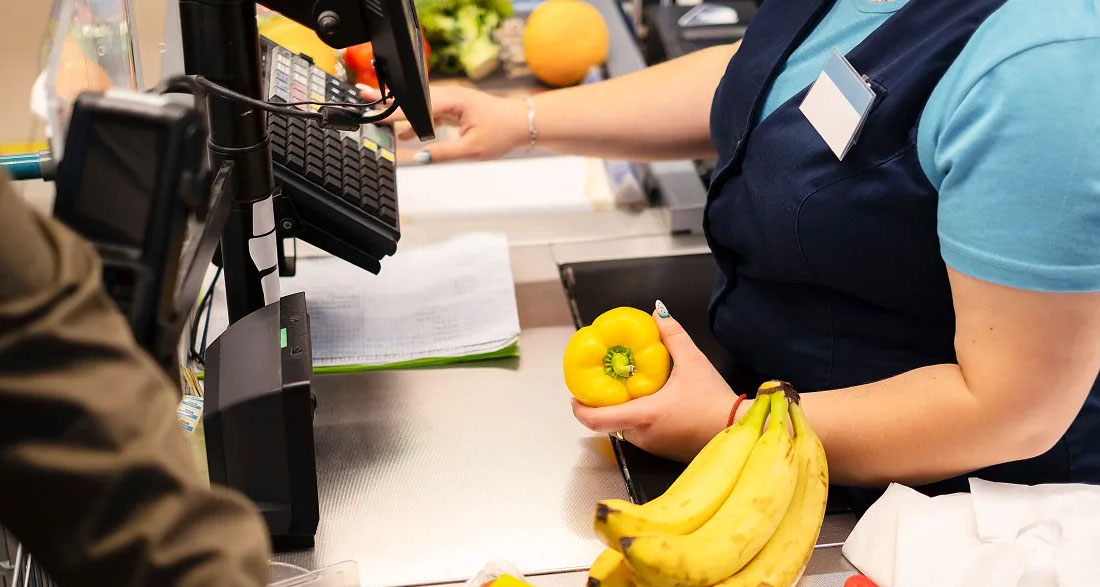
She strutted into my checkout line wrapped in a cloud of perfume so strong it almost choked me, and she carried herself with an air of entitlement that could crush anyone in her path.
I could see it in her eyes—she was ready to tear me down just for the crime of wearing a name tag.
What she didn’t know was that her cruelty would spark the moment that would change my life forever.
I’ve been working as a cashier at the same grocery store for two years now. It wasn’t the life I pictured for myself. I didn’t expect to lose my husband and suddenly be a single parent to two kids.
I didn’t expect strangers’ words to weigh so heavily on my shoulders. And I definitely didn’t expect that one night, someone would walk in and turn everything around.
Before all this, I had an office job. It was stable, decent pay, benefits. But when the company downsized, I was let go with nothing but a cardboard box and a fake smile from my boss. No warning. Just, “Best of luck.”
My husband, Tommy, worked construction. He’d come home covered in cement dust, his boots heavy on the floor, his hands rough from steel beams and bricks.
Yet he always walked through the door with a grin and kissed my forehead like it was the best part of his day.
Every night, without fail, he’d ask me the same thing: “So, what did you burn for dinner tonight?” And we’d laugh, because that was our little tradition.
But then came the accident. It was raining. The ground gave out. One phone call shattered my world. He never came home that night—he never would again.
The funeral blurred by, but the silence afterward was the hardest. The walls of our home echoed with the emptiness of his laugh.
I had to learn how to breathe again, to keep living when my insides felt hollow. I promised myself the kids wouldn’t see me fall apart, even when I could barely stand.
We stayed in our little ranch house—the one we’d bought together in our mid-20s.
The paint is peeling, the back door squeaks like it’s complaining every time we open it, and the toaster only works if you press it down with a spoon.
But it’s ours. It smells of old coffee every morning, and it holds the only memories we have left of him.
When I lost the office job, I was desperate. No savings. No degree. Just two kids with hungry bellies. I swallowed my pride and took the cashier job. Register four became my world.
It’s not glamorous, but it’s honest. That job has kept Jacob in cleats, Lila in braces, and the lights on in our home. I’ve paid for peanut butter sandwiches and school field trips one beep of the scanner at a time.
The rhythm becomes second nature. The beep, the crinkle of bags, the smile you glue to your face even when your back aches and your feet scream.
You learn the regulars—like Mrs. Dorsey with her endless cans of cat food even though she doesn’t own a cat, or Carl who insists on bagging everything himself and hands out gum like it’s Christmas. And, of course, you learn who to avoid.
That Thursday night was slow. The kind of shift where the clock seems to crawl backward.
I cleaned the belt three times, restocked gift cards, and daydreamed about reheating mac and cheese at home. My mom was watching the kids, so at least they were safe and warm.
At exactly 9:42 p.m., the doors slid open with a hiss—and in walked trouble.
She looked like she owned the whole world. Perfect hair. Nails sharp enough to cut glass.
A long black coat with gold buttons, heels clicking like gunfire across the floor, and sunglasses perched on her face even though it was pitch black outside.
Her perfume hit me before her cart did—thick, sharp, suffocating. She tossed a loaf of artisan bread onto the belt like it had personally offended her.
Before I could even say hello, she looked me up and down.
“Wow,” she said, dragging the word like she was chewing on it. “Do they let anyone work here now?”
My throat went dry, but I plastered on the practiced cashier smile—the one that hides everything.
“Good evening, ma’am. Did you find everything you were looking for?”
She laughed, a sharp, cruel sound.
“Oh, I found everything just fine,” she said. “I’m just surprised you managed to find your way to work today.”
A young couple with a stroller joined the line behind her. The woman shot me a sympathetic glance, but—like always—no one spoke up.
I kept scanning. My hands were steady, though my cheeks burned. Then I picked up her last item, a bottle of expensive imported wine. That’s when she sneered loud enough for the whole line to hear:
“Careful, sweetheart. That bottle costs more than your whole paycheck.”
The couple behind her shifted uncomfortably. My ears rang. My chest burned. But I kept my voice calm.
“That’ll be $212.58,” I said flatly.
She smirked and flicked her platinum card across the counter with two fingers like she was feeding an animal. “Try not to mess this up,” she hissed.
I swiped the card. The screen blinked red. DECLINED.
Her smirk vanished.
“What did you do?” she snapped. “Don’t play dumb. People like you always find a way to steal!”
I tried again. Declined. She slammed her hand on the counter, making the wine bottle wobble dangerously.
“Get me your manager. NOW!”
I paged Dave, our tired but kind manager. He arrived quickly, asking, “What seems to be the problem, ma’am?”
“She humiliated me!” the woman screeched, pointing at me like a villain in a play. “She’s incompetent, and your machines are trash!”
Before Dave could answer, a calm voice spoke up from the line.
“Actually, sir,” a man said evenly, “the cameras caught everything. You might want to check before making any decisions.”
Everyone froze. His voice cracked the tension like lightning. Dave nodded and left to check the footage. The woman muttered angrily under her breath, her nails tapping impatiently on the counter.
When Dave returned, his whole demeanor changed. “Ma’am,” he said firmly, “I reviewed the footage and records. I’m going to have to ask you to leave.”
She exploded. “What? You can’t do that! I’m a paying customer!”
“Your card was declined,” I whispered, too tired to care anymore.
Her face turned crimson. She screamed about how she had plenty of money and how she’d make us regret this. Security escorted her out as she yelled about being an “important customer.”
Silence filled the store. Then the man who had spoken up stepped forward, placing a chocolate bar on the belt.
“You look like you’ve had a long day,” he said softly, with a smile that didn’t pity—it understood. “Have something sweet on me.”
For the first time all night, I smiled.
I didn’t know it then, but I’d see him again.
Days later, he returned. Each visit came with kindness—sometimes a note, sometimes a sunflower, sometimes just a smile.
My coworkers teased me, but I didn’t care. After years of emptiness, those small gestures felt like sunlight creeping back into my life.
Eventually, he asked me to dinner. His name was Daniel. He listened when I talked about Tommy. He didn’t shrink away from my grief. He simply said, “He sounds like he was a good man.”
And he was.
But so is Daniel.
Dinner turned into another dinner, then coffee, then Sunday mornings together. He met my kids, who adored him instantly.
Months later, laughter returned to my home. My children started calling him “Dan,” like he’d always been there.
Now, a year later, we’re engaged. The house feels warm again. I’m helping Daniel with his small contracting business. We’re building a new life together—steady, patient, and filled with love.
And sometimes, when I’m at register four, I think back to that night. To the cruel woman with the sharp nails and poisonous perfume.
If not for her, Daniel and I might never have crossed paths.
Life is strange that way. From one awful moment came the best thing that’s ever happened to me.
