
Part 1:
Five years after my husband and our three sons died in a terrible storm, my youngest daughter woke me in the middle of the night and whispered, “Mom, I don’t think the police told us the truth about Dad.”
Then she handed me a note she had found hidden inside her teddy bear.
The moment I recognized my husband’s handwriting, my hands began to shake.
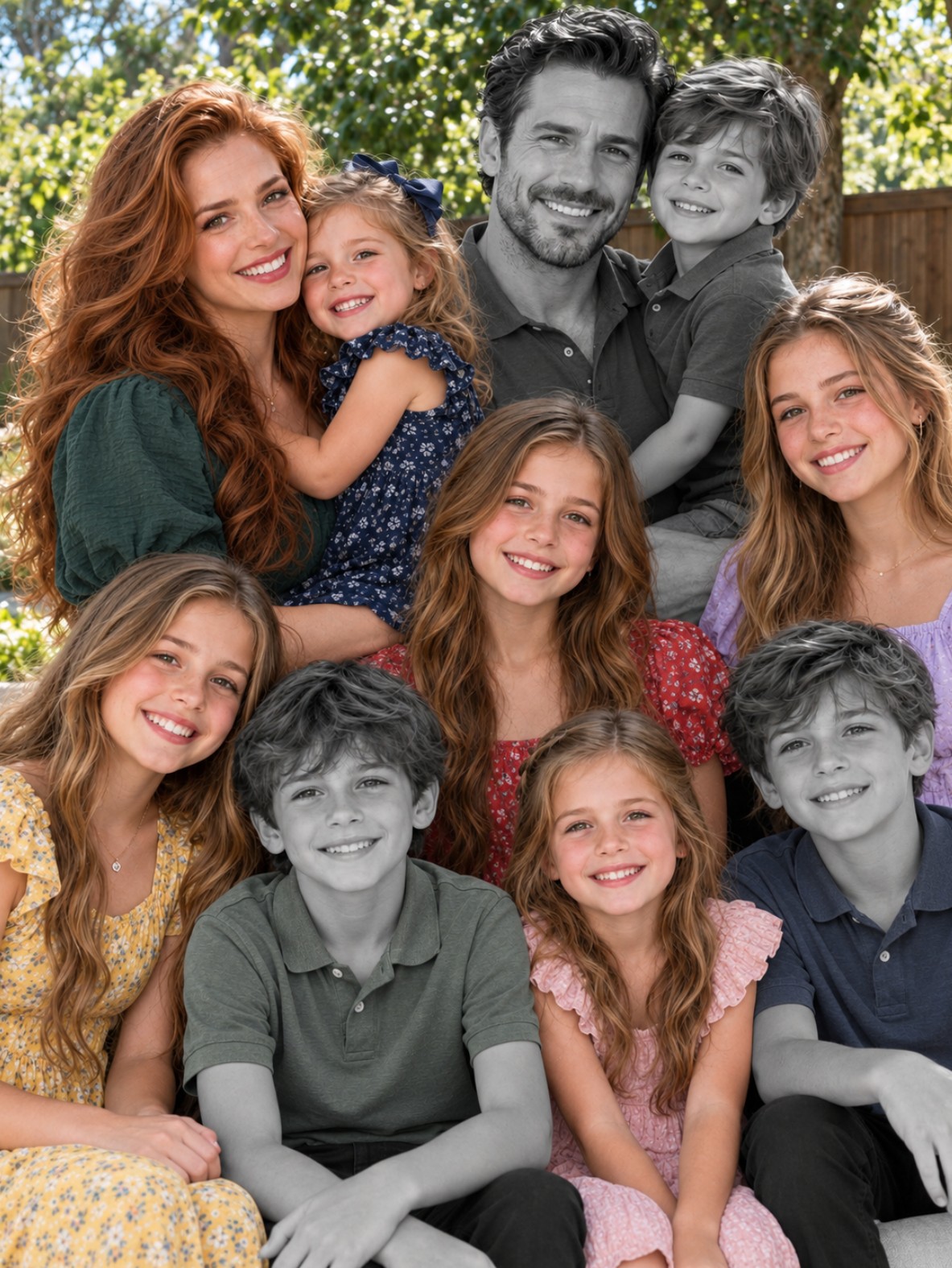
My husband, Brandon, and I had eight children together: five daughters and three sons. Our home in Cedar Falls was always noisy and chaotic, but I loved every single moment of our busy family life.
There was never a dull day in our house. Someone was always laughing, arguing, asking for help with homework, or running through the hallway. Brandon often joked that our home was less like a house and more like a train station during rush hour.
I used to laugh and tell him that he was the one who had helped create all that chaos.
And he would always pull me into his arms and say, “Would you have it any other way, Hannah?”
“No,” I would answer. “Not for anything in the world.”
When our boys were old enough, Brandon started taking them on father-and-son weekends to an old family cabin tucked away in the woods near Pine Ridge. It quickly became their favorite tradition.
They would leave on Friday afternoon with fishing rods, sleeping bags, snacks, and enough excitement to fill the entire truck. They would return on Sunday evening covered in mud, smelling of campfire smoke, and bursting with stories about their adventures.
Brandon loved those trips because they gave him time to teach the boys things he believed every young man should know. He showed them how to build a fire, recognize animal tracks, fish in the creek, and find their way through the woods without relying on a phone or a map.
“They need to know how to take care of themselves,” he would tell me.
“And who is going to teach them how to clean the mud out of your truck?” I would tease.
He would grin. “That sounds like a job for their mother.”
I would pretend to be offended, and he would kiss my forehead before heading out the door.
Those weekends were some of the happiest times of our family’s life.
But five years ago, one of those trips ended in a tragedy that destroyed everything I thought I knew about the world.
Brandon took our three sons to the cabin as he had done so many times before. They planned to spend the weekend fishing, hiking, and enjoying the quiet mountain air before returning home on Sunday.
They never made it back to us.
A violent storm swept through the mountains that evening, bringing heavy rain, powerful winds, and widespread destruction. According to the official police report, Brandon lost control of his truck on an extremely slippery section of road. The vehicle left the road and plunged down a steep embankment into a rocky ravine.
The report stated that none of the four had survived.
I was completely broken.
For weeks, I could barely get out of bed. My daughters cried themselves to sleep, and I spent countless nights sitting alone in the boys’ bedroom, holding their clothes against my chest and begging God to give me one more chance to hear their voices.
But even in the middle of my grief, something about the accident never made sense to me.
Brandon knew those mountain roads better than almost anyone in the county. He had driven them for years, and he was an extraordinarily careful driver whenever our children were in the vehicle.
He checked the weather forecast before every trip. He inspected his truck regularly and never took unnecessary risks with the boys.
How could a man who knew those roads so well make such a catastrophic mistake on a route he traveled almost every month?
I asked those questions during the first few days after the accident, but the answers never brought me any comfort.
Our close family friend, Deputy Austin Parker, had been among the first emergency responders to reach the scene. He came to my house shortly after the police identified the wreckage and sat with me in our living room while I struggled to understand what had happened.
His eyes were red, and his voice trembled as he explained the official findings.
“The storm was terrible, Hannah,” he told me. “Visibility was almost nonexistent, and the road was dangerously slick. From what we know so far, Brandon appears to have been driving too fast for the conditions.”
“But he knows that road,” I protested through my tears. “He has driven it hundreds of times. He would never take a risk with our boys in the truck.”
Austin reached across the table and took my hand.
“I know how much he loved those boys,” he said softly. “There is nothing suspicious about what happened up there, Hannah. It was a horrible, tragic accident.”
I wanted so desperately to believe him because the alternative was too painful to consider.
After the funeral, Austin became one of our family’s greatest sources of daily support and comfort.
He helped me navigate the endless piles of legal paperwork. He checked on my grieving daughters, repaired broken things around the house, and stayed beside me whenever I felt as though I could no longer keep going.
When our wooden gate broke during a winter storm, he came over with his tools and fixed it without asking for anything in return.
When my daughters struggled with their homework, he sat at the kitchen table and helped them understand their assignments.
When Daisy began having terrible nightmares about the accident, Austin checked every lock and window in the house to reassure her that she was safe.
He was always there.
Over the next few years, our close friendship slowly transformed into a quiet romance.
At first, I felt guilty whenever I caught myself smiling at one of his jokes or looking forward to his visits. I worried that allowing myself to love another man meant I was somehow betraying Brandon’s memory.
Austin never pressured me.
“I don’t want you to feel that you have to give me anything,” he told me one evening. “You’ve been through more pain than anyone should have to endure. If all you ever need from me is friendship, I’ll accept that.”
His patience gradually helped me open my heart again.
Eventually, I allowed myself to believe that I might still have a future filled with love, laughter, and happiness.
For the first time since losing Brandon and my boys, I genuinely thought I was learning how to live again.
Yet one person in our family never stopped asking questions about that terrible night.
My youngest daughter, Daisy.
She had been only six years old when her father and brothers died. Now, at eleven, she was old enough to recognize that some of the answers she had received over the years did not make sense.
She wanted to understand what had really happened on that dark mountain road.
Every time she brought it up, I struggled to give her a proper answer because the memories were still too painful.
“Mom, why didn’t Dad call us before the accident?” she asked once.
“I don’t think he had time, sweetheart.”
“But what if he did have time and something stopped him?”
I would pull her into my arms and tell her that we might never know every detail of what happened.
I thought I was protecting her by refusing to explore those questions.
Then, late one night, Daisy appeared beside my bed while clutching the worn brown teddy bear she had owned since she was a baby.
“Mom, please wake up,” she whispered, gently nudging my shoulder. “I found something inside Barnaby.”
I sat up immediately, my heart beginning to race.
“Sweetheart, what’s wrong?”
I switched on the bedside lamp.
Her face was terribly pale, and her small hands were trembling.
“Barnaby ripped open under his arm while I was sleeping,” she explained. “I was trying to fix the stuffing, and I felt something hard hidden deep inside him.”
She held out a small, tightly folded piece of paper.
“It was buried in the cotton, Mom. I think Dad put it there a long time ago.”
My heart began pounding against my ribs.
“Why do you think your father hid it there?”
“Because I recognize his handwriting,” Daisy whispered.
I took the paper from her hands and unfolded it with trembling fingers.
She was right.
It was unmistakably Brandon’s handwriting.
His letters always leaned slightly to the right, and he pressed so hard when writing that his pen left deep marks on the paper.
When I saw his familiar handwriting, a cold chill ran down my spine.
I had not seen a message written by him in five years.
Daisy watched my face carefully.
“Mom, does this mean Dad knew something bad was going to happen to him?”
I couldn’t answer her immediately.
Whatever Brandon had been trying to tell me, he had deliberately hidden the message somewhere inside our home, where someone in our family might eventually discover it.
After five long years of believing his death was simply a tragic accident, I suddenly had a terrible feeling that the truth might be far more complicated.
And I was afraid to discover what that truth might be.
Part 2:
For several long seconds, neither Daisy nor I made a sound.
The bedroom seemed to hold its breath around us. Rain tapped against the window, and the old wooden frame of the house creaked in the darkness.
Downstairs, the refrigerator hummed steadily.
I looked down at the paper again, hoping I had somehow misunderstood what I was seeing.
But the handwriting was unmistakable.
Brandon’s letters had always leaned slightly to the right, as though they were rushing to keep up with his thoughts. He also pressed hard enough that his pen left deep impressions on the paper beneath it.
The note was brief, consisting of only a few carefully written lines.
“Hannah, if you are reading this, then something terrible happened before I could make it back home to you. Please do not trust the first police report under any circumstances. Ask about the blue survey marker near the north bend of the trail. Austin knows exactly where it is located. I am so sorry I kept this secret from you, but I was only trying to protect you and our precious children. Love, Brandon.”
My fingers went numb.
Daisy stared at me, her eyes wide with fear.
“What does the rest of the letter say, Mom?”
I folded the paper quickly, struggling to keep my voice steady.
“It says your father loved us more than anything in the world.”
“I know he loved us,” she replied. “But that’s not all it says, is it?”
I looked at her.
“Does it tell us what really happened to Dad and my brothers?”
I saw the little girl who had lost so much of her childhood in a single night. Her dark hair was tangled from sleep, and one sleeve of her oversized pajamas had slipped over her small hand. She clutched the damaged teddy bear against her chest as though it were the last piece of her father she had left.
She deserved to know the truth.
But she also deserved to be protected from a burden that adults should have been carrying.
“I don’t know all the answers yet, Daisy,” I told her gently. “There are some things I need to figure out first.”
Her eyes dropped to the note.
“Is Deputy Parker part of this secret?”
Her question struck me harder than I expected.
I sat on the edge of the mattress and pulled her closer.
“Why would you ask that about Austin?”
“Because Dad wrote his name on the paper.”
“He only said that Austin knows where a certain marker is located,” I explained. “That doesn’t mean he did anything wrong.”
Daisy lowered her eyes to the carpet.
“You trust him a lot, don’t you?”
“I do trust him,” I admitted.
“Do you trust him more than you trust Dad?”
Her words were innocent, but they struck a deep emotional wound I had spent five years trying to protect.
“No, sweetheart,” I said softly. “I have never stopped trusting your father.”
That wasn’t entirely true.
I had never stopped loving Brandon or missing his laughter around the house. But grief had changed the way I remembered those terrible days.
Sometimes, I remembered his bright smile and felt certain that the accident had been a cruel twist of fate.
Other times, I replayed the official reports in my mind and remembered how confidently Austin had explained everything.
I had never doubted Brandon’s love for us.
But I had begun to doubt my own judgment.
Daisy reached out and took my trembling hand.
“Are you scared right now, Mom?”
I squeezed her fingers.
“A little bit, sweetheart. I’m not going to lie to you.”
“Should we call the police?”
“Not tonight.”
“Why not? If Dad left us a message, shouldn’t we tell them?”
“Because I need to understand what this means before I share it with anyone else.”
She frowned.
“But if Dad was trying to warn us—”
“He was trying to protect us,” I interrupted gently. “I want to understand his warning before I put you girls in the middle of something we don’t understand.”
Daisy glanced toward the dark hallway.
“Does Austin know we found the note?”
“No.”
“Are we going to tell him tomorrow?”
I stared at the folded paper in my palm.
Brandon had placed the note inside a tiny plastic sleeve to protect it from moisture. He had folded it carefully and pushed it deep into the teddy bear’s stuffing.
He hadn’t hidden it carelessly.
He had planned it.
And he had specifically mentioned Austin.
“I honestly don’t know what we should do yet,” I admitted.
Daisy leaned her head against my shoulder.
We sat together in silence while the rain continued to fall outside.
Eventually, she whispered, “I just don’t want you to be all alone again, Mom.”
The tenderness in her voice nearly brought me to tears.
“I’m never alone,” I reassured her, kissing the top of her head. “I have you and your sisters.”
“And we have Austin, too.”
I looked down at the note.
“Yes,” I replied cautiously. “We have Austin.”
For the first time in five years, I wondered whether being supported by someone and being protected by them were actually two different things.
After I tucked Daisy back into her bed, I knew I wouldn’t be sleeping again that night.
I went downstairs, placed Brandon’s note on the kitchen table beneath the yellow overhead light, and read it over and over.
“Please do not trust the first police report.”
The first report had been compiled after Austin arrived at the scene and gave his initial account of the accident. He had been one of the first officers to reach the wreckage, and he had called me from the station with a gentle voice to explain the terrible news.
He had assured me that the storm made the mountain pass dangerous and that Brandon must have been driving too fast for the wet conditions.
Austin had held my shaking hands at the funeral when I could barely stand.
He had sat at this very kitchen table for hours while my daughters cried, helping them with their math homework because I was too numb to understand even the simplest problems.
When Daisy suffered from nightmares, he came over to check the windows and locks.
When I couldn’t bear to enter my sons’ empty bedroom, he helped me pack their clothes and toys into storage boxes.
He had been patient when I was distant, understanding when I lashed out in anger, and kind when I had nothing left to give.
Over time, he had become much more than a family friend.
How could someone who had stood so loyally beside us be connected to the terrifying secret Brandon had left behind?
At six o’clock that morning, I slipped the note into an envelope, placed it in my coat pocket, and made a decision.
I needed to visit the north bend of the trail myself.
The old mountain road was less than an hour from our house, but I had deliberately avoided that area since the accident. We had sold the family cabin two years earlier because my daughters could no longer bear to visit it.
I had convinced myself that I had no reason to return.
Now I had one.
After making sure my daughters were awake, dressed, and safely on their way to school, I prepared to leave. Daisy begged to come with me, but I insisted on going alone.
“I promise I’ll call you before lunch,” I told her.
She looked worried but eventually agreed.
I drove through the cold gray morning, gripping the steering wheel so tightly that my knuckles turned white.
The mountain peaks loomed ahead beneath a thick blanket of clouds. Their steep slopes were covered with jagged rocks and evergreen trees, the same landscape Brandon had known like the back of his hand.
He used to recognize every twist in the trail by pointing out unusual rock formations or bends in the creek.
When we first started dating, he loved teasing me about my terrible sense of direction.
“You rely way too much on street signs, Hannah,” he once joked.
“That’s because street signs are actually meant to guide people, Brandon.”
“I don’t need signs. I always know exactly where I’m going.”
“You say that every time we drive into the woods.”
“And have I ever gotten us lost?”
I had smiled at him.
“You’re completely impossible.”
“And yet you still married me.”
“Yes, despite all the warning signs.”
He had laughed and kissed my cheek.
The memory brought a brief smile to my face, but it disappeared as I approached the turnoff leading into the mountains.
The road had been repaved since the accident. Fresh black asphalt stood out against the older gray sections, and a heavy steel guardrail now protected the sharpest curve from the steep drop into the ravine below.
I pulled onto the gravel shoulder, turned off the engine, and stepped into the cold mountain air.
The air smelled of damp earth and pine needles. Far below, I could hear water rushing through the ravine.
I checked the printed map I had brought from home.
The blue survey marker wasn’t shown on any public road map, but I remembered Brandon once mentioning that county surveyors used colored metal posts to identify locations requiring structural inspections.
I walked slowly along the roadside, counting the turns and studying the trees.
For nearly twenty minutes, I found nothing.
Then I noticed a small smear of faded blue paint on the trunk of an old oak tree.
It was almost hidden beneath moss and dark water stains.
I climbed carefully over the guardrail and began descending the muddy slope. Branches caught on my coat, and the ground slipped beneath my boots.
More than once, I considered turning back.
Then I saw it.
A short metal post stood firmly in the soil beside a cluster of large boulders. Its blue paint had faded, but the color was still visible beneath the dirt.
I knelt beside it and examined the post.
There were no markings, dates, or hidden compartments.
But buried directly behind it, partially covered by fallen leaves, was a small rusted metal box.
My heart began pounding.
The box was small enough to hold in one hand. Its lid was secured with a thick wire loop that had loosened over the years.
I pulled the wire free and opened it.
Inside were a folded topographic map, a brass key, and a small photograph.
The moment I saw the picture, my throat tightened.
It showed Brandon standing beside our family truck outside the cabin. He rested one arm casually on the hood while our three young boys stood in front of him, grinning at the camera.
The photograph had been taken only a few weeks before the accident.
I remembered that day clearly. The boys had been arguing about who would get to sit in the front passenger seat on the drive home, and Brandon had jokingly threatened to make them all walk if they didn’t stop.
I turned the photograph over.
On the back, Brandon had written a date and a mysterious code.
“October 14 — 7:30 p.m. — C-17.”
The date was exactly three days before the fatal crash.
Underneath it, in smaller handwriting, were four words.
“Check the maintenance log.”
Suddenly, a sharp snap echoed from the woods above me.
I scrambled to my feet and looked toward the road.
For one breathless moment, I expected to see someone standing there, watching me.
But the shoulder was empty.
Mist drifted between the trees, and a crow suddenly flew from a high branch with a harsh cry.
I quickly put the photograph, map, and brass key into my bag and hurried back up the slope.
Only after I had locked all four doors of my car did I allow myself to breathe normally.
The key had a code stamped into its side.
C-17.
I had no idea what it opened.
Instead of driving home, I went to the public library in downtown Cedar Falls.
The historical archives were kept in a quiet room behind the main reading area. The head librarian, Mrs. Gable, greeted me warmly.
“Hannah, it’s wonderful to see you,” she said. “It’s been far too long.”
“I’m looking for county road maintenance records from five years ago,” I explained.
Her smile faded slightly.
“Which area are you researching?”
“The north mountain pass near the old cabin trail.”
She studied my face but didn’t ask any personal questions.
“Those records should be in our digital county database,” she said. “Some of the older files require special access, though.”
“Please, I really need to see them.”
For nearly an hour, we searched through spreadsheets, inspection reports, and work orders.
Eventually, the code C-17 appeared in a series of maintenance logs from the weeks before the accident.
It referred to a drainage culvert near the sharp north bend of the trail.
The first inspection had classified the culvert as clear and fully operational.
A second inspection, filed two weeks later, reported that the drain was severely blocked and required urgent repairs.
Three days after that, the records stated that the work had been completed.
But one important detail was missing.
The contractor identification number.
Mrs. Gable frowned at the screen.
“That’s very unusual.”
“Why?”
“Every official county work order must identify the maintenance crew or contractor responsible for the work. Leaving that field blank violates standard procedure.”
“Could it be a clerical mistake?”
“It’s possible,” she admitted. “But given how strictly the county handles liability, I would consider it highly unusual.”
I stared at the screen, trying to understand what I was seeing.
“Are there any other records connected to this location?”
Mrs. Gable searched through several archived folders and found a formal complaint filed by a former county road surveyor named Samuel Vance.
The complaint stated that the north bend had suffered from repeated drainage failures, causing dangerous water accumulation on the road. It also reported that someone had deliberately removed a temporary hazard warning sign before the necessary repairs were completed.
A chill swept over me.
“Who filed this complaint?”
“Samuel Vance. He worked as a senior inspector for the county engineering department for more than ten years.”
“Does he still work there?”
She checked the personnel database.
“No. He resigned suddenly five years ago, around the time of your husband’s accident.”
“Do you have his contact information?”
Mrs. Gable hesitated before standing.
“Let me check our old physical directories.”
A few minutes later, she returned with a small piece of paper containing a handwritten telephone number.
“Samuel moved out of state shortly after leaving his job,” she explained. “This is the last number he left with us.”
I copied it into my phone.
Before leaving, I turned back to her.
“Mrs. Gable, do you remember whether Brandon ever came here to look at these records?”
She nodded slowly.
“Yes. He came in about a week before the storm.”
My stomach tightened.
“Why didn’t anyone tell me?”
“I assumed he had discussed it with you,” she said apologetically. “He asked to see the same drainage logs you looked at today. He seemed deeply troubled by something he had discovered.”
“Did he say what he was looking for?”
“Not exactly. But I remember him asking whether we kept public records about private access roads in the mountains.”
“Private access roads?”
“There’s an old service road behind the north bend. It leads to a utility shed and a communications relay tower. Most residents don’t even know it exists.”
“Would Brandon have known about it?”
Mrs. Gable gave me a sad smile.
“Hannah, your husband spent his entire life in those woods. He knew those trails better than anyone in town.”
I thanked her and headed home.
When I pulled into my driveway, I was startled to see Austin standing on my front porch.
He straightened as soon as my car stopped. His face showed a mixture of relief and anxiety.
Austin had always been good at reading my expressions, so I forced myself to remain calm as I walked toward him.
“You haven’t answered any of my messages today,” he said.
“I was busy running errands at the library.”
“Is everything all right?”
The question sounded perfectly normal coming from the man who had supported my family for five years.
I placed my bag beside the front door.
“Why wouldn’t everything be all right?”
“You seemed distant this morning. You look shaken.”
“I had a rough night and couldn’t sleep.”
“Did something happen with Daisy?”
“No. She’s fine.”
He studied me.
“Then what’s bothering you?”
I wanted to pull Brandon’s note from my pocket and demand answers.
Why had my husband written Austin’s name?
Why had he warned me not to trust the police report?
And what did Austin know about the blue survey marker?
But something held me back.
Perhaps it was the suspicious timing of his visit.
Perhaps it was the hidden metal box I had discovered in the ravine.
Or perhaps it was the realization that everything I had believed for five years might be wrong.
“I had a strange dream about Brandon last night,” I lied.
“About the accident?”
“Yes.”
That part, at least, was true.
Austin reached for my hand, but my fingers stiffened beneath his touch.
“You should have called me,” he said gently. “You know I would have come over immediately.”
“I know.”
“No matter what’s troubling you, Hannah, you don’t have to carry it alone.”
I looked into his familiar face.
He wore the dark green canvas jacket I had bought him for his birthday two years earlier. A small tear near the cuff had been repaired by my own hands while he sat at my kitchen table drinking coffee.
Five years of memories couldn’t simply disappear because of a single note.
But that note couldn’t be ignored, either.
“Austin, were you personally involved in investigating Brandon’s crash five years ago?”
He blinked in surprise.
“Of course. I was one of the first officers at the scene.”
“Did you write the final official report?”
“No. I gave my witness statement, but Detective Miller handled the actual case file.”
“Did you know about the drainage problem near the north bend?”
A tiny flicker of tension crossed his face.
It disappeared almost immediately, but I noticed it.
“What makes you ask that out of nowhere?”
“I’m trying to understand what happened to my family.”
“Hannah, it was a tragic accident caused by a terrible storm.”
“That’s what you’ve always told me.”
“Because that’s what the physical evidence showed.”
“Was there a blue survey marker near the bend?”
His hand suddenly loosened around mine.
For the first time since I had known him, Austin looked genuinely rattled.
“Why are you asking about a survey marker?”
I slowly pulled my hand away.
He noticed the movement, and his expression fell.
“Hannah, what exactly did you find today?”
“I don’t know everything I’ve found yet.”
He took a small step backward.
“That mountain trail is dangerous. You shouldn’t have gone up there alone.”
“I handled myself.”
“You could have slipped down the embankment.”
“But I didn’t.”
“I’m not trying to control you.”
“I never said you were.”
His face showed genuine hurt.
“You’re looking at me as if I’m a stranger.”
“I’m trying to figure out whether I ever truly knew you at all.”
The words escaped before I could stop them.
Austin went completely still.
“If you believe I did something terrible to your family, ask me directly,” he said quietly.
“Did you?”
His face drained of color.
“Did I what?”
“Did you do something wrong back then?”
He glanced toward the street.
“We shouldn’t discuss this on the porch.”
“Why not?”
“Your daughters will be home from school soon. They shouldn’t have to see us arguing.”
“We aren’t arguing, Austin.”
“No,” he said softly. “Not yet.”
He picked up his car keys.
“Where are you going?”
“To the police station. I need to request the original archived case file.”
“Can you still access it after all these years?”
“I can submit a formal request.”
“Will you actually do it?”
He stopped at the bottom of the steps and looked back at me.
“I should have done it five years ago.”
Then he walked to his cruiser and drove away.
I stood on the porch, watching his car disappear around the corner.
My heart was heavy with anxiety.
Later that evening, after my daughters were settled downstairs, I took out the number Mrs. Gable had given me and called Samuel Vance.
The phone rang four times before a tired voice answered.
“Hello?”
“Is this Samuel Vance?”
“Yes. Who’s calling?”
“My name is Hannah Bennett. I’m calling about the north mountain pass near Pine Ridge.”
The silence that followed was so long that I thought the call had dropped.
Finally, he spoke.
“Why are you asking me about that road after all these years, Mrs. Bennett?”
“Because my husband and my three sons died there five years ago.”
“I know who you are,” he admitted quietly.
My breath caught.
“Did you know my husband?”
“I met with Brandon twice. He came to me because he was investigating the drainage problem near the north bend.”
“What did he want to know?”
“He wanted to confirm whether the county had completed the required repairs to the culvert.”
“Had they?”
“No,” Samuel answered firmly. “The repairs were never completed.”
I gripped the phone.
“But the official records say the work was finished.”
“Then those records were deliberately altered.”
The room seemed to spin around me.
“Who altered them?”
“I don’t know exactly who changed the files. But someone in authority wanted that dangerous road to appear safe on paper.”
“Why would anyone do that?”
“Because heavy commercial trucks were regularly using an unpaved service trail behind the north bend. They were traveling through there late at night.”
“What kind of trucks?”
“I never got close enough to identify their cargo or company markings.”
“Did Brandon see them?”
“He told me he had seen bright headlights moving along the ridge several times. He suspected someone was illegally transporting heavy industrial equipment through the state forest.”
“What kind of equipment?”
“I honestly don’t know.”
“Why didn’t you report it to the police?”
“I did. I filed a formal complaint.”
“Did anyone investigate?”
“Deputy Parker came to my house personally.”
My pulse quickened.
“What did Austin say?”
“He told me I was mistaken. He claimed the lights belonged to routine county maintenance vehicles and advised me not to spread rumors.”
“Did he threaten you?”
“No. He was very polite. But he made it clear that he wanted me to drop the matter.”
“Did Brandon know you had spoken to Austin?”
“Yes.”
“Was Brandon afraid?”
“Not exactly. He was determined to uncover the truth.”
That sounded like my husband.
Brandon had never been reckless, but he had always refused to ignore something he believed was wrong.
“Did you give him any documents?”
“No. I didn’t have the physical records with me.”
“Did he mention a code? Something like C-17?”
Samuel gasped.
“Where did you hear that code?”
“I found it on the back of a photograph he hid near the road.”
“Then you found his blue marker.”
My mouth went dry.
“What marker?”
“The blue survey post. Brandon told me he planned to hide a key and some important evidence near it so that nobody would find them if his truck was searched.”
“Why did he hide them?”
“He said that if anything happened to him, his wife would be smart enough to find them.”
My eyes filled with tears.
That was exactly the kind of thing Brandon would have said.
“Did he believe someone was trying to hurt him?”
“I can’t say for certain. But during our last conversation, he told me he was taking his sons to the cabin for the weekend and planned to inspect the service trail himself.”
“Did he name anyone who might be involved?”
“No.”
“Did he mention Austin again?”
Samuel fell silent.
Finally, he answered.
“He told me Deputy Parker had been asking him a lot of questions.”
“What kind of questions?”
“Questions about what Brandon had seen on the mountain and whether he had told anyone else about his suspicions.”
My heart hammered against my chest.
“Did Brandon still trust Austin?”
“I don’t think he knew whom he could trust anymore.”
Samuel promised to mail me copies of the notes he had kept from that time, although he warned me that they might not provide definitive legal proof.
After we hung up, I sat alone in the dim kitchen for hours.
When my daughters came downstairs for dinner, I forced myself to smile. I cooked their favorite meal, listened to their stories about school, helped Daisy with her reading homework, and laughed when my eldest daughter shared a funny story.
I did everything I could to make them feel safe.
But beneath my calm exterior, fear and suspicion were tearing me apart.
Once the girls were asleep, I returned to the kitchen table and picked up Brandon’s note.
As I held the plastic sleeve beneath the lamp, I noticed something I had missed earlier.
The sleeve had a tight double fold at the bottom.
I carefully slid the paper out and smoothed it against the table.
There, faintly pressed into the paper in tiny pencil marks, were several additional lines that had been almost impossible to see in the dark bedroom.
I traced them with my fingertip.
“The brass key is not for the cabin or the truck.”
My breath caught.
Below that sentence was a street address on the industrial edge of Cedar Falls.
And beside it was a unit number.
C-17.
Part 3:
I read the address three times before I could fully understand what I was looking at.
The storage facility stood on the outskirts of Cedar Falls, behind an old feed mill and a lumber yard. I had driven past it hundreds of times without paying much attention.
It consisted of long rows of low metal buildings surrounded by a tall chain-link fence. Bright security lights illuminated the gravel driveways, and a small office stood near the entrance.
Unit C-17.
The brass key lay beside Brandon’s letter on the kitchen table.
I reached for it, then stopped.
Driving to an isolated storage facility in the middle of the night by myself felt reckless. But calling Austin and asking him to accompany me felt even worse.
I sat quietly for several minutes, listening to the peaceful sounds of my home.
Upstairs, my daughters were asleep. Daisy’s bedroom door was slightly open, allowing a narrow beam of light to spill across the hallway floor.
I considered waking my seventeen-year-old daughter, Chloe, and telling her what was happening.
But I quickly dismissed the idea. She was still young, and I refused to place this terrifying burden on her shoulders.
Instead, I pulled out my phone and called my sister, Paige.
She answered on the fourth ring, her voice thick with sleep.
“Hannah? Is everything okay?”
“Everyone is fine, Paige. Nobody is hurt.”
“People don’t call at eleven-thirty at night just to say everyone is fine,” she replied sharply.
“I really need a favor.”
“Are you in trouble?”
“I found something important connected to Brandon’s accident.”
A long pause followed.
“What kind of something?”
“I can’t explain everything over the phone. Can you come over?”
“I’m putting on my coat right now.”
Paige lived less than fifteen minutes away. She arrived wearing jeans, a heavy winter jacket, and the fiercely protective expression I knew so well.
She pulled me into a tight hug as soon as she stepped inside.
“Where are the girls?”
“Fast asleep upstairs.”
“Are you safe?”
“Yes.”
“Is Austin involved in whatever is happening?”
I instinctively lowered my eyes.
Paige noticed immediately.
“What on earth is going on, Hannah?”
I led her into the kitchen and showed her Brandon’s note, the brass key, and the handwritten address.
She read the message twice without speaking.
When she finished, she placed the paper carefully on the table.
“You’re planning to go to this storage unit tonight, aren’t you?”
“I think I have to.”
“Right now?”
“I don’t know what’s inside, and I’m terrified someone else might get there before I do.”
Paige leaned against the counter.
“Do you think Austin knows about this place?”
“I have no idea.”
“Did he ever have a key to your house?”
“He helped me repair things after Brandon died. I gave him a spare key for a while.”
“How long did he have it?”
“Until about a year ago.”
She looked at me with deep concern.
“Hannah, listen to yourself. You’re investigating whether the man you’ve been dating betrayed your family, but you’re still worried about protecting him.”
“I’m not protecting Austin.”
“Then who are you protecting?”
Her question cut straight through me.
I thought of Daisy finding the note inside her teddy bear. I thought of my four other daughters, who had spent five years grieving their father and brothers while gradually accepting Austin into their lives.
Whatever we discovered, the truth could shatter their world all over again.
“I’m trying not to destroy what’s left of our family’s peace before I know what really happened,” I admitted.
Paige’s expression softened.
“Protecting your family isn’t the same as shielding the wrong person.”
She picked up the brass key.
“I’m coming with you.”
“No, Paige. I don’t want to put you in danger.”
“You called me because you were afraid to go alone. So we’re going together, or I’m waking the girls and taking them to my house while you find someone else to help you.”
Despite everything, I managed a small smile.
“You’ve become incredibly bossy.”
“I learned from watching you.”
She slipped the key into her pocket.
“Now let’s go.”
We left a short note on the kitchen counter for Chloe, explaining that Aunt Paige and I had stepped out to handle an urgent errand. We instructed her to call me if anyone needed us.
I didn’t mention the storage facility.
The drive across town was quiet. Rain fell steadily against the windshield, turning the streetlights into blurry yellow halos.
Paige watched me as I drove.
“You don’t have to explain everything right now,” she said softly. “But I need you to answer one honest question.”
“What?”
“Do you still love Austin?”
I gripped the steering wheel.
“Yes.”
“Do you trust him?”
“I don’t know anymore.”
“That must be agonizing.”
“It is.”
She reached across the console and squeezed my hand.
“Whatever we find tonight, you won’t face it alone.”
When we arrived, the storage facility’s main security gate was locked. A digital keypad stood beside the entrance, and a separate pedestrian gate was secured with a heavy padlock.
The office was dark.
I checked the facility’s website on my phone. It stated that registered tenants had twenty-four-hour access through an electronic entry code.
Unfortunately, I had neither a code nor a rental agreement.
Paige looked through the windshield.
“Maybe the brass key is for the unit itself, not the main gate.”
I got out and walked along the fence, looking for another entrance.
Near the far corner, I found a narrow service gate that hadn’t been latched properly. It opened with a quiet metallic squeak.
“Hannah,” Paige whispered, following me. “Are you sure about this?”
“I’m not breaking anything. The gate was already open.”
“That is exactly what people say before getting arrested for trespassing.”
She tried to smile, but I could hear the nervousness in her voice.
We slipped through the opening and walked onto the wet gravel driveway.
The storage units stood in several long rows. We followed the painted signs until we reached a building with white numbers on its metal doors.
C-11.
C-12.
C-13.
My pulse quickened with every step.
Finally, we reached C-17.
A brass padlock hung from the door’s metal latch.
I inserted Brandon’s key and turned it.
The lock clicked open.
For a moment, neither of us moved.
Then I grabbed the handle and pulled the heavy roll-up door upward.
The unit smelled of dust, old cardboard, and aged wood. A motion-activated light flickered on above us, revealing several plastic storage bins, a narrow metal filing cabinet, two wooden crates, and a dusty folding chair.
There were no obvious signs of anything unusual.
Paige stepped inside and looked around.
“This just looks like someone’s private storage area.”
I approached the nearest plastic bin and knelt beside it.
A strip of faded masking tape was stuck to the lid.
In Brandon’s unmistakable handwriting, it read:
“Family Records & Documents.”
My throat tightened.
I lifted the lid.
Inside were old tax returns, insurance policies, medical records, and family photo albums. But beneath those ordinary items lay several sealed envelopes addressed directly to me.
I had never seen them before.
I opened the first envelope with trembling hands.
Inside was a copy of our mortgage agreement, along with a handwritten list of bank accounts and safety deposit box codes.
The second contained photographs of the mountain road and the cabin trail.
The third held a multi-page letter.
I recognized Brandon’s handwriting before reading the first word.
“Hannah, I am so deeply sorry. I kept telling myself I would explain everything once I understood what was happening, but I should have trusted you from the very beginning.”
I lowered the paper, tears filling my eyes.
Paige moved closer.
“What does it say?”
“I’m still reading.”
I wiped my cheeks and continued.
“For several months, I have been trying to understand why commercial vehicles are using the north mountain pass late at night. At first, I assumed they were part of routine county roadwork, but none of the trucks appear on the official county schedules. They enter through an unpaved service trail behind the sharp bend, and someone has repeatedly removed the warning signs.
“I spoke with Samuel Vance because he reported the drainage hazard. He believes the maintenance logs were falsified. I do not know who is responsible, but I have strong reason to believe someone high up in the county government is involved.”
I paused and read the paragraph again.
There was no direct accusation against Austin.
The next page contained neat columns of dates, partial license plate numbers, and notes about strange lights near the communications tower.
Brandon had organized everything carefully, as though putting the information in order helped him control a situation that frightened him.
Near the bottom of the page, one sentence had been underlined twice.
“The road was made dangerous intentionally, or someone wanted it to look like an accident waiting to happen.”
Paige let out a slow breath.
“Did he know all this before he took the boys to the cabin?”
“Yes.”
“Why didn’t he tell you?”
“He thought he was protecting us.”
Paige looked at me sadly.
“That’s what people say when they make huge decisions for everyone else without giving them a choice.”
I folded the letter.
“He was scared.”
“Scared of what?”
“I don’t know yet.”
I moved to the second storage bin.
Inside were a handheld digital audio recorder, three microSD memory cards, and a leather notebook.
The recorder’s batteries were dead, but Paige found a fresh pack inside the filing cabinet.
I replaced the batteries and switched it on.
The small screen displayed a list of saved recordings, most of them dated within the month before the crash.
I selected the earliest file and pressed play.
Brandon’s familiar voice filled the storage unit.
“October ninth. Six forty-five p.m. North service trail. Observed two heavy commercial trucks operating without visible company logos or state markings. One white pickup and one dark green utility truck. They entered through the lower access gate and remained on site for approximately twenty minutes before departing.”
His voice was steady and practical, but I could hear the tension beneath it.
I played the next recording.
“October eleventh. The same two vehicles returned tonight, accompanied by a third, larger flatbed truck. I heard heavy machinery operating near the relay tower, but I couldn’t get close enough to inspect the cargo without risking being seen.”
Paige stared at me, her eyes wide with fear.
I selected another recording.
“October twelfth. Spoke with Samuel Vance again today. He confirmed that the temporary warning sign was deliberately removed before the culvert repairs were ever completed. He believes someone wants drivers to approach the sharp bend without realizing the road surface has become unstable.”
The recording ended with a quiet click.
“Why would anyone deliberately create such a dangerous road?” Paige whispered.
“I don’t know.”
Suddenly, we heard a noise outside.
Both of us froze.
Footsteps crunched across the wet gravel, followed by the metallic clatter of another storage door being opened somewhere down the row.
Paige grabbed my arm.
“Is someone out there?”
“I don’t know.”
I quickly switched off the overhead light.
Darkness swallowed the unit.
A vehicle engine roared to life nearby.
Through the narrow gap beneath the door, headlights swept across the gravel. The light paused outside our unit for several agonizing seconds before slowly moving away.
We didn’t breathe normally again until the engine disappeared.
“Maybe it was another tenant,” Paige whispered.
“Maybe.”
“Do you want to leave?”
I looked at the open bins and the evidence Brandon had preserved.
“Not until we check everything.”
We continued searching, moving as quickly and quietly as possible.
Inside the top drawer of the filing cabinet, I found a thick folder labeled “Project C-17.”
It contained photocopied survey maps, a list of names, and a small envelope sealed with clear tape.
The names were familiar.
The first belonged to a senior county road supervisor.
The second belonged to a private construction contractor who had handled several municipal projects.
The third was Austin Parker.
I felt as though all the air had been sucked out of my lungs.
Beside Austin’s name, Brandon had written:
“Asked me detailed questions about what I knew regarding the north bend. Claimed he was concerned about local rumors but refused to explain where he heard them.”
Below that, on a separate line, he had added:
“Austin may genuinely be trying to help solve this, but I need to be absolutely certain before I involve Hannah.”
Paige took the paper from my shaking hands and read it under the light of her phone.
“He doesn’t explicitly accuse Austin of being involved.”
“No.”
“He’s being cautious because he doesn’t know whom to trust.”
“Yes.”
The folder also contained a grainy photograph of a white pickup truck parked near the mountain trail. Its license plate was only partly visible.
On the back, Brandon had written:
“Is this vehicle registered to Parker’s family property? Must confirm.”
I turned toward Paige.
“What does that mean?”
“I don’t know.”
“Did Austin own a white pickup five years ago?”
Paige thought for a moment.
“He drove a white utility truck before you two started dating. I think he sold it about three years ago.”
“Do you know who bought it?”
“No.”
The discovery only deepened the mystery.
At the bottom of the folder lay another sealed envelope addressed to me.
My hands trembled as I opened it.
“Hannah, if you have discovered this file, it means you successfully followed my clues. I pray I am standing beside you and explaining everything in person, but life does not always give us the time or the outcome we hope for.
“I need you to understand that I never believed Austin was intentionally trying to harm me or our family. I believed he was trapped between powerful people who held great leverage over him and a duty he was too afraid to carry out.
“That fear does not excuse his silence, but it might help explain it.
“If the official police report claims my crash was caused solely by speed or bad weather, demand to know who inspected the vehicle and who authorized the final report. Do not assume one answer will explain the whole truth.
“The reality is probably not the work of one evil mastermind. It may be a tragic chain of bad decisions made by cowardly people who convinced themselves they were preventing a bigger disaster.
“I love you with all my heart, Hannah. I love our children more than life itself. If I have failed you by keeping this secret, it was never because you mattered less than the truth. It was because I genuinely believed I could keep you safe while uncovering the facts.
“Love always, Brandon.”
Paige read the letter over my shoulder, tears running down her face.
For a long time, neither of us spoke.
“What did he mean by a chain of bad decisions?” she finally asked.
“I don’t know.”
“Do you think Austin helped cause the crash?”
“I think Brandon believed Austin knew far more than he was admitting.”
“Knowing something and causing a crash are two different things, Hannah.”
“Yes, they are.”
“Then we need the original case file.”
I nodded.
Suddenly, my phone vibrated in my coat pocket.
A message from Austin appeared on the screen.
“Hannah, I managed to retrieve the original archived case file from storage. We need to talk immediately before you hear details from someone else.”
A second message followed.
“Please tell me where you are right now so I can come to you.”
Paige stared at the screen.
“Did you tell him about this place?”
“No.”
“Then how does he know something is happening?”
I stared at the phone.
Perhaps he had seen me leave home earlier. Perhaps someone had told him I was asking questions.
Or perhaps he had known about Unit C-17 all along.
Before I could decide how to respond, another message arrived.
“Hannah, the official vehicle inspection report was altered after I submitted my original statement five years ago.”
My fingers went cold.
Paige leaned closer.
“Ask him what was altered.”
I typed the question.
“What was changed?”
His response arrived almost immediately.
“The mechanical inspection log. My original report noted severe pre-existing damage to the steering linkage before the vehicle ever left the road. The final official report claimed the steering linkage snapped as a result of the crash impact.”
I read the message twice.
The steering linkage had allegedly failed before the truck left the road.
If that was true, the accident might not have been caused by reckless driving or excessive speed.
I quickly typed another question.
“Who changed the inspection report?”
This time, I had to wait.
Finally, Austin replied.
“I don’t know for certain, but I know who had administrative access to the file that night. Detective Miller, the county mechanic, myself, and the private insurance adjuster.”
Paige shook her head.
“That leaves four people with access.”
Another message appeared.
“There is something else I have to tell you, Hannah. The night of the crash, I saw someone standing on the service trail just before I reached the wreckage in the ravine. I left that detail out of my official statement because Detective Miller told me it would unnecessarily complicate the investigation.”
My heart began pounding.
I typed:
“Who did you see standing on the trail?”
The typing dots appeared, disappeared, and appeared again.
Finally, his answer arrived.
“I saw Brandon.”
I stared at the screen in disbelief.
Paige gasped.
“What?”
I handed her the phone.
A second message appeared.
“He was standing right by the edge of the service road. He was alive when I arrived at the scene.”
The storage unit seemed to shrink around us.
Alive.
Brandon had been alive when Austin reached the crash site.
“If he was alive, why did everyone say he died in the crash?” Paige whispered.
“I don’t know.”
My phone rang.
Austin was calling.
I answered immediately.
For several seconds, all I could hear was his ragged breathing.
“Hannah,” he finally said, his voice trembling. “I should have confessed this five years ago.”
“You actually saw Brandon alive that night?”
“Yes.”
“Where?”
“Near the north bend, by the entrance to the private service trail.”
“Was he alone?”
“No.”
The single word hit me like a physical blow.
“Who was with him?”
“I couldn’t identify the other person clearly because of the storm.”
“But you’re certain it was Brandon?”
“I saw his face when my headlights swept across the trail.”
“Was he injured?”
“No. He appeared completely unharmed.”
“Then what happened?”
“I pulled my cruiser over and started walking toward him. He signaled for me to stop and shouted that our sons were trapped in the truck down in the ravine.”
My knees began to weaken.
“He told me the person who had forced him off the road was still hiding in the woods. He said he was going to try to draw that person away and told me to secure the top of the ridge.”
“Did you see the truck?”
“Yes. I could see its taillights through the trees.”
“Why didn’t you go down and help my boys immediately?”
“Because Brandon insisted he was going to flank the person in the woods. He begged me to secure the ridge first. Then a massive gust of wind hit, the rain came down violently, and I lost sight of him.”
“What did you do after that?”
“I waited two minutes, then scrambled down the embankment. I found the boys, Hannah.”
His voice broke.
“They were already gone. The impact had killed them. I called for backup over the radio, but by the time the other officers arrived, Brandon had disappeared.”
My knees buckled.
Paige caught me before I fell.
“Where did he go?” I sobbed into the phone.
“I thought he might have slipped into the creek at the bottom of the ravine. We searched for hours in the storm.”
“Did you ever find him?”
“No.”
The answer hung between us.
“Then how could you tell me he died in the crash?”
“Because that was what the department officially concluded.”
“You sat in my living room and swore my husband was dead!”
“I know what I told you, Hannah. I’m so sorry.”
“You told me there were no suspicious circumstances!”
“I know.”
“You told me he was driving too fast!”
“I lied to you,” he confessed. “I was terrified.”
“What were you so afraid of?”
“I was terrified of telling you that I had seen your husband alive and unharmed, then lost him while your sons died in that vehicle. I knew you would hate me if you knew the truth.”
“That still doesn’t explain why the official report was falsified!”
“No,” he whispered. “It doesn’t.”
I struggled to breathe.
“What else are you hiding from me, Austin?”
There was a long silence.
Then he spoke so quietly that I almost didn’t hear him.
“The body recovered from the creek three days later wasn’t Brandon.”
My entire body went numb.
Paige stared at me in horror.
“What did you just say?”
“The body was wearing Brandon’s heavy dark jacket. The face had been badly damaged by the rocks and water. The coroner identified the body using the wallet found in the jacket pocket and dental records.”
“Then whose body was buried in my husband’s grave?” I screamed.
“I honestly don’t know.”
“You let my family bury a stranger?”
“I believed the identification was accurate at the time,” he said desperately. “I had doubts, but Detective Miller assured me that the dental records matched. The department was under enormous pressure to close the case. Your family was destroyed by grief, and I convinced myself that raising questions without proof would only cause you more pain.”
I pressed my hand over my face and sobbed.
“Why did Brandon hide that note inside Daisy’s teddy bear?”
“I don’t know.”
“Why did he disappear?”
“I don’t know, Hannah.”
“Is my husband still alive somewhere?”
Austin released a ragged breath.
“I honestly don’t know whether he’s alive or dead.”
Paige squeezed my shoulder.
Then Austin revealed another detail.
“The night before the crash, Brandon left a voice message on my private phone. He told me that if anything happened to him on the mountain, I should look for a blue survey marker near the north bend.”
I stared at the open storage bins.
“He trusted you.”
“Yes,” Austin whispered. “And I failed him.”
“Did you ever go back to search for him?”
“Dozens of times. I searched those woods whenever I could without attracting attention.”
“Why didn’t you tell me the truth years ago?”
“Because the people who altered the maintenance logs and police reports had access to everything in the county. I believed that if I stayed close to you and your daughters, I could protect you from whoever was behind it.”
A bitter laugh escaped my throat.
“You became part of our family under false pretenses.”
“I know how terrible it looks.”
“Was any of your care for us genuine, or was it all an act?”
“I fell in love with you long before I understood how deeply I was trapped in this web of secrets,” he said passionately. “I stayed because leaving would have made me look guilty, but staying while hiding the truth became the worst betrayal of all.”
I couldn’t answer.
Paige gently took the phone from my trembling hand.
“Where are you right now, Austin?”
“I’m sitting in my cruiser outside the central police station.”
“Are you alone?”
“Yes.”
“Then stay there.”
“Paige, please let me speak to Hannah—”
“Do not come to her house, follow us, or contact any of her daughters tonight,” she interrupted.
“I won’t,” he promised.
Paige ended the call.
For several minutes, neither of us spoke.
Then, as I gathered Brandon’s documents, I noticed a small white piece of paper wedged between two wooden slats of a crate in the back corner.
I carefully pulled it free.
The handwriting was unfamiliar. It was small, precise, and very different from Brandon’s.
The note contained only one sentence.
“If Hannah ever discovers this storage unit, inform her that the man depicted in the photo is not Brandon.”
Beneath the sentence was a date written in red ink.
Three months earlier.
And below that was an address I recognized immediately.
Our old family cabin in Pine Ridge.
Part 4:
The address on the note belonged to our old family cabin in Pine Ridge.
For several seconds, I couldn’t understand what I was looking at.
We had sold the property two years earlier after my daughters and I agreed that keeping it served no purpose other than preserving our painful memories. I hadn’t returned since the day we signed the closing papers.
The buyer, an elderly retired schoolteacher named Leonard Ross, had promised to renovate the cabin into a peaceful weekend retreat.
I read the note again.
“If Hannah ever discovers this storage unit, inform her that the man depicted in the photo is not Brandon.”
Paige took the paper from me and studied it.
“What photograph is this referring to?”
“The photograph in the folder,” I replied. “The one showing Brandon beside our truck with the boys.”
“Read the wording carefully,” she said. “It specifically says the man in that photograph isn’t Brandon.”
“How can that possibly be true? I know my husband’s face!”
“Maybe the photograph was altered. Or maybe someone who looked like him was wearing his clothes.”
I remembered the picture clearly.
The man standing beside the truck had looked remarkably like Brandon. His arm rested casually on the hood, and our three young sons stood smiling in front of him.
I knew my husband’s posture, the broad shape of his shoulders, and the way he always seemed ready to step forward and protect his family.
“How could I not recognize him?” I whispered.
Paige looked toward the open storage door.
“There’s only one way to find out.”
I took out my phone and found Leonard Ross’s contact information in my saved real estate records.
My hand trembled as I called.
The phone rang six times before an elderly voice answered.
“Hello?”
“Mr. Ross, this is Hannah Bennett. I’m sorry to bother you so late.”
“Hannah? Is everything all right?”
“I need to ask you an urgent question about the cabin in Pine Ridge.”
His breathing changed.
“Has something happened to the property?”
“Have you been staying there recently?”
“No. I haven’t been up there in several weeks. I’ve been staying in town with my daughter while some plumbing repairs are being done.”
“Could you meet me at the cabin tonight?”
A long silence followed.
“Why do you need to meet me there in the middle of the night?”
“Because I’ve discovered evidence connected to the accident that killed my husband and sons.”
Another pause.
Then Leonard spoke in a strangely solemn voice.
“I suppose I owe you a complete explanation.”
My heart hammered.
“What do you mean?”
“I’ll drive up and meet you in twenty minutes.”
He gave me directions to a side gate before ending the call.
Paige was already packing Brandon’s files into my bag.
“We’re not driving into those isolated woods without telling Austin where we’re going,” she declared.
“I don’t know if we can trust him anymore.”
“We don’t have to trust him completely to make sure someone knows where we are. If Brandon is still alive, or if someone left that note recently, we may need law enforcement support.”
The possibility that Brandon might still be alive was almost too much for me to comprehend.
It frightened me more than his death had, because hope after five years of mourning carried its own danger.
What if he had been horribly injured and couldn’t return?
What if he had chosen to abandon us and build a new life somewhere else?
What if the truth waiting at the cabin was just another cruel deception?
We locked the storage unit and returned to my car.
Then I called Austin.
He answered immediately.
“Hannah?”
“Paige and I are driving to the cabin in Pine Ridge.”
“I’m turning my cruiser around. I’ll meet you there.”
“Don’t come alone.”
“I’m bringing retired Detective Miller with me.”
I stiffened.
“Detective Miller is involved in this, too?”
“He retired two years ago, but he knows how the original reports were handled. He’s willing to talk. We need to handle this properly.”
Paige nodded.
“Tell them to meet us at the property.”
I gave Austin the meeting details before ending the call.
During the drive into the mountains, neither Paige nor I spoke much. Rain slicked the winding roads, and thick fog drifted between the pine trees.
I kept one hand on the steering wheel and the other close to the bag containing Brandon’s letters.
When we turned into the cabin’s dirt driveway, Leonard’s sedan was already parked near the porch.
He stood beneath the small wooden awning, wrapped in a heavy coat and holding a flashlight.
The cabin looked smaller than I remembered. The roof showed signs of wear, and the wooden porch steps had recently been replaced, but the tall pines still crowded around the walls.
This was where Brandon had taught our boys to fish in the nearby creek.
This was where Daisy had taken her first steps across the uneven floorboards.
This was where I had once imagined our family gathering for generations.
Leonard opened the front door as we approached.
“I’m very sorry, Hannah,” he said softly.
“What are you sorry for?”
“Please come inside out of the cold.”
The cabin smelled of dust, cold wood ash, and pine. Most of our old furniture was gone, but the large stone fireplace remained.
Several shelves along the back wall held tools and boxes of hardware.
Leonard closed the door and turned toward us.
“I bought this cabin two years ago because I wanted a quiet place to read and relax after retirement,” he began. “A few months after moving in, I was repairing something beneath the staircase when I noticed a loose floorboard.”
He paused.
“When I lifted it, I found a small metal lockbox hidden beneath the floor joists.”
“What was inside?” I asked.
“Old photographs, a personal journal, and a handheld tape recorder. I assumed they belonged to your husband, but I didn’t know how to contact you directly. The property sale had been handled through an attorney, and I was told your family wanted privacy.”
“Why didn’t you take the items to the police?” Paige asked.
“I did.”
My stomach tightened.
“When?”
“About three months ago.”
“Which officer did you give them to?”
“Deputy Austin Parker.”
Paige and I exchanged a horrified look.
“What exactly did you give him?”
“The lockbox and everything inside. He examined the contents here and told me they were unrelated to the accident. He promised to contact you if he discovered anything important.”
“And he never told me,” I whispered.
Before Leonard could answer, heavy footsteps sounded on the porch.
The door opened, and Austin entered, followed by an elderly man with thick silver hair and a deeply lined face.
I recognized him immediately.
Retired Detective Miller.
Both men looked exhausted beneath the dim lighting.
Leonard walked to the staircase, crouched beside the bottom step, and pressed on the corner of a floorboard. It lifted with a quiet creak.
“I didn’t put anything back after Deputy Parker took the lockbox,” Leonard explained. “But I found this thin notebook behind the support beam when I searched again.”
He reached into the cavity and pulled out a weather-stained leather notebook.
The initials B.B. were stamped into the lower corner.
Brandon Bennett.
My hands trembled as I opened it.
The first pages contained detailed observations about the service trail, the blocked culvert, and the unregistered trucks.
But the middle entries became more personal.
“October 13. Austin stopped by the cabin late tonight. He admits he has heard rumors about unauthorized heavy equipment being transported through the relay station, but claims he cannot confirm who authorized it. He pleaded with me to stop watching the service trail for my own safety. I told him I would gladly back off if he could explain why official county road maintenance records were being altered.”
I turned the page.
“October 14. The white pickup truck returned again tonight. License plate ending in 417. I saw a man near the access gate. It was definitely not Austin. He was roughly the same height and wore a heavy dark coat, but I couldn’t identify his face in the darkness.”
I quickly turned to the next entry.
“October 15. Spoke with Austin again today. He seems genuinely terrified of what will happen to his career and safety if the department discovers how much he knows about the illegal road access. I understand his fear, but fear has a tragic way of forcing good people to choose silence over justice.
“I need to decide whether protecting my family means keeping them completely in the dark or asking them to stand beside me. I already know which answer Hannah would choose.”
Tears spilled down my cheeks.
Brandon had always believed that courage meant carrying heavy burdens alone until they became unbearable.
I had loved him for his protective nature, but I had also resented how often he excluded me from his struggles.
I turned to the final entry, dated the morning of the accident.
“October 16. The storm is rolling in heavily today. I believe I have finally uncovered the connection between the illegal road usage and the relay tower project.
“The private construction contractor listed on the maintenance work orders is a shell company registered to a holding firm connected to the municipal communications project.
“I’m taking the boys to the cabin for our weekend trip as planned, but I intend to inspect the service trail one last time before we head home.
“If I’m wrong about all of this, I’ll drop it forever tonight. But if I’m right, I need to make sure copies of the evidence are stored somewhere Hannah can eventually find them.”
The entry ended abruptly.
I turned the page, expecting blank paper.
Instead, I found lines written in a completely different hand. The writing was rushed, messy, and jagged.
“He explicitly ordered me to stay away from the service trail, but I couldn’t leave him alone in that storm. I watched from the trees until the heavy rain completely obscured the truck lights. When I finally scrambled down to the site, no one was there. The boys were still trapped in the vehicle. Brandon was completely gone.”
The entry was signed with a single capital letter.
A.
I looked up at Austin.
“You wrote this, didn’t you?”
He swallowed hard and nodded.
“I wrote it the night after your husband’s funeral.”
“Why did you write in his notebook?”
“Because I was desperately trying to record every detail of what I saw before my memories became confused. I was terrified I’d start forgetting things.”
“Why didn’t you show it to me five years ago?”
“Because I thought I could find Brandon before I had to destroy your life with the truth.”
“Five years is an agonizingly long time to search in silence, Austin!”
“I know,” he whispered. “I hate myself for it every day.”
Retired Detective Miller stepped forward, removing his hat.
“Mrs. Bennett, I owe you and your daughters a sincere apology.”
“You owe me far more than an apology, Detective.”
“Yes, I do.”
He didn’t try to defend himself, which somehow made my anger harder to express.
Miller explained that the original investigation had been compromised almost from the beginning.
The private contractor hired by the county to oversee road safety had falsified maintenance reports to hide structural hazards. The same contractor was connected to a major municipal communications project that used the unpaved service trail to transport heavy equipment through the state forest without the necessary permits.
“What they were doing was illegal?” Paige asked.
“A significant portion of it was,” Miller admitted. “Environmental permits were bypassed, heavy equipment was transported without proper clearance, and official records were altered. County officials were desperate to finish the communications tower before a major budget deadline. Several people convinced themselves that paperwork mattered less than completing the project.”
“And the road where my family crashed?” I demanded.
“Samuel Vance had formally reported the drainage hazard, but the culvert was improperly patched with cheap gravel. The temporary warning signs were removed before proper repairs were completed because the signs were slowing down the transport trucks.”
He lowered his head.
“That created an extremely dangerous road condition, although we couldn’t legally prove that anyone had deliberately intended to cause a crash.”
“Was the road responsible for the accident?”
“The vehicle’s steering linkage suffered a catastrophic mechanical failure just before the truck reached the curve,” Miller explained. “The original certified mechanic reported that the damage existed before the vehicle left the road. But the final report stated that the linkage snapped when the truck struck the embankment.”
“Who ordered the report to be changed?”
Miller sighed and pointed to himself.
“I received the original mechanic’s report from Deputy Parker that night. I passed it to the county supervisor and the insurance representative. When the supervisor realized that a mechanical failure connected to dangerous road conditions could expose the county to millions of dollars in liability, he suggested that another inspection be performed.”
“And you allowed them to falsify the record?”
“The second mechanic claimed the first inspector was inexperienced. I allowed myself to believe the second report because it was easier, safer for my career, and closed the case quickly.”
He looked at me with shame.
“I lied to myself, Mrs. Bennett.”
“You lied to protect corrupt officials while my family was destroyed!”
Miller lowered his head.
“Yes, I did.”
I turned toward Austin.
“What actually happened to my husband that night?”
No one answered immediately.
Then Leonard spoke from beside the fireplace.
“You need to examine this second photograph, Hannah.”
He retrieved a faded photograph from a small plastic sleeve.
It showed the back of the cabin through a thick cluster of pine trees. A digital date stamp in the corner read October 16.
A tall figure wearing a dark canvas jacket stood near the service trail.
At first glance, the man looked like Brandon.
He had a similar height and build. The jacket appeared identical to the one Brandon often wore, and his posture resembled the way my husband stood with his hands tucked into his pockets.
But his face was turned away from the camera.
Leonard handed me a small magnifying glass.
I examined the photograph closely.
The man’s shoulders were narrower than Brandon’s. His hair was lighter, and he held a small shiny object in one hand that reflected the camera’s flash.
“Who took this picture?” I asked.
“Your husband,” Leonard replied. “The camera was inside the hidden lockbox.”
“Then who is this man wearing Brandon’s jacket?”
“We don’t know,” Miller admitted.
Austin took a hesitant step toward me.
“The night of the crash, I saw a man wearing Brandon’s jacket near the service trail. Because of the storm and poor visibility, I assumed it was Brandon. But when I reached the wreckage, I noticed that his heavy jacket was missing from the front seat where he usually kept it.”
“Brandon always carried a spare jacket in his truck,” I said.
“I know.”
“He was wearing his dark green fleece over a gray wool sweater that day.”
Austin nodded.
“I found the gray sweater on the floorboard of the wreckage, but the green fleece was gone.”
The pieces began coming together in my mind, although I still couldn’t see the entire picture.
Brandon had parked his truck and stepped out to investigate suspicious activity on the service trail. Someone else had taken his canvas jacket, perhaps to impersonate him or draw attention away from the real scene.
The body recovered downstream had been identified using Brandon’s belongings rather than conclusive physical evidence.
“Why was the body released to my family for burial without positive identification?” I asked Miller.
“The storm caused a massive mudslide further down the ravine. The body remained in freezing water for days, and the face was badly damaged. The department relied on personal effects and a rushed dental comparison provided by the county coroner.”
“Were the dental records independently verified?”
“No.”
I felt the room sway beneath me, and Paige wrapped an arm around my waist.
Austin looked down at the floor.
“There was one detail that never made sense to me,” he admitted. “The coroner’s report noted an old, healed fracture on the deceased person’s left wrist. But I knew Brandon had broken his right wrist when he was sixteen.”
I stared at him.
“You knew that five years ago?”
“Yes.”
“And you still allowed us to bury a stranger?”
“I was twenty-nine years old, Hannah. I was the youngest officer at the scene. Detective Miller insisted the records were solid and that the department wanted the case closed immediately. I convinced myself that raising doubts would only prolong your family’s nightmare.”
“You could have come to me!”
“I know. I should have stood beside you, exposed the corruption, and accepted whatever consequences followed. Instead, I let fear control me. I convinced myself that I knew what was best for you, and I became another liar making decisions behind your back.”
The truth was overwhelming because it wasn’t simple.
Austin hadn’t been the innocent friend I believed him to be. He had lied, withheld crucial information, and allowed my family to bury a stranger.
But he also wasn’t necessarily the person who had caused the crash.
His fear had become a wall of silence, and that silence had shaped five years of our lives.
I looked into his tear-filled eyes.
“Did you ever truly love me, Austin?”
“I loved you with every part of my soul.”
“Was any part of our relationship real?”
“Every second was real.”
I slowly turned away.
Love could be real and still fail us when courage was required.
Leonard cleared his throat gently.
“There is one final item you need to see.”
He returned to the space beneath the staircase and reached deep into the cavity. This time, he pulled out a thick envelope sealed with dark red wax.
My name was written across the front in Brandon’s bold, familiar handwriting.
My hands shook as I broke the seal.
Inside was a letter.
“Hannah, my dearest love, if you are reading these words, it means I failed to make it home to you and our precious girls.
“I need you to know that I went down to the service trail because I believed those commercial trucks were connected to the altered road records. I thought I could document the illegal operation, present the evidence to federal authorities, and bring justice to our community.
“I was wrong about one critical thing, my love. I thought I had plenty of time to fix everything.
“If a body identified as mine is eventually recovered, I beg you not to accept that answer without independent genetic proof.
“But please, do not put yourself or our daughters in danger trying to hunt down my memory. Build a beautiful, joyful life for our girls. Let them remember me as a loving father who cherished them, rather than an unsolved mystery that consumes their happiness.
“I have asked Austin to assist you in any way he can if I am gone. That does not mean you are required to trust him blindly. It simply means I believe that, deep down, he wants to do what is right, even when fear overwhelms him.
“Hold him accountable for his choices, but do not allow his failures to dictate the future of your life.
“If I am somehow still alive out there, I promise you I will find my way back home to your arms.
“If I am not, I pray you can find it in your heart to forgive me for leaving you with so many painful, unanswered questions.
“I love you beyond every winding road, every storm, and every physical distance that separates us.
“Forever yours, Brandon.”
I pressed the letter against my chest and sank into a chair, sobbing.
For five long years, I had believed that grieving meant holding desperately to what I had lost.
Now, sitting in the quiet cabin, I understood that grief also meant accepting what I might never recover.
I had lost my husband and three precious sons. I had lost the certainty that the world made sense. And I had spent years trusting people who had hidden the truth from me.
But I still had my daughters.
And I still had the chance to find out what had really happened.
We never found Brandon.
Following that night at the cabin, the state police officially reopened the investigation. The unidentified body buried in our family plot was exhumed, and advanced DNA testing confirmed what the altered records had hidden.
The man buried in Brandon’s place was an unregistered private driver who had worked for the illegal transport company.
The state investigation eventually uncovered a network of falsified records, illegal transport operations, and corrupt political deals. Several local officials had convinced themselves that no one would be hurt and that the project would be completed before anyone discovered what they were doing.
The private contractor responsible for removing the road safety signs eventually cooperated with prosecutors in exchange for a reduced sentence.
The county was forced to pay a substantial financial settlement to our family.
But no amount of money could replace the lives we had lost or the years stolen from us.
Austin officially resigned from the police force before the internal review was completed. He submitted a full statement detailing his own failures, the information he had withheld, and the steps he had taken to conceal his doubts.
Retired Detective Miller did the same, accepting legal responsibility for his role in allowing the mechanical report to be altered.
For a long time, Austin and I didn’t speak outside official courtroom proceedings.
Eventually, he sold his house and moved into a small apartment on the other side of the state.
My daughters naturally asked difficult questions about his sudden departure. This time, I chose to answer honestly.
“Austin made some terrible, cowardly mistakes five years ago,” I explained as we sat together in the living room. “He should have told us the truth from the beginning. But people can be complicated. Someone can care about us and still make terrible choices.”
I looked at each of my daughters.
“We have every right to feel angry and disappointed. We don’t have to excuse what he did. But we can decide for ourselves what healing and forgiveness will look like for our family.”
Daisy listened quietly, holding Barnaby against her chest.
A few months after the investigation officially concluded, she brought the teddy bear into the kitchen. The tear beneath its arm had been carefully repaired with bright blue thread.
“Mom, do you want to keep Dad’s note in your memory box?” she asked.
“I think it belongs to you, sweetheart,” I replied, smoothing her hair. “You’re the brave girl who found it.”
She looked down at the folded paper.
“Even though finding it made our lives so complicated and sad?”
“Sometimes the truth is complicated, Daisy. But living with a lie is far worse.”
She thought about that for a moment.
“Do you think Dad is still alive somewhere?”
I looked out the kitchen window toward the distant mountains. The sun was setting, painting the sky in brilliant shades of orange and gold.
That question still lived deep inside my heart, but it no longer had the power to stop me from living my life.
“I don’t know the answer, sweetheart,” I admitted. “I pray every night that he found kind people who helped him. I know he loved us with all his heart. And I hope that wherever he is, he knows we’re honoring his memory by living with joy.”
Daisy leaned her head against my side.
“If he ever came walking up our driveway again, would you leave with him?”
I thought of Brandon’s final letter and the wonderful man he had been. I also thought about the protective choices he had made that had caused us so much pain, even though he believed he was doing the right thing.
“I would sit on the porch and listen to everything he had to say,” I answered softly. “Then, together as a family, we would decide what was best for our future.”
Daisy smiled and nodded, apparently satisfied with my answer.
A full year after the state investigation closed, I took all five of my daughters back to the mountain cabin in Pine Ridge.
Leonard had renovated the property and graciously invited us to spend a peaceful afternoon there. As we walked through the rooms and explored the surrounding woods, we found our old fishing rods stored safely in the shed.
We also discovered the height chart we had carved into the wooden doorframe years earlier.
My daughters stood against it, laughing and pointing out how much they had grown.
I stepped onto the wide front porch and watched the sunset cast a golden glow across the pine trees.
For years, I had been terrified that moving forward meant abandoning Brandon and our three boys in the past.
But as I listened to my daughters laughing, I finally understood something important.
My lost family wasn’t trapped behind me in the shadows.
Brandon lived on in my daughters’ fierce independence, in our shared memories, in Daisy’s repaired teddy bear, and in every courageous choice I made to choose truth over fear.
Paige walked onto the porch and leaned against the railing beside me.
“How are you feeling, Hannah?”
“I’m at peace,” I answered honestly.
“Do you still wonder what happened to Brandon after he disappeared from that trail?”
“Sometimes.”
“Does it still keep you awake at night?”
I smiled.
“Not anymore.”
Down in the yard, Daisy called my name and waved for me to join her and her sisters beside the stream.
I looked at my beautiful, resilient family.
The road home waited beyond the trees, wet with fresh evening rain and shining beneath the fading daylight.
I couldn’t go back and rewrite the tragedy that had unfolded on that mountain five years earlier. I couldn’t reclaim the years stolen by silence, secrets, and unanswered questions.
But I could choose what came next.
I turned away from the porch, walked down the wooden steps, and headed toward my daughters.
For the very first time since the storm, I didn’t look back.
THE END.
