
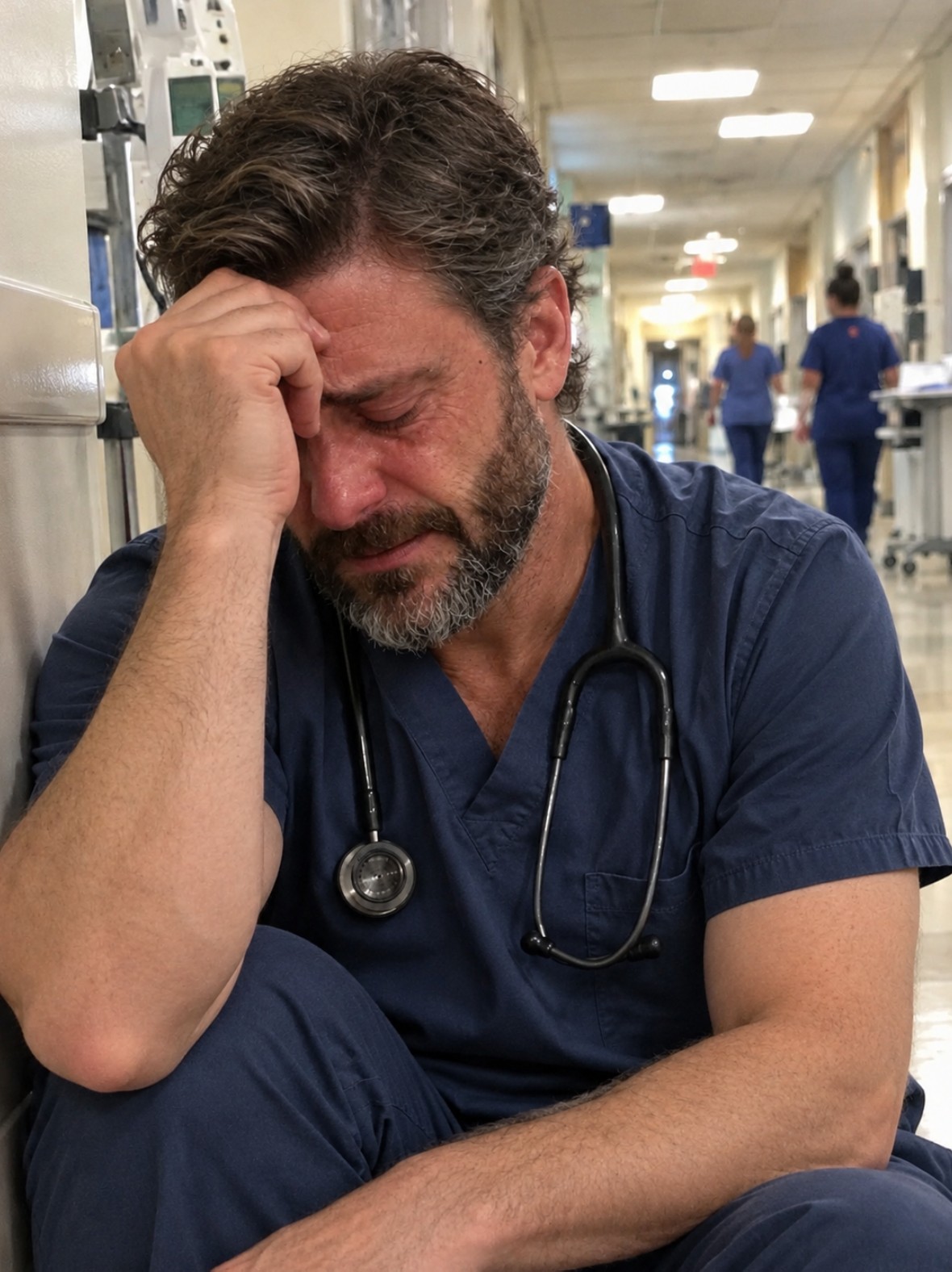
Part 1:
Callum and I had been married for eleven years. For every one of those years, I had shared my husband with Saint Jude Medical Center in Columbus.
Callum was an exceptionally talented surgeon, and I had always been proud of him. He had dedicated his life to saving people, and I knew how much his work meant to him. Whenever someone asked me about my husband, I would smile and tell them how many lives he had helped save.
But during the past year, something had changed.
I began wrapping up his dinner before I even had the chance to sit down and eat my own. Some nights, I would leave his plate on the kitchen counter, cover it with foil, and hope he would be home before the food went cold.
Most of the time, he wasn’t.
He missed Thanksgiving. He missed our wedding anniversary. And he even missed our daughter Sadie’s eighth birthday.
That last one hurt more than I wanted to admit.
Sadie had spent the entire morning asking when her father would arrive. She had made him a handmade birthday card and insisted on saving him a piece of her cake. When it was time to blow out the candles, she looked toward the front door one last time.
“Is Daddy coming home soon, Mommy?” she asked.
I forced a smile and brushed a strand of hair away from her face.
“He’s working, sweetheart. You know how important his job is.”
“But he promised he’d be here.”
I had no answer for that.
I called Callum several times that evening, but he didn’t pick up. Eventually, he sent me a short message.
I’m sorry, honey. Emergency surgery. Please tell Sadie I love her. I’ll make it up to her.
I read the message twice, trying to convince myself that everything was normal.
After all, Callum was a surgeon. Emergencies happened. Patients needed him. I understood that when I married him, and I had never expected him to put our family ahead of someone whose life was in danger.
But lately, it seemed as though there was always an emergency.
There were nights when he didn’t come home at all. Other nights, he would arrive long after midnight, move quietly through the house, and collapse into bed without saying more than a few words.
“We’re short-staffed, honey,” he would tell me. “Please don’t stay up waiting for me.”
His voice always sounded tired, but I assumed it was because he had been working for too many hours.
Whenever he finally climbed into bed, he looked so completely exhausted that I forced myself to swallow every complaint.
How could I argue with a man who spent his days trying to keep people alive?
I told myself that this was simply another difficult period in our marriage. Things would eventually get better. The hospital would hire more staff, the emergencies would slow down, and Callum would return to the husband and father we knew.
I had no idea how wrong I was.
One night, I woke up and noticed that Callum’s side of the bed was empty.
At first, I thought he had been called back to the hospital. Then I heard a faint sound coming from beside me.
I turned and saw him sitting on the edge of the mattress, his shoulders trembling.
He was crying.
For a moment, I couldn’t move. In eleven years of marriage, I had seen Callum tired, frustrated, worried, and even angry. But I had rarely seen him cry.
“Callum?” I whispered.
He immediately wiped his face with the back of his hand and turned toward me.
“What’s wrong?” I asked, sitting up. “Did something happen at the hospital?”
He shook his head.
“No, honey. I’m fine.”
“Then why are you crying?”
He reached for my hand and squeezed it.
“Just a rough night. Go back to sleep.”
I wanted to ask more questions, but he looked so broken that I didn’t have the heart to push him.
I lay back down, and after a few minutes, he joined me. He wrapped his arms around me and held me tightly, almost as though he was afraid I might disappear.
I fell asleep believing he had simply had a terrible day.
Looking back, I would give anything to return to that night and ask him what was really happening.
But I didn’t know. And Callum wasn’t telling me.
So that Tuesday, after watching him leave the house with his hospital badge clipped to his pocket, I decided I would surprise him.
I had been thinking about him all morning. Perhaps a proper lunch and a few minutes together would remind him that he didn’t have to carry the weight of the world on his shoulders.
I prepared his favorite meal, packed it carefully into a lunchbox, and added a generous slice of apple pie for dessert.
Then I took a small piece of paper and wrote a message on it.
You don’t have to take care of everyone. Let me have a turn.
I slipped the note beneath his fork and closed the lunchbox.
For the first time in weeks, I felt genuinely excited.
I imagined Callum sitting in the hospital break room, opening the lunchbox, and smiling when he discovered the apple pie. I pictured him calling me to say thank you. Maybe, if he had a few minutes to spare, we could even sit together and eat.
It wasn’t much, but I missed my husband.
I missed the man who used to dance with me in the kitchen while dinner cooked. I missed our late-night conversations, our weekend breakfasts, and the way he used to make me laugh even when I was in a terrible mood.
I missed feeling as though I was part of his life instead of someone waiting outside it.
When I arrived at Saint Jude Medical Center, I carried the lunchbox inside and made my way toward the nurses’ station.
The hospital was busy, just as I expected. Nurses hurried between rooms, doctors discussed test results, and the sound of footsteps echoed along the polished floors.
But the instant I reached the nurses’ station, something felt wrong.
A woman I had known for years looked up at me. Her expression changed the moment she recognized me.
She had been smiling at something another nurse said, but her smile disappeared so quickly that I almost wondered whether I had imagined it.
“Hi!” I said cheerfully. “Is Callum around?”
She stared at me without answering.
“And please don’t tell him I’m here,” I added with a laugh. “He’ll just say I shouldn’t have gone to all this trouble.”
The nurse standing beside her glanced at her colleague.
They exchanged a quick, uncomfortable look.
My smile slowly faded.
“Is something wrong?” I asked.
Neither woman answered.
A strange feeling began spreading through my chest.
“Did something happen to him?” I asked, my voice becoming sharper. “Where is Callum?”
The nurses looked at each other again.
By then, I was frightened and starting to lose my patience.
“Please,” I said. “Someone tell me what’s going on.”
Before either woman could respond, I noticed Callum’s colleague, Vincent, walking toward me.
Vincent had worked with my husband for years. He was usually confident and friendly, the kind of man who could make a tense room feel calmer simply by walking into it.
But that day, his face was completely pale.
He looked as though he had seen something terrible.
I tried to smile at him, hoping he might explain the strange behavior of everyone around me.
“I’m so glad you’re here!” I said. “Can you tell me where Callum is? I’ve brought him lunch.”
Vincent stopped directly in front of me.
He didn’t answer immediately. Instead, he stared at my face as though he were trying to find the right words.
Then his eyes filled with tears.
My stomach dropped.
“Vincent?” I whispered. “What’s wrong?”
He swallowed hard.
Then he asked a question that would change my life forever.
“He hasn’t told you anything, has he?”
Part 2: The Truth Behind His Absence
My blood ran cold.
The lunchbox in my hand suddenly felt unbearably heavy. I stared at Vincent, watching his lips tremble as he struggled to speak.
“Told me what?” I asked.
My voice sounded strange, even to my own ears. It was sharp and breathless, filled with a fear I couldn’t explain.
“Vincent, what is going on? Is Callum hurt? Did he collapse?”
Vincent glanced toward the nurses’ station. Several people had stopped working and were watching us from a distance.
He placed a trembling hand on my arm.
“Come with me, please.”
“Why? Where are you taking me?”
“Somewhere private. We need to talk.”
I didn’t want to move. Every instinct told me that something terrible was happening, and I was terrified of hearing the words that would confirm it.
But I followed him down the corridor.
He led me into a small consultation room and closed the door behind us. The familiar sounds of the hospital faded into the background, leaving only the distant hum of medical equipment and the occasional footsteps outside.
Vincent turned toward me.
“Please, sit down.”
“No!” I shouted. “I’m not sitting down until you tell me where my husband is!”
My voice broke, and I could feel tears gathering in my eyes.
“Why was everyone looking at me like that at the desk? Why are you crying? Vincent, you’re frightening me!”
He took a deep breath, but it seemed impossible for him to steady himself.
For a moment, he looked down at his hands. Then he raised his eyes to mine.
“Elena, there’s something you need to know about Callum.”
I barely recognized my own voice when I answered.
“Then tell me.”
Vincent swallowed hard.
“Callum didn’t miss your anniversary or Sadie’s birthday because the hospital was short-staffed.”
I stared at him.
“What?”
“He took himself off the surgical rotation six months ago.”
The words made no sense.
I shook my head immediately.
“No. That’s impossible. He leaves the house every morning at six. He comes home smelling like surgical scrub. He tells me about his patients and his colleagues. How could he have stopped operating without me knowing?”
Vincent’s eyes filled with tears again.
“Because he wasn’t coming here to operate, Elena.”
He paused, struggling to continue.
“He was coming here as a patient.”
I felt the room tilt around me.
“A patient?” I whispered.
Vincent nodded slowly.
“Callum was diagnosed with aggressive Stage IV pancreatic adenocarcinoma back in March.”
For several seconds, I couldn’t understand what he had said.
Then the meaning of his words struck me with such force that I felt as though someone had punched me in the chest.
Cancer.
My husband had cancer.
Not just cancer, but an advanced, aggressive form of the disease.
I opened my mouth, but no words came out.
Vincent continued speaking, his voice barely above a whisper.
“He didn’t want anyone to know. Especially you and Sadie. He started receiving high-dose palliative chemotherapy in our oncology department. He would spend hours here, undergoing treatment and waiting for the worst side effects to pass.”
I shook my head again and again.
“No. No, he would have told me. He would never keep something like this from me.”
But even as I said those words, memories began flooding back.
The nights he had come home looking pale and exhausted.
The meals he could barely finish.
The way he sometimes disappeared into the bathroom after dinner, claiming he had an upset stomach.
The night I had found him crying on the edge of our bed.
Every strange moment suddenly seemed to fit together.
Vincent lowered his eyes.
“He wanted to come home looking as normal as possible. He was afraid that if you saw how sick he really was, you would know something was wrong. He would sit in his office for hours after treatment, waiting until he felt strong enough to leave.”
I gripped the edge of the table.
“But why?” I whispered. “Why wouldn’t he tell me?”
“Because he loves you and Sadie,” Vincent replied. “He thought he was protecting you.”
“Protecting us?” I cried. “By lying to us?”
Vincent didn’t argue.
He simply stood there, looking as devastated as I felt.
The room suddenly seemed to have no air in it. My chest tightened, and my knees gave out beneath me.
I collapsed into one of the plastic chairs.
The lunchbox slipped from my fingers and hit the floor. Its lid popped open, sending the carefully packed food scattering across the tiles.
The slice of apple pie landed upside down.
My little handwritten note fluttered beside it, face up.
You don’t have to take care of everyone. Let me have a turn.
I stared at those words through my tears.
I had written them because I wanted my husband to know he didn’t have to face every burden alone.
Meanwhile, he had been facing the biggest battle of his life without telling me.
“How long?” I managed to ask.
Vincent crouched beside my chair.
“Since March.”
“March?” I repeated.
It was October.
For seven months, my husband had known he was seriously ill. For seven months, he had watched me worry about his long hours, his missed family dinners, and his strange behavior.
For seven months, he had let me believe that his job was keeping him away from us.
I pressed both hands against my mouth to stop myself from screaming.
“Does Sadie know?”
“No,” Vincent said gently. “Callum didn’t want her to be frightened. He hoped he could find a way to explain everything when he was ready.”
“When he was ready?” I repeated, my voice breaking. “How could he possibly decide something like this without me?”
Vincent lowered his head.
“I know this is hard to understand, Elena. I tried to convince him to tell you. More than once. But he was determined to keep the diagnosis private.”
I wiped my face with trembling hands.
“Where is he now?”
Vincent hesitated.
That hesitation frightened me more than anything he had said so far.
“Where is my husband?” I demanded.
“He was receiving what was intended to be his final chemotherapy treatment when he developed acute respiratory distress about two hours ago.”
My heart seemed to stop.
“What does that mean?”
“His breathing became dangerously difficult. The team stabilized him as best they could and transferred him to the intensive care unit.”
I struggled to stand.
“Take me to him.”
“Elena—”
“Take me to my husband right now!”
Vincent rose immediately and opened the door.
“He’s in ICU Room 4.”
I hurried toward the corridor, barely aware of the people moving around me.
Vincent followed close behind.
“He has been asking about you,” he said quietly. “He wanted us to contact you when he could no longer hide how sick he was.”
I stopped so abruptly that Vincent nearly walked into me.
“He wanted you to call me only when he couldn’t hide it anymore?”
Vincent didn’t answer.
I looked at him, unable to believe what I was hearing.
My husband had spent months trying to protect me from the truth. But in doing so, he had taken away the chance for us to face it together.
I didn’t know whether I wanted to hold him or shake him.
All I knew was that I needed to see him.
I needed to hear his voice.
And I needed him to know that he never should have had to go through this alone.
Part 3: The Secret Room
I ran down the long, sterile hallway, my footsteps echoing against the walls.
Every second seemed painfully slow.
I passed the nurses’ station, turned the corner, and hurried toward the intensive care unit. Vincent had told the staff who I was, so no one stopped me as I approached Room 4.
When I pushed open the door, I froze.
The room was quiet, except for the steady beeping of a heart monitor and the soft sounds of the equipment helping Callum breathe.
There, in the middle of the room, lay my husband.
For a moment, I couldn’t reconcile the man in that bed with the Callum I knew.
The man who used to lift our daughter onto his shoulders and swing her around the backyard was gone.
The strong, energetic surgeon who could spend hours on his feet in an operating room had been reduced to a painfully thin figure beneath the white hospital sheets.
His skin was pale. His cheeks were sunken, and his arms looked frighteningly fragile.
An IV line ran into his hand, and oxygen tubing helped him breathe.
I covered my mouth with both hands.
How had I not seen it?
How had I spent so many nights beside him without understanding how much he was suffering?
I moved toward the bed, each step heavier than the last.
Then the door clicked shut behind me.
Callum’s eyelids fluttered.
Slowly, he opened his eyes.
When he saw me, he tried to smile.
A tear slipped down his hollow cheek.
“Hey, honey,” he rasped.
His voice was barely more than a breath.
I grabbed the side of the bed to steady myself.
“Callum…”
He looked at the lunchbox I was still carrying by its handle. In my panic, I had somehow picked it up again from the floor outside the consultation room.
His eyes moved back to my face.
“You… you brought lunch?”
That was all it took.
I broke down completely.
I collapsed beside his bed and wrapped both hands around his cold, frail hand.
“You absolute idiot!” I sobbed. “You foolish, stubborn man! How could you do this to me? How could you keep something like this from me?”
Callum closed his eyes briefly.
I pressed his hand against my cheek.
“Six months of chemotherapy,” I cried. “You went through six months of treatment without me! You came home every night and let me believe you were just tired from work. You let me worry about our marriage when you were fighting for your life!”
His fingers moved weakly against mine.
“I’m sorry,” he whispered.
“No, don’t just say you’re sorry! Tell me why!”
My voice cracked as I leaned closer to him.
“Why didn’t you tell me? Why didn’t you let me help you? I’m your wife, Callum. I’m supposed to be there when things get difficult. I’m supposed to stand beside you when you’re frightened.”
He struggled to draw a breath before answering.
“Because every day I spent as a patient reminded me of how terrifying this disease is.”
His eyes filled with tears.
“I’ve spent my whole life giving families terrible news in hospital waiting rooms. I’ve watched husbands break down when they learned their wives weren’t going to recover. I’ve watched wives hold their children’s hands while doctors explained that their fathers might not come home.”
He paused, gathering what little strength he had left.
“I knew what this diagnosis could mean. And I couldn’t bear to look at you and Sadie and see that same devastation in your eyes.”
I shook my head, crying harder.
“Callum, we are your family!”
“I know.”
“No, I don’t think you do!” I said, squeezing his hand. “We were supposed to face this together. You weren’t supposed to carry this mountain on your own!”
He looked at me for a long moment.
Then, despite his weakness, the faintest smile appeared on his face.
“I didn’t carry it alone.”
I stared at him.
“What are you talking about?”
“Every night when I came home exhausted and found you waiting with warm food… every morning when Sadie drew pictures for my briefcase…”
His voice grew softer.
“Those things gave me the strength to survive another round. Knowing I could still come home to you both made me want to keep fighting.”
I pressed his hand to my lips.
“You should have told me,” I whispered. “I would have held you when you were sick. I would have gone with you to every appointment. I would have sat beside you through every treatment, even if we couldn’t change the outcome.”
“I know, honey.”
“Then why?”
He looked at me with an expression I would remember for the rest of my life.
“Because I wanted to give you a few more ordinary days.”
I couldn’t speak.
“I wanted Sadie to have a few more days when her daddy could still smile at her, listen to her stories, and tell her everything was going to be okay. I wanted you to have a few more evenings when you could see me walk through the front door and believe we still had time.”
His voice broke.
“I knew I couldn’t give you forever. I just wanted to give you a little more time before everything changed.”
I bowed my head over his hand.
For months, I had been angry about the dinners he missed and the nights he never came home. I had felt lonely, rejected, and frightened that our marriage was slowly falling apart.
Now I understood that while I had been waiting for my husband to return to our old life, he had been trying desperately to hold on to whatever life he had left.
But understanding didn’t make the pain disappear.
“I don’t want a few more ordinary days,” I whispered. “I want you. I want my husband. I want you home with us.”
Callum’s eyes filled with tears.
“I want that too.”
I leaned forward and kissed his forehead.
For a while, neither of us spoke.
I held his hand, listening to the steady beeping of the monitor and the soft sounds of his breathing.
Eventually, I looked up at him.
“Does Sadie know you’re here?”
He shook his head slightly.
“Not yet.”
“She thinks you’re working.”
“I know.”
“She’s eight years old, Callum. She misses you. She keeps asking when you’re going to come home.”
His face crumpled.
“I know, honey. I know.”
He tried to lift his hand, but he was too weak to raise it very far. I caught it gently and placed it against my cheek.
“Please don’t let her remember me only like this,” he whispered.
I shook my head.
“She won’t.”
“Tell her I love her. Tell her that every picture she ever drew for me is still important to me. Tell her that I kept them all.”
“I will.”
“And tell her that if she ever feels frightened, or lonely, or thinks she isn’t good enough, she should remember something for me.”
“What?”
“She was the best thing that ever happened to me. Both of you were.”
I couldn’t hold back my sobs.
“You can tell her yourself,” I insisted. “You’re going to tell her yourself. You’re going to come home, and we’re going to sit at the kitchen table, and you’re going to eat the apple pie I brought you.”
He gave me a weak, sad smile.
“That sounds wonderful.”
I stayed beside him for hours, holding his hand and talking about our life together.
I reminded him of our wedding day, when he had been so nervous that he nearly forgot his vows. I told him about the time Sadie had covered the kitchen floor in flour because she wanted to bake him a birthday cake. I reminded him of our first home, our vacations, and the silly little arguments that had seemed so important at the time.
Sometimes he smiled.
Sometimes he closed his eyes and rested.
And sometimes, when I mentioned a memory that meant something to both of us, a tear would slip down his cheek.
I didn’t know how much time we had left.
But I knew I would never leave him alone again.
For the next three days, I remained by his side as much as the hospital allowed. Vincent and the other members of the medical team did everything they could to keep Callum comfortable.
There were moments when he was awake enough to speak, and others when he seemed to drift somewhere far away.
I held his hand through all of it.
On the third day, Callum’s breathing became quieter.
I leaned close to him, resting my forehead against his.
“I’m here, honey,” I whispered. “I’m right here.”
His eyes opened one last time.
He looked at me, and I saw the same tenderness in his expression that I had seen on our wedding day.
“I love you, Elena,” he whispered.
“I love you too.”
His fingers tightened around mine for one brief moment.
Then he relaxed.
The monitor continued its steady rhythm for a little longer before the room filled with the quiet movements of the medical team.
Callum Vance, my husband of eleven years, was gone.
He passed away peacefully, surrounded by the love of his family and the people who had cared for him.
I held his hand long after the room had gone quiet.
For seven months, he had tried to protect me from losing him.
And now, I had to learn how to live in a world without him.
Part 4: The Gift He Left Behind
Callum’s memorial service was held in the hospital atrium.
Hundreds of people came to pay their respects. Former patients whose lives he had saved stood beside colleagues who had worked with him for years. Nurses, residents, and other hospital staff filled the room.
Some people brought flowers. Others shared stories about the surgeon who had treated them with kindness when they were frightened and vulnerable.
Again and again, I heard the same words.
“He was an extraordinary doctor.”
“He saved my life.”
“He never gave up on his patients.”
One former patient, an older man who had undergone emergency surgery several years earlier, approached me after the service.
“Your husband gave me another chance at life,” he said, his eyes shining with tears. “I wouldn’t be standing here today if it weren’t for him.”
I thanked him, barely able to speak.
As I listened to the stories, I realized that Callum’s life had touched far more people than I had ever known.
He had spent years giving others more time with their families.
And during his final months, he had been trying to give his own family the same gift.
The hospital staff had known about his diagnosis and had respected his wish to keep it private. Some had helped him arrange his treatments. Others had quietly adjusted schedules to give him time to rest.
They had watched a brilliant surgeon become a patient, and they had carried the burden of his secret because he had asked them to.
I was still struggling to understand that part of the story.
I wished someone had insisted more strongly that he tell me. I wished I had known soon enough to be there for every appointment, every frightening conversation, and every difficult night.
But I also understood that Callum had been trying to make his own decisions in the face of a future he couldn’t control.
I would never agree with his choice to hide the truth from us.
Yet I could no longer doubt the love behind it.
A week after the funeral, Vincent came to our house.
Sadie and I had been spending most of our days together, trying to adjust to the silence that had settled over our home.
Callum’s shoes were still beside the front door. His favorite coffee mug remained in the kitchen cupboard, and his jacket still hung in the hallway closet.
I couldn’t bring myself to move any of it.
When I opened the door and saw Vincent standing on the porch, I immediately knew something important had brought him there.
He was holding a thick, leather-bound journal and a small wooden box.
“Elena,” he said softly.
I stepped aside and invited him in.
We sat in the living room, where Callum used to read bedtime stories to Sadie on the weekends.
Vincent placed the journal and box on the coffee table.
“He asked me to give these to you when it was over,” he said.
I stared at the objects.
“What are they?”
“The journal is for you. The box is for you and Sadie.”
He paused before continuing.
“He spent a lot of time preparing them. He wanted to make sure you both had something to hold on to.”
My eyes filled with tears.
“Why didn’t he tell me he was doing this?”
Vincent gave me a sad smile.
“I think he wanted you to discover it in your own time.”
He leaned forward and gave me a gentle hug.
“I’m sorry for everything you’ve been through. Callum loved you both more than anything.”
Then he stood up, said goodbye, and left us alone.
Sadie and I sat together on the living room rug.
For several minutes, neither of us touched the box.
Finally, Sadie looked at me.
“Mom, what’s inside?”
“I don’t know, sweetheart. Your dad wanted us to have it.”
Together, we lifted the lid.
Inside were dozens of video recordings and handwritten letters, carefully arranged and labeled.
I picked up one of the recordings.
A small label on the front read:
Sadie’s Ninth Birthday.
Another said:
Sadie’s Tenth Birthday.
There were recordings for her high school graduation, her wedding day, her first heartbreak, and many other important moments in her life.
Callum had spent hours in his hospital office recording messages for our daughter.
He had prepared bedtime stories, words of encouragement, funny memories, and advice for the future.
He had even recorded videos for moments he knew he might never live to see.
Sadie picked up one of the tapes with trembling hands.
“Does this mean Daddy knew he was going to die?”
I pulled her into my arms.
“I think he knew he was very sick, sweetheart.”
“Why didn’t he tell us?”
I closed my eyes for a moment, trying to find words that an eight-year-old could understand.
“Your dad was frightened, honey. I think he wanted to protect us from being sad. He thought keeping everything to himself would make things easier for us.”
“But we were sad anyway,” she whispered.
“I know, sweetheart. I know.”
She rested her head against my chest.
“I wish he had told me. I would have hugged him.”
I held her tightly, wishing I could take away the pain in her little heart.
“Me too,” I whispered. “Me too.”
After a while, we opened the first recording.
Callum’s face appeared on the television screen.
He was sitting in his hospital office, wearing a simple blue shirt. He looked tired, but he was smiling in that familiar way that had always made our daughter laugh.
“Hello, my beautiful girl!” he said. “If you’re watching this, then it’s your ninth birthday. I hope you’ve had a wonderful day, and I hope your mom has bought you a cake big enough to feed the entire neighborhood!”
Sadie let out a small laugh through her tears.
Callum continued.
“There’s something I want you to remember as you grow up. You don’t have to be perfect to be loved. You don’t have to win every race, get every answer right, or make everyone happy. Just be kind, be brave, and always remember that you are loved more than you can imagine.”
Sadie pressed both hands against her mouth.
“That’s Daddy,” she whispered.
I wrapped my arm around her shoulders.
“Yes, sweetheart. That’s Daddy.”
We watched the entire recording.
Then we watched another.
And another.
Every video brought a little more of Callum back into our home.
He told jokes, shared memories, and gave advice about growing up. In one recording, he described how he had once tripped over his own feet during a school soccer match, sending the entire team into laughter.
Sadie laughed so hard that she had to wipe her eyes.
For the first time since his death, the sound of laughter filled our living room without immediately turning into tears.
After we finished watching the recordings, I opened the leather-bound journal.
The pages were filled with Callum’s familiar, sharp handwriting. Some entries were short, while others stretched across several pages.
I turned to the first page.
At the top, he had written:
To my beloved wife.
I took a deep breath and began to read.
My darling Elena,
You told me I didn’t have to take care of everyone, and that you wanted a turn.
I have read those words more times than you could ever imagine.
You probably thought you were simply reminding me to eat lunch, to take a break, or to let someone else look after me for once.
But those words meant so much more to me.
You have been taking care of my heart since the moment we met.
When I was frightened, you made me feel brave. When I was exhausted, you reminded me why I kept going. And when I came home from a difficult day at the hospital, you made our house feel like the safest place in the world.
I fought with everything I had because I wanted to give you a few more months of peace, free from the shadow of my pain.
I wanted to keep being your husband, Sadie’s daddy, and the man who danced with you in the kitchen while dinner got cold.
I know I should have told you the truth. I know that by keeping it from you, I took away your chance to stand beside me when I needed you.
For that, I am truly sorry.
But please, my darling, do not remember me only in that hospital bed.
Remember me in our kitchen, dancing with you while the food got cold.
Remember the mornings when Sadie climbed into our bed and demanded that we both wake up.
Remember our silly arguments, our holidays, and all the ordinary moments that turned out to be the most precious parts of our lives.
I am at rest now.
It’s your turn to live, to love Sadie, to laugh again, and to discover all the beautiful things the world still has waiting for you.
Do not feel guilty when you are happy. Do not think that moving forward means leaving me behind.
You will always carry me with you.
My love for you and Sadie will never, ever end.
Forever yours,
Callum.
By the time I finished reading, tears were streaming down my face.
Sadie wrapped her arms around me, and I held her close.
For a long time, we sat together on the living room rug, surrounded by the letters and recordings he had left behind.
Then we played one more video.
Callum looked directly into the camera.
“Elena, if you’re watching this with Sadie, I want you both to know something.”
He smiled gently.
“I know I can’t be there for every birthday, every school play, or every important moment. But I hope these little messages remind you that I will always be proud of you.”
He paused, his eyes shining.
“Elena, thank you for loving me. Thank you for making my life beautiful. And Sadie, my sweet girl, never forget that you were the greatest gift your mother and I ever received.”
He took a breath.
“I love you both. Always.”
The screen went dark.
I sat there holding Sadie, listening to the silence that followed.
For weeks, grief had felt like a weight pressing down on my chest. I had wondered how I could possibly move forward when the person I wanted beside me was gone.
But as Callum’s voice faded from the room, something inside me began to change.
The pain was still there. It would always be there.
Yet beneath it, I felt something warmer.
Love.
Callum hadn’t been able to stay with us, but he had spent his final months creating something that would help guide us long after he was gone.
He hadn’t left us completely in the dark.
He had simply spent his remaining time building a light that would guide us through the years ahead.
Part 5: The Garden in Autumn
Three autumns passed before I could bring myself to visit the courtyard behind Saint Jude Medical Center without feeling the sharp, familiar twist of grief in my chest.
For the first two years after Callum’s death, the hospital remained a fortress of painful memories.
Its sterile corridors reminded me of the truth he had hidden. The consultation rooms reminded me of the moment Vincent told me about his diagnosis. And the intensive care unit reminded me of the final hours I had spent holding my husband’s hand.
Even passing the hospital on the way to the grocery store could leave me fighting back tears.
But time moved forward, whether I was ready or not.
As Callum had often told the families of his patients, time was not always an enemy. Sometimes, it was a slow and quiet healer. It didn’t erase the pain, but it gradually softened the sharpest edges of loss until the memories became something we could carry without breaking.
I began to understand what he meant.
Sadie and I slowly rebuilt our lives.
We celebrated birthdays, went on small trips, and found reasons to laugh again. We still missed Callum every day, but his absence no longer filled every corner of our home with silence.
His voice remained with us through the recordings he had prepared.
On Sadie’s ninth birthday, we sat together in the living room and played the video he had made for that occasion.
Callum joked about how she was growing so quickly that soon he would need a ladder just to give her a hug.
Sadie laughed and told me that Daddy would have loved how tall she was getting.
On her tenth birthday, we watched another recording.
This time, Callum told her the hilarious story of how he had tripped over his own feet during his first middle-school soccer match. He described the incident so dramatically that Sadie laughed until tears ran down her face.
Those recordings became part of our family traditions.
Whenever Sadie reached another milestone, we would open the wooden box and find the message her father had left for her.
We couldn’t create new memories with him, but we could still discover the love he had carefully preserved for us.
Then, on a crisp Saturday afternoon in October, I finally returned to the hospital courtyard.
The hospital had created a memorial garden in Callum’s honor. I had heard about it before, but I hadn’t felt ready to visit.
Now, as the autumn leaves turned deep shades of red and gold, I found myself walking along the flagstone paths with Sadie beside me.
She was eleven years old now.
She wore a golden knit sweater, and her father’s mischievous smile appeared whenever she was about to say something funny. In her arms, she carried a small wooden crate filled with tulip bulbs and a trowel.
“Mom, over here!” she called.
She hurried ahead and stopped near a dark granite bench nestled beneath a white oak tree.
I followed her, my coat pulled tightly around me against the cool autumn breeze.
When I reached the bench, I stopped.
Engraved across the backrest were the words:
Dr. Callum Vance
He gave his life to heal others, and his heart to those he loved.
I ran my fingers gently across the engraved letters.
For a moment, I could almost imagine Callum sitting beside me, telling me that I was making too much of a fuss over something as simple as a bench.
I smiled through my tears.
Beside the bench stood a young dogwood tree. The surgical staff had planted it two years earlier in his honor, and it had begun to grow strong and beautiful.
Sadie crouched down near the base of the bench.
“Is this the spot?” she asked.
“This is it, sweet pea,” I replied, kneeling beside her.
She opened the wooden crate and carefully examined the bulbs.
“If we plant them now, before the first frost, they’ll rest under the soil all winter,” I explained. “And when spring comes, they’ll bloom right when the morning sun hits the bench.”
Sadie nodded solemnly.
Then she picked up the trowel and began digging her first small hole in the dark earth.
I watched her hands as she worked.
They were steady and careful, almost uncannily like her father’s.
She measured the distance between the holes, adjusted the depth, and gently placed each bulb in the soil before covering it.
For a moment, I felt as though I were watching Callum preparing for an operation, concentrating on every small detail because he knew how much it mattered.
My heart ached.
But this time, the ache was accompanied by warmth.
Over the last three years, Callum had never truly left our lives.
He was there when Sadie struggled with something at school. He was there when she needed encouragement before trying something new. He was there when she laughed at one of his recorded jokes or listened to his advice during a difficult moment.
Sometimes, Sadie would ask what her father might have said about a particular problem.
We would sit together and talk about him, remembering the things he used to tell us.
His recordings had become more than memories.
They were a living connection to the man who had loved us so deeply.
He had turned his final, painful months into a lasting legacy of love.
As Sadie planted another bulb, I heard footsteps crunching against the gravel behind us.
I turned.
Vincent was walking down the path.
He wasn’t wearing his surgical scrubs that afternoon. Instead, he had on a dark navy coat and was carrying two warm paper cups from the coffee shop across the street.
“I thought I might find you two out here,” he said with a warm smile.
He handed me one of the cups.
“Thank you,” I said. “That’s very thoughtful.”
“Hi, Dr. Vincent!” Sadie called cheerfully, without stopping her work. “Look! I’ve already planted three bulbs!”
Vincent laughed and crouched beside her to inspect the small holes.
“Three already? That’s impressive.”
He examined the spacing and nodded approvingly.
“You’ve got your dad’s precision, Sadie. Not a single bulb out of alignment.”
Sadie beamed.
“Daddy always liked doing things properly.”
“He certainly did,” Vincent replied.
For a moment, the three of us sat quietly beneath the trees.
Then Vincent turned toward me.
“Elena, there’s something I wanted to ask you.”
I looked at him.
“Of course. What is it?”
“The annual surgical department dinner is next Friday. The board has decided to present the first Callum Vance Humanism Award to one of our junior residents.”
I felt my throat tighten at the sound of my husband’s name.
“An award?”
Vincent nodded.
“We want to recognize a young doctor who understands that medicine isn’t just about technical skill. It’s about kindness, patience, and treating frightened people with dignity. Callum believed that being a good surgeon meant more than knowing how to operate.”
He glanced toward the hospital buildings.
“We’d be honored if you and Sadie would attend the dinner.”
I looked down at my coffee, trying to collect my thoughts.
For years, Callum had worked in those operating rooms, saving lives and comforting families. Now, the hospital was finding a way to carry his values into the future.
“We’d be honored, Vincent,” I said.
I looked up at him and smiled.
“Callum would be so proud to see his team continuing his work.”
Vincent’s expression softened.
“We miss him every day in the operating theater, Elena.”
He paused before continuing.
“But every time one of us takes an extra ten minutes to sit with a frightened patient, or stays late just to hold a family’s hand in the waiting room, we know we’re keeping his spirit alive.”
I looked at the engraved words on the bench.
“He always believed that those little things mattered,” I said.
“He did,” Vincent replied. “And he was right.”
I looked up through the golden leaves toward the clear blue sky.
“He’s still here,” I whispered.
Vincent nodded.
“I believe that too.”
After a little while, Vincent said goodbye and headed back toward the hospital.
Sadie finished planting the remaining bulbs. She covered each one carefully, patted the soil smooth with her small palms, and stood up to brush the dirt from her jeans.
Then she sat down beside me on the granite bench and leaned her head against my arm.
We watched the sunlight filter through the trees.
For a while, neither of us spoke.
Then Sadie turned toward me.
“Mom?”
“Yes, honey?”
She hesitated before asking the question.
“Do you think Dad knows we’re here?”
I put my arm around her shoulders and pulled her close against the warmth of my coat.
I thought about the journal resting safely on my nightstand at home. I thought about the wooden box filled with recordings, the letters he had written, and the note I had tucked beneath his apple pie all those years ago.
You don’t have to take care of everyone. Let me have a turn.
I had written those words because I wanted to take care of my husband.
I hadn’t known that he was already fighting a battle he might not survive.
And although he had made the painful decision to keep his illness secret, he had spent his final months trying to ensure that Sadie and I would still have his love and guidance long after he was gone.
I kissed the top of her head.
“I don’t just think he knows, Sadie,” I whispered.
She looked up at me.
“I think he’s sitting right here with us, watching you plant those flowers. And I think he’s smiling because he knows we’re going to be okay.”
Sadie smiled softly.
“Do you think he can see the flowers in spring?”
“I hope so, sweetheart.”
“Then I hope they grow really big.”
I laughed gently through my tears.
“Me too.”
She closed her eyes and leaned against my side.
We sat together on that bench for a long time, watching the afternoon sunlight dance across the garden floor.
The breeze rustled the crimson leaves above us, and somewhere in the distance, we could hear the sounds of the hospital continuing its work.
Doctors were saving lives. Nurses were comforting frightened patients. Families were waiting for news about the people they loved.
And somewhere inside those walls, another young surgeon was learning what Callum had always known: that healing people required more than medical knowledge. It required compassion, patience, and the courage to stand beside someone when they were afraid.
I knew I would always miss my husband.
There would always be birthdays when I wished he could be there, holidays when I would look toward the door out of habit, and moments when I would want to tell him something wonderful that had happened.
Grief would never disappear completely.
But it no longer felt like an empty room I could never leave.
It felt like a part of our story, a reminder of a love that had been real and beautiful, even though it hadn’t lasted as long as we had hoped.
Callum had given so much of himself to the world.
He had saved lives, comforted families, and taught his colleagues that kindness could be just as important as skill.
And in his final months, he had tried to leave something behind for the two people he loved most.
He had left us his memories, his advice, his laughter, and his voice.
He had left us a way to keep moving forward without feeling that we were abandoning him.
As I sat beside my daughter, I finally understood something I had struggled to accept since the day he died.
Love doesn’t end simply because a person’s life does.
Sometimes, it lives in a handwritten letter.
Sometimes, it lives in a recording that makes a child laugh years after her father is gone.
And sometimes, it lives in a garden where two people plant flowers beneath a tree, trusting that spring will come again.
I held Sadie a little closer.
The sun began to sink behind the hospital buildings, casting a golden glow across the granite bench.
For the first time in a long while, I felt peaceful.
Not because I had stopped missing Callum, but because I no longer believed that missing him meant I could never be happy again.
We had lost him, but we had not lost everything he had given us.
His love was still there, surrounding us in ways both large and small.
And as the autumn leaves drifted gently to the ground, I found myself smiling at the thought of those tulip bulbs resting beneath the soil.
All winter, they would remain hidden.
Then, when the days grew warmer and the morning sunlight returned, they would rise from the darkness and bloom.
Just as Callum had hoped, life would go on.
And we would be okay.
The End.
