
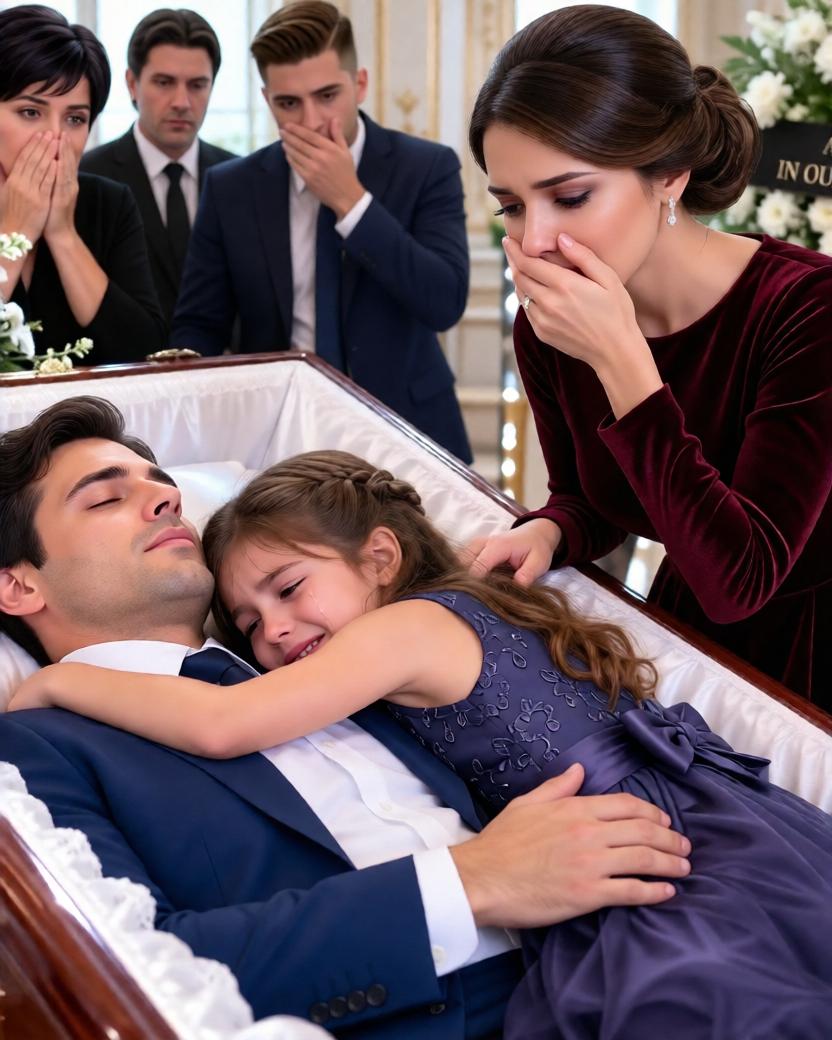
Then she looked straight at me and whispered, “Mommy, Daddy isn’t dead.”
I didn’t argue or dismiss her.
I put my hand against his face and immediately called 911.
But before the paramedics arrived, I glanced at her uncle’s phone…
One message on that screen changed everything I thought I knew about my husband’s “death.”
Part 1:
My eight-year-old daughter climbed right inside her father’s casket while our entire family screamed at her to get out.
What she said next made even the doctor who had signed his death certificate turn ghost-white.
“Mommy, Daddy isn’t dead.”
I felt all the strength drain from my legs.
Until that exact moment, Chloe had spent nearly seven hours sitting beside Mark’s casket. She hadn’t cried. She hadn’t eaten. She had barely taken two sips of water.
The wake was being held at my mother-in-law’s house in suburban Chicago. Mark, my husband, had supposedly died after suffering a sudden cardiac arrest at one of the refrigerated warehouses owned by his company.
He was thirty-nine years old.
He had always been completely healthy.
And just two days earlier, he had told me something that kept replaying in my mind.
“If anything strange happens at the company tomorrow, don’t sign a single thing for Marcus.”
Marcus was Mark’s older brother and business partner in a cold-chain logistics company they had inherited from their father.
When I asked Mark what was going on, he had only shaken his head.
“I want to verify it first.”
Then he changed the subject.
On the afternoon of his supposed death, Marcus called me in a panic.
He claimed Mark had collapsed during a routine inspection inside one of their refrigerated warehouses.
By the time I reached the private clinic where Marcus said Mark had been taken, my husband was already lying beneath a white sheet.
Dr. Salgado explained that they had attempted resuscitation for nearly half an hour.
“I am so sorry, Mrs. Vance,” he said softly. “He didn’t respond.”
I was too devastated to ask the questions I should have asked.
But that fog slowly began to lift during the wake.
Chloe had asked for a chair so she could sit close to her father’s face. My mother-in-law, Teresa, allowed her to stay there.
Several relatives whispered that the poor girl was simply in shock.
But I knew my daughter.
When Chloe was frightened, she sobbed.
When she didn’t understand something, she asked endless questions.
That night, she did neither.
She was watching.
At 11:20 PM, I walked over to her.
“Chloe, sweetheart, come with me for a minute.”
“No.”
“You need to rest.”
She stared closely at Mark’s face.
“Daddy isn’t resting either.”
A cold shiver ran down my spine.
“What do you mean?”
She didn’t answer.
Then I noticed something that suddenly brought back the final hours before Mark was brought home.
Mark had not been prepared by a normal funeral home. Marcus had insisted that everything be handled quickly because, according to him, Mark had always said he wanted no invasive procedures after death.
Marcus had also personally chosen a tiny independent funeral home owned by an acquaintance of his.
At the time, I had been too broken to question him.
Now, that decision no longer felt like a thoughtful family gesture.
I pulled out my phone and opened a photograph I had taken at the clinic when they allowed me to say goodbye.
Mark’s wristwatch in the picture showed 4:13 PM.
I looked down at the watch still resting on his wrist inside the casket.
It showed 11:37 PM.
The second hand was still moving.
That did not prove he was alive.
But it meant nobody had properly prepared his body or removed the watch.
I stared at my husband.
“Chloe,” I whispered, leaning closer to her. “What did you see?”
My daughter brought her face inches from her father’s.
“At first, I thought it was just my imagination.”
“What was?”
“His nose.”
My chest tightened.
“Explain it to me, sweetie.”
“Sometimes it moves just a tiny bit right here.”
She gently tapped the area beneath his nostrils.
Before I could respond, Marcus stepped behind me.
“Claire, enough. The girl needs to go to sleep.”
Something about his voice bothered me.
It wasn’t grief.
It was sharp, controlled impatience.
Then Chloe stood up on her chair.
Everything happened in seconds.
She placed one knee on the edge of the velvet-lined casket and climbed inside.
“Chloe!” several relatives screamed.
I rushed forward as my daughter curled up against Mark’s chest, pressing her ear against his suit jacket.
Marcus immediately reached for her.
“Get her out of there!”
I shoved his arm away.
“Don’t touch her!”
Chloe looked up at me.
She was pale, but her eyes were completely focused.
“Mommy.”
“Yes, sweetie?”
“I felt two thumps.”
The entire room went silent.
I leaned over the casket and pressed two fingers against the side of Mark’s neck, where I knew his carotid artery was.
I felt nothing.
Marcus released a loud breath.
“See? This is insane. She’s hysterical.”
Then Chloe grabbed her father’s right hand.
Mark’s index finger twitched.
Once.
Then again.
My mother-in-law dropped her tea glass. It shattered across the hardwood floor.
I bent down and pressed my cheek directly above my husband’s nose and mouth.
I waited.
Nothing.
I waited again.
Then I felt it.
A tiny, warm, almost impossible-to-detect puff of air touched my skin.
“Call 911!” I screamed.
Marcus instantly grabbed my forearm.
“Claire, think about what you’re doing!”
I looked straight into his eyes.
“That is exactly what I’m doing for the first time since you called me today.”
My sister-in-law immediately dialed emergency services.
As we waited, I saw Marcus slowly backing toward the hallway.
His cell phone was clenched tightly in his hand.
Then Mark made a sound.
It was low, raspy, and barely audible.
A groan came from deep inside his throat.
The entire room gasped.
But I wasn’t looking at Mark anymore.
I was staring at Marcus’s glowing phone screen.
Over his shoulder, I saw a text message he had just sent.
“He’s breathing. We have a problem.”
Part 2:
I snatched the phone from Marcus’s hand before he could lock the screen.
“Who did you just send this to?” I demanded.
He lunged toward me.
“Give me the phone, Claire!”
“Who is ‘we’?”
His face turned completely pale.
He refused to answer.
I shoved his phone deep into my purse just as red emergency lights flashed through the front windows.
The paramedics rushed inside with a stretcher.
One immediately began checking Mark’s vital signs while another cleared the family away from the casket.
Then the medic shouted something that made my heart stop.
“We have an extremely faint cardiac rhythm!”
My mother-in-law let out a horrified scream.
Marcus stood frozen near the door.
“That’s impossible,” he whispered.
I heard him clearly.
Mark was rushed to Northwestern Memorial Hospital.
Chloe and I followed with Teresa in another vehicle.
Marcus tried to come with us.
“You’re not coming with us,” I told him coldly.
I shut the door before he could argue.
At the emergency department, doctors immediately began treating Mark.
The attending physician later explained that Mark had a weak pulse, moderate hypothermia, and severe respiratory depression.
Those findings did not fit a straightforward, irreversible cardiac arrest.
The doctor spoke carefully.
“We don’t know the full cause yet, Mrs. Vance. But your husband should not have been declared dead without a properly verified absence of vital signs and a complete cardiac evaluation.”
I demanded copies of everything.
The admission records.
The toxicology panels.
The body-temperature readings.
The blood work.
The treatment notes.
I was finished accepting vague explanations.
By 3:40 AM, Mark was still unconscious in the ICU, but his condition had stabilized.
I pulled Marcus’s phone out of my purse.
It was locked with a passcode.
“Try Grandma’s birthday,” Chloe whispered from the hospital chair beside me.
I entered the six digits.
The phone unlocked instantly.
I opened the messaging app and found the message I had seen at the wake.
The recipient was saved only under the letter “V.”
There were several earlier messages from that day.
“He’s out of the cold vault.”
“Bring him straight to the private drive.”
“Do not let him go through a major hospital.”
Then, that afternoon:
“We need the certificate signed today.”
I used my own phone to photograph every message thread.
I made sure the dates, times, and numbers were visible.
At dawn, I called my sister, who worked as a forensic accountant.
“I need you to meet me at Mark’s company headquarters right now.”
“What are we looking for, Claire?”
I remembered Mark’s warning.
“Something he uncovered right before they tried to bury him alive.”
By mid-morning, preliminary toxicology results from the hospital came back.
Doctors had found high concentrations of Zolpidem and an unusual level of Clonazepam in Mark’s bloodstream.
Mark took no prescription medications.
The doctor explained that heavy sedatives could severely depress breathing and consciousness. Combined with extreme cold, the drugs could make a person appear almost lifeless and make ordinary checks much more difficult.
It did not yet prove who had given Mark the drugs.
But it proved that his condition had not been a simple, unexplained cardiac event.
At 9:15 AM, my sister and I arrived at Vance Cold Logistics.
Marcus wasn’t there.
I walked straight into the security office and demanded the electronic access records for the refrigerated warehouse where Mark had collapsed.
The head of security hesitated.
“Mrs. Vance, I can only release internal security logs to company directors.”
“I am acting on behalf of my husband, who owns half of this company and is currently in the ICU,” I replied sharply.
The man swallowed.
“Well… Mr. Marcus assumed sole interim control this morning.”
That confirmed what I had feared.
We had to move quickly.
I called Mark’s corporate attorney.
He arrived forty-five minutes later with a copy of the partnership agreement.
Marcus had no legal right to block access to the company’s records on his own.
With the attorney present, the security department released the relevant server and access logs.
At 12:48 PM on the day of the incident, Mark had badged into Cold Room B.
Four minutes later, Marcus badged into the same room.
Marcus badged out at 1:11 PM.
Mark’s badge showed no exit until 2:37 PM.
But there was something even stranger.
Mark’s keycard had apparently been used from the inside access panel.
My sister stared at the records.
“That makes no sense. If Mark was already unconscious, someone else must have used his keycard.”
We checked the climate-control records next.
At 1:14 PM, someone had manually overridden the temperature inside Cold Room B.
The temperature dropped from 38°F to -10°F.
Then we saw the authorized user ID.
M. Vance.
Marcus.
A wave of nausea hit me.
But one piece was still missing.
The security officer then handed us the visitor log for the secondary loading dock.
At 1:36 PM, a vehicle belonging to Dr. Salgado—the doctor who had declared Mark dead—had entered the facility through the private bay.
It wasn’t an emergency medical response.
It was a planned visit.
My sister looked at me.
“Claire, what was he doing there?”
I couldn’t answer.
But I knew we had found something much bigger than a family dispute.
Later that afternoon, I returned to the hospital.
Mark was still unconscious, but his condition had improved.
Then, as I stood beside his bed, his eyes slowly opened.
I rushed toward him.
“Mark, honey. It’s me.”
His lips moved.
I leaned closer.
His voice was barely more than a whisper.
“It… wasn’t… just… Marcus.”
Part 3:
For several seconds, I thought Mark was confused because of the sedatives and the severe cold he had survived.
“What do you mean it wasn’t just Marcus, honey?”
He tried to speak again.
The nurse gently stepped forward.
“Please don’t push him, Mrs. Vance. His body and brain are still recovering.”
I nodded.
I waited until evening.
By then, Mark could stay awake for longer periods.
I pulled out a notepad.
I didn’t want to suggest names or put ideas into his head.
“Tell me only what you remember,” I said softly.
Mark closed his eyes.
He took a slow breath.
“The coffee.”
I frowned.
“What coffee?”
“In the main office… before I went to the warehouse floor.”
He swallowed with difficulty.
“Marcus came in arguing about the audit I ordered. He was furious about missing funds.”
He paused.
“Then he walked out. I stayed to review the ledgers.”
“And then?”
“I drank the coffee on my desk.”
His hand slowly moved toward his throat.
“Within ten minutes… my hands went numb. My vision blurred. I tried to walk to the warehouse to find help.”
I stared at him.
“Who made that coffee, Mark?”
He took a long time to answer.
“Veronica.”
The name hit me like a physical blow.
Veronica Miller was the chief financial officer of Vance Logistics.
She had worked with Mark and his family for fourteen years.
She had attended our wedding.
She had held Chloe when she was a baby.
And she was the executive Mark trusted most with company audits.
My attorney and I immediately contacted state law enforcement and the Cook County State’s Attorney’s Office.
We turned over everything.
The digital access records.
The temperature overrides.
The toxicology reports.
The messages from Marcus’s phone.
The investigators then recovered the internal financial audit Mark had started.
It was hidden inside an encrypted folder on his laptop.
Inside were months of fraudulent invoices sent to three shell vendor companies.
More than $3.2 million had been taken from Vance Logistics in less than a year.
The payments were supposedly for refrigeration maintenance that had never happened.
Investigators traced the shell companies directly to Veronica’s brother-in-law.
Now we understood the money.
But Marcus’s exact role was still unclear.
Then investigators found an archived email thread.
Three months earlier, Marcus had approved several huge wire transfers without reviewing the attached invoices.
When Mark confronted him, Marcus had written:
“Veronica says these are urgent equipment fees. I trust her judgment. Stop looking for problems where there aren’t any.”
Marcus hadn’t created the entire fraud scheme.
But he had been careless.
He had ignored warning signs.
And he had become financially compromised.
When he realized Veronica’s fraud could expose his own negligence and leave him facing enormous financial losses, he allowed himself to be manipulated into helping cover up Mark’s supposed death.
Then investigators found the final piece.
Three days before Mark was poisoned, he had sent Veronica a written notice.
“I am handing these invoices over to an external forensic team on Friday.”
That was the moment Veronica knew she was about to be exposed.
She had to act.
According to the medical investigation, the Zolpidem and Clonazepam had been slipped into Mark’s coffee.
The drugs severely suppressed his consciousness and breathing.
After Mark collapsed inside the warehouse, Marcus deliberately lowered the temperature in Cold Room B to -10°F.
The extreme cold pushed Mark into profound hypothermia, slowing his metabolism and vital functions to dangerously low levels.
His pulse and breathing became so weak that a rushed and deliberately incomplete examination could miss them.
Dr. Salgado was part of the plan.
Investigators discovered that he had been receiving secret payments from companies connected to Veronica’s shell corporations under the false description of “corporate wellness consulting.”
After Marcus contacted him, Salgado came to the warehouse through the private loading dock.
Instead of calling emergency services and having Mark properly evaluated, he helped Marcus move Mark to the private clinic.
There, Salgado falsely declared Mark dead after claiming that resuscitation efforts had failed.
He signed the death certificate without performing the proper cardiac and neurological checks that should have been required.
Marcus then arranged for Mark to be taken to the small funeral home he had selected and later brought to Teresa’s house for the wake.
The plan was simple.
Declare Mark dead.
Avoid a full hospital examination.
Avoid an autopsy.
Avoid questions.
Then make sure Mark never woke up.
They believed they had created the perfect crime.
They hadn’t.
They had forgotten about an eight-year-old girl.
Chloe.
She had refused to leave her father’s side.
She didn’t understand medical terminology.
She didn’t know anything about company audits.
She didn’t understand death certificates.
She simply watched her father.
She noticed the tiny condensation beneath his nose.
She felt the subtle movement of his chest beneath his suit.
She listened.
While every adult around her accepted the doctor’s paperwork, Chloe kept looking at the man she loved.
She refused to accept that he was gone.
Six weeks later, state and federal investigators moved in.
Veronica Miller was arrested and charged with attempted first-degree murder, corporate fraud, and grand larceny.
Dr. Salgado was arrested and charged in connection with the attempted murder and falsification of medical documents. His medical license was permanently revoked.
Marcus Vance was arrested for his role in the conspiracy, corporate endangerment, and obstruction of justice.
During the legal proceedings, prosecutors presented the evidence.
The climate-control records.
The badge-access logs.
The toxicology results.
The financial audit.
And the messages recovered from Marcus’s phone.
Faced with the evidence and the possibility of decades behind bars, Veronica eventually entered a guilty plea and implicated Salgado and Marcus as part of her agreement with prosecutors.
Mark spent three weeks in intensive rehabilitation.
He was recovering from neurological inflammation and nerve damage caused by the extreme cold, but he slowly regained his strength.
Then, finally, the day came when he walked through the front door of our home on his own two feet.
Chloe didn’t run toward him.
Instead, she stood in the entryway and stared at him with her huge brown eyes.
Mark dropped to his knees.
He opened his arms.
“Can I get a real hug now, sweetie?”
Chloe slowly walked toward him.
She placed both of her little hands against his cheeks.
Then she leaned toward his face.
She brought her nose close to his.
She took a breath.
She listened.
For a few seconds, she said nothing.
Then she smiled.
“Okay. Now you can.”
Mark pulled her into his arms.
Tears streamed down his face as he held our daughter tightly against his chest.
In the months that followed, Mark began the legal process of restructuring Vance Logistics.
His brother’s ownership and management rights were removed through the legal process, and an independent board of directors was brought in to oversee the company.
Our family also went to counseling to deal with what had happened.
Recovery wasn’t instant.
Some nights were still difficult.
Sometimes a sound or smell brought everything back.
But slowly, our house became warm again.
There was music.
There was laughter.
There was life.
And Chloe stopped watching every breath her father took.
Sometimes people ask me how an eight-year-old girl managed to notice what an entire room full of adults missed.
The answer is simple.
And it still haunts me.
The adults had already accepted a story.
There was a signed document.
There was a doctor.
There was a casket.
Everyone believed the ending had already been decided.
Everyone except Chloe.
She was the only one who hadn’t stopped looking.
She didn’t care about protocol.
She didn’t understand social expectations.
She didn’t know she was supposed to give up.
She only knew that she loved her father.
So she stayed close.
She listened.
She watched.
And she refused to say goodbye until she was absolutely certain he was gone.
That night wasn’t saved by a miracle.
It was saved by a little girl who refused to walk away.
The End.
