
Part 1:
My name is Emily Rivera, although I stopped using my biological family’s last name a long time ago. I am thirty-one years old, and what I am about to tell you is the story of my personal rebellion.
It was not a rebellion against a country or a government.
It was a rebellion against the people who gave me life and then decided that my life was too expensive to save.
This is not a sweet story about forgiveness. It is a story about justice, consequences, and the painful difference between people who share your blood and people who actually earn the right to be called family.
Before I tell you what happened on the graduation stage at Columbia University—before I explain how my biological mother sat frozen in a premium seat while thousands of people listened to me reveal the truth—I need to take you back to where everything began.
I was thirteen years old on a cold Tuesday afternoon in October.
We were inside Room 218 at Mercy General Hospital.
I still remember the smell of that room.
Sharp antiseptic.
Rubbing alcohol.
A fake floral air freshener plugged into the wall.
I was sitting on the edge of the examination table, wrapped in a thin paper gown that would not stay closed. My legs dangled above the floor because I was small for my age. I was shaking so badly that the paper crinkled with every breath.
Dr. Collins had just given us the diagnosis.
Acute lymphoblastic leukemia.
He explained that it was one of the most common childhood cancers. He tried to sound hopeful. He told us that with aggressive chemotherapy, my chances of survival were strong—around eighty-five to ninety percent.
“Those are good odds, Emily,” he kept saying gently. “Very good odds.”
My mother, Karen, sat beside the window and stared at the ceiling as if the water stain above her was more important than I was.
My father, Richard, stood near the door with his arms crossed. His face was becoming redder by the second.
My older sister, Ashley, sat in the corner, tapping on her phone.
She never looked up.
Not even when the word leukemia entered the room.
“The treatment will be intense,” Dr. Collins continued. “We’re talking about two to three years of chemotherapy. The first month will be induction therapy, and Emily will need to stay in the hospital for most of that phase. After that, we move into consolidation and maintenance.”
My father finally spoke.
“How much?”
That was the first thing he asked.
Not, Is she in pain?
Not, Will she survive?
Not, What can we do?
Just:
“How much?”
Dr. Collins paused, clearly surprised by the question.
“With your insurance, you may be responsible for roughly twenty percent of the total cost. Over the full treatment plan, that could mean sixty to one hundred thousand dollars. But there are payment plans, financial aid programs, and state assistance—”
My father gave a short, bitter laugh.
“So we’re supposed to pay a hundred grand because she got sick?”
“Richard,” my mother murmured, still staring toward the ceiling.
Dr. Collins’ expression became serious.
“I understand that this is overwhelming, but Emily’s prognosis is very good. If we begin treatment immediately, she has a strong chance of recovering and living a normal life.”
My father shook his head.
“Ashley is applying to colleges next year. Harvard. Stanford. She scored 1520 on her SAT. We’ve been saving for her education since she was born.”
A cold heaviness settled in my stomach.
Dr. Collins looked from my parents to me.
For the first time, his professional calm began to disappear.
“Perhaps we should discuss financial matters privately,” he said carefully. “Emily does not need to hear—”
“Emily needs to understand reality,” my father snapped.
Then he looked directly at me.
Really looked at me.
There was no warmth in his eyes.
No fear for me.
No protection.
Only calculation.
“We have one hundred and eighty thousand dollars in Ashley’s college fund,” he said. “That money is for her future. We’re not throwing it away on medical bills.”
Something inside my chest seemed to split open.
“There are other options,” Dr. Collins said, his voice becoming sharper. “State support, Medicaid, charity care—”
“We are not taking charity,” my mother suddenly said.
Her voice was full of offended pride.
“What would people think?”
Dr. Collins stared at them.
“What exactly are you suggesting?”
My father answered without shame.
“She’s thirteen. She can become a ward of the state. Then Medicaid covers everything, and it doesn’t touch our finances.”
For a moment, I thought I had misunderstood him.
I waited for him to say he was panicking.
I waited for him to turn around.
I waited for him to apologize and hold me.
He did none of those things.
Dr. Collins stared at him in disbelief.
“You cannot be serious.”
“We have another child,” my mother said, as if she were the one being treated unfairly. “Ashley has a future. She’s brilliant. We can’t let this ruin everything we built.”
“Mom,” I whispered.
My voice was tiny.
“I’m scared.”
She finally looked at me.
“You’ll be fine, Emily. The doctor said the odds are good. When you’re eighteen, you can figure out your own life.”
I stared at her.
“I’m your daughter.”
My father immediately snapped back.
“So is Ashley. And she has real potential. You’ve always been average. Average grades, average everything. We are not destroying a promising future for an average one.”
Those words hurt more than I could explain.
I was thirteen years old.
I had cancer.
I was terrified.
And my own father was standing in front of me, explaining why I was not worth the money it would take to keep me alive.
Dr. Collins suddenly stood so quickly that his stool slammed against the cabinet.
“I need you to leave while I speak with Emily privately.”
“We’re her parents,” my mother protested.
“Leave now,” he said coldly, “or I will call security and Child Protective Services.”
My father walked out first.
My mother followed.
Ashley left behind them without once lifting her eyes from her phone.
The door clicked shut.
And in that moment, I realized something.
The cancer was not the scariest thing in that room.
Part 2:
My first night in the pediatric oncology ward felt endless.
I lay in a narrow hospital bed, attached to IV lines and surrounded by machines that beeped quietly in the darkness.
Rain streaked down the window.
I was no longer afraid only of cancer.
I was afraid of being unwanted.
By sunset, my parents had signed emergency custody papers.
I was officially a ward of the state.
My biological parents had chosen to give me up rather than spend their savings on my treatment.
Then the door opened.
And she walked in.
Megan Rivera was thirty-four years old and worked as a pediatric oncology nurse at Mercy General.
She had dark, curly hair tied back in a messy ponytail, warm brown eyes, and a smile that seemed to bring light into the room.
“Hey, Emily,” she said softly as she checked my chart. “I’m Megan. I’ll be your night nurse. How are you holding up?”
“Terrible,” I whispered.
She pulled a chair close to my bed.
“Yeah,” she said quietly. “I heard what happened. There really isn’t a nice way to say this. What they did was awful.”
Her honesty broke something open inside me.
I started crying again.
Megan did not give me empty comfort.
She did not tell me that my parents loved me in their own way.
She did not make excuses for them.
She simply handed me tissues and sat beside my bed in the darkness while I mourned the family I had just lost.
When I finally stopped crying, she leaned closer.
“I won’t lie to you,” she said. “The next few years will be hard. Treatment is brutal. But you are not doing this alone. I will be here. Every step.”
“You don’t even know me,” I whispered.
“Not yet,” she said with a small smile. “But I think you’re pretty remarkable.”
That night, Megan brought in an old deck of cards.
We played Go Fish until two in the morning.
She told me about her life.
She was divorced. She had always wanted to be a mother but had never been able to have children. She lived in a small house about fifteen minutes away with a fat cat named Waffles.
“Why did you become a nurse?” I asked.
She was quiet for a moment.
“My little brother had leukemia when I was eighteen,” she said. “He survived. But I never forgot the nurses who treated him like a person instead of a broken machine. I wanted to be one of the good ones.”
I looked at her.
“Did your parents leave him?”
Her expression hardened.
“No,” she said. “They went broke helping him and never complained once. That is what real parents do.”
During that first month of chemotherapy, Megan became my anchor.
When the medication made me sick, she held my hair back.
When my hair began falling out, she made me laugh by showing me pictures of her terrible high school perm.
When I was afraid to sleep, she sat beside me.
My biological parents never visited.
Not once.
My social worker, Denise, eventually told me the truth.
Karen and Richard had signed the final surrender papers.
They had legally given me up.
They had legally erased me from their family.
On day twenty-eight, I was in remission.
Dr. Collins came into the room smiling.
“You’re responding beautifully,” he said. “We can move to outpatient care soon.”
Megan immediately asked the question that mattered.
“Where will she go?”
Denise looked down at her clipboard.
“Foster care. I have a family experienced with medical needs.”
My stomach dropped.
Then Megan spoke.
“I want to take her.”
Everyone turned toward her.
“I want to foster her,” Megan continued. “I’m already approved. I completed the state training two years ago. I can do this.”
Denise looked concerned.
“Megan, this is not temporary babysitting. She has years of treatment ahead of her.”
“I know.”
Megan looked directly at me.
“If Emily wants to come home with me.”
For the first time in weeks, the future did not look completely dark.
The paperwork took a week.
On November 15, Megan packed my few belongings into her old Honda and drove me to Maple Lane.
Her house was small.
The paint on the porch was peeling.
But the second I stepped inside, I felt something I had almost forgotten existed.
Safety.
“This is your room,” she said.
The walls were lavender.
I had mentioned once, during a late-night card game, that lavender was my favorite color.
There was a new bed with a purple comforter, a desk beside the window, and a framed photograph of the two of us smiling in the hospital.
“Welcome home, Emily,” she whispered.
I broke down completely.
But this time, the tears were not only from grief.
They were tears of relief.
Megan wrapped her arms around me.
“You’re safe now,” she whispered. “I’m not going anywhere.”
Part 3:
The next two years were brutal.
Chemotherapy burned through my body.
There were days when I could barely get out of bed.
There were fevers, hospital visits, painful treatments, sleepless nights, and mornings when I looked in the mirror and barely recognized myself.
But Megan was there for every infusion.
Every fever.
Every panic attack.
Every bald-headed morning when I felt ugly and broken.
She would look at me and smile.
“Good morning, beautiful girl. I’m lucky to see your face.”
Insurance paid for most of my treatment, but the extra costs were overwhelming.
There were co-pays, medications, special food, gasoline, transportation, and countless appointments.
Megan’s nursing salary was not enough.
But she never let me see how worried she was.
Years later, I learned the truth.
She had taken out a second mortgage on her house so I would never feel like a burden.
Six months into my treatment, she sat me down at the kitchen table.
Waffles the cat was asleep on the rug nearby.
“Emily,” she said nervously, “I need to ask you something important.”
My heart froze.
For one terrible second, I thought she was going to send me away.
“I want to adopt you,” she said quickly, tears already filling her eyes. “Not just foster you. I want you to be my daughter forever. Would that be okay?”
I could not speak.
I simply threw my arms around her neck.
The adoption became official on my fourteenth birthday.
I became Emily Rivera.
Megan gave me a silver necklace with both our initials engraved on it.
“You’re mine now,” she said.
Then she smiled through her tears.
“Forever.”
By fifteen, I was in maintenance treatment.
My hair had started growing back.
I had more energy.
But I had fallen far behind in school.
One night, Megan dropped a stack of textbooks onto the kitchen table.
“You are brilliant,” she told me. “Your biological parents called you average. We are going to prove them so wrong that they never recover from it.”
She enrolled me in advanced online classes.
She hired a math tutor with money she did not really have.
After working twelve-hour hospital shifts, she stayed awake late into the night helping me study.
My anger became fuel.
I wanted to become a doctor.
I wanted to become like Dr. Collins.
I wanted to become like Megan.
By sixteen, I was taking college-level classes.
I earned straight A’s.
I scored higher on the SAT than Ashley ever had.
And when it was time to apply to college, I had one dream.
“Columbia University,” I told Megan while staring at the brochure. “Their pre-med program is incredible. But it’s so expensive.”
“Apply,” Megan said immediately.
“But—”
“Apply,” she repeated. “We will figure out the money.”
I got in with a strong merit scholarship.
But housing and living expenses were still a mountain.
Megan promised she would handle it.
So I went to New York determined to become everything my biological parents had said I could never be.
College was exhausting.
Organic chemistry.
Biology.
Physics.
There were nights when the textbooks seemed endless.
Every time I wanted to quit, I heard my father’s voice.
You’ve always been average.
So I studied harder.
I called Megan every night.
“You beat cancer,” she would tell me. “You can beat organic chemistry.”
I laughed every time.
But she was right.
I could.
Part 4:
When I came home for Thanksgiving during my junior year, I immediately noticed something was wrong.
Megan had become very thin.
Her scrubs hung loosely from her body.
There were dark shadows beneath her eyes.
“Mom, what is going on?”
She smiled weakly.
“Just extra shifts.”
I knew she was lying.
Later, I found her pay stubs.
She was working sixty-hour weeks so I would not have to drown in student loans.
I sat there staring at the papers, feeling my heart break.
She had already given me a home.
She had given me her name.
She had given me her time.
She had taken on debt for me.
And now she was exhausting herself so I could have a future.
It did not make me want to quit.
It made me unstoppable.
I graduated at the top of my class and entered Columbia University College of Physicians and Surgeons.
Medical school made undergraduate studies feel easy.
The rotations were exhausting.
The hours were brutal.
There were nights when I slept only a few hours before returning to the hospital.
But I knew exactly what kind of doctor I wanted to become.
Pediatric oncology.
I wanted to walk into rooms filled with scared children and say the words I had once needed to hear.
“I know what this feels like.”
“You are not alone.”
Four years passed in a blur of textbooks, hospital rounds, exams, research, and sleepless nights.
During all those years, I heard nothing from Karen or Richard.
They were ghosts.
Then, in April of my final year, the Dean’s office called.
I had been chosen as valedictorian for the Class of 2026.
I had the highest academic standing.
My clinical evaluations were excellent.
My research in pediatric oncology had received outstanding recognition.
And I would deliver the commencement address.
I called Megan.
She screamed so loudly that I had to pull the phone away from my ear.
Then she started crying.
And I cried too.
“We did it,” I whispered.
“Yes,” she said through her tears. “We really did.”
For a few minutes, neither of us said anything.
We simply cried.
Part 5:
Two weeks before graduation, I received an email from the university coordinator.
As valedictorian, I had been given a reserved VIP section.
I had listed Megan and the friends who had become my chosen family over the years.
Then I reached the next paragraph.
It stopped my breathing.
The university had received an additional request for my VIP seating section.
A couple named Karen and Richard Parker had contacted the university.
They claimed to be my parents.
They wanted access to the ceremony.
The coordinator asked whether they should be added to my list.
I stared at the screen.
Karen and Richard Parker.
The people who abandoned me because I was too expensive.
Now that I was about to become Dr. Emily Rivera, valedictorian at one of the most prestigious medical schools in the country, they suddenly wanted seats close enough to claim me.
I called Megan.
“Mom.”
“Yeah?”
“They want to come.”
She was quiet for a moment.
“How do you feel?”
I looked at the email again.
“I want them to see exactly what they threw away.”
Megan was silent for another few seconds.
Then her voice softened.
“Then let them come. Let them sit in the front row and watch who you became because a real mother stood beside you.”
I closed my eyes.
Then I replied to the university.
They could come.
After sending the email, I opened my speech.
And I rewrote it.
Part 6:
May 20, 2026.
The commencement ceremony was held at Madison Square Garden.
Thousands of graduates, families, professors, and guests filled the arena.
I stood backstage in my academic robes.
Under my gown was the silver necklace Megan had given me years earlier.
As my class filed into the arena, I searched the VIP section.
There she was.
Megan.
She was wearing an emerald green dress and clutching a bouquet of yellow roses.
She was already crying.
Two seats away from her sat Karen and Richard.
I had not seen them in fifteen years.
My father had lost most of his hair.
My mother looked smaller than I remembered.
Nervous.
Uncomfortable.
They were scanning the graduates, probably searching for Emily Parker.
They did not yet understand that the name printed in the program was Emily Rivera.
The ceremony moved slowly.
Speeches.
Applause.
Music.
Then the Dean stepped up to the microphone.
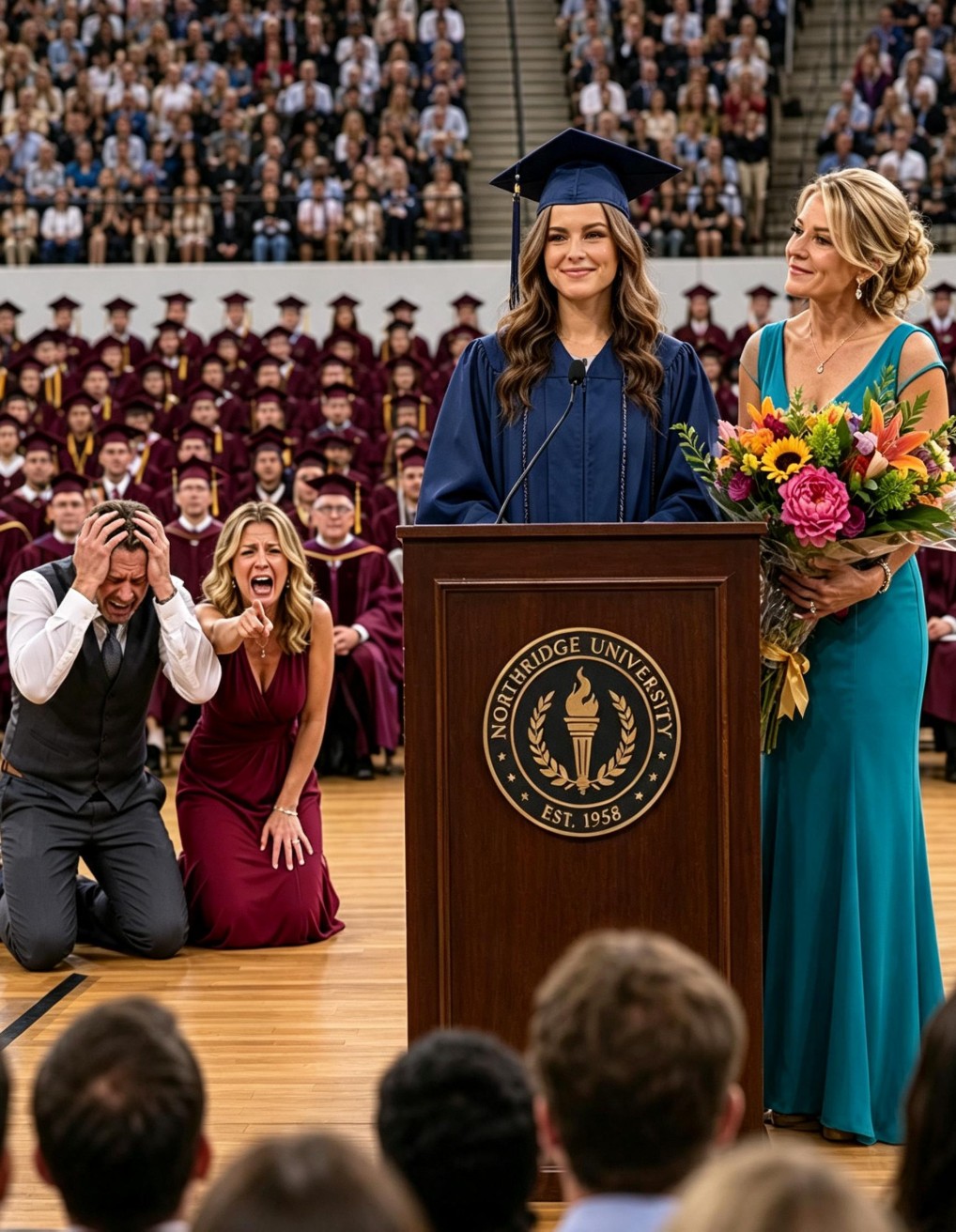
“It is my honor to introduce our valedictorian. She graduates at the top of her class and has completed outstanding research in pediatric oncology. Ladies and gentlemen, Dr. Emily Rivera.”
The arena erupted.
I stood.
My legs felt strangely calm.
I walked toward the podium.
When I looked toward the VIP section, Karen and Richard were frozen.
My mother covered her mouth.
My father’s face turned pale.
They were finally connecting the truth.
I adjusted the microphone.
“Thank you, Dean,” I began.
“To the faculty, families, distinguished guests, and my fellow graduates—congratulations.”
The crowd applauded politely.
I gripped the podium.
“When I was thirteen years old, I was diagnosed with acute lymphoblastic leukemia.”
The arena slowly became silent.
“I remember sitting in a hospital room, terrified and wondering whether I would survive. But the most frightening thing was not cancer.”
I paused.
“It was realizing that I would have to fight it alone.”
Nobody moved.
“My biological parents made a choice that day,” I continued. “They looked at the cost of my treatment, looked at their savings, and decided my life was not worth the investment.”
A few people gasped.
“They told me my sister’s college fund mattered more than my survival.”
I looked toward Karen and Richard.
“They legally abandoned me in that hospital room. I was thirteen. I was sick. I was bald, terrified, and discarded.”
The arena was completely silent.
My mother was crying.
My father stared down at his lap.
People around them had begun whispering.
“But I was not alone for long.”
I turned toward Megan.
“Because a pediatric oncology nurse named Megan Rivera saw a child who had been thrown away and decided to become her mother.”
Megan covered her mouth.
Tears streamed down her face.
“Megan took me home. She held my hand during treatment. She worked double shifts so I never went without. When my biological parents called me average, she told me I could change the world.”
I took a breath.
“She adopted me.”
My voice trembled.
“She saved me.”
I removed my graduation cap and placed it on the podium.
“This degree does not belong only to me,” I said.
“It belongs to Megan Rivera.”
I looked directly at her.
“She taught me that family is not blood. Family is the person holding your hand when everything goes dark.”
Megan was openly crying now.
Then I turned toward Karen and Richard.
“To my biological parents, who requested VIP seats today—thank you.”
My father slowly looked up.
“Thank you for abandoning me.”
The entire arena seemed to stop breathing.
“If you had not thrown me away, I would never have found my real mother.”
My mother covered her face.
“You gave up a daughter to protect a bank account.”
I paused.
“I hope it was worth it.”
The silence that followed was suffocating.
Then I turned back toward Megan.
“Mom, I love you.”
My voice broke.
“This is for you.”
And then the arena exploded.
It was not normal applause.
It was a thunderous standing ovation.
My classmates stood.
Professors stood.
Families stood.
People were cheering through tears.
I looked toward Karen and Richard.
They finally stood too.
But they were not standing proudly.
They were trying to leave.
Their faces burned with humiliation as people stared at them.
They moved toward the aisle, but security was already managing the crowd and guided them toward the exit.
For a few seconds, they looked trapped.
Not by security.
By the truth they had created themselves.
Part 7:
At the reception afterward, classmates and professors surrounded me.
Everyone wanted to congratulate me.
But I only wanted Megan.
When I finally found her, we held each other and cried.
“You didn’t have to say all that,” she whispered.
“Yes,” I said. “I did.”
I wiped my tears.
“It was the truth.”
Across the crowd, I saw Karen and Richard standing near the exit.
They lingered.
They seemed to be waiting for me to approach them.
I did not.
I turned away.
Eventually, they left.
But the story did not end there.
Over the next two weeks, more of the truth came out.
After abandoning me, my parents had poured everything into Ashley.
She went to Stanford.
Then she attended law school.
She married a wealthy investment banker.
Karen and Richard drained much of their retirement savings supporting the lifestyle they had built around Ashley.
Then everything collapsed.
Six months before my graduation, Ashley’s husband was indicted in a massive insider-trading case.
He was convicted and sent to federal prison.
Ashley lost her corporate law job because of the scandal.
Their assets were frozen.
Their house was seized.
Ashley cut my parents off completely.
Karen and Richard were suddenly facing foreclosure and had almost no one left.
Then they saw the university press release about me.
Their abandoned daughter was graduating as valedictorian from medical school.
And suddenly, they wanted to reconnect.
But I knew why.
They did not come back because they had finally discovered that they loved me.
They came back because they needed something.
They thought their successful doctor daughter might save them.
Instead, I told the truth.
The voicemails started almost immediately.
“Emily, it’s Mom,” Karen said in one message. “I know you’re angry. We made mistakes. But we’re losing the house. Ashley can’t help us. You’re a doctor now. Doctors help people. Please call me.”
I deleted it.
Then came an email from my father.
“Emily, you humiliated us. We made the best decision we could at the time. You turned out fine, so clearly we didn’t ruin your life. We are your blood. You owe us a conversation and some financial help.”
I stared at those words for a long time.
You turned out fine.
As if surviving leukemia without them had somehow proved they had been right.
As if my survival erased what they had done.
After dozens of messages, I finally replied once.
I wrote:
“When I was thirteen, you told me I was a bad investment. You called me average and threw me away to protect your money. Megan Rivera invested her life in me. She is my mother. My money, my success, and my family belong to her. I owe you nothing.”
I paused before adding one final sentence.
“Enjoy your return on investment. Do not contact me again.”
Then I blocked them.
Part 8:
That was three years ago.
I am thirty-one now.
I am officially Dr. Emily Rivera, and I am completing my fellowship in pediatric oncology at Boston Children’s Hospital.
Every day, I walk into hospital rooms and see children who remind me of the girl I once was.
Children who are frightened.
Children who do not understand why their bodies are betraying them.
Children who wonder whether they are going to survive.
And whenever I can, I sit beside them.
I hold their hands.
I look them in the eyes.
And I tell them what I once needed someone to tell me.
“You are not alone.”
Megan still lives in New York, although she works part-time now.
I bought her a new car last year.
We talk every day.
She is my mother.
My anchor.
My hero.
I heard that Karen and Richard eventually lost their house.
They now live in a small apartment and survive on Social Security.
Ashley no longer speaks to them.
They have almost no one.
People sometimes ask me whether I feel sorry for them.
I don’t.
I do not feel guilt.
I do not feel triumph.
And I do not feel sadness.
They made a financial decision fifteen years ago.
I simply finalized the transaction on that stage.
If you are reading this and you have ever been abandoned, rejected, or told by the people who were supposed to love you that you were not enough, listen carefully.
They were wrong.
Your worth is not determined by people who are too blind to see it.
You do not become worthless because someone failed to recognize your value.
And family is not defined by blood.
Family is defined by who stands beside you when everything is falling apart.
It is the person who stays when staying is difficult.
It is the person who holds your hand when you are terrified.
It is the person who sees your potential when you cannot see it yourself.
For me, that person was Megan.
She did not give me life.
She gave me something even more important.
She gave me a reason to keep living.
So find your Megan.
Build your life.
Build your future.
Build your own family.
And then let your success become the loudest answer to every person who ever told you that you were not worth saving.
Because sometimes the best revenge is not hurting the people who hurt you.
Sometimes it is simply becoming everything they were too blind to believe you could be.
The end.
