
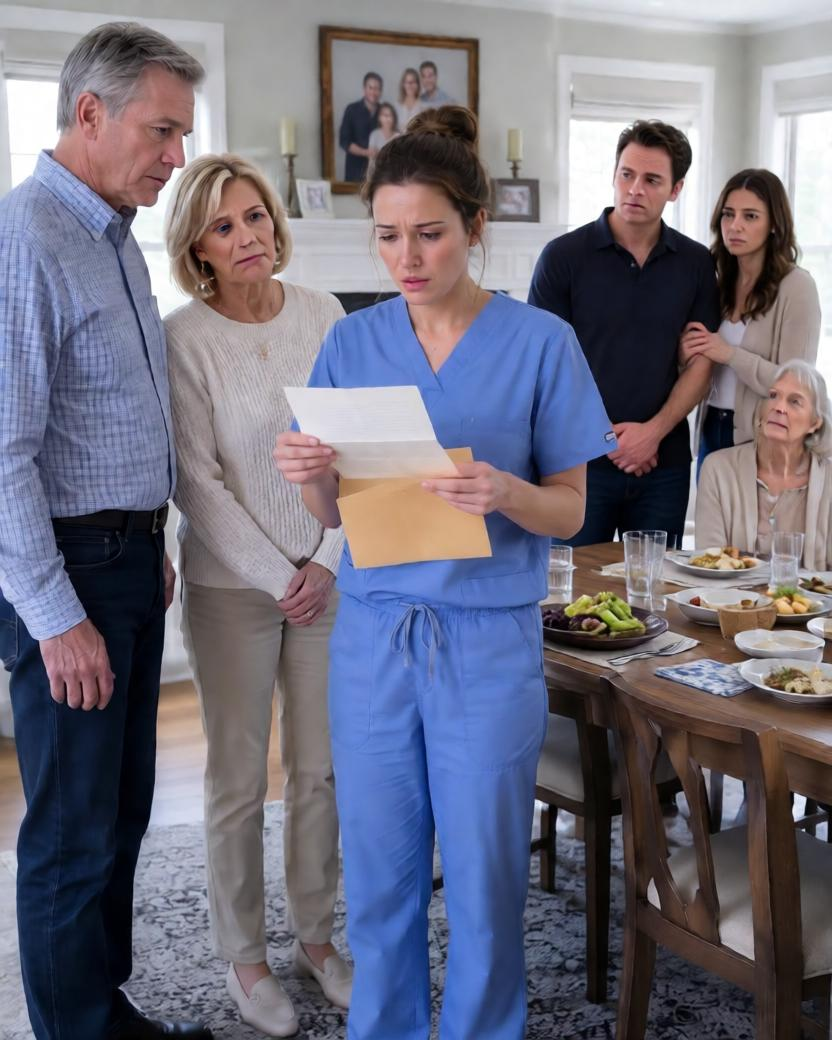
Part 1:
For six years, I gave my entire paycheck to my parents because they told me they were helping me build a better future.
I believed every word they said.
I believed the money was being saved for my first home. I believed the sacrifices I was making would eventually pay off. I believed my parents were pushing me because they loved me.
But everything changed during one simple family dinner.
My father laughed and casually revealed that the money I had worked so hard for was never a savings fund at all.
It was just “rent.”
The moment I heard those words, I felt the blood leave my face. My hands went cold, and my entire body felt numb. I wanted to scream. I wanted to demand answers.
But I stayed completely still.
Instead, I slowly reached into my bag and pulled out a folder.
A folder filled with everything they never expected me to have.
“If you are going to keep living under this roof, you are going to pay me twenty-five hundred dollars every month,” my father, Frank, told me the morning after I came home from university.
“And you need to understand that we are doing this completely for your own good.”
My name is Cheryl. I was twenty-two years old at the time, and I had just started a job at a dental laboratory in the city of Riverdale.
I was not earning a huge salary, but for the first time in my life, I felt like I was moving forward.
I had a career.
I had independence.
I had a plan.
After university, I moved back into my parents’ house in a quiet suburban neighborhood. I thought it would only be temporary. I wanted to save as much money as possible so I could buy my own condo before my friends started buying homes of their own.
To me, moving back home was not a failure.
It was a smart financial decision.
At least, that was what I believed.
That morning, my father sat at the head of our old oak dining table.
My mother, Dorothy, sat beside him with a cup of coffee waiting for me.
That immediately felt strange.
My mother was not usually the type to prepare something for me before a conversation. Looking back, I realize they had planned everything before I even walked into the room.
The moment I sat down, my father began explaining the arrangement like it was already decided.
There was no discussion.
No negotiation.
Just a plan they expected me to accept.
I would continue living in their house, and every month I would hand over $2,500.
But they assured me it was not really gone.
They said they would put the money into a high-yield savings account under my name.
After three or four years, they promised, I would have enough for a large down payment on a beautiful home of my own.
My mother reached across the table and grabbed my hand.
She gave me a soft smile.
“It is all for your future, sweetie,” she said. “I promise that one day you will look back and thank us for being so strict about this.”
I quickly did the math in my head.
$2,500 every month meant $30,000 every year.
After several years, I would have more saved than most people my age.
Yes, it was a lot of money.
Yes, it would be difficult.
But I convinced myself it was the responsible choice.
I told myself that this was what adults did.
They made sacrifices now so they could have a better life later.
So I agreed.
“I’ll do it,” I told them.
And at that moment, I actually felt proud of myself.
I thought I was making a mature decision.
I thought I was building my future.
For the first year, I followed the plan perfectly.
Every month, I handed over half of my salary to my parents.
The rest went toward my basic expenses.
Gas.
Car insurance.
My phone bill.
A few personal necessities.
That was it.
I drove an old, worn-out sedan with a faded dashboard and scratches covering the outside. While my coworkers ordered expensive lunches, I brought my own food to the dental lab in cheap plastic containers.
When my coworkers invited me to go out for sushi or suggested ordering fancy desserts after work, I always smiled and gave the same answer.
“I’m following a strict financial plan right now.”
They respected me for it.
They thought I was disciplined.
And honestly, I thought so too.
I truly believed I was making the right choices.
When I reached the one-year mark, I wanted to check how much my savings had grown.
I asked my mother if she could send me a screenshot of the account balance.
That same night, she sent one.
The image showed a plain white screen with a perfect, round number.
$30,000.
But something was missing.
There was no bank logo.
No account number.
No official information.
Nothing that proved it came from a real bank.
Still, I did not question it.
I felt proud instead of suspicious.
I told myself my mother probably removed the details to protect my privacy.
I trusted her.
My older brother, Caleb, had always been treated differently.
He had lived in the same house until he was twenty-six years old, and during all those years, my parents never charged him a single dollar.
Not for rent.
Not for groceries.
Not for anything.
Recently, he had married his longtime girlfriend, Heidi.
They now had a beautiful daughter named Joy.
Whenever I asked why Caleb never had to contribute like I did, my father reacted like I had insulted the entire family.
One night, during dinner, I finally brought it up again.
My father immediately slammed his fork onto his plate.
“Caleb faced very different circumstances than you do, so stop asking questions,” he snapped.
I looked at him, frustrated.
“I’m trying to build my future too,” I said. “I’m doing exactly what you told me to do. I don’t understand why I’m the only one contributing.”
My mother quickly stepped in.
She waved her hand as if my concern was unreasonable.
“Do not compare yourself to your brother, Cheryl,” she said. “That is not a healthy way to look at our family.”
I wanted to argue.
I wanted to ask more questions.
But I already knew how things worked in that house.
Keeping quiet was something I had learned over many years.
So I dropped the subject.
At least for the moment.
I had no idea that the money I was sacrificing every month was not building my future.
It was building someone else’s.
And soon, the truth would begin to appear.
Part 2:
A few months later, Caleb and Heidi announced some exciting news.
They had bought a house.
Not just any house.
It was a beautiful home in a brand-new development just outside the town.
Everyone gathered around them as they proudly shared the details. They explained that they had managed to put down a $60,000 down payment.
At the Sunday family lunch, my father looked happier than I had seen him in years.
He walked over to Caleb, hugged him tightly, and smiled with pride.
“That is my boy right there,” my father announced while raising his glass. “I am so incredibly proud to see you finally own your own home.”
The whole dining room filled with applause.
Everyone smiled.
Everyone celebrated.
And I clapped along with them.
But inside, something felt wrong.
A heavy feeling settled in my stomach.
Because I could not stop thinking about one question.
Where did Caleb get $60,000 for a down payment?
On the drive back to the dental lab that afternoon, I rolled down my car window and let the warm air hit my face.
Normally, I would have been proud of myself too.
I was saving money.
I was being responsible.
I was following the plan my parents created for me.
But the more I thought about it, the more uncomfortable I became.
Caleb had somehow bought a house while I was still living like a college student.
I was bringing cheap lunches to work.
I was driving an old car.
I was giving away thousands of dollars every month.
And somehow, my brother had managed to buy a home.
The question stayed in my mind.
Where had that money really come from?
Three years after starting the savings arrangement, I finally decided I needed answers.
This time, I did not just ask my mother for the balance.
I asked for the actual account information.
I wanted the account number.
I wanted to visit the bank myself.
I wanted to see my money with my own eyes.
My mother was standing in the kitchen cleaning the counters when I approached her.
She did not even look up.
“The account is held in your father’s name for tax reasons,” she said. “But do not worry. Every single cent is still there, safe and sound.”
I stared at her.
That answer did not make sense.
“It is my money,” I said carefully. “Can I at least get official bank statements?”
She continued wiping the counter.
“I will get them for you later,” she replied.
I waited.
Days passed.
Then weeks.
I followed up with a text message asking about the documents.
Her response was always the same.
“Be patient, Cheryl.”
Eventually, she sent me another screenshot.
Once again, it showed a balance.
$90,000.
But just like before, it was nothing more than a number on a blank white screen.
No bank logo.
No account information.
No official statement.
No proof.
I stared at the image for a long time that night.
Something felt different this time.
I noticed small things I had ignored before.
The font looked slightly uneven.
The spacing between the numbers seemed strange.
It was not just about the screenshot anymore.
It was a feeling deep inside me.
A warning I could not explain.
Something was wrong.
The truth finally began to come out on a Tuesday afternoon.
I had to leave the dental laboratory early because a plumbing problem had flooded the break room.
I was supposed to work until the evening, but the manager sent everyone home.
When I arrived back at my parents’ house, it was just before 2 p.m.
My father’s truck was gone from the driveway.
But my mother’s car was parked exactly where it always was.
The sliding glass door leading to the patio was slightly open.
I walked toward the house quietly.
Before I could announce that I was home, I heard my mother’s voice.
She was talking on the phone.
Her voice was low.
Serious.
Almost secretive.
I stopped behind the kitchen island and listened.
“That amount covers almost everything we owe for Caleb’s house,” my mother said.
My entire body froze.
Then she continued.
“And the best part is that she has not even noticed anything is wrong.”
My heart started beating faster.
I knew that voice.
The person on the other end of the phone was my Aunt Martha.
She was my mother’s sister.
And she was a retired accountant.
Someone who understood money.
Someone who would understand exactly what my mother was talking about.
I stood there silently, afraid to even breathe.
Then my mother spoke again.
“Frank says that if he can keep her paying for two more years, we will finally be able to finish covering up the debts from his failed business venture.”
My stomach dropped.
The room suddenly felt smaller.
The air felt heavy.
I felt like someone had pulled the ground out from under me.
For three years, I had believed I was saving for my future.
But my parents were using my money to fix their own problems.
And Caleb’s house.
Aunt Martha said something on the other end of the phone, but I could not hear the words.
All I heard was my mother’s reply.
Her voice sounded calm.
Cold.
Like what they were doing was completely normal.
“Oh, Martha, do not be so dramatic about it,” my mother said. “Cheryl will get it back eventually, so just keep your mouth shut for now.”
I felt something inside me break.
Not because I finally discovered the money was gone.
But because of how easily they talked about it.
Like my dreams did not matter.
Like my sacrifices were just a tool they could use.
I slowly stepped away from the kitchen.
I did not confront them.
I did not yell.
I did not cry.
I quietly walked upstairs to my bedroom and closed the door behind me.
Then I sat on the edge of my bed.
For a long time, I just stared at the floor.
And suddenly, I understood.
All those conversations I had overheard years earlier.
All those strange explanations.
All those times they told me they were doing this “for my future.”
They were never talking about my future.
They were talking about theirs.
The most painful part was not only that my parents had lied to me.
It was realizing what they had done with my trust.
For three years, I had handed over my hard-earned money every single month because I believed I was building a better life.
But while I was sacrificing everything, my brother was living in a beautiful new home partly paid for by the money I had given my parents.
The people who were supposed to protect me had been using me.
And now that I knew the truth, I had a choice to make.
I could confront them immediately.
Or I could wait.
And make sure they could never lie their way out of it.
Part 3:
That night, I made the most important decision of my life.
I would not confront my parents.
Not yet.
I knew them too well.
If I walked downstairs and accused them of stealing my money, they would deny everything. They would twist the story. They would make me look like the ungrateful daughter who attacked her own family.
I needed proof.
Real proof.
I needed something they could not explain away.
So I decided to wait.
I decided to collect every piece of evidence I could find and expose the truth when they had nowhere left to hide.
I opened my laptop and created a new folder on my cloud drive.
I named it:
Home Fund
That folder became my secret weapon.
I started gathering everything.
Every text message.
Every email.
Every screenshot of the fake account balances.
Every conversation where my parents talked about my savings or my future.
Every promise they had made.
I saved everything.
By the time I went to sleep that night, I already had fourteen separate files stored inside the folder.
Fourteen pieces of evidence.
Fourteen reminders of what they had done.
The next morning, I acted like nothing had changed.
I walked into the kitchen.
I smiled.
I handed my mother the usual $2,500.
Exactly like I had done every month before.
She accepted the money with the same warm expression she always used.
“Thank you, Cheryl,” she said. “I am so proud of how responsible you are being.”
Those words almost made me laugh.
Almost.
Because she had no idea that every lie she told me was now becoming evidence against her.
From that day forward, I became extremely careful.
I stopped asking questions in person.
I stopped giving them opportunities to rewrite conversations.
Instead, I made sure everything happened through messages or emails.
I wanted a digital record.
Something permanent.
Something they could not deny.
“Mom, how is my fund doing this month?” I would text her.
A few minutes later, she would reply.
“It is growing beautifully, honey. You are so close to reaching your goal!”
Every single message went directly into my folder.
I saved everything.
The lies.
The promises.
The fake updates.
All of it.
A few weeks later, I decided I needed to speak with Aunt Martha.
I drove to her small cottage on the edge of town.
Her home was quiet and peaceful, filled with plants sitting on every windowsill.
It was the kind of place where someone could feel safe.
When I knocked on the door, she opened it before I even finished.
For a moment, she just looked at me.
Almost like she had been expecting this day to come.
“Auntie, I need you to tell me exactly what you know,” I said.
My voice shook slightly, but I forced myself to stay calm.
She stared at me for several seconds.
Then she sighed.
“You heard the phone call, didn’t you?”
I slowly nodded.
She stepped aside and invited me inside.
We sat at her kitchen table.
Aunt Martha removed her glasses, folded them carefully, and placed them beside her.
The way she did it made the moment feel serious.
Like she was preparing to testify in court.
“Your mother told me exactly what was happening,” she said.
She paused.
“She told me that the money you gave them every month was being used to cover almost all of Caleb’s mortgage payments.”
My chest tightened, even though I already knew the truth.
Aunt Martha continued.
“I told her it was wrong. I told her you deserved to know what was happening. But she insisted they would pay you back once your father’s business recovered.”
I looked down at the table.
A strange feeling came over me.
It was not happiness.
It was not relief.
It was something else.
A strange calm.
Because for the first time, the confusion was gone.
The questions were gone.
The truth was finally clear.
I looked back at my aunt.
“Would you be willing to say that again in front of someone important?” I asked.
She understood immediately.
“A lawyer?” she asked.
I nodded.
For a moment, she closed her eyes.
When she opened them again, there was determination in her expression.
“She is my sister,” Aunt Martha said quietly. “But what they have done to you is an absolute betrayal. I cannot stand by and watch you be destroyed.”
Those words meant more to me than she probably realized.
For years, I felt like I was alone.
But now I had someone who knew the truth.
Someone willing to stand beside me.
The following week, I found a legal clinic that offered free advice for people dealing with situations like mine.
I arrived straight from work.
I was still wearing my dental lab scrubs.
My hands were sweating as I sat in the office and handed my phone to the lawyer.
For thirty minutes, I explained everything.
Then the attorney carefully reviewed every piece of evidence I had collected.
The screenshots.
The messages.
The emails.
The recordings.
Everything.
Finally, he looked up at me.
“How much evidence do you have?” he asked.
“I have twenty-two separate files,” I replied. “Messages, emails, a recorded voice note, and a witness.”
The lawyer slowly nodded.
His expression became serious.
“Keep saving everything,” he told me. “Do not change your behavior. And whatever you do, do not let them know you understand what is happening.”
I listened carefully.
Because I knew he was right.
The moment my parents realized I knew the truth, they would try to protect themselves.
So I followed his advice.
I continued living in their house.
I continued paying the monthly “rent.”
I continued smiling at family dinners.
Meanwhile, I watched my father proudly talk about Caleb as if he had achieved everything by himself.
I listened as my parents treated me like the daughter who was struggling to get her life together.
They had no idea that the person they underestimated was quietly building a case against them.
The months passed.
Then the years passed.
Finally, the sixty-second month arrived.
The final payment.
The last $2,500.
After six years of payments, the total amount they had taken from me reached:
$180,000.
Money I had earned.
Money I had sacrificed for.
Money they had promised to protect.
That same week, my mother sent a message to our family group chat.
“Thanksgiving lunch is at our house this year, and everyone is invited. I hope you are all excited!”
My family loved huge gatherings.
Almost thirty people would usually attend.
Normally, I hated those events.
I hated sitting at the table pretending everything was normal.
But this time was different.
This time, I knew exactly what I was going to do.
Before Thanksgiving, I called my lawyer.
I explained that I planned to ask my parents about the money in front of everyone.
She listened carefully.
Then she gave me advice.
“If they lie in front of witnesses, it will only strengthen your case,” she told me.
I thanked her.
I did not want revenge.
I did not want to destroy my family.
I simply wanted the truth.
I planned to give my parents one final opportunity to admit what they had done.
If they told the truth, maybe there was still a way to fix things.
But if they lied again…
Then everyone would finally see who they really were.
And this time, they would not be able to hide.
Part 4:
On the day of the Thanksgiving lunch, I arrived early.
I wanted everything to look normal.
I did not want anyone to suspect what was about to happen.
I walked into my parents’ house carrying a large pot of mashed potatoes. I helped set the table, arranged the dishes, and even helped my niece Joy find some of her toys.
To everyone else, it looked like another ordinary family gathering.
Nobody knew what was hidden inside my bag.
Nobody knew about the manila folder sitting near the coat rack.
Inside that folder were six years of my life.
Six years of sacrifices.
Six years of lies.
The dining room slowly filled with family members.
The conversations became louder.
The smell of food filled the house.
Everyone laughed and acted like we were the perfect family.
But underneath all of it, I felt a quiet tension.
Aunt Martha looked nervous.
She knew what was coming.
My father, Frank, sat proudly at the head of the table like he always did.
He loved being the center of attention.
He lifted his wine glass and looked around the room.
“You know,” he said, “a home is more than just walls. It is about the sacrifice and hard work we put into our children so we can watch them succeed.”
He looked directly at Caleb.
“Just like Caleb has.”
Caleb smiled proudly and raised his own glass.
“I could not have done it without the foundation you built for me, Dad,” he replied.
Everyone smiled.
Everyone admired them.
But I stood quietly near the sideboard, watching the people who had spent years lying to me.
Then I spoke.
“Speaking of sacrifices…”
My voice cut through the laughter.
The entire room became silent.
Every person at the table turned toward me.
My mother’s smile disappeared for just a second.
Then, as always, she quickly replaced it with a sweet expression.
“Cheryl, honey,” she said softly, “this is not the time for this.”
Her voice sounded gentle.
But I knew that tone.
It was the same tone she used whenever she wanted me to stop asking questions.
I looked at her.
“No, Mother,” I said calmly. “I think today is actually the perfect time to talk about this.”
I stepped closer to the table.
“It has been exactly six years since I started the savings fund for my apartment.”
My father let out a small laugh.
Not a nervous laugh.
A mocking one.
He looked around the room like he expected everyone to find the situation funny.
“Oh, Cheryl,” he said. “Are you still obsessed with that silly thing?”
He shook his head.
“You are young. You do not understand how real-world finances work.”
I looked straight at him.
“I think I understand perfectly, Father.”
My voice stayed steady.
“I have done the math.”
I paused.
“Seventy-two deposits of $2,500 each equals $180,000.”
The room became even quieter.
“I just want to know when we are going to the bank so I can finally move that money into my own account and start looking for my first home.”
For a few seconds, nobody said anything.
Then my father’s expression changed.
The confidence disappeared.
His face became angry.
He slammed his hand against the table.
The silverware jumped.
Several family members flinched.
“You are making a scene!” he shouted. “You are being incredibly ungrateful!”
He pointed around the room.
“We gave you a roof over your head. We gave you food. We let you live here. Do you really think those things come for free?”
I stood there, looking at him.
“I paid my share of the household expenses, Dad,” I replied. “And we both know that the $2,500 was supposed to go into my savings account.”
Then my father said the words I had been waiting six years to hear.
“The deal?”
He laughed bitterly.
“You want to know about the deal?”
His voice became louder.
“That was rent, Cheryl!”
The entire room froze.
“You were living in my house, eating my food, and using my electricity. That money was used to keep this family afloat while you played around at your dental lab.”
Silence.
Absolute silence.
Nobody moved.
Nobody spoke.
My grandmother looked horrified.
Caleb stared down at his daughter Joy, suddenly unable to look anyone in the eye.
And me?
I felt something I had not felt in years.
Relief.
Because my father had finally admitted the truth.
In front of witnesses.
I looked directly at him.
“So you lied to me for six years?”
My voice was quiet.
“You let me believe I was building a future while you were taking my money and using it to help pay for my brother’s house?”
My mother immediately stood up.
“Do not you dare bring your brother into this!” she shouted.
Her calm mask was gone.
“He is a man with a family!”
She pointed at me.
“You are just a spoiled girl who does not understand the value of family loyalty!”
I almost laughed.
Family loyalty.
That was what she called it.
I walked over to the coat rack.
Nobody stopped me.
Nobody knew what I was about to do.
I picked up my bag and removed the manila folder.
Then I walked back to the table.
I placed it down beside the gravy boat.
I did not scream.
I did not cry.
I did not need to.
The evidence spoke for itself.
“Loyalty is a two-way street, Mother,” I said.
My voice was calm.
Cold.
“I have every text message. Every fake promise. Every balance update you sent me.”
I opened the folder.
“And I have a witness.”
I looked around the room.
“And I have a lawyer who is ready to take this to court.”
My father slowly stood up.
His face was filled with anger.
“You would really destroy this family over money?”
I looked at him.
The man who had spent years pretending to protect me.
The man who had taken my trust and used it against me.
“No,” I answered.
“You destroyed this family when you decided to steal from your own daughter.”
Nobody spoke after that.
For the first time in six years…
The truth was finally sitting at the table with us.
Part 5:
The aftermath was like a storm ripping through our family.
Nobody knew what to say.
The cheerful Thanksgiving celebration was gone.
The laughter disappeared.
The room that had once been filled with smiles was now filled with uncomfortable silence and whispers.
One by one, relatives started leaving.
Some avoided eye contact.
Some looked at my parents with disappointment.
Others looked at me with sympathy.
But nobody could deny what had happened.
The truth was finally out.
As I walked toward the front door, Caleb rushed after me.
“Cheryl, wait,” he said.
I stopped for a moment.
I could hear the panic in his voice.
He knew what this meant.
He knew that the house he was so proud of had been built partly on my sacrifices.
But I did not turn around.
I did not want excuses.
I did not want explanations.
I simply walked outside into the cool afternoon air.
Behind me, the folder remained open on the dining table.
A reminder of everything they had done.
A reminder that their lies were finally exposed.
The next three months were the hardest months of my life.
But they were also the most powerful.
For the first time, I was no longer pretending.
I was no longer protecting people who had hurt me.
I was finally protecting myself.
My lawyer was incredible.
She carefully reviewed every piece of evidence.
The messages.
The emails.
The screenshots.
The recorded conversations.
The testimony from Aunt Martha.
Everything I had collected over six years became impossible to ignore.
When my parents realized I was serious and that I was not going to simply forgive and forget, their confidence disappeared.
The attitude they once had was gone.
They could no longer laugh at me.
They could no longer tell me I was imagining things.
They knew they had been caught.
The biggest problem was that they did not actually have the $180,000 sitting in a bank account.
The money was gone.
They had spent it.
They had invested it.
They had used it to support their lifestyle.
But they still owned their suburban house.
That house became the center of the settlement.
The mediation meeting felt like saying goodbye to the childhood I thought I had.
My father sat across from me.
For the first time, he looked different.
Smaller.
Older.
Defeated.
The man who had once acted like he controlled everything now looked like someone who had finally run out of excuses.
He tried to explain himself.
He tried to argue that things were more complicated than I understood.
But then my lawyer placed the evidence on the table.
The transcripts from the recorded conversations.
The messages.
The notarized statement from Aunt Martha.
Everything.
My father looked down at the documents.
His shoulders dropped.
Finally, he whispered:
“We do not have the cash.”
The room became quiet.
I looked at him.
“Then you have the house,” I said.
The settlement happened quickly after that.
My parents signed over a portion of their home equity to me.
It was not the exact outcome I had imagined years earlier.
When I started saving, I dreamed of seeing money sitting safely in my own bank account.
I dreamed of walking into a real estate office and buying my first home with the savings I had built.
Instead, I received something different.
A legal document.
A piece of property.
Proof that my hard work had not completely disappeared.
Proof that I had stood up for myself.
The day the papers were finalized, I moved out.
I packed my belongings quietly.
I did not make a dramatic speech.
I did not yell.
I did not cry.
And I did not say goodbye.
Because there was nothing left to say.
The relationship I thought I had with my parents had already been broken long before that day.
Two years later, everything had changed.
I stood on the balcony of my own small apartment in a quiet, beautiful neighborhood in Silver Creek.
It was not a mansion.
It was not a huge house.
But it was mine.
Every corner of that place represented my own choices.
My own strength.
My own freedom.
The sun was setting in the distance, painting the sky with shades of orange and violet.
For the first time in years, I felt peaceful.
Then my phone buzzed.
I looked down.
It was a message from my mother.
“We miss you so much. Can we please come over for dinner? Joy really misses her aunt.”
I stared at those words for a long time.
I thought about the girl I used to be.
The girl who lived in a bedroom with peeling paint.
The girl who ate simple leftovers every night because she believed she was making a sacrifice for her future.
The girl who trusted her parents completely.
I thought about my father sitting at that dinner table, laughing as he called my dreams “rent.”
I thought about all the years I spent believing their promises.
And strangely…
I realized I was no longer angry.
The anger belonged to the younger version of me.
The girl who was still trapped inside that house.
The woman standing on that balcony was different.
She had survived.
She had rebuilt her life.
She had found peace.
I typed my response.
“I have moved on, and I suggest you do the same. I have a life now that I built myself, and I am not interested in revisiting the past.”
I looked at the message one final time.
Then I pressed send.
After that, I blocked the number.
I placed my phone down on the small table beside me.
Then I turned back toward the view.
The evening air was cool against my skin.
For the first time in my entire life, I felt completely free.
The future was no longer something my parents controlled.
It was no longer something they could promise me.
It was mine.
And I had built it myself.
THE END.
