
Part 1:
I sent a message to our family group chat:
“My flight lands at five. Can anyone pick me up?”
I had just returned from another country after burying my husband.
I wasn’t asking for anything big.
I just wanted to see a familiar face after the worst days of my life.
My brother replied first.
“Lucas: Today is hectic. Just call an Uber.”
A few moments later, my mother added:
“Mom: Why didn’t you arrange this sooner? You know Tuesdays are difficult for everyone.”
I stared at the screen.
I read the messages again and again.
Then I typed only two words:
“No problem.”
At the time, I had no idea that those messages would appear on television less than a day later.
And when my family saw what happened on the evening news, every one of them would be left speechless.
My name is Clara.
I am thirty-five years old.
And that morning, I buried my husband, Julian, in a country that never truly felt like home for either of us.
The day had passed in a blur of paperwork, tears, and painful goodbyes.
Julian had died suddenly from a brain aneurysm.
One moment he was alive.
The next, everything we had planned for our future was gone.
I had spent days alone in a foreign country dealing with things no one should ever have to face alone.
I identified his body.
I signed documents I barely understood.
I arranged an overseas funeral.
And I stood beside his grave without a single member of my family beside me.
When my plane finally landed at Portland International Airport, the tires hit the runway with a sharp screech.
The sound pulled me back into reality.
Before we even reached the gate, I grabbed my phone.
My hands were shaking.
Not because of the cold.
Not because I was tired.
But because a small part of me still hoped my family would come through.
Maybe they would surprise me.
Maybe they would understand that I needed them.
Maybe they would finally show up.
I opened our family group chat and typed:
“My flight arrives at 5:00 p.m. Could someone please pick me up?”
Almost immediately, the typing dots appeared.
For one brief moment, my heart lifted.
Someone was answering.
Someone cared.
Then my brother’s message appeared.
“Lucas: Today is hectic. Just call an Uber.”
The hope disappeared instantly.
A few seconds later, my mother responded.
“Mom: Why didn’t you arrange this sooner? You know Tuesdays are difficult for everyone.”
I stared at those words until they became blurry.
Arrange it sooner.
As if I had planned Julian’s death.
As if his brain aneurysm had been an event I should have added to a family calendar.
As if losing my husband was simply a scheduling problem.
I could have argued.
I could have reminded them what I had just gone through.
I could have told them about the funeral.
About standing alone beside Julian’s grave.
About carrying the weight of everything by myself.
But I didn’t.
I didn’t have the strength.
I didn’t want another disappointment.
So I wrote:
“No problem.”
I had no idea that those two words would become the final message my family ever received from me.
By the time I reached baggage claim, my phone buzzed again.
This time it was my father.
“Dad: Heavy rain is expected tonight. Be careful getting home.”
Then my mother sent another message.
“Mom: Your father and I have dinner with the Hendersons. We accepted weeks ago.”
I read it twice.
Their dinner plans mattered more than picking up their daughter after she had buried her husband alone.
That realization hurt more than I expected.
I locked my phone and placed it inside my coat pocket.
A few minutes later, two large black suitcases appeared on the luggage carousel.
They contained almost everything I had left of Julian.
His shirts.
His shoes.
His shaving kit.
The dark-blue tie he wore during our anniversary dinner.
Small pieces of a life that had ended far too soon.
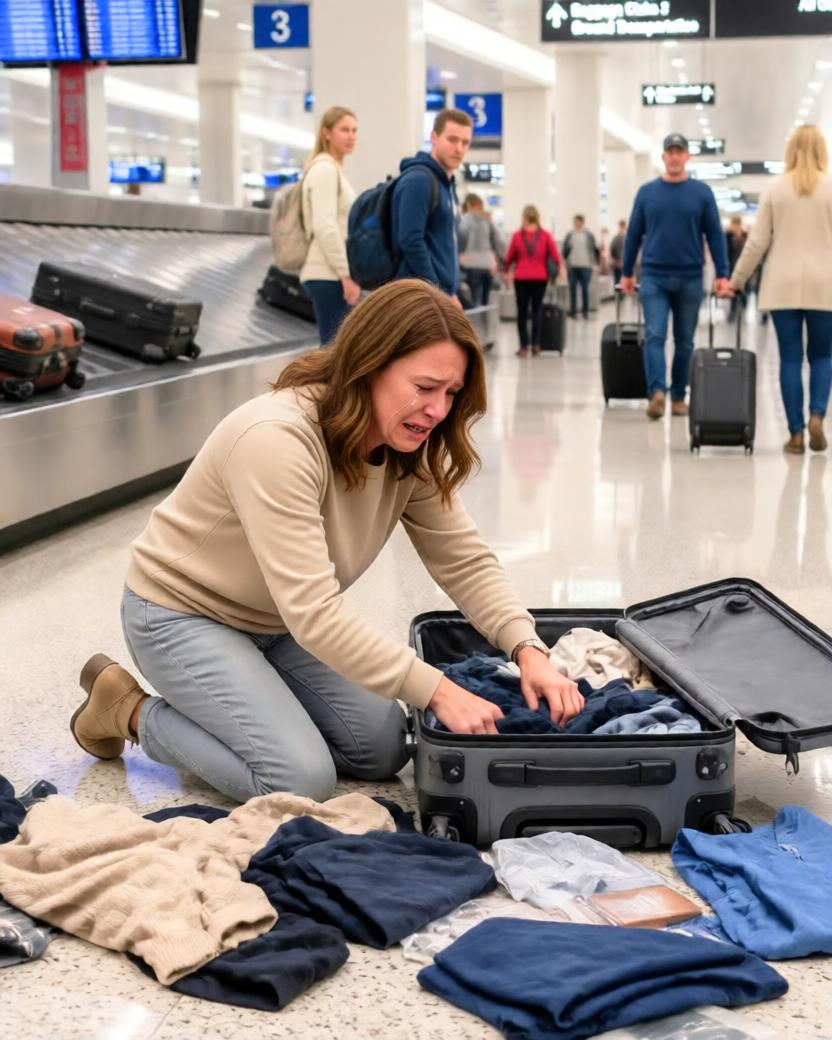
I struggled to lift both suitcases onto a luggage cart.
The weight felt impossible.
Not just because of the bags.
Because of what they carried.
Memories.
Love.
A life that was suddenly only memories.
I pushed the cart toward the exit.
Then one of the wheels suddenly locked.
The cart stopped.
The upper suitcase fell forward.
It crashed onto the airport floor and split open.
Julian’s belongings spilled everywhere.
Socks.
Ties.
Folded shirts that still carried a faint trace of his cologne.
Pieces of the man I loved scattered across cold terminal tiles.
People walked around me, rushing to catch flights and return home.
But I dropped to my knees.
I didn’t care who was watching.
I grabbed his clothes with shaking hands, trying to put everything back.
My eyes filled with tears.
My chest tightened.
For a moment, I felt like I couldn’t breathe.
Then an airport employee noticed me.
He walked over, knelt beside me, and started helping collect Julian’s things.
A complete stranger showed me more kindness than my own family had.
My family lived less than an hour away.
Not one of them was coming.
I ordered a rideshare and sat quietly in the back seat while rain tapped against the windows.
The driver tried speaking to me twice.
Both times, I pretended I didn’t hear him.
I didn’t have the energy to explain.
I didn’t have the strength to tell another person that I had just buried my husband.
When the car finally stopped outside my house, every window was dark.
The home Julian and I had built together looked empty.
Cold.
Different.
The moment I stepped inside, freezing air surrounded me.
I left the suitcases near the entrance.
I didn’t turn on the lights.
I didn’t unpack.
I walked straight to the living room and sat in the armchair where Julian used to sit every Sunday morning with his coffee and newspaper.
The silence was unbearable.
It filled every corner of the house.
It pressed down on me from every direction.
I believed I was completely alone.
But I didn’t know something inside the house had already started going terribly wrong.
Something my family never noticed.
Something that would break the silence before the night ended.
Soon, neighbors would rush into the street.
Emergency vehicles would fill the driveway.
News cameras would arrive before sunrise.
And by the time my family saw my house on the evening broadcast, it would be far too late to erase the messages they had sent.
Part 2:
The first thing I noticed was the cold.
It wasn’t normal winter cold.
It was the kind of cold that seemed to enter your bones.
I sat in the dark living room, wrapped in a blanket, still wearing the same clothes I had traveled in.
I was exhausted.
My body was tired.
My heart was broken.
But I knew I couldn’t stay like that forever.
The house needed heat.
The temperature inside kept dropping, and I realized something was wrong with the furnace.
I forced myself to stand up.
My legs felt weak, but I walked toward the basement.
As I reached the stairs, my phone buzzed again.
For a second, I thought maybe my family had changed their minds.
Maybe they were checking on me.
Maybe they were asking if I was safe.
But it wasn’t a message from them.
It was only another reminder that I was alone.
I went downstairs and carefully made my way toward the electrical panel.
The basement floor was wet.
At first, I thought it was just a small leak.
Then I noticed water spreading across the ground.
The heavy rain outside must have caused flooding.
I stepped carefully, trying not to slip.
I reached toward the electrical box, hoping I could fix the problem and bring warmth back into the house.
But the moment my hand moved closer, everything changed.
My foot lost its grip on the wet floor.
I slipped.
My body fell backward.
And suddenly, a powerful electrical shock shot through me.
Pain exploded through my entire body.
The force threw me across the basement floor.
For a moment, there was nothing.
No sound.
No movement.
No thoughts.
Then slowly, I opened my eyes.
I didn’t know how long I had been unconscious.
A few seconds?
A few minutes?
Everything was blurry.
My head was spinning.
The basement felt freezing.
I tried to move, but my muscles barely responded.
I was scared.
I was alone.
And nobody even knew I was there.
Somehow, I forced myself to crawl.
Every movement hurt.
My arms shook as I pulled myself across the floor.
I reached the stairs and slowly climbed upward.
Each step felt impossible.
But I kept going.
When I finally reached the living room, I collapsed onto the sofa.
I couldn’t even lift my head.
I closed my eyes, trying to catch my breath.
Then I heard it.
A sound that cut through the silence.
Beep.
Beep.
Beep.
At first, I didn’t understand.
Then I realized.
The carbon monoxide alarm.
My eyes opened.
A wave of fear rushed through me.
The furnace wasn’t just broken.
Something was seriously wrong.
Dangerous gas was filling the house.
Carbon monoxide.
A silent killer.
I tried reaching for my phone.
It was sitting only inches away on the table.
So close.
But my body wouldn’t cooperate.
My arm moved slowly.
Too slowly.
My vision started fading.
The room began spinning.
The edges of my sight turned dark.
I knew I needed help.
But I couldn’t call.
I couldn’t move.
I couldn’t even shout.
I thought about Julian.
I thought about how unfair it was.
I had already lost him.
I couldn’t believe my life might end in the same house we had shared together.
Then suddenly—
A loud crash.
The front door flew open.
“Fire department!”
The voice echoed through the house.
I heard heavy footsteps rushing inside.
“Ma’am! Can you hear me?”
I wanted to answer.
I wanted to tell them I was there.
But I couldn’t.
The next thing I knew, someone was lifting me.
Fresh air hit my face.
Cold rain touched my skin.
The emergency workers had found me.
And the reason I was alive was because someone else noticed what my own family had ignored.
My neighbor, Diane.
She had seen water flowing from underneath my front door.
At first, she thought something was wrong with the house.
Then she noticed the carbon monoxide alarm could be heard from outside.
She didn’t hesitate.
She called emergency services.
She saved my life.
While my family sat at dinner with the Hendersons, believing I was just taking an Uber home, Diane had been the person who came looking for me.
A neighbor.
A person who wasn’t related to me.
A person who simply cared.
And she arrived just in time.
Because if she had waited any longer, I would not have survived that night.
Part 3:
The cold rain of Portland continued falling as blue emergency lights flashed across my front yard.
The storm that night made everything feel darker.
Firefighters moved quickly through the house, carrying heavy equipment and dragging thick black hoses through the front door.
Paramedics wrapped me in warm thermal blankets.
An oxygen mask covered my face as they tried to stabilize me.
My body was weak from the electrical shock and the carbon monoxide poisoning.
I could barely understand what was happening around me.
But outside, something else was already beginning.
News vans were arriving.
Their satellite dishes rose into the dark sky.
The local news crew had been following the winter storm problems happening throughout the neighborhood.
They had expected another report about damaged homes, flooding, and dangerous weather conditions.
But then they saw firefighters carrying a woman out of a house.
A woman who had just returned from burying her husband overseas.
A woman who had nearly died alone.
The story suddenly became something much bigger.
An investigative reporter named Sarah Vance walked toward the ambulance.
She held a microphone in her hand.
The red light on the camera turned on.
She looked at me with genuine concern.
“Ma’am,” she said softly, “we heard from the fire chief that you had just returned home from overseas. Do you have any family nearby we can call?”
My vision was still blurry.
The effects of the gas were making it difficult to think.
My voice came out weak and rough.
I looked down at my shaking hands.
Then I looked at the phone resting beside me on the hospital gurney.
The screen was still open.
The family group chat was still visible.
I couldn’t find the words to explain.
So I simply pointed.
Sarah picked up the phone.
Her eyes moved across the screen.
She read every message.
Every timestamp.
Every word.
The messages that showed exactly what happened.
“Clara: My flight arrives at 5:00 p.m. Could someone please pick me up?”
“Lucas: Today is hectic. Just call an Uber.”
“Mom: Why didn’t you arrange this sooner? You know Tuesdays are difficult for everyone.”
“Dad: Heavy rain is expected tonight. Be careful getting home.”
“Mom: Your father and I have dinner with the Hendersons. We accepted weeks ago.”
Sarah’s expression changed as she read.
The concern on her face slowly turned into disbelief.
She looked back at me.
Then she looked toward Diane, who was standing nearby.
My neighbor was wrapped in a raincoat, her face wet from both the rain and her tears.
Sarah lowered the phone.
“Is this true?” she asked Diane. “She buried her husband today?”
Diane covered her mouth for a moment, trying to hold back her emotions.
Then she nodded.
“Yes,” Diane said, her voice shaking. “Her husband, Julian, died suddenly from an aneurysm overseas last week. She flew back all by herself.”
She looked toward me.
“Her family lives only twenty minutes away in Lake Oswego. But not one of them came.”
Diane wiped away tears.
“If I hadn’t seen the water coming from under her door, she would have died in there tonight while they were out having dinner.”
The reporter turned back toward the camera.
The rain continued falling around her.
The emergency lights reflected across the street.
Then Sarah spoke.
“Reporting live from Northeast Portland,” she said, her voice calm but serious. “Tonight, we are following the story of a grieving widow who returned home after burying her husband overseas, only to face a life-threatening emergency alone.”
She paused.
“Her survival came not from her immediate family, but from a neighbor who noticed something was wrong and called for help.”
The cameras captured everything.
The damaged home.
The emergency vehicles.
The messages from my family.
The truth.
And by morning, the entire region would know what happened.
At 6:30 a.m., the morning news aired across the Pacific Northwest.
My mother, father, and brother were sitting in their bright, spotless kitchen in Lake Oswego.
They were drinking espresso and preparing for another normal day.
They had no idea what was coming.
Then the television screen changed.
A red banner appeared.
PORTLAND WIDOW SURVIVES NIGHTMARE AFTER OVERSEAS TRAGEDY
My mother stopped moving.
Her coffee cup froze halfway to her mouth.
On the screen was my house.
Yellow police tape surrounded the property.
Water poured down the driveway.
Fire trucks blocked the street.
And next to the reporter was something that made all three of them go completely silent.
The screenshots.
The family group chat.
Every message.
Every timestamp.
Every dismissive response.
The entire world could see them.
“Lucas: Today is hectic. Just call an Uber.”
“Mom: Why didn’t you arrange this sooner?”
My mother’s face turned pale.
“Oh, my God,” she whispered.
My father stared at the television.
He couldn’t speak.
Then suddenly, his phone rang.
A few seconds later, my brother’s phone rang too.
Then the home phone on the kitchen counter began ringing again and again.
The story had spread.
The broadcast had not hidden their names.
Local viewers recognized them.
Family friends recognized them.
Business partners recognized them.
People from my mother’s social circle recognized them.
And everyone had the same question:
How could they leave their own daughter alone after she buried her husband?
Within fifteen minutes, my brother’s employer, a respected regional law firm, had received hundreds of messages from angry people demanding answers.
They wanted to know why they employed an attorney who ignored his grieving sister during a dangerous storm.
Clients began questioning their relationship with the firm.
My mother’s bridge club members started sending angry messages.
They couldn’t believe she chose dinner with the Hendersons instead of helping her daughter.
My father opened his laptop.
His corporate email inbox was overflowing.
Messages from coworkers.
Messages from board members.
Messages from people who knew the family.
But they all asked the same thing:
“Is this how you treat your own family?”
For the first time, my family had to face what I had already known.
They weren’t just people who failed to pick me up from the airport.
They had abandoned me when I needed them most.
And now the entire community knew it.
Part 4:
By noon, the doctors had removed most of the carbon monoxide from my system.
The danger had passed.
But my body still carried the damage from that night.
My shoulders burned from the electrical shock.
Every movement reminded me of what had happened.
I sat quietly in the hospital bed, staring at the white walls around me.
The only sound in the room was the steady rhythm of the heart monitor.
Beep.
Beep.
Beep.
For the first time since everything happened, I had a moment to think.
I thought about Julian.
I thought about the funeral.
I thought about coming home expecting comfort and finding nothing but silence.
Then the hospital door suddenly opened.
My mother, father, and brother walked inside.
They looked completely different from the people who had ignored my messages the day before.
They looked nervous.
Tired.
Panicked.
Their phones kept lighting up in their hands.
They weren’t just worried about me.
They were worried about what everyone else thought.
“Clara!” my mother cried as she rushed toward the bed.
She reached for my hand.
“Oh, thank God you’re alive! What an absolute nightmare!”
I slowly pulled my hand away.
I placed it beneath the thin hospital blanket.
I didn’t say anything.
My brother stepped closer.
His face was red.
Part of him looked embarrassed.
The other part looked angry.
“Clara, you need to call the news station right now,” Lucas said.
His voice was urgent.
“You need to tell them it was a misunderstanding. People are leaving terrible reviews on my firm’s website. Clients are canceling because of this!”
I stared at him.
Not once did he ask how I was feeling.
Not once did he ask if I was in pain.
Not once did he ask if I was afraid.
My father adjusted his tie nervously.
A habit he always had when he was uncomfortable.
“Your mother and I have had our phone numbers leaked online, Clara,” he said.
“People are calling our house and calling us monsters. We didn’t know the furnace was broken. How could we have known?”
I looked at the three of them.
My parents.
My brother.
The people who were supposed to be there when life became unbearable.
For thirty-five years, I had spent my life trying to fit into their world.
I had learned to make myself smaller.
I had learned not to ask for too much.
I had accepted their excuses.
Their busy schedules.
Their forgotten promises.
But when Julian died, I thought something would finally change.
I thought the weight of losing the person I loved most would make them see me.
I thought my pain would finally matter.
I thought grief would become the bridge that brought us closer.
But standing there in that hospital room, I finally understood.
They weren’t looking at me like someone who almost died.
They were looking at me like someone who had damaged their reputation.
They weren’t worried about my lungs.
They weren’t worried about my injuries.
They weren’t worried that I had spent hours alone, freezing and unconscious inside my own home.
They were worried about what people were saying about them.
I looked at them and spoke quietly.
“You didn’t know the furnace was broken,” I said.
My voice was calm.
Steady.
Almost emotionless.
“Because you didn’t come.”
The room became silent.
My mother’s expression changed.
“Clara, please,” she whispered.
Tears appeared in her eyes.
But I could see the difference.
Those tears weren’t because she almost lost her daughter.
They were because the world had seen what she had done.
“We made a mistake,” she said.
“We should have picked you up from the airport.”
She looked away for a moment.
“But to let that reporter put our private family messages on television? Do you have any idea what the Hendersons are saying about us today?”
I almost couldn’t believe what I was hearing.
I let out a quiet laugh.
Not because anything was funny.
Because it hurt too much.
“I buried my husband yesterday,” I said.
I looked directly into my mother’s eyes.
“And all you care about is what the Hendersons think.”
My brother stepped forward.
His frustration finally broke through.
“We are your family!” Lucas shouted.
I looked at him.
Then I looked at my parents.
For years, I had waited for them to prove those words were true.
But they never did.
I pointed toward the hospital door.
“No,” I said.
“Family is the woman who saw water coming from under my door and called 911.”
My voice became stronger.
“Family is the paramedic who held my hand in the ambulance when I couldn’t breathe.”
I took a breath.
“You three are just people I happen to share DNA with.”
My father stepped backward.
The coldness in my voice clearly shocked him.
“What are you saying?” he asked.
I didn’t look away.
“I’m saying you need to leave my room.”
A long silence followed.
Then I said the words I should have said years earlier.
“And you need to lose my number.”
Nobody spoke.
My mother looked like she wanted to say something.
My brother looked angry.
My father looked completely lost.
But I didn’t change my mind.
For the first time in my life, I wasn’t trying to make them understand me.
I was choosing myself.
They slowly turned and walked out of the room.
The door closed behind them.
And for the first time since Julian’s death, the silence didn’t feel painful.
It felt peaceful.
Because I finally understood something.
Being related to someone doesn’t mean they know how to love you.
And sometimes, the people who stand beside you in your darkest moments are not the ones who share your blood.
They are the ones who choose to show up.
Final Part:
Two months passed.
Spring finally arrived in the Pacific Northwest.
The endless rain disappeared, and the gray skies slowly gave way to warm sunlight.
My house had been completely restored.
The insurance company replaced the damaged floors.
A brand-new heating system was installed.
The flooded kitchen was rebuilt with beautiful wooden cabinets and fresh finishes.
It looked different now.
Brighter.
Warmer.
A place that felt like home again.
A place Julian would have loved.
On a clear Saturday afternoon, I stood in the driveway loading two large boxes into the back of my SUV.
They were filled with Julian’s clothes.
His shirts.
His jackets.
The things that once belonged to the man I thought I would grow old with.
I wasn’t throwing away his memory.
I was donating his clothes to a local veterans’ shelter, where they could help someone else.
Where they could continue bringing comfort to another person.
As I closed one of the boxes, I heard footsteps on the driveway.
I turned around.
It was Diane.
She walked across the lawn carrying two mugs of hot coffee.
She smiled gently as she handed one to me.
“How are you holding up, Clara?” she asked.
I wrapped my hands around the warm cup.
For a moment, I thought about everything that had happened.
The funeral.
The loneliness.
The night I almost died.
The family I thought I could depend on.
Then I looked around.
At my repaired home.
At the peaceful neighborhood.
At the person who had saved my life.
“Better,” I said with a small smile.
“Much better.”
Diane smiled back.
And she didn’t need to say anything else.
She already knew how far I had come.
My family had tried reaching out many times during those two months.
They sent flowers.
They wrote long letters.
They tried explaining themselves.
They claimed they wanted to fix everything.
But most of their messages focused on one thing.
Their reputation.
They wanted people to stop judging them.
They wanted the community to forget what happened.
But some things cannot simply be erased.
The world had seen the truth.
The messages were real.
The words had been written.
And no apology could change what they had chosen to do.
The consequences came quickly.
My brother had been forced to take a leave of absence from his law firm while the situation was reviewed.
The company had questions about his judgment and his actions.
My mother stepped down from several committees at her club.
She couldn’t handle the cold looks from people who once considered her a friend.
The women who had admired her now knew what she had done.
My father tried to stay silent, hoping the attention would disappear.
But people remembered.
The community had seen everything.
Not a rumor.
Not a misunderstanding.
Not a story someone invented.
The truth was sitting there in black-and-white messages.
And no public relations strategy could make it disappear.
I never answered a single message.
I blocked their numbers.
I removed myself from the family group chat.
I changed my emergency contacts at the hospital and at work.
Diane became the person listed.
The person I trusted.
The person who proved what family truly meant.
I closed the trunk of my SUV and looked up at the sky.
It was bright blue.
Clear.
Peaceful.
For most of my life, I believed family was something you were stuck with.
Something you had to accept no matter how much pain it caused.
I thought sharing blood meant people would automatically love you.
I thought you had to keep forgiving people because they were family.
But standing there in that quiet driveway, surrounded by neighbors who cared about me and memories of a husband who loved me completely, I finally understood something.
Family is not just about who you are connected to.
Family is about who chooses you.
Who stands beside you.
Who shows up when you need them most.
Peace does not come from forcing people to love you.
Peace comes from having the courage to walk away from those who don’t.
I took one last look at the house.
The same house where I had almost died.
The same house where Julian and I had built our life together.
But now it was no longer a place filled with loneliness.
It was a place filled with healing.
I walked back inside.
The warm air surrounded me.
I closed the heavy oak door behind me.
Then I turned the key in the lock.
Not to shut the world out.
But to protect the peace I had finally found.
From that day forward, only genuine love would ever be welcomed inside.
The end.
