
Part 1:
“Sign the documents and stop playing the victim, Fiona. A woman who has just given birth is clearly not thinking with a level head.”
The words struck Fiona O’Malley like a slap across the face.
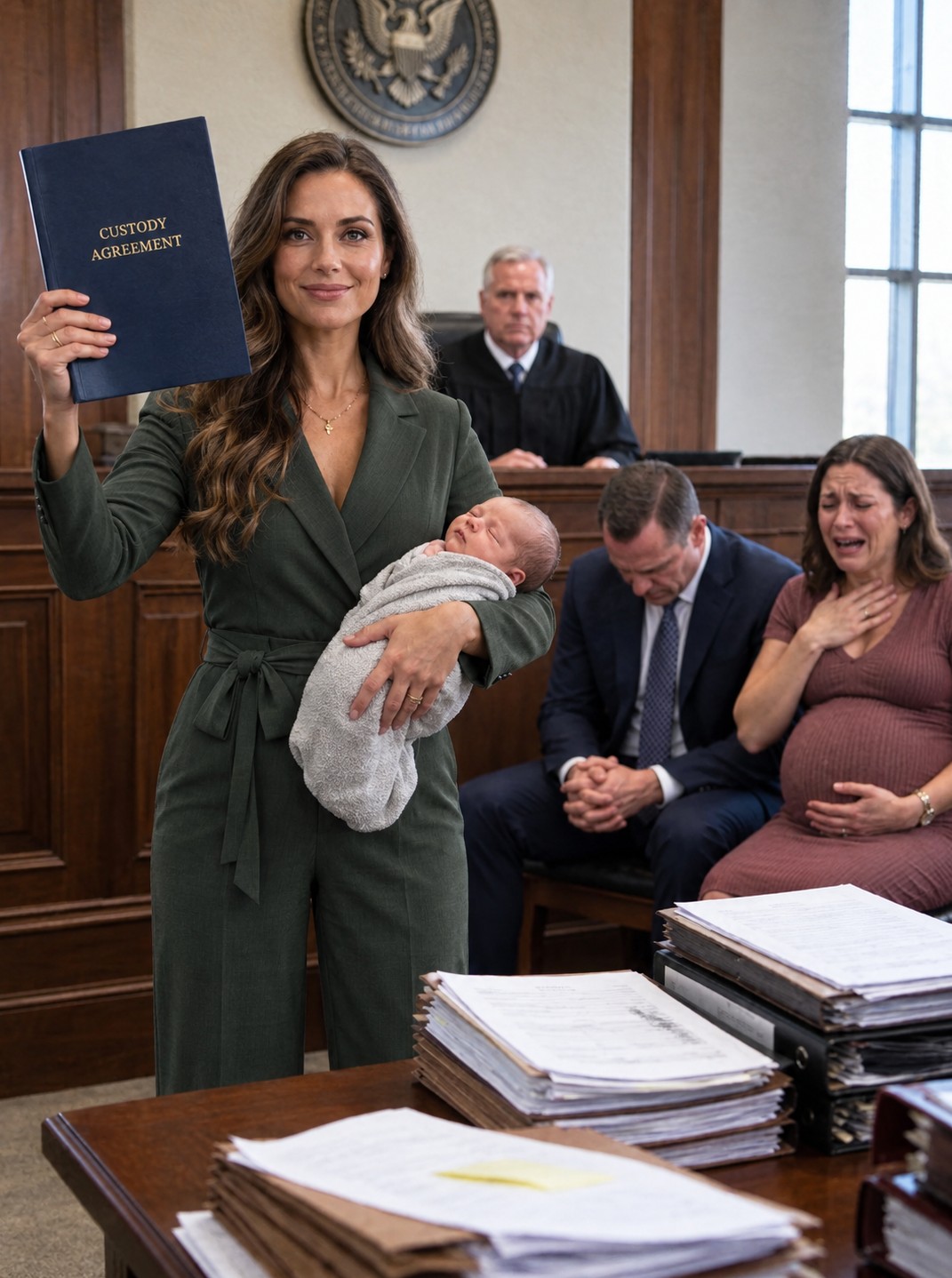
It was just after nine in the morning at Oakwood Family Courthouse, where Fiona had arrived for a scheduled temporary custody and divorce hearing.
She had given birth only ten days earlier.
Her newborn son, Finn, slept peacefully against her chest beneath a charcoal-gray blanket that still carried the faint, sterile smell of the hospital.
Fiona stood beside the table reserved for the parties and their lawyers, trying to remain calm while the judge reviewed the morning’s case file from the bench.
Across the courtroom sat her husband, Jasper Fitzpatrick.
He had arrived early with his attorney and looked completely relaxed.
He wore a crisp white dress shirt beneath an expensive tailored blazer. His hair was perfectly styled, and his expression carried the quiet confidence of a man who believed everything had already been decided in his favor.
Beside him sat Kayla, his administrative assistant.
She was not a party to the divorce case, but Jasper had asked her to attend as a potential witness.
She wore a tight emerald dress that could not hide the unmistakable curve of her advanced pregnancy.
Fiona felt uncomfortable the moment she saw her.
The courtroom itself was quiet and formal.
A court clerk sat at a desk near the judge.
A court reporter was recording the proceedings.
A few people waited on benches near the back wall for their own hearings.
This was not a private meeting where Jasper could simply force her to sign papers.
It was a family-court proceeding.
The judge was there to hear both sides before deciding whether temporary custody, support, and other emergency orders were appropriate while the divorce case continued.
Fiona’s lawyer, Claire Whitmore, sat beside her with a thick legal file.
Claire had already reviewed the documents.
They had spent several days preparing.
Fiona had brought her own red folder as well.
But she had not shown it to Jasper.
The judge looked down at the paperwork.
“Mr. Fitzpatrick’s counsel has submitted a proposed temporary agreement,” she said. “Mrs. O’Malley, have you had an opportunity to review it with your attorney?”
“Yes, Your Honor,” Fiona answered.
Jasper leaned toward her from across the table.
“Then sign it and stop playing the victim,” he whispered. “You just gave birth. You’re not thinking clearly.”
Fiona looked at him.
The words hurt.
But she did not react.
Jasper’s proposed agreement would require Fiona to leave their shared home within sixty days.
It offered her only a modest amount of temporary child support.
Most alarming of all, it requested that the court order a psychological evaluation before allowing Fiona to have unrestricted custody of Finn.
Jasper was presenting the request as a reasonable safety measure.
Fiona knew exactly what it was.
It was the final step in a story he had been building for weeks.
A story in which she was unstable.
A story in which she was supposedly unable to care for her newborn.
A story in which Jasper would become the responsible parent rescuing Finn from his supposedly troubled mother.
Fiona looked toward the judge.
“Are you really trying to take my son away from me?”
Jasper sighed.
“I am not trying to take him away from you,” he said. “I am trying to protect his future.”
He turned slightly toward the judge.
“My mother has seen Fiona crying constantly. She has photographs showing the condition of the house. Kayla has also seen how unstable Fiona has been.”
Kayla lowered her eyes.
She looked embarrassed.
Almost ashamed.
But Fiona knew it was part of the performance.
Jasper had been preparing this story long before he filed for divorce.
Fiona remembered the night Finn was born.
The contractions had become intense.
Her blood pressure had risen to a dangerous level.
She had called Jasper eighteen times from St. Jude Medical Center.
He had not answered.
Not once.
It was almost three in the morning when he finally returned her call.
“I’m in the middle of a high-stakes meeting in St. Louis,” he had snapped. “Stop making a scene.”
But Fiona later learned that Jasper had not been in St. Louis.
The next day, while Fiona was still recovering in the hospital, an anonymous number sent her a photograph.
Jasper was sitting on a sunny patio in Lake Tahoe.
Kayla was sitting beside him.
Both were smiling.
Jasper had a glass raised toward the camera.
On the table sat a small celebration cake.
Written across the top in dark chocolate icing were the words:
Our baby is on the way.
Fiona stared at the photograph.
She did not call him.
She did not post it online.
She did not confront Kayla.
Instead, she saved the original message and photograph to a private cloud folder.
She also forwarded the message to Claire so there would be a dated copy outside Fiona’s phone.
That was the first piece of evidence she preserved.
But it was not the last.
During the birth, a nurse named Elena had stayed beside Fiona.
When Fiona became frightened, Elena held her hand.
When the pain became almost unbearable, Elena helped her focus on breathing.
And when Finn was finally born, Elena helped place him against Fiona’s chest.
Fiona cried.
She cried from exhaustion.
She cried from relief.
And she cried because she suddenly understood that her marriage had ended long before her son took his first breath.
After she returned home, Jasper’s behavior became even more disturbing.
His mother began arriving without warning.
She inspected the kitchen.
She checked whether Finn’s clothes were clean.
She opened the refrigerator.
She took photographs of dishes in the sink.
Once, she photographed a basket of unfolded laundry.
At first, Fiona thought the woman was simply being cruel.
Then Claire explained what the photographs could be used for.
“Don’t delete anything,” Claire had told her. “Don’t argue with her. If she comes into the house, document what happens afterward. Let me handle the legal side.”
That was when Fiona stopped reacting emotionally.
She started documenting everything.
She kept copies of text messages.
She saved emails.
She photographed important documents.
She kept records of payments and bills.
And when Jasper accidentally sent a private voice message into their family group chat and immediately deleted it, Fiona preserved the message before it disappeared from her phone.
She sent that copy to Claire.
Claire did not simply assume the recording was genuine.
She preserved the original file and had it reviewed before deciding whether and how it could be used in court.
Meanwhile, Claire began using the formal discovery process available in the divorce case.
She requested financial records from Jasper.
She demanded records concerning the couple’s accounts, business interests, debts, and property.
Some records arrived voluntarily.
Others required subpoenas and additional requests through the court.
That process uncovered something Fiona had not known about.
Money had been repeatedly transferred from Fiona’s personal account to a company called Horizon Holdings.
The company was registered to Kayla.
Claire traced the transfers and compared them with Fiona’s bank statements.
The amounts were too regular to be dismissed as accidental payments.
Then came the credit-card records.
A secondary card had been issued under Fiona’s name.
The charges included luxury hotels, jewelry, expensive restaurants, and a private medical clinic.
Claire requested the underlying transaction records and receipts.
Some of the medical charges were connected to prenatal appointments.
Fiona had never authorized them.
The more Claire investigated, the more serious the situation became.
Then the property records revealed something even worse.
A loan had been secured against Fiona’s grandmother’s historic home in Ridgefield.
The paperwork contained what appeared to be Fiona’s digital signature.
But Fiona had never signed the loan.
Claire immediately requested the underlying electronic records from the lender.
She did not simply rely on Fiona saying the signature was fake.
The lender provided the electronic signing history, account information, and copies of the documents used during the transaction.
Claire then arranged for a forensic document and digital-signature specialist to examine the material.
The findings raised serious questions about how the signature had been created and submitted.
By the time Fiona entered the courtroom that morning, Claire already had a carefully organized file.
The evidence had not appeared overnight.
It had been collected, requested, verified, and reviewed over days.
And now it was ready.
The judge looked toward Claire.
“Counsel, do you wish to respond to the proposed temporary orders?”
Claire stood.
“Yes, Your Honor.”
Jasper’s confident expression remained.
Until Fiona reached into her bag.
She pulled out a thick red folder.
And placed it quietly beside Claire’s legal file.
Jasper noticed it.
His smile disappeared.
“What exactly is that?” he demanded.
Fiona did not answer.
Claire opened the folder.
The judge leaned forward.
And the hearing was about to change completely.
Part 2:
Kayla gave a nervous laugh.
“Oh, Fiona, I really don’t understand why you’re making this such a huge scene,” she said. “Jasper only wants the baby to be properly cared for.”
Fiona turned toward her.
“My son is being cared for,” she said calmly. “The only thing that was never safe was the life I was living with a man who lied to me while I was giving birth.”
Jasper’s face hardened.
“Be very careful about what you say.”
Claire stood.
“Your Honor, before my client is accused of instability, we would like the court to review the financial records and supporting evidence we obtained through discovery.”
Jasper’s lawyer immediately objected.
“Your Honor, we have not had sufficient time to review everything counsel is attempting to introduce.”
Claire remained calm.
“These records were disclosed through the discovery process and served on opposing counsel before today’s hearing. We are not presenting evidence that the other side has never seen.”
The judge reviewed the file.
“Proceed with the documents that are properly before the court.”
Claire took out several bank statements.
“These records show repeated transfers from Mrs. O’Malley’s personal account to Horizon Holdings over the past eight months.”
She handed copies to the judge and opposing counsel.
“The company is registered to Ms. Kayla.”
Kayla’s face went pale.
“I didn’t know the money was hers.”
Jasper immediately turned toward her.
“Stop talking.”
The judge looked at him.
“Mr. Fitzpatrick, you will allow your attorney to speak for you.”
Jasper sat back.
His lawyer began examining the records.
After several moments, she looked at her client.
“Jasper, these transactions were not included in the financial disclosures you provided to our office.”
He stared at her.
“I told you everything I knew about.”
“That is not what these records show,” she replied quietly.
Claire continued.
“There is additional financial evidence.”
She produced copies of credit-card records.
“These records show charges made on a secondary card issued in Mrs. O’Malley’s name.”
She pointed to the transactions.
“Hotels. Jewelry. Restaurants. And a private medical clinic.”
Kayla’s hand moved slowly toward her stomach.
“A private clinic?”
Fiona looked at her.
“Did Jasper tell you that some of your prenatal medical expenses were paid with my credit card?”
Kayla stared at Jasper.
He looked away.
“I didn’t know,” she whispered.
Claire placed another document before the judge.
“These charges were not authorized by my client.”
Jasper suddenly pushed his chair back.
“This is ridiculous. She’s twisting everything because she’s bitter.”
Claire did not react.
Instead, she took out a phone and connected it to a small speaker.
“Your Honor, we also have an audio recording that was preserved by my client and reviewed before today’s hearing.”
Jasper’s expression changed.
“Claire—”
The judge raised a hand.
“Counsel, explain the relevance.”
Claire did.
“The recording concerns a conversation about using photographs of the home and allegations about Mrs. O’Malley’s mental health to influence the custody proceeding.”
The judge allowed the recording to be played for the limited purpose of the hearing.
Claire pressed play.
Jasper’s voice filled the courtroom.
“My mother is already collecting photos of the house looking messy. If Fiona gets difficult about the terms, we’ll claim she has severe postpartum depression. The baby is so small that any judge will have doubts. If we take the house first and then push for custody, she’ll be forced to accept whatever we give her.”
The recording ended.
Nobody spoke.
Fiona felt her hands trembling.
She remembered hearing the same words alone in the dark.
She had been sitting in bed at four in the morning while nursing Finn.
She had listened to the recording over and over because she could not believe the man she had married was planning to use her exhaustion against her.
Now the judge had heard it too.
Kayla began crying.
“You told me she didn’t want the baby,” she said.
Jasper stared at her.
“You told me she begged you to take him because she couldn’t handle being a mother.”
Fiona looked at Kayla.
“I spent hours in labor begging the doctors to tell me whether my baby was okay,” she said. “And while I was fighting to bring him safely into this world, Jasper was somewhere else planning how to convince people that I didn’t want him.”
Kayla covered her mouth.
Jasper’s lawyer leaned toward him and whispered urgently.
He barely responded.
Claire then turned to the next section of the evidence.
“Your Honor, the financial records are not the only issue.”
She placed copies of the Ridgefield property records before the judge.
“This property was inherited by my client from her grandmother before her marriage.”
Jasper immediately spoke.
“That house was marital property.”
Claire looked at the judge.
“We disagree.”
She then presented the deed showing how Fiona had received the property.
The judge examined it.
Claire continued.
“More importantly, during the marriage, a loan was secured against this property using what appears to be my client’s electronic signature.”
Jasper’s lawyer looked at him.
“Jasper?”
He said nothing.
Claire placed the lender’s records beside the deed.
“These are the underlying electronic transaction records obtained from the lender. We also have a forensic report concerning the signature and the signing process.”
The judge studied the documents.
Jasper’s face had gone completely pale.
Fiona watched him carefully.
This was no longer about an argument between a husband and wife.
There were now financial records, property documents, electronic records, and expert findings in the case file.
The judge turned toward Jasper.
“Mr. Fitzpatrick, your attorney will have an opportunity to respond. Do not interrupt.”
Jasper swallowed.
For the first time that morning, he looked frightened.
Part 3:
Claire slowly placed the forensic report on the table.
“The expert did not simply compare the appearance of the signature,” she explained. “The review also examined the electronic signing records supplied by the lender.”
The judge read through the report.
The signing information raised questions about whether Fiona had personally completed the transaction.
The report did not by itself decide who had committed the alleged fraud.
That would require further investigation.
But it was enough to show that the loan required serious scrutiny.
The judge looked toward Jasper’s attorney.
“Was this loan disclosed?”
The lawyer checked her file.
“No, Your Honor. Not in the financial information originally provided to us.”
Jasper finally spoke.
“That house was technically part of the marriage.”
The judge looked at him.
“That does not answer my question.”
Jasper became silent.
Claire continued.
“The loan proceeds were deposited into an account associated with Mr. Fitzpatrick’s auto-parts business.”
She placed the relevant records before the judge.
“The evidence indicates that the funds were used in connection with a business expansion in the neighboring county.”
Fiona stared at Jasper.
“You used my grandmother’s house to finance your business?”
Jasper looked at her.
“I was going to pay it back.”
“You never told me.”
“It was temporary.”
“You never told me,” Fiona repeated.
Her voice was quiet.
That made the words sound even stronger.
“You were willing to put my home at risk without telling me.”
Jasper looked away.
Kayla slowly stood.
She was crying now.
“You told me she gave you the house,” she said.
Jasper turned toward her.
Kayla continued.
“You told me she was unstable. You told me her family had abandoned her. You said that’s why nobody would believe her.”
Fiona closed her eyes for a moment.
“My family lives in Savannah,” she said. “You both knew that.”
Kayla’s face crumpled.
“I didn’t know any of this.”
Fiona looked at her.
“I know you believed some of his lies.”
She paused.
“But you also chose to help him.”
Kayla lowered her head.
The judge ordered the parties to provide additional financial information and directed that the disputed property and loan be reviewed through the appropriate legal process.
The judge also made clear that the family-court hearing was not a criminal trial.
Any possible criminal conduct would have to be investigated separately by the proper authorities.
That distinction mattered.
The court could make temporary family-law orders.
It could protect the child.
It could address support and possession of property within the divorce case.
But it could not simply declare Jasper guilty of a crime during a temporary custody hearing.
The evidence concerning the disputed signature and loan would be referred to the appropriate authorities for further investigation.
The hearing continued for several more hours.
Jasper changed his story repeatedly.
First, he said he knew nothing about the transfers.
Then he blamed his accountant.
Then he claimed the accountant had misunderstood the business records.
When the judge asked about the property loan, Jasper said he believed Fiona had authorized it.
When asked why there was no written communication from Fiona approving the loan, he had no clear answer.
Every explanation was compared against the documents already in the record.
The financial statements.
The lender’s records.
The property deed.
The electronic signing information.
The messages.
The photographs.
The preserved recording.
The nurse’s sworn statement concerning Fiona’s condition and Jasper’s absence during the birth.
One by one, the story Jasper had created became harder to defend.
Eventually, the judge issued temporary orders.
Fiona was granted temporary primary custody of Finn while the larger custody case continued.
Jasper was ordered to pay child support based on the financial information established before the court.
The judge also entered protective restrictions preventing Jasper and his family from harassing, intimidating, or improperly interfering with Fiona.
The disputed Ridgefield property was protected from further unauthorized transactions while the ownership and loan issues were investigated.
And the evidence concerning the suspected unauthorized signature and financial conduct was referred for separate investigation.
It was not the final end of the divorce.
There would be more hearings.
More financial disclosures.
More legal arguments.
Possibly even more investigations.
But Jasper did not get the quick victory he had expected.
When he walked out of the courthouse that afternoon, the smug expression he had worn that morning was gone.
His shoulders were lowered.
His face looked exhausted.
His lawyer walked beside him, speaking quietly.
Jasper barely answered.
Kayla left through another exit.
She held her stomach with one hand and wiped tears from her face with the other.
She had entered the courthouse believing she knew the truth about Fiona.
Now she understood that much of what Jasper had told her was false.
Fiona remained inside for several minutes after the hearing ended.
Claire gathered the legal documents.
“Are you okay?” she asked.
Fiona looked down at Finn.
“I don’t know,” she admitted.
Claire nodded.
“You don’t have to know today.”
Those simple words stayed with Fiona.
She finally walked outside.
The evening air was cool.
The sun was beginning to disappear behind the buildings.
Across the street, food trucks were still serving customers.
Delivery trucks rumbled down the road.
People hurried along the sidewalks.
Cars stopped at traffic lights.
The world looked completely ordinary.
But Fiona’s life had changed.
Finn stirred in her arms.
His tiny eyes opened.
He looked up at his mother.
Fiona looked down at him.
Then she finally allowed herself to cry.
These were not tears of defeat.
They were tears of release.
She had spent ten days recovering from childbirth while dealing with fear, betrayal, exhaustion, and legal threats.
She had been told she was too emotional.
Too unstable.
Too overwhelmed to make decisions.
Yet she had continued protecting her son.
She had saved evidence.
She had asked for legal help.
She had trusted the facts instead of allowing fear to silence her.
The months that followed were difficult.
There were more court hearings.
More paperwork.
More sleepless nights.
There were days when Fiona questioned herself.
She also began therapy to work through the betrayal and fear she had experienced.
She rented a quiet apartment while the dispute over her grandmother’s home continued.
She returned to her work designing custom event invitations.
And slowly, she learned that accepting help did not make her weak.
It made life possible.
Jasper’s business relationships also became more difficult after the investigation became known among some of his professional associates.
His mother stopped coming to Fiona’s home with her phone camera.
Kayla eventually provided information to investigators about what Jasper had told her concerning Fiona, the house, and his finances.
Fiona did not celebrate Jasper’s problems.
She did not need to.
Her victory was not watching him struggle.
It was waking up each morning knowing that she could protect her son without asking Jasper for permission.
It was hearing Finn laugh for the first time.
It was returning to work.
It was sleeping through a night without wondering what Jasper might do next.
And most of all, it was knowing that the truth no longer depended on Jasper’s version of events.
Sometimes a woman does not need to scream.
She does not need to threaten anyone.
She does not need to prove herself to everyone around her.
Sometimes she simply needs to stay calm, hold her baby close, preserve every piece of truth she can find, and let the evidence speak when the right moment comes.
Because exhaustion is not defeat.
Tears are not weakness.
And silence does not mean surrender.
Never make the mistake of confusing a tired mother with a defeated woman.
THE END.
