
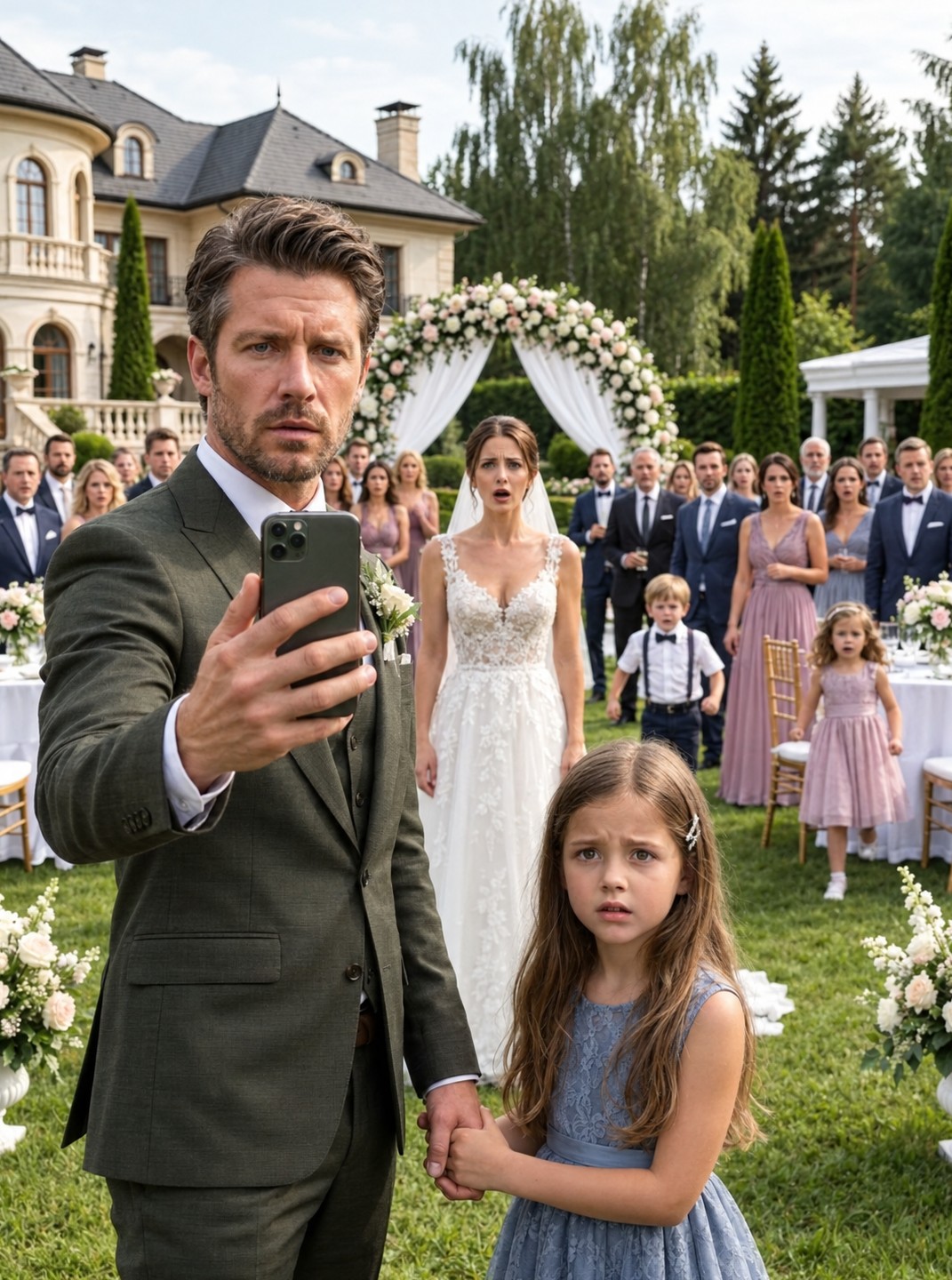
Part 1:
“If that girl shows up at my wedding, I am not marrying you.”
Isabella said it so calmly that, for a moment, I thought I had misunderstood her.
I stared at my fiancée across the kitchen table.
“Penelope?” I asked.
“Who else would I mean?”
My stomach tightened.
Penelope was my thirteen-year-old daughter. Her mother had died when she was seven, and since then, the two of us had become incredibly close. I was her father, but I was also the person she trusted most in the world.
Isabella knew that.
At least, I thought she did.
When Isabella and I first started dating, she seemed to love having Penelope around. She brought her small gifts, asked about school, and sometimes sat with us during dinner.
Penelope had even told me once, “I think Isabella really likes me.”
I had been happy to hear that.
After our engagement, however, Isabella slowly changed.
She began correcting the way Penelope spoke to me. She complained when Penelope wanted to spend time with me. She said Penelope was too dependent on me and needed to “grow up.”
Then Isabella announced that our wedding would be child-free.
At first, I accepted it.
She said she wanted a quiet, elegant ceremony at a rustic estate outside Asheville. She wanted adults only, no children running around, and no distractions.
I understood that.
What I did not understand was why the rule seemed to apply only to my daughter.
Isabella had a young son and several nephews. Whenever I asked about them, she insisted they would not be attending as guests.
“They’re children,” she said. “And the wedding is child-free.”
I believed her.
Three weeks before the wedding, I finally told Penelope that she would not be attending.
I hated saying it.
“I’m sorry, sweetheart,” I told her. “Isabella wants the wedding to be adults only.”
Penelope looked down at her hands.
She was quiet for several seconds.
Then she forced a small smile.
“It’s okay, Dad. It’s just one day.”
That answer hurt more than if she had cried.
She was trying to protect me from feeling guilty.
I hugged her.
“I love you more than anything,” I whispered.
“I know.”
At the time, I still believed I was simply making a difficult compromise for the woman I was about to marry.
I had no idea I was being pushed into choosing between my future wife and my daughter.
And three days before the wedding, I finally discovered the truth.
Part 2:
Three days before the ceremony, I was sitting at my desk going through the final wedding details.
Isabella and I had been using a shared wedding-planning email account so both of us could see messages from the venue, caterer, photographer, and coordinator.
I opened the latest message from the wedding coordinator.
It contained the final ceremony schedule.
I almost skipped over it.
Then I saw the list of people taking part in the ceremony.
Page boys.
Ring bearer.
Flower child.
I read it twice.
The children listed were Isabella’s son and two of her nephews.
My hands went cold.
I kept reading.
Penelope’s name was nowhere on the guest list or ceremony list.
I immediately called the wedding coordinator.
“I’m looking at the final ceremony schedule,” I said. “Can you explain something to me?”
“Of course.”
“Why are Isabella’s son and her nephews listed as part of the ceremony? I was told there would be no children at the wedding.”
There was a pause.
Then the coordinator said, “The instruction we received was that the wedding would be adults-only for guests, but Isabella’s son and her nephews would participate in the ceremony.”
I felt my chest tighten.
“And Penelope?”
Another pause.
“Your daughter was not included in the final guest list.”
I stared at the screen.
“Who gave you those instructions?”
“Isabella and her sister, Katherine.”
I thanked her and ended the call.
Then I opened the rest of the email thread.
There were photographs Katherine had sent to the coordinator showing the boys’ outfits.
One picture showed Isabella’s son wearing a small blue bow tie.
Another showed the two nephews in matching outfits.
There were also messages discussing where the boys would stand during the ceremony.
Everything had been arranged.
Everything had been planned.
And nobody had told me.
I took screenshots of the emails and saved the ceremony schedule.
Then I called Isabella.
She didn’t answer.
I called again.
Still nothing.
Instead of waiting, I drove to Penelope’s school.
When she got into the car, she immediately noticed something was wrong.
“Dad?”
“Can I ask you something?”
She nodded.
“Does Isabella ever say things to you when I’m not around?”
Penelope looked out the window.
“What kind of things?”
“Anything that makes you uncomfortable.”
She was silent for a long time.
Then she quietly said, “Sometimes she tells me I’m too old to be so attached to you.”
My hands tightened around the steering wheel.
“What else?”
“She says that after she marries you, things are going to be different.”
“How?”
Penelope swallowed.
“She told me I need to learn my place.”
I felt sick.
“Why didn’t you tell me?”
“Because you were happy.”
That sentence broke something inside me.
I had been so worried about keeping peace that I had failed to notice what was happening to my own daughter.
I drove home and found Isabella waiting for me.
I put my phone on the table and showed her the ceremony schedule.
“You told me there would be no children.”
She crossed her arms.
“There won’t be children as guests.”
“Your son and your nephews are in the ceremony.”
“They’re part of the wedding party.”
I stared at her.
“And Penelope?”
Her expression hardened.
“She doesn’t need to be there.”
That was the moment everything became clear.
This was never about a child-free wedding.
It was about one particular child.
My daughter.
Part 3:
The wedding was held at the rustic estate outside Asheville.
I arrived early that morning.
For several minutes, I stood near the entrance trying to convince myself that I was overreacting.
Then I saw them.
Isabella’s son was wearing the blue bow tie from the photograph.
Her two nephews were dressed in their matching outfits.
They were standing near the ceremony area, exactly where the schedule had said they would be.
I walked toward Isabella.
She was speaking with Katherine.
When she saw me, her smile disappeared.
“What’s wrong?” she asked.
I held up my phone.
“You told me this wedding was child-free.”
Katherine immediately stepped between us.
“They’re family.”
“So is my daughter.”
Isabella sighed.
“Lucas, please don’t do this today.”
“Do what?”
“Create a scene.”
I looked around.
The children from her family were right there.
“Why was Penelope excluded while your son and your nephews were allowed to participate?”
Katherine shook her head.
“Penelope was not going to die from missing one night of festivities.”
I turned toward her.
“That isn’t the point.”
“It is exactly the point,” Katherine said. “You are making this much bigger than it needs to be.”
I looked back at Isabella.
“Did you deliberately tell me the wedding was child-free so Penelope couldn’t come?”
She didn’t answer.
That silence told me enough.
I pulled out my phone and showed her the emails.
“The coordinator confirmed that you and Katherine gave these instructions.”
Isabella’s face changed.
“You checked the wedding account?”
“Yes.”
“You had no right—”
“It was a shared account.”
She looked away.
I realized I was standing in a room full of people preparing to watch me marry a woman who had already made her decision.
She wanted me to choose her.
She wanted me to prove that Penelope could be pushed aside.
I wasn’t going to do it.
I looked at Isabella.
“I am not marrying you.”
Her face went pale.
“What?”
“I said I’m not marrying you.”
Katherine gasped.
“You’re really doing this because your daughter couldn’t attend?”
“No,” I said. “I’m doing this because I finally understand why she couldn’t attend.”
Isabella grabbed my arm.
“Lucas, think about what you’re doing.”
I pulled away.
“I have.”
Then I walked away from the ceremony.
There would be no wedding.
Part 4:
That evening, I went to my parents’ house with Penelope.
I told my mother what had happened.
She was furious.
“You embarrassed this family,” she said.
I stared at her.
“Mom, she deliberately excluded my daughter.”
“You could have handled this after the wedding.”
“No.”
My father stayed silent.
I knew he didn’t understand everything, but I didn’t have the strength to explain it again.
I left with Penelope.
That night, Isabella began sending messages.
The first few were angry.
Then they became cruel.
One message said:
“Your daughter is always getting in our way and ruining our happiness.”
Another said:
“Penelope is not nearly as innocent as you think she is.”
I saved every message.
I did not answer.
The next morning, Isabella called repeatedly.
I ignored the calls.
Then she sent another message.
“You are throwing away everything we built because of one child.”
That was when I finally replied.
“You made me choose. I chose my daughter.”
Isabella had been living in my house during our engagement, but the house was mine alone. I had bought it years before meeting her, and Isabella had never been added to the deed or mortgage. She had moved some of her clothes and personal belongings into the house after we became engaged, but she had no ownership of the property.
After the wedding was cancelled, I told her she could no longer live there.
Because she still had belongings inside, I gave her a personal deadline of thirty days to arrange their removal. I did not try to force her out or remove her things myself.
I contacted my lawyer, Samantha, to make sure I handled everything properly.
Samantha explained that because Isabella had been living there and still had belongings inside, I needed to follow the formal legal process rather than simply changing the locks or throwing her possessions outside.
She prepared the required written notice.
The formal move-out period under the legal process was forty-five days.
That was different from the thirty-day personal deadline I had first given Isabella.
I told Isabella clearly that I would cooperate with the formal process and that she could arrange a time to collect her belongings.
For a while, she stayed away.
Then came the message that made me nervous.
“I need to get the rest of my things.”
I told her to arrange the visit with me or through Samantha.
She never did.
Instead, she still had the old key she had used while living there.
And one evening, she used it.
Part 5:
I was at my parents’ house when Don Ernest, my neighbor, called.
“Lucas, are you home?”
“No. Why?”
“I think Isabella is inside your house.”
My heart dropped.
“What?”
“I heard banging. I looked outside and saw her car.”
I immediately called the police.
I also called Samantha.
“Don’t go inside,” Samantha told me. “Let the police handle it.”
A few minutes later, Don called again.
“The police are here.”
I drove home.
When I arrived, two officers were standing outside.
One of them walked toward me.
“Are you the homeowner?”
“Yes.”
He explained that they had found Isabella inside.
She had apparently entered using the old key and claimed she had come to collect her belongings.
But instead of simply taking her things, she had become angry and started damaging property.
A chair had been knocked over.
A lamp was broken.
Several framed photographs had been smashed.
There were scratches across a cabinet, and one of the bedroom doors had been damaged.
The officers had found her still inside the house.
She was crying and shouting that I had destroyed her life.
Then she saw me.
“This is your fault!” she screamed.
I didn’t answer.
One of the officers told her to step outside.
She refused at first.
Then they placed her in handcuffs.
As she was led away, she shouted:
“You think Penelope has won, but you have no idea what she has done!”
I stood there watching her disappear into the police car.
For the first time, I understood how far things had gone.
Part 6:
A few days later, Isabella sent me a long voice message.
I almost deleted it without listening.
Instead, I pressed play.
Her voice was shaking.
“I know you think I planned everything from the beginning,” she said. “But you don’t understand how it started.”
She paused, then continued.
“It was after the engagement dinner. Penelope went upstairs because she said she wasn’t feeling well. I heard her laughing while she was talking to someone on the phone.”
Her voice became bitter.
“She sounded so happy. And for some reason, it made me angry. That’s when I realized I didn’t actually like being around her.”
I listened in silence.
“I tried to convince myself it would get better. My sisters kept telling me that teenage girls can manipulate their fathers and that Penelope would always come first.”
She took a shaky breath.
“I started thinking about what would happen after we got married. I was afraid that you would always choose her.”
Then she said something that made my stomach turn.
“So I decided the wedding could solve it.”
She explained that she had pushed for the child-free rule because she knew Penelope would be excluded.
“But I told Katherine that the boys could still be in the ceremony because they were part of the wedding party. I knew you wouldn’t question it.”
She became defensive again.
“I thought if you went through with the wedding without Penelope, things would finally change. I thought you would understand that she couldn’t always come first.”
Then her voice cracked.
“I didn’t think you would cancel everything.”
I stopped the recording.
There it was.
Not a perfect confession.
Not a carefully prepared statement.
Just an angry, emotional voice message from a woman trying to justify what she had done.
But it confirmed what I had already discovered.
The wedding rule had never been about children.
It had been about Penelope.
I saved the audio file.
I also saved the emails, screenshots, photographs, messages, and police report.
Samantha kept copies of everything for the legal matter.
Part 7:
In the weeks that followed, Isabella’s family became quieter.
Katherine still defended her.
“She was hurt,” she told me once. “She made mistakes.”
I answered, “She tried to make my daughter feel like she didn’t belong in her own family.”
Katherine had nothing to say.
Isabella’s son’s father also became involved after hearing about the incident. He requested a review of the existing custody arrangements and raised concerns about what had happened.
I stayed out of that process except when I was asked for information.
My focus was Penelope.
She had spent months believing she was the problem.
I wanted her to understand that she wasn’t.
One evening, we sat together on the porch.
“Dad?”
“Yeah?”
“Did you really cancel the wedding because of me?”
I looked at her.
“No.”
She looked confused.
“I cancelled it because of what she was doing to you.”
She lowered her eyes.
“I thought you were going to marry her.”
“So did I.”
“And then?”
I smiled sadly.
“Then I finally paid attention.”
She leaned against my shoulder.
“I love you, Dad.”
“I love you too.”
I held her tightly.
For months, I had been afraid that protecting my relationship with Isabella would somehow protect my future.
I had been wrong.
My future was sitting beside me.
Part 8:
Over the next few months, we repaired the house.
Some of the damage could be fixed.
Some things had to be replaced.
But the hardest thing to repair was the feeling of safety we had lost.
Penelope helped me repaint her bedroom.
We bought new picture frames.
We cleaned the broken glass from the floors.
Slowly, the house started feeling like ours again.
One morning, Penelope came downstairs holding two travel brochures.
“Dad?”
“Yes?”
“Can we go somewhere?”
I smiled.
“Where?”
She pointed to the coast.
So we took a trip.
It wasn’t luxurious.
It didn’t need to be.
We walked along the beach, ate at small restaurants, laughed about stupid things, and talked for hours.
For the first time in a long time, there was no wedding to plan.
No arguments.
No trying to keep everyone happy.
Just my daughter and me.
I had almost convinced myself that keeping my engagement alive was the responsible thing to do.
But cancelling that wedding had saved something much more important.
It had saved my relationship with my daughter.
And when I looked at Penelope laughing beside me on that beach, I knew I would make the same decision again.
Because sometimes the hardest decision is also the clearest one.
And sometimes protecting the person who trusts you most means finally saying no to the person asking you to betray them.
The end.
