
I used to think I had everything under control. My job, my marriage, my kids — all of it. I honestly believed I was the solid one, the “rock” of the family, the guy who always had a plan.
But the night my wife fainted, and the morning I blocked an ambulance on the road, everything I believed about myself shattered. I learned the hard way just how blind I really was.
I didn’t know the truth until later: the child inside that ambulance… was my own son.
My wife, Miranda, works from home as a freelance editor. She’s amazing at it, but the job is tiring. I run a consulting firm — intense, stressful, and loud — but I bring in good money.
We have three kids: Luke, nine; Clara, seven; and little Max, five. I always thought I had this perfect balance under control.
I was wrong. Completely, painfully wrong.
And it all truly began with the nanny argument.
One chaotic evening after dinner — dishes piled high, kids arguing, toys everywhere — Miranda looked exhausted.
She dropped her shoulders and said quietly, “Nathan, we need a nanny. I can’t do this anymore. I can’t handle work, the house, and the kids alone.”
I laughed. Actually laughed. “A nanny? Come on, Miranda. They’re expensive. It’s not worth it, babe.”
Her eyes were pleading. “Nathan, I’m serious. Please. Even though they’re older, I simply cannot do this alone.”
But I shut her down.
“No. Absolutely not,” I said firmly. “My mother raised me alone, juggling two jobs, and I turned out fine. You just need to be firmer about discipline after school. That’s all.”
Miranda let out a long, tired sigh. She didn’t fight me. She just… went quiet. And I thought silence meant everything was fine.
A few days later came the real warning shot — the one I should’ve paid attention to.
I was stuck in a dull meeting when my phone buzzed. Luke. I never answer when it’s not school calling, but the meeting was boring, so I stepped out and picked up on the second ring.
“Dad?” Luke’s voice was trembling. “Mom fainted. She was standing in the living room and she just fell. Should I call 911?”
My heart thudded, but instead of doing the reasonable thing, my old stubborn instincts kicked in.
“No, Luke! Don’t call 911,” I said immediately.
I don’t know why my voice sounded so sharp — fear, maybe, pretending to be confidence.
“I want you to call Mara, okay? Our neighbor. She’s a nurse. She’ll know what to do.”
Mara worked night shifts at the big hospital downtown. She was tough, sharp, and knew her stuff.
By the time I sped into our driveway, Mara was kneeling beside Miranda, checking her pulse and speaking calmly.
“How is she? What happened?” I asked, practically shoving my briefcase aside.
Mara stood up slowly and said, “She’s conscious now, but fainting like that is not normal. She needs to see a doctor.”
“She needs to see a doctor,” she repeated, firmer this time.
I crossed my arms tight. “No doctors. I don’t trust them.
My mother was misdiagnosed when I was a kid, and they never listened when she complained about my father. We’ll do a blood test at an independent lab. That’s it.”
Mara frowned deeply. “Nathan, she needs proper care, not some drive-thru blood test. You’re being ridiculous.”
“Maybe I am,” I snapped, “but that’s how it is.”
In the end, the blood test showed Miranda had anemia. She recovered, but she wasn’t the same — more tired, more careful, more wary.
Not long after, she brought up the nanny again.
“I need help, Nathan,” she said softly. “That fainting spell could’ve been much worse. I need time to rest.”
I squeezed her hand and said the stupidest thing: “You just need to manage the schedule better. We’ll survive.”
Why did I think “survival” meant everything was okay?
But the universe had a brutal lesson waiting for me.
One morning, I was rushing to a huge client meeting. Traffic was awful, cars barely crawling. My mind was locked on profits, presentations, and being on time.
Then I heard sirens — loud, sharp, getting closer.
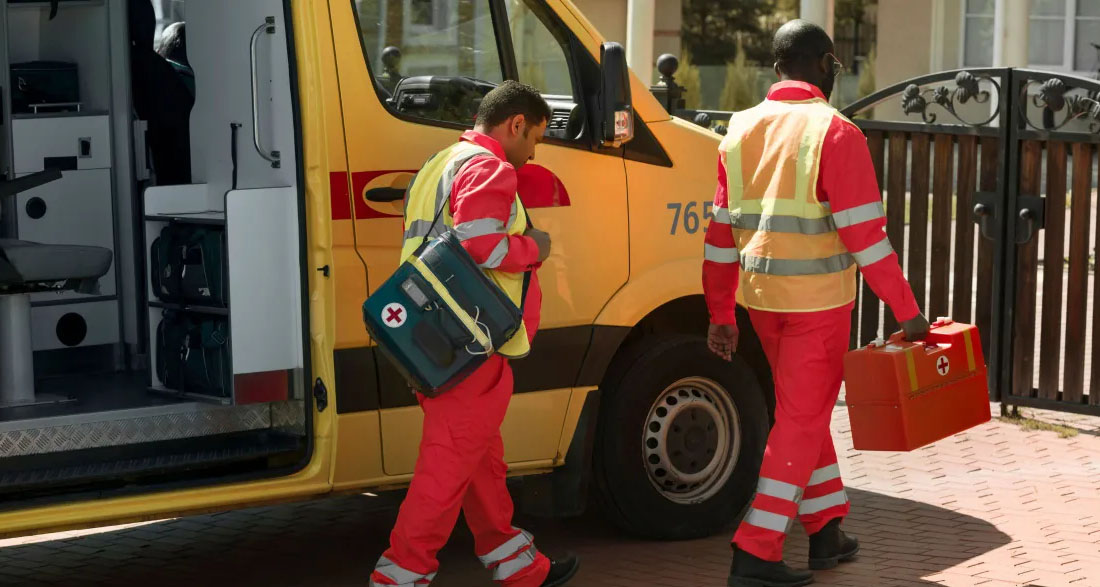
I checked my rearview mirror. An ambulance. Red lights flashing. Swerving, squeezing through the narrow spaces between cars.
And me? I froze.
Then I did something unforgivable.
I didn’t move.
I had enough room to pull onto the shoulder. Just a few feet. But I didn’t. My brain clung to my stupid meeting, my schedule, my ego.
The ambulance blared its horn again and again. I pretended not to see it. The driver leaned on the siren, desperate.
Finally, the driver himself — silver-haired, furious, drenched in sweat — jumped out, marched to my window, and pounded on the glass.
He shouted, “Move, man! What are you doing? Move your car!”
I didn’t even blink. “I’m not moving. I’m already late for an important meeting. I don’t need this.”
His face twisted from shock into pure rage.
“Sir, there is a child inside this ambulance who needs urgent care!” he yelled.
I barked out a bitter, nasty laugh. My distrust of doctors and hospitals boiled over.
“Doctors can’t help him anyway,” I said coldly. “So what does it matter?”
He stared at me like I was a monster. Honestly… I was.
He stormed back to the ambulance. They ended up driving onto the sidewalk to get around my car.
And there I sat, irritated, completely unaware that the child inside that ambulance was my son.
I walked into my meeting like nothing happened. Then my phone vibrated and lit up with Miranda’s name. I declined the call. Put the phone on silent. Let it buzz again and again.
Hours later, I finally checked the messages.
“Luke is in the hospital! Emergency surgery! Call me NOW!”
My whole body went cold.
I didn’t call. I sprinted. I raced to my car and drove like a madman, blasting through every red light like the world was ending.
When I reached the hospital, I found Miranda sitting on a plastic chair, her face pale and streaked with tears. Clara and Max clung to her legs like frightened kittens.
“What happened? Where is he?” I asked, breathing hard.
Miranda’s eyes met mine — scared, broken, accusing.
“He’s in surgery,” she whispered. “We don’t know yet if… if he’ll be okay.” She swallowed hard. “He fell in the park. Hit his head. It was bleeding badly.”
My legs nearly collapsed. I knelt down and wrapped my arms around all of them.
“It’s okay,” I whispered shakily. “It’s okay, it’s going to be okay…” But inside, I was falling apart.
Hours passed like centuries.
Finally, the surgeon came out. He looked tired but calm.
We jumped to our feet. Miranda squeezed my hand so tightly I barely felt my fingertips.
The surgeon said, “He’s stable. The operation went well. He’s recovering in the ICU. You got here just in time.”
“Just in time?” I repeated, confused.
“Yes,” he said. “There was a nasty traffic jam on the main road. It delayed the ambulance. If it had taken much longer… the outcome might have been different.”
A traffic jam. The main road. An ambulance.
Me.
The realization hit me like a fist to the chest.
I had blocked the only vehicle that could save my son.
I stumbled backward, fell into a plastic chair, and sobbed uncontrollably. Miranda rushed to my side, wrapping her arms around me, but nothing could stop the guilt clawing through my heart.
Later, when Luke finally woke up — groggy but alive — relief washed over me. But guilt stayed.
I couldn’t move forward without facing the man I had wronged.
So I asked the nurse, “Is the ambulance driver who brought my son in still here? I need to speak to him.”
A little while later, he walked into the waiting room. Same silver hair. Same stern eyes.
He took one look at me and pointed. “You! Aren’t you the guy who wouldn’t move his car?”
I nodded, tears running freely. “I am. And I am so, so sorry. I was an idiot. A complete, unfeeling idiot.” My voice cracked. “That boy… that boy was my son. Thank you for saving him.”
I reached out and hugged him. At first he stood stiff as a board, but slowly his arms came up and held me.
“Just doing my job, sir,” he said quietly. “I’m really glad he’s safe. I am.”
When we pulled apart, I wiped my face and breathed deeply.
“James,” I said, looking straight at him, “I have an offer for you. I want to hire you. Right now. Whatever salary you make, I’ll match it.
And I’ll give you a huge bonus. I need a personal driver — someone competent. Someone who actually knows what matters in life.”
He blinked, surprised. Then he nodded.
Over the next months, James — once the ambulance driver I disrespected — became my right hand. My confidant. My reminder of what I had almost lost.
His wife, Helena, who’d been struggling to find good work, joined us as our nanny. She helped Miranda rest, recover, breathe again. Our home became calmer. Better. Healthier.
I finally learned that being the “rock” didn’t mean controlling everything. It meant letting good people help me hold the world together.
If you’re reading this, I hope you learn from my mistakes.
Don’t wait for disaster to open your eyes.
Don’t wait until you almost lose everything to realize how much you need help.
