
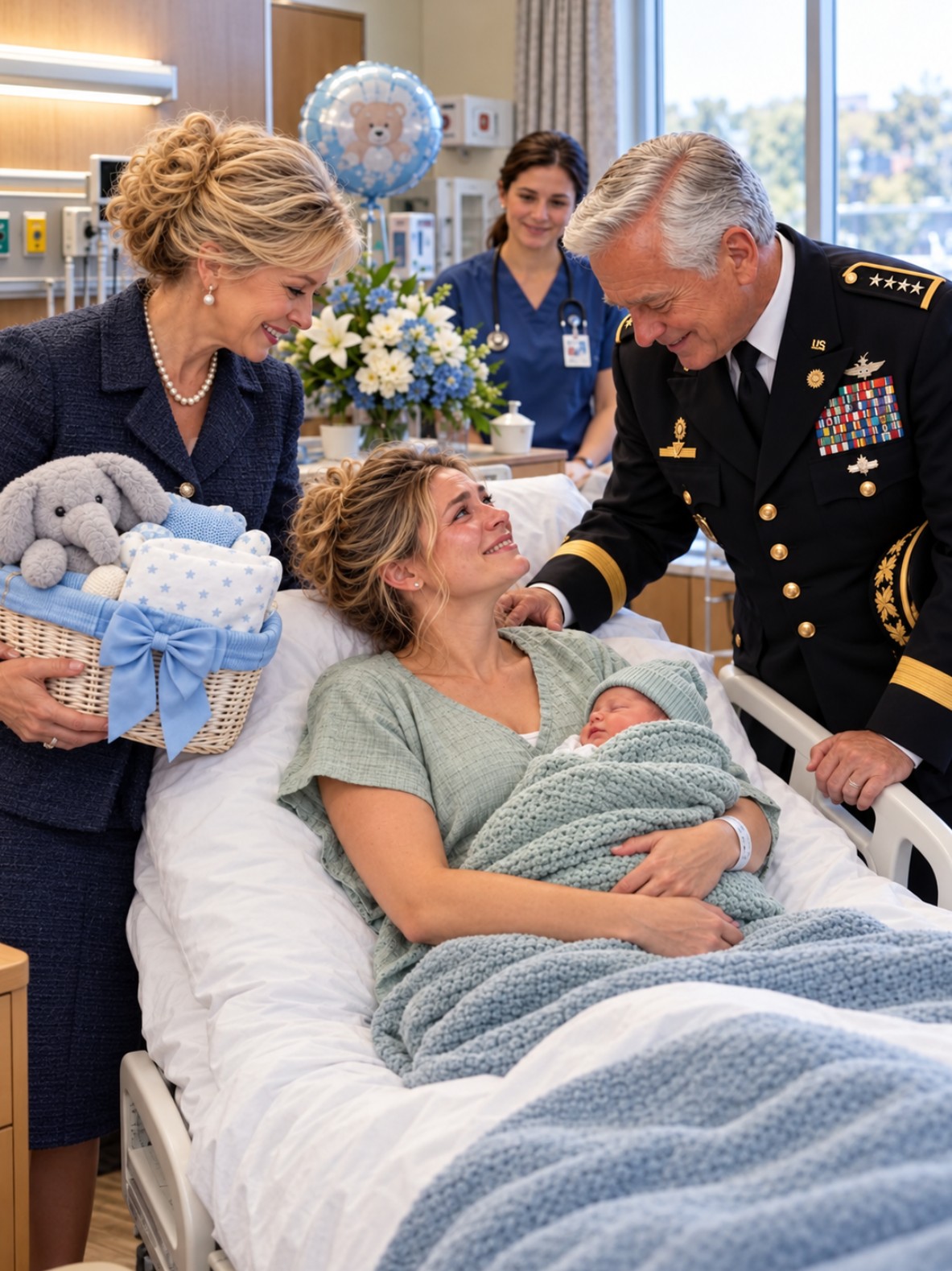
My father didn’t ask if I was alive—he snapped, “It’s Whitney’s night. You made your own bed, Seraphina,” before hanging up. Three hours later, at two in the morning, my hospital door opened… and the man who walked in was the one my parents had underestimated for almost ten years.
Part 1:
I made the call at exactly 10:47 p.m., gripping my phone with my left hand because my right arm was trapped inside a heavy cast. Every breath sent pain through my ribs, and dried blood still stained the sweatshirt the paramedics had cut off me after the crash.
Somewhere down the hospital corridor, my newborn son, Noah, was crying in the nursery. I wasn’t strong enough to hold him safely on my own, and the thought of being unable to comfort my own baby made me feel even more helpless.
When my father finally answered, I could barely get the words out.
“Dad,” I whispered. “Please… can you and Mom take Noah for just one night?”
Music and laughter echoed behind him. I heard glasses clinking and someone uncorking a bottle of champagne.
“What is it now, Seraphina?” he asked impatiently.
“I’m at St. Anne’s Hospital. A delivery truck hit my car. My arm is broken, I needed stitches, and I can’t take care of Noah by myself tonight.”
The silence that followed wasn’t filled with worry. It was filled with annoyance.
“Tonight is Whitney’s engagement dinner,” he said. “Your mother and I are hosting everyone.”
Whitney had always been the favorite. When she made mistakes, she was overwhelmed and needed understanding. When I struggled, I was irresponsible and had only myself to blame.
“Dad,” I pleaded, “I’m not asking you to cancel the party. I’m asking you to help your grandson.”
“And ruin Whitney’s celebration?”
“I was in a car accident.”
“And she’s finally having the evening she deserves.”
Tears blurred my vision.
“I can’t even lift my baby,” I whispered.
His voice turned colder than I’d ever heard it.
“You chose to have that baby without a husband. You chose this life. You made your own bed, Seraphina. Now lie in it.”
Before I could answer, he hung up.
I stared at the dark screen until all I could see was my bruised reflection. For years, I’d defended my parents and convinced myself they loved me in their own way. I’d made excuses for their behavior because admitting the truth meant accepting that the people who were supposed to love me unconditionally had never treated me the same way they treated my sister.
That night, I finally understood something I’d spent my entire life trying to deny.
My parents weren’t unable to help me. They had simply decided I wasn’t worth helping.
A nurse named Melissa quietly adjusted my blanket before bringing Noah back into my room. She showed me how to rest one hand gently on his tiny chest without having to lift him.
“I’m so sorry,” I whispered, ashamed of the tears running down my face.
Melissa looked at me with kind eyes.
“You have nothing to apologize for,” she said. “You’ve been through a terrible accident. You’re allowed to need help.”
Three long hours crawled by. The medication dulled the pain, but it couldn’t quiet my fear. I kept imagining dropping Noah because I only had one usable arm. Every time he moved, I worried I might hurt him without meaning to.
At exactly 2:03 a.m., the door slowly opened.
I expected another nurse.
Instead, my Uncle Richard walked in wearing a rain-soaked charcoal coat over a dark suit. Behind him stood my Aunt Beatrice, cradling Noah against her shoulder while he slept peacefully beneath his blue hospital blanket.
“Uncle Richard?” I whispered.
His eyes moved across my cast, the bruises on my face, and the bandage above my eyebrow.
His expression didn’t show shock. It showed recognition, followed by the calm, focused look of a man assessing damage and deciding what needed to be done first.
“I just found out,” he said quietly.
“The charge nurse called us,” Aunt Beatrice explained. “Your emergency contact still listed Richard.”
I’d forgotten that years earlier, when I moved out of my parents’ house, Uncle Richard had made me promise to keep his number.
“If no one else answers,” he’d told me, “call me.”
Richard stepped closer to my bed.
“Your father’s party is over.”
My stomach tightened.
“What did you do?”
“I called him.”
Despite the pain, I almost smiled.
My parents had spent years calling Richard a failure because he lived quietly outside Washington, Virginia, and rarely attended family events. They never seemed to understand why he had no interest in their expensive dinners or endless conversations about money and status.
What they didn’t know—or perhaps had never bothered to acknowledge—was that Richard had spent more than thirty years serving as a highly respected colonel in elite U.S. military operations. He had led men and women whose lives depended on whether he answered their calls.
And when his own family needed him, he answered, too.
Richard looked me directly in the eyes.
“I put your father on speaker,” he said. “And everyone at Whitney’s engagement dinner heard him tell his injured daughter she wasn’t worth leaving the party for.”
Part 2: My Sister’s Fiancé Heard What My Father Really Thought of Me
For a few seconds, all I could hear was the quiet rhythm of Noah’s breathing against Aunt Beatrice’s shoulder.
My father’s words seemed to echo inside the hospital room, but this time they sounded different. Smaller. Exposed.
Richard hadn’t raised his voice or made a dramatic speech. He had simply allowed the truth to stand where everyone could see it.
“You put him on speaker?” I whispered.
Richard pulled a chair closer to my bed. Rainwater clung to his coat, leaving dark marks across the fabric, but he moved with the same careful calm I remembered from childhood, as if storms were ordinary things that could be crossed without complaint.
“I did,” he said. “After he told me you were exaggerating, I asked him to repeat himself.”
Aunt Beatrice’s mouth tightened, though her hands remained gentle around Noah.
“Whitney’s fiancé heard it,” she added softly. “So did his parents.”
I closed my eyes.
Part of me wanted to feel satisfied. Another part, the tired and bruised part, felt nothing but shame, as if my father’s cruelty somehow belonged to me.
“I didn’t want a scene,” I said.
Richard leaned forward, resting his elbows on his knees.
“Seraphina, you didn’t create the scene. You asked for help.”
The words were simple, but something inside me loosened.
Maybe it was because nobody in my parents’ house had ever said it that way. Need was always treated like failure. Pain was treated like drama. Asking for help meant you had mismanaged your life and expected someone else to clean up the mess.
“I called them because I didn’t know what else to do,” I said, my voice shaking.
“I know.”
“I thought maybe because it was Noah…” My throat closed around his name.
Aunt Beatrice came closer.
“Honey, they should have come because it was you.”
The softness in her voice broke something I had been trying desperately to hold together. Tears slipped sideways into my hairline, stinging near the stitches above my eye.
I hated crying in front of people, but there was no dignity left to defend. Not that night.
Richard reached for the box of tissues beside the bed and placed it within reach of my left hand.
No lectures. No disappointed sighs. No reminders of the choices I’d made years earlier.
Just a tissue box moved a little closer.
That kindness hurt more than my ribs.
“What happened after you called him?” I asked when I could finally breathe normally again.
Richard’s expression changed slightly. It wasn’t exactly anger, but I recognized the restraint in his face.
“Your father said family obligations had to be respected.”
Despite everything, a laugh escaped me. It sounded sharp and broken.
“Family obligations.”
“Yes,” Richard said. “That was his phrase.”
Aunt Beatrice shifted Noah carefully as his tiny mouth opened in a sleepy yawn.
“Your mother tried to take the phone from him after she realized everyone could hear,” she said. “But by then, the room had gone quiet.”
I pictured my parents’ dining room glowing with candlelight. Whitney would have been sitting beneath the crystal chandelier, surrounded by beautifully dressed guests. My mother’s best silver would have been laid out beside folded linen napkins, and expensive champagne would have been flowing freely.
Then my father’s voice had filled the room.
You made your own bed, Seraphina. Now lie in it.
I imagined every polished face turning toward him as the guests realized what he had just said to his injured daughter.
For years, I’d feared embarrassment more than loneliness. I’d learned to keep the family’s secrets smooth and presentable.
If my mother forgot my birthday, I said she was busy.
If my father missed my graduation lunch, I told everyone work had run late.
If Whitney borrowed money and never paid it back, I called it a misunderstanding.
If my parents excluded me from family gatherings, I convinced myself they were simply busy.
That night, I’d finally been too injured to cover for anyone.
“What did Whitney say?” I asked.
Aunt Beatrice looked at Richard.
He sighed.
“Nothing at first.”
Of course she hadn’t.
Whitney had always understood silence as a kind of protection. As long as nobody challenged the version of life that benefited her, she could pretend she had nothing to do with the damage around her.
“Then?” I asked.
“Then her fiancé asked whether Noah was safe.”
That surprised me.
“Daniel?”
Richard nodded.
“He wanted the hospital’s name. Your father refused to give it to him.”
Aunt Beatrice’s eyes flashed.
“So Richard gave it to him.”
I stared at them.
“Daniel knows I’m here?”
“He does,” Richard said. “Whether he comes is his decision.”
I turned my face toward the window. Rain slid down the glass in thin silver lines. Beyond it, the city was dark except for blurred parking lot lights and the occasional flash of headlights.
I’d met Daniel only three times. He was polite, quiet, and observant in a way my family mistook for dullness. Whitney had described him as steady, which, coming from her, had sounded almost like an insult.
He came from a family with old money and careful manners, the kind my mother had spent years hoping would notice Whitney.
I wondered what he thought of us now.
“I don’t want him involved,” I said, although I wasn’t sure I meant it.
Richard studied me.
“You don’t have to manage everyone else’s feelings tonight.”
Before I could answer, the hospital door opened.
Melissa stepped inside, carrying a clipboard and wearing the same calm expression she’d maintained through my earlier panic.
“I’m sorry to interrupt,” she said. “I need to check your pain level and make sure little Noah is feeding soon.”
At the sound of his name, Noah stirred against Beatrice, making small searching motions with his mouth.
“I can help,” Aunt Beatrice said.
Melissa smiled.
“We’ll work around your injuries. No rushing.”
That became the pattern of the next hour.
Nobody expected me to be stronger than I was. Nobody stood over me asking why I hadn’t planned better.
Melissa arranged pillows until my ribs were supported. Beatrice placed Noah carefully along my uninjured side, making sure I was comfortable and could hold him safely. Richard turned his back politely toward the window while I tried to feed my son with one arm and a body that felt as though it had been dropped from a great height.
Noah fussed at first.
I panicked immediately.
“I can’t do it,” I whispered.
“You are doing it,” Beatrice assured me.
“He’s crying.”
“He’s four weeks old. Crying is one of his main ways of communicating.”
Melissa laughed softly.
“She’s right.”
Noah’s tiny fingers opened against my hospital gown. His face wrinkled with frustration before he finally settled.
The weight of him against me was barely more than a loaf of bread, yet it anchored me to the world.
I looked down at him and felt the fear return, deep and cold.
“What happens when I go home?” I asked.
Nobody answered too quickly. I appreciated that more than they could have known.
Richard turned away from the window.
“You and Noah will come home with us for a while.”
I looked up at him.
“Uncle Richard—”
“No debate tonight.”
“I can’t just move in.”
“It’s not moving in. It’s recovering.”
“I have rent. I have Noah’s things. I have work. I have—”
“You have a broken arm, cracked ribs, stitches, and a newborn,” Beatrice said gently. “That is enough to have on your plate.”
My first instinct was to refuse.
Not because I wanted to be alone, but because accepting help felt like signing a confession. My parents had trained me to believe assistance always came with a hidden invoice. Favors were stored like weapons. Shelter had strings attached. Money was never forgotten.
Richard seemed to understand without my having to explain any of it.
“No conditions,” he said. “No speeches. No keeping score.”
I swallowed.
“Why?” I asked.
His face softened.
“Because when you were seven years old, you used to wait on the porch with your backpack when your mother forgot to pick you up. You would pretend you liked watching the streetlights come on.”
I remembered that porch.
I remembered the cold concrete step beneath my legs and the way I told myself Mom would arrive any minute.
I remembered Richard’s old truck pulling up one evening when the sky had turned purple. He’d brought me hot chocolate and told me, “Traffic happens.”
He had never said, “They forgot you.”
“I thought you didn’t notice,” I whispered.
“I noticed everything.”
The room blurred again.
Beatrice reached over and brushed Noah’s blanket smooth.
“We both did.”
Before I could speak, a knock sounded at the door.
It was too hesitant to be a nurse.
Richard’s posture changed immediately. He became alert, watching the doorway without moving from his chair.
Melissa glanced toward the hallway and then back at me.
“Are you expecting anyone else?”
“No,” I said.
The door opened a few inches.
Daniel stood outside in a navy overcoat, his hair damp from the rain. In one hand, he held a bouquet of white tulips wrapped in brown paper.
“I’m sorry,” he said. “I know it’s late. The front desk said I could come up for a few minutes.”
Richard said nothing. He waited for me to decide.
“It’s okay,” I said.
Daniel stepped inside slowly. His eyes went first to Noah, then to my cast, and finally to the dark bruising along my cheek.
“I’m so sorry, Seraphina.”
“Thank you.”
He looked at Richard.
“Colonel Hayes.”
Richard gave a small nod.
“Daniel.”
“You two know each other?” I asked.
“Not well,” Daniel said. “My father knows your uncle.”
Daniel placed the flowers on the windowsill.
“I heard what happened. My face burned when I realized what your father had said.”
He paused before continuing.
“Not everyone understood what they were hearing at first. Your father tried to explain himself afterward. He said you had a history of making emergencies out of inconveniences.”
Aunt Beatrice inhaled sharply, but Richard remained still.
“And you believed him?” I asked.
Daniel met my eyes.
“No.”
He looked down for a moment, as though choosing his next words carefully.
“I asked Whitney why she hadn’t told me you’d had the baby. She said you wanted privacy.”
Daniel’s jaw tightened.
“Seraphina, I didn’t come here to stir up family matters. I came because what happened tonight made me realize there are things I should have asked about sooner.”
He looked directly at me.
“Such as why your parents told my family that you were living out of state.”
I stared at him.
“I live twenty minutes from them.”
“My mother asked about you last month,” he explained. “Your mother told her you’d moved away and weren’t close to the family anymore.”
“They erased me,” I said.
The words came out quietly, but hearing them aloud made the truth impossible to ignore.
Daniel reached into his coat pocket and removed a folded cream-colored envelope. My name was written across the front in my mother’s handwriting.
“I found this tonight,” he said. “In the drawer of the entry table. Whitney asked me to get her gloves before I left. This was underneath them.”
He held it out to me.
With my left hand, clumsy and shaking, I took the envelope.
Seraphina Elise Hayes.
Not a married name, because I’d never married.
Hayes. My mother’s maiden name.
“Why would she write Hayes?” I whispered.
Inside was a single sheet of paper and a smaller photograph.
The photograph slipped from the envelope and landed on my blanket. It showed my mother much younger, holding a baby wrapped in a yellow blanket on a porch. Beside her stood Richard in uniform.
On the back, someone had written a date: thirty-one years earlier, the year I was born.
The paper was a copy of a legal document titled Guardianship Appointment and Family Trust Addendum.
Beneficiary: Seraphina Elise Hayes.
“When your grandparents died, they left provisions for you and Whitney,” Richard explained. “Separate provisions for each of you.”
“I’ve never heard about a trust.”
“They controlled it while you were a minor. According to the documents I remember, you were supposed to receive full access to the records after you turned twenty-five.”
I was twenty-nine.
Richard examined the copy more closely.
“This copy has a notary stamp from six weeks ago.”
Daniel added another troubling detail.
“I found it underneath Whitney’s gloves, along with a folder containing wedding vendor contracts. The venue deposit was paid yesterday. It was a very large deposit.”
Suddenly, Daniel’s phone buzzed.
Whitney’s name appeared on the screen.
He looked at me, then at Richard.
“I’m going to answer this.”
He accepted the call and put it on speaker.
“Daniel, where are you?” Whitney asked. Her voice was bright and brittle. “Please tell me you didn’t actually go to the hospital.”
“I did.”
“Daniel, Seraphina always finds a way to make things about her.”
“She was hit by a truck,” Daniel replied. “Why didn’t you tell me she had a son?”
“Because it wasn’t relevant,” Whitney snapped.
Daniel’s expression hardened.
“I found the envelope.”
Silence.
Then Whitney’s voice dropped.
“Bring it back. Daniel, please. You don’t know what you’ve done.”
Richard leaned forward.
“What has he done, Whitney?”
The line went dead.
Daniel lowered the phone and looked at me.
“I’m sorry for bringing this here tonight.”
“No,” I said, looking down at the document. “I think it was already here. You just carried it into the light.”
Daniel left shortly afterward. Aunt Beatrice carefully lowered Noah into the bassinet while Richard opened the envelope again and examined the photograph.
“There’s something else,” he said.
Beneath the date on the back of the photograph were four faded words:
Tell Seraphina the truth.
Before I could ask what they meant, my phone rang.
My mother’s name lit up the screen.
Part 3: My Mother Hid a Family Trust—and a Secret About My Birth
My mother’s name glowed on the screen like something alive.
For years, seeing her name had been enough to make me sit straighter, wipe my face, and prepare to explain myself. Even as an adult, I had felt the need to prove that I wasn’t selfish, irresponsible, or difficult.
But as I looked at Noah, I knew I didn’t want him to inherit my fear.
“No,” I said quietly to Richard. “I’ll answer.”
I pressed the accept button.
“Mom.”
“Seraphina,” she said, her voice thin and tense. “Where is Richard?”
“Here.”
“That envelope belongs to me.”
I looked at the document resting on my blanket.
“It has my name on it.”
“You have no idea what you might destroy,” she warned.
For once, I didn’t rush to reassure her. I didn’t tell her that everything would be fine or promise to keep her secrets.
“I’m keeping a copy,” I replied. “And tomorrow, I’m speaking to an attorney.”
Then I hung up.
My hand trembled, but I didn’t regret it.
When I looked at Richard, he was watching me with an expression I couldn’t quite understand.
“When you were born,” he said, “your mother asked me to become your legal guardian if anything happened to her.”
Aunt Beatrice nodded.
“When your mother was young, she depended on Richard more than she has ever admitted. Your father didn’t like that. He wanted to be the person everyone depended on, and he wanted to control what happened inside his family.”
I looked again at the photograph.
“Why would my mother hide this from me?”
Richard didn’t answer immediately.
“That’s one of the things we’re going to find out.”
The next morning, Richard’s attorney, Maren Cole, arrived at the farmhouse to meet with me. She was a composed woman with silver-streaked hair, sharp eyes, and a leather briefcase that looked as though it had accompanied her through years of difficult cases.
Richard had already given her the basic information, but she wanted to hear the story directly from me.
“Seraphina, I need you to tell me everything you remember about your family’s finances, your grandparents’ estate, and anything your parents may have said about inheritance,” Maren explained. “Don’t worry about whether a detail seems important. Let me decide that.”
I told her everything.
I explained how my parents had always treated Whitney as the more valuable daughter. I described the years of being excluded from family events, the way my parents had discouraged me from asking questions, and how they had told other people I was living out of state when I was only twenty minutes away.
I also told her about the envelope, the photograph, and the mysterious trust.
Maren studied the document carefully.
“The original drafting firm was Benton, Vale & Harrow,” she said. “That firm dissolved years ago. One of its former partners was disbarred for mishandling estate funds.”
“Does that mean the document is fake?” I asked.
“Not necessarily,” she replied. “But it means we need to verify the original, establish its history, and determine whether anyone altered it. A notary stamp from six weeks ago doesn’t, by itself, prove that the underlying document is valid or invalid.”
She placed the copy inside a protective folder.
“Until we know more, don’t sign anything your parents give you. Don’t agree to any financial arrangement, and keep copies of every document you find.”
For the first time, someone was taking my questions seriously without making me feel guilty for asking them.
That afternoon, Daniel returned.
He was carrying a glass vase filled with white tulips, similar to the bouquet he’d brought to the hospital the night before.
“I spoke with my parents,” he said after greeting me. “They’re postponing any wedding discussions until we understand what’s going on.”
He sat down and reached into his coat pocket.
“There’s something else you need to see.”
He pulled out a small pink envelope that he said he’d found among Whitney’s belongings.
Inside was a photograph of Noah lying in his hospital bassinet.
My stomach tightened.
It was a picture I hadn’t taken, and I certainly hadn’t sent it to Whitney.
On the back, she had written four words:
He looks like her.
I stared at the photograph.
“Why does Whitney have a picture of my baby?”
Daniel shook his head.
“I don’t know. But I think we need to find out how she got it.”
Maren, who had stayed to review the documents with Richard, asked Daniel whether anyone at the hospital had mentioned seeing Whitney.
That question led to another discovery.
The hospital administrator, Mrs. Alvarez, agreed to check the visitor records from the day after Noah’s birth. With the appropriate privacy procedures followed, she confirmed that a visitor matching Whitney’s details had signed in on the maternity floor.
Whitney had visited secretly.
She had asked questions about the birth announcement and left without telling me she’d been there.
I couldn’t understand it.
My sister had never shown much interest in my pregnancy. She hadn’t called to ask whether I was all right after Noah was born, and she hadn’t offered to help me prepare for motherhood.
Yet she’d gone to the hospital and taken an interest in my baby without my knowledge.
“Why would she do that?” I asked.
Daniel looked uncomfortable.
“I think it might have something to do with my family.”
He took a breath before explaining.
“There is a genetic condition that runs in my family. One of its distinctive features is a particular shade of gray-green eyes. My mother’s maiden family name is Harrow.”
Richard, who had been examining the old photograph again, suddenly looked up.
“Your grandfather was Edward Harrow?”
Daniel nodded.
“Yes. Edward Harrow was my grandfather.”
Richard’s expression changed.
“He drafted your grandparents’ trust,” he said, looking at the documents in front of him. “Or at least, he was involved in the legal work connected to it.”
Maren immediately wrote down the name.
“That gives us another avenue to investigate,” she said. “But we need original records before we draw conclusions.”
The photograph, the trust, Whitney’s secret hospital visit, and Daniel’s family history were beginning to form a pattern.
I just didn’t know what the pattern meant yet.
That evening, the hospital discharged me into Richard’s care. The doctors had confirmed that my injuries needed time to heal, and I would require help with everyday tasks while my arm was immobilized and my ribs recovered.
Richard drove us to his white farmhouse outside town.
The house was warm and welcoming, with soft lights glowing in the windows and the smell of freshly cooked food drifting from the kitchen.
For the first time in years, I entered a home where nobody expected me to explain why I deserved to be there.
When Richard showed me the guest room, I stopped in the doorway.
A handmade wooden cradle stood beside the bed.
I ran my fingers over its smooth edge.
“Where did this come from?”
Richard looked almost embarrassed.
“I built it years ago.”
“For whom?”
“For you. I started building it eight years ago. I thought that one day you might need somewhere safe to stay, and I wanted you to have something made especially for you.”
I stared at him.
Eight years.
While my parents had been treating me like an inconvenience, my uncle had been quietly preparing a place for me.
On the pillow lay my old childhood blanket, the one my grandmother had made by hand.
I picked it up carefully, pressing the familiar fabric against my cheek.
I couldn’t remember the last time I’d felt so safe.
Later that night, after Noah had been fed and settled into his cradle, I finally allowed myself to rest.
Then my phone buzzed.
A message had arrived from an unknown number.
I opened it.
Ask Richard about the day your mother tried to leave. And ask why Noah looks like the baby in the yellow blanket.
I read the message twice.
Then I read it a third time.
The baby in the photograph.
The yellow blanket.
The mysterious trust.
And now someone was telling me that my mother had once tried to leave my father.
I locked the phone just as Richard entered the room with a glass of water.
“Uncle Richard,” I said slowly, “what happened the day my mother tried to leave?”
The glass in his hand went perfectly still.
Part 4: The Baby in the Yellow Blanket Wasn’t Me
The glass in Uncle Richard’s hand didn’t spill, but his knuckles turned white against it.
Outside, the winter wind rattled the farmhouse’s heavy wooden shutters, filling the silence that stretched between us.
Aunt Beatrice appeared in the doorway, carrying a freshly warmed bottle for Noah. She took one look at Richard’s rigid posture, then at my face, and set the bottle on the nightstand without a word.
“Who sent that text, Seraphina?” Richard asked. His voice was barely louder than a whisper, but it carried the weight of a command.
I turned my phone toward him.
He didn’t take it. He simply read the message again.
Ask Richard about the day your mother tried to leave. And ask why Noah looks like the baby in the yellow blanket.
Beatrice gasped softly, covering her mouth.
“Richard… it’s time. Maren is already digging into the trust. She’s going to find the old hospital records from thirty-one years ago anyway.”
Richard closed his eyes and took a slow, measured breath. It was the habit of a man who had faced impossible crises in remote corners of the world, now struggling to face the secrets of his own family.
He pulled the armchair closer to my bed and sat down heavily.
“Thirty-one years ago, your mother didn’t just give birth to a baby, Seraphina,” he began, looking at the small moon-shaped night-light near the floor. “She ran away.”
My breath caught in my chest, sending a sharp spark of pain through my cracked ribs.
“Ran away?”
“Your father was obsessed with status, control, and money, even back then,” Richard explained. “He lost a massive amount of money in bad investments shortly after he married your mother. Instead of accepting responsibility, he pressured her to use her parents’ assets to cover his losses.”
I listened, barely daring to breathe.
“Your grandparents refused to let him take control of their money. When your mother became pregnant with her first child, the pressure became unbearable. One night, during the final months of that pregnancy, she packed a single bag, drove out to this farmhouse, and begged me to hide her.”
“She came to you?” I asked, struggling to reconcile the cold, distant woman who had just hung up on me with the desperate young woman Richard was describing.
“She did,” Beatrice answered softly. “She was terrified of your father. She had finally realized that he didn’t love her for who she was. He loved what her family represented and what their money could give him.”
Beatrice took my left hand in hers.
“She stayed here for three weeks. Richard helped her find medical care at a private clinic in Richmond. Your grandparents came to see her, and they brought their family lawyer, Edward Harrow.”
“Daniel’s grandfather?” I asked.
Richard nodded.
“Edward helped your grandparents prepare the guardianship documents and establish a protected trust for their grandchildren. They wanted to make sure that if your mother left your father permanently, he couldn’t take the money intended for you or your sister. They also wanted to ensure that if anything happened to your mother, I could protect you from him.”
I frowned.
“But I wasn’t born thirty-one years ago. I’m twenty-nine.”
Richard glanced at the photograph in my hand.
“You’re right. I need you to understand something about that picture. The date on the back is two years before your birth. The baby in the yellow blanket wasn’t you.”
I stared at him.
“So whose baby was it?”
Richard lowered his eyes.
“Your mother’s first child.”
For a moment, the room seemed to tilt around me.
“My mother had another baby?”
Beatrice nodded, tears gathering in her eyes.
“A little girl. She was born prematurely while your mother was staying at the clinic. There were severe complications, and the baby survived only four days.”
I stared at the photograph.
A tiny girl wrapped in yellow wool. My mother holding her close. Richard standing beside them in uniform.
I tried to imagine my mother experiencing that kind of loss. I tried to imagine her grieving a baby she had carried, delivered, and held for only four days.
“Did she have a name?” I asked.
Richard’s eyes filled with sadness.
“Yes. Your grandmother named her Eleanor.”
I swallowed hard.
“I had a sister.”
“Yes,” Beatrice whispered. “You did.”
For a while, nobody spoke.
Then I looked at Richard again.
“Why did my mother go back to my father?”
His expression hardened.
“Because your father found out about the clinic. And he discovered something else.”
Richard reached into his coat pocket and took out the old photograph.
“Look at the baby, Seraphina.”
I picked it up with my trembling left hand.
The photograph was faded, but the baby’s face was still visible. A small tuft of dark hair peeked out from the yellow knitted blanket. Even in the old black-and-white image, there was something distinctive about the baby’s eyes: a pale ring around the iris.
The Harrow eyes.
I remembered what Daniel had told us about the unusual gray-green eyes that ran in his family.
My mind raced as I tried to understand what I was seeing.
“Eleanor had those eyes,” I whispered.
Richard nodded.
“Your father discovered that Edward Harrow had been involved in serious financial misconduct involving funds connected to the clinic. He found evidence that could destroy Harrow’s reputation and expose the people involved.”
“Was Edward stealing money from the clinic?” I asked.
“That’s what your father claimed,” Richard answered. “We still need to verify the details. But he used the allegations as leverage. He threatened to expose Harrow, ruin your grandparents, and drag the entire family into a public scandal unless your mother returned home and resumed her role as the perfect wife.”
I felt sick.
“So my father blackmailed her?”
“Yes.”
“And my grandparents allowed her to go back?”
“They were terrified of what would happen if the accusations became public. Your mother was grieving, vulnerable, and afraid. She believed returning home would protect the rest of the family.”
Beatrice wiped her eyes.
“She thought she could survive it. She thought she could bury the pain and start again.”
“But she didn’t start again,” I whispered. “She just stayed with him.”
Richard nodded sadly.
“She returned to your father, and you were born about two years later. Your grandparents tried to protect the inheritance through the trust, but Edward’s involvement became a weakness your father could exploit.”
He paused before continuing.
“Your father pressured Edward to change the trust’s administrative provisions. The idea was to give him greater control over the estate while presenting it as a way to protect the family’s privacy. Edward agreed because he was afraid the financial misconduct would be exposed.”
“Did my father steal the money?”
“We don’t know the full amount yet,” Richard replied. “But the records suggest that money meant for you may have been diverted over the years. Maren will have to examine the original documents and financial records before we can establish exactly what happened.”
I looked at the photograph again.
For most of my life, I’d believed my mother was simply cold. I’d assumed she’d always preferred Whitney because Whitney was easier to love, more successful in the eyes of society, and better at making our parents look good.
Now I wondered how much of her life had been shaped by fear, shame, and the decisions she’d made to protect herself.
But understanding her past didn’t erase what she had done to me.
She had allowed me to grow up believing I was unwanted.
She had let my father treat me like a burden.
And even now, when I was injured and needed help, she had chosen a party over her own daughter.
“What about Whitney?” I asked, my voice cracking. “Where does she fit into all this?”
Beatrice answered.
“Whitney was born four years after you. By then, your mother had completely surrendered to your father’s control. She had buried her grief over Eleanor and convinced herself that the only way to survive was to keep up appearances.”
Richard nodded.
“Your father wanted a daughter who would follow his rules, impress his friends, and never challenge him. Whitney learned how to be that daughter.”
“And I didn’t.”
“You asked questions,” Richard said. “You reminded him of your grandmother. And your father couldn’t stand the thought of anyone remembering what he had done to your mother.”
I stared at the old photograph.
“And I looked too much like the truth.”
“You had your grandmother’s face,” Richard replied, his voice thick with emotion. “Your father hated me because I knew what he was capable of. He kept you away from me because he was afraid I’d tell you about the trust when you were old enough to understand it.”
I thought about all those childhood afternoons when I’d waited on the porch for my mother to pick me up.
I remembered the excuses I’d made for my parents, the birthdays they’d forgotten, and the family gatherings where Whitney had been celebrated while I was barely acknowledged.
Perhaps they had never intended to let me discover the truth.
A soft chime sounded from my phone on the nightstand.
It wasn’t another text. It was an email notification.
The sender was Daniel.
I opened the message.
There were three scanned documents attached, along with a short note.
Seraphina,
I asked my mother about my grandfather’s disbarment tonight. She finally broke down and gave me his old personal journal entries from thirty years ago.
He kept a private ledger documenting trusts and estate arrangements he had altered under pressure. Some entries refer to your family’s estate.
The records suggest your father may have been diverting money from your grandparents’ estate for years to cover losses from his business ventures. I can’t tell you the full amount, but the entries appear to go back at least twenty years.
The notarized copy I found under Whitney’s gloves may explain why she was so frightened. She found it last week while looking for money. From what I’ve been able to piece together, she realized that you might be the principal beneficiary of the Hayes family estate, including the house my parents live in.
I also think I understand why Whitney secretly visited the hospital after Noah was born. She may have been worried about his eyes and what they could mean in light of the Harrow family history. I can’t prove her motive, but I don’t believe that visit was simply an act of sisterly concern.
I’m breaking off the engagement tonight. I can’t marry Whitney while these questions remain unanswered, and I won’t pretend that what happened to you was acceptable.
My lawyer will contact Maren Cole in the morning with the original records and everything else my family can provide.
I’m sorry for what my family’s silence has allowed to happen.
— Daniel
I read the email twice.
Then I lowered the phone onto the mattress.
The door had finally opened.
The secret my parents had built their lives around—the secret they had traded my childhood for, the lie they had used to justify treating me like an outcast—was beginning to crumble.
“They didn’t just reject me tonight because of a party,” I said, looking toward the bassinet where Noah slept peacefully. “They rejected me because they were afraid the truth about the estate would finally catch up with them.”
Richard’s expression was grim.
“That may be part of it. We need the records to establish the rest.”
“And Whitney knew something was wrong.”
“Apparently,” he replied. “But we still need to find out exactly what she knew and when she learned it.”
I looked at the documents on my phone.
For the first time, I had evidence that my family’s behavior might have been about more than favoritism. There were questions about an inheritance, possible financial wrongdoing, and a secret that had been buried for decades.
And now there were people willing to help me find the answers.
“What happens next?” I asked.
Richard stood up and walked toward the window.
“Maren will contact the appropriate financial professionals and determine whether there are grounds to seek an emergency court order protecting the estate. If the records support it, she’ll take the necessary legal steps.”
He turned to face me.
“Your father may have spent years believing that nobody would challenge him. That doesn’t mean he’s untouchable.”
He walked over to Noah’s bassinet and reached down with one large, calloused finger.
Noah immediately wrapped his tiny hand around it, holding on with surprising strength.
Richard smiled.
“You don’t ever have to cover for them again, Seraphina.”
He looked at me with eyes full of a lifetime of fierce, unbroken loyalty.
“You have a real home now. And so does he.”
For the first time since the truck slammed into my car on that rain-slicked highway, the crushing tightness in my chest began to ease.
The pain in my ribs was still there. The cast on my arm was still heavy. I was still frightened about the future, and I knew the legal battle ahead might be long and difficult.
But as I looked around the warm room, I saw Aunt Beatrice folding a handmade quilt, Uncle Richard standing protectively beside my son’s cradle, and the night-light casting a gentle glow over us.
Nobody was asking me to apologize for needing help.
Nobody was telling me that I had ruined someone else’s celebration.
Nobody was making me prove that I deserved to be loved.
I finally understood that my parents’ behavior had never been a measure of my worth.
They had told me I had made my own bed and had to lie in it.
They were right about one thing.
But for the first time in my life, I was lying in a bed surrounded by love, truth, and a family that would never make me beg for a place in their lives.
And as Noah slept peacefully beside me, I made a promise to myself.
He would never grow up believing that love had to be earned by being silent, obedient, or convenient.
He would never have to beg his family to show up when he needed them.
Whatever happened with the trust, the estate, or the secrets buried in my parents’ past, I would face it with people who genuinely cared about us.
My old life had been built on fear and silence.
My new life would be built on truth.
The End.
