
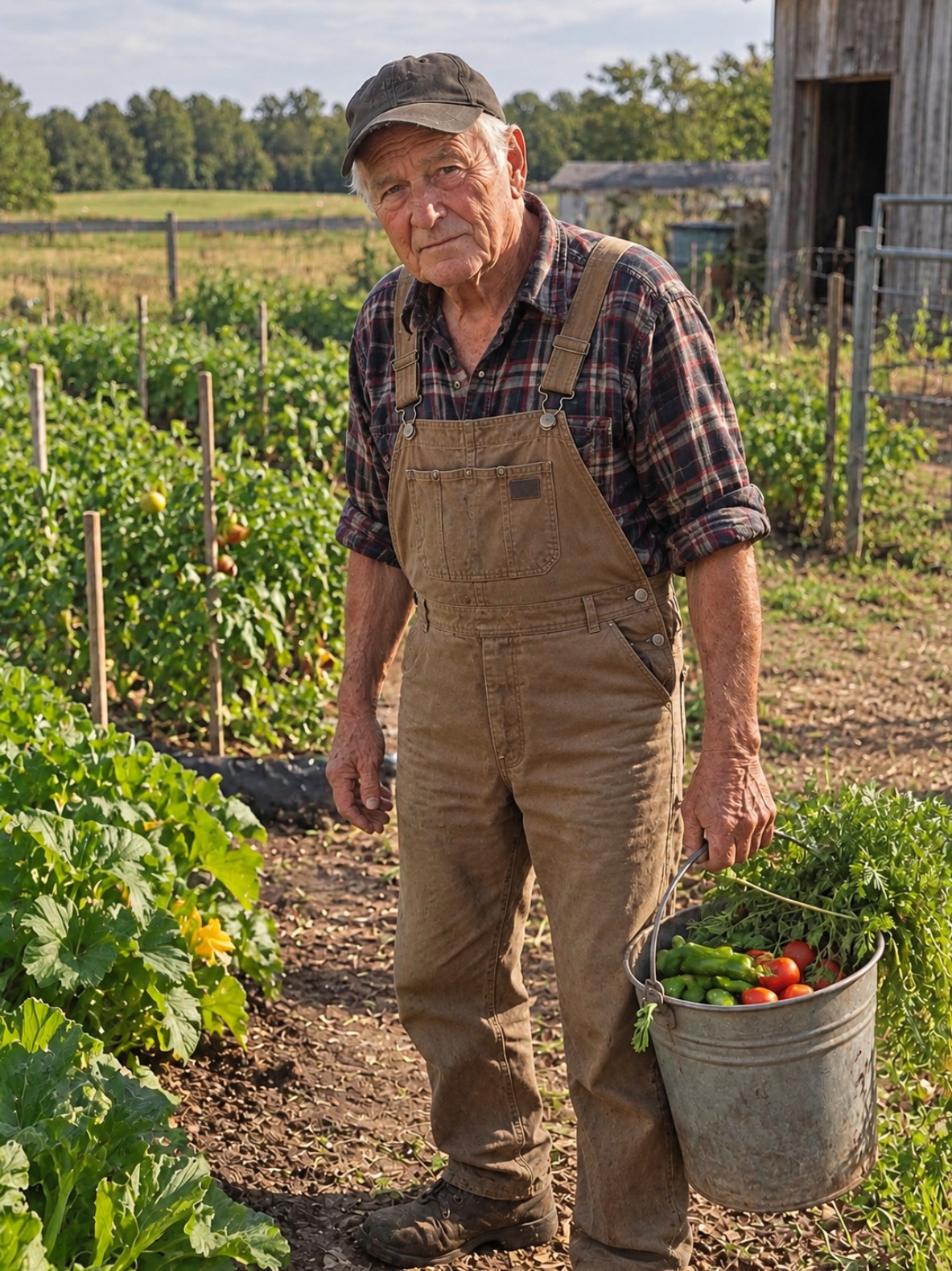
Part 1:
A new neighbor reported my seventy-nine-year-old father’s vegetable garden to the county zoning office, calling it an eyesore. A young county inspector arrived with an official notice giving Dad thirty days to bring the property into compliance. But instead of arguing, shouting, or demanding to speak to a lawyer, Dad simply shook the inspector’s hand and asked him for one small favor.
“Would you come back Saturday morning at six o’clock?” my father asked quietly.
The inspector looked confused.
“Six in the morning, sir?”
“That’s right,” Dad replied calmly.
What happened that Saturday morning would change the lives of everyone involved. It would also reveal a secret my father had kept for decades, a secret even his own daughter had never fully understood.
The official letter arrived on a crisp Tuesday morning.
I was standing at the kitchen sink, rinsing Dad’s glass coffee pot, when I heard the envelope tear behind me. Then the kitchen fell completely silent.
I turned around.
My father, Bernard Callahan, was sitting at the old wooden kitchen table with his reading glasses resting halfway down his nose. He held a single sheet of paper in his weathered hands. He read it once, turned it over to check the back, and then turned it around and read it again.
“Dad, what is it?” I asked, setting down the coffee pot.
He didn’t answer immediately. Instead, he laid the paper flat on the table and smoothed it with both hands, using the same gentle motion he always used when covering freshly planted seeds with soil.
“Says right here that I have unmaintained agricultural use in a residential zone,” he finally said.
“What in the world does that mean?”
He slid the letter toward me.
It came from the County Code Enforcement Division. An official blue seal sat at the top, followed by a case number and several paragraphs of legal language.
The letter stated that a formal complaint had been filed against the property at 1147 Ridgeview Road. A county inspection would take place on Thursday morning, and the garden could be considered a public nuisance under local regulations.
I read the letter twice before looking out the large kitchen window.
Beyond the wooden back porch, the clothesline, and the faded red storage shed lay my father’s vegetable garden.
It covered nearly half an acre of dark, fertile soil.
Nine long rows of green beans climbed strings he tied by hand every May. Nearly three hundred tomato plants stood upright in wire cages. There were potatoes, squash, onions, beets, carrots, and cucumbers spreading along a low wire fence.
Two long rows of sweet corn rose above everything else, their green leaves rustling gently in the morning breeze. Along the garden’s edge grew a patch of wild strawberries my mother had planted decades earlier.
Not a single weed seemed to exist anywhere in that garden.
I had watched Dad kneel in the dirt at five in the morning, pulling weeds so small they were barely bigger than my fingernails.
“Unmaintained?” I said, unable to hide my disbelief.
“That is what the piece of paper says,” Dad replied quietly.
“Dad, this garden is probably the best-maintained property in the entire county!”
He removed his glasses, folded them carefully, and slipped them into his front shirt pocket.
“Well, somebody around here obviously doesn’t think so.”
My father was seventy-nine years old. He had been born in this very farmhouse in 1947, just as his own father had been born on the same land before him.
He spent thirty-four years working at the regional paper mill down in the valley. When the mill finally closed, he found another job driving a yellow school bus, a job he kept for twelve more years before retiring.
Growing things in the soil had always been his greatest pleasure.
My mother, Martha, died of pancreatic cancer three years earlier, in October 2023. She and Dad had been married for fifty-one years. From her first diagnosis to her funeral, only four short months had passed.
After she died, I honestly thought Dad would let the garden go.
I imagined him selling the family home and moving into one of those modern senior apartments near the town square, complete with small concrete patios and shuffleboard courts.
Instead, he made the garden even bigger.
Dad lived alone and ate like a little bird. For breakfast, he usually had a small bowl of warm oatmeal. At noon, he ate a simple sandwich. In the evening, he might have a piece of baked fish with a potato.
He remained as thin as an old wooden fence post.
Yet every spring, he planted enough food to feed far more people than himself.
About two years earlier, I had stood beside the nine rows of green beans, trying to estimate how much food the garden would produce.
There had to be hundreds of pounds of beans, thousands of tomatoes, and enough potatoes to feed an entire military division.
“Dad, who are all these green beans really for?” I had asked.
He was kneeling in the dark soil, tying up a heavy tomato vine that had fallen during a thunderstorm. He didn’t even look up.
“People,” he answered.
That was all he said.
I waited for him to explain, but he continued tying the vine with a strip of an old bedsheet. His large, weathered fingers moved slowly and carefully.
At the time, I assumed he gave the extra vegetables to friendly neighbors, took them to church, or perhaps left some of the harvest unused.
I never asked again.
Looking back, I wish I had.
Because the truth was far more meaningful than anything I could have imagined.
The man who reported Dad was our new neighbor, Chad Miller.
The previous spring, Chad had purchased the old Jenkins property next door. The Jenkins family had lived beside my parents for more than forty years. Old Mr. Jenkins had even taught me how to ride a bicycle on the rough gravel road between our yards.
After he died, his grown children sold the land to a real estate developer, who eventually sold it to Chad.
Chad tore down the family’s cozy white farmhouse, removing every old board, and replaced it with a massive modern residence that looked as though it belonged on the cover of an architectural magazine.
The house had two stories of smooth charcoal-gray siding, bold black window frames, and an oversized three-car garage. A pristine basketball hoop stood in the driveway, although I never saw anyone use it.
The front lawn was so dark green and perfectly trimmed that it almost looked artificial.
But the most noticeable feature was the enormous upper deck.
It wrapped around the second floor and looked directly over Dad’s low wooden fence, providing a clear view of the entire vegetable garden.
I visited Dad almost every Sunday morning. We usually shared a pot of coffee and talked about whatever had happened during the week.
During many of those visits, I spotted Chad standing on his elevated deck in a plush bathrobe, holding a ceramic mug and frowning at the crops below.
He seemed especially annoyed by the sweet corn.
That summer, the corn grew more than seven feet tall, blocking part of the panoramic view of the valley from his deck.
One Sunday, I noticed Chad staring down at the garden again.
“He really doesn’t like your vegetables very much,” I remarked.
Dad glanced toward the window and shrugged.
“Takes all kinds of folks to make a world.”
That was my father. He could probably find something forgiving to say about a rattlesnake that had just bitten him.
I had spoken directly to Chad only once before the official complaint arrived.
It happened in early June, while I was helping Dad harvest the first sweet strawberries of the season.
Chad stepped onto his upper deck and watched us working below.
He looked to be about forty-five years old. He was tall, athletic, and carefully groomed, with the appearance of someone who spent hours at a gym following a trainer’s strict instructions. An expensive gold watch glinted on his wrist.
Dad stood up from the strawberry patch, wiped his hands on his worn denim overalls, and walked toward the fence.
“Good morning!” he called cheerfully.
Chad looked down at him.
“Good morning.”
“My name is Bernard Callahan,” Dad said. “I’ve been meaning to come over and welcome you to the neighborhood properly.”
“Chad Miller,” the man replied crisply.
Dad lifted a small green cardboard basket filled with bright red strawberries.
“These are the first of the season. My late wife planted these years ago, and they’re the sweetest berries in the valley. You’re more than welcome to take some.”
Chad looked at the strawberries, then at Dad, and finally at the rows of cultivated soil behind him.
“No thanks,” he said coldly. “I’m really not big on fresh fruit.”
Dad slowly lowered the basket.
“Well, the offer stands regardless. Anytime you want fresh produce, just let me know. The tomatoes will be ripe in July, and the green beans should be ready by August.”
Chad gave a short nod without smiling, turned around, and slid his glass patio door shut.
Dad stood by the fence for a moment, still holding the basket. Then he walked back toward me and placed the strawberries in the grass beside the path.
“Not big on fresh fruit,” he mused. “How about that?”
“Dad, he was incredibly rude to you!” I said angrily.
“He was probably busy,” Dad replied.
“He was standing on his private deck doing absolutely nothing!”
“Maybe he was thinking about something important,” Dad said, kneeling back down. “A man is allowed time to think.”
That was the end of the conversation.
But when the county’s official letter arrived that Tuesday morning, I knew exactly who had filed the complaint.
“It’s Chad,” I said firmly, slapping the letter onto the table. “It has to be him. Nobody else can even see the garden from the road. He’s been glaring at your corn all summer as though it personally offended him.”
Dad said nothing.
“He cannot do this to you,” I continued. “He cannot buy the property next door and start ordering you around on land our family has owned for generations. He’s barely lived here five months!”
“The county zoning office says people are allowed to file complaints,” Dad replied.
“Well, then the county is wrong!”
“Perhaps they are.”
I pulled out my smartphone and began typing.
“I know a good lawyer. Well, Susan from my office knows an attorney who handles land disputes and zoning issues. His name is Douglas Vance. I’m calling his office right now.”
“Kristin,” Dad said softly.
“I am dialing the number this second.”
“Kristin.”
His voice was so calm that I stopped with my fingers hovering over the screen.
“Let’s wait patiently and hear what the county inspector has to say first.”
“Dad, they’re going to make you dig up the entire garden!”
“Maybe they will. Maybe they won’t.”
“How can you possibly be so calm about this?”
He looked through the kitchen window at the tall corn and the heavy tomato vines bending beneath their own weight.
“Because I’ve been growing crops on this land for nearly seventy years,” he explained. “When you farm, you learn that important things cannot be rushed. You plant your seed in the dark ground, you wait patiently, and you see what eventually comes up.”
I had no idea what he meant by that.
Nevertheless, I wrote Douglas Vance’s name and telephone number on the back of the county envelope, just in case.
I wasn’t about to let my father’s garden disappear without a fight.
I simply didn’t know yet that Dad had a very different kind of fight in mind.
Part 2: The County Inspector Arrived—and My Father Refused to Fight
I took Thursday morning off from work so I could be there when the county inspector arrived.
I worked as a licensed dental hygienist in Oakridge, about forty minutes from Dad’s farmhouse. In the previous three years, I had taken only two sick days, so my supervisor looked surprised when I asked for another morning off.
“Is your father having health problems?” she asked with genuine concern.
“He’s doing fine,” I explained. “It’s his new neighbor who’s causing serious trouble.”
I drove to the farmhouse at seven o’clock Thursday morning.
Dad was already in the garden, kneeling among the green bean rows with his trusty metal bucket beside him.
“Dad, the inspector will be here at nine!” I called from the edge of the field.
“I know,” he called back.
“Shouldn’t you come inside and put on a clean shirt?”
He looked down at his faded blue work shirt. The fabric was worn thin at the elbows, and a small tear showed near the pocket.
“What’s wrong with my shirt?” he asked.
“Nothing at all,” I sighed. “Never mind.”
I sat on the wooden back porch steps with a mug of hot coffee and watched him work.
The morning sun rose above the trees, bathing the garden in golden light. Bees hovered around the yellow squash blossoms, and a robin searched the freshly turned soil for worms.
It was one of the most peaceful sights I had ever seen.
Yet the man living in the modern gray house next door had officially labeled it an eyesore.
I glanced toward Chad’s upper deck. It was empty, and the thick curtains behind the glass doors were drawn tightly shut.
At five minutes to nine, a small white county sedan pulled into the driveway. An official emblem was stamped on the driver’s door.
The inspector stepped out. He looked about twenty-six years old and introduced himself as Wayne Miller. He wore wire-rimmed glasses, had a neat haircut, and carried an identification badge clipped to his belt.
From the moment he approached us, he was polite and respectful.
He shook my hand, then Dad’s, addressing my father as “sir.”
“Mr. Callahan, thank you for meeting with me today,” Wayne said. “I’m genuinely sorry to interrupt your morning.”
“It’s no trouble at all,” Dad replied warmly. “Would you like a fresh cup of coffee?”
Wayne blinked in surprise, as if property owners rarely offered him coffee during official code enforcement visits.
“Oh, no, thank you, sir. I’m fine.”
He opened his clipboard and began inspecting the property.
Wayne walked around the entire garden, taking photographs with his phone, measuring the cultivated area, and writing notes. Dad followed him quietly, his dirty hands tucked into his overall pockets, while I stayed close behind them, ready to argue if necessary.
At one point, Wayne stopped near the long tomato rows.
Nearly three hundred healthy plants stood in neat lines. Every vine was supported by a stake or wire cage, and faded strips of cloth held up the heavier branches. There were no obvious signs of neglect.
“Sir, how many hours a day do you spend maintaining all this?” Wayne asked.
Dad thought for a moment.
“About six hours. Sometimes seven in June, when the weeds grow quickly.”
“Do you work out here every day?”
“Every single day that God grants me.”
Wayne wrote something on his clipboard.
He then looked toward Chad’s modern gray house before turning back to the garden.
When we returned to the porch, he took a deep breath. He looked uncomfortable as he tapped his pen against the clipboard.
“Mr. Callahan, I’m genuinely sorry about this,” he began. “But once an official complaint is filed, our department has to investigate and apply the relevant regulations.”
Dad nodded, encouraging him to continue.
“According to the local ordinance, agricultural cultivation exceeding a quarter acre in a designated residential zone requires a special land-use permit. Your garden covers roughly half an acre, and we have no permit on file.”
“I’ve never needed a permit before,” Dad replied mildly. “My father worked this garden before me, and his father worked it before him.”
“I understand, sir. The county updated the zoning classification in 2019, when this section of Ridgeview Road was designated for new residential development.”
Wayne glanced at his paperwork.
“Your garden may qualify as a grandfathered use, but the applicable local rules allow that protection to be challenged when a formal complaint is filed. Because this complaint has been submitted, I must issue a notice of violation giving you thirty days to bring the property into compliance.”
“Which means what, exactly?” I demanded.
Wayne turned toward me.
“It means reducing the cultivated garden to less than a quarter acre or removing it entirely.”
I stared at him.
“You’re telling a seventy-nine-year-old man to destroy half his crops?”
“Another possibility is to apply for a special-use variance,” Wayne explained. “Unfortunately, that review can take at least six months. During that period, the violation would remain active, and daily fines could accumulate under the applicable rules.”
He lowered his eyes.
“I’m truly sorry.”
“Thirty days,” Dad repeated quietly.
“Thirty days, sir.”
I could feel my whole body shaking with anger.
The lawyer’s number seemed to burn through the envelope in my back pocket. I wanted to shout at Wayne, although I knew he was only doing his job. I wanted to remind him that my father’s garden was older than most of the houses in the neighborhood, that my mother had planted those strawberries decades ago, and that our family had cared for this soil for generations.
Most of all, I wanted to march over to Chad’s expensive house, pound on his front door, and tell him exactly what I thought of his complaint.
I opened my mouth.
Dad gently placed his weathered hand on my forearm.
He didn’t squeeze my arm or pull me back. He simply rested his warm, dirty hand there, just as he used to do when I became upset at the dinner table as a little girl.
I closed my mouth.
Dad stood up from the porch steps. His old knees cracked in the quiet morning air as he walked toward Wayne and extended his hand.
The young inspector looked surprised for a moment, then shook it respectfully.
“I appreciate you taking the time to come out here,” Dad said warmly. “I know you’re just doing the job you were hired to do.”
“Thank you, sir,” Wayne replied.
Dad held his hand for another moment.
“Would you be willing to do me one small favor before you submit your final paperwork?”
Wayne hesitated.
“If it’s within my authority, sir.”
“Come back this Saturday morning at six o’clock.”
Wayne looked at him, clearly confused.
“Six in the morning this Saturday?”
“Yes.”
“May I ask what will be happening then?”
Dad finally released his hand.
“There’s something important I’d like you to observe in person before you finalize your decision.”
Wayne glanced toward the perfectly maintained tomato vines, then at Dad’s calm face, and finally at the gray house next door.
“All right,” he agreed slowly. “I’ll be here at six o’clock Saturday morning.”
“Thank you, young man.”
Wayne returned to his white county sedan and sat inside for a few minutes, reviewing his notes. Then he drove away.
I immediately turned toward Dad.
“What on earth is happening on Saturday?”
Dad picked up his metal bucket.
“Saturday is simply Saturday,” he replied before heading back to his green bean rows.
I stared after him.
Sometimes, I wondered whether my father had always been this mysterious or whether I had simply never paid enough attention to him.
That evening, I decided not to return to my apartment. I was too angry and too worried about what might happen to the garden.
I called my dental clinic and requested Friday off as well. My supervisor sighed loudly over the telephone before finally approving the extra day.
Then I did something impulsive.
At around six o’clock that evening, as the sun cast long orange shadows across the grass, I walked straight over to Chad’s property.
His glossy black SUV was parked in the concrete driveway, gleaming beneath the evening light.
I followed the perfectly maintained front path and pressed the electronic doorbell. A polished chime sounded inside the house.
A moment later, Chad opened the door.
He wore a crisp golf shirt and dark trousers and held a glass of red wine. He looked at me with mild curiosity, as though he was trying to remember where he had seen me before.
“Can I help you with something?” he asked.
“I’m Kristin Callahan,” I said firmly. “Bernard’s daughter. I live next door.”
Recognition flickered across his face before his expression returned to normal.
“Ah, yes. How can I help you?”
“You reported my father’s garden to the county zoning office.”
He took a slow sip of wine.
“I submitted a formal zoning complaint through the proper county channels, yes.”
“Why would you do that?”
“Because it’s an eyesore,” he replied, as if the answer should have been obvious. “It’s half an acre of raw dirt, towering corn, and what looks like decaying vegetation directly outside my main living-room windows. I paid a substantial amount of money for this lot and built a custom home here. I didn’t invest that money to look at an active farm every day.”
I stared at him in disbelief.
“The vegetables aren’t decaying! That garden is probably the cleanest and most carefully maintained property in this county.”
“It remains an agricultural operation in a planned residential zone,” Chad replied smoothly. “Zoning regulations exist for a reason.”
“My father is seventy-nine years old! He’s lived on that land his entire life. Our family has farmed that soil for a century, while you’ve barely lived here five months.”
“I’m sure that history is very meaningful to him,” Chad said in a detached voice. “However, the legal zoning classification has changed, and his property is out of compliance. That’s hardly my fault.”
“You could have spoken to him directly instead of filing a complaint behind his back!”
“I have no reason to negotiate personal terms when the county provides a formal code enforcement process.”
I felt my eyes burning with frustration.
“He offered you fresh strawberries in June. He walked over to your fence and offered you berries my mother planted before she died, and you dismissed him as if he were trying to sell you something!”
Chad’s jaw tightened.
“Look, I don’t know what kind of unlicensed business your father is operating over there,” he said coldly. “But I see trucks arriving early every week. He loads boxes into his vehicle and drives away before sunrise. That isn’t a personal hobby garden. It looks like a commercial operation, and if he’s selling produce without the proper business license or paying the required taxes, that’s another problem.”
I could hardly believe what I was hearing.
“You have absolutely no idea who my father is or what he stands for.”
“I don’t need to know him,” Chad replied flatly.
Then he closed the front door.
I stood there for several seconds, staring at the polished wood.
I had never met anyone who could make a perfectly reasonable conversation feel so cold.
I walked back across his immaculate lawn, crossed the low boundary between our properties, and found Dad sitting on the back porch, shelling fresh peas into a stainless-steel bowl.
He had seen me walk over to Chad’s house and return.
“Well?” he asked mildly.
“He claims you’re running an illegal commercial operation and selling vegetables without a tax license.”
Dad burst into a hearty laugh.
It was a real, full laugh, the kind I hadn’t heard from him since before Mom’s funeral.
“A commercial operation!” he chuckled. “That’s a good one. I’ll have to remember that.”
“Dad, this isn’t funny!”
“It is a little funny.”
I sat heavily on the porch steps.
“He said he’s seen your green truck leaving before sunrise every week, loaded with boxes.”
Dad’s hands stopped moving for a moment.
Then he resumed shelling the peas.
“You leave every Friday morning,” I continued. “I’ve always assumed you were having trouble sleeping and going for early drives.”
Dad remained silent.
A pea dropped into the stainless-steel bowl with a soft metallic click.
“Where do you actually go every Friday morning, Dad?” I asked quietly.
He snapped open another pod with his thumb.
“You’ll see soon enough.”
“I want to know now.”
“You’ll see everything on Saturday morning,” he promised. “Everyone will.”
I watched him for a long moment, searching his face for some hint of what he was planning.
There was none.
That night, I slept in my old childhood bedroom, surrounded by faded wallpaper and familiar wooden furniture.
At four fifteen on Friday morning, the deep rumble of a truck engine woke me.
I walked to the window and looked down into the driveway.
The sky was pitch-black, but the yellow porch light illuminated Dad as he carried heavy cardboard banana boxes from the storage shed to his green pickup truck.
He placed each box carefully in the truck bed, arranging them beneath a dark tarp.
I could see fresh tomatoes, green beans, squash, and potatoes packed inside.
I counted eleven full boxes.
Dad secured the tarp with ropes, checked every knot twice, and climbed into the driver’s seat.
He backed down the driveway with his headlights off until he reached the paved road. Then the lights came on, and he disappeared into the darkness.
I stood at the window, watching his red taillights fade into the distance.
For a moment, I considered grabbing my car keys and following him.
But I remembered what he had said.
You’ll see everything on Saturday morning.
So I waited.
Dad returned at nine thirty that morning with an empty truck bed.
He came into the kitchen, washed his hands thoroughly at the sink, poured himself a cup of coffee, and sat down across from me as though he hadn’t been gone for hours delivering eleven boxes of food to unknown destinations.
“Good morning,” he said warmly.
“Good morning.”
He blew gently on his coffee.
“You ought to turn in early tonight,” he advised. “We’ve got a big morning ahead of us tomorrow.”
I looked at him suspiciously.
“Are you finally going to tell me what’s happening?”
He smiled faintly.
“Tomorrow.”
And that was all I got.
Part 3: At Six in the Morning, the Cars Started Arriving
I set my alarm for five o’clock Saturday morning, although I was already awake by four thirty, staring at the ceiling and wondering what my father had planned.
When I walked downstairs, Dad was already in the kitchen preparing coffee.
But he wasn’t using his usual little four-cup coffee pot.
Instead, he had brought out the enormous thirty-cup coffee urn my mother used to take to community gatherings.
I stopped in the doorway.
“Dad, what on earth is that big coffee pot for?”
He glanced at me.
“People,” he replied simply.
Then he picked up his familiar metal bucket and headed outside toward the garden.
I followed him onto the porch.
Saturday morning arrived beneath a thick blanket of mist. Cold valley fog rolled across the fields, hiding the far end of the garden, the wooden fence, and much of the tall sweet corn.
I stood on the back porch, holding a warm cup of coffee between my hands.
At five minutes before six, headlights appeared through the fog.
Wayne Miller’s white county sedan pulled onto the roadside. The young inspector stepped out wearing a windbreaker over a sweatshirt, with his clipboard tucked beneath his arm.
He looked tired and slightly anxious as he walked up the gravel driveway.
“Good morning,” he greeted me. “I’m here as your father requested.”
“Would you like some hot coffee?”
“Yes, please. Thank you.”
I handed him a paper cup.
He wrapped both hands around it, enjoying the warmth.
“Where is your father?” he asked.
I pointed toward the mist-covered garden.
A lone figure was moving between the bean rows, bent over his metal bucket and harvesting vegetables as though this were an ordinary Saturday morning.
“He’s out there,” I said. “And I honestly have no idea what he wants you to see.”
Wayne followed my gaze.
Then I noticed movement on the neighboring property.
Chad was standing on his second-story deck, wearing a dark blue bathrobe and holding his usual coffee mug.
He had clearly noticed the county car and wanted to watch the official notice being delivered.
He raised his mug slightly toward us in what looked like a mocking toast.
Wayne didn’t acknowledge him.
I turned back toward the road.
The clock on the kitchen wall ticked closer to six.
Then, exactly at six o’clock, headlights appeared through the fog.
An old red pickup truck with rusted fenders slowed down and pulled onto the gravel shoulder.
Two more trucks followed immediately. One was a white Chevrolet, and the other was a blue Dodge with a cracked windshield.
They parked neatly behind the first vehicle.
Then came a compact sedan, a station wagon, a rusty Buick, and a minivan displaying a handicap parking permit.
One vehicle after another arrived, forming a long line along the road.
Wayne slowly lowered his coffee cup.
I started counting.
Twelve vehicles.
Fifteen.
Eighteen.
And still, the cars kept coming.
Doors opened, and people climbed into the cold morning air.
An elderly man wearing work overalls stepped out of a pickup. A young mother emerged from a sedan with an infant secured against her chest in a carrier and a toddler holding her hand.
A middle-aged man wearing a retail store vest had apparently come straight from a night shift.
Two teenage brothers carried a wicker laundry basket between them. A woman in medical scrubs climbed out of another vehicle, followed by an elderly lady leaning on a walking cane.
A man with a prosthetic leg carefully stepped down from a minivan. Another car carried a family of five, whose young children wore jackets over their pajamas.
They all carried empty containers.
Some had cardboard boxes. Others brought plastic buckets, cloth grocery bags, or small utility wagons.
Nobody seemed confused about where to go.
Nobody asked for instructions.
They simply exchanged quiet greetings and walked toward Dad’s garden.
I watched in complete bewilderment.
What was happening?
Had Dad invited all these people?
How did he know so many families?
And why had I never heard about any of this before?
The elderly man in overalls headed straight toward the potato rows. He took a small hand fork from his bag and began loosening the soil around the plants.
The young mother walked to the strawberry patch my mother had planted decades earlier. She set her toddler down on a patch of grass, and the little boy immediately reached for a ripe strawberry.
The two teenage brothers went to the sweet corn. One pulled the ears downward while the other twisted them off the stalk with practiced ease.
The woman in medical scrubs walked toward the tomato vines.
The elderly lady with the cane moved slowly toward the bean rows, where Dad was working.
He straightened when he saw her.
They exchanged a few quiet words, and he handed her his bucket of freshly harvested beans.
She smiled at him, then began carefully selecting vegetables for her own bag.
All around the garden, people worked quietly and respectfully.
They picked only what their families needed. Nobody grabbed handfuls of produce or tried to take more than their share. They left plenty of vegetables behind for the other families who had come.
It was as though everyone understood the rules without anyone needing to explain them.
Wayne stood beside me on the porch, his clipboard hanging uselessly from one hand.
His pen hovered over the paper, but he wasn’t writing anything.
“What is all this?” he whispered.
I tried to answer, but no words came out.
My eyes had begun to fill with tears.
Then, suddenly, I understood.
Two years earlier, I had asked Dad who all those green beans were for.
People.
That single word, which I had never thought much about, suddenly seemed to contain an entire world.
I looked toward Chad’s deck.
He was still standing at the railing.
But his coffee mug was no longer raised.
He gripped the wooden railing with both hands, staring down at the garden and the growing number of people moving through its rows.
His face had gone pale.
The long line of cars stretched down the road, and the fog made the entire scene look almost unreal.
Then another vehicle appeared.
It was a silver minivan.
The driver moved slowly through the mist and parked at the very end of the line.
For several moments, nobody stepped out.
Then the driver’s door opened.
An elderly woman climbed out, wearing a tan raincoat that was slightly too large for her small frame. She had simple white sneakers on her feet, and her gray hair was pulled neatly back.
She carried two folded cloth grocery bags beneath one arm.
She closed the car door and began walking slowly up the gravel driveway.
Her head was lowered, and she appeared quiet and reserved.
Halfway up the path, she raised her eyes toward the garden.
Then she looked beyond the vegetables and toward the second-story deck of the modern gray house.
She stopped.
Completely.
One of her cloth grocery bags slipped from beneath her arm and fell onto the damp gravel.
She didn’t bend down to retrieve it.
She simply stood in the middle of the driveway, staring up at Chad.
On the deck, Chad carefully placed his coffee mug on the railing.
His fingers seemed to have lost their strength.
For a moment, everything around them appeared to slow down.
The families continued harvesting in the mist, unaware of the tension unfolding near the driveway.
Wayne and I watched in silence.
Even Dad, standing among the bean rows, had noticed what was happening.
The elderly woman finally bent down, picked up her fallen bag, and held both bags tightly against her chest.
Her eyes remained fixed on the upper deck.
Chad suddenly turned away.
He disappeared through the glass patio doors, leaving his coffee behind.
A moment later, he reappeared around the side of his house.
He was running barefoot through the dew-covered grass, still wearing his expensive bathrobe.
He hurried toward the wooden fence, stepped over a low section where an old post leaned, and pushed through the tall corn.
Within seconds, he reached the gravel driveway.
He stopped about ten feet from the woman.
His face was pale, and his breathing was unsteady.
“Mom?” he asked.
His voice trembled.
The woman pressed her grocery bags against her chest.
“Chad,” she whispered. “What are you doing out here?”
“I live right here,” he answered, pointing toward the enormous modern residence. “That’s my house, Mom.”
She looked up at the building.
Her eyes moved across the dark windows, the expansive upper deck, and the three-car garage.
“I had no idea which house belonged to you,” she whispered. “You never invited me out here to see it.”
Chad opened his mouth, but no words came out.
After a moment, he looked down at the bags in her hands.
“What are you doing here?” he asked quietly. “At this garden?”
His mother glanced down at her plain sneakers.
Then she looked toward the people harvesting vegetables.
Chad followed her gaze.
He saw the elderly man digging potatoes, the young mother gathering strawberries for her children, and the families filling their containers with fresh food.
Finally, he looked at his mother’s empty grocery bags.
The realization seemed to hit him all at once.
“No,” he whispered.
Then he took a shaky breath.
“Mom, no. Are you here to get food?”
His mother lifted her chin slightly.
Her lower lip trembled.
“I come here every Saturday morning,” she confessed. “I’ve been coming for a year and a half.”
Chad took a step backward as though someone had struck him.
“Why would you do that?” he asked desperately. “I send you two hundred dollars every single month!”
His mother nodded.
“You do, and I’m deeply grateful for your help. But my pension is only eleven hundred dollars a month. My apartment rent is eight hundred, and my heart medication costs three hundred and forty dollars after insurance.”
She paused, clutching the bags more tightly.
“The numbers simply don’t add up, Chad. They haven’t added up since your father passed away.”
Chad stared at her.
“You never told me you were struggling like this.”
“How could I tell you that?” she asked tearfully. “You worked so hard to build your life. You put yourself through college with loans, established your own business, and worked for everything you have. You were so proud of your success, and I was so proud of you.”
Her voice cracked.
“Every time you called, you were happy telling me about your career and your new house. I didn’t want to become the burden that dragged you back down.”
“You could never be a burden to me!” Chad insisted.
“I know that in my heart,” she replied. “But I didn’t want you looking at me and remembering the old trailer, the empty pantry, and how hard things used to be.”
Chad stood barefoot on the sharp gravel, wearing his expensive bathrobe.
He looked utterly devastated.
And I realized that the story unfolding in front of us was much bigger than a zoning complaint.
This was a family secret that had remained hidden for years.
And my father had known part of it all along.
Part 4: The Truth About Chad’s Mother—and the Secret Behind the Garden
Wayne stood beside me on the porch, watching the emotional scene unfold.
“Does he know what she means?” he whispered.
I couldn’t answer.
My attention was fixed on Chad and his mother.
Then Dad appeared from between the bean rows, carrying his metal bucket.
He walked toward the driveway with the same unhurried steps he took every morning.
When he reached the elderly woman, he smiled gently.
“Good morning, Evelyn,” he said. “There’s no need to apologize for anything.”
Evelyn’s eyes filled with tears.
“Good morning, Bernard.”
Chad turned sharply toward my father.
“You know my mother?”
Dad nodded.
“She comes by every Saturday morning.”
He glanced at Evelyn’s grocery bags.
“She prefers the yellow squash and the little red potatoes. She says those small potatoes taste just like the ones her mother used to grow.”
Evelyn let out a tearful sigh and held her bags closer.
Chad looked between the two of them, struggling to understand what he was hearing.
“You’ve been giving my mother vegetables?”
“Of course,” Dad replied.
“For how long?”
“For as long as she’s needed them.”
Chad stared at the rows of vegetables, then at the families moving through the garden.
Finally, he looked directly at Dad.
“I called the county code enforcement office on this garden,” he admitted. His voice sounded hollow. “I called it an eyesore and demanded that they force you to tear it all out.”
“I know you did,” Dad replied calmly.
Chad swallowed hard.
“You knew she came here for food?”
Dad shook his head.
“I didn’t know Evelyn was your mother. I only knew her as Evelyn, a sweet widow who lives in the town apartments and needs fresh vegetables.”
He paused, looking around at the people gathering their food.
“People don’t need to show credentials to receive food from this land. If someone needs vegetables, we help them. That’s all there is to it.”
Chad lowered his head.
Dad continued gently.
“I hoped that if you watched this garden long enough, you’d eventually see its real purpose. I hoped you might begin to feel differently about looking at it every morning.”
Chad slowly lowered himself onto the rough gravel driveway.
He sat with his elbows resting on his knees and buried his face in his hands.
His expensive bathrobe gathered around him, and his bare feet were covered in damp dirt.
Evelyn stepped closer and placed a gentle hand on his hair, comforting him as she might have done when he was a small boy.
“It’s okay, son,” she whispered.
Chad shook his head.
“No, Mom. It’s not okay.”
His shoulders trembled.
“It isn’t okay at all.”
The families around us began to notice what was happening.
One by one, they paused their harvesting and stood quietly among the rows.
Nobody laughed at Chad.
Nobody scolded him.
They simply watched as a successful man, standing beside a house worth far more than the old trailer he had grown up in, struggled to face a truth he had spent his life avoiding.
After a few moments, Chad lifted his head.
His eyes were red, and his face was wet with tears.
“When I was growing up, we lived in an old trailer on County Road 9,” he began.
His voice carried across the driveway, and the people nearby listened.
“My father injured his back and couldn’t drive his delivery route anymore. My mother started growing vegetables because we needed the food. Without that garden, we wouldn’t have had enough to eat.”
Evelyn closed her eyes as her son continued.
“Every summer afternoon, I had to pick green beans in the boiling heat. I’d go to school with dark dirt beneath my fingernails that wouldn’t come off, no matter how hard I scrubbed.”
He gave a bitter laugh.
“The kids at school mocked me. They called me ‘Bean Boy’ because green beans were in almost every lunch I carried.”
He looked down at his hands.
“I hated it. I hated the dirt, the trailer, the garden, and the way people looked at us. I promised myself that I would work until I was wealthy. I would never touch another bean, and nobody would ever look at me and see poverty again.”
He turned his head toward the enormous gray house.
“So I built that place up there. I worked hard, made money, started my own business, and finally bought a beautiful house. I wanted to leave all those memories behind.”
His voice grew quieter.
“Every morning, I’d step onto my deck with my coffee and look down at Bernard’s garden. All I could see was that old trailer on County Road 9. I could see my mother on her knees in the dirt and remember our empty kitchen cupboards.”
He pressed his hands against his face.
“I hated looking at it because it reminded me of everything I’d tried so hard to escape.”
He took a shaky breath.
“But my own mother was coming here every Saturday to get food from the very garden I tried to destroy.”
He covered his face again.
Nobody spoke.
I stood on the porch, tears running down my cheeks.
For the first time, I understood that Chad’s complaint hadn’t really been about the appearance of the garden.
He had looked at those rows of vegetables and seen the worst years of his childhood. He had mistaken a reminder of his family’s suffering for something shameful that needed to disappear.
He had spent years trying to erase his past, never realizing that the same vegetables he hated had once helped keep his family alive.
And now, those same vegetables were helping his own mother survive.
Dad looked at Chad for a long moment.
Then he slowly lowered himself onto the gravel beside him.
His knees cracked loudly in the quiet morning air.
I instinctively started to move toward him, worried he might hurt himself, but Dad settled beside Chad and rested his bucket on the ground.
“Back in 1982, the paper mill laid off more than two hundred workers,” Dad began quietly. “I was one of them.”
Chad lifted his head.
Dad rubbed his calloused hands together.
“I had a wife, a five-year-old daughter, a mortgage, and no job prospects. The mills all over the valley were shutting down. There weren’t many places left for a man like me to find work.”
He looked toward the farmhouse.
“Back then, Martha had a little garden. Mostly flowers, with a few tomato plants. She loved growing things, but we never imagined that a garden could make the difference between having food and going hungry.”
Dad paused.
“That winter was especially hard. There was a cold week in February when we had almost nothing left in the kitchen. We had a box of crackers and a jar of peanut butter. That was about it.”
My heart tightened.
I had no memory of those days. I had been only five years old in 1982.
“Martha gave her entire portion of food to little Kristin,” Dad continued. “She pretended she wasn’t hungry so our daughter could eat.”
I stared at him.
My mother had never told me.
Dad looked down at his hands.
“One morning, I opened the front door to go looking for work and found a large cardboard box sitting on the porch. It was filled with potatoes, onions, canned vegetables, flour, and a whole ham.”
He paused, letting the memory settle.
“There was no name on it. Just a little note that said, ‘From your neighbors. Pass it on.’”
Chad listened without moving.
“Every Friday morning after that, until I found a job at the school bus garage in May, another box appeared on our porch,” Dad continued.
“We never found out who left those supplies. Martha always believed it was the Jenkins family, who lived where your house stands today.”
Dad smiled faintly.
“Old Mr. Jenkins was too stubborn to admit anything like that. But Martha was convinced it was him.”
A few people in the garden smiled through their tears.
Dad continued.
“Those boxes kept us going. They helped us survive a winter when we didn’t know how we’d feed our daughter.”
He looked at Chad.
“Martha made me promise that we’d pass that kindness along for the rest of our lives. She said no family on this road should ever have to face an empty pantry if we could do something about it.”
Chad lowered his head again.
“So Martha expanded the garden year after year,” Dad explained. “She began opening it to anyone who needed fresh food. Every Saturday, people could come and take vegetables without having to explain their situation or prove they were poor.”
Dad glanced toward Evelyn.
“And on Friday mornings, before sunrise, we’d load boxes into the truck and deliver food directly to people who couldn’t come here themselves. Elderly folks who could no longer drive, people living alone, families going through difficult times, and anyone who was too proud or embarrassed to ask for help in public.”
He looked toward the farmhouse.
“Martha kept that tradition alive for forty years. Even when she became sick, she worried about the people who depended on the garden.”
His voice trembled.
“Her very last words to me in the hospital were that I must never stop the Friday deliveries.”
Dad fell silent for a moment.
Then he looked down at his bucket.
“So I kept my promise to her.”
Tears streamed down my face.
I had lived my entire life beside this garden. I had eaten its tomatoes, potatoes, strawberries, and beans. I had watched my parents work in the soil, year after year.
But I had never understood the real reason behind it.
I had never known about the food boxes that appeared during our hardest winter.
I had never known that my mother had given up her own food to make sure I could eat.
And I had never known that she had spent four decades turning one act of kindness into a tradition that helped dozens of families.
I looked around at the people standing among the rows.
The elderly man with the hand fork was still holding his basket of potatoes. The young mother had her baby against her chest, and her toddler was eating another strawberry. The woman in medical scrubs wiped her eyes with the back of her hand.
They weren’t strangers who had happened to discover a generous farmer.
They were part of a promise my mother had made possible.
A promise my father had quietly kept for decades.
Part 5: The Inspector Made a Decision That Changed Everything
Wayne Miller had been standing beside me throughout my father’s story.
At some point, he had set his clipboard on the porch railing.
Now he stepped forward, looking out over the garden.
“How many families does this garden support?” he asked quietly.
Dad thought for a moment.
“On Saturdays, we serve about forty families. On Fridays, I deliver to eleven homes. Whatever produce is left after those deliveries goes to Saint Jude’s food pantry down the road.”
Wayne looked at the people standing among the rows.
“Forty families,” he repeated.
He glanced at the clipboard on the railing, where the formal violation notice lay beneath his handwritten inspection notes.
For a moment, he said nothing.
Then he picked up the paperwork and carefully removed the notice he had prepared.
He folded the sheet several times and slipped it into his jacket pocket.
“Mr. Callahan,” he began, his voice clearer now, “the county ordinance is intended to address neglected agricultural land and other uses that violate the applicable zoning rules. In my professional judgment, this is the single most carefully maintained property I have ever inspected.”
He looked around at the people harvesting vegetables.
“I’m going to recommend that this complaint be closed as unfounded, based on what I’ve observed today. I’ll also document the community use of the garden and review the appropriate permit process with my department.”
Dad looked up at him with a warm smile.
“Thank you, young man.”
Wayne shook his head.
“Please don’t thank me, sir. My own grandmother received fresh vegetables from a kind neighbor when I was a child. I remember how much that meant to her and to our family.”
He wiped his eyes.
“I’m going to personally submit an application for a special community garden permit on your behalf on Monday morning. I can’t promise what the final approval will be, but I’ll make sure the application explains what this garden does for the community.”
Dad nodded gratefully.
“That’s very kind of you.”
Chad slowly stood up from the gravel.
His bathrobe was dusty, and his bare feet were covered in dirt. He brushed himself off and turned toward Wayne.
“I want to formally withdraw my zoning complaint,” he said firmly. “As soon as possible. Bring me whatever paperwork I need to sign.”
Wayne nodded.
“I’ll have the withdrawal forms ready on Monday.”
Chad then turned to Dad.
For a moment, he seemed unable to find the right words.
“Mr. Callahan, I’m deeply sorry for my arrogance. I don’t know what else to say.”
Dad looked at him kindly.
“Call me Bernard.”
He extended his hand.
“Now, help me up, son. My knees aren’t as reliable as they used to be.”
Chad immediately reached down and took Dad’s hand. He supported my father’s elbow and helped him rise from the gravel.
When Dad was standing steadily, Chad continued holding his arm for another moment to make sure he was balanced.
“Is there anything I can do to help?” Chad asked earnestly.
Dad looked toward the garden.
Then he picked up his dented metal bucket and held it out.
“The green beans are on the left, in nine long rows. Your mother prefers the yellow squash, but she’ll need some green beans too.”
Chad stared at the bucket.
Dad continued explaining, just as he would to anyone who had never harvested vegetables before.
“Always pick from the bottom up. The beans lower on the plants usually mature first.”
Chad slowly reached out and took the handle.
“Bottom up,” he repeated.
“Bottom up,” Dad confirmed with a nod.
For a moment, Chad stood still, looking at the bucket in his hand.
I wondered what he was thinking.
Perhaps he was remembering those hot summer afternoons on County Road 9, when he had been a boy forced to pick beans while other children played.
Perhaps he was remembering the embarrassment he had felt when his classmates called him names.
Or perhaps, for the first time in many years, he was looking at a green bean plant without seeing poverty and shame.
Whatever was happening inside him, something had changed.
He walked into the garden wearing his blue bathrobe and bare feet. At the beginning of the first row, he knelt in the dark soil.
Then he began picking green beans.
Evelyn watched her son with tears of joy in her eyes.
Around them, the families slowly returned to their harvesting. The elderly man continued digging potatoes, the young mother gathered strawberries, and the teenagers filled their basket with sweet corn.
As the morning sun broke through the fog, golden light spread across the garden.
For the first time since Chad had built his house, I imagined he might eventually look down from his deck and see something beautiful.
Not an eyesore.
Not a reminder of poverty.
But a place where people helped one another.
A place where his mother could get the food she needed without having to explain herself.
A place where my mother’s kindness had survived long after she was gone.
I walked down from the porch and wrapped my arm around Dad’s thin frame.
“You could have told me all of this years ago,” I whispered. “The Friday deliveries. The boxes we received when I was little. Everything about Mom’s promise.”
Dad looked at me with his usual calm expression.
“You never asked me about it.”
I laughed through my tears.
“That’s your defense?”
He smiled.
“When you asked who the beans were for, I told you they were for people. That was the absolute truth.”
I shook my head, still smiling.
“I had a lawyer’s number written down. I was ready to fight Chad with everything we had.”
Dad looked toward the rows where Chad was now working.
“You might have won a legal battle,” he said thoughtfully. “But a lawyer would have left Chad standing on his deck every morning, still hating this garden and carrying those old wounds.”
He paused.
“A legal document can force a man to stop complaining, but it can’t heal his heart. Sometimes, the only way to change something like that is to let a person see the truth for himself.”
I looked at my father.
For most of my life, I had thought of him as a quiet, hardworking man who preferred his garden to almost everything else.
I had never realized how much wisdom he carried.
He didn’t try to humiliate Chad in front of the neighbors. He didn’t demand an apology or tell everyone what a terrible person Chad had been.
He simply opened the garden and let the truth speak for itself.
And somehow, that had accomplished more than any argument I could have imagined.
Before long, people began thanking Dad and gathering their containers for the trip home.
Evelyn filled her grocery bags with yellow squash, small red potatoes, and green beans. Chad helped her carry them toward the silver minivan.
Before she left, she stopped in front of Dad.
“Thank you, Bernard,” she said softly. “For everything.”
Dad gave her a gentle smile.
“You’re welcome, Evelyn. Come back whenever you need anything.”
She hugged him.
Then she turned to Chad, who was standing nearby holding the metal bucket.
For a moment, neither of them spoke.
Finally, Chad put his arm around his mother’s shoulders.
“Next time, Mom, you don’t have to drive here alone. Just call me, and I’ll bring you whatever you need.”
Evelyn nodded, wiping her eyes.
“I’d like that.”
Chad helped her to the minivan and made sure her bags were safely inside.
As the silver vehicle pulled away, I saw him standing at the end of the driveway, watching it disappear through the thinning fog.
When he returned, he didn’t go back to his house.
Instead, he walked straight toward the bean rows and picked up where he had left off.
That morning, my father lost none of his garden.
And Chad, I believe, gained something he hadn’t realized he was missing.
Part 6: The First Friday I Joined My Father on His Deliveries
The following Friday morning, I set my alarm for three forty-five.
For the first time in my life, I wanted to join Dad on his early morning deliveries.
I walked downstairs while the house was still dark and found him in the kitchen, already preparing the cardboard boxes.
He looked up when I entered.
“Couldn’t sleep?” he asked.
“I could ask you the same question.”
He smiled.
“There’s plenty to do.”
We spent the next hour packing eleven boxes with fresh produce from the garden. We filled them with tomatoes, green beans, potatoes, squash, onions, and whatever else was ready to harvest.
Dad checked each box carefully, making sure everything was packed securely.
By the time we finished, the sky was still dark.
We loaded the boxes into his green pickup truck and drove down Ridgeview Road, heading toward the first delivery.
Dad knew every turn without needing directions.
Our first stop was a small blue house on Elm Street. It belonged to Walt, a ninety-one-year-old man who could no longer drive and had difficulty walking without assistance.
Dad carried a full box to the porch and placed it beside the front door.
Then he tapped lightly on the glass window.
A moment later, Walt appeared inside.
His face brightened when he saw us.
He raised one hand and waved.
Dad waved back.
“Morning, Walt!” he called.
Walt gave us a cheerful thumbs-up before disappearing from the window.
We climbed back into the truck and continued down the road.
Our next stop was a small trailer community where a young mother lived with her children. Her husband had been hospitalized, and she had been struggling to keep everything together.
Dad left a box on her porch, along with a short handwritten note wishing her family well.
At another stop, we delivered vegetables to an apartment building where several elderly residents lived alone.
Then we visited a small home with a wheelchair ramp. It belonged to Curtis, a veteran who had lost his legs while serving his country.
Curtis was waiting for us on his porch with a thermos of hot coffee.
“Bernard!” he called when he saw the truck. “I was hoping you’d come by this morning.”
Dad laughed as he carried the box toward him.
“Wouldn’t miss it, Curtis.”
Curtis poured us each a little coffee, and we sat with him for a few minutes.
He told us stories about his time in the service and remembered how my mother used to bring him fresh peach pies every August.
“She always knew exactly when I needed a visit,” he said with a smile. “Your mother had a gift for that.”
Dad looked down at his coffee.
“She certainly did.”
I listened quietly, realizing how many people had memories of my mother that I had never heard.
We eventually said our goodbyes and continued with the deliveries.
At each stop, Dad greeted people by name. He asked about their families, checked whether anyone needed anything extra, and made sure every box reached the right doorstep.
There was no paperwork to complete and no public announcement about what he was doing.
He simply delivered food.
After we dropped off the final boxes at Saint Jude’s food pantry, Dad turned the truck toward the peaceful cemetery on the hill behind the church.
I looked at him.
“Are we going somewhere else?”
He nodded.
“There’s one more person we need to visit.”
I knew immediately where we were going.
We parked near the cemetery entrance and walked across the wet grass.
My mother’s grave marker stood beneath a tree.
It read:
**MARTHA CALLAHAN**
**1949–2023**
**SHE PASSED IT ON.**
Dad had chosen those words himself.
He reached into the truck’s small cooler and took out a large, perfectly ripe red tomato.
Then he placed it gently on top of her headstone.
For a moment, he stood without speaking.
Finally, he rested his hand against the cold stone.
“Morning, Martha,” he whispered.
I stood a little behind him, giving him a moment alone.
He began telling her about the garden’s record harvest, the families who had come on Saturday, and the young county inspector who had promised to help secure a community garden permit.
Then he told her about Chad.
He explained how Chad had apologized and how he had begun helping with the harvest.
He told her that Evelyn was receiving the food she needed and that her son had finally started to understand what the garden meant.
I watched my father standing beside my mother’s grave, speaking to her as though she were still there beside him.
After a while, he lowered his head.
“We’re keeping the promise, Martha,” he whispered. “Don’t you worry. We’re still passing it on.”
I felt tears gathering in my eyes.
For years, I had believed that when my mother died, the most important part of her life had ended.
But standing there, I finally understood that her kindness had never depended on her being physically present.
It lived in every vegetable Dad planted, every box he delivered, and every family that came through the garden gate.
And now, it was beginning to live in Chad, too.
Part 7: The Garden Became a Community Treasure
Over the following months, wonderful changes took place.
Wayne worked with the county to process the special community garden permit. Six weeks later, the permit was approved, securing the garden’s future under the applicable local rules.
A neat wooden sign was placed at the entrance.
It read:
**THE MARTHA CALLAHAN COMMUNITY GARDEN**
**GROWING FOOD. SHARING KINDNESS. PASSING IT ON.**
Dad stood beside the sign for a long time the day it was installed.
He ran one weathered hand over the lettering and smiled.
“Martha would have liked that,” he said.
I knew he was right.
Chad changed, too.
That autumn, he decided to remove half of his perfectly trimmed front lawn and turn the space into another vegetable garden.
At first, I thought he was joking when he told us about the plan.
“You’re going to grow vegetables?” I asked.
He gave me a small smile.
“Apparently, they’re not so bad after all.”
He hired a contractor to build a beautiful wooden gate connecting his property to ours. The gate made it easier for people to move between the two gardens without walking back to the road.
In November, Evelyn officially moved into Chad’s home.
He had made room for her in a comfortable bedroom on the main floor, so she wouldn’t have to climb stairs. He also arranged for her to have a safe, convenient space for her medication and other daily needs.
The first morning after she moved in, I saw them standing together on the upper deck.
Chad held a mug of coffee.
Evelyn held a cup of tea.
They looked down at the thriving garden below.
For the first time, Chad’s face showed no sign of annoyance.
Instead, he was smiling.
He had finally learned to see the beauty in the place he had once wanted to destroy.
Soon, he began joining Dad on the Friday morning delivery runs whenever his work schedule allowed.
At first, I think he found the early hours difficult.
He had spent years building a successful business and maintaining a demanding schedule. Getting out of bed before four in the morning wasn’t exactly part of his usual routine.
But he kept showing up.
He carried heavy boxes up apartment stairs, walked along narrow garden paths, and learned the names of people who depended on the deliveries.
He listened to their stories.
He learned about the elderly man who could no longer drive, the young mother struggling with hospital bills, and the veteran who still remembered every peach pie my mother had brought him.
Gradually, the people who had once known Dad as the man who ran the garden began to know Chad, too.
They stopped seeing him merely as the wealthy man in the big gray house.
They saw him as someone who was willing to help.
Sometimes, while carrying boxes together, Chad would tell Dad stories about his childhood.
He talked about the old trailer on County Road 9, his father’s injury, and the long summer afternoons spent picking beans.
But he no longer told those stories with bitterness.
He spoke about them more openly, as though he had finally accepted that those years were part of his life rather than something he needed to erase.
One morning, as they loaded vegetables into the truck, I heard him say something that stayed with me.
“I used to think success meant never having to live like that again.”
Dad lifted a box of potatoes into the truck bed.
“And what do you think now?” he asked.
Chad considered the question.
“I think success means making sure someone else doesn’t have to go through it alone.”
Dad smiled.
“That’s a pretty good way to look at it.”
Chad nodded and picked up the next box.
From then on, I noticed that he no longer tried to hide the dirt beneath his fingernails.
He simply washed his hands when he was finished working and carried on with his day.
The garden had given him something his expensive house and successful business never could.
It had given him a way to make peace with his past.
Part 8: When My Father Needed Help, the Entire Community Showed Up
The following spring, Dad turned eighty in May.
We celebrated his birthday at the farmhouse with a simple gathering. Evelyn brought a homemade cake, Wayne arrived with a card from the county office, and several families from the garden came by to wish Dad well.
There were no expensive decorations or elaborate arrangements.
We had sandwiches, coffee, fresh strawberries, and a small birthday cake.
Dad seemed happier than I had seen him in years.
He spent most of the afternoon talking to people and telling stories about his younger days.
But a few weeks later, something happened that reminded all of us how fragile life could be.
Dad experienced a cardiac problem and needed to be admitted to the hospital.
The news frightened me more than I wanted to admit.
He had always seemed so strong. Even after turning eighty, he continued working in the garden for hours every day.
Suddenly, I found myself sitting beside a hospital bed, watching monitors and wondering what would happen if he couldn’t return to the garden.
There were vegetables to plant.
There were families depending on the harvest.
And there were eleven homes that expected their Friday deliveries.
For the first time, I understood just how much responsibility Dad carried.
But I soon discovered that he wasn’t carrying it alone.
The moment word spread that Dad was in the hospital, Chad, Evelyn, Wayne, and numerous local families began organizing themselves.
They divided the work, checked the planting schedule, and made sure the garden was cared for while Dad recovered.
Chad took charge of the heavier work.
He arranged for extra help turning the soil and made sure the rows were ready for planting.
Evelyn helped organize the volunteers and prepared food for those working long hours.
Wayne stopped by after work to help with the garden whenever he could.
The families who had benefited from Dad’s generosity came forward, bringing their own tools, seeds, and supplies.
Some planted peas.
Others worked on the green beans, onions, and potatoes.
A few volunteers took over the Friday delivery route, making sure no family missed out on its food.
Within days, the garden was back on schedule.
Every row was planted at the right time.
Every task was assigned.
And every family continued receiving the food it needed.
When I visited Dad in the hospital, I told him what was happening.
He listened quietly, his eyes shining.
“They’re taking care of the garden?” he asked.
“They’re taking care of everything, Dad.”
He looked toward the window.
For a moment, he didn’t speak.
Then he smiled.
“Good,” he whispered. “That’s good.”
I took his hand.
“You don’t have to do everything yourself anymore.”
He gave me a thoughtful look.
“I suppose not.”
He remained in the hospital for four days before being cleared to return home.
When we finally drove back to the farmhouse, I expected him to be worried about all the work he had missed.
Instead, he looked out the truck window and smiled when he saw the rows of green plants stretching across the dark soil.
The garden was thriving.
Chad was working near the corn.
Wayne was helping another volunteer with the tomato cages.
Several families were gathering vegetables, and children were running around the strawberry patch.
As soon as Dad stepped out of the truck, people began greeting him.
“Welcome home, Bernard!”
“We missed you!”
“Don’t worry. We kept everything going!”
Dad stood in the driveway, looking around at the people who had gathered.
He wiped his eyes with the back of his hand.
“I see that,” he said softly.
Chad walked over and placed a hand on Dad’s shoulder.
“Everything’s ready for you, Bernard. Just tell us what needs doing.”
Dad looked at him with a warm smile.
“Well, son, the green beans aren’t going to pick themselves.”
Chad laughed.
“No, sir. They certainly aren’t.”
And together, they walked back into the garden.
Part 9: “Who Are All These Green Beans For?”
This morning, another Saturday arrived beneath a blanket of fog.
I stood on the back porch with my coffee, watching the familiar scene unfold.
The air was cool, and the mist hung low over the fields. The sweet corn rustled in the breeze, and the tomato vines glistened with tiny drops of moisture.
At the end of the road, headlights appeared.
Then another set.
And another.
By the time the sun began rising above the trees, a record twenty-three vehicles had lined the roadside.
Families climbed out carrying boxes, buckets, grocery bags, and small wagons.
I spotted Evelyn gathering yellow squash near the far end of the garden.
Wayne was carefully selecting tomatoes, while several young children ran toward the strawberry patch.
The elderly man who loved potatoes was there, too, slowly working his way down the rows.
Some of the families were familiar faces. Others were newcomers who had heard about the garden from friends or relatives.
Nobody needed to explain why they had come.
They knew they could take fresh vegetables home without being questioned or judged.
Down among the green beans, my eighty-year-old father was working alongside Chad.
Dad wore his familiar faded blue shirt and denim overalls.
Chad wore an old pair of jeans and a plain work shirt.
Both men had dark dirt beneath their fingernails.
The difference was that Chad no longer tried to scrub every trace of it away.
He had finally learned that dirt wasn’t something to be ashamed of.
It was simply part of growing something useful.
As I watched them work, a car pulled up near the entrance.
A family stepped out, looking uncertain.
The parents stood close together, and their little boy held his mother’s hand. They glanced at the wooden sign, then at the people moving through the garden.
They appeared unsure whether they were allowed to come closer.
Chad noticed them.
He put down his bucket and walked toward the driveway with a friendly smile.
“Good morning!” he called. “First time here?”
The father nodded hesitantly.
“Yes. Someone told us about the garden. We weren’t sure if we were allowed to come in.”
“Of course you are,” Chad assured him. “That’s what it’s here for. Come on in, and I’ll show you where everything is.”
The little boy looked up at Chad.
“Do you own this garden?”
Chad smiled and knelt down so they were at the same height.
“Not exactly. It belongs to Mr. Callahan and his late wife, who started it a long time ago. Lots of people help take care of it now.”
The boy looked toward the rows of vegetables.
His eyes settled on the green beans.
“Who are all these green beans for?” he asked innocently.
Chad went quiet for a moment.
I watched from the porch, holding my coffee between my hands.
For an instant, I wondered whether Chad remembered the first time he had heard that question, back when he was a boy growing up on County Road 9.
I wondered whether he remembered the hot summer afternoons, the old trailer, and the children who had mocked him.
Then he looked toward Dad, who was standing among the bean rows.
My father caught his eye and smiled.
Chad turned back to the little boy.
“They’re for people,” he answered softly.
He paused, his smile growing warmer.
“People exactly like you. Come on, I’ll show you how to pick them.”
He led the family toward the first row and handed the boy a small metal bucket.
“See these beans?” he explained. “You want the ones that are ready, but leave the little ones to grow a bit longer.”
The boy nodded seriously.
“And where do I start?”
Chad pointed toward the lower part of the plant.
“Start picking from the bottom up.”
The boy carefully reached for his first green bean.
His mother smiled.
His father thanked Chad.
And just like that, another family became part of the garden.
Down at the end of the rows, Dad looked up and caught my eye.
He raised one hand in a gentle wave before bending down to continue his work.
I stood on the porch, watching the community thrive beneath the morning sun.
The garden that had once been called an eyesore was now a place where people found food, friendship, and dignity.
The man who had tried to destroy it had become one of its most devoted helpers.
The widow who had quietly come for vegetables was now living comfortably with her son.
The young inspector who had arrived with a clipboard and a violation notice had helped secure the garden’s future.
And my father, who had spent decades quietly keeping a promise to his late wife, had discovered that the kindness he passed on could grow far beyond anything he had planted in the soil.
I thought about my mother.
I thought about the box of food that had appeared on our porch in the winter of 1982, when we had almost nothing left to eat.
I thought about the anonymous note that had changed our lives.
*From your neighbors. Pass it on.*
For more than forty years, my parents had done exactly that.
They had passed it on through tomatoes, potatoes, green beans, and squash.
They had passed it on through early morning deliveries, quiet acts of kindness, and an open garden that welcomed anyone who needed help.
And now, the promise was being passed on again.
I took another sip of coffee and smiled as I watched Chad teach the little boy how to pick green beans.
The sun rose higher, burning away the last of the morning fog.
The garden was full of life.
And somewhere in the middle of it all, my eighty-year-old father continued doing what he had always done.
He planted seeds.
He grew food.
He helped people.
And he reminded everyone who came through that wooden gate that kindness, like a garden, grows when someone is willing to care for it.
THE END.
