
Part 1: The Night Ethan Carter Became a Parent
At just fourteen years old, Ethan Carter became a parent overnight.
Not because he wanted to.
Not because he was ready.
But because one rainy October night, in a rundown apartment complex on the south side of Chicago, his mother disappeared without warning. She left behind two young boys, an empty refrigerator that no longer worked, and a six-year-old child who cried himself to sleep every night, wondering why his mother wasn’t coming home.
Ethan still remembered that night as if it had happened yesterday.
The small apartment smelled of cigarette smoke and burnt ramen noodles. Cold wind slipped through a crack in the kitchen window, and the distant sound of police sirens echoed through the streets outside.
His little brother, Noah, sat curled up on their stained couch, hugging a stuffed dinosaur that was missing one eye.
Noah had always loved that toy. He carried it everywhere, even when he went to bed.
That night, however, he barely looked at it.
Instead, he kept staring at the front door.
Their mother had told them she would be back soon.
Hours had passed.
The sky had grown dark.
And still, there was no sign of her.
Finally, Noah turned toward Ethan. His small voice trembled as he asked the question Ethan had been dreading.
“Maybe Mom got lost,” Noah whispered. “Do you think she can’t find her way home?”
Ethan felt something twist painfully inside his chest.
He was only fourteen himself. He didn’t know where their mother was, why she had left, or whether she would ever return.
But he knew one thing.
His little brother was terrified, and someone had to make him feel safe.
So Ethan swallowed his own fear and forced a smile.
“Yeah, buddy,” he replied gently. “Maybe she got lost. But she’ll come back. You’ll see.”
It was the first lie he told Noah that night.
And it certainly wouldn’t be the last.
Their mother never came home.
Not the next morning.
Not the day after that.
Not even when the landlord nailed an eviction warning to their apartment door.
At first, Ethan believed she might have been in trouble. Perhaps she had been arrested. Perhaps she had gotten sick. Perhaps something terrible had happened to her.
He kept imagining different explanations because the truth was too frightening to face.
What if she had simply decided she didn’t want them anymore?
He couldn’t bear to consider it.
So he did what he thought any older brother would do.
He tried to keep their lives together.
At fourteen, Ethan learned things no child should have to learn.
He learned how hunger could feel like sharp knives twisting inside his stomach.
He learned how to make one loaf of bread last four days.
He learned to drink water when he was hungry and pretend he wasn’t feeling sick.
He learned how to search kitchen cupboards for forgotten cans of food and how to stretch whatever little money he had left.
Most importantly, he learned how to hide his fear.
Whenever Noah asked whether they would have enough to eat tomorrow, Ethan smiled.
Whenever Noah woke up crying, Ethan held him.
Whenever the little boy asked when their mother was coming home, Ethan repeated the same promise.
“Don’t worry, buddy. I’m here.”
He would gently brush Noah’s hair away from his forehead and pull the blanket over his shoulders.
“I’ll never leave you. I promise.”
Those words became Ethan’s reason for getting out of bed every morning.
He didn’t know how he would pay the rent.
He didn’t know how he would find enough food.
He didn’t even know how he would make it through another week.
But he knew he couldn’t abandon Noah.
He had already lost their mother.
He refused to let his little brother lose him, too.
Unfortunately, love and determination weren’t enough to keep the world from noticing what was happening.
Three months after their mother disappeared, Child Protective Services arrived at the apartment.
Neighbors had reported that two young boys were living alone without an adult.
By then, Ethan had grown used to pretending everything was fine. He had become an expert at making excuses and hiding the worst parts of their situation.
But he couldn’t hide everything.
The empty refrigerator, unpaid rent, lack of proper supervision, and two children struggling to survive told a story he could no longer cover up.
When the social worker explained that the boys would have to leave the apartment, Ethan panicked.
“No!” he shouted. “You can’t take him away!”
The social worker tried to explain that they needed to make sure both boys were safe.
But Ethan barely heard her.
All he could think about was Noah.
He grabbed the edge of the social worker’s car as another worker helped Noah into the back seat.
Noah began screaming.
“ETHAN!”
The sound tore through Ethan’s chest.
“Noah!” he shouted back. “I’m right here!”
His little brother stretched both arms toward him, tears streaming down his face.
“Don’t leave me! Ethan, please!”
“I’m not leaving you!” Ethan cried. “I promise! I’m coming back for you!”
But the car door closed.
The engine started.
And the vehicle began pulling away.
Ethan ran after it barefoot, his feet striking the freezing pavement as tears blurred his vision.
“NOAH!”
He chased the car down the street until his lungs burned and his legs could no longer carry him.
When he finally stopped, he dropped to his knees on the sidewalk.
The street was empty.
His brother was gone.
Ethan pressed his hands against the pavement and sobbed.
Then he lifted his head toward the departing taillights and screamed with every bit of strength he had left.
“This isn’t forever! I swear to God, Noah! I’ll get you back!”
Nobody answered him.
But Ethan heard his own words, and he held on to them.
From that moment on, getting Noah back became the center of his entire existence.
He would work.
He would study.
He would grow up faster than anyone should have to.
And one day, he would walk into a courtroom and prove that he could give his little brother a real home.
He didn’t know how many years it would take.
He didn’t know how many times he would fail.
But he had made a promise.
And Ethan Carter intended to keep it.
Part 2: Four Years of Fighting for His Brother
The family court system didn’t care about promises.
It cared about age.
It cared about income, housing, employment, and stability.
And a fourteen-year-old boy with bruised knuckles, a disrupted education, and no reliable adult to support him was not considered a suitable legal guardian.
Ethan learned that lesson the hard way.
He begged social workers to let him keep Noah. He explained that he had been the one caring for his brother long before anyone from Child Protective Services had arrived.
He told them about the meals he had skipped, the nights he had stayed awake comforting Noah, and the promises he had made.
But the answers remained the same.
He was too young.
He didn’t have enough money.
He didn’t have a stable home.
He couldn’t legally take responsibility for a six-year-old child.
No matter how hard he argued, the decision didn’t change.
The brothers were separated.
Over the next four years, Noah moved through eight different foster homes across Illinois.
Some families treated him kindly.
They gave him warm meals, clean clothes, and a comfortable bed. For a little while, he would begin to relax.
Then another placement would fall through, and he would have to pack his belongings again.
Other homes were much worse.
One family locked the pantry at night, leaving Noah afraid to ask for food even when he was hungry.
Another treated foster children as if they were nothing more than government payments walking around in small shoes.
Noah learned to stay quiet.
He learned not to ask for too much.
He learned that getting comfortable in a new home could be dangerous because he might be forced to leave it without warning.
But there was one thing he never stopped asking about.
His brother.
“Have you heard from Ethan?” he would ask during visits.
“Does Ethan know where I am?”
“Is he still trying to get me?”
And whenever the social workers arranged supervised visits, Noah asked the same heartbreaking question.
“When can I come home with you?”
Ethan never knew how to answer.
He wanted to tell Noah that it would happen tomorrow.
He wanted to promise that everything would be over by Christmas or his next birthday.
But he had learned that promises meant very little when he couldn’t control the people making the decisions.
So he smiled and reached for his brother’s hand.
“Soon, buddy,” he would say. “We’re getting closer. I promise I’m working on it.”
Noah studied his face.
“Really?”
“Really.”
“You’re not going to forget about me?”
Ethan felt those words like a punch to the stomach.
“Never,” he replied firmly. “You could be a hundred miles away, and I’d still be your brother. Nothing will ever change that.”
He wanted Noah to believe him.
More than anything, he needed Noah to believe him.
But after every visit, when Noah had to return to his foster home, Ethan would walk away feeling as if someone had ripped a piece of him out.
Sometimes he rode the bus downtown and sat alone in the station bathroom, crying where nobody could see him.
He was still a teenager.
He wanted to have friends.
He wanted to go out, play sports, and worry about ordinary things.
Instead, he spent every waking hour trying to become the kind of person the court might finally approve.
At 4:30 every morning, Ethan reported to a wholesale produce market near Fulton Market.
While most teenagers were still asleep, he was unloading crates of fruit and vegetables from delivery trucks.
The work was exhausting.
His hands became rough and sore. His back ached from lifting heavy boxes. During the winter, the cold seemed to settle into his bones.
But he kept going.
Every dollar mattered.
By noon, he would head to a downtown garage, where he washed cars under the brutal summer sun.
The heat made the pavement shimmer. Sweat ran down his face, and his shirt often became soaked before his shift ended.
Sometimes customers complained about tiny spots he had missed. Sometimes his supervisor gave him extra work without extra pay.
Ethan swallowed his frustration and continued.
He couldn’t afford to quit.
At night, he attended GED classes, determined to complete the education he had struggled to maintain after his mother’s disappearance.
He often arrived with aching arms and heavy eyes.
There were evenings when he could barely keep his head upright over his textbooks.
Still, he forced himself to study.
He knew that if he wanted to raise Noah, he needed more than love.
He needed qualifications.
He needed employment records.
He needed a future that a judge could look at and consider stable.
Every time he felt like giving up, he remembered Noah standing behind the social worker’s chair, asking when he could come home.
And Ethan opened his books again.
Every dollar he managed to save went into an old metal coffee tin hidden beneath loose floorboards in his tiny rented attic room.
He didn’t spend the money on new clothes or entertainment.
He didn’t buy himself expensive food.
He saved for rent, legal expenses, and the day he hoped Noah would finally move in with him.
That attic room became his dream.
It was small, with slanted ceilings and a window that rattled whenever the wind grew strong. The paint was old, and the floor creaked whenever someone crossed it.
But Ethan saw something different.
He saw a home.
A place where Noah could sleep without worrying about being moved again.
A place where he could leave his toys on the floor and know they would still be there the next morning.
A place where he could ask for food without being afraid.
The room belonged to an elderly Puerto Rican landlady named Mrs. Rodriguez, who lived downstairs.
She had watched Ethan struggle for years.
She knew he worked multiple jobs. She knew he studied late into the night. And she knew he was saving every possible dollar for his younger brother.
Mrs. Rodriguez could easily have charged him more for the room, but she didn’t.
She kept the rent affordable because she understood what he was trying to do.
One evening, while Ethan was patching a loose section of the bedroom wall, she appeared at the doorway carrying two cups of coffee.
“You’re working yourself to death, mijo,” she told him.
Ethan wiped his forehead with the back of his hand.
“I’m fine.”
She gave him a look that made it clear she didn’t believe him.
“You’re seventeen years old, and you look like you’ve been carrying the whole world on your shoulders.”
Ethan glanced at the empty room.
“Maybe I am.”
Mrs. Rodriguez followed his gaze.
“Then let’s make sure you’re carrying something worth fighting for.”
She set the coffee down and rolled up her sleeves.
“Come on. If your brother is going to live here, we’re going to make this room feel like home.”
Together, they painted the walls blue.
Ethan chose the color because it made the small room feel brighter. Mrs. Rodriguez helped him cover the floor and reach the high corners beneath the slanted ceiling.
When they finished, Ethan stood in the doorway and imagined Noah running into the room.
He bought secondhand dinosaur bedsheets from a thrift store because Noah had always loved dinosaurs.
He found a small lamp at a garage sale and spent an evening repairing its loose wiring and replacing a damaged plug so it would work safely.
He even placed Noah’s old stuffed dinosaur on the pillow.
The toy had been returned to Ethan among Noah’s belongings after the boys were separated. One of its eyes was still missing, and its fabric had grown thin from years of use.
Ethan brushed away the dust and set it carefully against the pillow.
“There you go, buddy,” he whispered.
He stood there for a long time, looking at the empty bed.
Then he made himself another promise.
One day, Noah would sleep there.
One day, he would wake up in the morning and see his brother in the next room.
One day, they would no longer have to say goodbye at the end of a supervised visit.
Until then, Ethan kept working.
He attended every required meeting.
He completed every form.
He collected every document he could find.
He followed up on every application, even when the people responsible for answering his questions took weeks to respond.
Sometimes he received encouraging news.
Other times, his paperwork was rejected because a document was missing, a requirement had changed, or he needed to provide more evidence of his ability to support Noah.
Each setback felt like a door slamming in his face.
But Ethan refused to walk away.
Four years passed like that.
Four years of early mornings, exhausting shifts, late-night studying, and carefully planned visits.
Four years of saving money while other teenagers spent theirs.
Four years of watching his little brother grow older through supervised meetings and telephone calls.
By the time Ethan turned eighteen, he had completed his GED, built a steady work history, and continued saving toward a home for Noah.
He had also begun the long legal process of seeking guardianship.
He knew that being Noah’s brother did not automatically give him custody. He would have to prove that he could provide a safe, stable home and that placing Noah with him was in the child’s best interests.
So he did exactly that.
He submitted records.
He gathered recommendations.
He opened his attic room to the people who inspected it.
He answered every question, no matter how painful.
And slowly, after years of fighting, the court finally scheduled a final guardianship hearing.
Ethan was now eighteen.
Noah was ten.
And for the first time in four years, there was a real chance they might go home together.
Part 3: The Hearing That Could Change Everything
The family courthouse in downtown Chicago smelled of old paper, floor polish, and desperation.
Ethan sat at a wooden table, trying to keep his hands from shaking.
Beside him, Noah sat quietly, gripping his own knees.
The ten-year-old boy had grown taller since Ethan had last lived with him, but there were still moments when he looked exactly like the frightened six-year-old who had stretched his arms toward his brother from the back seat of a social worker’s car.
Today was one of those moments.
Noah kept glancing at the courtroom doors.
He was terrified that someone would tell him he was being sent to another foster home.
Or worse, that he would be placed in a permanent group home far away from Ethan.
His brother noticed his trembling hands.
Ethan leaned closer.
“Hey, buddy. Look at me.”
Noah slowly turned his head.
“What’s going to happen if the judge says no?”
Ethan’s stomach tightened.
He wanted to promise that the judge would say yes.
But he had learned not to make promises about things he couldn’t control.
So he squeezed Noah’s shoulder.
“Whatever happens today, I’m not giving up on you.”
Noah’s eyes filled with tears.
“But I want to live with you.”
“I know.”
“I don’t want another home.”
Ethan swallowed hard.
“I know, buddy. And I’m going to tell the judge everything I’ve done to make sure you have a safe place with me.”
He tried to smile.
“Remember the blue room I told you about?”
Noah nodded.
“The dinosaur sheets?”
“Yep.”
“And the stuffed dinosaur?”
“He’s waiting for you.”
For the first time that morning, Noah managed a small smile.
“Can I really sleep there?”
“That’s what we’re fighting for.”
Across the courtroom, Ms. Bennett, the social worker assigned to their case, reviewed the file.
She had worked with many children over the years, and she had seen plenty of relatives promise to help before disappearing when the responsibility became difficult.
Ethan was different.
She had watched him attend meetings after exhausting shifts. She had reviewed his employment records and visited the room he had prepared.
She respected him deeply.
But she also knew that the court would examine every detail of the proposed guardianship.
Ethan was young.
His income was modest.
His housing situation was far from luxurious.
And raising a ten-year-old child while working long hours would be difficult.
The court needed to be confident that his determination could translate into a safe and lasting home.
Ms. Bennett understood those concerns.
She also understood something else.
Noah trusted Ethan in a way he trusted very few people.
And after four years of separation, that relationship mattered enormously.
At the front of the courtroom sat Judge Harold Whitmore, a stern, gray-haired man known for asking difficult questions.
He adjusted his glasses and studied the documents before him.
Ethan had submitted employment records, proof of rent payments, educational documents, references, and evidence of his preparations for Noah’s arrival.
Some pages were wrinkled from being carried around in his folder. Others had faint marks from the coffee he had spilled on them during one of his late-night study sessions.
Every document represented hours of work.
Every signature represented another step toward bringing his brother home.
Ethan looked at the judge.
He had done everything he knew how to do.
He had a room.
He had steady employment.
He had completed his education.
He had no criminal record.
He had people willing to testify that he was responsible and dependable.
Most importantly, he had never stopped showing up for Noah.
Yet the decision still wasn’t his to make.
If the court rejected his petition, he would have to continue fighting through the legal system.
He knew that.
But the thought of another year without his brother made it difficult to breathe.
Judge Whitmore picked up his pen.
The room grew quiet.
“This court has reviewed the petition for legal guardianship of Noah Carter,” the judge began. “We have also considered the child’s placement history, the proposed guardian’s living arrangements, his employment, and the recommendations submitted in support of his petition.”
Ethan held his breath.
The judge glanced down at the paperwork.
“Before making a final determination, the court will—”
BANG!
The courtroom doors slammed open so violently that several people jumped in their seats.
The judge stopped speaking.
Everyone turned toward the entrance.
Ethan felt his blood run cold.
Standing in the doorway was a woman he had spent four years trying not to think about.
His mother.
Claire Carter had returned.
She wore expensive boots, bright makeup, and a fitted coat that looked completely out of place beside the courthouse’s worn wooden benches.
Her hair was perfectly styled.
Her expression was confident.
And a smug smile rested on her face, as if she had arrived to collect something that had always belonged to her.
She wasn’t alone.
A sharply dressed private attorney stood beside her, carrying a leather briefcase.
Behind them stood a large man with tattooed hands. He kept one hand possessively around Claire’s waist as he looked around the courtroom.
Ethan stared at his mother.
For four years, she had made no meaningful effort to raise her sons.
For four years, she had missed birthdays, holidays, school milestones, and every ordinary moment that made up their lives.
She hadn’t been there when Noah needed comfort.
She hadn’t helped Ethan pay for food.
She hadn’t once shown up to make sure her children were safe.
Now, suddenly, she was here.
And she looked as if she expected everyone to welcome her.
Noah saw her, too.
The moment he recognized their mother, his expression changed.
His face went pale.
He immediately moved behind Ms. Bennett’s chair, gripping the back of it with both hands.
He wasn’t smiling.
He wasn’t running toward her.
He was hiding.
His body trembled so badly that the chair moved slightly beneath his fingers.
Claire noticed him.
“Noah!” she called, spreading her arms. “Baby, look at Mommy!”
Noah pressed himself closer to Ms. Bennett.
“Please don’t let her take me,” he whispered.
Ethan heard him.
Those words filled him with a rage so powerful he could barely keep himself seated.
Their mother had been gone for four years.
And Noah’s first reaction to seeing her wasn’t happiness.
It was fear.
Claire’s attorney stepped forward before the judge could resume the proceedings.
“Your Honor, my client is the biological mother of Noah Carter, and she is formally requesting the immediate restoration of her parental custody rights.”
Judge Whitmore frowned.
“This hearing concerns a guardianship petition. When was this request filed?”
The attorney opened his briefcase.
“We have submitted an emergency motion, Your Honor. My client has returned and wishes to reunite with her son.”
Ethan’s hands curled into fists beneath the table.
His mother hadn’t even asked how Noah was doing.
She hadn’t asked about school, his health, or the foster homes he had lived in.
She had walked into the courtroom and immediately demanded custody.
The attorney continued.
“My client’s position is that the proposed guardian is not financially or emotionally prepared to raise a child. Mr. Carter is only eighteen years old. He lives in a converted attic in a neighborhood with significant safety concerns, and he supports himself through multiple low-wage jobs.”
He paused and glanced toward Ethan.
“Although we acknowledge that he has maintained contact with his brother, affection alone does not make someone a suitable parent. The biological mother’s rights must be considered before the court permanently places this child with another family member.”
Judge Whitmore looked directly at Claire.
“Mrs. Carter, where have you been for the last four years?”
For the first time, Claire’s confident expression faltered.
Then her eyes filled with tears.
“I was struggling, Your Honor,” she said, her voice trembling. “I was sick. I was trying to survive. I wasn’t in a position to care for my children, and by the time I was ready to come back, the system had already taken them away from me.”
She pressed a hand against her chest.
“I never stopped loving my babies. I thought about them every day.”
Ethan stared at her in disbelief.
Every word sounded rehearsed.
Every tear seemed carefully timed.
She spoke as if she had been the victim of a cruel misunderstanding instead of the person who had left two children alone in an apartment without an adult to care for them.
The judge continued watching her.
“Why did you not contact the children through the social workers during this period?”
Claire hesitated.
Her attorney quickly intervened.
“Your Honor, my client faced serious personal difficulties. We ask the court to focus on her present circumstances rather than punish her indefinitely for her past.”
Ethan could hardly believe what he was hearing.
Punish her?
Who had punished Noah by forcing him to move through eight foster homes?
Who had punished Ethan by making him spend his teenage years working until he could barely stand?
Who had been there when they were hungry, frightened, and alone?
Certainly not Claire.
And yet she stood in court speaking as if she deserved sympathy.
Ethan looked at Noah.
His little brother was still hiding behind Ms. Bennett.
Then Ethan looked back at their mother.
He knew she was lying about at least one thing.
She had never cared enough to come back when they needed her.
But now she had appeared at the exact moment Ethan was about to win guardianship.
And he had a terrible feeling that she hadn’t returned for Noah at all.
Part 4: The Truth Behind Their Mother’s Return
For several minutes, Claire’s attorney continued presenting his argument.
He described Ethan as inexperienced, financially limited, and unprepared for the demands of raising a child.
He questioned whether the young man could continue working enough hours to support himself while also caring for Noah.
He suggested that Ethan’s anger toward their mother might interfere with Noah’s relationship with her.
Then he presented photographs of Ethan’s attic room.
The pictures showed the slanted ceiling, the small window, the modest furniture, and the narrow staircase leading up to the room.
There was nothing luxurious about it.
The bed was secondhand.
The dresser had a chipped corner.
The walls had been painted by hand.
To Ethan, the room represented four years of sacrifice.
To Claire’s attorney, it was evidence of financial weakness.
“Your Honor,” the attorney said, holding up one of the photographs, “this is the environment Mr. Carter proposes for a ten-year-old child. My client believes Noah deserves greater stability and more space than this arrangement can provide.”
Ethan’s jaw tightened.
The attorney continued.
“Love does not pay the bills. Good intentions do not guarantee a child’s future. My client is Noah’s biological mother, and she is asking for the opportunity to rebuild their relationship.”
For one terrifying moment, Ethan thought the argument might work.
He knew how the room looked.
He knew he didn’t earn much money.
He knew he was younger than most people who applied to become guardians.
He had spent years trying to overcome those disadvantages.
Now, after everything he had done, he was watching someone use them against him.
His heart pounded.
Had he worked himself half to death for nothing?
Had he sacrificed his education, his teenage years, and every spare dollar he could save, only to lose Noah at the last possible moment?
Ethan glanced at the judge.
Judge Whitmore had not yet made a decision.
That uncertainty was almost unbearable.
Then Claire’s attorney revealed another part of their argument.
“My client also wishes to clarify that she was unaware of certain developments involving the child until recently. She has now learned that financial assistance may be available to support Noah’s future.”
Ethan went still.
There it was.
The real reason his mother had suddenly become interested in returning.
A nonprofit organization had learned about Noah’s difficult history and the brothers’ struggle to reunite. Moved by their circumstances, the organization had arranged financial assistance for Noah’s future, including a trust fund and monthly support payments intended to help meet his needs.
The money had been established for Noah’s benefit.
It was supposed to help with things such as education, essential expenses, and other needs as he grew older.
The information had spread through neighborhood gossip.
Somehow, Claire had heard about it.
And now she was standing in court demanding custody.
Ethan felt sick.
His mother hadn’t come back because she had suddenly remembered the sound of Noah’s laughter.
She hadn’t come back because she wanted to make up for the birthdays she had missed.
She hadn’t come back because she had spent four years wondering whether her youngest son was safe.
She had come back after hearing that money had been set aside in his name.
And she wanted control.
“My son belongs with me!” Claire suddenly cried, raising her voice. “Not with some angry, rebellious teenager who has spent years turning him against his own mother!”
Ethan couldn’t take it anymore.
He shot to his feet so quickly that his chair crashed backward.
“You don’t get to call yourself his mother!”
The entire courtroom froze.
Judge Whitmore raised his hand.
“Mr. Carter, you will address the court respectfully.”
Ethan’s chest heaved.
“I’m sorry, Your Honor,” he said, struggling to control his voice. “But I can’t sit here and listen to her pretend she cares about him.”
Claire glared at him.
“How dare you speak to me that way?”
Ethan turned toward her.
“How dare I? You want to know how dare you?”
His voice broke, but he continued.
“You left us like we were garbage! I was fourteen years old, and Noah was six! We were children! We didn’t have enough food, our refrigerator didn’t even work, and we didn’t know where you were!”
Claire opened her mouth, but Ethan didn’t stop.
“When Noah got sick in the middle of the night, I was the one sitting beside him with cold towels on his forehead! When he cried because he was hungry, I was the one trying to find something for him to eat!”
Tears gathered in Ethan’s eyes.
“When there wasn’t enough food for both of us, I skipped meals so he could have more! When he woke up crying for you, I held him and told him everything would be okay, even though I had no idea how I was going to keep us alive!”
His voice echoed through the courtroom.
“You weren’t there!”
Claire’s expression hardened.
“You have no idea what I was going through!”
“Maybe I don’t!” Ethan shouted. “But I know what we went through without you!”
Noah began crying behind Ms. Bennett’s chair.
Ethan immediately looked toward him.
The sight of his little brother’s tears reminded him that this wasn’t only about his own pain.
He took a shaky breath and lowered his voice.
“I worked every job I could find. I studied at night. I saved every dollar I could because I wanted a place where Noah could live with me. I did everything the court asked me to do.”
He turned back toward their mother.
“And you didn’t do anything. Not for four years. Now you’re here because you heard someone put money aside for Noah?”
Claire’s face flushed.
“That money belongs to my child!”
“Then why weren’t you here when he needed food? Why weren’t you here when he was afraid? Why weren’t you here when he moved from one foster home to another?”
Ethan’s voice cracked.
“You lost the right to pretend you were protecting him the day you abandoned us!”
Claire’s attorney stepped between them.
“Your Honor, my client’s son is clearly angry and emotionally unstable. This outburst demonstrates precisely why he may not be prepared to act as a guardian.”
Ethan looked at him in disbelief.
He was angry.
Of course he was angry.
He had spent four years carrying a burden no child should have been forced to carry.
But his anger had never stopped him from working, studying, or showing up for Noah.
If anything, it had made him fight harder.
Still, the attorney’s words left a terrible silence behind them.
Ethan returned slowly to his chair.
His hands were shaking.
He had said what he needed to say, but he knew the judge would not make a decision based on emotion alone.
He needed evidence.
He needed people who could show the court what he had done and who Claire really was.
And for one awful moment, he wasn’t sure whether enough evidence existed to overcome the argument her attorney had made.
Then something unexpected happened.
The courtroom doors opened again.
This time, they didn’t slam.
They swung inward quietly.
Mrs. Rodriguez entered first, walking with the determined expression Ethan had seen whenever someone tried to take advantage of him.
Behind her came Denise Walker, Noah’s most recent foster mother.
Six more people followed them.
They were neighbors from Ethan’s block, people who had watched him grow from a frightened teenager into a young man who refused to give up on his brother.
Each carried folders, envelopes, receipts, photographs, or signed statements.
Ethan stared at them.
He hadn’t known they were coming.
Mrs. Rodriguez spotted him and gave him a small nod.
Then she walked straight toward the judge’s bench.
“Your Honor,” she said firmly, “we have information the court needs to see.”
For the first time since Claire had entered the courtroom, Ethan felt a flicker of hope.
Maybe he wasn’t fighting this battle alone after all.
Part 5: The Evidence That Changed Everything
Mrs. Rodriguez stood before Judge Whitmore with her folder pressed against her chest.
She was an older woman, but there was nothing uncertain about the way she carried herself.
For years, she had watched Ethan struggle.
She had seen him leave the building before sunrise and return long after dark. She had watched him climb the stairs to his attic room with aching shoulders and exhausted eyes.
She had seen the empty coffee tin he used to collect his savings.
She had helped him paint the room blue.
And she had watched him place the stuffed dinosaur on the pillow every night, even when Noah wasn’t there.
Now she intended to make sure the court understood what those years had meant.
“Your Honor,” she began, “I’ve owned that building for thirty-two years. I’ve rented rooms to all kinds of people. Some work hard. Some make excuses. Some promise they’ll change and never do.”
She glanced at Ethan.
“But I’ve never seen a young man fight harder for someone he loves.”
Claire rolled her eyes.
Mrs. Rodriguez noticed.
She turned toward her.
“And I certainly have never seen a mother disappear for four years and then walk into a courtroom demanding to take back the child she abandoned.”
“Objection,” Claire’s attorney interrupted. “This witness is making emotional statements rather than addressing the legal issues.”
Judge Whitmore looked at him.
“She may continue, provided her testimony remains relevant. If you have a specific objection to the evidence she presents, you may raise it.”
Mrs. Rodriguez nodded.
Then she placed the first stack of papers on the judge’s desk.
“These are Ethan’s rent receipts. Every payment is documented. He has paid on time, and he has worked hard to keep his housing stable.”
She handed over another folder.
“These are his work records, along with letters from his employers confirming that he has maintained steady employment.”
Then she placed several photographs on the desk.
“These show the room he prepared for Noah. I helped him paint it. I saw him repair the furniture, put up the curtains, and buy those dinosaur sheets. He did all of it with his own money.”
The judge examined the photographs.
One showed the small blue bedroom.
Another showed the bed with the dinosaur sheets.
A third showed the stuffed dinosaur resting on the pillow.
Ethan stared at the pictures, feeling his throat tighten.
He had never thought of the room as evidence.
To him, it was simply a place where his brother might finally feel safe.
Mrs. Rodriguez wasn’t finished.
“And if this court wants to discuss stability,” she continued, “then I believe you should know what happened before those boys were taken into care.”
Claire shifted uneasily in her seat.
Mrs. Rodriguez pulled another folder from her bag.
“These are police reports and records of complaints made by neighbors four years ago. People reported that the boys had been left alone while their mother disappeared for days at a time. There were concerns about her gambling and her failure to provide proper care.”
Claire’s face drained of color.
Her attorney immediately leaned toward her and whispered something.
For the first time that afternoon, Claire looked genuinely nervous.
Judge Whitmore took the folder and began reading.
The courtroom fell silent.
Ethan sat motionless, afraid to hope too soon.
He had known that people had complained about their mother’s behavior. He remembered neighbors knocking on their door and asking where she was.
But he hadn’t known that Mrs. Rodriguez had kept records and gathered the information together.
She had been protecting the truth long before he realized how much he would need it.
When the judge finished reviewing the first documents, Denise Walker stepped forward.
Denise had been Noah’s last foster mother. She had cared for him long enough to understand his fears, his habits, and the emotional scars he carried from being moved between homes.
She had also witnessed something that had impressed her from the beginning.
Noah never stopped believing his brother would come back for him.
“Your Honor,” Denise said, her voice trembling slightly, “I’ve fostered children for twenty years. I’ve seen children arrive angry, frightened, withdrawn, and convinced that nobody will ever stay.”
She looked at Noah.
“This little boy has been through more changes than most children could imagine. Eight foster homes in four years. Eight different places where he had to learn new rules, meet new people, and figure out whether he was safe.”
Noah lowered his head.
Denise continued.
“Some children eventually stop expecting anyone to come back. They protect themselves by not getting attached. Noah struggled with that, too. But there was one person he never stopped talking about.”
She turned toward Ethan.
“His brother.”
Ethan’s eyes filled with tears.
Denise looked back at the judge.
“Every time he was frightened, he asked whether Ethan knew about it. Every time he worried that he might have to move again, he asked whether Ethan was still working to bring him home.”
She took a breath.
“I’ve cared for many children, Your Honor. I know that love alone cannot provide food, shelter, or medical care. A child needs practical support, too. But Ethan has spent years building the life he believes Noah deserves.”
She paused.
“And I’ve seen the effect that relationship has had on Noah. Ethan isn’t just his brother. He’s the person Noah still trusts when everything else feels uncertain.”
The courtroom remained silent.
Denise’s voice softened.
“These boys have already lost too much time together. I believe placing Noah with Ethan would give him the chance to grow up with someone who knows his history, understands his fears, and has never stopped showing up for him.”
Judge Whitmore nodded slowly.
“Thank you, Ms. Walker.”
Then he turned to Ms. Bennett, the social worker.
“Ms. Bennett, does the department have a position on this petition?”
She stood.
“Yes, Your Honor.”
Her expression was serious, but her voice was clear.
“The department recognizes that Mr. Carter is young and that his income is limited. Those concerns have been part of our assessment from the beginning.”
Ethan’s stomach tightened.
“But,” she continued, “he has consistently complied with the requirements of the guardianship process. He has maintained employment, secured housing, completed his educational requirements, and prepared a room for Noah.”
She glanced toward the brothers.
“He has also maintained a consistent relationship with the child throughout the separation.”
Ms. Bennett paused before continuing.
“We have concerns about the disruption another placement could cause. We also recognize the importance of Noah’s wishes, his attachment to his brother, and the evidence presented regarding the circumstances that led to his removal from his mother’s care.”
Claire’s attorney rose again.
“Your Honor, we must not allow emotional testimony to replace the legal standard. My client is Noah’s biological mother. She is entitled to have her request considered fairly.”
Judge Whitmore looked at him.
“Her request is being considered fairly. That does not mean the court must ignore the evidence.”
He turned toward Claire.
“Mrs. Carter, do you dispute the records concerning your absence? Do you dispute that your children were left without adequate adult care?”
Claire opened her mouth, then looked toward her attorney.
He leaned close to her and whispered.
Finally, she replied.
“I was going through a difficult time.”
“That was not my question,” the judge said.
Claire’s lips tightened.
“I made mistakes.”
“Do you dispute the testimony that you failed to maintain contact with your children for an extended period?”
She hesitated again.
“I couldn’t always reach them.”
Ms. Bennett spoke carefully.
“Mrs. Carter, the department’s records show that there was no consistent contact from you during the period in question. You were informed of the children’s placements and the available procedures for arranging visits.”
Claire’s expression hardened.
“Well, I wasn’t in a position to do all that!”
The judge studied her for several seconds.
Then he looked down at the documents again.
The courtroom was so quiet that Ethan could hear the pages turning beneath the judge’s fingers.
For four years, Ethan had feared that the system would see only his age, his limited income, and his modest room.
Now the court was finally examining the entire picture.
His mother had abandoned them.
He had fought to finish his education.
He had worked multiple jobs.
He had paid his rent.
He had prepared a room.
He had maintained his relationship with Noah.
And the people who had watched him do all of it were standing beside him, ready to tell the truth.
Still, the decision had not yet been made.
Ethan reached for Noah’s hand beneath the table.
Noah squeezed it tightly.
Neither brother spoke.
They simply waited.
Part 6: The Judge’s Decision
Judge Whitmore spent several more minutes reviewing the documents.
He examined the rent receipts, employment records, school transcripts, letters of recommendation, and photographs of the attic room.
He read the statements from the neighbors.
He considered Denise Walker’s testimony and Ms. Bennett’s assessment.
Finally, he placed the papers in front of him and removed his glasses.
When he looked up, his expression had changed.
He appeared less stern than before, but the seriousness in his eyes remained.
“Mrs. Carter,” he began, “the court recognizes that biological relationships are important. A parent-child relationship is not something to be dismissed lightly.”
Claire sat straighter in her chair.
For a moment, Ethan wondered whether the judge was preparing to give her another chance.
Then Judge Whitmore continued.
“But parenthood is not established by biology alone. It also involves responsibility, protection, and consistent care.”
Claire’s expression faltered.
The judge looked down at the documents.
“The evidence presented today shows that Noah Carter was removed from his mother’s care after concerns arose regarding his safety and the absence of adequate adult supervision. The evidence also shows that his mother failed to maintain a consistent relationship with him during the following years.”
Claire’s attorney stood.
“Your Honor, my client—”
“Please sit down, counselor,” the judge said firmly. “You will have an opportunity to respond if necessary.”
The attorney slowly returned to his chair.
Judge Whitmore continued.
“The court has also heard compelling evidence about Ethan Carter’s efforts to reunite with his brother. Although he was a minor when the boys were separated, he continued working toward that goal as he grew older.”
He glanced at Ethan.
“Mr. Carter completed his education, maintained employment, secured appropriate housing, and complied with the requirements of this process. He has also demonstrated a sustained commitment to his brother’s welfare.”
Ethan could barely breathe.
The judge turned another page.
“The court does not consider financial wealth to be the only measure of a suitable home. A guardian must provide safety, consistency, and the ability to meet a child’s needs. Based on the evidence before me, I find that Mr. Carter has demonstrated the capacity and willingness to provide those things.”
Ethan’s fingers tightened around Noah’s hand.
Then Judge Whitmore looked directly at Claire.
“Giving birth to a child does not automatically make someone a responsible parent. And seeking custody after learning that financial assistance is available does not, by itself, demonstrate that a parent’s intentions are in the child’s best interests.”
Claire’s face turned red.
“That’s not fair!” she exclaimed. “I’m his mother!”
Judge Whitmore raised his hand.
“Mrs. Carter, you will not interrupt this ruling.”
She fell silent, although her expression remained furious.
The judge looked down at the final page.
“The court has considered the child’s placement history, the relationship between the brothers, the recommendations of the department, the proposed guardian’s circumstances, and the evidence regarding the mother’s absence.”
He paused.
Then he delivered the words Ethan had spent four years praying to hear.
“The petition for restoration of parental custody is denied.”
Claire stared at him.
“What?”
Judge Whitmore continued before she could interrupt.
“The petition for legal guardianship filed by Ethan Carter is granted. Subject to the entry of the final order, Ethan Carter is appointed Noah Carter’s legal guardian, with authority and responsibility to provide for the child’s care, housing, education, and general welfare.”
For a second, Ethan couldn’t understand what he had heard.
He looked at the judge.
Then at Ms. Bennett.
Then at Noah.
Had it really happened?
After four years of waiting, working, saving, and fighting, was this finally the end?
Judge Whitmore lifted his gavel.
“This court finds that the guardianship arrangement is in Noah Carter’s best interests. The court further orders that the financial assistance established for Noah’s benefit remain subject to its existing legal protections and applicable requirements. Neither party may treat those funds as personal property merely because of a family relationship.”
Claire’s attorney lowered his eyes.
The judge looked toward Ethan one last time.
“Mr. Carter, this process should never have required so much sacrifice from a young person. You were placed in an impossible situation at an age when you should have been worrying about school and growing up.”
His voice softened.
“But you continued to act in your brother’s interests, even when the circumstances were painful and uncertain. You have shown a level of commitment that deserves recognition.”
Ethan’s eyes filled with tears.
Judge Whitmore raised the gavel.
“This court grants legal guardianship of Noah Carter to his brother, Ethan Carter. The final order will be entered accordingly.”
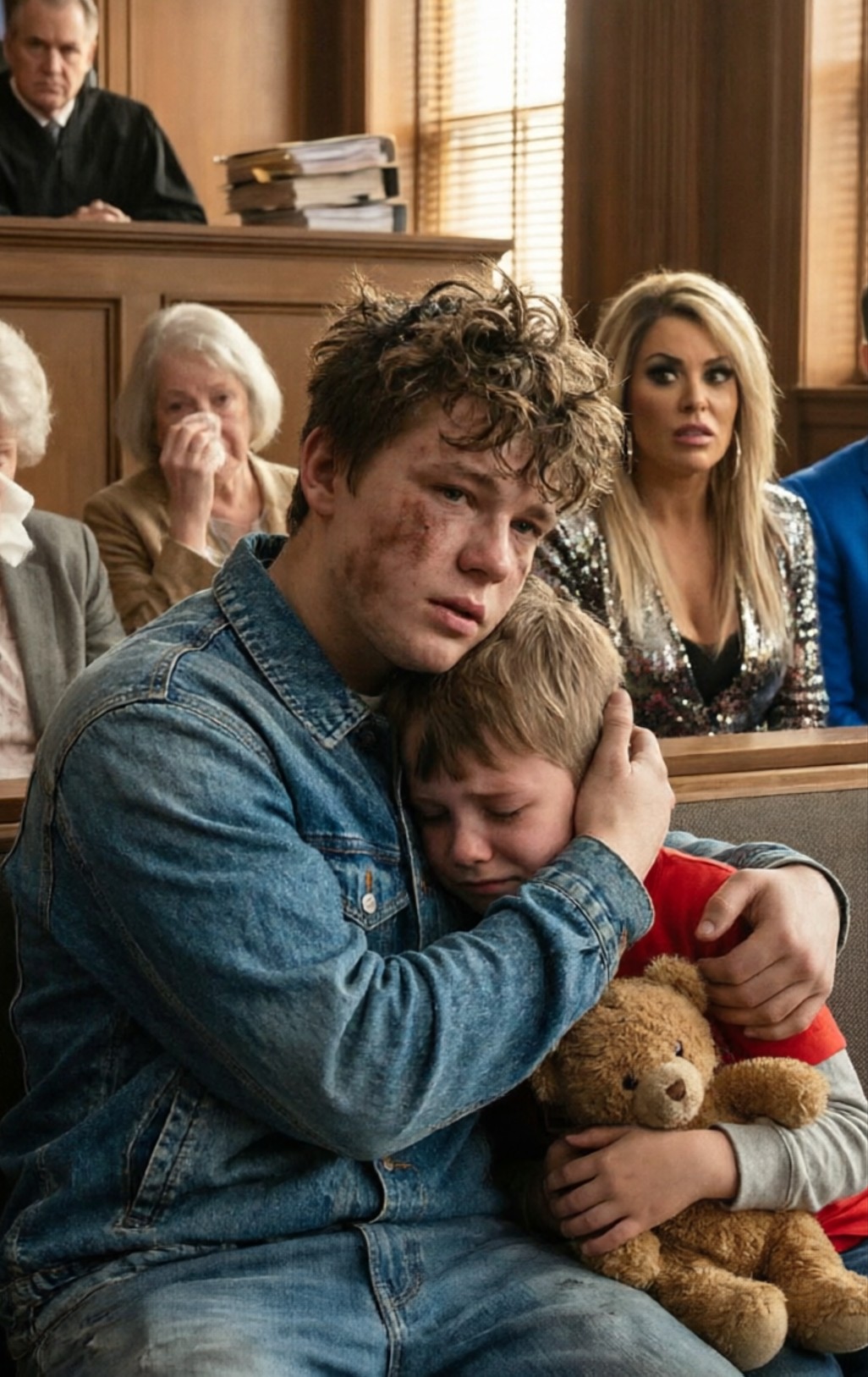
BANG!
The gavel struck the desk.
And Noah screamed.
“ETHAN!”
The little boy leaped out of his chair and ran across the courtroom.
Ethan dropped to his knees just in time to catch him.
Noah wrapped both arms around his neck and buried his face against his shoulder.
“We’re going home?” Noah sobbed. “We’re really going home?”
Ethan held him so tightly that neither of them wanted to let go.
“Yeah, buddy,” he whispered, his voice breaking. “We’re going home.”
Noah pulled back just enough to look at him.
“Forever?”
Ethan brushed the tears from his brother’s cheeks.
“Forever, buddy. You’re not going to another foster home. You’re coming home with me.”
Noah began crying even harder.
“I missed you so much.”
Ethan pressed his forehead against Noah’s.
“I missed you, too. Every single day.”
For several moments, neither brother could speak.
They simply held each other in the middle of the courtroom, crying years of fear and loneliness out of their bodies.
Ms. Bennett wiped her eyes.
Denise Walker began crying openly.
Mrs. Rodriguez clapped her hands, her face glowing with pride.
The neighbors who had come to support Ethan smiled and applauded.
Even Judge Whitmore allowed the moment to continue before calling for order.
Across the room, Claire stood frozen.
Her face had gone pale, and her mouth hung open in disbelief.
She had arrived expecting to reclaim her son.
Instead, she had watched the court recognize the person who had actually been there for him.
Her attorney quietly gathered his briefcase.
Claire turned toward Ethan.
“You can’t keep him away from me forever!” she snapped.
Ethan looked at her.
For years, he had imagined what he might say if he ever stood face-to-face with his mother again.
He had imagined shouting at her.
He had imagined demanding explanations.
He had imagined telling her how much pain she had caused.
But now, with Noah’s arms wrapped around him, something had changed.
He no longer needed her to understand what she had done.
He no longer needed her approval.
And he no longer needed to prove that he loved his brother.
The court had heard the evidence.
Noah had chosen where he felt safe.
And Ethan had finally kept his promise.
So he looked at Claire and spoke calmly.
“I’m not keeping him from you. I’m protecting the home he deserves.”
Claire’s face twisted with anger.
She turned sharply and stormed out of the courtroom.
Her boyfriend followed behind her without saying a word.
The doors closed.
And just like that, the person who had haunted the brothers’ lives for four years was no longer the center of their world.
Nobody followed her.
Nobody called her back.
Nobody cared about the scene she was making in the hallway.
Because Ethan and Noah were still holding each other.
And for the first time in four years, they knew they were going home together.
Part 7: The Home That Had Been Waiting for Them
That evening, the Chicago sunset painted the streets in shades of gold and orange.
Ethan and Noah walked side by side, holding hands as they made their way home.
The city was the same city they had always known.
Cars rushed past them.
Buses stopped at crowded corners.
People hurried along the sidewalks, carrying shopping bags and talking on their phones.
But something felt different.
For the first time in years, Ethan wasn’t walking toward an empty room.
He was bringing his brother home.
Noah kept looking up at him as if he was afraid the whole thing might disappear if he stopped paying attention.
“So,” Noah said after a few minutes, “I don’t have to go back to Denise’s house tonight?”
Ethan smiled.
“Nope. We’re going to my place.”
“Our place,” Noah corrected immediately.
Ethan stopped walking.
Then he laughed.
“Our place,” he agreed. “You’re right.”
Noah grinned.
“And I can leave my dinosaur on my bed?”
“You can leave your dinosaur wherever you want.”
“Even on the couch?”
“Even on the couch.”
“What about the kitchen table?”
Ethan raised an eyebrow.
“Let’s not get carried away.”
Noah giggled.
The sound filled Ethan with a feeling he had almost forgotten.
Happiness.
Not the forced smile he had worn during supervised visits.
Not the brief relief he felt whenever a new form was accepted.
Real happiness.
The kind that made the world seem a little less heavy.
As they walked, Noah began asking questions about the room.
“Did you really paint it blue?”
“Every wall.”
“Are the dinosaur sheets still there?”
“Of course.”
“And my stuffed dinosaur?”
“He’s been waiting for you.”
Noah’s eyes widened.
“You kept him?”
Ethan looked at his brother.
“Buddy, I’ve kept everything I could.”
Noah went quiet.
Then he slipped his hand more tightly into Ethan’s.
“Thank you for not forgetting me.”
Ethan stopped again.
He turned toward Noah and knelt so they were at the same height.
“Listen to me,” he said gently. “There was never a day when I forgot you. Not one.”
Noah’s eyes filled with tears.
“Even when I was far away?”
“Especially then.”
Ethan pulled him into another hug.
“I told you I was coming back for you. I meant it.”
Noah held on for a moment longer before pulling away.
Then his stomach growled loudly.
Both brothers froze.
They looked at each other.
And suddenly, they started laughing.
“Okay,” Ethan said, wiping his eyes. “I think that’s our signal.”
“For what?”
“For dinner.”
Noah’s face lit up.
“Tacos?”
Ethan laughed.
“Absolutely.”
“With extra cheese?”
“Yes.”
“And extra hot sauce?”
Ethan pretended to consider it.
“You’re going to regret that later.”
“No, I’m not!”
“That’s what you said last time.”
Noah burst into giggles.
They stopped at a nearby restaurant and ordered tacos, filling their plates with everything they wanted.
For years, Ethan had measured food in terms of how long it would last.
He had calculated how many slices of bread they could eat before the next paycheck.
He had skipped meals so Noah could have more.
He had stood in grocery stores calculating prices while pretending he wasn’t hungry.
Tonight, he didn’t have to count every bite.
He didn’t have to worry that the next meal might be their last for several days.
He could sit across from his little brother, watch him eat, and enjoy the simple pleasure of being together.
Noah covered his taco with hot sauce.
Ethan shook his head.
“You’re making a terrible decision.”
Noah grinned.
“I can handle it.”
Two bites later, his eyes widened.
He reached desperately for his drink.
Ethan burst out laughing.
“I told you!”
Noah drank half his water in one go, then glared at his brother with tears in his eyes.
“Don’t laugh!”
“I’m not laughing.”
“Yes, you are!”
Ethan tried to look serious, but another laugh escaped him.
Noah started laughing, too.
Soon, they were both laughing so hard that they could barely finish their dinner.
For a little while, they weren’t the abandoned children from a troubled apartment.
They weren’t the brothers who had spent four years separated by a system they didn’t understand.
They were simply Ethan and Noah.
Two brothers eating tacos, teasing each other, and making plans for tomorrow.
After dinner, they continued home.
When they reached the building, Mrs. Rodriguez was waiting near the entrance.
She had heard the news and had clearly been waiting for them to return.
The moment she saw Noah, her face broke into a wide smile.
“Look at you!” she exclaimed. “You’re finally home!”
Noah ran toward her.
Mrs. Rodriguez wrapped him in a warm hug.
“Thank you,” Noah said quietly.
She pulled back and looked at him.
“For what, sweetheart?”
“For helping Ethan.”
Mrs. Rodriguez glanced at Ethan, whose eyes were already filling with tears again.
Then she gently touched Noah’s cheek.
“Your brother did the hard work, mijo. I just helped him along the way.”
She turned toward Ethan.
“And now both of you are going upstairs before I start crying in front of everyone.”
Ethan laughed.
“Too late.”
She swatted his arm affectionately.
“Go on. Your room is waiting.”
The brothers climbed the stairs together.
Ethan unlocked the door to the attic room.
Then he stepped aside.
“After you.”
Noah walked in slowly.
He looked at the blue walls.
The small dresser.
The neatly made bed.
The dinosaur sheets.
And finally, the stuffed dinosaur resting against the pillow.
For several seconds, he didn’t move.
Then he hurried toward the bed and picked up the toy.
“You kept him!”
Ethan smiled.
“I told you I did.”
Noah hugged the dinosaur against his chest.
He looked around the room again, taking in every little detail.
“This is really mine?”
Ethan nodded.
“It’s yours.”
Noah looked up at him.
“And I can stay?”
Ethan walked over and knelt beside him.
“Yes, buddy. You can stay.”
Noah’s lower lip trembled.
“Even tomorrow?”
Ethan felt his heart break all over again.
He realized that four years of uncertainty had taught his little brother not to trust good news too quickly.
So he took both of Noah’s hands in his.
“Tomorrow, next week, next month, next year. We’re going to wake up here together, and you’re going to know you’re home.”
Noah stared at him for a moment.
Then he threw his arms around his brother’s neck.
Ethan held him close.
Outside, the city continued moving.
Cars passed beneath the window.
Sirens echoed somewhere in the distance.
The wind rattled the old glass.
But inside the little blue room, something had finally changed.
Noah was safe.
Ethan was no longer waiting for permission to become the person his brother needed.
And the promise he had made at fourteen had finally become real.
That night, Ethan helped Noah unpack his few belongings.
They placed his clothes in the dresser and his toothbrush in the bathroom.
They arranged his favorite things beside the bed.
Then Ethan pulled the blanket over him.
Noah held his stuffed dinosaur close.
“Hey, Ethan?”
“Yeah, buddy?”
“Can you stay until I fall asleep?”
Ethan sat down beside the bed.
“Of course.”
Noah looked at the ceiling for a while.
Then he whispered, “I was scared you wouldn’t get me back.”
Ethan’s throat tightened.
“I was scared of that, too.”
“But you did.”
Ethan brushed his brother’s hair away from his forehead.
“Yeah. I did.”
Noah’s eyes began to close.
“You’re the best brother in the whole world.”
Ethan smiled through his tears.
“And you’re the best little brother in the whole world.”
A few minutes later, Noah fell asleep.
His breathing became slow and steady.
For the first time in four years, he didn’t have to wonder which house he would wake up in tomorrow.
He didn’t have to worry about packing his belongings.
He didn’t have to ask a stranger whether his brother was still coming for him.
He was home.
Ethan stayed beside him for a long time.
He watched Noah sleep beneath the dinosaur sheets and listened to the quiet sounds of the little room.
Then he reached down and gently adjusted the blanket.
Four years earlier, he had sat beside his brother on a stained couch in a cold apartment, promising that he would never leave him.
He had been fourteen years old.
He had been frightened, hungry, and completely unprepared for the life that had suddenly been forced upon him.
But he had kept his promise.
And now, as he watched Noah sleep, Ethan finally allowed himself to believe that their lives could be different.
They would still face challenges.
Money would sometimes be tight.
Ethan would still have to work hard, and raising a child while building his own future would not always be easy.
But they would face those challenges together.
Noah would have someone to turn to when he was frightened.
Someone who knew his history.
Someone who understood why he sometimes needed extra reassurance.
Someone who would sit beside him on difficult nights and remind him that he was not alone.
Ethan leaned down and kissed his brother’s forehead.
“Good night, buddy,” he whispered.
Then he turned off the lamp and stepped quietly into the next room.
For the first time in years, he didn’t have to cry in a bus station bathroom after a visit.
He didn’t have to stare at an empty bed and imagine what it would feel like to bring Noah home.
He didn’t have to wonder whether his sacrifices would ever be enough.
His brother was home.
And that was enough for tonight.
Part 8: The Promise That Changed Two Lives
In the days that followed, Ethan and Noah began building a life together.
Their home was small, but it was theirs.
They established routines.
Ethan made sure Noah got to school on time. They planned meals, organized homework, and figured out how to balance Ethan’s work schedule with the responsibilities of raising a ten-year-old boy.
There were practical challenges to solve.
Ethan had to make sure Noah had everything he needed for school. He had to arrange reliable supervision during the hours when he was working. He had to budget carefully so they could pay rent, buy groceries, and cover unexpected expenses.
The guardianship order had changed their lives, but it hadn’t magically made everything easy.
Some evenings, Ethan came home exhausted.
Some mornings, Noah struggled to get out of bed.
There were days when they disagreed over homework, chores, and how much hot sauce belonged on a taco.
But they were together.
And when problems came, they could talk about them instead of facing them separately.
Ethan continued working and saving.
He also began learning how to be more than the frightened teenager who had once believed that everything depended on his shoulders alone.
He learned that asking for help wasn’t a failure.
Mrs. Rodriguez remained a steady presence in their lives. She checked on the boys, shared meals with them, and reminded Ethan that he didn’t have to solve every problem by himself.
Denise Walker continued to care about Noah’s progress, too. She was relieved to see him settle into a stable home with someone he trusted.
And Noah slowly began to relax.
He started leaving his dinosaur on the couch.
He stopped checking the front door every time he heard footsteps in the hallway.
He began talking about school, making plans with friends, and asking what they would do during the next holiday.
Little by little, the frightened child who had spent years moving between foster homes began to believe that he could have a normal childhood.
One evening, several weeks after the hearing, Ethan found Noah sitting on the bed with his stuffed dinosaur beside him.
The boy was looking at a photograph of the two brothers from years earlier.
Ethan sat down beside him.
“What are you thinking about?”
Noah traced the edge of the photograph with one finger.
“Do you remember when we lived in the old apartment?”
Ethan nodded.
“Of course.”
“I remember you telling me Mom would come back.”
Ethan looked down.
He remembered that night, too.
The broken refrigerator.
The cold wind.
The smell of burnt noodles.
The little boy sitting on the couch, asking whether their mother had gotten lost.
For years, Ethan had carried guilt over that promise.
He had been a child himself, but he still wished he could have done more.
“I’m sorry I couldn’t keep us together back then,” he said quietly.
Noah turned toward him.
“You were a kid, too.”
Ethan looked at his brother in surprise.
Noah continued.
“You tried to take care of me. You gave me your food. You stayed with me when I was scared.”
He hugged the stuffed dinosaur.
“I don’t remember everything, but I remember that you were there.”
Ethan’s eyes filled with tears.
Noah leaned against his shoulder.
“You came back for me. That’s what matters.”
Ethan wrapped an arm around him.
For a long time, they sat together without speaking.
Then Noah lifted his head.
“Can I ask you something?”
“Anything.”
“Why didn’t you give up?”
Ethan thought about the question.
He could have given Noah a simple answer.
Because he loved him.
Because they were brothers.
Because he had promised.
All of those things were true.
But there was something deeper, too.
“Because when you were little, you trusted me,” Ethan said. “You thought I could make everything okay, even when I didn’t know how. And after we were separated, I kept thinking about how scared you must have been.”
He took a slow breath.
“I couldn’t control what our mother did. I couldn’t control the court. I couldn’t control how many foster homes you had to live in. But I could control whether I kept trying.”
Noah listened carefully.
“So I kept trying,” Ethan continued. “Even when I was tired. Even when I was scared. Even when I thought I might lose.”
He looked directly at his brother.
“I didn’t know whether I would win. But I knew I didn’t want you to grow up thinking nobody wanted you.”
Noah’s eyes filled with tears.
Ethan gently squeezed his shoulder.
“You were never unwanted, buddy. Not by me. Never by me.”
Noah hugged him tightly.
“I love you, Ethan.”
“I love you, too.”
Outside the window, the lights of Chicago glowed against the evening sky.
The city that had once seemed so cold and unforgiving no longer felt quite the same.
Ethan knew that their past would always be part of their story.
There would be difficult memories.
There would be questions Noah might not be ready to ask until he was older.
There would be days when the pain of their mother’s abandonment returned without warning.
But the brothers had something they hadn’t had for years.
Time together.
A home they could return to.
And the chance to build a future that wasn’t defined by the worst night of their lives.
Ethan had once believed that being strong meant never breaking down.
Now he understood that strength could mean admitting how frightened he had been.
It could mean accepting help.
It could mean continuing to show up, even when the outcome was uncertain.
And sometimes, strength meant sitting beside a child who had been hurt by the world and reminding him, again and again, that he was safe.
The legal battle had ended, but their real life together was only beginning.
Years later, Ethan would remember the night his mother disappeared.
He would remember the empty refrigerator, the cold apartment, and the sound of Noah crying for someone who never returned.
He would remember running barefoot down the street as the social worker’s car carried his brother away.
He would remember the jobs, the exhaustion, the paperwork, the rejected applications, and the fear that all his efforts might never be enough.
But those memories would no longer be the only things that defined his life.
He would also remember the day the judge granted guardianship.
The moment Noah ran across the courtroom and threw his arms around him.
The tacos they shared that evening.
The laughter in their little blue room.
And the first night Noah fell asleep knowing he was finally home.
Ethan had spent four years trying to prove that he could give his brother a safe place to live.
In the end, he learned that a home was more than a room, a bed, or a roof over someone’s head.
It was a place where a child could stop wondering whether he would be abandoned.
A place where he could cry without being ashamed.
A place where he could make mistakes and still be loved.
A place where the people who promised to stay actually stayed.
And that was what Ethan had fought so hard to give Noah.
Because real family isn’t defined only by the people who share your blood.
It’s defined by the people who show up when life becomes unbearable.
The people who sacrifice when nobody is watching.
The people who keep their promises even when keeping them costs everything they have.
It’s found in the meals someone skips so another person can eat.
In the early mornings and sleepless nights.
In the small bedroom prepared with love.
In the hand that reaches for yours when you’re frightened.
And sometimes, it’s found in a fourteen-year-old boy who has every reason to give up but chooses to keep fighting because his little brother needs him.
Ethan could never change what their mother had done.
He couldn’t give Noah back the childhood he had lost.
But he could give him something just as important.
A future in which he no longer had to face the world alone.
And after four years of separation, fear, and uncertainty, two brothers finally walked forward together.
They had lost their mother.
They had lost years they could never get back.
But they had found their way home.
And no matter what the future brought, they would never again have to wonder whether they mattered to each other.
Because the answer was there in every sacrifice Ethan had made.
It was there in every promise he had kept.
And it was there in the little blue room, where a ten-year-old boy slept peacefully beside a one-eyed stuffed dinosaur, knowing that the person he trusted most was only a few steps away.
After years of darkness, the brothers had finally won something more valuable than money, more lasting than a court order, and stronger than the mistakes of the people who had hurt them.
They had found safety.
They had found hope.
They had found a home.
And, most importantly, they still had each other.
The End.
