
Part 1:
The pain didn’t hit me like a lightning strike. It came slowly and quietly, almost politely, building inside me for weeks before it finally tried to kill me.
At first, it was nothing more than a dull pressure deep in my lower abdomen. I blamed it on stress, poor sleep, too much coffee, and the countless hours I had spent pretending everything was fine.
I had spent most of my life ignoring my own needs. Whenever something hurt, I pushed through it. Whenever I felt exhausted, I kept going. Someone else always needed something more urgently, and I had learned that my problems could wait.
But that morning, standing in the parking lot of a beautiful wedding venue outside Dayton, Ohio, I realized I could no longer ignore what my body was trying to tell me.
The dull ache suddenly sharpened into something vicious. It twisted deep inside my abdomen, hot and unbearable, stealing the air from my lungs.
One second, I was trying to keep up with my sister, Madison, as she hurried toward the venue entrance for another wedding appointment.
The next, my knees buckled.
The pavement rushed toward me. Gravel scraped my palms as I tried to catch myself. My vision narrowed until everything around me disappeared into a thin, bright tunnel.
Then everything went black.
When consciousness returned, it came in broken pieces.
First, I saw a ceiling covered in harsh fluorescent lights. Then I heard the metallic rattle of wheels rolling over hospital tiles. Voices floated above me, urgent and clipped. A blood pressure cuff squeezed my arm.
My abdomen felt as though someone had split me open from the inside. Every shallow breath sent another wave of pain through my body.
“Thirty-year-old female,” a paramedic said near my head. “Collapsed in a wedding venue parking lot. Severe abdominal pain. Blood pressure dangerously low.”
I tried to speak, but only a weak, broken sound came out.
Then I heard Madison.
“She does this,” my sister said with a brittle little laugh.
It was the same laugh she used whenever she wanted strangers to understand that she was embarrassed by me.
“Not exactly this, obviously,” she continued, “but she gets dramatic when she’s overwhelmed.”
Even through the pain, her words hurt.
I forced my eyes open.
“I’m not…” My throat burned, and I struggled to swallow. “I’m not faking.”
A nurse leaned into my blurry line of sight.
“Ma’am, can you hear me? On a scale of one to ten, how bad is your pain?”
“Ten,” I whispered.
Another wave ripped through me, making my entire body tense.
“Eleven.”
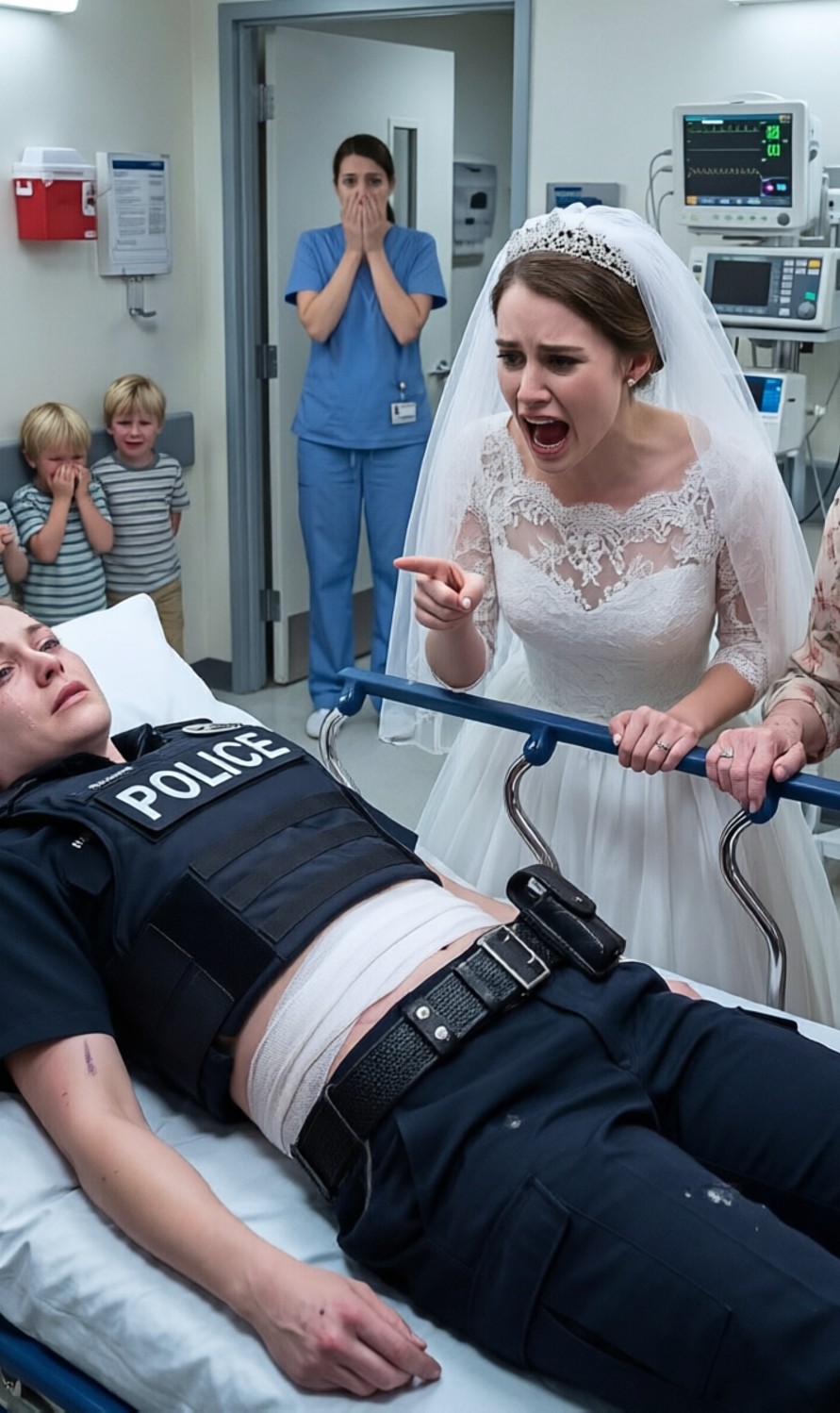
Madison stood near the curtain in a cream-colored sweater and designer boots. Her arms were folded tightly across her chest, and her engagement ring flashed beneath the hospital lights like a tiny weapon.
Six days from then, she was supposed to get married.
It was the kind of wedding our mother had treated like a national event. Every flower, every table setting, every guest invitation, and every tiny detail had been discussed for months.
Nothing was allowed to go wrong.
Apparently, that included me.
A few minutes later, my mother arrived.
Diane didn’t rush to my bedside with tears in her eyes. She didn’t look frightened or ask whether I was going to be okay.
She looked irritated.
“What happened now, Avery?” she demanded.
Even while I lay half-conscious on a hospital bed, shaking and struggling to breathe, I almost laughed.
Of course that was her first question.
Not *Are you okay?*
Not *What did the doctors say?*
Just *What happened now?*
As if my body collapsing in a parking lot were another inconvenience on her wedding checklist.
Madison let out a long sigh.
“We were at the venue finalizing the flowers. She just dropped right by the valet area. I told her she should have stayed home if she was going to make this week about herself.”
I tried to lift my hand, but my fingers barely moved.
They caught weakly on the sleeve of my faded army-green field jacket, which lay across my lap.
I wore that jacket almost everywhere. It had deep pockets, strong seams, and a battered practicality that suited the life I had built.
I had spent years in the military before moving into logistics work and contract jobs. I was used to long hours, difficult assignments, and solving problems without complaining.
My family had come to expect the same thing from me.
I was the dependable one. The one who could be called whenever someone needed money, help, or an extra pair of hands.
And I had spent far too long believing that being useful was the same thing as being loved.
“Please,” I managed to whisper. “Doctor.”
A man in navy scrubs stepped beside my bed. He had calm eyes and a steady voice.
His name was Dr. Bennett.
“Avery, look at me,” he said. “I need you to answer a few questions. When did the pain start?”
“This morning,” Madison answered before I could say anything.
“No,” I forced out.
Dr. Bennett leaned closer.
“Take your time, Avery.”
“Weeks,” I whispered. “It started weeks ago.”
His expression changed immediately.
“Weeks?”
I nodded as much as my strength allowed.
“Worse today. Dizzy. Nauseous. Feels like something tore.”
That got his full attention.
He turned toward the medical team.
“Get blood work, start IV fluids, and prepare a type and crossmatch. I want a CT scan of her abdomen and pelvis immediately.”
My mother stepped forward.
“Wait a minute. A CT scan? Isn’t that expensive?”
Dr. Bennett continued giving instructions.
My mother wasn’t finished.
“Avery is between contracts right now. She doesn’t exactly have premium insurance. Are you sure all of that is necessary?”
He finally looked at her.
“Her blood pressure is dropping, and she’s experiencing severe abdominal pain. She needs imaging.”
“She catastrophizes,” Diane insisted. “Her sister’s wedding is on Saturday. We cannot approve unnecessary tests just because Avery is having another episode.”
I stared at her.
Something colder than pain moved through me.
My mother was standing beside my hospital bed, watching me shiver and gasp for air, and her first instinct was still to protect the wedding budget.
I had known for years that Madison came first. I had watched it happen at birthdays, holidays, family gatherings, and every important moment of our lives.
But there was a difference between being overlooked and watching your own mother question whether you deserved emergency medical care.
“Mom,” I whispered. “Stop.”
Madison turned toward the nurse and forced a sweet smile onto her face.
“Can’t you please focus on people who are actually in danger? She’s probably dehydrated. We have a cake tasting later.”
The nurse stared at her in disbelief.
“Excuse me?”
Dr. Bennett’s voice cut through the room.
“My only concern right now is my patient.”
He turned back to me.
“Avery, do you consent to the CT scan?”
“Yes,” I whispered.
My mother clicked her tongue.
“You’re not thinking clearly.”
I looked at her through the tears gathering in my eyes.
“No,” I said, struggling to draw another breath. “You just never let me.”
For a moment, nobody spoke.
Then the pain exploded.
My fingers went numb. My grip slipped from the jacket, and the edges of the room began to darken.
The monitors beside my bed started screaming.
Dr. Bennett shouted for the emergency team. Nurses rushed toward me, moving quickly as the room filled with urgent voices and the sound of equipment being wheeled into place.
I tried to hold on to consciousness, but it felt as though something was pulling me away from the world.
And above all the noise, I heard my mother hiss something I would never forget.
“Her sister’s wedding is in six days. She needs the money more than this.”
The words reached me just as darkness swallowed the room.
Of course.
Even now.
Even while I was dying.
My sister’s wedding still mattered more than my life.
Part 2: The Secret Inside My Army-Green Jacket
I didn’t disappear completely.
Somewhere beneath the noise, I remained trapped inside a body that was losing its fight to stay alive.
I could hear footsteps. I heard Velcro ripping open, plastic packaging snapping, and nurses calling out information to one another.
Then someone said something that would change the entire situation.
“We need her ID for the blood bank. Check her jacket.”
My jacket.
I wanted to tell them to be careful with it, but my tongue felt too heavy to move.
For eight months, that army-green field jacket had carried almost everything that mattered to me.
I wore it because it was practical. It had survived years of hard work, bad weather, and countless long days. Its hidden pockets were deep enough to hold important documents without anyone noticing.
But that morning, those pockets held two things that were about to expose the truth about my family.
One was a medical packet from a low-cost imaging clinic I had visited just three hours earlier.
The other was a thick bank envelope sealed with tape.
I had gone to the clinic that morning because the pain had become impossible to ignore.
For weeks, I had told myself it was probably something minor. Maybe stress. Maybe a digestive problem. Maybe I had been working too much and not taking proper care of myself.
But that morning, the pain was so intense that I finally admitted I needed help.
The clinic had managed to fit me in for an urgent examination.
During the ultrasound, the physician assistant had grown increasingly quiet. She stared at the screen, adjusted the equipment, and examined the images again.
Then the color drained from her face.
She turned toward me.
“Avery, I need you to listen very carefully,” she said. “You need to go to the emergency room immediately.”
My stomach tightened.
“What is it?”
“We’re concerned that you’re bleeding internally. There may be a problem with an artery in your abdomen, and you need emergency evaluation.”
She printed the report and handed it to me.
Across the front, she wrote three words in thick red marker:
**GO TO ER NOW.**
She explained that the findings suggested a possible splenic artery aneurysm and that I needed emergency care. An aneurysm is a weakened, enlarged area of a blood vessel that can leak or rupture, causing dangerous internal bleeding.
I was frightened.
Of course I was.
I knew enough about the human body from my military years to understand that internal bleeding was not something to ignore.
The sensible thing would have been to drive straight to the hospital.
But then I looked at my phone.
Madison had already sent six messages.
The first asked where I was.
The second demanded to know why I wasn’t answering.
The third said the florist was waiting.
The fourth warned that if I missed another wedding appointment, she would remove me from the wedding party.
The fifth accused me of being selfish.
The sixth was from my mother.
*You always find a way to ruin important moments. Please, for once, think about your sister.*
I sat in my car outside the clinic, holding the medical packet in one hand and staring at the messages with the other.
I should have ignored them.
I should have gone straight to the emergency room.
Instead, I made a desperate, foolish decision.
I told myself I could stop at the wedding venue first. I would hand Madison the money I had saved for her wedding, smile through the final appointment, and then drive myself to the hospital.
I convinced myself that I could endure a little more pain.
I convinced myself that if I finally did something big enough for my family, they might stop treating me as though I were a burden.
That was how I had survived in my family for most of my life: by putting everyone else first and hoping they would eventually notice.
The money in the envelope represented eight months of sacrifice.
I had sold my motorcycle, the one thing I owned that was truly mine. I had worked double shifts, accepted extra contracts, skipped holidays, eaten cheap noodles, and cut every unnecessary expense.
I had given up weekends, sleep, and almost every small pleasure I once enjoyed.
Every dollar had been saved for Madison’s wedding.
The total was twenty-three thousand dollars.
I had planned to hand her the envelope privately, away from the guests and vendors. I wanted her to know that despite everything she had said about me, I had shown up for her.
I wanted my mother to see it, too.
I wanted them to understand that I wasn’t jealous of Madison. I wasn’t trying to ruin her happiness. I wasn’t the selfish, dramatic sister they had spent years describing.
I was simply someone who wanted to belong.
So I put the medical report and the bank envelope into the hidden pockets of my jacket and drove toward the venue.
I never made it past the valet area.
Back in the hospital, someone lifted my jacket from the bed.
Something heavy hit the floor with a loud slap.
“Oh my God,” a nurse whispered.
I forced my eyes open.
Nurse Carla stood beside my bed, holding the jacket. Its hidden pockets had spilled open.
My identification lay on the floor beside the medical packet. A handwritten note on thick cream-colored stationery had fallen beside it, along with the sealed bank envelope.
Dr. Bennett snatched up the medical report.
His expression darkened as he read it.
“Get radiology ready,” he ordered. “Page vascular surgery now.”
My mother blinked.
“What is that?”
For one satisfying second, nobody answered her.
Then Dr. Bennett turned toward her.
His voice was cold and controlled.
“This is a report from an imaging center. Your daughter was told to come to the emergency room three hours ago because of suspected internal bleeding and a possible splenic artery aneurysm.”
The room went silent except for the frantic beeping of the monitor.
He held up the report.
“The findings raised serious concerns, and her current condition supports those concerns. This was not dehydration. It was not panic. And it certainly was not dramatics.”
Madison’s smile disappeared.
Nurse Carla picked up the handwritten note and the bank envelope. She examined the envelope briefly before handing both items to Madison.
I knew every word written on that note because I had written it in my car with shaking hands.
It said:
*Madison—*
*For the venue, flowers, band, or anything that makes your day perfect. Mom says I never show up for you. I hope this proves I do.*
*Love, Avery.*
Madison opened the envelope.
Inside were cashier’s checks totaling twenty-three thousand dollars.
For several seconds, she simply stared at them.
Then she read the note again.
The color drained from her face.
For the first time that day, she looked less annoyed than afraid.
My mother stepped closer.
“That’s…” She stopped and swallowed. “That’s for the wedding?”
Not *Is Avery going to survive?*
Not *What can we do to help her?*
Not even *Why didn’t anyone tell us she was this sick?*
Just, *That’s for the wedding?*
I gathered enough strength to speak.
“It was.”
My voice was barely audible, but everyone heard me.
Dr. Bennett immediately moved between my family and the bed.
“This conversation is over. She is going to surgery. Everyone who is not medical staff needs to leave.”
My mother straightened.
“I’m her mother!”
He didn’t blink.
“Then act like it.”
For once, Diane had nothing to say.
Everything that followed happened too quickly for me to understand.
The medical team moved me toward the CT scanner. My blood pressure remained dangerously low, and the doctors needed to identify the source of the bleeding and determine the safest way to stop it.
The scan confirmed what the clinic had feared.
The suspected splenic artery aneurysm was leaking, and I was unstable. The doctors could not afford to wait.
I needed emergency surgery.
As they prepared to move me, I caught a glimpse of my mother and sister through the glass doors.
Madison was still holding the envelope.
My mother stood beside her, looking as though she had just discovered that something important had slipped out of her control.
I should have been angry.
Instead, a strange calm settled over me.
I had spent years trying to prove that I deserved a place in their lives. I had sacrificed my possessions, my time, my money, and my peace of mind.
Now, lying on a hospital bed with my life hanging in the balance, I finally understood something.
No amount of money could make someone care about you if they had already decided that your needs didn’t matter.
I turned toward Dr. Bennett.
“Doctor,” I whispered.
He leaned closer.
“Tell her not to touch that money. Not one dollar.”
“I’ll make sure your belongings are secured,” he assured me.
The operating room doors swung open.
Bright lights shone overhead. Medical staff surrounded me, speaking in calm, practiced voices as they prepared for surgery.
Someone explained what would happen next, but the words seemed distant.
Then the anesthetic entered my veins.
Warmth spread through my body, followed by a heavy, peaceful darkness.
I closed my eyes.
For the first time that morning, I stopped fighting.
I had no idea whether I would ever open them again.
Part 3: I Survived, but My Family Had Learned Nothing
Surgery felt like a missing chapter of my life.
One moment, I was staring at bright operating room lights. The next, I was clawing my way up through a thick fog.
My throat was raw. My body felt impossibly heavy, and a deep, brutal ache spread across my abdomen.
I tried to move, but even the smallest movement reminded me that I had undergone major emergency surgery.
A monitor beeped steadily beside me.
For several seconds, I didn’t know where I was.
Then a familiar voice reached me.
“Welcome back, Avery.”
Nurse Carla stood beside my bed, adjusting my IV.
I struggled to swallow.
“Did I make it?”
She smiled. Her eyes looked tired, but there was genuine kindness in her expression.
“You did. It was close, but you made it.”
I closed my eyes again.
Relief washed over me so suddenly that I almost cried.
I was alive.
I had survived the surgery.
For a while, that was all I could think about.
Later that evening, Dr. Bennett came to explain what had happened.
The surgical team had repaired the leaking artery before it could rupture completely. I had lost a dangerous amount of blood, and my condition had been serious enough that delaying treatment could have cost me my life.
But the bleeding had been controlled.
I was stable.
Recovery would take time, and I would need to follow the medical team’s instructions carefully, but the immediate danger had passed.
I listened quietly, trying to take in everything he told me.
Then he hesitated.
“Your family is in the waiting room,” he said. “Your sister cried. Your mother has been asking questions.”
I looked at him.
“What kind of questions?”
His expression became carefully neutral.
“Billing. Visitor policies. And whether a patient’s personal belongings can be released to their next of kin.”
I let out a short laugh.
The movement pulled at my stitches, and I immediately regretted it.
“Of course she did.”
Dr. Bennett studied my face for a moment.
“Do you want to see them?”
I turned toward the window.
Outside, the Cincinnati skyline glittered in the darkness. The distant lights looked peaceful, completely separate from the chaos that had filled my day.
I thought about my mother standing beside my hospital bed.
I thought about Madison holding the envelope.
I thought about the fact that I had nearly died while trying to give them something they had never earned.
Then I looked back at Dr. Bennett.
“No,” I said. “Please ban them from my floor.”
He nodded.
“We can restrict their access and make sure the staff knows not to let them visit without your permission.”
“Thank you.”
For the first time in my life, I had made a decision that put my own needs first without asking my family whether I was allowed to do it.
It felt strange.
It also felt right.
Over the next few days, my mother tried repeatedly to get around the boundary.
She called the nurses’ station under different names, hoping someone would accidentally give her information or allow her into my room.
Madison sent flowers.
Unfortunately, they contained pollen from flowers I was allergic to, so I had the nurses move them away from my room.
Then came a giant fruit basket.
After that, she sent a long text message explaining that wedding stress made people say things they didn’t mean.
I read it once and put my phone down.
Neither my mother nor my sister seemed particularly interested in asking how I was feeling.
They wanted the situation to return to normal.
They wanted me to forgive them, hand over the money, and help Madison have the wedding she had spent months planning.
They wanted the old Avery back.
The woman who apologized when other people hurt her.
The woman who took responsibility for problems she hadn’t caused.
The woman who would rather exhaust herself than disappoint her family.
But that woman was beginning to disappear.
There was only one message from someone connected to my family that made me feel as though a real person had written it.
It came from Ethan, Madison’s fiancé.
**ETHAN:** I just found out about the money and what happened in the ER. I’m sick over it. I had no idea. Please focus on healing.
I read his message several times.
I didn’t know what Madison had told him about the incident, but it was clear that he hadn’t understood the full situation until after I was taken into surgery.
For the first time since the collapse, I felt that someone outside the medical team understood that something terrible had happened.
I sent him a short reply.
**ME:** Thank you. I’m recovering. I appreciate you reaching out.
Then I put my phone away.
I didn’t have the energy to explain everything to him, and I wasn’t ready to deal with another person’s reaction.
My body needed rest.
My mind needed time.
And for once, I decided those needs were enough.
On the fourth day of my hospital stay, a social worker came to my room with an estimate of my medical bills.
The number was painful to look at.
I had already been worried about money because I was between contracts. Now I was facing the cost of emergency surgery, hospitalization, medication, and follow-up care.
I stared at the paperwork for a long time.
My belongings bag sat on the chair beside the bed. Inside it was the bank envelope—the same money I had nearly died trying to give away.
I looked at it.
For eight months, I had imagined handing that envelope to Madison and watching her face soften.
I had imagined my mother finally telling me that I had done something wonderful.
I had imagined, in the most childish corner of my heart, that twenty-three thousand dollars might buy me the feeling of being wanted.
Instead, the envelope had ended up beside my hospital bed while doctors fought to save my life.
I turned toward the social worker.
“Can I use my cashier’s checks to pay my hospital balance?”
She looked at the envelope and then at me.
“If the checks are yours and haven’t been endorsed or otherwise restricted, we can help you understand how to use those funds toward your bills. We’ll also need to check the hospital’s payment procedures.”
I nodded.
There was no dramatic speech.
No music swelling in the background.
No magical moment when every problem disappeared.
There was only paperwork, numbers, and a decision.
The money I had saved to buy my family’s love would now help pay for the medical care that had saved my life.
And for the first time, that money felt as though it belonged exactly where it should.
Part 4: My Sister Still Wanted the Money
That evening, I received a message from Madison.
I had hoped she might finally understand what had happened. Perhaps she would apologize. Perhaps she would ask how I was recovering.
For a moment, I even wondered whether the sight of me on a hospital bed had changed something inside her.
Then I opened the message.
MADISON: Avery, I know you’re hurt, but if you can’t give the whole $23k, can you at least cover the venue balance? They’re threatening to cancel. We’ll pay you back after the honeymoon.
I read it once.
Then again.
Then a third time.
I waited for the words to change into something else.
They didn’t.
My sister knew I had nearly died. She knew I had undergone emergency surgery. She knew the money had been intended for her wedding.
And somehow, she still believed the most important question was whether she could get her hands on it.
I felt something inside me finally snap.
Not in a dramatic way.
There was no screaming, no throwing my phone across the room, and no long argument.
I simply stopped making excuses for her.
I opened the message box and typed.
**ME:** You watched me bleed out on a gurney, and you still think I owe you centerpieces.
I stared at the sentence for a moment before sending it.
Then I blocked her number.
After that, I blocked my mother’s number, too.
My hands were shaking, but I didn’t undo either decision.
The next morning, I contacted the bank to cancel the cashier’s checks, following the bank’s instructions for stopping and replacing them. I wanted to make sure the original checks could not be used and that the funds remained under my control.
Once everything was confirmed, I began arranging to use the money for my medical expenses and recovery.
Every step felt like reclaiming a small piece of my life.
For years, I had mistaken usefulness for love.
I thought that if I worked harder, sacrificed more, stayed quiet longer, and gave away enough of what I had, my family would eventually see me.
I believed that one day, my mother would look at me with the same pride she showed Madison.
I believed that if I became dependable enough, generous enough, and patient enough, I would finally stop being the daughter who was expected to make herself smaller.
But lying in that hospital bed, I understood the truth with a clarity that hurt worse than any incision.
Love that only accepts your labor is not love.
It is access.
It is ownership dressed up as family.
And I had spent thirty years handing over the keys.
When the hospital finally discharged me, I needed someone to drive me home.
In the past, I would have called my mother.
I would have apologized for being a burden, thanked her for agreeing to help, and listened to her complain about how inconvenient the entire situation had been.
She probably would have reminded me how much she had done for me, even though I had spent my life doing things for her.
But this time, I didn’t call her.
I texted Jordan.
Jordan was a former army medic I knew through logistics contracts. We had worked together on several assignments, and over the years, she had become one of the few people I trusted without hesitation.
She was blunt, practical, and allergic to emotional nonsense.
But she had shown me more loyalty in three years than my family had shown me in thirty.
Her response came quickly.
**JORDAN:** I’ll be there. Don’t try to carry anything yourself.
When she arrived at the hospital, she was wearing an oversized hoodie and carrying a huge duffel bag.
She looked at me sitting in the wheelchair and nodded toward the bag.
“Before you ask, yes, I brought supplies.”
“What kind of supplies?” I asked as she helped me stand carefully.
“Soup, gauze, electrolyte drinks, and one of those grabber tools so you don’t rip a stitch trying to pick up your remote.”
I looked at her.
She raised an eyebrow.
“Don’t make it weird.”
I almost cried.
Not because she had done anything grand.
Because it was simple.
She had listened when I told her I needed help, and she had shown up.
There was no guilt trip, no lecture about my responsibilities, and no demand that I prove how grateful I was.
She simply helped.
Jordan drove me home, carried my bag upstairs, and helped me settle onto the couch. She checked that my medication was within reach, placed a bottle of water on the coffee table, and warmed the soup in my kitchen.
By the time we finally sat down, I was exhausted.
My abdomen still hurt, and every movement reminded me how close I had come to losing my life.
But I was home.
I was safe.
And I wasn’t alone.
We had barely begun eating when someone started hammering on my apartment door.
My stomach tightened.
I knew that knock.
Jordan put down her spoon and stood.
“Stay there.”
She walked to the door and looked through the peephole.
“Older woman. Expensive bag. Looks furious.”
She turned toward me.
“Want me to tell her to leave?”
I took a slow breath.
My abdomen throbbed beneath the blanket, and I could feel my heart beating faster.
I knew exactly who was standing outside.
My mother had finally decided that the rules no longer applied to her.
For a moment, I considered telling Jordan to send her away.
But another part of me was tired of hiding from the person who had spent my entire life making me feel as though I had done something wrong.
I wanted to say what I needed to say while I could still look her in the eye.
“No,” I said quietly. “Let her in.”
Part 5: I Finally Told My Mother to Get Out
Jordan opened the door.
My mother walked into my apartment as though she owned the walls, the furniture, and the air everyone else breathed.
She didn’t greet Jordan.
She barely looked at my face.
Instead, her eyes swept across the room, taking in the blanket over my legs, the medication bottles on the coffee table, and the careful way I held myself to protect my healing abdomen.
Even then, I saw no real softness in her expression.
“Avery,” she said. “You look terrible.”
I stared at her.
“I had emergency surgery, Mom.”
She ignored the answer and sat down on my sofa without asking.
“Madison is devastated. She has been crying for two days.”
I waited.
My mother looked at me as though I was supposed to understand the seriousness of that statement.
“Because I almost died?” I asked.
Her jaw tightened.
“Because you canceled the checks! The venue is threatening to pull the reservation. You are causing a massive family divide right before the most important day of your sister’s life.”
There it was.
The final answer to a question I had been asking myself since childhood.
I had spent years wondering what I needed to do to make my mother care about me the way she cared about Madison.
I had tried being helpful.
I had tried being quiet.
I had tried working harder, giving more, and asking for less.
I had even sold the motorcycle I loved to save money for a wedding I wasn’t responsible for paying for.
And now, after I had nearly died, my mother was sitting in my apartment complaining that I had taken away the money she wanted for my sister.
The last fragile hope inside me—the childish hope that she might finally behave like a mother—quietly died.
I looked directly at her.
“I canceled the checks to pay the people who saved my life, Diane.”
She flinched.
I had called her Mom my entire life. Using her first name was a small thing, but it made her realize that something between us had changed.
“Don’t be cruel,” she snapped. “Emotions were high in the emergency room.”
I felt a bitter laugh rising in my throat, but I swallowed it.
“You told a trauma doctor that Madison needed my money more than I needed a CT scan.”
“I was panicking.”
“No,” I said. “You were prioritizing.”
She opened her mouth, but I continued before she could interrupt.
“I worked double shifts for almost a year. I sold my motorcycle. I saved twenty-three thousand dollars because I thought that if I paid for Madison’s perfect wedding, maybe you two would finally love me.”
My voice began to shake.
I could feel tears gathering in my eyes, but I refused to stop.
“I thought if I gave enough, if I sacrificed enough, if I proved that I was willing to do anything for this family, you would finally stop treating me like I was the problem.”
My mother looked away.
I leaned forward slightly, then stopped when the movement pulled at my stitches.
“But I nearly died, Mom. I was lying on a hospital bed while doctors tried to save me, and all you cared about was the envelope.”
The apartment went silent.
Even Jordan, who had been standing near the kitchen, said nothing.
For once, my mother had no immediate answer.
She stood, her face darkening.
“You have always been jealous of your sister.”
I stared at her.
“You make everything difficult. You turn every situation into a personal attack. We are your family, Avery!”
I had heard those words so many times that I could almost recite them before she spoke.
*We are your family.*
In the past, those words would have been enough to silence me.
They would have made me question myself. They would have convinced me that I was being selfish and that I needed to apologize.
But this time, they had no power over me.
“Not anymore,” I said.
My mother froze.
I pointed toward the door.
“Get out. And don’t come back.”
She looked genuinely shocked.
For thirty years, I had been the daughter who gave in.
I was the one who called back after an argument, even when I wasn’t at fault. I was the one who apologized to keep the peace. I was the one who made excuses for everyone else’s behavior because admitting the truth would have meant facing how little they cared about me.
My mother had never imagined that I might finally stop.
“You cannot be serious,” she said.
“I am.”
“You will regret this.”
“Maybe,” I replied. “But I would regret letting you treat me like a walking ATM even more.”
Her lips pressed into a thin line.
She snatched up her expensive bag and turned toward the door.
Jordan stepped forward and opened it for her.
My mother walked out without another word, her heels striking the hallway floor like angry punctuation.
The door closed behind her.
I sat completely still.
I had expected to feel guilty. I thought I might start worrying that I had been too harsh, that I had made everything worse, or that I should have found a gentler way to say what I meant.
I waited for that familiar feeling to arrive.
It didn’t.
Instead, I felt something I had almost forgotten existed.
Lightness.
Jordan returned to the couch and sat beside me.
“You okay?” she asked.
I looked at the closed door.
Then I looked at the soup she had made, the water she had placed within my reach, and the medication she had organized so I wouldn’t have to struggle to get up.
“Yeah,” I whispered.
For the first time in a long time, I meant it.
Part 6: The Wedding Day That Changed Everything
Saturday arrived bright and beautiful.
It was the day Madison was supposed to become the center of the universe.
The weather was perfect. The venue outside Dayton was ready. The flowers had been arranged, the tables decorated, and the final details prepared for the ceremony that my mother had spent months planning.
Or at least, that was how I imagined it.
I wasn’t there to see any of it.
Instead, I sat on my couch in loose sweatpants, eating the soup Jordan had prepared and moving carefully around the ache in my abdomen.
The sunlight came through my apartment windows, warming the room.
My phone sat on the coffee table.
For years, missing an important family event would have destroyed me. I would have felt selfish, cruel, and unforgivable. I would have spent the entire day imagining the conversations happening without me and wondering what I needed to do to make things right.
I would have worried that my absence proved everything my mother had ever said about me.
But that Saturday, something was different.
My absence didn’t feel like a failure.
It felt like a boundary.
And for once, I didn’t feel obligated to apologize for having one.
At two in the afternoon, my phone buzzed.
The message was from Ethan.
I picked it up and read the words.
**ETHAN:** I thought you should know. I canceled the wedding.
I stared at the screen.
For several seconds, I couldn’t make sense of what I was reading.
Then another message arrived.
**ETHAN:** What Madison did in the hospital wasn’t wedding stress. It showed me who she is. I can’t marry someone who would watch her own sister nearly die over a venue balance. I hope you heal, Avery.
I sat quietly, reading the messages again.
Ethan had finally seen what I had spent years trying to explain.
Madison’s behavior in the hospital had not been a single unfortunate comment made during a stressful week. It was part of a pattern—a belief that her needs mattered more than everyone else’s, even when someone else’s life was at risk.
I didn’t know every detail of what had happened between Ethan and Madison after my collapse.
I didn’t know how many conversations they had shared or what other things he had learned.
But his decision was his own.
He had looked at the situation and decided he could not enter a marriage under those circumstances.
I didn’t smile.
I didn’t celebrate.
I simply sat there, feeling a deep, quiet sadness.
I felt sorry for Ethan, who had learned the truth in the ugliest possible way.
I felt sad for the family I had spent my life trying to repair.
And I felt sad for the woman I had been—the one who believed love had to be earned through exhaustion.
I had imagined that the day I finally stopped giving my family everything would be a day of triumph.
Instead, it was a day of grief.
Because walking away from people who have hurt you doesn’t erase the love you once felt for them.
It doesn’t erase the childhood memories, the birthdays, the holidays, or the moments when you genuinely hoped things might get better.
It doesn’t erase the part of you that still wishes your mother would call and say she was sorry.
It simply means that you finally understand that wishing for something doesn’t make it happen.
About thirty minutes later, my phone began ringing from an unknown number.
I looked at the screen.
I already knew who it was.
Madison had either borrowed someone else’s phone or found another way to reach me.
I let it ring until the call went to voicemail.
A few minutes later, a notification appeared.
I pressed play.
Madison’s voice filled the room.
She was furious.
She accused me of ruining her life. She said Ethan had left because of me. She complained about the embarrassment, the canceled wedding, and the humiliation of having to explain the situation to friends and relatives.
She never asked whether I was recovering.
She never apologized for what she had said in the hospital.
She never acknowledged that I had nearly died.
According to Madison, everything was my fault.
I listened until the recording ended.
Then I deleted it.
I blocked the unknown number, too.
Afterward, I placed my phone facedown on the table and leaned back against the couch.
The apartment was quiet.
Outside, cars passed along the street, and somewhere in the building, someone laughed.
The world continued moving.
For so long, I had believed that my family’s happiness was my responsibility. I had treated their anger as a problem I needed to solve and their disappointment as evidence that I had failed.
But sitting there that afternoon, I finally understood something else.
Madison’s canceled wedding was not my responsibility.
My mother’s anger was not my responsibility.
The consequences of their own choices were not mine to carry.
I had not canceled the wedding.
I had canceled checks that I had every right to control.
I had not forced Ethan to make his decision.
I had simply stopped hiding the truth about what had happened.
And I had not abandoned my family.
I had finally stopped abandoning myself.
Part 7: Six Months Later, I Finally Felt Free
Six months passed.
My scar slowly faded from an angry red line to a pale silver mark across my abdomen.
At first, I hated looking at it.
It reminded me of the parking lot, the ambulance, the hospital lights, and the terrifying hours when I didn’t know whether I would survive.
It reminded me of the envelope spilling out of my jacket and the look on my mother’s face when she learned what was inside.
It reminded me of Madison’s message asking for the wedding money even after I had nearly died.
But as time passed, my feelings about the scar began to change.
It was no longer just a reminder of pain.
It was proof.
Proof that I had survived.
Proof that my life mattered, even when the people closest to me had acted as though it didn’t.
And proof that I had finally stopped offering myself up for people who would never choose me in return.
My recovery had not been easy.
There were days when I felt exhausted after doing very little. There were nights when the memories returned without warning, leaving me staring at the ceiling and wondering how my own mother could have reacted that way.
There were moments when I missed Madison.
Not the person she had shown herself to be in the hospital, but the sister I had hoped she might become.
I missed the idea of having a sister who cared whether I was happy, who called to ask how I was doing, and who could celebrate my successes without making me feel as though I had taken something away from her.
Sometimes, I even missed my mother.
That was the hardest part to admit.
Even after everything she had done, there were moments when I wanted to hear her voice and pretend that none of it had happened.
But whenever that feeling appeared, I reminded myself of the facts.
I had collapsed in a parking lot.
I had been rushed to the hospital with dangerously low blood pressure.
I had needed emergency surgery.
And while doctors were fighting to save my life, my family had been worrying about a wedding budget.
I didn’t have to hate them to recognize that the relationship had become unhealthy for me.
I didn’t have to spend the rest of my life angry.
I simply had to stop giving them opportunities to hurt me in the same way.
I began building a different life.
I moved into a brighter apartment across the city. It had larger windows, more sunlight, and a small kitchen where I could cook without feeling as though I were preparing for someone else’s inspection.
My bank account slowly recovered as I returned to taking logistics contracts.
I worked at a pace that allowed me to rest between assignments. I learned to turn down jobs when I was exhausted and to stop treating every request for help as an emergency.
I also updated my legal and medical documents.
I made sure my medical records reflected my wishes and that my mother could not automatically make decisions for me simply because she was my next of kin. Where appropriate, I formally designated the person I wanted involved in my care and made sure the relevant paperwork was completed.
It was a practical step, but it gave me peace of mind.
I wanted to know that if I ever found myself unconscious in a hospital again, the people making decisions would be people I trusted.
I didn’t want to risk being placed in the same position twice.
As for my family, I maintained my distance.
I didn’t respond to messages passed along through relatives. I didn’t investigate every rumor about Madison’s canceled wedding or ask whether my mother had finally understood what she had done.
I had spent enough years trying to manage their feelings.
I was ready to manage my own life.
One evening, I stood in my bedroom getting ready to go to dinner when my phone buzzed.
It was Jordan.
**JORDAN:** Dinner at my place. Bring that cornbread you make. Don’t be late.
I smiled at the screen.
That was Jordan. No dramatic speeches, no complicated promises, and no expectation that I should prove my worth before she wanted me around.
She wanted me at dinner because she enjoyed my company.
That simple fact still felt extraordinary sometimes.
I put my phone down and walked toward the closet.
For a moment, I considered what to wear. Then my eyes settled on the army-green jacket hanging near the back.
I hadn’t worn it much since the hospital.
For a while, I had wanted to throw it away.
It felt too heavy, too full of memories from that day. Every time I looked at it, I remembered the hidden pockets, the medical packet, and the envelope that had carried so much of my hope.
I had associated it with the worst moment of my life.
But now, standing in front of it, I realized that the jacket had never been the problem.
It had simply carried the truth.
The jacket hadn’t made me ignore my pain.
It hadn’t forced me to sacrifice my motorcycle or work double shifts.
It hadn’t made my mother prioritize a wedding over my health.
And it hadn’t made Madison believe she was entitled to my money.
Those choices belonged to the people who had made them.
The jacket had only been there when everything finally became impossible to deny.
I reached out and took it from the hanger.
Its fabric was still worn in the same places. The seams were still strong, and the pockets were still deep enough to hold everything I needed.
I unzipped the hidden compartments.
They were empty.
No medical packet.
No bank envelope.
No handwritten note begging my sister to believe that I loved her.
No money I had saved to prove that I deserved a place in my own family.
For the first time, the empty pockets made me smile.
I slipped my arms into the sleeves.
The jacket fit exactly as it always had.
But I no longer wore it like armor.
I didn’t need armor anymore.
I had learned that strength wasn’t the ability to endure endless pain without complaining.
It wasn’t the ability to sacrifice everything for people who never appreciated it.
And it wasn’t the willingness to keep showing up for someone simply because they shared your blood.
Sometimes, strength meant admitting that you were hurt.
Sometimes, it meant asking for help.
And sometimes, it meant closing a door and refusing to open it again.
I grabbed my keys and checked that I had everything I needed.
Then I turned off the lights, locked my apartment door, and stepped into the cool evening air.
The city was alive around me. Cars moved through the streets, people hurried toward restaurants, and the evening breeze brushed against my face.
I walked toward my car, thinking about the life I was slowly building.
It wasn’t perfect.
I still had bills to pay. I still had painful memories. I still had days when I wondered whether my family would ever understand what they had done.
But I no longer needed their understanding to move forward.
I no longer needed my mother’s approval to feel worthy.
I no longer needed Madison to acknowledge my sacrifices.
And I no longer needed to empty my pockets to prove that I deserved love.
For thirty years, I had walked toward other people’s demands, convinced that if I kept going long enough, I would eventually arrive at a place where I belonged.
Now I understood that I had been searching in the wrong direction.
The life I wanted wasn’t waiting at the end of another sacrifice.
It was waiting for me to choose it.
I opened my car door, sat behind the wheel, and took one last look at the jacket sleeve resting beside me.
Then I started the engine.
For the first time in my life, I wasn’t walking toward someone else’s expectations.
I was moving toward my own future.
And that was enough.
The End.
