
The Room of Dolls
On a warm Friday evening in Baltimore’s Inner Harbor, the city hummed with life. Tourists licked the salt off their pretzels. Buses sighed at the curb. Gulls darted through the golden light.
James Randall walked through it all like he was moving underwater, untouchable, separate. His polished Oxfords reflected the streets around him, but he felt nothing.
Five years of meetings, mergers, and endless boardrooms had turned into one long hallway—and he kept moving forward because stopping meant feeling.
James had learned to ignore the small things: the fresh smell of rain on brick, the music spilling from street performers, the way real laughter could catch in someone’s throat.
Even the weight of his Rolex—a gift from Cassandra on a birthday they’d never finished celebrating—barely registered.
Then he heard a little girl cry.
It wasn’t the sharp cry of a tantrum. It was softer, heavier, a cry that felt sorry for existing. It tugged at James before he even realized it.
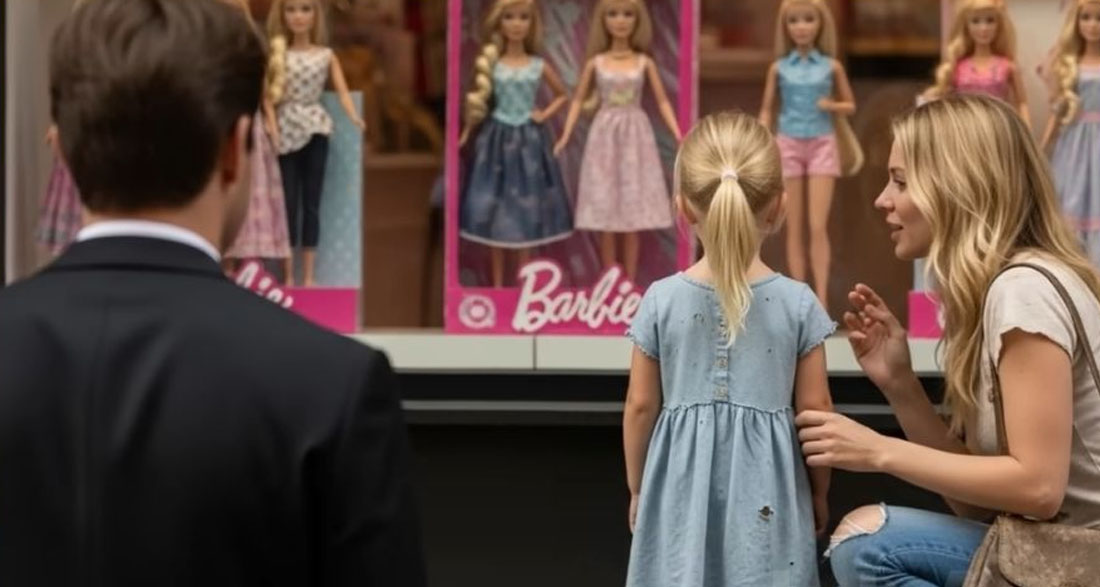
He looked up and saw them in front of a bright toy store window. A young woman knelt on the concrete, holding a little girl with a yellow ribbon in her ponytail.
Behind them, pink boxes glimmered with ballerina dolls, astronauts, and sparkling mermaids.
The woman’s T-shirt was clean but worn; her jaw set like she knew every penny the month’s rent had cost, and what going without really meant.
“I just want one,” the girl whispered, her voice shaking. “For my birthday. Just one. Everyone else has one.”
“I’m trying, honey,” her mother said, pressing her forehead to the child’s. Her voice cracked. “We need the money for rent and groceries. I’m so sorry.”
The apology seemed to hollow her out as she said it.
James usually stepped past moments like this. Pain was a door he kept locked. But something had slipped its foot in the jamb, and the door wouldn’t close.
Cassandra’s laugh floated up from a memory. Cassandra, who had lined shelves with Barbie dolls since she was five, who would have shared them with the daughter they never had.
Before he even thought, James moved.
“Excuse me,” he said. The woman’s head snapped up. Green eyes, red-rimmed, wary yet proud. She pulled the girl behind her instinctively.
“I’m sorry to intrude,” James said, surprised at how rough and unused his voice sounded when it wasn’t giving orders. “My name’s James. If you’ll allow me, I’d like to buy your daughter a birthday present.”
“We don’t accept charity,” she said firmly. Not unkind, but strong—enough to have kept a lot of wolves from their door.
“It isn’t charity,” he said softly. “Today would have been my wife’s birthday. She loved dolls—had a collection. We never had a chance to share it with a child. It would mean a great deal to me to do something kind in her name.”
The little girl peeked around her mother. “Mommy, his wife liked dolls,” she whispered. “That’s… sad.”
The woman—Tracy, James would learn—looked between them, her stance softening ever so slightly. Pride did not leave her. But love found a way in.
“All right,” she said finally. “Thank you.”
Inside the store, noise and color exploded. Brenda, the little girl, moved toward the Barbie aisle like it was a cathedral. Her fingers hovered over the boxes like a curator studying a priceless painting.
“Do you have a favorite?” James asked, crouching beside her.
“That one,” she breathed, pointing to a mermaid with blue-and-violet scales that shimmered. “She goes on quests. She helps people.”
“Excellent choice,” he said. And when she smiled, something unlocked inside him—a window painted shut finally giving way.
At the register, Tracy stood tall. “You don’t know what this means,” she murmured. “People walk past. You didn’t.”
“Most days,” he admitted. “I do.” He surprised himself with the truth.
Outside, Brenda hugged the box to her chest, then suddenly flung her arms around James. “You’re my favorite person,” she declared into the expensive fabric of his jacket.
He hadn’t felt a hug like that—unasked for, sincere—in years. Carefully, like holding a fragile antique, he wrapped his arms around her.
“Happy almost birthday,” he whispered. And the words landed in the empty space he’d kept closed for too long.
That night, he canceled meetings and wandered through the lit streets, noticing everything for the first time in years—the harbor’s dark mirror, music spilling into the air scented with Old Bay and river water.
Back in his mansion in Roland Park, he paused outside a bedroom he hadn’t entered in half a decade: Cassandra’s room. Her shelves. Her dolls.
He didn’t open the door. But he laid his palm against it—and did not pull away.
Three weeks later, he found himself in a working-class café near Randall Industries. He told himself he needed fresh air.
He told himself CEOs could stand in line like everyone else. He told himself he wasn’t hoping for anything.
“Be right with you,” called a woman behind the espresso machine.
He knew the voice before he saw her.
“James.” Tracy’s cheeks flushed. No tears this time—just determination in a brown apron and jeans. Shadows under her eyes betrayed sleepless nights.
“What do you recommend?” he asked.
“Americano. Simple. Strong.”
“Perfect,” he said, meaning more than coffee. When she slid the cup across, he asked without thinking, “How did Brenda like her birthday?”
“She adored it.” Tracy’s face brightened. “She drew you something. I didn’t think I’d see you to give it to you.”
It was a crayon masterpiece: three stick figures under a sun. One in a black suit. One with yellow hair. One tiny with a ponytail, holding a mermaid. In block letters: “Thank you, James. You are nice.”
He folded it like a deed to a house and put it in his briefcase.
“If you want to say hello on Saturday,” Tracy blurted, “we feed the ducks at Patterson Park around two.”
“I’ll be there,” he said. And he realized keeping a promise felt good.
The park became a ritual: bread in paper bags, ducks jostling like tiny bankers, Brenda narrating the world with scientific seriousness.
James relearned simple verbs—push the swing, tie a lace, tell a joke. He learned the exact color of Brenda’s laugh and the way Tracy’s shoulders eased when someone else shared the weight of worry.
“Do you ever feel guilty for being happy again?” Tracy asked one crisp day, while Brenda inspected a flowerbed.
“Every day,” James admitted. “Less than I used to. Cassandra would want happiness for me. Not… this half-life.”
Tracy nodded, understanding. She had a way of keeping fragile pieces safe.
Six weeks later, an unknown number lit his phone.
“I shouldn’t be calling,” Tracy said, raw with panic. “But James, it’s Brenda. We’re at Baltimore General. Leukemia. They’re saying… I can’t lose her.”
The world tilted. James ran before thinking, asking, “Which floor? Don’t sign anything. I’m coming.”
Hospitals try to soften fear with murals and fish tanks. Terror finds its way around paint. Tracy looked tiny in a plastic chair.
“I’m here,” he said, gathering her before she could fall apart.
Doctors spoke policy. James spoke resources. Transfers, attending physicians, private suites—he moved mountains.
He phoned Johns Hopkins for Dr. Eleanor Sheffield by name. He wired guarantees, arranged paid leave for Tracy, did everything he could.
“You can’t—” Tracy gasped.
“It’s nothing,” he said. “Against a child’s life, everything else recalibrates to zero. Please let me.”
“Why?” she asked.
“Because when I am with you and Brenda, I feel like a person,” he said. “Because she hugged me like I mattered. Because I can help, and that means I must.”
Brenda clutched her mermaid through admissions, blood draws, explanations no seven-year-old should hear. When she asked if she would die, James held her tiny hand. “No. We are going to do everything. And you are going to get better.”
And then he did.
He became the person doctors relied on, nurses smiled at. He moved meetings, learned medical vocabulary, fought for every resource.
“Stubborn,” Tracy said one evening, watching Brenda sleep. “Overbearing. Impossible.”
“Caring,” he offered.
She laughed through tears. “Caring,” she agreed.
Four months later, Dr. Sheffield beamed: “Remission.”
Tears, hugs, gratitude. Brenda asked, “Did you keep your promise?”
“I helped,” he said. “Your doctor made you better. You made you better.”
She hugged him, full force. Something inside James cracked open and set right.
He brought them to his mansion. “She can’t come back here yet,” he said quietly.
“This is what we have,” Tracy said, practical and tender.
“Have mine,” he said. “Until she’s strong.”
Love won.
James transformed the master bedroom into a library, a space for light, books, and naps.
The doll collection went into a climate-controlled “For Play” room. Saturday mornings became storytelling mornings, each doll with a story, each memory a bridge between past and present.
A year later, Patterson Park remained theirs. Ducks devoured bread. Tracy took James’s hand and placed it on her stomach.
“We’re going to need a double stroller,” she said, smiling.
He laughed and cried at once. “We will.”
“Cassandra would be thrilled,” Tracy whispered.
Brenda promised to teach the new baby to share—even the “Not-For-Play” dolls.
That night, James touched the dolls. “I didn’t forget,” he whispered. “Just… there’s room.”
He turned off the light. The past and future shared the same home. The human heart wasn’t a room to empty—it was a house to build, wing by wing, shelf by shelf.
James Randall, husband and father, went to sleep grateful he had once stopped in front of a toy store window—and decided to live.
