
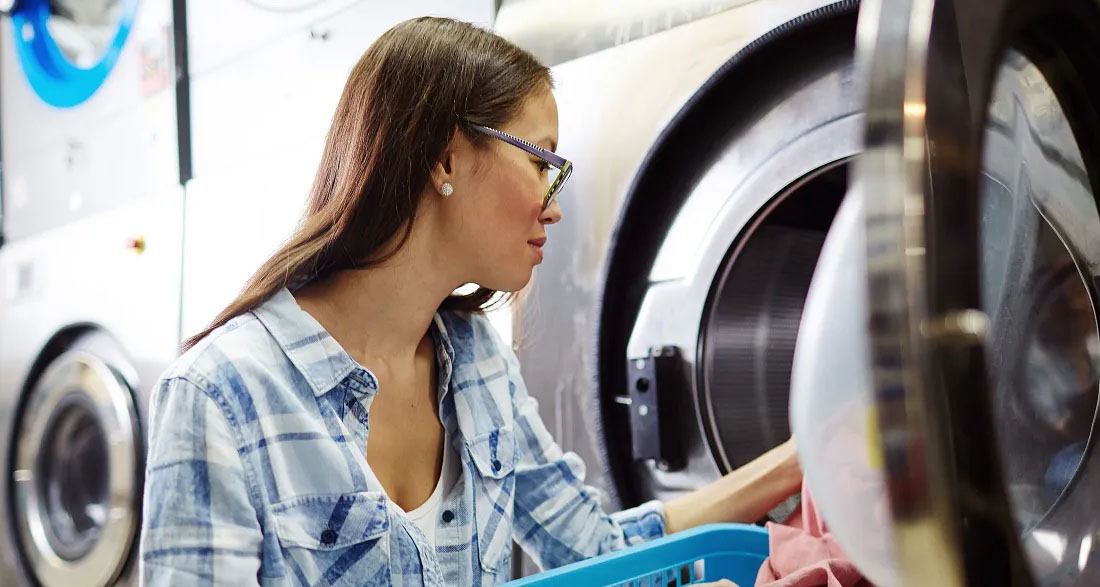
I dragged myself to the laundromat after another endless night shift, my seven-month-old daughter, Mia, fast asleep in my arms.
My body felt like lead, and exhaustion slammed into me so hard it made my head spin. I fed quarters into the washer, pressed start, and sat down, rocking Mia as the machine began to hum.
I told myself I’d just close my eyes for a second. Just one second. But when I woke up—everything had changed.
My laundry was folded. Perfectly.
And what I found inside the washer made my hands shake.
I work at a small pharmacy, where the schedule board pretends to make sense. It says I’m on day shift—but that’s just the story I tell myself to survive.
The truth is, I take whatever shifts they’ll give me. Overnight, double, back-to-back. Anything. Because overtime is the only thing keeping formula and diapers from sliding into the “maybe next week” pile.
Mia is seven and a half months old. She still smells like warm milk and sunshine, and when she smiles, the whole world goes quiet.
Every grin makes me forget—just for a second—the bills stacked on top of the microwave.
Her father walked out the moment I told him I was pregnant.
“I’m not ready for this life,” he said, like being a dad was an outfit that didn’t fit right.
I stopped checking my phone for his messages halfway through my second trimester. Now, it’s just me, my mom, and Mia against the world.
Mom watches Mia while I work. I try to tell myself the ache in my chest is gratitude, not guilt—but sometimes it’s both. She’s 61.
She already raised her kids. She shouldn’t have to wake up for midnight bottles and 3 a.m. diaper changes. But she does—without a single complaint.
We live in a small second-floor apartment in an old building. It’s cheap, but there’s no washing machine.
So when the laundry piles up, I lug it all down the street to the corner laundromat—the one with the flickering neon sign and the floor that’s always a little sticky.
That morning, I came home after a long night shift, running on fumes. My eyes felt gritty, and every muscle in my body ached. When I saw the overflowing laundry basket, I let out a tired sigh.
“Guess we’re going to the laundromat, sweetheart,” I whispered to Mia, who was snuggled against my chest.
Mom was still asleep after staying up most of the night with her. I didn’t want to wake her—she needed the rest more than I did.
So I bundled Mia into her little jacket, stuffed the dirty clothes into one big canvas bag, and stepped out into the chilly morning. The air smelled like rain and detergent before dawn.
The laundromat was nearly empty when I got there. Machines whirred softly. The place smelled like bleach and dryer sheets.
The only other person there was a woman in her fifties, folding towels at the end of the row. She looked up and smiled.
“What a beautiful girl you have,” she said warmly.
“Thank you,” I replied, smiling back.
She gathered her things and left. And then, it was just me and Mia, alone with the steady hum of the machines and the buzz of the fluorescent lights.
I loaded all our clothes into one washer—Mia’s tiny onesies, my scrubs, towels, her favorite elephant blanket—everything together.
I pressed the button, sat down on a hard plastic chair, and rocked her gently when she started to fuss.
She finally drifted off, her small hand gripping my shirt. I realized I didn’t have anything clean to cover her, so I took the thin receiving blanket from the dirty pile, shook it out, and wrapped it around her anyway.
Her breathing slowed, soft and even. My head dropped back against the wall. “Just a second,” I whispered to myself.
And then I was gone.
When I woke up, sunlight was pouring through the laundromat windows. For a moment, I had no idea where I was. Panic shot through me.
Mia was still in my arms—safe, warm, sleeping. Relief washed over me. But then I looked around.
The machines were silent. The air felt still.
And my laundry—my entire load—was folded neatly on the table beside me.
I froze.
My shirts were pressed into perfect squares. Mia’s clothes were sorted by color. Even the towels were stacked like something out of a department store. Someone had done this. While I slept.
Fear prickled through me. What if someone had touched Mia? What if—
But she was fine. Everything was fine. Except… the washer I’d used wasn’t empty.
I walked over, my hands trembling. The machine was filled—not with clothes, but with something else.
Inside were baby supplies: a full pack of diapers, wipes, two cans of formula, a soft fleece blanket, and a stuffed elephant with floppy ears. On top of it all was a small, folded note.
I picked it up and unfolded it with shaking hands.
“For you and your little girl. — S.”
That was it.
Five simple words.
I stared at the paper until tears blurred the ink. Someone—someone I didn’t even know—had seen me, really seen me, and decided to help.
I looked around the empty laundromat. Whoever “S” was, they were gone.
When I got home, I spread everything out on the bed. Mom came into the room, stopped short, and gasped.
“Sarah,” she whispered, her voice trembling, “there are still kind people in this world.”
I nodded, tears running down my face.
I pinned the note to the fridge with our sunflower magnet. Every time I looked at it, it reminded me that somewhere out there, someone cared.
A week later, after another brutal double shift, I trudged up the stairs to our apartment—and stopped dead.
There was a wicker basket sitting outside the door.
Inside were groceries: oatmeal, bananas, jars of baby food, crackers—and another note. Same neat handwriting.
“You’re doing amazing. Keep going. — S.”
I laughed and cried at the same time, standing there in the hallway with tears and snot and everything.
Who was this person? How did they know where I lived?
That night, I wrote a note of my own and slipped it under the doormat.
“Thank you. Please tell me who you are. I want to thank you properly.”
Days passed. Nothing. My note just sat there, untouched.
Then one morning, as I came home from work around seven, I saw a man standing near the gate. He looked nervous, shifting from foot to foot. When our eyes met, he smiled hesitantly.
“Sarah?” he asked softly.
I squinted at him. There was something familiar about his face. “Wait… Sean?”
He nodded. “Yeah. From high school.”
And just like that, I remembered. The quiet boy from the back of English class. The one everyone teased. The one I used to sit next to.
He rubbed the back of his neck, embarrassed. “I know this is weird. But my mom—she goes to that laundromat near your place. She told me about a young woman she saw there with a baby in her arms.
Said she looked exhausted but kept rocking her little girl even though she could barely stay awake. My mom said you reminded her of someone she used to know. Then she realized it was you.”
My breath caught. “Your mom… she was the woman I saw that morning?”
He nodded. “Yeah. Her name’s Lorraine. She couldn’t stop thinking about you. And when she told me, I couldn’t either.
You were the only person who was kind to me back in school, Sarah. You stood up for me when everyone laughed. I wanted to do something for you—even if you never knew it was me.”
My throat tightened. “Sean, you didn’t have to. You don’t owe me anything.”
He shook his head. “You once told me not to let people change who I am. I never forgot that. I just wanted to return that kindness.”
Tears rolled down my cheeks. “Thank you,” I whispered.
After that, Sean started stopping by sometimes. He’d bring diapers, or groceries, or offer to fix the leaky faucet that had been driving Mom crazy. He never asked for anything.
Mom started calling him “Uncle S,” which made him blush every time. There was nothing romantic between us—it was something quieter.
A friendship built out of small acts of kindness and shared memories.
Months later, my boss called me into his office.
“I’m giving you more stable hours,” he said. “And a small raise. Someone called to recommend you—said you’re one of the hardest-working people they’ve ever met.”
He wouldn’t tell me who it was, but I didn’t need to ask.
When I got home that night, I looked at the note still stuck to the fridge, edges curling, the words a little faded.
“For you and your little girl. — S.”
I smiled through my tears, tracing the letters with my finger. Because sometimes, the kindness you give years ago doesn’t disappear—it just waits quietly, patiently, until it finds its way back home.
Sean didn’t just help me with laundry or groceries or a better schedule. He reminded me that goodness never really leaves this world.
It just hides, waiting for the right moment to reappear—folded gently, like a gift, waiting in the washer for someone who needs it most.
