
The Envelope That Changed Everything
A week after I handed a tired young mother four dollars at the gas station, an envelope showed up at my work with my name scrawled across the front.
No return address. No clue who it was from.
Just a plain white envelope — the kind you’d almost throw away without thinking — except this one would end up changing how I saw kindness forever.
My name’s Ross, I’m 49, and I’m just an ordinary guy trying to keep my head above water.
I’ve got a wife, Lydia, who’s been my anchor through it all, and two kids who seem to grow out of their shoes faster than I can buy new ones.
We’ve got a little house with a big mortgage that still feels way too expensive for what it is. But it’s home. And after everything we’ve been through, that still counts for something.
A few years back, life took a turn I never saw coming. The factory I worked at for twenty-three years — the one where I gave my sweat, my time, and most of my youth — just… shut down.
Overnight.
One morning, I clocked in like always, grabbed a coffee, joked with the guys. By afternoon, the gates were locked, and there was a single piece of paper taped to the fence:
“Due to bankruptcy, this facility is permanently closed.”
That was it. No warning. No goodbye. Just gone.
I tried to bounce back. I sent out resumes, made phone calls, even drove around knocking on doors, hoping for a break. But the truth hit hard — at my age, people aren’t exactly lining up to hire you for anything decent.
The younger guys got new jobs right away. Me? I got told I was “overqualified” — which, in plain words, means “too old.”
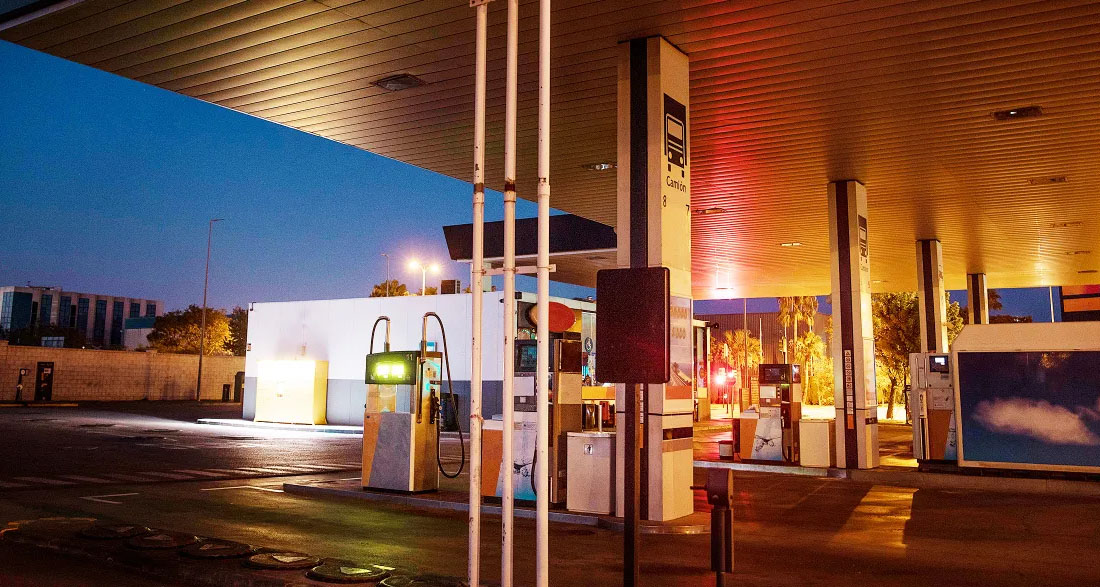
So now I work nights at a gas station off Highway 52.
It’s not glamorous, but it’s honest work. It’s one of those lonely stops where truckers grab coffee at 2 a.m., and the smell of burnt hot dogs never quite leaves the air.
The lights hum. The same three songs loop on the radio.
Most nights, it’s just me, the flickering fluorescent lights, and the sound of cars rushing by on the highway.
That night started out no different.
A couple of truckers came through around nine. Some teenager grabbed a pack of energy drinks and beef jerky an hour later.
By ten-thirty, it was quiet again. I was restocking cigarettes behind the counter when the bell over the door chimed.
It was 11:30 p.m.
She walked in carrying a sleeping child — a little boy, maybe three years old — limp and heavy against her shoulder.
She moved slowly, carefully, as if one wrong breath might wake him. Her hair was a tangled ponytail, her sweatshirt had stains on the sleeves, and her eyes… her eyes looked like she hadn’t slept in days.
She didn’t say a word.
Just went down the aisles, balancing the boy on her hip, grabbing a few things — a small carton of milk, a loaf of white bread, and a pack of diapers. Nothing else.
When she got to the counter, she set the items down gently, adjusted the boy on her shoulder, and looked at me.
“Fourteen seventy-two,” I told her.
She started digging through her purse, one hand still holding the boy. I watched her count out a few crumpled bills, her fingers shaking slightly. She looked at me with watery eyes.
“I’m short by four dollars,” she whispered. “Can I… put the diapers back?”
I didn’t even think.
“It’s fine,” I said quietly. “I’ve got it.”
She froze, staring at me like she wasn’t sure she’d heard right.
I smiled a little. “It’s late. Just get home safe, okay?”
Her lips trembled, and for a second, I thought she might cry right there. But instead, she nodded quickly. “Thank you,” she said in a small voice.
She grabbed the bag and hurried outside into the cold, holding that little boy tight against her.
Through the window, I watched her get into an old sedan that rattled as it pulled away. Then the station was quiet again.
A week passed. Nothing changed.
I worked my shifts, came home tired, helped Lydia when I could. We didn’t talk much about money anymore — there wasn’t much to talk about. We knew things were tight. Talking about it only made the air heavier.
Then Thursday came.
My manager, Mr. Jenkins, called me into his office. He’s one of those old-school types — gruff voice, but a decent man.
“Ross,” he said, leaning against his desk, “did you pay for someone’s groceries last Friday night?”
My stomach sank.
“Yeah, I did,” I admitted. “Was that against policy? I put my own money in the till—”
He lifted his hand. “Relax, you’re not in trouble.” He reached behind him and pulled out a white envelope. “This came in the mail this morning. It’s for you.”
I frowned. My name was written on the front in neat handwriting.
“Go on,” he said, nodding toward it. “Open it.”
I tore it open.
Inside was a folded piece of paper — and underneath it, a check for $5,000.
I blinked. Then blinked again.
No way. I looked closer. Five. Thousand. Dollars.
The note read:
Dear Ross,
Thank you for your kindness to my daughter, Emily. You have no idea how much you helped her that night. She made it home safe because of you. This is a small token of our gratitude.We would also love to have you over for lunch this Sunday if you’re willing. Please come. We’d like to thank you properly.
— Robert & Margaret [no last name]
There was an address written neatly below.
I just stared at the paper, my hands shaking.
Mr. Jenkins raised an eyebrow. “You okay, Ross?”
“I… I don’t know,” I said slowly. “I need to go home.”
When I walked through the door that evening, Lydia was in the kitchen making sandwiches for the kids’ lunches.
She turned and froze when she saw my face. “Ross, what happened? You look like you’ve seen a ghost.”
I handed her the envelope.
She opened it, and when she saw the check, her eyes went wide. “Oh my God. Ross, what is this?”
I told her everything — about the woman, the boy, the four dollars, the way she looked so lost.
Lydia read the note again, her voice trembling. Then she looked up at me with tears in her eyes. “Ross,” she said softly, “you have to go on Sunday.
And listen to me — I’m so proud of you. You did something kind when no one was watching. That’s who you are.”
I shook my head. “I didn’t do it for this, Lydia. I just wanted her to get home safe.”
“I know you didn’t,” she said, hugging me tight. “That’s why it means so much.”
Sunday came faster than I wanted.
I must’ve changed shirts three times before Lydia finally laughed and said, “You look fine. Go!”
The address led me to a quiet neighborhood across town — big houses, clean white fences, lawns so perfect they looked fake.
When I pulled up, an older couple was waiting on the porch. The woman smiled the second she saw me. The man stepped forward with a strong handshake.
“You must be Ross,” he said. “I’m Robert. This is my wife, Margaret. Come in, please.”
Inside, the house smelled like roast chicken and fresh bread.
We sat at a long table, plates already set. For a few minutes, no one spoke. Then Robert cleared his throat.
“Ross, we wanted to tell you about our daughter, Emily,” he began.
Margaret reached for his hand. Her eyes were wet.
“She was in a terrible marriage,” Robert said quietly. “Her husband controlled everything. He kept her away from us — from everyone.
When she finally got the courage to leave, she had almost nothing. That night at the gas station… that was the night she was driving home to us.”
Margaret’s voice shook. “She had just enough for gas and a few groceries. When she realized she didn’t have enough for the diapers, she almost broke down.
She told us later she thought she’d failed before she even started.”
I felt a lump in my throat.
“But then,” Robert said, smiling faintly, “you helped her. You didn’t judge her. You didn’t ask questions. You just said, ‘Get home safe.’”
Margaret wiped her eyes. “When she arrived here that night, she couldn’t stop crying. She said, ‘Mom, there was this man at the gas station who just helped me… like it was nothing.’”
I swallowed hard.
“I didn’t do much,” I said softly.
Robert shook his head. “You did everything. You gave her hope. You reminded her there’s still good people in the world.”
I tried to hand the check back. “I can’t take this.”
But Margaret placed her hand gently over mine. “Ross, please. It’s not payment. It’s gratitude. You helped bring our daughter and grandson home.”
We talked for hours. They told me about little Daniel, about Emily rebuilding her life, about how she finally smiled again. I told them about my kids, my job, the factory — everything.
When I left, Margaret hugged me again. “You’re a good man, Ross,” she said softly. “Don’t ever doubt that.”
Driving home, I thought about that night — how such a small act could ripple into something so big.
When I walked in, Lydia looked up from the couch. “So? How was it?”
I smiled and sat beside her. “You know what’s funny? I thought I was the one showing kindness that night. Turns out… kindness was finding its way back to me.”
She leaned her head on my shoulder. “That’s how it works, Ross. You give what you can, and somehow, the world remembers.”
I kept that check on the counter for two days before finally depositing it. It helped — we paid bills, fixed the car, and got the kids those new shoes without guilt.
But what really stayed with me wasn’t the money. It was Margaret’s words:
“The smallest acts of kindness — the ones you do without thinking — are the ones that matter most. Because they come from who you really are.”
I still work that night shift off Highway 52. The lights still buzz, and the coffee still tastes burnt. But now, when someone walks in looking tired or lost, I look up.
Because you never know when four dollars and a kind word might be exactly what helps someone make it home.
