
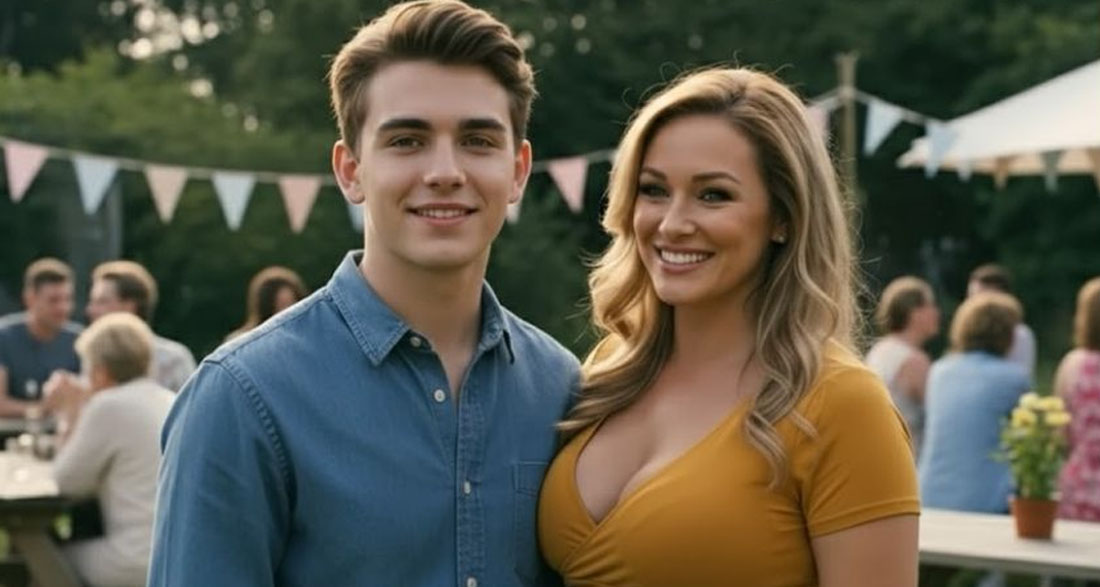
The Pretend Boyfriend
My name’s Mason, and I live in a quiet little town in Oregon, the kind of place where the air smells like rain and pine bark at night, and the crickets start singing right after sunset.
I’ve never left. My grandfather’s old white house—paint peeling, roof a little crooked—creaks every time I walk through the hallway. I fix bikes at a shop called Gear & Grind, squeezed between a thrift store and a laundromat. Life here is simple, quiet, predictable.
That was true until she moved in next door.
Her name was Julia. Early forties, brown hair that could never stay in a bun, and gray-green eyes that seemed to hold a thousand untold stories.
Mrs. Larson, our local gossip queen, said Julia used to be a journalist in Chicago. Divorced. Her ex-husband apparently traded her in for someone “flexible enough to do yoga and keep secrets.”
For three whole years, Julia and I existed like two houses facing each other across a street—close enough to see, but never touching. Then one Thursday evening, everything changed.
1. The Proposal
I was out watering my small patch of grass when I saw Julia standing on her porch, holding a crumpled piece of paper like it had personally offended her.
“Everything okay?” I asked over the fence.
She looked startled, then sighed and held up the flyer. “Neighborhood block party. Saturday night.”
I chuckled. “Free burgers and bad karaoke? Sounds like paradise.”
She gave a dry laugh. “My ex will be there. With her.”
The silence that followed felt heavier than the humid air. I could’ve told her not to go. But instead, my mouth betrayed me.
“What if I came with you—as your boyfriend? Fake, obviously.”
She blinked. Then, to my surprise, she laughed for real—a soft, surprised laugh that made her eyes shine. “You’re kidding.”
“Completely serious,” I said. “I’m good at pretending. Just ask my tax guy.”
Her smile faded slightly. “You’d really do that?”
“Why not?” I shrugged. “No one should have to face a circus alone.”
She studied me like she was trying to decide if I was brave or just foolish. Finally, she nodded. “Okay. But we’ll need practice. No one’s going to believe it otherwise.”
“When do rehearsals start?” I asked.
“Tomorrow,” she said, almost smiling. “My porch. Bring coffee.”
“Deal.”
As I walked home that night, every nerve in my body buzzed.
2. Rehearsal Nights
Friday evening came smelling of lilacs and fresh rain. I showed up right on time, holding two diner cups. “Black, no sugar for me,” I said, handing her one. “Oat-milk latte, no foam for you.”
Her eyebrow arched. “You’ve been spying on my coffee habits?”
“Call it research,” I grinned.
We sat side by side on her porch steps, our knees almost touching.
“So, fake boyfriend,” she said, crossing her legs. “Where do we begin?”
“Handholding 101,” I said, offering my hand.
She hesitated for a second, then placed hers in mine. Her palm was warm, soft but firm.
“How’s it feel?” she asked.
“Like a middle-school dance,” I said. “Awkward but kind of nice.”
She laughed—a full, genuine laugh that made something in my chest twist.
We practiced everything after that—how to smile at each other, how to lean in like we shared secrets, even pet names. But every attempt ended in laughter.
By the end of the night, she was wiping tears from her eyes. “We’re hopeless!”
“Hopelessly convincing,” I said, and she laughed even harder.
The next night, she invited me inside. Her living room smelled like cedar and fresh coffee. We shared a bottle of wine and swapped stories—about bikes and deadlines, about things we tried to fix to distract from what we couldn’t.
She told me about Chicago—late-night deadlines, dangerous investigations, adrenaline replacing sleep. “I thought that was living,” she said softly. “But maybe I was just running.”
I told her about my grandpa, who taught me how to rebuild a bike chain when I was ten. “He said fixing things teaches patience,” I remembered. “Guess I took that lesson seriously.”
She smiled, quiet and thoughtful. For a woman used to asking questions, she listened deeply.
By the third night, she fell asleep mid-sentence on the couch. I covered her with a blanket and sat on the floor, listening to her breathing. Somehow, my house across the street felt lonelier than ever.
3. The Eve of the Show
Friday came again, stormy and electric. Julia texted: “Come over. Made pasta. Out of fake excuses.”
Her kitchen glowed with golden light. Garlic, basil, and jazz filled the air. She moved barefoot, apron stained with tomato sauce, hair pinned with a pencil.
“Don’t just stand there,” she teased. “Open the wine.”
We ate slowly, laughing about nothing. The pasta was a little overcooked, but perfect anyway.
When I reached out to wipe a dot of sauce from her cheek, she froze, then smiled. “Thanks.”
“No problem,” I said quietly.
After dinner, we washed dishes side by side. Our shoulders brushed. The air between us felt thick—alive.
She broke the silence. “After tomorrow… when this is over… what then?”
I hesitated. “Then we decide if we keep pretending.”
Her gaze met mine. “Okay,” she said softly.
When I left that night, the smell of rain followed me home.
4. The Party
Saturday night arrived, painting the sky peach and gold. I crossed the street in my best shirt. Julia waited on her porch in a pale green dress that made her eyes glow.
“You look incredible,” I said.
She smiled. “You clean up well yourself.”
She slipped her hand through my arm as we walked toward the park. String lights hung above picnic tables, laughter and country music filling the air.
Then I saw him—Mark. Her ex. Broad shoulders, smug grin, expensive watch. And beside him, a young blonde woman who looked like she’d just stepped out of a catalog.
“Julia!” Mark called, voice oily with confidence. “Didn’t expect to see you here.”
“Mark,” she said flatly.
He gestured to the blonde. “This is Tiffany. Tiffany, my ex-wife.”
Then his eyes landed on me. “And you are…?”
“Her boyfriend,” I said, sliding my arm around Julia’s waist. “Mason.”
Tiffany snorted. “Didn’t know you were into mechanics, Jules.”
“Careful,” I said evenly. “That’s my girlfriend you’re talking about.”
Her laughter died. Mark’s smirk twitched. Julia straightened, her voice calm but strong. “Enjoy the party, Mark.”
Before he could reply, a familiar song started—Can’t Help Falling in Love.
“Dance with me,” I said quietly.
Her eyes widened, then softened. “Okay.”
We stepped onto the grass, and I pulled her close. Her head rested on my shoulder.
“You okay?” I whispered.
“No,” she murmured. “But keep going.”
We swayed under the lights, and the world disappeared. I could feel Mark watching us, burning with jealousy.
“He doesn’t win anything tonight,” I said quietly.
She looked up. “Then prove it.”
So I did.
I kissed her.
It wasn’t for show, or revenge. It was real.
When we finally pulled apart, she whispered, “That wasn’t part of the plan.”
“Guess we’re off-script,” I said.
5. Silence
She left the party with her head high, hand still in mine. On her porch, she stopped. “That kiss… it wasn’t fake.”
“No,” I admitted. “It wasn’t.”
“I need time,” she said softly. “To figure out what this is.”
“Take all the time you need.”
She nodded, went inside, and closed the door. I stood there until the porch light flickered off.
Days passed. Every morning, I left coffee at her door. Some days she drank it. Some days it stayed there until evening. The distance between our houses felt wider than the street.
Neighbors whispered about “the show” we’d put on. I didn’t care.
6. Rain on the Porch
Late August brought thunder. When I got home one evening, my porch light was on—I never leave it on.
A note waited on the door:
Meet me on my porch. Bring your appetite. —J
My heart pounded as I crossed the street through the humid, rain-heavy air.
Julia sat at a table, two mugs steaming, sandwiches wrapped in foil.
“Turkey and Swiss,” she said. “You still like mustard, right?”
I grinned. “You remembered.”
“I pay attention.”
We ate quietly, listening to crickets and distant thunder. Afterward, she slid a folder across the table.
“I sent it,” she said.
Inside was her essay—The Day I Found Myself Again—with the words Pacific Northwest Quarterly – Accepted stamped at the top.
I read the first line aloud: “I used to think love was a deadline. Turns out it’s a porch light left on.”
My throat tightened. “Julia…”
She smiled through tears. “It’s small, but they want more. A series, maybe.”
At the bottom was a handwritten note: For the boy who left coffee and never asked for anything back.
I looked up, speechless.
“You didn’t have to thank me,” I said.
“I wanted to,” she replied. “I was scared, Mason. Scared of what people would think. Scared of needing someone again. But I’m tired of being scared.”
She reached for my hand. “I don’t know what this is yet. But I don’t want to figure it out alone.”
I squeezed her hand. “Then don’t.”
Rain started falling—soft, rhythmic, cleansing.
She stood. “Come inside. It’s getting cold.”
I followed her in, leaving the empty mugs and her published dream on the table. Behind us, her porch light burned warm through the storm.
7. After
People love stories with perfect endings—kisses, rain, happy music. But real life ends differently. It just keeps going, quieter, steadier.
Julia’s articles became a regular series—stories about loss, healing, and finding yourself again. Her last one mentioned “a mechanic who taught her that some things aren’t broken, just paused.”
That winter, I opened Haven Cycles, a bike-and-coffee shop downtown. She wrote the article that made people show up.
Most mornings, she sits by the window, laptop open, coffee in hand. Sometimes she looks up and catches my eye. No pretending anymore.
When the sun sets, we lock up together and walk home side by side. Sometimes we stop by the fence where it all started.
“Remember when this was fake?” she teases.
“Best rehearsal ever,” I tell her.
And every time she laughs, I think about how something that started as pretending became the truest thing I’ve ever known.
Because sometimes, love doesn’t arrive with fireworks—it starts with coffee on a porch, a fake plan, and a light left burning in the rain.
