
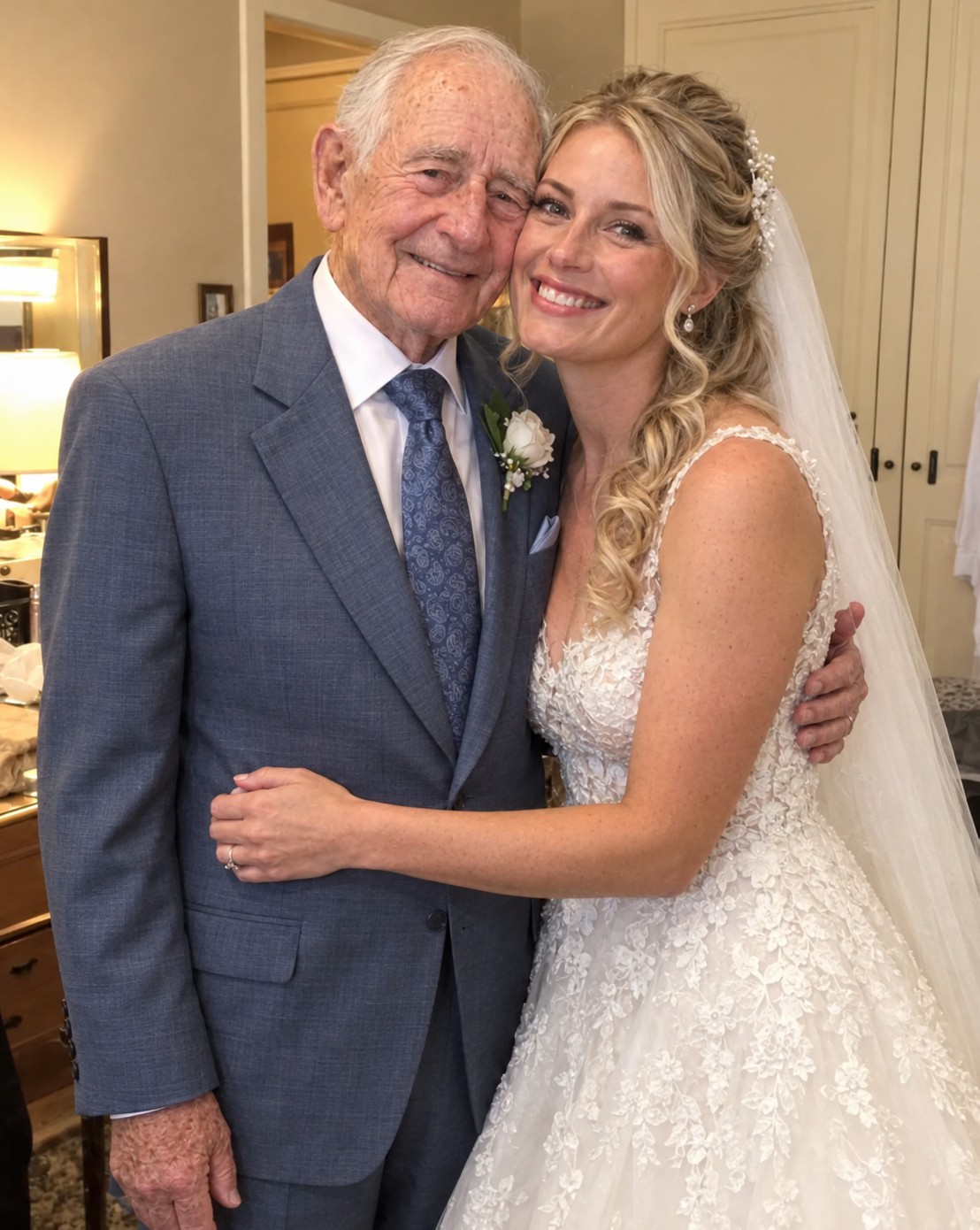
Part 1:
At twenty-nine, I had never managed to keep a job for more than a few weeks.
“Why should I spend my life trapped behind a desk?” I told my mother. “I’m attractive enough to marry a successful man.”
I truly believed that someone like Arthur would eventually come into my life.
Then, one evening, I saw him dining alone in an expensive restaurant. His gold watch looked extremely valuable, his navy suit seemed perfectly tailored, and every waiter appeared to know exactly who he was.
He was old enough to have been my grandfather, but I forced myself not to think about that.
When his hand suddenly began to tremble and his wineglass slipped from his fingers, I rushed over and helped him before the waiter could get there.
A few weeks later, Arthur sent an enormous arrangement of roses to my apartment.
Not long after that, he proposed with a diamond ring so large that people could notice it from across a room.
My parents begged me not to rush into marriage.
“He is almost eighty,” my father warned. “Do you actually love him?”
“He treats me well,” I replied. “Shouldn’t that be enough?”
The truth was that I could barely think about anything except Arthur’s magnificent family mansion.
He told me the mansion was being renovated, but he promised that once we were married, I would live there with him.
I imagined sweeping staircases, enormous bedrooms, elegant dinner parties, and a life where I would never have to worry about money again.
But as our wedding approached, Arthur’s situation began to seem more and more strange.
His Bentley was suddenly “in the repair shop.”
Then he told me that his investment accounts had been temporarily frozen.
A few weeks before the wedding, he even asked me to lend him money so he could pay for his wedding suit.
“I’m arranging a huge surprise for you, darling,” he kept telling me. “I only need a little more time.”
I wasn’t interested in surprises.
I wanted the fortune.
So I stayed patient.
Our wedding day was everything I had imagined.
The ballroom was filled with flowers, crystal lights, and elegantly dressed guests. I stood beside Arthur in my carefully chosen gown, already imagining myself walking through the doors of his mansion as his new wife.
Then, in the middle of our vows, Arthur reached for the microphone.
The room immediately fell silent.
“My bride does not know one very important detail about me,” he announced.
Every guest turned toward me.
Arthur smiled.
“The truth is, I have been testing her to discover whether she truly loves me.”
My fingers tightened around my bouquet.
What?
Then Arthur looked directly into my eyes.
“Because when it comes to my fortune…”
I stopped breathing as I waited for him to finish.
Part 2:
“…because when it comes to my fortune,” Arthur continued into the microphone, his voice echoing through the silent ballroom, “I have given every last cent of it away.”
A collective gasp moved through the rows of guests.
My heart didn’t simply drop. It froze.
My knuckles turned white around the bouquet of white orchids as the floor beneath my satin heels seemed to disappear.
Arthur turned toward me, his aging face glowing with what he clearly believed was the perfect romantic gesture. He reached out and took my trembling hand.
“Three months ago,” Arthur continued, tears shining in his eyes, “I decided that I would not spend my final years wondering if the people in my life loved me for my bank account or for my soul. So, I established a permanent charitable trust. I transferred my mansion, my investment portfolio, my vintage automobile collection, and all liquid capital to the Children’s Hospital Foundation.”
My mother squeezed her eyes shut in the second row. My father covered his mouth with one hand.
“I sold the Bentley,” Arthur proudly announced to everyone in the room. “I closed my private lines of credit. I posed as a man on the brink of financial ruin—a man who couldn’t even afford his own wedding suit! And through it all, this beautiful, selfless woman stood beside me. She lent me money. She listened to my troubles. She loved me when she believed I had nothing left to offer!”
The wedding guests, most of whom were Arthur’s wealthy high-society friends and charity board members, immediately stood and applauded.
The sound filled the vaulted ballroom.
Some people wiped tears from their eyes. Others whispered about the beautiful, almost unbelievable purity of our love.
Arthur looked into my eyes and grinned like a victorious schoolboy.
“We have no millions, my darling,” he whispered after pulling the microphone away. “We have no mansion. We have a modest two-bedroom rental apartment on the outskirts of the city, my pension, and an unbreakable love that money could never buy. Shall we finish our vows?”
I stood frozen in my twenty-thousand-dollar custom wedding gown.
I had charged that gown to my own credit card because I fully expected to pay the bill with Arthur’s money after our marriage.
My mind was racing.
I had spent my entire adult life avoiding work.
I had accumulated forty thousand dollars in personal debt buying designer clothes, leasing luxury cars I could not afford, and eating at expensive restaurants because I wanted to look like the kind of woman a wealthy man would marry.
I had built my entire future around Arthur’s death and his eighty-million-dollar estate.
And now I was standing at the altar, about to tie myself to a seventy-eight-year-old man, a tiny two-bedroom rental apartment, and his monthly Social Security checks.
If I walked away now—if I dropped my flowers, screamed, and ran down the aisle—the entire high-society crowd sitting in those chairs would call me a cold, heartless gold-digger.
My reputation would be destroyed.
My parents would be humiliated.
Worse, I would still owe forty thousand dollars, have no job, and have almost no money.
So I forced my lips into a smile.
I let one dramatic tear slide down my cheek.
“Yes, Arthur,” I choked out, my voice trembling with panic and desperation. “Let’s finish our vows.”
The priest smiled and continued with the final blessing.
We exchanged rings.
Arthur kissed me on the lips, his breath smelling of peppermint and old age, while the crowd cheered for the selfless young bride who had supposedly chosen love over money.
As we walked down the aisle, smiling for the photographers, I squeezed Arthur’s hand so hard that my nails nearly dug into his skin.
“You set me up,” I whispered through my bright smile, making sure my face remained turned toward the cameras.
“I tested you, my love,” Arthur purred, happily waving at one of the charity board members. “And you passed with flying colors.”
I smiled even wider.
My heart was pounding like a war drum.
He believed he had pulled off the ultimate romantic trick on a selfish young woman.
But as we left the venue and climbed into the beaten-up silver sedan he had rented as our getaway car, a cold realization began forming in my mind.
Arthur had spent months creating an elaborate lie to test my character.
What he didn’t know was that I had spent the last six months studying his legal affairs.
And as we drove toward that “modest two-bedroom rental,” I remembered one tiny detail buried inside the public announcement about his charitable donation.
It was a detail Arthur had completely overlooked while playing the role of the heroic philanthropist.
Part 3:
The two-bedroom apartment smelled of stale tea and old carpet.
Arthur sat on the worn floral sofa in his socks, holding a cup of warm water and looking completely satisfied. He had changed out of his rented wedding suit and put on a faded cardigan.
“Isn’t it wonderful, Vanessa?” Arthur said with a smile, gesturing around the small living room. “No servants. No grand halls to manage. Just the two of us, living simply and honestly.”
I sat across from him on a wooden dining chair, still wearing my wedding dress. I had loosened the back just enough to breathe.
“It’s cozy, Arthur,” I said smoothly, pouring myself a glass of tap water. “Truly rustic.”
“I knew you’d understand,” he said happily. “My ex-wives… ah, they were vultures. The moment the money slowed down, they ran to their lawyers. But you… you have a pure heart.”
I took a slow sip of water.
Then I let the silence continue until he finally placed his cup down.
“Arthur,” I began in a sweet, innocent voice, “when you transferred your estate to the Children’s Hospital Foundation three months ago… did you use the Vance Family Irrevocable Trust structure?”
Arthur blinked.
His smile faded slightly.
“Well, yes,” he said. “My tax attorney, Marcus, handled the paperwork. Why do you ask, darling?”
“Because,” I said, getting up and walking toward my handbag on the laminate kitchen counter, “I read the public press release from the hospital board. It was published in the Financial Gazette in July.”
Arthur gave a soft chuckle and waved his hand dismissively.
“Oh, Vanessa, don’t bother your pretty head with legal jargon. The money is gone. It belongs to the sick children now. It’s a closed chapter.”
“It’s not quite closed, Arthur.”
I walked over and placed my tablet directly on his lap.
He frowned, pulled his reading glasses from his cardigan pocket, and put them on.
“Look at Section 4, Paragraph B,” I said, pointing with my manicured fingernail. “Under the New York State Charitable Trust Act, any unilateral transfer of real estate and liquid assets exceeding ten million dollars into a public foundation requires a mandatory ninety-day irrevocable ratification period.”
Arthur stared at the screen.
“Yes… and?”
“The ninety days ended at midnight before our wedding,” I said calmly. “Which means the transfer remained legally pending throughout the entire time you were testing me.”
Arthur’s hand began trembling slightly.
It was the same subtle tremor I had noticed the first day I met him in the restaurant.
“Vanessa…” he said. “What are you getting at?”
“I’m getting at the fact that you lied to a room full of two hundred high-society guests today,” I said, my voice becoming cold and precise. “You told them you were a penniless man who had given everything away to test my love.”
“I did give it away!” Arthur snapped. His voice rose as he became defensive. “The paperwork was signed!”
“The paperwork was signed, but the assets were held in an escrow account pending final judicial review,” I continued. “And because you married me before the final judicial decree was executed at noon today, under the applicable state marital-property rules, my signature was required as your lawful spouse to complete the transfer of the residential real estate registered as a primary family asset.”
Arthur became completely still.
His face drained of color.
“You… you didn’t sign anything,” he whispered.
“No, I didn’t.”
I smiled and stepped back, smoothing the satin skirt of my wedding dress.
“Because no one presented me with the consent waivers. You were so busy staging your dramatic performance about your own moral superiority that you forgot to tell your estate attorney that you were getting married on the exact date of the escrow release.”
Arthur scrambled to his feet, his cardigan slipping from his shoulders.
“No! No, that’s impossible! Marcus assured me!”
“Marcus assumed you were marrying a foolish twenty-nine-year-old woman who didn’t know how to read a land registry form,” I interrupted. “I called Marcus’s office from the limousine on our way here while you were taking a nap in the back seat.”
Arthur opened his mouth, but no sound came out.
“Marcus was quite panicked, Arthur,” I continued, sitting at the small wooden dining table and crossing my legs. “He told me that because the primary mansion in Westchester was still designated as your legal residence at the time of our 11:00 a.m. wedding ceremony, the hospital cannot take title without my explicit, notarized spousal waiver.”
“You… you have to sign it!” Arthur stammered, stepping toward me with shaking hands. “I gave my word to the hospital board! There’s a wing named after me! The press has already covered the donation!”
I looked up at him.
Then I gave him the sweetest, most breathtaking smile I had ever produced.
“I am a gold-digger, Arthur,” I said, dropping the innocent act completely and allowing him to see the coldness underneath. “You were right about me. I married you for your eighty million dollars, your Bentley, and your mansion.”
Arthur gasped and grabbed the back of the sofa for support.
“You… you monster! You lied to me!”
“You lied to an entire room full of people today just to humiliate me and make yourself look like a saint!” I shot back. “You wanted a fairytale, Arthur. You wanted to play the grand, noble patriarch testing the greedy young girl. Well, congratulations. The test is over.”
I leaned back in my chair.
“And now it’s time to negotiate.”
Part 4:
The formal library of the Vance Estate in Westchester was silent except for the ticking of a grandfather clock in the corner.
Sunlight poured through the floor-to-ceiling stained-glass windows, illuminating the intricate mahogany woodwork, Persian rugs, and velvet armchairs.
Marcus, Arthur’s chief legal counsel, sat behind the heavy oak desk, looking completely exhausted.
Arthur sat beside him.
He looked ten years older than he had on our wedding day. His sharp suit hung loosely from his fragile frame.
I sat across from them in a tailored ivory pantsuit, calmly sipping black coffee from a porcelain cup.
“Let us review the terms once more, Mrs. Vance,” Marcus said, rubbing his temples.
“Ms. Vance,” I corrected smoothly. “I am keeping my maiden name for professional purposes.”
Marcus sighed and opened a thick leather folder.
“Under the proposed marital agreement, you agree to sign the spousal consent waiver releasing sixty percent of the liquid investment portfolio—approximately forty-eight million dollars—to the Children’s Hospital Foundation as originally planned.”
“Correct,” I said with a nod. “The hospital gets its new wing. Arthur keeps his public legacy as a great philanthropist. Everyone wins.”
“And in exchange?” Marcus asked, glancing nervously at his client.
“In exchange,” I said, placing my coffee cup on the desk with a soft clink, “the Westchester mansion, the vintage car collection, and the remaining thirty-two million dollars in liquid capital will be placed into a joint marital trust. I will be designated as the primary trustee, with sole operational control over property management, staff hiring, and financial distributions.”
Arthur slammed his hand against the mahogany armrest.
“It’s extortion! She’s holding my legacy hostage!”
I looked at my husband with calm, unbothered eyes.
“You wanted to live in a modest two-bedroom rental apartment, Arthur,” I reminded him gently. “You told two hundred people that you wanted a simple, authentic life without the burdens of wealth.”
I leaned forward slightly.
“If I don’t sign that waiver, the entire transfer fails. The hospital can sue you for breach of your pledge. The press will discover that your grand charitable gesture was a legal disaster. And the entire eighty million dollars could end up trapped in a public court battle that lasts longer than your remaining life expectancy.”
Arthur’s mouth snapped shut.
His chest rose and fell heavily as he stared at me.
He finally understood that he had built his own trap.
“You have two choices, Arthur,” I continued.
“Option one: we go public. You admit to your board members that you failed to execute your trust properly. The charity loses forty-eight million dollars, and your name is dragged through every tabloid in the country as a senile billionaire who was outsmarted on his own wedding day.”
Arthur winced.
“Option two,” I said softly, “we sign this agreement. You get your public sainthood. The hospital gets its funding. You move back into this magnificent mansion with full access to your private chef, groundskeepers, and medical team.”
I smiled.
“And I manage the estate as your devoted, brilliant wife.”
Marcus looked at Arthur.
“Arthur… legally speaking, this is the cleanest resolution available. If this becomes probate litigation, the legal fees alone could consume millions, and the publicity would be catastrophic.”
Arthur looked around the grand library he had built over fifty years.
The books.
The artwork.
The legacy he had tried so desperately to control.
Then he looked at me.
He no longer saw an innocent, starry-eyed young woman.
He saw an equal.
A predator who had recognized his game and played it better than he had.
Slowly and reluctantly, Arthur reached for the fountain pen lying on the desk.
“You’re a terrifying woman, Vanessa,” he muttered, his hand trembling as he brought the pen to the paper.
“I’m a woman who knows what she’s worth, Arthur,” I replied smoothly. “You taught me that yourself.”
He signed his name on the dotted line with a heavy, sharp stroke.
Marcus immediately stamped the document with his notary seal and slid the second copy toward me.
I picked up the pen and signed my name beside his with a flourish.
Six months later, the afternoon sun cast a warm, golden glow over the manicured gardens of the Westchester estate.
I stood on the stone terrace wearing a simple silk dress, holding a glass of chilled champagne.
Below me, a team of landscapers trimmed the rose bushes while the head butler organized preparations for an upcoming charity gala we were hosting for the hospital.
Behind me came the soft sound of a wheelchair rolling across the stone flagstones through the open French doors.
Arthur rolled onto the terrace wrapped in a soft cashmere blanket.
His health had declined slightly over the winter, but his eyes were clear, sharp, and strangely peaceful.
“The roses look good this year, Vanessa,” he said softly, looking out over the estate.
“I had the head gardener replace the soil mix last month,” I replied, walking over and standing beside his wheelchair. “It’s making a world of difference.”
Arthur looked up at me.
A faint, amused smile touched his thin lips.
“Do you know what the funny thing is, my dear?” he asked quietly.
“What’s that, Arthur?”
“My first three wives… they spent all my money on jewelry, clothes, and trips to Europe,” he said with a weak chuckle. “They nearly emptied my accounts before I divorced them.”
He looked toward the gardens.
“But you… you’ve actually increased the trust’s net yield by four percent since taking over the portfolio.”
I smiled and took another sip of champagne.
“I told you, Arthur. I don’t like trapped desk jobs. But I am very good at executive management.”
Arthur let out a soft, genuine laugh.
It was a sound completely free of the arrogance and theatrical behavior that had defined him on our wedding day.
“I suppose I got what I asked for,” he murmured, watching the sun sink behind the rolling green hills of the estate. “I asked for a woman who would stand by me when the money was gone.”
“And I stood by you,” I reminded him gently, placing a soft hand on his shoulder. “I just brought the money back with me.”
Arthur reached up and placed his fragile, spotted hand over mine.
He squeezed it gently.
There was a quiet, mutual respect between us now—the kind that can only come from two players who survived the same game.
“Yes, you did, Vanessa,” he whispered, turning his gaze back toward the golden horizon.
“Yes, you did.”
The End.
