
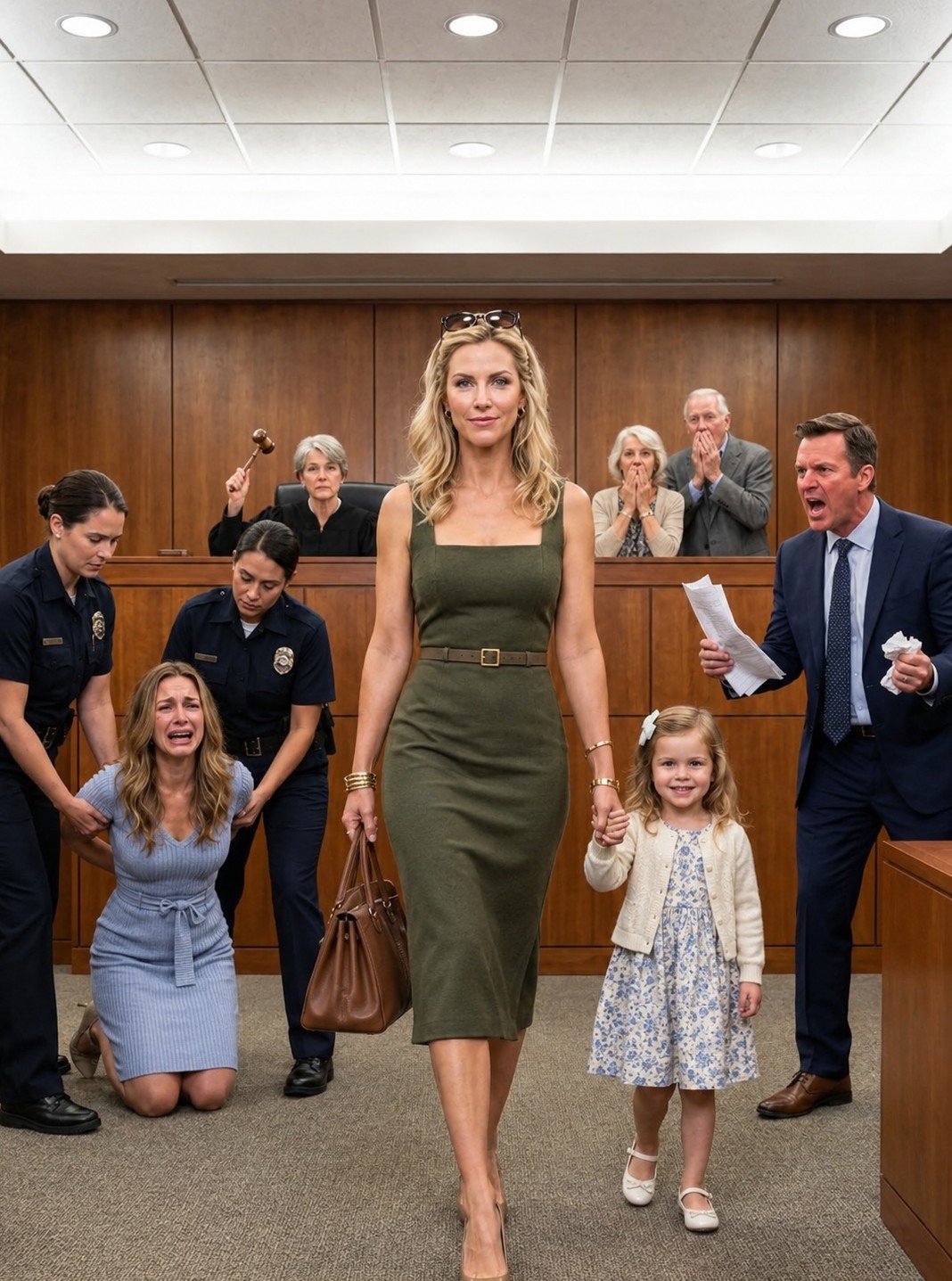
Part 1:
“When we leave this building, that lake house won’t be yours anymore, Felicia. You will finally understand that you are not the one calling the shots in this family.”
Isabelle whispered the words directly into my ear just moments before the bailiff called our case.
Her voice was sweet, almost gentle, but there was something cold and cruel underneath it. She smiled as though she had already won. I could almost imagine what she was thinking: herself sitting on the porch of my private getaway in Aspen, sipping expensive wine from a glass she had never worked a single hour to afford.
My mother, Beatrice, sat directly behind her. Her designer handbag rested stiffly on her lap, and she wore the same proud expression she always had whenever Isabelle managed to bully someone into giving her what she wanted.
My father, Marcus, sat beside her with his lips pressed into a thin, hard line. He looked like he had appointed himself the moral authority of the entire family.
To them, I had always been the black sheep.
I was the daughter who moved out without asking their permission. I was the woman who refused to get married by twenty-five. I was the daughter who chose to build a successful logistics company instead of spending every Sunday at boring family brunches just to make my aunts happy.
Isabelle was different.
She was their golden child.
She was always described as the sweet daughter, the loving sister, and the perfect wife. Yet somehow, she was also constantly in need of money.
Whenever Isabelle pretended to cry, my parents rushed to comfort her. They opened their arms, opened their wallets, and sometimes even opened their checkbooks.
When I struggled, they told me I was strong enough to handle everything alone.
That had been the story of my entire life.
The Aspen cabin was the one place that belonged completely to me.
It had beautiful stone walls, warm cedar beams, and a private dock overlooking the lake. I had bought it after years of working through holidays, weekends, and even days when I was sick with a fever.
Every dollar had come from my own work.
It was not an inheritance.
It was not a family gift.
It was not something my parents had given me.
It was my reward for everything I had sacrificed.
And now Isabelle and her spineless husband, Patrick, were trying to steal it from me using a fraudulent deed.
We entered the courtroom, and Patrick walked ahead of us with the confidence of a man who believed he owned the entire justice system.
He wore a dark, perfectly pressed suit and polished shoes. He carried himself like someone who believed every person had a price.
As he passed me in the aisle, he leaned closer.
“It would be better for everyone if you stopped making a scene,” he whispered. “Your parents are already incredibly disappointed in your behavior.”
I didn’t answer.
Instead, I sat beside my attorney, Gregory Vance.
Gregory had remained calm throughout the entire ordeal. During the previous few weeks, he had repeatedly told me the same thing.
“Let them talk,” he had said. “People who lie usually give you the evidence you need if you let them talk long enough.”
At that moment, the courtroom doors opened.
Judge Katherine Sterling entered, and everyone stood.
Once she took her seat, the room became silent.
Isabelle’s attorney immediately stood.
“Your Honor,” he began in a serious, rehearsed voice, “my client is asking this court to recognize and enforce a private property agreement signed by her sister, Felicia. Under that agreement, Ms. Felicia voluntarily transferred her interest in the family property in Aspen to my client.”
He held up the document.
“We believe this request is reasonable because the defendant has no children and no immediate family legacy that would justify her continuing to hold such a valuable property.”
My stomach tightened.
There it was.
The real reason they believed I did not deserve my own home.
I was unmarried.
I had no children.
Therefore, according to them, everything I had worked for was somehow available for my sister to take.
Behind me, I heard my mother quietly nodding in agreement.
Isabelle looked pleased.
She had been jealous of that cabin for nearly a decade.
The lawyer handed the supposed agreement to the judge.
At the bottom of the document was a signature that was supposed to be mine.
It was supposed to prove that I had voluntarily given Isabelle the property.
But even from where I sat, I could see the problem.
The signature was terrible.
The lines were shaky.
The letters leaned at the wrong angle.
It looked like someone had tried to copy my handwriting without ever having actually studied it.
Isabelle lifted a silk handkerchief to her eyes and made a soft crying sound.
“I only want the promise she made to be honored,” she said. “That house is part of our family legacy.”
It was a beautiful lie.
The judge examined the document.
At first, her expression was bored.
Then she stopped.
She turned the page.
Her eyebrows slowly moved together.
She looked at another section, then back at the first page.
Finally, she looked up.
“Ms. Felicia,” Judge Sterling said, “this property appears to be registered under a corporate entity rather than under your personal name.”
“That is correct, Your Honor.”
Isabelle’s fake crying stopped immediately.
The judge looked back at the paperwork.
“Is the Aspen property one of your company’s holdings?”
“Yes, Your Honor.”
There was a long silence.
Then the judge asked, “How many properties does the company currently hold?”
I looked at Isabelle.
Then at my parents.
Finally, I looked back at the judge.
“Twelve, Your Honor.”
My answer hit the courtroom like a bomb.
“Twelve?” my mother blurted out.
Judge Sterling immediately looked at her.
My mother shrank into her chair, her face turning bright red.
Isabelle stared at me as if I had committed some terrible betrayal by failing to tell her how much money I had.
Patrick’s confident posture disappeared.
His eyes moved quickly around the courtroom.
For the first time, he looked nervous.
The judge turned toward my attorney.
“Mr. Vance, please clarify the corporate holdings for the record.”
Gregory stood.
“Certainly, Your Honor. My client owns a portfolio that includes commercial retail buildings in Austin, luxury condominiums in Miami, a large logistics warehouse in Boise, and several residential estates. The Aspen property was purchased entirely with Ms. Felicia’s own capital years before her sister ever made this claim.”
My father’s jaw tightened.
For years, they had called me selfish because I refused to keep lending them money.
They had called me cold because I refused to pay for Isabelle’s reckless spending.
They mocked my business trips.
They complained about my long hours.
They made jokes about me working through holidays.
Not once had they stopped to ask what I was actually building.
They had simply assumed that because I didn’t brag about my success, I had none.
Isabelle’s lawyer stood again.
He was sweating now.
“That information does not change the fact that there is a legally binding document bearing the defendant’s signature,” he argued.
Gregory calmly opened his black leather folder.
“Actually, Your Honor, that is precisely why we need to discuss the signature.”
Isabelle blinked.
“What does that mean?” she asked, her voice suddenly trembling.
Gregory handed a thick file to the judge.
“We have submitted a formal forensic handwriting report. It concludes that the signature on the document presented by the plaintiff does not belong to Ms. Felicia. It is a forgery.”
Isabelle jumped to her feet.
“That is a total lie!”
The judge looked sharply at her.
But Isabelle kept going.
“She signed it! I saw her sign it!”
Judge Sterling struck her gavel.
“Ms. Isabelle, sit down and remain silent.”
Isabelle slowly sat.
Patrick said nothing.
He didn’t defend his wife.
He didn’t claim the document was real.
He simply stared straight ahead.
That silence told me more than any words could have.
Gregory walked toward the large display screen at the front of the courtroom.
“And we have evidence showing how the fraudulent document was created.”
The screen came alive.
A security video appeared.
It showed my private office inside the Aspen property.
The timestamp read October 4.
That date was important.
The supposed agreement claimed that I had signed it nearly two months earlier.
The office door opened.
Patrick walked inside.
He stopped and looked around nervously.
My mother gasped.
Isabelle covered her mouth.
My father stared at the screen without moving.
On the video, Patrick walked directly to my desk.
He opened drawers.
He searched through private files.
Then he pulled out several sheets of my company letterhead.
He took a pen from my desk.
He looked toward the hallway.
Then he gathered the papers and left.
Gregory paused the footage.
Patrick’s face was clearly visible as he turned toward the security camera.
“Your Honor,” Gregory said, “the defendant’s husband entered my client’s private property without authorization and removed corporate stationery from her office. That same stationery was later used to prepare the fraudulent agreement submitted to this court.”
Patrick suddenly stood.
“That proves absolutely nothing!” he shouted. “And those cameras weren’t supposed to be there!”
For the first time that morning, I turned toward him.
“I was inside my own home, Patrick. You were the person who had no right to be there.”
He stared at me.
Isabelle turned toward him.
Her entire body was shaking.
“You told me she had signed it!” she cried. “You told me we only had to put a little pressure on her!”
Patrick looked at her with fury.
Then he laughed.
It was an ugly, empty sound.
“Don’t stand there pretending you’re innocent, Isabelle.”
He pointed at her.
“You were the one who said you couldn’t stand watching your single sister live a better life than you.”
Isabelle’s face went white.
“You said the cabin should have been yours,” Patrick continued. “You said you deserved it because you had a husband and wanted a family.”
My mother began sobbing.
My father closed his eyes.
In less than five minutes, he looked ten years older.
The courtroom erupted in shouting.
Judge Sterling repeatedly demanded silence.
Then Gregory reached into his briefcase.
“There is one final piece of evidence, Your Honor.”
He placed a thick envelope on the table.
Isabelle saw it.
Her expression changed immediately.
She knew.
Gregory opened the envelope carefully.
“We are submitting verified and certified screenshots of private text conversations between Ms. Isabelle and Mr. Patrick.”
Isabelle shook her head violently.
“No. You can’t use those. Those are private!”
Patrick turned toward her.
His face filled with anger.
“You saved those messages?”
Isabelle began crying.
This time, nobody believed her tears.
Gregory began reading.
“Ms. Isabelle wrote: ‘If Felicia says she didn’t sign it, our parents will pressure her. She always caves when we make her feel guilty.’”
The courtroom was silent.
Gregory continued.
“Mr. Patrick replied: ‘With the paper and the forged signature, the judge won’t look too closely. And she doesn’t have a family, so she won’t fight back.’”
My chest tightened.
But I kept my head high.
Gregory turned to the next message.
“Ms. Isabelle wrote: ‘That cabin should have been mine. I have a husband, and I can fill it with a real family. She just uses it to feel superior to us.’”
My mother covered her face.
My father no longer looked angry.
He looked defeated.
It seemed as though he was finally seeing his favorite daughter clearly for the first time.
Not as the sweet child they always protected.
Not as the victim they always rescued.
But as someone who wanted what belonged to someone else.
Judge Sterling looked over the evidence.
Then she looked directly at Isabelle and Patrick.
“Did you knowingly present a fraudulent document to this court with the intention of taking Ms. Felicia’s property?”
Nobody answered.
Isabelle suddenly turned toward me.
She stood and moved closer.
“Felicia, please,” she begged. “I was desperate. Patrick kept putting these ideas in my head. You have so much, and I have nothing.”
I stepped back.
“You didn’t want my help, Isabelle.”
My voice was quiet.
“You wanted to punish me because I built a life of my own without asking your permission.”
She started crying harder.
“I’m still your sister.”
My father suddenly stood.
His voice cracked.
“Felicia, please think carefully about this. She’s your sister. You can’t destroy the family like this.”
Those words cut deeper than I expected.
I had heard them my entire life.
I heard them when Isabelle broke my toys.
I heard them when she stole my money and refused to return it.
I heard them when she humiliated me at family dinners.
Every time she hurt me, my parents told me the same thing.
“She’s your sister.”
“Family comes first.”
“Be the bigger person.”
“Don’t destroy the family.”
But standing there in that courtroom, I finally understood something.
A family that only contacts you when they want something from you is not a safe place.
It is a liability.
I looked at my father.
Then at my mother.
Then at Isabelle.
And finally, I looked at the judge.
Judge Sterling picked up her ruling.
Her voice was firm.
“This lawsuit is dismissed with prejudice.”
Isabelle froze.
The judge continued.
“Based on the evidence presented, the District Attorney’s Office is hereby notified so that an investigation may be opened into potential forgery, criminal trespass, theft, and attempted fraud upon this court.”
Patrick’s face collapsed.
“No,” he whispered.
Then louder:
“No, there has to be a mistake.”
The courtroom doors opened.
Two police officers entered.
Isabelle screamed Patrick’s name.
My mother rushed forward, begging the officers not to arrest him.
My father tried to speak to the judge, as though his authority as a father still mattered.
Nobody listened.
The officers placed handcuffs on Patrick.
As they led him away, Isabelle turned toward me.
“Please! Drop the charges! You can’t do this to me!”
I walked close enough that only she could hear me.
“I didn’t do anything to you, Isabelle.”
I paused.
“I simply stopped saving you from your own terrible decisions.”
Patrick was taken out of the courtroom.
Isabelle remained behind, crying.
For the first time in my life, I did not feel responsible for fixing her problems.
Part 2:
The consequences came quickly.
Over the next few months, the investigation continued.
Patrick lost his career and eventually accepted a plea deal in exchange for a lighter sentence.
The evidence against him had become impossible to ignore.
The stolen company stationery.
The security footage.
The forged signature.
The messages between him and Isabelle.
Everything fit together.
Isabelle also paid a price.
She had spent years depending on other people to rescue her, but this time there was no easy escape.
She sold her suburban home to cover her growing legal expenses.
Eventually, she was forced to move back into my parents’ house.
The woman who had once dreamed of living in my beautiful Aspen cabin ended up sleeping in a cramped attic room where my parents stored old boxes and broken furniture.
I didn’t celebrate her suffering.
I didn’t visit.
I didn’t send money.
I simply stayed away.
A few months after the courtroom battle, I returned to my cabin in Aspen.
It was a clear, crisp afternoon.
The lake was calm.
The air was cold and clean.
I walked inside, started a fire, and sat in front of the stone fireplace with a cup of coffee.
For the first time in my adult life, I felt completely peaceful.
There was no guilt.
No family argument.
No demands.
No one telling me that I owed something to people who had spent years taking from me.
Just silence.
Then my phone buzzed.
It was my mother.
She had sent me a long audio message.
I pressed play.
“Felicia, your sister is struggling and she needs money. Don’t be so harsh. You have plenty to spare.”
I stopped the recording.
I didn’t listen to the rest.
Then I deleted it.
For years, I had believed that forgiveness meant opening the door again.
I no longer believed that.
Sometimes forgiveness means accepting that someone hurt you and choosing not to carry that pain anymore.
Sometimes it means walking away.
Sometimes it means locking the door.
And sometimes, it means staying silent and allowing the people who tried to destroy your peace to learn how to live without having access to it.
For the first time, my life truly belonged to me.
And this time, I wasn’t going to apologize for it.
THE END.
