
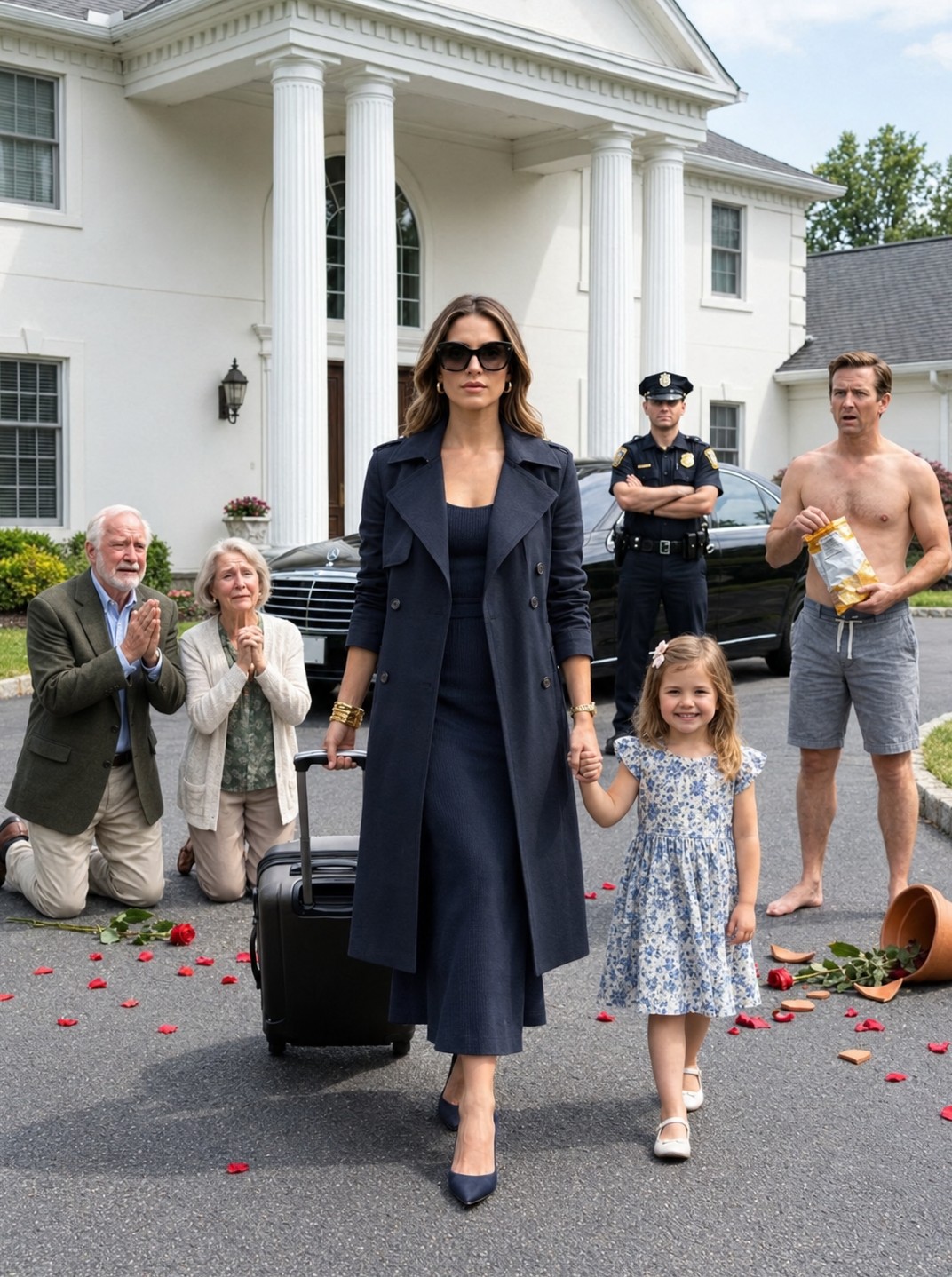
Part 1: The Monthly Sacrifice
I learned the hard way that blood is not always thicker than water.
Sometimes, blood is simply stickier.
Sometimes, it is used to trap you inside a web that someone else has created.
My name is Rebecca Foster. I am thirty-four years old, and for most of a decade, I believed love was something you could trade for belonging.
I truly believed that if I gave enough, sacrificed enough, and kept proving how much I cared, I could finally buy my way into a family that actually felt like home.
I was completely wrong.
For three years, the first day of every month followed the same cold and mechanical ritual.
I would sit at my mahogany kitchen table in my quiet suburban home, open the banking app on my phone, and send exactly three thousand dollars to my mother.
Three thousand dollars.
Every month.
The payment was officially listed as household support. In reality, it had become the price of my place inside the Foster family.
It was the money I paid to keep my mother from crying on the phone.
It was the money I paid so my younger brother would not have to face the humiliation of working a normal forty-hour week.
And, most painfully of all, it was the money I paid because I was terrified of what would happen if I stopped.
It had started immediately after my father’s funeral.
Our small house just outside Detroit, Michigan, still smelled of white lilies and funeral flowers. The graveyard soil was barely settled when the bank notices started arriving in the mailbox.
The mortgage was becoming a serious problem.
My mother, Margaret, had no way to handle it alone.
I still remember her sitting at my kitchen table one rainy afternoon. Her hands trembled as she squeezed a lace handkerchief between her fingers.
“I just don’t want to lose the house, Rebecca,” she sobbed. “Your father’s spirit is woven into those walls. If we lose the house, I feel like I’m losing him all over again.”
My younger brother Dylan was sitting on the oversized velvet sofa.
He was twenty-nine years old, perfectly capable of working, and completely absorbed in his phone. His thumb moved endlessly across the screen as he scrolled through social media.
He said nothing.
He offered no solution.
He offered no money.
He simply waited for someone else to solve the problem.
Eventually, I was the one who broke.
“I’ll help you handle this, Mom,” I said.
At the time, I honestly believed I was offering temporary help.
I had a successful career in cybersecurity consulting. My job was remote, so I could work from almost anywhere as long as I had a secure internet connection.
I was financially stable.
I had savings.
I could afford to help for a few months.
I told myself Mom would eventually get back on her feet.
I told myself Dylan would finish the business certification he was always talking about and start earning his own money.
I told myself the situation would change.
It didn’t.
Months became years.
The temporary bridge I had built became a permanent highway for their expectations.
My help stopped being a favor.
It became an obligation.
Dylan did not become grateful for what I was doing. Instead, he slowly began acting as if my money was something he was entitled to.
He treated my monthly contribution like a natural resource that would always be there.
I should have seen what was happening.
I should have noticed that the phone calls usually came around the end of the month, when the payment was due.
I should have realized that I was no longer being treated like a daughter.
I was being treated like a walking bank account.
Then came the Sunday afternoon when everything finally collapsed.
I had just returned from a grueling ten-day work trip to a conference in Minneapolis.
I was exhausted.
My entire body hurt. I felt like I could sleep for a week and still not recover.
But when I opened the front door, there was no warm welcome.
No meal.
No hug.
Instead, my heavy suitcase was sitting directly in the middle of the hallway.
And Dylan was standing beside it.
His jaw was tight.
His arms were crossed.
He looked at me like he had finally decided to take out the trash.
There was no guilt in his expression.
There was only anger.
And I suddenly knew something was very wrong.
Part 2: The Parasite Protocol
“What is the meaning of this, Dylan?” I asked.
My voice was caught somewhere between confusion and growing fear.
Dylan didn’t move.
He crossed his arms more tightly over his chest and lifted his chin.
“You really can’t keep living here, Rebecca,” he said.
I stared at him.
“Excuse me?”
“You’re thirty-four years old,” he continued. “You’re hiding out in your mother’s house like a coward. It’s pathetic. We need our own space now.”
He paused.
“I deserve my own space.”
I felt as if someone had punched me in the chest.
“Hiding out?” I repeated. “Dylan, I pay the entire mortgage every month.”
My voice grew louder.
“I pay for the groceries you eat. I pay for the internet you’re using right now while you search for opportunities you never actually take.”
Dylan gave a sharp, ugly laugh.
“Yeah, you pay,” he said. “Because you’re a total parasite, Rebecca.”
The word hit harder than I expected.
“You cling to this house and this family because without us, you’d have absolutely no one. You buy your way into our lives because you’re too socially awkward to have a real life of your own.”
He stepped closer.
“You pretend you’re needed because you’re too lonely to admit that nobody actually wants you around.”
My ears started ringing.
I looked past him.
My mother was standing in the kitchen doorway.
Her fingers were nervously twisting the edge of her floral apron.
She wouldn’t look directly at me.
“Mom,” I whispered. “Are you hearing this?”
She finally looked up.
“Rebecca, please just stop,” she said. “Don’t start a huge fight today. Dylan has been under so much pressure lately. He’s worried about his future.”
“He just called me a parasite,” I said. “In the house that I am paying for.”
My mother’s expression hardened.
“You always make things so difficult, Rebecca.”
I stared at her.
She continued.
“You have all this money and all this success. Why do you have to rub it in his face? He just wants to feel like a man in his own home.”
She sighed.
“If you really loved us, you would understand that.”
Something inside me went completely cold.
That was the moment I finally understood the hierarchy inside my family.
Dylan was the golden son.
I was the provider.
He could fail, complain, refuse to work, and insult me.
I was expected to continue paying.
The bank account did not get feelings.
The bank account did not get hurt.
And apparently, the bank account did not get to leave.
“So that’s really it?” I asked.
My voice shook.
“You’re choosing him?”
I looked directly at my mother.
“You’re choosing the person who contributes almost nothing over the daughter who has kept you from losing your home for three years?”
My mother said nothing.
She simply turned around and walked back into the kitchen.
The swinging door clicked shut behind her.
That tiny sound broke something inside me.
I didn’t scream.
I didn’t throw anything.
I didn’t argue with Dylan.
There is a certain kind of silence that comes when your heart finally breaks.
It isn’t loud.
It is empty.
I picked up my suitcase.
My laptop was already inside my backpack.
I walked to the kitchen counter, took out my house keys, and placed them on the granite.
Then I walked out.
I didn’t look back.
As I drove down the long driveway, I glanced toward the living room.
Dylan was watching me through the window.
He was smiling.
He actually looked proud.
He thought he had won.
He thought he had removed the annoying sister while keeping the money.
He had no idea that when you throw out the person paying the bills, the bills eventually come due.
I drove directly toward the airport.
I wasn’t looking for a cheap hotel.
I wasn’t planning to stay away for a week.
I was looking for a one-way flight.
And I wanted to go much farther away than they could imagine.
Part 3: The Lisbon Silence
Two weeks later, everything around me felt different.
The humid summer air of Michigan was gone.
Instead, I could smell the Atlantic Ocean.
Fresh coffee.
Grilled sardines.
Warm stone.
I was in Lisbon, Portugal.
Months before I left, my company had offered me a senior position at its European Union headquarters.
The offer included a large relocation package, a significant raise, and the opportunity to lead a global team.
I had rejected it at the time.
I had told my boss that my family needed me in Michigan.
Now I called him from an airport lounge in New York.
He didn’t ask for details.
He simply said, “The desk is still yours, Rebecca. Just get here as fast as you can.”
That was it.
No interrogation.
No guilt.
Just an opportunity.
I found a small, sun-filled apartment in Lisbon’s historic Alfama district.
The streets were narrow and covered with old cobblestones. Cars could barely pass through some of them. The walls were decorated with beautiful blue tiles that had been there for generations.
For the first time in years, I made a decision without asking whether my family would approve.
I didn’t post about the move on Facebook.
I didn’t update LinkedIn.
I changed my phone number.
Only my company’s HR department and two trusted friends received the new number.
Then I disappeared.
The first few days were strangely peaceful.
I kept waiting for the guilt to arrive.
I expected that familiar feeling in my stomach.
The feeling that told me I was a bad daughter.
But it never came.
Instead, I walked through Praça do Comércio and watched the sunset turn the Tagus River gold.
I felt something I hadn’t felt since childhood.
Light.
Freedom.
Peace.
Of course, my family didn’t notice immediately.
When people become dependent on your support, they don’t always notice your presence.
They notice when your support disappears.
The first of the month arrived.
In Lisbon, it was a beautiful Tuesday morning.
I sat in a small bakery, drinking strong espresso and eating a pastel de nata.
Then I opened my banking app.
For the first time in thirty-six months, there was no three-thousand-dollar transfer scheduled.
I stared at the screen.
My heart started beating faster.
I felt fear.
Then relief.
Then something dangerously close to happiness.
I put my phone away and walked along the river.
The storm finally arrived the next morning.
At exactly 9:00 a.m. Eastern Time, the first messages began appearing on my old American phone.
I had kept my old U.S. SIM card in a spare phone because I wanted to see what would happen.
The notifications came one after another.
Mom:
“Rebecca, the mortgage payment hasn’t cleared. Did you change the password?”
Another message followed.
“Please call me right away. The bank says the money isn’t there.”
Then:
“Dylan says the banking app might be glitching. Fix it soon, honey. The late fee is already $150.”
A glitch.
They really believed the money would continue forever.
They thought the entire system had simply malfunctioned.
By noon, the messages changed.
Dylan wrote:
“Stop being dramatic and childish. We know you’re still mad about the suitcase thing. The house bills don’t care about your petty feelings. Send the money right now.”
I stared at the message.
There was no “Are you okay?”
No “Where are you?”
No apology.
No concern.
Just a demand.
That evening, I called my mother.
She answered on the first ring.
“Rebecca! Thank God! What is going on with the account? The bank is calling, and Dylan is frantic!”
“I’m not in Michigan anymore, Mom.”
There was silence.
“What do you mean?”
“I moved.”
Another silence.
“What do you mean you moved?”
“I relocated to Europe,” I said. “It’s permanent.”
I heard her take a sharp breath.
“You can’t just leave like that! What about the house? What about the mortgage? You know I can’t pay that on my Social Security!”
“I know.”
“And Dylan doesn’t have a job!”
“I know that too.”
I paused.
“But Dylan told me I was a parasite. So I decided to stop clinging to the family.”
“That’s not what he meant!”
“He seemed very clear.”
“He was angry! He was stressed!”
She began crying.
“Rebecca, you’re punishing us over a few words. We’re family. Family doesn’t abandon each other over money.”
“You’re right,” I said quietly.
“Family doesn’t do that.”
I took a breath.
“But you didn’t treat me like family. You treated me like a guaranteed insurance policy.”
She said nothing.
“And insurance policies can be canceled when the premiums become too high.”
“If you don’t send the money, we’re going to lose everything!”
“Then Dylan needs to start applying for jobs.”
“Rebecca!”
“I have to go. My dinner is getting cold.”
I ended the call.
My hands were shaking.
My heart was pounding.
But I didn’t reach for my banking app.
For the first time in my life, I allowed myself to feel the pain without immediately trying to fix it.
I thought that would be the end.
I was wrong.
I had underestimated how deeply their sense of entitlement had grown.
Part 4: The House of Cards
The following month became a painful lesson in what happens when people have been protected from consequences for too long.
I didn’t block my family.
Part of me wanted to see what would happen.
Another part of me needed to watch the situation unfold so I would never be tempted to return to the old arrangement.
I soon discovered that Dylan had more access to my mother’s finances than I had realized.
Years earlier, Mom had added him to her primary bank account so he could help with bills.
When my $3,000 payment didn’t arrive, the mortgage still came due.
The account didn’t have enough money.
The automatic payment pushed it deep into overdraft.
Then the bank fees began.
Dylan tried to cover the electricity bill with a cash advance from a high-interest credit card.
He was trying to stop a flood with a piece of tape.
It didn’t work.
By the third week, my mother’s messages changed.
The anger was gone.
Now she sounded frightened.
“Rebecca, they turned off the water.”
Another message followed.
“Dylan is looking for work, but nobody is calling him back.”
Then:
“Please. Just send $500. Just enough to get the water turned back on.”
I was sitting in a beautiful garden outside Lisbon when I read it.
The hills were green.
Ancient castles rose in the distance.
Jasmine filled the air.
And suddenly I felt terrible.
I pictured my mother sitting inside the house my father had loved.
I pictured the darkness.
The silence.
The empty rooms.
For a moment, I almost opened my banking app.
Then I remembered my suitcase sitting in the hallway.
I remembered Dylan calling me a parasite.
I remembered my mother standing there and refusing to defend me.
And I remembered her telling me that I was the one making things difficult.
I didn’t send the $500.
Instead, I sent her information about a local food bank and the contact details for a social worker who helped seniors find affordable housing.
Dylan responded almost immediately.
“You are a monster.”
Then another message:
“You’re sitting over there in luxury while your mother suffers in the dark. I hope you can live with yourself when she’s out on the street.”
Then:
“You killed this family.”
I read the messages twice.
It was the ultimate reversal of responsibility.
In Dylan’s mind, the person who stopped paying was the villain.
The people who refused to support themselves were the victims.
By the end of the second month, the situation became impossible to ignore.
A “For Sale” sign appeared in front of the Michigan house.
It was no longer about choice.
The family needed to sell before the mortgage problems became even worse.
The house my mother had once called a connection to my father was now being sold because they could no longer afford to keep it.
A few days later, I received an email from Mom.
There was no subject line.
She wrote:
“Rebecca, we’re moving out. Dylan found a room in a shared house near the warehouse district. He’s working night shifts loading trucks for a logistics company now.”
She continued:
“I’m moving into a small studio apartment in a senior complex. It’s tiny and loud. I’ve had to sell most of the furniture.”
Then came the sentence that hurt the most.
“I hope you’re happy with what you’ve done to us.”
I sat alone in my Lisbon apartment that night.
Moonlight stretched across the floor.
And I cried.
Not because I believed I had destroyed them.
I cried because the entire chapter of my life had finally ended.
The Foster house was gone.
The responsibility was finally off my shoulders.
I answered with one sentence:
“I am not happy that you lost the house, Mom, but I am relieved that you finally allowed Dylan to grow up.”
I thought that was the end.
But three months later, my mother asked for a video call.
And that conversation changed everything.
Part 5: The Final Audit
Three months after the house was sold, my mother requested a video call.
I agreed.
But I had two conditions.
Dylan could not be in the room.
And if she asked me for money, I would end the call immediately.
When her face appeared on my laptop screen, I barely recognized her.
She looked older.
Much older.
Her normally styled hair was now thin and gray.
Her small apartment behind her was dim and cluttered.
“You look very well, Rebecca,” she said.
Her voice sounded different.
The sharpness was gone.
There was only exhaustion.
“I am well, Mom,” I said.
I paused.
“Actually, I’m happy.”
She nodded.
“Dylan hates you.”
“I know.”
“He talks about you every day. He says you’re the reason everything fell apart.”
“I know.”
She looked down.
“But I realized something last night.”
She reached for a box beside her.
“I was going through some of your father’s old papers. They were in the closet.”
She took a shaky breath.
“I found the original records for the house.”
She looked back at me.
“I saw how much was left on the mortgage when your father died.”
Then she said something that made my chest tighten.
“I also looked at my bank statements from the last three years.”
She wiped her eyes.
“I never really looked at the numbers before.”
I said nothing.
“I just saw the balance staying the same. I assumed everything was fine.”
Her voice broke.
“I chose to believe it was easy for you.”
She shook her head.
“I told myself you were doing it because you had so much money that it didn’t matter.”
“It mattered,” I said quietly.
“Every dollar mattered.”
She closed her eyes.
“I’m sorry.”
I didn’t answer immediately.
“Every dollar was an hour of my life,” I continued. “An hour I spent working so Mom could keep her house and Dylan could avoid becoming responsible for himself.”
“I know that now.”
She looked directly into the camera.
“Because now that it’s gone, I finally understand what it cost you.”
She wiped another tear from her cheek.
“Dylan didn’t lose the house.”
She paused.
“I didn’t lose the house.”
Her voice became almost a whisper.
“You were the only person who actually gave something up.”
I felt my throat tighten.
“I made you the responsible one because it meant I didn’t have to be responsible myself,” she continued. “I used your love to protect Dylan from the consequences of his failures.”
It was the apology I had waited years to hear.
It didn’t erase what happened.
But it finally acknowledged it.
“Why didn’t you stop him?” I asked.
“Why didn’t you say anything when he put my suitcase in the hallway?”
My mother looked down at her lap.
“Because I thought if you left, the fighting would stop.”
She took a slow breath.
“I thought you would still send the money.”
My heart sank.
“I thought I could have the money without having to deal with the conflict.”
She looked at me.
“I didn’t understand that you were the only thing holding everything together.”
I swallowed.
“I’m sorry it ended this way.”
“Don’t be,” she said.
For the first time during the call, she smiled.
It was small and sad.
“Dylan is working hard now.”
She sighed.
“He’s miserable. He complains every day. But he’s working.”
Then she continued.
“And I’m learning to live on what I actually have.”
She looked around the little apartment.
“It’s not much.”
She smiled again.
“But it’s mine.”
We didn’t talk about money again.
We didn’t talk about me coming back.
Instead, we talked about Lisbon.
She asked about the weather.
I told her about the books she could borrow from the local library, and she told me she had finally started reading again.
For twenty minutes, we weren’t a bank account and a dependent family.
We were simply a mother and daughter.
When the call ended, I closed my laptop and sat quietly for a while.
I felt something I hadn’t felt in years.
Closure.
The financial debt had never really been the important debt.
The emotional debt was the one I had finally stopped carrying.
But when I looked out at the lights of Lisbon, I realized the biggest surprise wasn’t that my family had fallen apart without me.
It was that I had finally discovered who I was without them.
Part 6: The Sovereign Life
A year has passed since I left Michigan.
The woman who used to open her banking app with shaking hands is gone.
In her place is someone who finally understands that boundaries are not walls.
They are gates.
They decide who is allowed to enter your life and how much access that person gets.
I built a life in Portugal that isn’t based on transactions.
I have friends who enjoy my dry sense of humor.
They like my love of local music.
Some of them don’t even know what I earn.
And that feels wonderful.
I am also dating a man named Thomas.
He is a talented architect.
Recently, he took me to dinner for my birthday.
When the check arrived, I automatically reached for my purse.
It was instinct.
Years of being the person who paid for everything had trained my body to react before my brain could think.
Thomas gently placed his hand over mine.
“Rebecca,” he said with a smile, “let me take care of this.”
I looked at him.
“You do enough for everyone else in your life. Let someone else do something for you.”
I almost cried right there at the table.
My mother and I still speak once a week.
Our relationship isn’t perfect.
There are still awkward moments.
Sometimes she hints about how difficult things are financially.
But I don’t feel the old need to rescue her.
I listen.
I offer sympathy.
I offer ideas.
But I don’t send money.
Dylan is still Dylan.
He still lives in the shared house.
He still blames me for the loss of what he calls the family legacy.
I don’t see him.
And I don’t plan to.
Some bridges are better left burned.
Sometimes the light from the fire helps you see the road ahead.
The lesson cost me more than $100,000.
It also cost me three years of my life.
But I would pay that price again to become the woman I am today.
Because I finally understand something.
If your love is only recognized when it comes with money, it isn’t really love.
It’s a subscription.
And the moment you stop making the payments, you discover exactly what people thought you were worth.
I left the country.
They called it abandonment.
I called it survival.
And for the first time in my life, the money I earn supports the person who had always been last in line.
Me.
I am not a parasite.
I was the host.
And I finally became tired of being eaten alive.
Now I wake up every morning in a country I once thought was impossibly far away.
I walk through streets filled with music.
I drink coffee beside the river.
I work hard.
I laugh.
I love.
And I sleep peacefully.
The view from the other side is absolutely breathtaking.
THE END.
