
Part 1:
My mother’s seventy-eighth birthday wish was simple. She did not want a party, an expensive gift, or even a large family gathering. She wanted one quiet dinner at an Italian bistro her friends from church had been talking about for months.
They had told her about the homemade gnocchi, the warm bread, the old-fashioned atmosphere, and the family recipes that supposedly tasted like something straight out of Italy.
For my mother, that was enough.
But when we arrived, the hostess took one look at my mother’s cane and worn handbag and decided we did not belong there. She refused to seat us and then called my mother cheap in front of a crowded dining room.
Ten minutes later, a crash came from the kitchen.
An elderly man in a white chef’s jacket came rushing through the doors with tears in his eyes.
The moment he saw my mother, everything changed.
I drove through downtown Minneapolis with my mother humming softly in the passenger seat. Seventy-eight years had done nothing to dull her excitement over life’s small pleasures, and tonight, that small pleasure was a single dinner.
She had chosen her favorite dress for the occasion. It was a vintage navy dress covered in tiny white flowers, the same dress she had owned since I was a little girl.
I glanced over at her while we waited at a red light.
“You look beautiful tonight, Mom.”
She waved her hand at me with modest embarrassment.
“Oh, stop it now. I look like an old woman trying to remember what being young feels like.”
I smiled as I looked at her reflection in the window.
“You look like the prettiest woman I will see all night.”
She laughed softly and shook her head.
“Thank you for doing this for me, my troublesome little daughter.”
“That old nickname never gets old, does it?” I asked with a chuckle.
“It fits you just as well now as it did when you were four years old,” she replied with a gentle smile.
We parked about half a block from the bistro on a quiet street in Minneapolis.
I walked around to her side of the car, opened the door, and offered her my arm. She gripped her wooden cane with one hand and wrapped her other arm around my elbow.
Every step was slower than it used to be, but her eyes were filled with determination.
“The ladies at church will not stop talking about this place,” my mother said as we carefully made our way along the pavement. “Sister Beatrice told me the gnocchi was so tender it made her cry.”
“Then we will definitely get you the gnocchi tonight,” I promised.
Mom looked up at me with a soft smile.
“Only if it is not too expensive, my sweet girl.”
“It is your seventy-eighth birthday, so nothing is too expensive tonight,” I reassured her.
She squeezed my arm affectionately.
“You sound just like your father whenever you say things like that.”
I did not answer immediately.
My father had been gone for nineteen years, and Mom rarely mentioned him without her voice becoming softer, as if she were suddenly speaking to someone who was no longer in the room.
Tonight, however, there was a deep sense of peace in her voice, so I let the silence remain between us for a quiet moment as we walked.
“Tell me again about your home back in Italy,” I said softly. “Tell me about the village and the hills.”
“Ah, you have heard those old stories a hundred times already,” she replied with a quiet chuckle.
“I want to hear them a hundred and one times.”
Her eyes developed that familiar wet shine whenever she talked about her hometown.
“There was a little square with a stone fountain right in the center,” she began. “The local bakery was on the corner, where I bought fresh bread every morning. And the neighborhood boys would play soccer in the street until sunset.”
“It sounds absolutely perfect,” I whispered.
“It really was,” she murmured. “Until it was not anymore. But that is a long story for another night.”
I did not press her for details.
There were parts of my mother’s past she had folded away and tucked deep inside herself long before I was born. I had learned to respect the corners of her heart she preferred not to open.
That night, I only wanted her to be happy.
I had no idea that the past she rarely talked about was waiting for her just a few minutes away.
Part 2: The Rejection
We finally reached the bistro, where heavy wooden doors stood beneath a glowing amber light.
Through the frosted glass windows, I could see the soft, inviting glow of the main dining room. As another couple opened the entrance, the rich smell of roasted garlic, melted butter, and slow-simmered tomato sauce drifted outside into the cool evening air.
Mom stopped in her tracks and inhaled deeply through her nose.
“Oh, my goodness,” she whispered in awe. “That smells just like home.”
“Then let us go inside and enjoy home for a couple of hours,” I said as I pulled the door open for her.
She stepped inside, her cane tapping softly against the polished hardwood floor.
The dining room was beautiful.
Crisp white tablecloths covered the tables. Low golden lamps cast a warm glow over the room. Candles flickered beside fine china, and the quiet clink of silverware filled the air.
Somewhere toward the back corner, a pianist was playing a slow, peaceful melody.
For a moment, my mother simply stood there.
She looked around the room, breathing in the familiar smells as though she had been transported thousands of miles away.
“Mom, the hostess stand is right over there,” I gently reminded her.
She nodded and squeezed my fingers tightly.
We walked toward the polished mahogany front desk.
But the warmth I had felt upon entering the restaurant disappeared almost instantly.
A young hostess in a sleek black dress stood behind the desk. Her name tag read Alyssa.
She looked up from the reservation system and stared at us.
It was not a casual glance.
Her eyes traveled slowly from my mother’s orthopedic shoes to her worn wooden cane. Then they settled on the faded leather handbag my mother held tightly against her chest.
When Alyssa finally spoke, she gave us an empty, mechanical smile.
“I am so sorry, but we are completely booked for the entire evening.”
I glanced over her shoulder.
Several unoccupied tables were clearly visible from where I stood.
“There are at least seven open tables right over there,” I said. “I can clearly see them.”
Alyssa’s smile tightened into a thin line.
She leaned forward slightly and lowered her voice, pretending to be helpful while making it clear that she was judging us.
“Ma’am, our minimum spend per guest is quite high here.”
Then she looked directly at my mother.
“I really do not think this establishment is the right fit for the two of you.”
I waited for her to explain.
Instead, she dropped all pretense.
“You look so cheap.”
The words seemed to freeze the entire room.
My mother’s hand went limp inside mine.
When I looked down, I saw that her shoulders were trembling.
This was my mother.
A woman who had carried heavy grocery bags up four flights of stairs well into her seventies.
A woman who had never raised her voice at a stranger.
A woman who had spent her entire life giving everything she had to other people.
And now she was standing in a beautiful restaurant on her seventy-eighth birthday, being humiliated because someone had decided that her old shoes and worn handbag made her less worthy.
She lowered her head toward the floor.
“Sweetheart, please,” she whispered. “Let us just leave. I do not want to cause a scene.”
I stared at her in disbelief.
“Mom, no. We made a reservation, and we have every right to be here.”
“It does not matter,” she murmured. “It is only a dinner. We can go back home, and I will cook something for us.”
Something inside me snapped.
My mother was apologizing for existing in a place where she had every right to be.
I turned back toward Alyssa and forced myself to keep my voice calm.
“We made a reservation three weeks ago under the name Maria. Could you please check the computer?”
Alyssa did not even bother looking at the screen.
“I am quite sure there has been a mistake on your end.”
“There is no mistake,” I insisted. “Please just look at your screen.”
“I do not need to look,” Alyssa replied, her tone becoming harder. “I am telling you that the table is not available.”
I could feel my anger rising.
But then I looked at my mother.
She was trying not to cry.
And suddenly, I realized this was not just about a restaurant table anymore.
Someone had decided that my mother’s appearance told them everything they needed to know about her.
They had no idea who she was.
They had no idea what she had survived.
And they certainly had no idea what was waiting for her in that kitchen.
Part 3: The Confrontation
A couple standing behind us shifted uncomfortably on their feet.
A man in a tailored suit suddenly became very interested in the wine list on the wall. A woman nearby glanced at my mother and then quickly looked away.
That look hurt almost as much as Alyssa’s words.
It was filled with pity and the unspoken assumption that we did not belong there.
“Alyssa, please,” I said again, suppressing my rising anger. “It is her seventy-eighth birthday. We came here because she misses her home in Italy. Please just find us any table, even a small one by the kitchen door.”
For a brief second, something flickered across Alyssa’s face.
But it was not compassion.
“Look, I am trying to be nice about this,” she said with a condescending tilt of her head. “Honestly, there are some lovely family diners a few blocks away where you would probably be much more comfortable. And the portions are much larger too.”
My mother flinched as if she had been struck.
“Please, my sweet girl,” she whispered, tugging gently at my sleeve. “Let us go.”
I looked down at her fragile hands.
Those hands had raised three children.
They had stitched our school clothes by hand.
They had prepared meals even when there was barely enough food for herself.
My mother had skipped her own meals so that her children could have second helpings.
She had spent decades putting everyone else first.
And now, on her birthday, she was begging me to let a rude stranger humiliate her simply because she wanted to avoid making a scene.
“Okay, Mom,” I whispered.
I bent down and kissed her forehead.
“Okay. We will go.”
I turned back toward Alyssa.
I kept my voice low so my mother would not hear the anger trembling inside me.
“I genuinely hope someone treats your grandmother with this exact same cruelty someday,” I said. “And I hope you remember this night when it happens.”
Alyssa gave a sharp, mocking laugh.
“My grandmother is not some beggar who would ever end up in a situation like this.”
My jaw tightened.
“Get your manager right now.”
“The owner is busy in the kitchen,” Alyssa replied, crossing her arms defensively. “And I am the floor manager on duty tonight. So unless you have a valid reservation, we are completely done here.”
“You do not get to speak to a seventy-eight-year-old woman as if she is worthless,” I said through clenched teeth.
“I did not say she was worthless,” Alyssa replied.
Then she looked directly at my mother.
“I simply said this place is not meant for her.”
My mother pulled gently at my arm.
Her eyes were filling with tears.
“Please,” she whispered. “I do not want to remember my birthday like this.”
Seeing her tear-stained face brought a sharp clarity to my mind.
Every second I spent arguing with Alyssa was another second my mother had to endure this humiliation.
So I stopped.
“Okay, Mama,” I whispered gently, wrapping my arm around her waist. “Let us go home.”
Alyssa gave a small, triumphant nod, as if she had just won some great prize.
“Have a lovely evening,” she called out sweetly.
We took three slow steps toward the heavy wooden exit doors.
Then—
CRASH!
A violent noise exploded behind us.
It was not the sound of a dropped glass.
It was the massive impact of metal and ceramic shattering against the floor.
The entire dining room fell silent.
Steam rose through the small kitchen service window.
Through the glass, I saw several line cooks backing away in shock.
Standing in the center of the kitchen was an elderly chef in a spotless white jacket.
His hand remained suspended in midair where he had dropped a heavy tray.
His face was completely frozen.
He was not looking at his staff.
He was not looking at the broken dishes.
He was staring directly at my mother.
His mouth hung slightly open, as though a long-lost word had suddenly returned to him.
“Sir?” one of the line cooks asked cautiously. “Sir, are you all right?”
The old chef did not answer.
He turned abruptly and disappeared from the service window.
I looked at my mother.
She was staring back at the kitchen, confused.
Neither of us understood what had just happened.
But we were about to.
Part 4: The Reunion
Alyssa rolled her eyes in annoyance.
She muttered something about clumsy kitchen workers before straightening the menus on her desk.
Then she looked at us again.
“Ma’am, the exit is that way.”
My mother stood frozen.
Her fingers were gripping her cane so tightly that her knuckles had turned white.
“Something is wrong,” she whispered.
Her eyes remained fixed on the kitchen.
“That man looked at me like…”
She stopped.
Before she could finish the sentence, the heavy double doors of the kitchen burst open.
The elderly chef rushed into the dining room.
For a man his age, he was moving incredibly fast.
His white jacket billowed behind him as he hurried between the tables. He nearly knocked over a busser carrying a tray of water glasses, but he did not even seem to notice.
His entire attention was focused on my mother.
Alyssa stepped forward.
“Chef, everything is under control here. These people were just leaving.”
The chef pushed past her as if she were invisible.
He stopped only a few feet from my mother.
His eyes were filled with tears.
His hands trembled violently at his sides.
For several seconds, he simply stared at her.
Then he whispered one word.
“Maria?”
My mother’s knees buckled.
I quickly grabbed her elbow and held her upright.
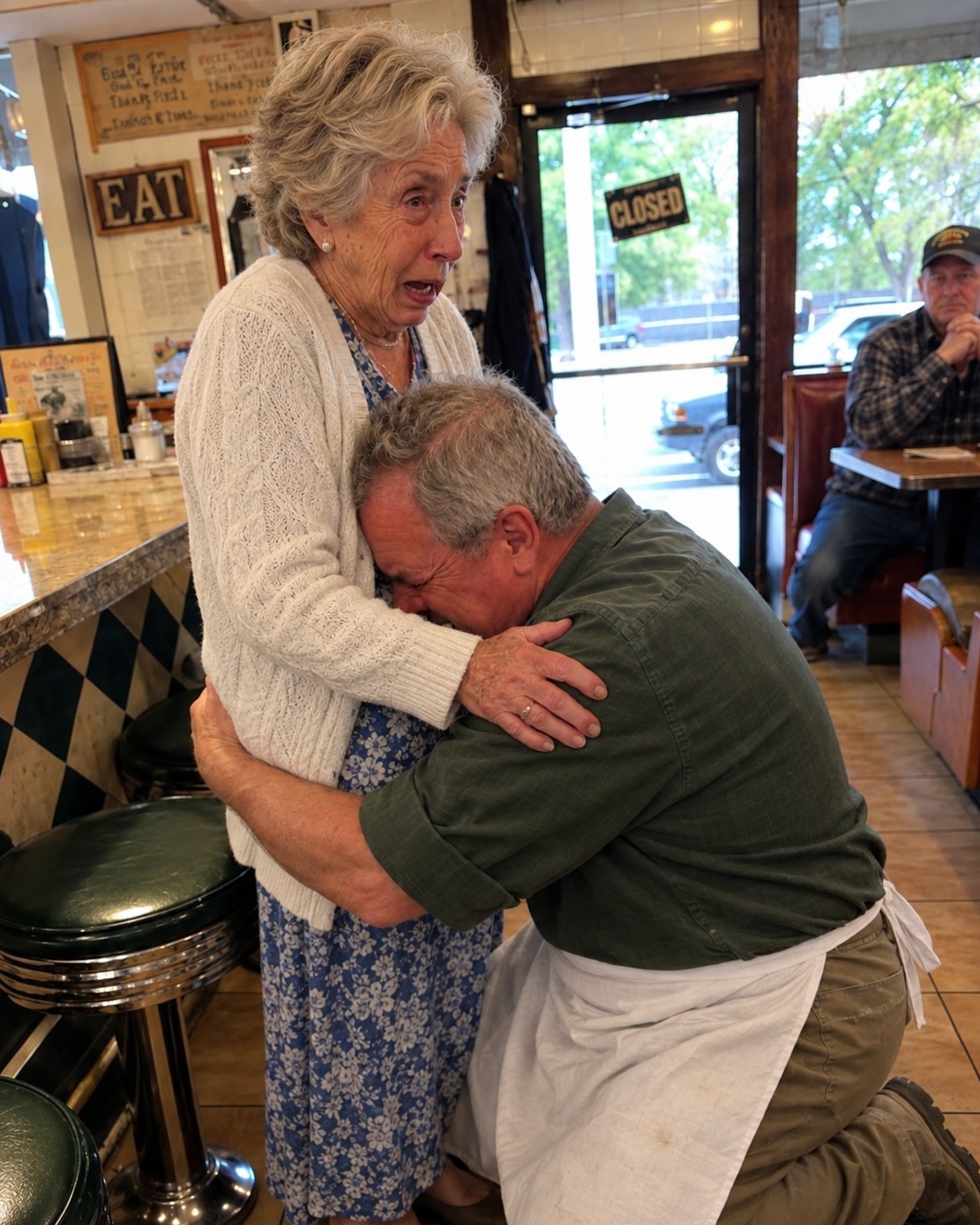
The old chef slowly dropped to his knees on the hardwood floor directly in front of her.
“Cara mia,” he choked out.
Tears spilled down his weathered cheeks.
“I have searched for you for so many years.”
My mother’s wooden cane slipped from her hand and clattered loudly against the floor.
Neither of them noticed.
She stared down at him with wide, disbelieving eyes.
“Giovanni?” she breathed.
Her voice was barely more than a whisper.
“Is it truly you?”
Giovanni reached up and took both of her hands into his trembling palms.
“It is me, Maria,” he said. “I came to America searching for you. I built this restaurant hoping and praying that one day you might walk through those doors.”
Tears streamed down my mother’s face.
And in that instant, something changed in her expression.
The weight of seventy-eight years seemed to disappear.
For the first time that evening, she did not look like an elderly woman struggling with a cane.
She looked like the young woman from the old photographs I had seen as a child.
The woman she had been before life had taken so many things from her.
“I thought you had forgotten about me after all this time,” she murmured.
Giovanni shook his head vigorously.
“Never, my love. Not for a single day of my life.”
The entire dining room had gone completely silent.
Every guest and every server was watching them.
Even the pianist had stopped playing.
Alyssa stood near the hostess podium, her face completely pale as she gripped the wooden edge for support.
She had no idea what had just happened.
None of us did.
Giovanni slowly rose to his feet while keeping a firm hold on my mother’s hand.
Then he turned toward Alyssa.
The warmth in his face disappeared.
His expression became stern.
“I heard every single word you said from the kitchen,” Giovanni said.
His voice carried clearly across the silent dining room.
“You told my first love, the woman I searched decades for, that she looked cheap.”
Alyssa swallowed hard.
“Sir, I did not know who she was.”
Giovanni stared at her.
“You did not need to know who she was.”
His voice was calm, but there was no softness in it.
“You are required to show kindness and respect to every human being who enters this building.”
Alyssa opened her mouth, but Giovanni continued.
He walked over to the hostess stand and pointed at the reservation monitor.
“Is their reservation listed right there?”
Alyssa looked at the screen.
She bit her lip nervously.
Then she nodded.
“Yes.”
Giovanni’s eyes hardened.
“Then you knew they had a reservation.”
Alyssa lowered her gaze.
“I…”
“Pack your personal belongings immediately,” Giovanni said.
She looked up in shock.
“Chef, please—”
“You are fired,” he said firmly. “And you will never work in my restaurant again.”
Alyssa stood completely still.
She seemed to be waiting for him to change his mind.
He did not.
Slowly, she gathered her purse and personal belongings.
Without another word, she walked toward the front doors.
This time, nobody stopped her.
And she did not look back.
Giovanni turned toward the remaining restaurant staff.
“No guest will ever be mistreated in this establishment again. Is that understood?”
The staff members nodded.
“Yes, Chef,” several of them answered.
A moment later, a guest at a nearby table began to applaud.
Then another person joined.
Within seconds, the entire dining room erupted into warm applause.
My mother looked around in complete disbelief.
The woman who had arrived feeling ashamed was now surrounded by strangers standing and applauding her.
Giovanni turned back toward her.
Tears still glistened in his eyes.
He offered her his arm.
“Cara mia,” he said softly, “tonight you will sit at the finest table in my house, and I will personally cook every dish for you.”
He guided us toward a beautiful round table in the center of the dining room.
My mother sat down slowly.
I took the chair beside her.
Under the table, she reached for my hand.
Her fingers were trembling.
But this time, they were trembling with joy.
Tears rolled down her cheeks as she leaned toward me.
“I told you, my sweet daughter,” she whispered. “I just wanted to feel at home again.”
I looked around the room.
The candles were glowing.
The pianist had begun playing again.
The smell of garlic, butter, tomatoes, and fresh bread filled the air.
And across from us sat the man who had spent decades waiting and hoping that the woman he had loved would somehow walk through his doors.
My mother had come to the bistro wanting nothing more than a simple birthday dinner.
Instead, she had found a priceless piece of her past.
She had found a person who had never forgotten her.
And, after nearly a lifetime apart, she had finally found her way home.
THE END.
