
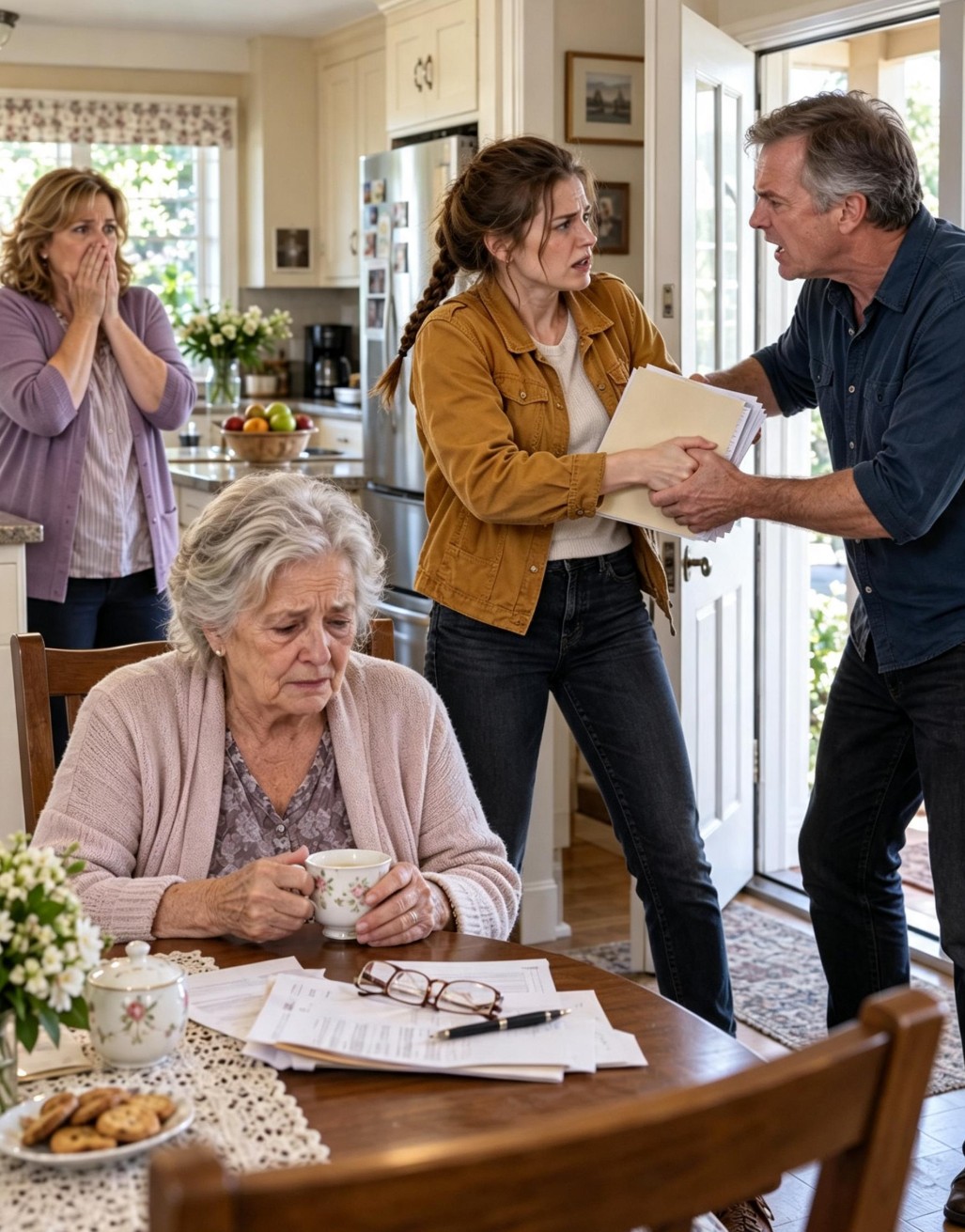
Part 1: The Foundation of Wooden Beams and Sunlight
Patrick built our house in 1974 with his own hands and the help of two close friends. He paid those friends with cold beer, weekend dinners, and the special satisfaction that comes from men who have worked together to create something real.
He was thirty-two that year, and we had already been married for seven years.
Our son Luke was five years old, and that entire summer he ran around the unfinished wooden frame, pretending the exposed floor joists were bridges crossing dangerous rivers.
Before we built the house, we had lived in a rental. It was comfortable enough, but it was never ours. That simple fact had been weighing on both of us for years.
Patrick handled burdens the same way he handled almost everything else in life.
He did something practical about them.
He had saved every spare dollar for five long years. He designed the house himself. He was not an architect, and he never pretended to be one, but he understood raw materials. More importantly, he had been imagining our home for so long that the picture in his head had become almost as real as the lumber stacked outside.
Three bedrooms were included in his plans.
The kitchen faced east because one morning, years earlier, I had casually told him that morning sunlight in a kitchen was the exact thing that made a house feel like a home.
Patrick never forgot that.
He also built a back porch overlooking the wide green yard. He made it large enough for two people to sit comfortably side by side.
That was exactly what we did for the next forty-eight years.
We sat together on that porch through rain, snow, hot summers, cold autumn evenings, and quiet spring mornings. We watched Luke grow up in that yard. We watched the trees become taller, the grass change with the seasons, and our own lives move forward from that particular view.
There was something comforting about sitting on that porch with Patrick.
We had built something together.
We could see it.
And we knew exactly what it had cost us.
Patrick died two years ago on a crisp November morning.
He suffered a sudden stroke on a Monday while standing in the kitchen beneath the same east-facing window he had positioned so carefully all those years before.
By the time the ambulance reached our driveway, he was already gone.
There had been no warning.
No final conversation.
No chance for me to argue with death or beg it to give me more time.
Patrick was eighty-one years old.
He had spent forty-eight of those years living in the house he built.
After his death, I discovered that grief was not always loud. Sometimes it was simply waking up and expecting to hear another person breathing beside you, only to find an empty space.
Patrick had maintained our house with the same quiet attention he had given everything else in his life.
He painted the walls himself.
He replaced the roof when it needed replacing.
He changed the porch boards one at a time whenever they began to rot.
Because of that, the porch was both original and renewed. It had changed slowly over the decades without ever losing what it had been.
His funeral was held on a damp Thursday afternoon.
Three days later, on Sunday morning, Luke and his wife Brenda arrived with a massive moving truck parked directly in front of my garage.
My name is Margaret.
I was eighty-one years old.
I had lived in this house since I was thirty-three.
And I am going to tell you what happened to this place, to me, and to the family Patrick and I believed we had built over a lifetime.
Luke had been living four hours away in a neighboring town.
He had married Brenda eleven years earlier, shortly after his first marriage had fallen apart.
Brenda was a woman with very specific qualities.
Her strongest quality was her ability to examine every situation in terms of what it could offer her.
She could walk into a room and immediately calculate its value.
She looked at our family the same way a developer looks at an empty piece of land.
She saw weaknesses.
She saw opportunities.
And, in my case, she saw a house.
Luke had slowly learned to look at the world through Brenda’s eyes.
That Sunday morning, he walked into my kitchen and placed his keys on the counter.
“You shouldn’t be living alone here, Mom,” Luke said, looking around the room.
“We’re going to stay for a while and help you get settled,” he added as he opened my refrigerator.
“It’s simply the right thing to do for family,” he insisted when I stared at him without answering.
“You really don’t need to do that,” I replied, placing my teacup firmly on its saucer.
“We want to do this, Mom, so please don’t argue,” Luke said with a forced smile.
Then Brenda came into the kitchen carrying two large suitcases.
“We’ve already arranged everything with my employer,” she announced. “I can work remotely, so there’s really no problem.”
They moved into my house that very afternoon.
At first, I told myself it was temporary.
I told myself Luke was grieving.
I told myself Brenda was simply trying to be helpful.
I told myself many things.
But within a short time, I realized that they had not come to help me adjust to life without Patrick.
They had come to take control of the house.
Brenda began with my bedroom.
She did not openly demand that I leave.
She did something much more subtle.
She slowly began replacing my belongings with hers.
My dresses were moved into the dark hallway closet.
Her expensive cosmetics appeared on my bathroom counter.
Her clothes filled my closet.
Her shoes appeared beneath my bed.
She worked gradually, quietly, and confidently, as if she understood that possession was created through accumulation.
One evening, while I was making soup in the kitchen, Luke came to me.
“You’ll actually be much more comfortable in the sewing room, Mom,” he said without looking me in the eye.
“It stays much warmer in there during the winter.”
It did not.
The sewing room was smaller, colder, and barely large enough for the folding army bed they had placed inside.
But I was eighty-one years old.
And since Patrick’s death, I had already spent many nights awake at three in the morning.
It was not ordinary insomnia.
It was the strange, heavy wakefulness of an old woman whose bed suddenly contained the wrong number of people.
For forty-eight years, I had slept beside my husband.
Now there was only empty space.
I did not have the physical energy to fight over a bedroom.
So I moved into the sewing room.
I folded my clothes.
I placed my few belongings neatly in the corner.
And I watched.
Because I had always been good at watching.
Patrick used to laugh when we were with friends.
“Margaret sees everything,” he would tell them. “She just doesn’t always speak right away.”
He had been right.
I saw everything.
And I remembered everything.
Part 2: Whispers in the Dark Kitchen
By Thanksgiving, Brenda had started calling the property “our house.”
She never called it my house anymore.
She never said “Margaret’s house.”
It was always our house.
She used the words casually, almost innocently, but I understood what she was doing.
Ownership begins in language long before it appears on paper.
“Our house really needs a new furnace filter before December,” Brenda said one evening at dinner.
A few days later she stood near the west windows and announced, “Our house is getting terribly drafty on this side. These old window seals need to be replaced.”
Another afternoon, while wiping down my wooden kitchen table, she said, “I’ve been thinking about what structural changes we should make to our kitchen.”
I said nothing.
At eighty-one, I had learned that not every battle deserved my energy.
Choosing your battles is not weakness.
Sometimes it is simply energy management.
And my energy was limited.
I needed to save it for something important.
By January, Luke began taking three hundred dollars directly from my monthly pension.
“Everybody needs to pay their fair share of the utilities, Mom,” he said.
He stood beside my kitchen table with his hand extended.
Outside the window sat his shiny new pickup truck.
It was only seventeen months old, and he had complained several times about its expensive monthly payments.
I looked at his open hand.
Then I handed him the money.
“Here you are, Luke,” I said quietly.
I gave it to him because I was eighty-one.
But there was another reason.
I wanted to understand exactly what they were doing before I acted.
I was watching.
I was waiting.
And I was keeping track.
Patrick had always said I noticed details other people ignored.
He had been right.
Eight months after Patrick’s funeral, I began to understand exactly what Luke and Brenda intended to do.
One night in March, I woke around two in the morning.
My mouth was dry, so I got out of bed and went downstairs for a glass of cold water.
The hallway was completely dark.
But a bright yellow line of kitchen light stretched across the hardwood floor.
Luke was inside the kitchen, talking on his cell phone.
He did not hear me.
Patrick had built those stairs himself and knew exactly which boards creaked and which remained silent.
After forty-eight years, I knew the safe path too.
I stood beneath the dark hallway archway.
Then I heard Luke’s voice.
“She’s eighty-one years old now, man,” he said coldly.
I froze.
“The house is easily worth four hundred thousand in this market. We can list it the exact day she’s out of here.”
There was a pause.
Then Luke laughed.
That laugh hurt more than the words.
It was not a nervous laugh.
It was not an uncomfortable laugh.
It was the laugh of a man who had become completely comfortable discussing something cruel.
I stood there in the darkness and listened.
Then I quietly turned around.
I walked back to the sewing room.
I lay down on the thin mattress and stared at the ceiling.
Patrick had installed those ceiling boards himself during the hot summer of 1974.
Back then, the roof was not even finished.
He had worked beneath the scorching sun while I brought him cold mason jars filled with ice water.
One afternoon, he had taken the jar from my hand, drunk nearly all of it in one long swallow, and looked up at the wooden frame.
“This is going to be our house, Margaret,” he had whispered.
“Ours forever.”
When Patrick said “ours,” he had always meant mine too.
That was who he was.
He understood that the home he was building was not simply an accomplishment for himself.
It was a place of safety for the woman he loved.
By the time the first light of morning entered through the sewing room window, I knew what I was going to do.
I did not need to scream.
I did not need to confront Luke.
I simply needed to act.
Luke and Brenda had very predictable habits.
Monday through Friday, Luke left for work at seven in the morning.
Brenda drove to her sister’s house in a neighboring town every Tuesday.
Her sister lived forty minutes away, and Brenda usually stayed there until mid-afternoon.
The following Tuesday, I waited.
Luke left at seven.
Brenda drove away at exactly nine.
I watched her car disappear down the road.
Then I walked into the kitchen.
I opened the pantry.
On the shelf sat my old flour tin.
I had used that tin for forty-eight years.
Brenda had never touched it because she did not cook in my kitchen.
Beneath the paper sack of flour was Patrick’s old brown leather folder.
That folder had held important documents for decades.
Patrick had been organized about everything, and the condition of that folder proved it.
I pulled it out.
Inside was the original house deed.
I also took my checkbook from my apron pocket.
Then I picked up the kitchen telephone and called Natalie.
Part 3: The Secret Meeting on Elmwood Street
Natalie was my granddaughter.
She was Luke’s daughter from his first marriage.
Her mother, Hannah, had divorced Luke when Natalie was nine.
Hannah had been a good, hardworking woman. She had spent years giving everything she had to the marriage until she finally understood that giving more would not change anything.
Luke and Hannah divorced.
Two years later, Luke married Brenda.
Brenda never wanted Natalie around.
She never said it directly.
She did not have to.
The cold looks, the uncomfortable silences, and the constant suggestion that Natalie was inconvenient told the child everything she needed to know.
Natalie was intelligent.
She noticed.
And she remembered.
Even after Luke stopped making her feel welcome, Natalie continued sending me handwritten birthday cards every year.
She never forgot my birthday.
She never forgot Christmas.
She never forgot me.
Two years earlier, when Patrick died, Natalie came to the funeral.
Luke had told her she was not welcome near the main family.
So Natalie sat alone in the back row.
When I saw her there, I walked directly past Luke and sat beside her.
If Natalie was not considered family, then I had no interest in pretending the people sitting in the front were more important than she was.
That memory stayed with me.
So when I called Natalie that Tuesday morning, she answered almost immediately.
“Grandma Margaret?” she asked, surprised.
“Natalie, my dear, I need your help today,” I said.
“Tell me what’s wrong, Grandma,” she replied instantly.
“I need to find someone who is willing to buy a house.”
There was silence.
Then Natalie asked, “Grandma, are you all right?”
“I am completely fine in my mind,” I said. “But I need to explain something to you.”
I told her everything.
I told her about Luke and Brenda moving into the house after Patrick’s funeral.
I told her about the master bedroom.
I told her about the sewing room.
I told her about Brenda calling the property “our house.”
I told her about Luke taking three hundred dollars from my pension every month.
I told her about the new truck.
And finally, I told her about the phone call I had overheard in the dark kitchen.
I told her exactly what Luke had said.
I told her about his laugh.
Natalie did not interrupt me once.
When I finished, she was silent for several seconds.
“How much are they planning to sell it for?” she finally asked.
“The current market value is about four hundred thousand dollars,” I said. “A trusted attorney confirmed that for me.”
Then I took a breath.
“I want to sell the house to you for two hundred thousand dollars.”
“Grandma, that’s…” Natalie gasped.
“I want to sell it directly to you for two hundred thousand,” I repeated.
“But why me?”
“Because I know you,” I said. “You have been saving your money for years. You don’t waste it. You work hard. And most importantly, you have never forgotten me.”
“How do you even know how much I have saved?” she asked softly.
“Because you are the only person in this family who has remembered my birthday for thirty-two years,” I told her. “And because I have been paying attention to your life.”
Natalie became quiet again.
Then I heard her quietly crying.
“Yes,” she whispered. “Yes, Grandma. Of course I will.”
“Are you absolutely sure?” she asked after taking a breath.
“I have never been more certain of anything in my life since the day I decided to marry your grandfather.”
“When do we do this?” she asked.
“Today.”
I told her I was going to take a taxi downtown.
“I have the deed and my checkbook ready,” I said. “Meet me at the lawyer’s office.”
“Which lawyer?”
“Martin Clarke. His office is on Elmwood Street.”
Martin was a respected attorney in his late fifties. A woman from my church had recommended him to me. She told me he was honest, efficient, and, most importantly, that he treated elderly clients with respect.
When I arrived, Martin examined the original deed carefully.
Then he looked at me over his reading glasses.
“You are telling me you want to sell this property for fifty percent of its current market value?” he asked.
“Yes.”
“And you want to sell it directly to your granddaughter?”
“Yes. To Natalie.”
“And you want a legal life lease attached to the sale?”
“Yes.”
I sat up straight.
“I want the legal right to live in my home until the day I die. I want to pay one dollar per year in rent.”
Martin nodded slowly.
Then he turned toward Natalie.
“Miss Clarke, do you fully understand what you are agreeing to?”
“Yes, Mr. Clarke,” Natalie replied.
“You are purchasing a valuable property significantly below market value,” Martin explained. “But your grandmother will retain a binding life estate allowing her to live there for the rest of her natural life.”
“I understand.”
“Once these documents are executed and recorded, this will not be something you can simply reverse,” Martin warned. “This is a serious financial commitment.”
Natalie looked directly at him.
“I know what I am doing,” she said. “My grandfather built that house with his own hands. My grandmother has lived there for forty-eight years. I know exactly what I am doing today.”
Martin nodded.
“Very well.”
He began preparing the documents.
It took nearly two hours to draft, review, and verify everything.
The life lease was the most important part.
The documents stated clearly that I retained the absolute right to live in the property for the rest of my natural life.
I could not be evicted.
I could not be forced to leave.
The new owner could not require me to vacate.
The property would pass fully to Natalie only after my death.
The annual rent was one dollar.
We both signed.
The documents were notarized and prepared for recording with the county.
The purchase price was paid with Natalie’s two-hundred-thousand-dollar check.
Once the transaction was completed, Natalie stood up and wrapped her arms around me.
She held me tightly.
Martin looked down at his desk.
He had probably handled hundreds of property transactions, but very few had ended with that kind of emotion.
When Natalie finally stepped back, tears were running down her cheeks.
“Grandma, I need to ask you something,” she whispered.
“Ask me anything.”
“How are you going to deal with Dad and Brenda when they discover what we did?”
“They are not going to find out until I decide they should.”
“When will that be?”
“When the time is right.”
“Is that enough detail to make you feel safe?”
“That is exactly as much detail as I need.”
Natalie studied my face.
Then she nodded.
“All right,” she said. “Let me drive you home.”
Part 4: The Specter of the Realtor
Natalie drove me back to the house.
She dropped me off at the end of the driveway so Luke and Brenda would not see us together.
When I walked inside, Brenda was sitting in the kitchen scrolling through her phone.
“Where have you been all morning?” she asked without looking up.
“I was at a church luncheon with some friends,” I lied smoothly.
“Well, nobody misses you around here anyway,” Brenda scoffed.
I walked calmly into the pantry.
I opened the flour tin.
Inside, I placed the official recorded copy of the new deed.
Then I closed the lid.
For the next eight months, I watched.
I watched Brenda look at paint samples.
“Future buyers will want something light and neutral in the hallway,” she said one afternoon.
Another day, she held up two paint cards.
“I wonder what potential buyers will think about this old hardwood floor.”
I sat at the kitchen table drinking tea.
I said nothing.
A few weeks later, Luke invited a real estate agent named Chuck into my living room.
Chuck was tall, fast-talking, and carried himself like a man who had already spent the commission in his head.
He walked through every room while Luke followed behind him.
“Notice how the kitchen faces due east,” Luke said proudly.
“It gives you incredible morning light.”
He did not mention who had designed the kitchen.
He did not mention Patrick.
He did not mention the foundation.
He did not mention the window frame Patrick had built himself.
He simply treated the morning light as a selling feature.
“Good morning light is always a great selling point,” Chuck agreed.
I quietly poured coffee into two mugs.
I handed them to the men.
Chuck took his mug and looked around.
“The old lady stays with the property for now, obviously,” he said with a chuckle. “But not for long.”
Luke laughed.
I refilled their cups.
“Here is your coffee,” I said politely.
Neither man understood what had just happened.
By September, Brenda had brought a professional painter into the living room.
“We’re thinking about something warm but neutral,” she explained. “We want new buyers to feel like they can put their own stamp on the place.”
The painter examined the walls.
“These are in excellent condition,” he said.
Then he looked at me.
“This house has good solid bones.”
“Yes, it does,” I replied.
Brenda interrupted.
“We’ll contact you next week about the pricing.”
I took another sip of tea.
I said nothing.
By late October, a glossy brochure from a local senior living facility appeared in the mail.
It advertised a full-care facility forty minutes outside town.
The rooms looked sterile.
The prices were enormous.
Luke had requested the brochure.
One evening, he deliberately left it in the middle of the kitchen table.
I picked it up.
I looked at the photographs.
Then I placed it back down.
I said nothing.
Then came the Friday morning in early November.
I walked out of the sewing room.
My large blue suitcase was sitting beside the front door.
On top of it was an official nursing-home intake form.
A specific room and bed number had been circled in bright red ink.
They had already decided where I was going to sleep.
I stood there for a long moment.
Then Luke walked into the kitchen.
He pulled out a chair and sat down.
He slid a property transfer document across the table toward me.
A black pen rested beside it.
“Sign the house over to us today, Mom,” he said. “And prepare to leave by next Friday.”
I folded my hands in my lap.
“Before I do anything,” I said quietly, “you should probably ask the man who actually owns this house.”
Luke laughed.
“The only man who ever owned this house was buried six feet underground two years ago.”
Brenda slammed her coffee mug onto the table.
“Patrick is dead and gone, Margaret,” she snapped. “And you are a confused old woman.”
She leaned toward me.
“Confused old women belong in locked memory units, not comfortable sewing rooms.”
I looked at her.
I did not answer.
Luke leaned across the table.
“Next Friday is the deadline, Mom. The real estate agent is coming at ten o’clock to take the photographs. The moving van arrives at noon. Sign the transfer papers before then, and we can keep this friendly.”
I picked up my teacup.
I took one slow sip.
I did not say a word.
Later that afternoon, Luke and Brenda left to run errands.
I walked to the kitchen phone.
I called Natalie.
She answered immediately.
“It is happening this Friday,” I told her.
“Yes, Grandma,” she replied. “Are you ready?”
“I have been ready since that night in March.”
“Oh, Grandma.”
“I love you very much.”
“I love you too.”
“What time should I come?”
“The real estate agent is coming at ten.”
“I will be there at ten sharp.”
“Natalie.”
“Yes?”
“Bring the blue folder.”
“I have it.”
“And bring the house keys.”
“I have those too.”
“Good.”
I hung up.
Then I waited.
Part 5: The Blue Folder on the Table
Friday morning arrived.
Luke came downstairs wearing his crispest dress shirt.
He had spent twenty minutes ironing it.
He looked like a man preparing to close the biggest business deal of his life.
Brenda was in the kitchen arranging store-bought cookies on a delicate porcelain plate.
It was my mother’s floral china.
A family heirloom.
Brenda had taken it from the cabinet without asking.
She had no idea whose hands had held that plate before hers.
The property transfer document sat in the center of the kitchen table.
The black pen was beside it.
My blue suitcase remained beside the front door.
The nursing-home form was still sitting on top.
The red-circled bed number was impossible to miss.
At exactly ten o’clock, the doorbell rang.
Luke straightened his shirt.
He smiled.
Then he walked confidently toward the front door.
He opened it.
A young woman stood on the porch.
She held a thick blue folder in one hand.
In the other was a shiny ring of house keys.
I watched Luke’s face from the kitchen.
I had watched my son’s face for fifty-six years.
I had seen him happy.
I had seen him frightened.
I had seen him angry.
I had seen him crying.
I had seen him in love.
But I had never seen his face turn completely white.
“You…” Luke whispered.
He stepped backward.
“Hello, Dad,” Natalie said calmly.
“You’re nobody here!” Luke stammered.
He turned toward Brenda.
“She isn’t allowed inside this house!”
Natalie lifted the keys.
“That is a strange thing to say, Dad,” she replied calmly.
She jingled the keys.
“Especially because I have the keys to the front door.”
Then she walked past him.
She entered the house.
Brenda came rushing from the kitchen.
“Luke, who is this?” she demanded.
Luke stared at Natalie as if he had just seen a ghost.
Then he slowly looked toward me.
I was sitting at the kitchen table.
My tea was still warm.
I had prepared it the same way I had prepared tea for decades.
Luke’s eyes moved toward the blue folder.
He suddenly grabbed it from Natalie’s hands.
He opened it.
His eyes raced across the pages.
Then he stopped.
He read the owner’s name.
Once.
He blinked.
Then he read it again.
“This is impossible,” he whispered.
His hands began to shake.
“You didn’t have this kind of money. Who paid for this?”
Natalie held out her hand.
“Read the owner’s name out loud, Dad.”
Luke could not speak.
“Read it so Brenda can hear it.”
“Luke!” Brenda shouted. “What does it say?”
Luke looked at her.
Then he looked at Natalie.
Then at me.
I set my teacup on the saucer.
“Her name is Natalie,” I said.
“She is your biological daughter, Luke.”
I paused.
“And she is the sole owner of this house.”
Brenda took a step backward.
“That is ridiculous!”
“How could she possibly own this house?”
“Because I sold it to her eight months ago,” I said.
Brenda stared at me.
“You can’t just sell a house like that!”
“I legally can,” I replied.
“You need proper authorization!”
She stopped.
Then she tried again.
“You need legal assistance to sell real estate at your age!”
“I hired a respected attorney,” I said calmly. “I had the original deed. I had my checkbook. I had the property transaction legally drafted, notarized, and recorded.”
“That isn’t legal!”
“You are welcome to visit Attorney Martin Clarke on Elmwood Street.”
Brenda’s face changed.
“He can show you the recorded documents.”
Everything had been filed with the county.
The sale was complete.
The two-hundred-thousand-dollar payment had been processed.
The life lease was attached.
Brenda grabbed the blue folder.
“Dad!” Natalie said.
Luke looked at his daughter.
“I want my folder back.”
Luke took it from Brenda.
He handed it to Natalie.
“There is also a life lease attached to the title,” Natalie explained.
She looked directly at Luke and Brenda.
“Grandma has the absolute legal right to live here until the day she dies.”
Brenda’s mouth fell open.
“So you’re telling me this entire house was sold out from under us?”
“Eight months ago,” Natalie said.
“The sale is recorded.”
“The life lease is recorded.”
“Everything is finished.”
She pointed toward the table.
“The real estate agent isn’t needed.”
She pointed toward the front door.
“The nursing-home intake form is going into the trash.”
Then she pointed at the property transfer document.
“And my grandmother will never sign that.”
Brenda’s face turned red.
“We have been living in this house for two years!”
“Yes,” Natalie replied.
“You have been living here as my grandmother’s guests.”
She paused.
“Guests who took her bedroom.”
Another pause.
“Guests who took money from her pension.”
Then she looked at Brenda.
“And guests who had the nerve to call this place ‘our house.’”
Brenda turned toward Luke.
“Say something!”
Luke remained silent.
“When did you call her?” he finally asked Natalie.
“March.”
Luke’s face changed.
“The same morning after Dad stood in the hallway at two in the morning and told someone on the phone that the house was worth four hundred thousand dollars and that he’d list it the day Grandma was gone.”
Luke stared at me.
“How did you know?”
Natalie looked at him.
“She heard you.”
Luke shook his head.
“She was asleep.”
“I wasn’t asleep,” I said.
I looked directly at my son.
“I had gotten up for a glass of water.”
Luke stared at me.
“Mom…”
“Yes?”
“I didn’t mean…”
“Do not tell me what you meant.”
I leaned back.
“Tell me what you actually did.”
Luke opened his mouth.
Then closed it.
For the first time in months, he had nothing to say.
Part 6: The Weight of an East-Facing Window
Brenda slammed her hand onto the kitchen counter.
“This isn’t over!”
She was shaking with anger.
“We’ll hire a high-powered lawyer on Monday morning and fight this in court!”
Natalie smiled slightly.
“Yes,” she said. “Please do.”
Brenda stared at her.
“Attorney Martin Clarke will be in his office Monday morning at nine.”
Natalie held up the blue folder.
“He has the recorded deed, the life lease, the notarized closing documents, and the complete transaction records.”
“And he has the cleared two-hundred-thousand-dollar check,” she added.
“It was deposited and processed months ago.”
Brenda’s face fell.
Natalie continued.
“He also has the tax-transfer records.”
“So please,” she said calmly, “spend your money on a lawyer.”
Brenda turned toward Luke.
“She can’t get away with this!”
Then she looked at me.
“She is an old woman!”
She stopped.
Whatever she had intended to say next died in her throat.
She had looked at my face.
She had seen no confusion there.
Only determination.
“Brenda,” I said.
“What?”
“I want both of you to understand something.”
I spoke quietly.
“I did not sell this house because I was angry.”
“I sold it because it was mine.”
Patrick built this house for me in 1974.
He put my name first on the original deed.
It remained mine for forty-eight years.
It was mine to do with as I wished.
And I chose to sell it to Natalie.
“You only gave it to her because she needed the money!” Brenda shouted.
“No,” I replied.
“That isn’t why.”
“Then why?”
“Because she remembered me.”
Brenda went silent.
“She remembered my birthday for thirty-two years.”
I looked at Luke.
“She sat alone in the back row at her own grandfather’s funeral because you told her she wasn’t welcome with the rest of the family.”
Luke lowered his eyes.
“This house was built by a good man,” I continued.
“A man who believed family meant the people who actually showed up.”
I looked at Natalie.
“She showed up.”
“Mom, I showed up,” Luke said quietly.
“Yes,” I replied.
“You showed up.”
He looked hopeful for half a second.
Then I continued.
“But you showed up for the house.”
I looked directly into his eyes.
“Not for me.”
Luke looked down.
“It was the laugh,” I said.
“What laugh?” he whispered.
“The laugh in the dark kitchen.”
He swallowed.
“When you laughed about selling my house the day I was gone.”
Luke stood perfectly still.
“That was the one thing I could never forgive.”
Brenda slowly walked toward the table.
She sat down.
She picked up the unsigned transfer document.
She stared at the empty signature line.
Then she dropped it back onto the table.
“What happens with the life lease?” she asked.
“Grandma lives here until she dies,” Natalie answered.
“And then?”
“The property passes to me.”
Brenda’s jaw tightened.
“We’ve been paying money toward the house.”
Natalie looked at her.
“Are you asking whether Grandma wants reimbursement for the three hundred dollars you took from her pension every month?”
Brenda froze.
“Because if you want to take this to court,” Natalie continued, “Attorney Martin Clarke can certainly address that too.”
Brenda looked at Luke.
Luke said nothing.
Finally, he sat down across from me.
He put both elbows on the table.
Then he covered his face with his hands.
“I never thought you would do something like this, Mom,” he whispered.
“Do what?”
“Fight back.”
He lifted his head.
“You’re eighty-one.”
“Yes,” I said.
“I thought you would just accept it.”
He swallowed.
“I thought you would just go.”
“Where?”
Luke looked away.
“I don’t know.”
“I have lived in this house since I was thirty-three.”
I pointed toward the walls.
“Your father built every inch of this structure for me.”
“I sat on that porch and watched you run across the exposed floor joists when the house was being built.”
I smiled faintly at the memory.
“Your father nearly had a heart attack every time you got close to the edge.”
“I have poured forty-eight years of my life into these walls.”
“Where did you think I was going to go?”
Luke’s eyes filled with tears.
“Brenda said the senior facility was the best place for you.”
“Yes,” I said.
“She said it.”
“And you went along with her.”
“I know.”
His voice broke.
“I know, Mom.”
He wiped his face.
“I am sorry.”
I looked at him for a long moment.
“I know you are sorry.”
He stared at me.
“A real apology is a beginning.”
“But it is only a beginning.”
“What does that mean?” he asked.
“It means you start by packing your things and leaving my house today.”
Luke nodded slowly.
“And then you make things right with Natalie.”
He turned toward his daughter.
“Natalie.”
She looked at him.
“I stopped calling you years ago.”
“Yes, Dad.”
“I let Brenda push you out of my life.”
His voice cracked.
“I was a coward.”
Tears rolled down his face.
“I am so sorry.”
Natalie remained still.
“I hear you,” she said quietly.
“Can you ever forgive me?”
“I will think about it.”
Luke nodded.
He accepted the answer.
It was not forgiveness.
Not yet.
But it was not a closed door either.
Brenda sat silently at the table.
Her eyes fell on my mother’s floral china plate.
She reached for one of the cookies.
She picked it up.
Then she put it back down.
“How long have you known?” she asked me.
“Since March.”
“Since the night Luke laughed?”
“Yes.”
“And you stayed quiet for all those months?”
“I was watching.”
“Watching what?”
I looked at her.
“I watched you pick paint colors for buyers who were never going to come.”
Brenda said nothing.
“I watched you bring a real estate agent into my living room.”
Still nothing.
“I watched you serve cookies to strangers on my mother’s china plate.”
Brenda looked down.
“I didn’t know that plate belonged to your mother.”
“No,” I said.
“You didn’t.”
“Why?”
“Because you never asked.”
She looked up.
“That is the problem, Brenda.”
“You stopped seeing me as a human being who owned things.”
“Margaret…” she began.
“Listen carefully.”
My voice remained calm.
“This house will outlast every person sitting in this room.”
“Patrick built it with his hands in 1974.”
“It will still be standing long after you, Luke, Natalie, and I are gone.”
I looked around the kitchen.
“And when we are all gone, this house will still carry the truth.”
“A good man built it out of love for his wife.”
“A devoted granddaughter bought it to protect it.”
“And an old woman everyone assumed was powerless discovered she had more power than they ever imagined.”
Brenda looked at me.
“All because your name was first on the deed,” she whispered.
“Because Patrick put my name first,” I corrected.
She looked curious despite everything.
“Why?”
I smiled faintly.
“When we signed the original papers in 1974, I asked him why my name came before his.”
“What did he say?”
“He smiled.”
I could still hear his voice.
“He said, ‘Because it is your house, Margaret. I’m just the lucky man who gets to build it for you.’”
Brenda looked down.
She had nothing to say.
Luke finally stood.
“We’ll pack our things.”
He looked at me.
“We’ll be gone this afternoon.”
“Thank you, Luke.”
He started toward the stairs.
Then he stopped.
“Mom?”
“Yes?”
“Where are you going to sleep tonight?”
I smiled.
“My own master bedroom.”
Luke nodded.
“I’ll move our things out first.”
He walked upstairs.
Brenda remained behind.
She looked at Natalie.
“I know I have no right to say anything to you.”
Natalie waited.
“Say what you need to say.”
Brenda took a breath.
“Luke isn’t a malicious man at heart.”
She looked down.
“He is weak.”
“And he makes terrible choices when I push him.”
Natalie studied her.
“Yes,” she said.
“That is true.”
Brenda swallowed.
“I am sorry for how I treated you.”
Natalie nodded.
“I hear you.”
Then she added, “I will think about that too.”
Brenda nodded.
She walked upstairs.
Part 7: The House Belongs to Those Who Remember
The kitchen became completely quiet.
Natalie walked over to the table and sat across from me.
“Grandma?”
“Yes, my dear?”
“Are you really all right?”
I smiled.
“I am doing wonderfully.”
She looked concerned.
“I am eighty-one years old,” I continued, “and I am sitting in the sturdy house my husband built for me.”
I reached across the table and squeezed her hand.
“I am legally protected here for the rest of my life.”
I smiled at her.
“And I have a granddaughter who sat alone in the back row at her grandfather’s funeral because she was the kind of person who showed up for family even when she was told she wasn’t welcome.”
“Yes, Natalie.”
I squeezed her hand again.
“I am doing very well.”
Natalie smiled.
“I want to come visit you much more often.”
“I would love that.”
“How about every Sunday?”
“Every single Sunday,” she promised.
“I’ll bring delicious food.”
“You certainly will not.”
She laughed.
“You will sit right here and eat my cooking.”
“I would love that, Grandma.”
She looked around the kitchen.
Sunlight was coming through the east-facing window.
The same window Patrick had designed the entire kitchen around.
The same light I had once casually told him would make a house feel like a home.
“Grandma,” Natalie said.
“Yes?”
“When this house eventually becomes mine, what do you want me to do with it?”
I looked around the kitchen.
I thought about Patrick.
I thought about the summer of 1974.
I thought about Luke running across the unfinished wooden beams.
I thought about Patrick carrying lumber beneath the hot sun.
I thought about the porch.
I thought about forty-eight years of mornings.
Then I answered.
“I want you to sit on the back porch.”
Natalie smiled.
“That is all?”
“No.”
I looked at her.
“I want you to sit there on warm summer evenings.”
“I want you to look out over the green yard.”
“And I want you to remember the people who sat there before you.”
She listened quietly.
“Then invite the people you love to sit beside you.”
Natalie’s eyes filled with tears.
“I promise.”
“And I want you to cook wonderful meals in this kitchen.”
She laughed.
“You know I’m not a very good cook.”
“Then I’ll teach you.”
“When?”
I stood up.
“Right now.”
I walked into the pantry.
I reached for the heavy flour tin.
I carried it back to the table.
I opened the lid.
The recorded copy of the deed was still inside.
I took it out.
Then I poured fresh flour into the tin.
“Some important things are put away in a safe place until you need them,” I told Natalie.
I folded the deed neatly.
“Once everything is settled, you don’t need to hide them in the tin anymore.”
I slipped the document safely into my apron pocket.
“But you keep them close to your heart anyway.”
Natalie smiled.
“Yes, Grandma.”
“You keep them anyway.”
She was quiet for a moment.
Then she looked at me.
“Grandma?”
“Yes, dear?”
“Grandfather Patrick always knew, didn’t he?”
“Knew what?”
“That you would figure out a way to handle whatever trouble came your way.”
She smiled.
“He knew how strong you were.”
I paused.
I thought about Patrick.
I thought about the day we signed the original papers.
I remembered looking down at the deed and seeing my name written before his.
I remembered asking him why.
I remembered his smile.
“Because it is your house, Margaret.”
He had said it so simply.
“I’m just the lucky man who gets to build it for you.”
“Yes, Natalie,” I whispered.
“He always knew.”
“He was a very smart man,” she said.
“He certainly was.”
“He was right about almost everything.”
“Was that ever annoying?” Natalie teased.
“Only occasionally.”
We both laughed.
“The rest of the time,” I added, “it was absolutely wonderful.”
I pulled out a mixing bowl.
Then I began preparing the dough for fresh buttermilk biscuits.
Outside, I could hear the muffled sounds of Luke and Brenda loading their suitcases into their truck.
I did not look out the window.
I stayed exactly where I belonged.
In the middle of my kitchen.
In the house Patrick built.
Surrounded by the warm morning sunlight coming through the east-facing window.
The same sunlight he had designed the kitchen to catch.
The same light I had once told him would make a house feel like a home.
And as I mixed the dough, I realized something.
Patrick had been right.
The house had never really been about the walls.
It had never been about the money.
It had never been about the four hundred thousand dollars it was worth.
It had been about love.
About memory.
About the people who showed up.
And about the people who stayed.
Patrick had built the house with his hands.
But he had built something much more important inside it.
He had built a promise.
A promise that this would always be my home.
And forty-eight years later, that promise was still standing.
I looked at Natalie.
She smiled back at me.
Outside, the truck door slammed shut.
Inside, the kitchen smelled like fresh flour and warm sunlight.
I placed the bowl on the counter.
Then I began teaching my granddaughter how to make the biscuits Patrick had loved.
And for the first time in a very long time, the house felt completely quiet.
Not empty.
Not lonely.
Quiet.
Safe.
Mine.
Exactly as Patrick had intended.
THE END.
