
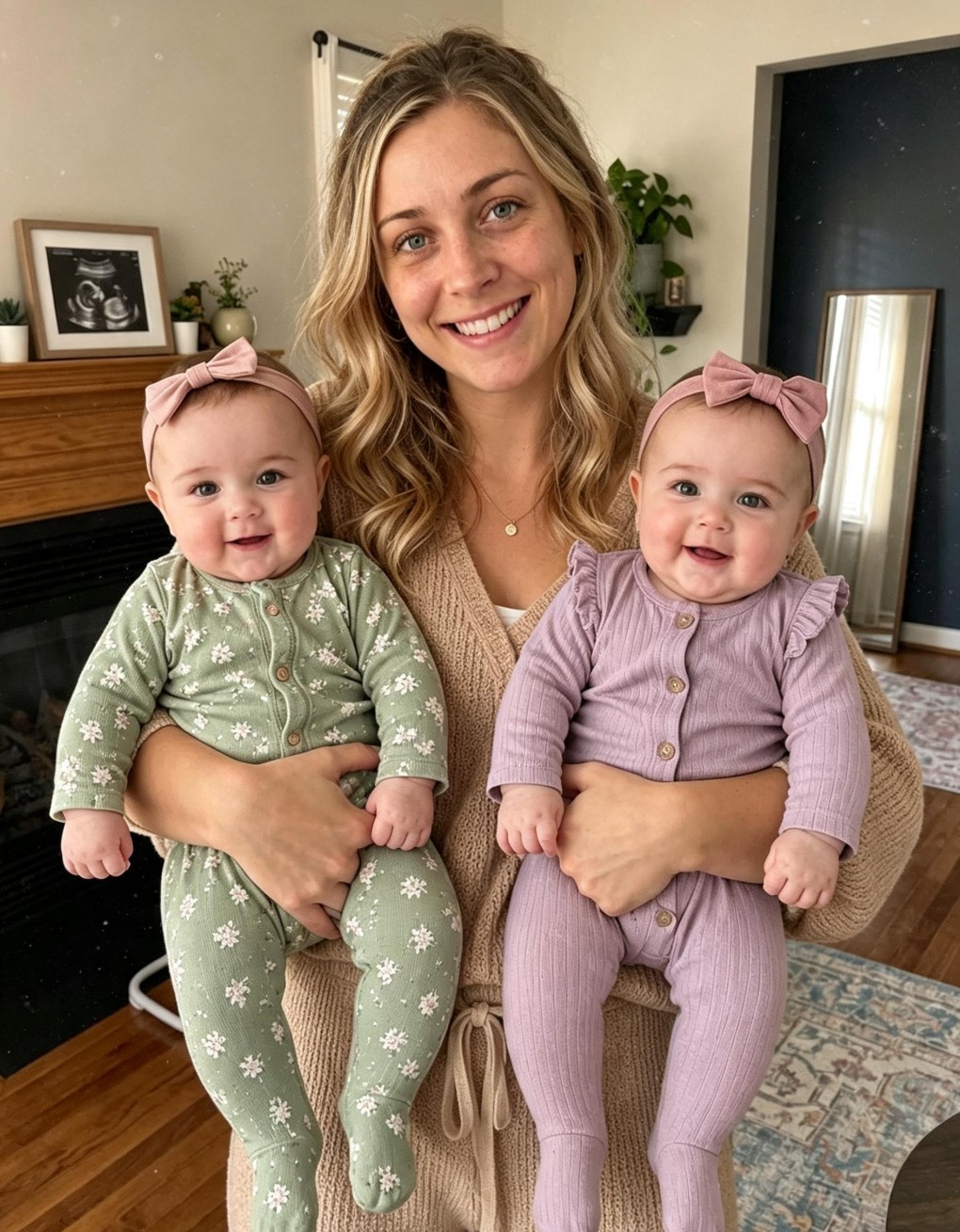
Part 1: The Four-Day Escape
My husband, Julian, and I had dreamed about becoming parents for years.
For a long time, having children seemed like something we might never experience. We went through years of fertility treatments, painful procedures, hormone injections, and disappointments. We suffered three miscarriages before we finally received the news we had been praying for.
We were having twins.
When our daughters were finally born, we were overwhelmed with happiness. After everything we had been through, holding two healthy baby girls in my arms felt like a miracle.
But the first six months of their lives were much harder than either of us had imagined.
The girls were only six months old, and I was barely sleeping. Every few hours, one or both babies needed to be fed. There were endless diaper changes, mountains of laundry, bottles that seemed to refill the sink as quickly as I washed them, and nights when both girls cried at the same time.
Some days, I felt like I was running on nothing but coffee and determination.
I never complained to Julian.
I knew becoming parents was a huge adjustment for both of us. I knew he had a demanding job and came home tired. So I handled the feedings, the laundry, the bottles, the sleepless nights, and almost everything else involving the babies.
I kept telling myself that things would eventually become easier.
Then, one evening, everything changed.
Both girls were crying.
I had one baby against my shoulder while I rocked the other with my foot in her bouncer. The kitchen counter was covered with dirty bottles, and there was a basket of unfolded laundry sitting beside the couch.
I looked at Julian, who was sitting at the kitchen table scrolling through his phone.
“Could you please wash the bottles?” I asked quietly.
It was such a small request.
I wasn’t asking him to take over the night. I wasn’t asking him to clean the entire house. I just needed him to wash the bottles so I could concentrate on getting the girls to sleep.
Julian sighed.
He looked around the house as if he had just walked into a disaster zone.
“I’m exhausted,” he said.
I stared at him.
“I know you are,” I replied. “I am too.”
But instead of helping, he became irritated.
“I come home every day to crying babies, dirty bottles, laundry everywhere, and you looking completely stressed out,” he said. “I can’t even relax when I get home.”
I felt something inside me sink.
“These are our babies, Julian.”
“I know that.”
“Then please help me.”
He shook his head.
Instead, he told me that he had already made plans with his friends.
He was going on a four-day fishing trip.
I thought I had misunderstood him.
“A four-day fishing trip?”
“Yes.”
“When?”
“Tomorrow morning.”
I stared at him.
“Julian, how exactly am I supposed to take care of two six-month-old babies alone for four days? I haven’t slept through the night in months.”
He barely looked at me.
He was already thinking about his trip.
“I need a break,” he said.
I looked at the two tiny girls in my arms.
Then I looked at my husband.
“You need a break?”
“Yes.”
I couldn’t believe what I was hearing.
I had not slept properly in six months. I had barely been alone long enough to take a shower. Every hour of every day was built around the needs of our daughters.
And he was telling me that he needed four days away because he was tired.
I asked him one last time to reconsider.
He didn’t.
Instead, he packed his fishing gear.
The next morning, Julian left the house with his bags and fishing equipment.
I stood in the doorway holding one of our daughters while the other slept in her crib.
He didn’t hug me.
He didn’t apologize.
He simply said, “I’ll be back in four days.”
Then he left.
For the next four days, I was completely responsible for the twins.
But I also used those four days to think.
I stopped asking myself how I could survive the way things were.
Instead, I asked myself what had to change.
By the end of those four days, I had made decisions that would change our marriage forever.
On the evening of the fourth day, Julian finally came home.
He unlocked the front door expecting everything to be exactly as he had left it.
Instead, he stopped dead in the doorway.
Part 2: The Silent Shift
Julian stood frozen on the entryway mat.
His tackle box hung loosely from one hand, and a fishing cooler was slung over his other shoulder.
He had clearly expected to return to the familiar chaos of our home.
He probably expected crying babies.
Dirty bottles.
Piles of laundry.
Diaper boxes.
And me, exhausted and walking around in the same faded clothes I had practically lived in for six months.
Instead, the house was silent.
Spotless.
And strangely empty.
The furniture in the living room had been carefully rearranged.
The massive double crib that normally sat near the bay window was gone.
So were the playpens, swing sets, formula dispensers, diaper boxes, and mountains of baby supplies that had once filled every corner of the house.
Even the smell had changed.
There was no longer the familiar mixture of baby powder, formula, and damp towels.
The house smelled like lavender and freshly polished wood.
Julian slowly put his cooler on the hardwood floor.
A deep crease appeared between his eyebrows.
“Evelyn?”
His voice echoed through the hallway.
“Where are the girls?”
I stepped out of my home office.
Julian looked at me and seemed almost as shocked by my appearance as he was by the house.
I wasn’t wearing yoga pants or an oversized shirt.
I was wearing a tailored cream-colored trouser suit.
My hair was styled.
My face was calm.
And in my hand was a cup of hot chamomile tea.
“In the nursery,” I said calmly. “They’re sleeping.”
Julian stared at me.
Then he looked around again.
“What happened to all their stuff?”
“I reorganized the house.”
“Why?”
“Because I realized something while you were gone.”
He waited.
“I can’t manage a five-bedroom house, two infants, my career, and my own health entirely by myself.”
Julian frowned.
“So what did you do?”
“I hired help.”
His expression immediately changed.
“You hired a nanny?”
“No.”
“Then what?”
“I hired a professional moving crew to reorganize the house, an estate organizer to make the space functional again, and certified overnight infant-care specialists.”
He stared at me.
“Overnight specialists?”
“Yes.”
“You’re serious?”
“Completely.”
His face darkened.
“Evelyn, we talked about this. A full-time nanny costs thousands of dollars a month. I work hard for our income.”
“I know you work hard.”
“Then why would you spend that kind of money?”
I set my tea down on the console table.
“Because while you were fishing, I realized that I had been trying to do the work of two parents by myself.”
Julian opened his mouth, but I continued before he could interrupt.
“The night you packed your bag, you told me that I wanted to be a mother, so I needed to act like one.”
His expression tightened.
“You were right.”
He looked confused.
“I spent those four days acting like a mother,” I said. “And part of that meant admitting that I needed help.”
I stepped closer.
“First, I arranged for two certified night-care specialists to cover the overnight feedings. That allowed me to get several uninterrupted hours of sleep each night. Second, I met with our estate attorney. Third, I separated forty-five percent of our joint liquid savings into a dedicated account for childcare and household support.”
Julian’s eyes widened.
“You took money from our savings?”
“I transferred forty-five percent of the joint liquid savings.”
“You can’t just take our money!”
“Forty-five percent is less than my fifty-percent share of the joint account,” I said evenly. “And I left the majority of the money untouched.”
He stared at me.
“What is that money for?”
“It will cover the overnight care, bi-weekly housekeeping, and a personal assistant for the next six months.”
“You’re insane!”
His voice suddenly exploded through the quiet house.
He dropped his tackle box onto the floor.
The crash echoed through the hallway.
“You can’t spend our savings because you felt overwhelmed for four days!”
“I felt overwhelmed for six months.”
“I go to work every morning to provide for this family!”
“And I work twenty-four hours a day without a paycheck, a lunch break, or a full night’s sleep.”
He shook his head.
“I deserved a break!”
“So did I.”
He became silent.
I continued.
“If your job gives you the right to walk away from your children for four days whenever you’re tired, then my responsibilities as a mother give me the right to use our family resources to pay for the care you refused to provide.”
“This is ridiculous!”
He grabbed his phone.
“I’m calling my mother. We’re going to sit down and figure out how to fix this emotional breakdown you’re having.”
“You can call your mother from a hotel room.”
His thumb stopped over the screen.
“What?”
I walked into my office and returned with a thin manila folder.
I placed it on the kitchen island.
Julian stared at it.
“What is that?”
“A proposed postnuptial agreement.”
His face changed.
“A what?”
“A postnuptial agreement.”
I opened the folder.
“It sets out clear responsibilities for both of us. Childcare outside our working hours will be shared equally. The cost of necessary hired childcare will also be shared equally. And neither of us will make personal travel plans lasting several days without discussing childcare arrangements with the other parent first.”
Julian stared at the document.
Then he noticed the second document underneath it.
“What is that?”
“A draft divorce petition.”
He went completely still.
“You’re serious?”
“Yes.”
Part 3: The Contract
Julian stood in the middle of the kitchen staring at the papers on the marble counter as if they were something dangerous.
“Divorce?”
The anger had disappeared from his voice.
Now he sounded frightened.
“Evelyn, you’re talking about destroying our marriage over four days of fishing.”
“No,” I said. “I’m talking about what those four days revealed.”
He swallowed.
“I needed a break.”
“So did I.”
“You could have told me.”
“I did.”
“You never told me you were this unhappy.”
I stared at him.
“I asked you to wash the bottles.”
He said nothing.
“That was me telling you.”
Julian pulled out one of the kitchen stools and sat down heavily.
“I was stressed.”
“So was I.”
“You don’t understand what it’s like carrying the financial pressure for four people.”
I leaned against the counter.
“Don’t tell me I don’t understand pressure.”
My voice remained calm, but every word carried the weight of six years.
“I spent six years going through IVF injections and hormone treatments. We went through three miscarriages. I carried these girls through a difficult pregnancy. Then I had an emergency C-section. And after they were born, I spent six months waking up every few hours to feed them.”
Julian lowered his eyes.
“I know.”
“No,” I said. “You know the facts. You didn’t understand the reality.”
He looked up.
“You wanted to be a family man, Julian. You wanted the photographs of our daughters on your desk. You wanted to tell your friends that you had twin girls. You wanted the pride that came with being their father.”
My voice hardened.
“But when the actual work of fatherhood began, you treated it like something I was supposed to handle.”
“That isn’t fair.”
“It is exactly what happened.”
He rubbed his face.
“I thought I just needed four days.”
“And you took those four days without making sure your wife and your six-month-old daughters were okay.”
He looked at the papers again.
“If I sign this, what happens?”
I answered immediately.
“You move into the guest room for the next three months while we reset our routines.”
He nodded slowly.
“You will take responsibility for the evening childcare shift from 6:00 PM to 10:00 PM after work.”
He looked nervous.
“You’ll learn how to wash and sterilize the bottles. You’ll learn how to prepare formula properly. You’ll learn how to soothe two crying babies at the same time.”
Julian swallowed.
“You’ll also handle your own laundry, and you’ll contribute fifty percent of the necessary hired childcare expenses from your personal discretionary spending.”
“And if I don’t sign?”
I picked up my phone.
“If you refuse, I call my attorney tomorrow morning and authorize the divorce filing.”
His face went pale.
“I’ll take the girls and stay with my parents in Boston while the legal process begins. Then you can explain to your family why you left your six-month-old daughters and your exhausted wife to go on a four-day fishing trip without making any childcare arrangements.”
Julian stared at me.
For six months, he had made a dangerous assumption.
He believed my silence meant I was willing to accept everything.
He believed my tears meant I was weak.
He believed that because I loved my daughters, I would continue absorbing every difficult part of parenthood while he continued living his normal life.
He had forgotten who I was before I became a mother.
Before the babies, I had been a senior corporate compliance director.
For ten years, I had negotiated high-stakes contracts, investigated corporate failures, and terminated agreements with companies that failed to meet their obligations.
I knew the difference between a promise and a commitment.
I knew what happened when someone refused to fulfill their responsibilities.
And now I was applying those same principles to my own life.
Julian looked at me for a long moment.
Then he reached into his jacket pocket.
He pulled out a pen.
His hand shook slightly.
He signed his name.
I watched him put the pen down.
Neither of us spoke for several seconds.
Then Julian quietly asked, “Where do I start?”
I looked toward the nursery.
“With the girls.”
Part 4: Learning to Be a Father
The first few weeks were not easy.
Signing the agreement didn’t magically transform Julian into a different person.
He struggled.
The first time he tried to wash the bottles, he forgot one of the sterilizing steps.
The first evening he tried to calm both girls at once, he became overwhelmed when they started crying together.
One night, he stood in the nursery holding Maya while Clara cried in her crib.
“I don’t know what I’m doing,” he admitted.
I stood in the doorway.
For a moment, the old version of me wanted to rush forward and take over.
But I didn’t.
“You have to learn,” I said.
Julian looked at me.
“Can you help me?”
“Yes.”
And I did.
But I no longer carried the entire responsibility for him.
I showed him how to prepare the bottles.
I explained the girls’ bedtime routine.
I taught him which songs calmed them and which ones made them more excited.
He learned.
Slowly.
He started recognizing their different cries.
He learned that Maya liked being held against his left shoulder.
He discovered that Clara would fall asleep faster when someone gently rubbed her back.
He learned how many diapers they went through in a day.
He learned how quickly clean laundry disappeared.
He learned that feeding two babies at once was an art form.
And, most importantly, he began to understand how much work had been happening around him.
One evening, after both girls had finally fallen asleep, Julian stood in the kitchen washing bottles.
He looked at me.
“I honestly didn’t realize.”
I didn’t answer immediately.
“That’s the problem,” I finally said.
He nodded.
“I thought you were just better at this than me.”
“I wasn’t better at it. I was doing it because someone had to.”
He lowered his eyes.
“I was selfish.”
“Yes.”
He gave a small, tired laugh.
“At least you’re honest.”
“I’ve always been honest.”
For the first time in months, we both smiled.
It wasn’t forgiveness.
Not yet.
But it was a beginning.
Part 5: The Recalibration
Six months after Julian signed the agreement, the early morning sunlight poured through the wide windows of our bright kitchen.
The twins were now twelve months old.
The house was no longer a war zone.
It wasn’t a cold corporate battlefield either.
It had become something much better.
A functioning home.
A shared home.
A home where both parents understood that raising children was a responsibility belonging to both of them.
At 6:30 in the morning, the gentle hum of the dishwasher filled the kitchen.
Julian stood at the counter in his suit trousers, preparing two bottles.
He tested the temperature of the formula against his wrist before carefully attaching the bottle nipples.
He didn’t need to ask me if he was doing it correctly anymore.
He knew.
Across the room, twelve-month-old Maya and Clara were sitting in their playpen.
They were laughing and pulling themselves up against the wooden rails, babbling excitedly at the family dog.
Julian picked up both bottles.
He walked over and knelt beside the playpen.
He lifted Clara into his arms and held her bottle for her while gently stroking her dark hair.
Maya leaned happily against his shoulder.
I walked into the kitchen wearing my coat.
My briefcase was in one hand, and my morning coffee was in the other.
Julian looked up.
“Morning.”
His smile was tired but genuine.
“They slept until six today,” he said. “I already changed their diapers and packed their daycare bags.”
“Good.”
I walked over and kissed each girl softly on the head.
“The daycare transport arrives at eight. I have board meetings until four, so I’ll handle pickup and dinner tonight.”
Julian nodded.
“I’ll take the bath routine and the nine o’clock wind-down.”
“Sounds good.”
There were no grand speeches.
No dramatic declarations.
No promises that everything between us had suddenly become perfect.
Our marriage was still something we were rebuilding.
Trust wasn’t restored in a single conversation.
It was rebuilt through hundreds of small actions.
Julian had finally learned that being a father wasn’t something he could turn on when it was convenient.
Fatherhood wasn’t a title.
It wasn’t a photograph on an office desk.
It wasn’t something that could be handed over to his wife whenever he felt tired.
It was an active, daily responsibility.
And I had learned something too.
Being a good mother didn’t mean destroying myself to prove how much I loved my children.
I could ask for help.
I could demand partnership.
I could protect my health without feeling guilty.
And I could love my daughters without carrying the entire world alone.
I picked up my keys from the console table and walked toward the front door.
Before leaving, I stopped.
I turned around and looked back at my family.
Julian was sitting on the floor with the girls.
Maya was trying to grab his silk tie.
Clara was laughing in his lap.
His hands were full.
His forehead was slightly sweaty.
And for once, he wasn’t trying to escape the beautiful chaos.
He was completely present in it.
I smiled.
Then I opened the front door and stepped into the warm morning light.
For the first time since our daughters were born, I didn’t feel like I was carrying the entire world on my shoulders.
I knew I wasn’t alone anymore.
And that was worth more than any fishing trip, any apology, or any promise he could have made.
Because Julian had finally learned the lesson I had needed him to understand from the beginning:
We had brought these two lives into the world together.
And we would raise them together.
The end.
