
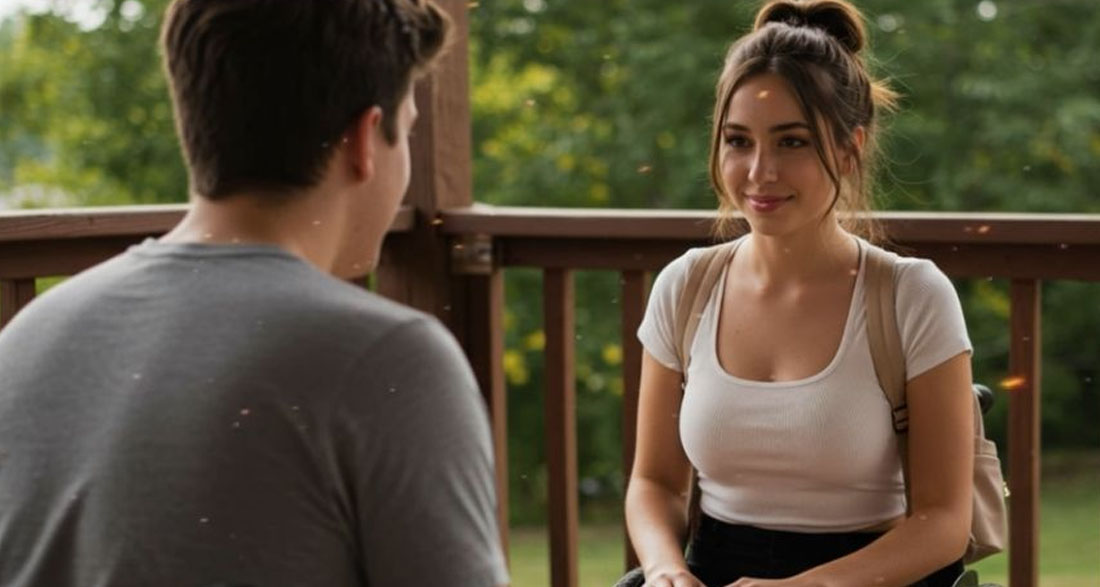
I Was Tricked Into Dating a Half-Paralyzed Girl — But She Taught Me What Real Love Looks Like
My name’s Liam. I’m twenty-five and a carpenter — the kind who builds house frames, the skeletons that hold everything up.
I work hard, swing a hammer all day, and by the time most people are waking up, I’m already covered in sawdust, the smell of pine stuck to my hands. My life runs on the rhythm of drills, hammers, and black coffee — no sugar, no milk.
I rent a small studio above a bike shop in Portland. It’s quiet — no roommates, no noise, just the sound of rain tapping against the window.
People say I’m slow with everything — work, words, women. My friend Jake, the lead framer at work, loves to joke,
“You’re gonna die alone, man, with your tools alphabetized and no one to notice.”
He’s probably right. My relationships never last. I like peace and quiet; most people don’t. They always leave, and we part like two polite business partners closing a deal.
So when Jake cornered me at the site one day, dust in his hair and hammer on his belt, saying,
“I’ve got a friend who knows a girl. She’s different. Coffee date. Just one hour.”
I was ready to say no. But then he added,
“One hour, and I’ll stop bugging you about your sad love life for a whole month.”
That was a deal I could live with.
The Girl by the Window
Saturday, 7 p.m., The Cozy Cup Café. Jake didn’t give me her name or photo, just said, “She’ll be near the window.”
The Cozy Cup smelled like cinnamon and burnt sugar, soft and sweet. I got there early, pretending not to care that I’d ironed my one good flannel. Then I saw her.
She sat by the brick wall — long brown hair tied in a low knot, wearing a forest-green dress that made her eyes shine.
A thin silver bracelet glinted in the light. And beside her chair — folded neatly — was a wheelchair.
Black. Compact. Silent.
I froze. She noticed. Her lips lifted into a small smile.
“You must be Liam.”
Her voice was calm, low, steady — not weak, not uncertain. I sat down, awkwardly careful with my movements.
“Jake said you’d be easy to spot,” she teased. “Tall, quiet, probably still wearing sawdust.”
She was right.
“He didn’t tell me you’d be early,” I said.
“I like watching people guess,” she said, eyes glinting. “Most stare at the chair first. You didn’t.”
“You looked like you already knew how this was going to end.”
She laughed — soft, real, like it surprised even her.
Coffee and Confessions
She ordered a cappuccino, extra foam. I got my black coffee. When she lifted her cup, I noticed her left hand moved slower than the right. She caught me looking and said,
“You can ask. Everyone does.”
“Ask what?”
“Why I don’t stand up. Why the chair. Why I’m here when Jake didn’t tell you.”
I looked at her and said quietly,
“I don’t need a reason to finish this cup. I just need a reason to get invited for the next one.”
She blinked, then smiled.
“That’s new.”
We talked for two hours — about Portland rain, about her art. She showed me her tablet, a digital sketch of a fox mid-leap.
“I draw kids’ books,” she said. “Easier with one good hand.”
No pity, no sadness. Just truth.
She told me she’d been an art student before a car accident four years ago changed everything.
“One moment you’re driving to a gallery,” she said, “the next, you’re learning how to live in a body that forgot how to walk.”
I didn’t say I’m sorry. She didn’t need that.
When the café closed, she looked at me and said,
“Tomorrow. Laurelhurst Park. Ten a.m. Bring coffee. I’ll bring the sketchbook.”
I said yes without thinking.
The Second Morning
Sunday was gray and calm. She was already under the maple tree when I arrived, sketchbook open on her lap. I brought two peach iced teas.
“You remembered,” she said, smiling.
We walked — well, she rolled — through the park paths, talking about life.
“Rehab was hell,” she admitted. “Year one, I was angry. Year two, I bargained. Year three, I stopped trying to walk and started drawing again.”
“That sounds brutal.”
“It’s life,” she shrugged. “It’s tiring, but better than feeling invisible.”
At the rose garden, she drew fast and messy.
“Real isn’t pretty,” she said. “Real’s interesting.”
“You ever get tired of interesting?”
“Every day. But being tired means I’m still alive.”
Before she left, she smiled and said,
“Next Saturday. Concert by the river. Bring tacos this time.”
And that’s how she became part of my week.
The Concert Night
We sat under string lights by the river, her hair loose and shining. I brought tacos and churros; she brought her laugh and iced tea.
But halfway through, two strangers kept whispering and glancing at her chair. Her smile faded.
“I think I’m done,” she whispered.
We packed up quietly.
By her van, she looked at me, eyes serious.
“You don’t have to stay if it’s pity.”
“It’s not pity,” I said. “It’s something else. I just don’t have the word yet.”
She nodded and drove off.
The Silence
Days passed. No texts, no drawings. Just silence.
I told myself she was busy, but the truth was I missed her. I started sketching — badly — on job permits and wood scraps. Not her face, but how she felt.
Ten days later, I found an envelope in my mailbox.
No stamp, just my name — Liam.
Inside was a sketch: me sitting on the park bench holding two peach teas. On the back, she’d written:
“People only draw what they don’t want to forget.
Thank you for drawing me when I erased myself.”
I ran to the park.
She was there, under the maple, sketching again.
“This yours?” I asked.
“Thought you’d recognize the subject,” she said softly.
“Why’d you stop seeing me?”
“Because I was tired of being the version of me that needed fixing. I wanted to see who I was without that.”
“Then show up,” I said.
She smiled.
“Saturday. Same bench. Bring tea. And Liam — don’t draw me unless you mean it.”
“I mean it.”
Saturdays
Every Saturday, she was there — always three minutes late, never apologizing.
We shared donuts, tea, stories from my work, and her fox drawings.
Rainy days, we hid under the tree with a thermos of hot tea. She’d draw the rain; I’d read thrift store novels out loud.
Silence didn’t feel empty anymore. It felt whole.
Winter
Winter came heavy and gray. We met under a leaky picnic shelter. I brought hot cider; she wore fingerless gloves.
“You’ll freeze,” she said when I gave her my jacket.
“Worth it.”
She leaned her shoulder against my arm.
“I see you, Liam.”
“I see you too.”
And that was enough.
Spring Again
When spring arrived, the air smelled like new beginnings. Clara’s hair was longer; she wore it in a braid.
One morning, she handed me a printed proof of her new children’s book: The Fox Who Learned to Fly.
On the first page, it said:
To L., who showed up when the wings were still paper.
I couldn’t speak. I just held her hand — the one that didn’t curl all the way. She squeezed back.
Ordinary Miracles
We never talked about labels. Our love was quiet, built on small rituals.
One June afternoon, she gave me a key.
“For when you bring donuts and I’m late.”
It hung next to my truck key.
Sometimes, she’d drive us to the coast. I’d handle the van; she’d navigate with a paper map. We’d eat fish tacos, her wheelchair tracks marking the sand.
The Question
One evening, by the pond under the willow, she asked,
“You ever think this is it? Just us, the bench, the donuts, the quiet?”
I thought about her laugh, about how silence with her felt alive.
“Yeah,” I said. “I think this is it.”
“No labels. No timeline. Just Saturdays.”
“Saturdays work for me.”
Years Later
We kept our promise.
No matter how busy life got, we found our way back to that bench.
Her fox book became a hit, even featured in The Oregonian.
When reporters asked about her inspiration, she said,
“Someone who saw me before I stood up.”
She never mentioned my name. She didn’t need to.
The Final Sketch
A year after our first coffee, she handed me one last drawing. It was us — sitting by the water, the maple behind us. No wheelchair. Just two silhouettes.
At the bottom, she’d written:
Real isn’t pretty. Real is home.
I framed that — not with wood or glass, but in my heart.
Every Saturday since, I still bring two peach teas. Sometimes she’s there. Sometimes not. But the bench always waits. So does the quiet — the kind that feels like love still breathing.
Epilogue
People ask how long we’ve been together. I never count.
With Clara, time doesn’t move in years. It moves in Saturdays — in the sound of her pencil, in the soft space between words.
She once told me,
“You don’t have to stay if it’s pity.”
And I told her,
“I’m not staying because I pity you. I’m staying because leaving would feel like forgetting how to live.”
