
Part 1:
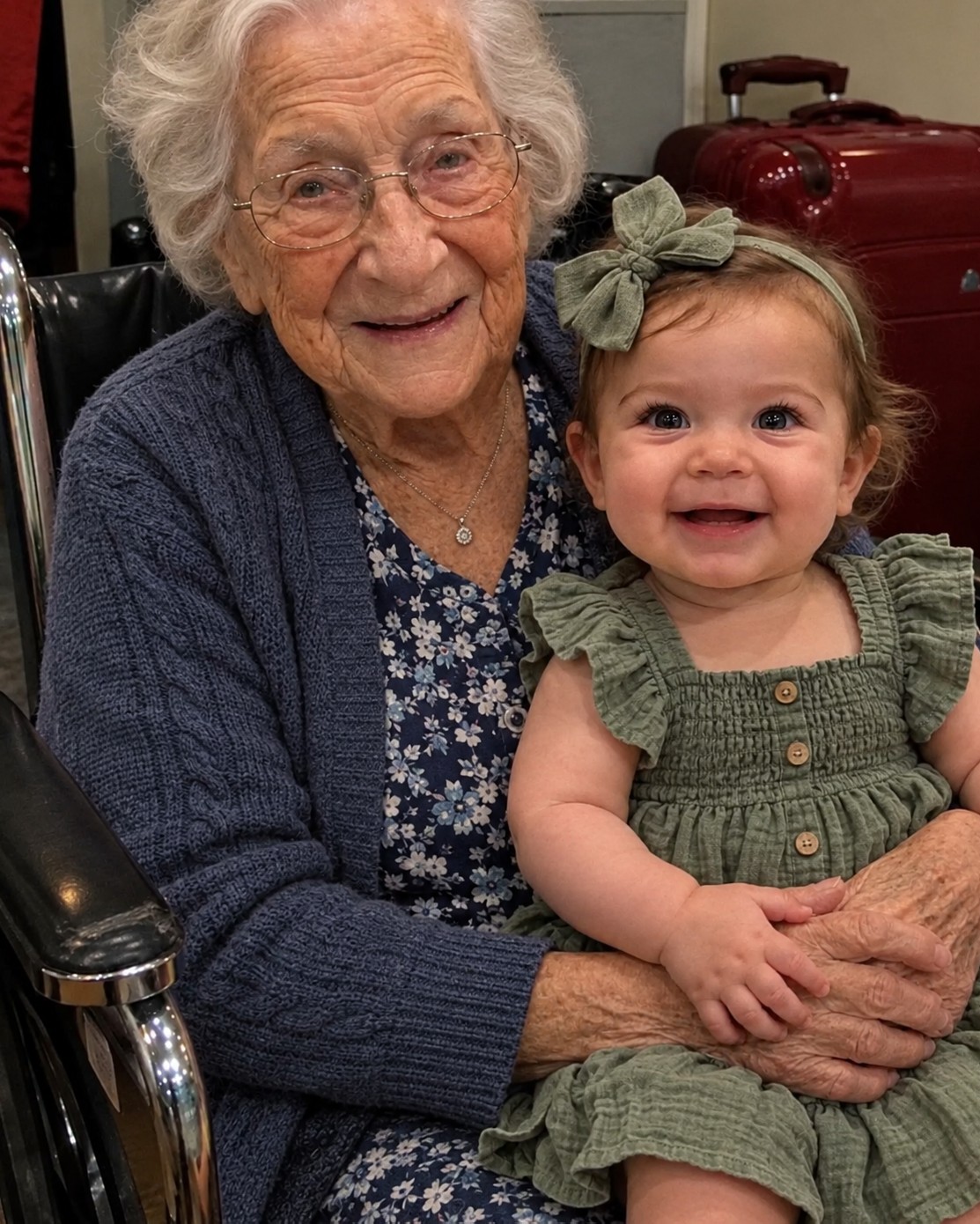
My grandmother Margaret was 101 years old and had not left her bed in almost two years.
So when she called me on the morning of my daughter Emma’s first birthday and said, “I’m coming,” I honestly thought I had heard her wrong.
“Grandma, you can barely sit up,” I said.
“I said I’m coming.”
There was something in her voice that made me stop arguing.
Three hours later, a medical transport van pulled into our driveway.
Two attendants carefully helped Grandma out of the van and into a wheelchair.
But that wasn’t what caught my attention.
Strapped to the back of her wheelchair was a small red suitcase.
It looked ancient.
The leather was scratched and faded. The brass corners were worn. A tiny brass padlock hung from the front.
But the strangest thing was how tightly Grandma guarded it.
When my husband, Mark, reached out to carry it for her, she immediately slapped his hand away.
“Nobody touches that.”
Mark raised both hands.
“Okay. Okay. I won’t.”
During the birthday party, Grandma barely looked at the decorations.
She didn’t seem interested in the cake, the balloons, or the presents.
She just watched Emma.
My little girl sat in her high chair, happily making a mess with birthday cake while our family and friends laughed around her.
Then, while everyone sang “Happy Birthday,” Grandma suddenly started crying.
She pointed directly at Emma.
“Take off her sock.”
The room went quiet.
I stared at her.
“What?”
“Her left sock. Now.”
“Grandma, what’s wrong?”
She didn’t answer.
Instead, she looked past me toward someone standing among our guests.
Then she whispered something that made my stomach drop.
“Lock the front door.”
Mark gave a nervous laugh.
“Why?”
Grandma grabbed my wrist.
And for the first time that day, I saw pure terror in her eyes.
Part 2:
My skin went cold.
Grandma Margaret’s fingers dug into my wrist with surprising strength for a woman who had spent nearly two years bedridden.
Her knuckles were white.
Her cloudy eyes were locked on a tall man standing near the patio doors.
Julian Vance.
My husband’s new business partner.
“Maya, lock the door,” Grandma repeated.
Her voice had dropped to a low, rough whisper.
“Do it now.”
Mark stepped between Grandma’s wheelchair and the guests.
“Grandma, you’re confused. Julian is my business partner. He came here to celebrate Emma’s birthday.”
“I am not confused!” Grandma snapped.
Tears ran down the deep lines of her face.
Then she pointed at Julian.
“Look at his wrist!”
Everyone turned.
“Look at his left wrist!”
Julian was dressed perfectly in a linen button-down shirt.
But the moment Grandma mentioned his wrist, he instinctively pulled his left sleeve farther down.
I caught a glimpse of a dark, faded tattoo near his watch.
It was a small stylized bird surrounded by a Roman numeral.
Julian gave a tight smile.
“I think your grandmother might be having a moment, Mark. It’s a big day. There’s a lot of noise…”
“Take off her sock, Maya!” Grandma demanded.
My hands were shaking as I knelt beside Emma’s high chair.
Emma looked up at me happily.
Pink birthday cake covered her cheeks.
I reached for her tiny left sock and pulled it down.
Then I froze.
On the arch of my one-year-old daughter’s left foot was a distinctive star-shaped birthmark.
Grandma stared at it.
A sharp gasp came from somewhere behind me.
She immediately reached beneath her cardigan and pulled out a tiny brass key hanging from a worn leather cord.
Her hands trembled as she inserted it into the padlock on the red suitcase.
Click.
The lock opened.
Grandma pushed back the lid.
Inside were no clothes.
No medicine.
No birthday presents.
The suitcase was lined with faded blue velvet.
Inside were yellowed newspaper clippings from 1954, a bundle of letters tied with red string, an old birth certificate, and a black-and-white photograph of a young woman holding a baby girl.
Grandma lifted the photograph with trembling fingers.
The baby’s left foot was bare.
And there it was.
The exact same star-shaped birthmark.
But the baby wasn’t what made my heart stop.
It was the young woman holding her.
She had my eyes.
My jawline.
And, strangely, Julian’s sharp, arched eyebrows.
“That is my sister, Clara,” Grandma whispered.
Her voice was broken by decades of pain.
“She disappeared from our family farm in 1954 with her three-month-old daughter.”
Everyone was silent.
“The police called it a runaway case,” Grandma continued. “But it wasn’t.”
She slowly raised her finger and pointed directly at Julian.
“Her husband was Arthur Vance.”
Julian’s face suddenly lost its color.
“He took the baby,” Grandma said. “He changed the child’s identity and buried the truth. Clara was murdered and hidden near the old orchard.”
Julian shook his head.
“This is insane.”
Grandma ignored him.
“That tattoo on his wrist is the Vance family crest. Arthur had it. His father had it. And now Julian wears it.”
Part 3:
The living room exploded into chaos.
Julian’s polished expression disappeared.
His face turned gray.
He took two steps toward the patio door.
“This is insane,” he said. “Mark, your grandmother is suffering from severe dementia. I’m leaving.”
“Don’t you move!”
Mark stepped directly into his path.
My husband was six-foot-two and broad-shouldered.
The relaxed man who had been laughing with our guests minutes earlier was gone.
“Julian,” Mark said, his voice hard, “what is she talking about?”
Julian looked at him.
“I have no idea.”
“I have the birth certificate!” Grandma shouted.
She pulled a crumbling document from the suitcase.
“The baby who disappeared in 1954 was named Evelyn.”
She held up the paper.
“Evelyn had the same hereditary vascular birthmark on her left foot. My sister Clara had it. Evelyn had it. I inherited the same family trait. Maya inherited it. And now Emma has it.”
I stared at Grandma.
She had never told me any of this.
She looked at Julian again.
“Your grandfather, Arthur Vance, died thirty years ago without ever answering for what he did.”
Julian’s jaw tightened.
“He raised that stolen baby under a false name in Chicago. But three weeks ago, Mark brought you to my nursing home and introduced you as his new business partner.”
Grandma reached deeper into the suitcase.
This time, she pulled out a modern brown folder.
Inside were police reports, private investigator notes, copies of old land records, photographs, and recent DNA testing documents.
“I may be old,” Grandma said, “and I may have been unable to leave my bed, but my mind was still clear.”
She looked directly at Julian.
“The moment I saw your face and heard your family name three weeks ago, I knew.”
Julian stared at her.
“I hired a private investigator from my nursing home room.”
She lifted one of the documents.
“We traced the Vance family line. The DNA analysis connected you to Arthur Vance’s family.”
Julian’s eyes widened.
Grandma’s voice became stronger.
“You are not simply Mark’s business partner, Julian. Your family’s fortune was built partly on land that belonged to my sister and her descendants.”
Julian looked around the room.
Several guests were already holding their phones.
“My grandfather didn’t kill anyone!” he suddenly shouted.
His refined voice cracked with anger.
“It was a family dispute over land rights! The farm was legally transferred!”
“No!”
Grandma shouted so loudly that everyone jumped.
“It was stolen through forgery after my sister was murdered!”
Then something happened that none of us expected.
Grandma stood up.
For almost two years, she had not stood without help.
But now she pushed herself out of the wheelchair.
Her legs trembled.
Her body swayed.
Mark immediately reached toward her.
But she waved him away.
She remained standing.
And she pointed the tiny brass key at Julian.
“My sister’s remains were found by developers three months ago near the old interstate,” she said.
Tears streamed down her cheeks.
“The police reopened the cold case. But they were missing the connection between Clara’s murder and the Vance trust.”
She lifted the red suitcase.
“I had it.”
Part 4:
The front door never had to be locked.
Seven minutes later, three police cars pulled into our driveway.
Red and blue lights flashed across the windows, illuminating the birthday decorations, the balloons, and the half-eaten cake still sitting on the table.
Grandma did not sit down until the officers had taken the red suitcase into evidence.
She handed over everything inside it, including the old documents and the certified chain-of-custody records her private investigator had prepared.
Julian Vance was taken from our home in handcuffs.
He was questioned in connection with the seventy-year-old cold-case homicide and child abduction.
But that wasn’t all.
Investigators also began examining an active land-fraud scheme connected to the Vance family’s commercial trust.
The old deeds Grandma had preserved contained forged signatures and records that could show how the family had continued benefiting from land that had been stolen decades earlier.
When everyone finally left, our living room became strangely quiet.
Mark sat on the rug with his head in his hands.
He looked completely overwhelmed.
The business empire he had been preparing to join had suddenly been connected to the destruction of my family.
I knelt beside Grandma’s wheelchair.
She was sitting again.
She looked exhausted.
Frailer than ever.
But something in her face had changed.
The heavy sadness that had followed her for most of her life seemed lighter.
“Grandma,” I whispered, taking her cold, wrinkled hand.
“You stayed in bed for two years.”
She looked at Emma.
Then she gently reached out and stroked my daughter’s hair.
“I was waiting, Maya.”
Her voice was soft.
“Every night for seventy years, I promised my sister Clara that I would not leave this earth until the truth came out.”
She smiled sadly.
“I thought I had failed.”
Then she looked toward the patio doors.
“But when Mark brought that boy to my room three weeks ago, I knew God had given me one last job to do.”
She smiled again.
This time, it was a peaceful smile.
“I had to finish what I started.”
She looked down at Emma’s little foot.
“I brought the red suitcase to her birthday because a story that began with a stolen child seventy years ago needed to end with a safe one today.”
Four months later, Grandma Margaret died peacefully in her sleep.
She was surrounded by family and white roses.
She did not leave behind a huge fortune.
She did not leave behind a grand estate.
But the small red suitcase remained with us.
We had it carefully restored.
The scratched leather was cleaned.
The brass corners were polished.
And the tiny padlock was kept open.
Inside, beside the old photograph of Clara and her baby, we placed a new photograph.
It showed Grandma Margaret standing on her own two feet, holding her great-granddaughter.
Emma’s tiny left foot was bare.
The star-shaped birthmark was visible.
Unhidden.
Free.
Part 5:
Two years after the sirens disappeared from our driveway, the autumn sun poured through the kitchen windows in long, warm rays.
The house was quiet.
The grandfather clock in the hallway ticked steadily.
I sat at the kitchen table with a mug of black coffee beside me and turned the final page of the state prosecutor’s report.
The coffee had gone cold.
The legal process had moved slowly.
For a long time, it felt as if nothing was happening.
But eventually, the entire truth came out.
Julian Vance’s trial had become one of the biggest scandals in the state.
The polished image of one of Chicago’s old commercial real estate families had been destroyed.
The yellowed papers Grandma had protected inside the red suitcase became a major part of the case.
Forensic document experts confirmed that signatures on the 1954 land deeds had been forged.
Genetic genealogy helped confirm that the remains discovered near the old interstate were those of Clara.
And the hereditary birthmark that had appeared across generations of our family helped support the connection between Clara, her daughter Evelyn, and our own family line.
Arthur Vance and the other people responsible for Clara’s death were long beyond the reach of the law.
But Julian was not.
Investigators found overwhelming evidence of corporate fraud, asset concealment, and conspiracy connected to the illegal conversion of the stolen land trust.
Julian eventually accepted a plea agreement.
He was serving a fifteen-year federal sentence in Illinois.
The Vance family’s commercial holdings were liquidated.
A court-ordered restitution trust was created for Clara’s surviving descendants.
I closed the thick blue folder.
For the first time in years, I felt like I could breathe.
Then I heard the back door open.
Light footsteps hurried down the hallway.
A moment later, I heard a familiar voice.
“Mommy! Look! Look what Daddy found!”
Emma burst into the kitchen.
She was three years old now.
Her cheeks were pink from the cold October air.
Her curly dark hair bounced around her face.
Her dark brown eyes reminded me so much of Grandma Margaret.
Emma reached the table and proudly placed a bright red maple leaf beside my coffee.
Mark walked in behind her.
He was brushing pieces of wood from his flannel shirt.
He looked older than he had on Emma’s first birthday.
The stress of rebuilding his career after ending his business relationship with Julian had left silver streaks in his hair.
But the haunted look that had remained in his eyes after Julian’s arrest was gone.
There was peace there now.
“She’s been searching for the reddest leaf in the yard for twenty minutes,” Mark said.
He smiled down at Emma.
Then he looked at me.
“How are you doing?”
“I’m good.”
I reached over and straightened Emma’s denim jacket.
“The final probate papers arrived today.”
Mark waited.
“The restitution trust is fully settled.”
I smiled.
“It’s over, Mark. It’s officially over.”
Mark closed his eyes.
He let out a long breath.
Then he pulled out a chair and sat beside me.
He took my hand.
“Grandma knew,” he whispered.
His eyes moved toward the living room.
“She knew exactly what she was doing when she held onto that suitcase for seventy years.”
I squeezed his hand.
“She kept her promise.”
Part 6:
We walked into the living room together.
Emma ran ahead, chasing a beam of sunlight across the rug.
On the top shelf of our oak bookcase sat the small red leather suitcase.
We had restored it carefully.
The leather was now smooth and rich.
The brass corners shone warmly.
The tiny brass padlock rested open beside the handle.
Inside, protected beneath archival glass, were two photographs.
The first was the original black-and-white photograph from 1954.
Clara was young and nervous, holding her infant daughter.
The baby’s bare left foot showed the faint star-shaped birthmark.
Beside it was a newer photograph.
It had been taken just two weeks before Grandma died.
Grandma was sitting in her wheelchair on our back porch.
She was holding a sleeping one-year-old Emma in her lap.
Grandma wasn’t looking at the camera.
She was looking at Emma.
Her weathered hand rested gently over the baby’s bare left foot.
Her face was peaceful.
Emma ran toward the bookcase.
She pointed at the suitcase.
“Great-Grandma Margaret,” she said proudly.
“That’s right, sweetie.”
I knelt beside her and wrapped my arms around her.
“That’s Great-Grandma Margaret.”
“She gave me the red box!” Emma said.
“Yes, she did.”
I kissed her soft hair.
“She gave us the red box so we would always remember where we came from.”
Emma turned in my arms.
Then, just as she often did inside the house, she kicked off her left shoe and pulled off her sock.
She lifted her tiny foot into the sunlight.
There it was.
The star-shaped birthmark.
Clear.
Distinct.
Impossible to miss.
For seventy years, that mark had been connected to a terrible secret.
It had been a silent witness to a crime that a powerful family believed they had buried forever.
It had been carried through generations of grief.
And it had waited until the right moment to help bring the truth into the light.
But as I watched my daughter laughing in the sunshine, I realized something.
That mark no longer represented what had been stolen from us.
It represented what had survived.
It was a symbol of resilience.
A reminder that wealth, power, lies, and even decades of silence cannot erase the truth forever.
The shadow that had followed our family for three generations was finally gone.
Emma laughed again.
I picked her up and held her tightly against my chest.
Her laughter filled the quiet house.
Clear.
Bright.
Free.
And for the first time, there was nothing left for us to fear.
The End.
