
Part 1:
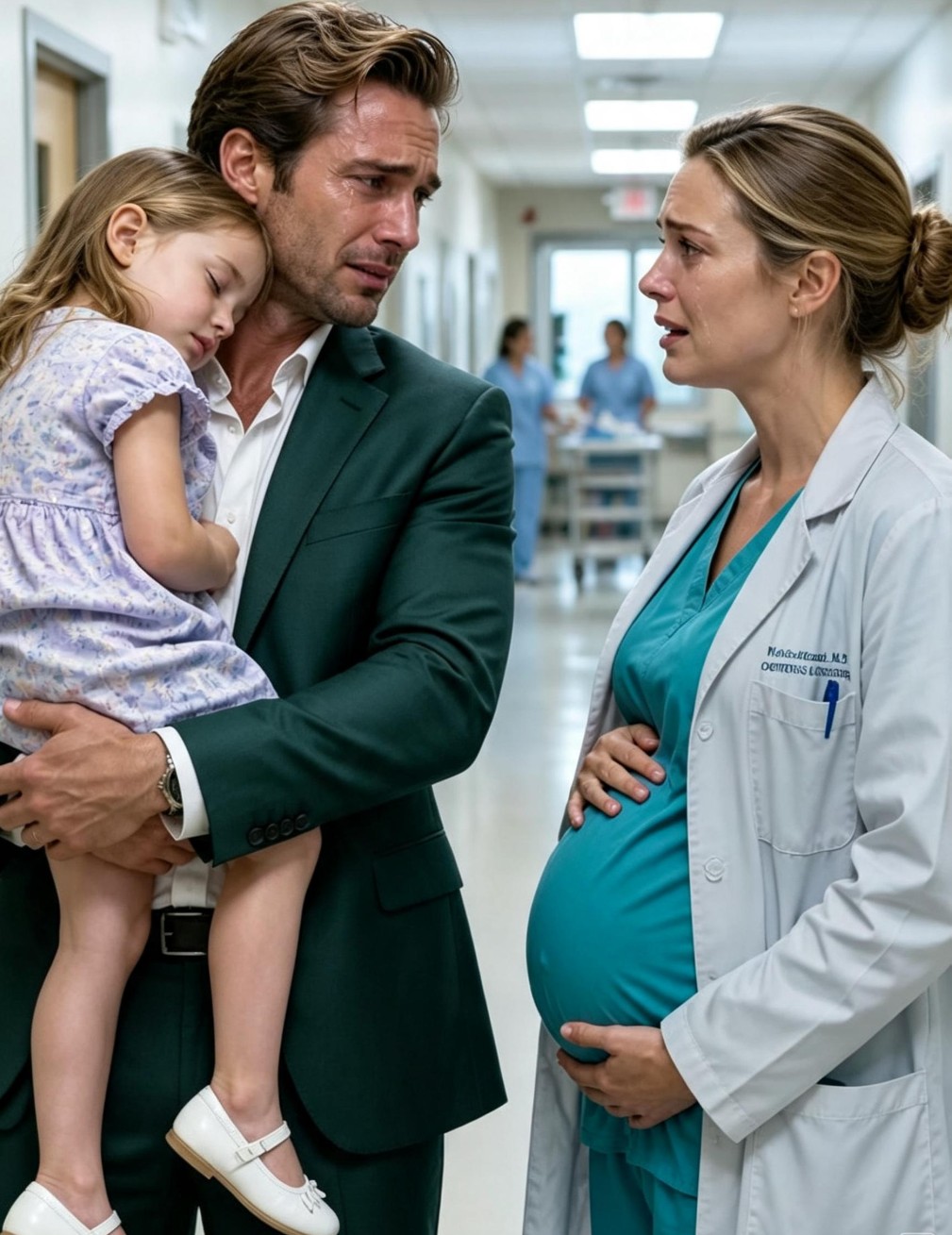
The evening Elias hurried his sobbing six-year-old daughter through the sliding glass doors of Saint Jude Medical Center’s emergency department, he expected chaos, paperwork, and possibly devastating medical news.
He certainly did not expect to see the woman he had completely shattered standing beneath the unforgiving fluorescent lights.
She was six months pregnant.
And one protective hand rested over a rounded belly that could only belong to his child.
For one suspended heartbeat, the entire emergency department seemed to stop breathing.
I stood at the entrance to Emergency Bay Two with my clinical stethoscope hanging around my neck. My dark hair was pulled into a messy ponytail, and my blue scrubs were wrinkled from a long shift.
I was a pediatric emergency medicine fellow at Saint Jude, employed by the hospital and already trusted to handle a wide range of emergencies under the supervision of the attending physicians.
I had spent years learning how to remain calm around arterial blood, broken bones, frightened parents, screaming children, and the endless alarms of hospital monitors.
I knew how to stay steady when someone else’s world was falling apart.
But no medical training had prepared me for seeing Elias rushing beside a gurney with pure terror written across his face.
“Daddy, it hurts so much,” the little girl whimpered from the stretcher.
Elias looked nothing like the powerful real estate mogul the world knew.
His expensive charcoal suit was badly wrinkled. His silk tie hung crookedly around his neck, and his usually perfect dark hair had fallen over his forehead.
He looked like a broken father who had just discovered that all his money and influence could not protect the person he loved most.
I forced a breath into my burning lungs.
The child needed a doctor.
She did not need a woman whose heart had just been ripped open.
“I am Doctor Adelaide,” I said, keeping my voice steady. “What is your name, sweetheart?”
The little girl blinked through her tears.
“I am Sophie. I fell from the tall climbing frame.”
“Was it at your school playground?”
Sophie nodded.
“Daddy got really scared when I hit the ground.”
The irony struck me so hard that I nearly stepped backward.
Elias, the man who had once been too afraid to admit that he loved me, was now trembling because his daughter had fallen from a playground.
I stepped beside the stretcher.
“Sophie, I am going to check your arm very gently. You tell me if anything hurts too much, okay?”
“Okay, Doctor.”
“Good girl.”
Then I finally looked at Elias.
“Sir, I need you to step behind the curtain so we can examine her properly.”
Our eyes met.
Six months disappeared in a single, agonizing heartbeat.
I watched the shock of recognition hit him.
Then came confusion.
Then disbelief.
His eyes slowly dropped toward my stomach.
The loose blue scrubs could not hide the unmistakable curve of my pregnancy.
His face went completely pale.
“Adelaide,” he whispered.
Not Doctor.
Not some polite title.
Adelaide.
The same name he used to whisper against my skin in the quiet darkness of his high-rise apartment when I had still foolishly believed the man beneath the expensive suits might someday be brave enough to love me openly.
I broke eye contact first.
“Let’s get vital signs, a full neurological examination, and imaging of her left forearm,” I instructed the nurse beside me. “Keep her talking about her favorite toys so she stays distracted.”
The medical team immediately moved into action.
I examined Sophie’s pupils, checked her collarbone, and carefully palpated her injured arm.
Every movement was controlled, professional, and gentle.
But I could feel Elias watching me.
I knew exactly what was happening inside his head.
He was doing the math.
Twenty-six weeks pregnant.
Six months since that final rainy Tuesday in his kitchen.
Six months since I had stood there in a blue dress with mascara running down my cheeks and asked him whether he actually loved me or simply needed me around.
He had stood there silently.
Beautiful.
Terrified.
Paralyzed by the ghosts of his past.
Finally, he had admitted that he did not know how to build a family.
So I had walked out into the cold rain.
Three weeks later, alone in my bathroom, I had stood there holding a plastic pregnancy test in my shaking hand.
That was when I realized I had not walked away from Elias’s life alone.
“Doctor Adelaide?”
Sophie’s small voice pulled me back into the present.
“Yes, honey. I am right here.”
“You are very pretty.”
Her eyes moved toward my stomach.
“Are you having a baby?”
Despite everything, I smiled.
“I am. The baby should be here in about fourteen weeks.”
Sophie’s face brightened.
“That is so cool. I always wanted a little sister to play with.”
Behind me, Elias made a tiny sound.
Almost no one else noticed it.
But I did.
I noticed because I had once known every tiny change in his breathing.
By ten that night, Sophie was resting upstairs in a quiet pediatric room. Her wrist had a light cast around a minor fracture, and her neurological scan was clear.
The emergency was over.
But the silence that followed felt far more dangerous.
I found Elias standing inside the dim family consultation room at the end of the hallway.
Both hands were gripping the windowsill so tightly that his knuckles had turned white.
“Sophie is stable,” I said from the doorway. “She should be discharged in the morning.”
He turned slowly.
Streetlights outside cast long shadows across his face.
Then he asked the question I had known was coming.
“Is the baby mine?”
His voice was raw.
There was no corporate confidence in it.
No armor.
My hand moved instinctively over my stomach.
“Your daughter needs you right now. You should go back to her room.”
“Adelaide, please. Just answer me.”
“No.”
My voice trembled.
I hated that he could still make me feel so weak.
“You do not get to do this,” I said. “You do not get to demand answers in a hospital hallway after one hundred and eighty days of silence.”
His jaw tightened.
“I truly did not know.”
“You did not look.”
My anger finally broke through my professional mask.
“I wanted you to fight for us, Elias. I wanted you to fight for me. Instead, you simply let me walk away.”
He looked as though my words had cut straight through him.
“I was a coward,” he said quietly. “And I know that.”
“Yes,” I whispered. “You were.”
Then I turned and walked away before he could see the tears filling my eyes.
I finished my shift in a complete daze.
I was still employed by Saint Jude and had every intention of finishing my pediatric emergency medicine fellowship, but that night I could barely remember how I made it through the rest of my shift.
By the time I reached my apartment building at two in the morning, I was exhausted and emotionally empty.
But when I stepped into the hallway outside my apartment, I stopped.
A large, elegantly wrapped box was sitting directly in front of my door.
There was no return address.
A heavy cream-colored card was tucked beneath a black silk ribbon.
I opened it with shaking hands.
The handwriting was sharp, feminine, and completely unfamiliar.
The message was short.
“Adelaide, some wars cannot be fought alone, especially the ones involving him. Look inside.”
My heart began beating faster.
I opened the box.
Inside was a breathtaking hand-knitted baby blanket in the softest shade of seafoam green.
Beneath it was a collection of rare vintage pediatric medical books.
It was expensive.
Thoughtful.
Personal.
And completely mysterious.
Who had sent it?
It clearly was not Elias. He would never have used an anonymous intermediary.
And the handwriting was unmistakably feminine.
Someone knew.
Someone who knew Elias intimately.
The mystery stayed with me through a restless weekend.
Then, on Sunday afternoon, a tentative knock sounded at my door.
I looked up from my medical journals.
When I opened it, Elias stood in the hallway.
He looked profoundly out of place in my modest apartment building.
Beside him stood Sophie, her arm still covered in a pristine white cast.
“Doctor Adelaide!” Sophie said brightly.
She held up a plastic container with her good hand.
“Dad and I baked cookies. Well, Dad burned the first batch, but these ones are actually good!”
A tired, genuine laugh escaped me before I could stop it.
I looked at Elias.
He rubbed the back of his neck, looking deeply embarrassed.
“We are attempting to earn our way into your good graces through sugar,” he admitted.
A small, self-conscious smile touched his lips.
“May we come in?”
Against every instinct telling me to protect myself, I stepped aside.
They entered.
My apartment was small and warm, filled with amber lamps, overflowing bookshelves, and the unmistakable evidence that a baby was coming.
Sophie immediately noticed the ultrasound photograph attached to my refrigerator.
“Is that the baby?”
Her eyes widened.
“It looks like a little bean.”
“It is getting bigger every day,” I said softly.
Elias stared at the photograph.
Then he looked at me.
His expression was impossible to read.
He reached inside his coat and pulled out something wrapped in soft velvet.
He walked to the kitchen counter and gently placed it down.
“I did not bring this to buy your forgiveness,” he said quietly. “I brought it because I want you to understand what I have been doing since the night you left.”
I slowly pulled the velvet away.
Inside was an intricately carved antique wooden music box.
It looked incredibly old.
The dark mahogany had been polished until it shone, but faint lines were still visible where the shattered wood had been carefully glued back together.
“I found it in an antique shop,” Elias explained. “It was completely destroyed. The gears were rusted, and the wood was splintered into dozens of pieces.”
I looked up at him.
“The shop owner told me it was a lost cause,” he continued. “But I spent the last five months taking it apart in my study.”
His voice became quieter.
“I cleaned every gear. I replaced the pins. I glued the wood back together.”
He stepped slightly closer.
“Because I am not a man who knows how to fix things with words, Adelaide.”
He reached out and turned the little brass key.
A delicate melody filled the kitchen.
It was a slow, hauntingly beautiful waltz.
“It is beautiful,” I whispered.
“It still has scars,” he said.
His thumb moved across one of the repaired cracks.
“But it plays. And that has to count for something.”
Before I could answer, my apartment intercom suddenly buzzed.
I frowned and walked over.
“Yes?”
The lobby attendant’s voice crackled through the speaker.
“Doctor Adelaide? There is a woman here to see you. She says her name is Genevieve.”
Elias froze.
The warmth disappeared from his face.
“Genevieve?”
I turned toward him.
“Who is Genevieve?”
“My ex-wife.”
His voice was suddenly tight.
Five minutes later, I opened the door.
A stunning woman stood in the hallway.
She had sharp, intelligent dark eyes, an immaculate trench coat, and the kind of commanding presence that made it seem as if she could negotiate a peace treaty or close a billion-dollar merger before breakfast.
She stepped inside.
Her eyes immediately found Elias.
“Hello, Elias,” she said. “I see you finally found your courage. It only took a trip to the emergency room to excavate it.”
Then she looked at me.
Her expression softened.
“And you must be Adelaide.”
She smiled.
“Thank you for opening the door. I presume you received the blanket?”
I stared at her.
“You sent it?”
“Yes.”
“How did you even know about me? Or the baby?”
Genevieve calmly removed her leather gloves.
“I have my ways.”
She glanced at Sophie.
“Sophie talks to me every night on video calls. A few months ago, she mentioned a pretty doctor who always looked sad. I put the pieces together.”
Elias stepped protectively between us.
“What are you doing here, Genevieve?”
She raised an eyebrow.
“Relax. I am not here to mark territory. I abandoned that barren land years ago.”
Then she looked directly at me.
“I am here because I heard rumors that the city’s most guarded man was finally thawing.”
Her eyes moved toward Elias.
“And I wanted to meet the woman responsible.”
She paused.
“And perhaps offer a warning.”
“I do not need a warning,” I replied, lifting my chin.
“Every woman who loves a broken man needs a warning, Adelaide.”
She walked toward the kitchen counter.
Her eyes settled on the restored music box.
“In four years of marriage, I loved him desperately. I thought my warmth could melt the glaciers he built around his heart after his parents died.”
Elias stared at the floor.
He looked devastated.
“He is not a cruel man,” Genevieve continued. “But he was a coward.”
She turned toward me.
“I left because I refused to become a ghost in my own marriage.”
Then her eyes moved toward the music box again.
“But if he is repairing music boxes and showing up at your door, then he is doing for you what he never managed to do for me.”
She gently touched my arm.
“You matter to him more than his fear.”
Her voice softened.
“But do not let him off the hook easily. Make him earn every inch of ground he walks on.”
She collected her gloves.
Then she kissed Sophie on the top of the head.
“I will pick you up at six, sweetheart.”
And with that, Genevieve swept out of my apartment.
Silence filled the room.
I looked at Elias.
The walls he normally hid behind were completely gone.
He stood exposed, vulnerable, and terrified of what I would say next.
“Is she right about you?” I asked.
His eyes were wet.
“Every single word.”
He swallowed.
“But I do not want to be that man anymore.”
I opened my mouth to answer.
I wanted to demand more explanations.
I wanted to tell him that forgiveness would take time.
I wanted to tell him I was afraid.
But before I could say anything, a blinding pain ripped through my lower abdomen.
I gasped.
My hands flew to my stomach.
My knees buckled.
“Adelaide!”
Elias lunged forward and caught me before I hit the floor.
The music box continued playing its delicate waltz behind us.
Then the edges of my vision turned black.
And everything disappeared.
Part 2:
I woke to the rhythmic beeping of a hospital heart monitor.
Harsh fluorescent light burned my eyes.
For one terrifying second, I did not know where I was.
Then the memory returned.
The pain.
Elias catching me.
The darkness.
My hands immediately moved toward my stomach.
“The baby,” I whispered desperately. “Is she safe?”
“The baby is holding strong.”
The calm, authoritative voice came from beside my bed.
I turned my head.
Doctor Naomi stood there.
She was my closest friend and a senior obstetrician, and the tight expression on her face told me this was serious.
In the corner of the room sat Elias.
He looked as though he had aged ten years in a single night.
His jacket was gone.
His shirt was unbuttoned at the collar.
His eyes were red from exhaustion and fear.
“What happened?” I croaked.
Naomi checked my chart.
“You developed severe preeclampsia. Your blood pressure rose dangerously high, and you had a small suspected placental abruption.”
My heart dropped.
“Adelaide, you were very lucky Elias got you here when he did. Another twenty minutes could have put both you and the baby in grave danger.”
I understood exactly what she meant.
I was a physician.
I knew how dangerous the situation had been.
I tried to sit up.
“I need to get back to the ward.”
Naomi immediately pushed me gently back against the pillows.
“No.”
“But I have patients.”
“You are a patient now.”
Her voice became firm.
“You are on strict bed rest for the remainder of this pregnancy. Your medical leave from Saint Jude starts immediately. No emergency shifts. No rounds. No fellowship duties. Nothing that raises your blood pressure.”
My eyes filled with tears.
“If your blood pressure spikes again and we cannot control it, we may have to deliver the baby immediately.”
The words terrified me.
I was a doctor.
I was supposed to be the person fixing things.
Not the person helplessly lying in a hospital bed.
Naomi squeezed my foot through the blanket.
“I will check on you again soon.”
Then she left.
Elias stood.
He moved toward the bed.
“You do not have to stay here,” I said, turning my face away so he would not see me cry. “I can arrange home nursing care. I can manage this.”
“Stop.”
His voice was quiet but desperate.
He reached for my hand.
His large, warm fingers covered my trembling, bruised hand.
“I have canceled my entire schedule for the next six weeks,” he said. “I have stepped back from the board of my own company.”
I stared at him.
“I am not leaving, Adelaide. Not today. Not tomorrow. Not ever.”
“You cannot simply pause your entire empire for me.”
My voice broke.
“There is no empire without you.”
His eyes filled with tears.
“I almost lost you today. Watching you collapse was the worst moment of my life.”
He bent down and kissed my knuckles.
“I refuse to let the darkness win this time.”
I stared at him.
“I am taking you to my house,” he continued. “I will convert the first-floor study into a medical suite. You will have everything you need, and I will take care of you.”
There was no hesitation in his voice.
No fear of obligation.
Only determination.
After several days of monitoring, my blood pressure stabilized enough for me to leave the hospital.
I was placed on strict home bed rest and remained on medical leave from Saint Jude.
That meant no clinical work, no fellowship duties, and no pretending that I could somehow keep living normally.
Elias took me to his historic downtown brownstone.
The first-floor study was transformed into a comfortable medical room with a hospital bed, monitoring equipment, medication storage, and everything Naomi had ordered for my care.
And the man I knew seemed to change with it.
The ruthless developer became the man who checked my blood pressure several times a day.
He prepared low-sodium meals and brought them to me on trays.
He learned which medications made me nauseous.
He sat beside my bed and read architecture history books aloud simply because he knew it kept my mind occupied.
Sometimes he did not speak at all.
He would simply sit there with his hand resting near mine.
Genevieve visited twice.
She brought Sophie with her, along with her usual sharp tongue and unapologetic support.
Strangely, I found myself cherishing both.
Week after week passed.
I could not work.
I could not return to Saint Jude.
I could barely walk around the house without feeling exhausted.
But slowly, carefully, and almost against my will, I began to trust Elias again.
Not because of his promises.
Because of his actions.
Every single day, he showed me that he was willing to stay.
Six weeks after my collapse, I reached thirty-two weeks of pregnancy.
By then, my blood pressure had remained controlled enough that Naomi allowed me to attend a carefully scheduled hospital ultrasound with Elias.
It was not a normal appointment.
It was a high-risk pregnancy visit, and I was still officially on medical leave.
Elias drove me to Saint Jude himself.
He drove with the intense, white-knuckled caution of a man transporting something more fragile than glass.
When we arrived, the main lobby elevators were packed with a noisy medical conference crowd.
I leaned heavily against his arm.
“Let’s use the service elevator in the old wing.”
Elias looked toward the ancient brass-gated elevator.
“Are you sure?”
“It is a straight shot to maternity.”
He still looked doubtful.
“That thing looks like it belongs in a museum.”
I smiled faintly.
“I used it during residency when I needed five minutes of sleep. It is perfectly safe.”
We stepped inside.
The doors closed with a heavy metallic clank.
Elias pressed the button for the fourth floor.
The elevator began climbing.
It groaned and shuddered as it passed the second floor.
Then the third.
Suddenly—
BANG!
A massive jolt threw me against the wood-paneled wall.
Elias caught me instantly.
He wrapped both arms around me.
The elevator shook violently.
A horrible screech of metal echoed through the shaft.
Then the fluorescent lights flickered once.
And went out.
We were plunged into darkness.
“Adelaide?”
Elias’s voice was tight.
“Are you alright?”
“I am fine.”
My heart was hammering.
“Hit the emergency button.”
I heard him fumbling against the control panel.
A dull click sounded.
Nothing happened.
“It is dead,” he said. “The whole panel is dead.”
He searched his pockets.
“Let me find my phone.”
A moment later, a harsh blue light illuminated the tiny elevator.
Elias looked at the phone.
“No signal.”
“The walls are too thick,” I said.
“Someone will realize we are stuck.”
I leaned against the wall and took a deep breath.
“We just have to wait.”
Then something happened.
Something I knew immediately was not a cramp.
A sudden, warm rush soaked through my maternity dress.
Fluid pooled on the elevator floor.
I froze.
Every breath left my body.
“Adelaide?”
Elias turned the phone toward me.
He saw my face.
“Elias…”
My voice shook.
“My water just broke.”
The words seemed to hang in the stale air.
His face went white.
“No.”
He took a step backward.
“No, Adelaide. You are only thirty-two weeks.”
He looked around the elevator.
“And we are trapped.”
A contraction suddenly tore through my lower back.
It wrapped around my abdomen like an iron vice.
I cried out and doubled over, gripping the brass rail.
“Adelaide!”
Elias dropped his phone.
It spun across the floor before settling against the wall, throwing long, distorted shadows around us.
He dropped to his knees.
“What do we do?”
His voice cracked.
“Tell me what to do!”
I rode out the contraction, gritting my teeth.
When it finally eased, I looked at him.
The corporate titan was gone.
The controlled man who repaired music boxes was gone.
This was simply a terrified man trapped in a dark elevator with the two people he loved most.
“I need you to stay calm,” I gasped.
“I am trying.”
“The baby is coming quickly.”
His eyes widened.
“I do not know how to deliver a baby!”
“I do.”
I grabbed his expensive lapels and pulled him close.
“I am a doctor. You are going to be my hands.”
Another contraction hit.
I cried out.
“You are going to listen to everything I tell you.”
He nodded frantically.
“I build skyscrapers,” he said, his voice shaking. “I do not deliver babies.”
“You are going to learn.”
The next contraction came faster.
I screamed and slid down the wall until I was sitting on the cold floor.
The pain was overwhelming.
Time seemed to disappear.
The dark elevator became the entire universe.
Elias immediately took off his jacket and rolled it beneath my head.
Then he removed his shirt and placed the clean fabric beneath me.
His hands were shaking.
But his eyes remained fixed on mine.
“Talk to me,” he said. “I am right here.”
“When I tell you to,” I panted, sweat running down my face, “you need to catch her.”
He nodded.
“She is going to be very small. You have to be gentle. Check whether the cord is around her neck.”
“I will.”
His hands moved into position.
“I have got you.”
“I have got her.”
“If she does not cry immediately, rub her back and clear her mouth.”
“I will not let her go.”
The pressure became unbearable.
My body took over.
The urge to push was impossible to resist.
“Now!”
I buried my chin against my chest and pushed with everything I had left.
In the cramped, dark elevator, surrounded by the smell of metal, fear, and ozone, I fought for my child’s life.
Elias did not look away.
He did not panic.
He kept talking to me.
His voice became the only steady thing in the darkness.
“One more, Adelaide.”
His voice cracked.
“One more push.”
He was crying now.
“I can see her.”
Another breath.
“I can see her!”
With one final scream, I pushed.
The pressure suddenly disappeared.
I collapsed against the wall, gasping.
Silence.
Complete silence.
My heart stopped.
“Elias?”
My voice was barely a whisper.
“Elias, is she breathing?”
“Come on,” he begged.
I heard fabric moving in the darkness.
“Come on, little one.”
His voice broke.
“Breathe for your mother. Breathe for me.”
I prayed to a God I had not spoken to in years.
Take my career.
Take everything.
Just let her breathe.
Then—
A sound pierced the darkness.
Thin.
Raspy.
Furious.
A tiny, angry cry.
A cry of life.
I burst into sobs.
“Give her to me.”
My arms trembled.
“Elias, please. Give her to me.”
He moved beside me.
A tiny, warm, slippery body was placed against my bare chest.
I wrapped my arms around her.
Her tiny heart beat rapidly against mine.
She was impossibly small.
Like a fragile little bird.
But she was crying.
She was alive.
Elias wrapped his arms around both of us.
He buried his face against my neck.
He was sobbing uncontrollably.
Then a loud mechanical clank echoed through the elevator shaft.
The lights flickered.
Once.
Twice.
Then suddenly came back on.
The elevator jerked.
The doors opened.
A team of maintenance workers stood outside.
Behind them was Doctor Naomi.
Their faces went blank with shock.
I was exhausted, covered in blood, and holding a tiny screaming newborn against my chest.
Elias was shirtless and crying, his arms wrapped around both of us.
Naomi immediately shouted down the hallway.
“Get a gurney! Now!”
Part 3:
The next three weeks became a blur.
Neonatal intensive care monitors.
Sterile hospital gowns.
Quiet alarms.
Long nights.
Longer mornings.
And the unbearable wait for our tiny daughter to become strong enough to breathe without assistance.
We named her Hope.
Because she had survived in the absolute darkness.
Because she had entered the world in a broken elevator and still managed to announce her arrival with a furious cry.
Elias never left the hospital.
He slept in a rigid plastic chair beside her incubator.
When he was awake, he talked to Hope through the glass.
He promised her the moon.
The stars.
A lifetime of safety.
I watched him every day.
And slowly, the final stubborn walls around my heart began to crumble.
Not because he asked me to forgive him.
He never pressured me.
He simply stayed.
When Hope finally grew strong enough to leave the incubator, Elias cried.
He tried to hide it.
He failed.
When the nurses placed her tiny hand around his finger, he stared at her for nearly a full minute without speaking.
Then he whispered,
“Your mother and I are going to spend the rest of our lives making sure you never doubt how loved you are.”
I looked away because tears were already filling my eyes.
He had changed.
Not completely.
Not magically.
But enough.
Eventually, Hope was strong enough to leave the hospital.
My own medical leave from Saint Jude continued while I recovered physically and cared for her.
I had not abandoned my career.
I was still employed by Saint Jude.
My fellowship had simply been interrupted by the pregnancy complications and premature delivery, and my program had arranged for me to complete the remaining training after maternity leave.
For the first time, that future no longer frightened me.
I knew I would return to medicine.
But I also knew my life would never be exactly the same.
On the evening the doctors finally told us Hope could go home, I sat in a quiet corner of the ward with my sleeping daughter against my chest.
Elias walked into the room.
He looked exhausted.
But his eyes were bright.
He pulled a stool beside me.
Then he looked down at Hope.
“She has your stubbornness,” he whispered.
His finger gently brushed against her tiny hand.
“She has your resilience,” I replied.
Elias looked up.
“Adelaide, I need to give you something.”
My heart began beating faster.
“I have been waiting for the right moment.”
He took a slow breath.
“But I finally understand something. There is no perfect moment.”
He reached into his bag.
“There is only now.”
He pulled out a heavy leather-bound book.
The cover looked old.
But when he placed it in my lap, I could see that the pages inside were crisp and thick.
“If you open this,” he said quietly, “there is no going back.”
I looked at him.
Then I opened the cover.
The first page contained no words.
It was an architectural blueprint.
I stared at it.
Then I looked closer.
It was a house.
Not just any house.
A sprawling, beautiful home designed specifically for our family.
I traced the details with my eyes.
A large, sunlit room was labeled:
Adelaide’s Medical Library.
A massive garden was labeled:
Sophie’s Greenhouse.
And the nursery sat perfectly between the master bedroom and the kitchen.
Hope’s Room.
I turned the page.
It was a timeline.
A detailed ten-year plan.
Year One: Adelaide completes her fellowship, and we travel to Italy so the girls can experience the architecture.
Year Three: I step down as CEO and launch a nonprofit focused on pediatric healthcare infrastructure, inspired by my brilliant wife.
Year Five: We adopt a golden retriever because Sophie has finally worn down my defenses.
Year Ten: We sit on the porch of the house on page one, drinking coffee while we watch our daughters change the world.
My vision blurred.
I kept turning pages.
There were plans.
Ideas.
Notes.
Dreams.
A future he had dared to imagine.
But this time, he had not designed it because he wanted to control every detail.
He had designed it because he finally wanted to live.
I reached the final page.
In the center of the crisp white paper, written in his elegant handwriting, were two sentences.
I am done running from the light.
Will you help me build this, Adelaide?
I looked up.
Elias was on one knee.
There was no velvet box.
No enormous diamond.
No photographers.
No grand corporate spectacle.
He reached into his pocket and pulled out a simple, beautifully braided gold band.
“I do not want a corporate merger,” he whispered.
His eyes were shining.
“I do not want an obligation.”
He looked at Hope.
Then back at me.
“I want the beautiful, chaotic, terrifying mess of loving you for the rest of my life.”
His voice broke slightly.
“I want to be the man who holds you in the dark and the man who stands beside you in the light.”
He took a breath.
“So marry me, Adelaide.”
His eyes never left mine.
“And build a life with me.”
I looked down at Hope.
She was sleeping peacefully against my heart.
Then I looked at the man who had delivered her into the world when every light around us had gone out.
The man who had once been too afraid to love me.
The man who had finally learned that love required action.
“Yes,” I whispered.
The word carried the weight of a thousand healed fractures.
“Yes, Elias.”
He slid the ring onto my finger.
It fit perfectly.
The months that followed were not magically easy.
Hope needed extra medical follow-up because of her premature birth.
I continued my recovery.
Eventually, with Naomi’s approval and my own doctors monitoring my health, I returned to Saint Jude.
I completed the remaining portion of my pediatric emergency medicine fellowship.
Elias kept his promise too.
He did not simply return to his old life and forget everything he had said.
He changed his priorities.
He became involved in pediatric healthcare projects and began working with hospital planners and nonprofit organizations.
Our lives were still messy.
But they were ours.
Three years later, the blueprint from the first page of that book had become a real home.
Brick.
Glass.
Warm wood.
And more love than I had ever imagined possible.
Saturday mornings were an exercise in joyful, unstoppable chaos.
Sophie was now nine.
Hope was three.
Sophie was standing in the living room, attempting to teach her stubborn little sister how to play the piano.
Hope, barely awake, was hitting the keys with frantic enthusiasm.
The golden retriever we had adopted was barking furiously at a squirrel outside the bay window.
I stood in the kitchen mixing pancake batter.
Flour covered my favorite sweater.
The front door opened.
Elias walked inside carrying a bag of fresh coffee beans.
He stopped.
He looked at the barking dog.
The chaotic piano.
The flour on my nose.
The two girls.
And he smiled.
It was a real smile.
Deep.
Warm.
A smile that reached his eyes and erased the shadows of his past.
He walked over and wrapped his arms around my waist from behind.
His chin rested on my shoulder.
“Naomi called,” he murmured, kissing the side of my neck.
“The hospital board approved the funding for the new pediatric wing.”
He smiled.
“Your design worked.”
I turned in his arms.
“And?”
He looked at me.
“The plans were approved exactly as you designed them.”
I wrapped my flour-covered hands around his neck.
“No.”
I kissed his cheek.
“Our design worked.”
In the corner of the kitchen, the antique music box was playing its delicate waltz.
The same melody that had played on the night everything changed.
A reminder of things that had once been broken.
And things that could be beautifully rebuilt.
“I love this life,” Elias whispered.
I smiled.
“It is a good entry for our diary today.”
Then I leaned up and kissed him.
My life had not been changed by one dramatic moment.
It had been rebuilt slowly.
Carefully.
Piece by piece.
Like that broken music box.
I had learned that love was not about finding someone who had never been broken.
It was about finding someone willing to sit with you in the darkness.
Someone willing to repair the damaged gears.
Someone brave enough to draw a map toward the future.
And, most importantly, someone willing to walk that road with you.
Step by step.
Out of the darkness.
And into the light.
THE END.

Best one yet!!