
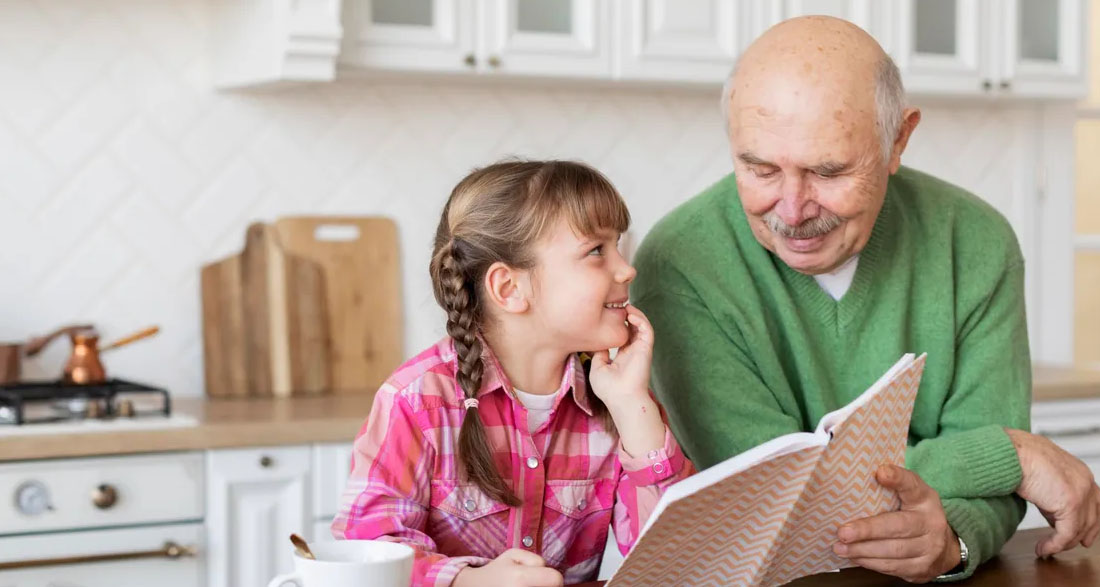
My granddaughter Lily used to run into Grandpa Jim’s arms the second she walked through our door. It was automatic, like a joyful little ritual.
So when she came to stay with us for a week and suddenly refused to hug him goodnight, I thought she was just tired—until she looked up at me in bed, eyes wide and serious, and whispered, “Grandma… he’s different.”
Lily had always adored my husband. She thought he hung the moon. The moment she stepped into our house, she’d bolt straight to him, arms flung wide, yelling, “I’m here!” as though she were reporting for duty.
She called him her “favorite person,” and Jim always pretended not to enjoy it—but I could see the pride in his eyes.
He taught her to ride a bike, to shuffle cards, even to whistle through her fingers. He let her wear his old baseball cap around the house like a crown, and she never failed to grin at him as though he was royalty himself.
Last month, my daughter Erin called me early on a Monday morning. Her voice was tight, almost frayed. “Mom, can Lily stay with you for a week?”
“Of course. Bring her tonight,” I said, smiling.
Erin hesitated. “Thank you. We’ve got work issues. It’s… complicated.”
I didn’t press. I knew when she said “complicated,” it meant a storm was brewing at home.
For the first three days, everything seemed normal. That evening, Lily exploded out of the car and sprinted up the driveway.
“GRANDPA!” she screamed.
Jim opened his arms, and she crashed into him so hard he grunted.
“Easy, kiddo,” he laughed. “You’re getting strong.”
“I’m seven,” she said, like that explained everything.
The first few days were full of pancakes, board games, and Jim letting her win—while Lily pretended not to notice. She laughed, he laughed, and everything felt ordinary.
But on the fourth day, something changed. Lily got quiet.
If Jim walked into a room, she followed silently, perched at the counter while he made coffee, narrating every step in a solemn little voice:
“First you scoop. Then you pour. Then you wait. Then you do not drink it because it’s yucky.”
Jim looked at me and chuckled. “See? I’m raising a critic.”
Dinner was different that night. She pushed peas around her plate, answering Jim’s questions with small, polite “yes” or “no.”
“Hey, Lil,” he said, trying to lighten the mood, “want to play cards after?”
“No hug tonight?”
“Maybe later,” she replied quietly.
Later, after brushing her teeth, she stopped in the hallway when Jim waited near the couch like he always did for her hug. She looked at him, shook her head once, and whispered, “I’m sleepy.”
Jim’s smile was strained.
Then Lily turned to me, voice barely audible: “Grandma… he’s different.”
I knelt beside her bed. “Different how, sweetheart?”
She swallowed hard. “I got up for water. I heard noises.”
My chest tightened. “Noises? What kind?”
She lowered her voice even more. “Like… when someone tries not to be loud. I peeked in the kitchen. Grandpa was at the table. His head was down. He was shaking. He had his hands on his face.” Her eyes glistened. “Grandpa never cries. He looked… small.”
I held her hand. “Thank you for telling me, Lily. You did the right thing.”
Her voice trembled. “Is he mad at me?”
“No,” I said firmly. “Not at all. Sometimes grown-ups cry. Even strong ones. It doesn’t mean you’re unsafe.”
“But he’s different,” she whispered.
“I know,” I said. “I’m going to talk to him, okay?”
Lily nodded, fingers clutching the edge of her blanket.
That night, I watched Jim more closely. He sat in his recliner, a book open but untouched, eyes staring at nothing. “You okay?” I asked.
“Fine,” he said, though the word sounded hollow.
The next day, I found him paused mid-card trick with Lily, annoyed at himself. Later, he was at his desk, papers scattered, shoving them into drawers too fast when he noticed me.
“Since when do you hide bills?” I asked gently.
“Bills,” he muttered, shutting the drawer hard.
That night, after Lily went to bed, I sat across from him at the table. “We need to talk,” I said.
“About what?” he asked, shoulders stiff.
“Lily. She saw you crying.”
His face went blank, then he looked away. “She shouldn’t have been up.”
“Jim. Tell me what’s going on,” I pressed.
“I was tired. I had a moment,” he admitted, voice small.
“A moment doesn’t make a child stop hugging you. She thinks something is wrong.”
He shook his head. “Kids are dramatic.”
“Don’t dismiss her. Tell me.”
“I—nothing,” he said quickly, voice cracking. “Drop it.”
I opened the drawer he had shoved shut so hard. Inside were papers, an appointment card, a pamphlet, and a printout with bold headings: Neurology. Cognitive assessment. Follow-up.
He froze in the doorway. “You went through my things.”
“I did. Because you wouldn’t tell me.”
A tense silence. Then he sagged. “They said it’s early. They love that word.”
“Early what?”
“Early dementia,” he whispered. “More tests. They said Alzheimer’s is possible. I’ve been forgetting things… names, why I walked into a room. I re-read, and it doesn’t stick.”
Tears welled in his eyes. “I didn’t want to be a burden. And Lily… she looks at me like I’m the safest place. I didn’t want that to change.”
I wrapped my arms around him. “You’re not a burden. And now we face this together.”
The next day, we called Erin and Daniel. Jim told them everything. “Honest. No more secrets that land on a child,” I said.
Erin hugged him, tears streaking her face. “We’re going to worry. That’s love.”
We made a plan: appointments, support, school notifications, insurance calls. Jim chose an “anchor” routine with Lily—something steady they could do even on hard days.
That evening, I explained gently to Lily. “Grandpa just might need more help sometimes. His brain gets mixed up, and that makes him sad. That’s why he cried.”
She nodded, wide-eyed. “Is he still Grandpa?”
“Yes. He’s still your Grandpa. Just might need extra help sometimes.”
Later, we walked into the living room. Jim knelt to her level. “Hi, kiddo,” he said, voice shaking.
“You’re still my favorite,” Lily said bravely.
“I’m lucky then,” he whispered, tears in his eyes.
“Are you scared?” she asked.
“Yes,” he admitted. “But I’m more scared of you doing it alone.”
“Then I’ll let you in,” she said firmly, “even when I don’t want to.”
Two days later, Erin picked up Lily. She hugged Jim before leaving, steady and serious, donning his old baseball cap like it mattered.
Later, the house emptied, and I drove to the cemetery, needing a place to feel fear and grief without holding it in.
The wind was sharp, the sky bright, but eventually, I made myself stand and walk back. My husband meant the world to me—I had to be there for him.
At home, Jim was in the kitchen with his book. “You okay?” he asked.
“No,” I admitted. “But I will be.”
He gave a small, tired smile. “Me too.”
I walked to him and wrapped my arms around him. He held me back, solid, warm, a steady anchor in a world suddenly uncertain. For now… he was still here.
