
Part 1:
My father did not raise his voice when he decided that I was worth less than my twin sister. That was exactly what made the moment so impossible for me to forget.
If he had shouted at me or slammed his hand against the coffee table in anger, I might have been able to tell myself that he had simply lost his temper. Perhaps I could have blamed his cruelty on stress or a bad day.
But he did none of those things.
Instead, he remained perfectly calm. He spoke in a gentle, reasonable tone that hurt far more than any scream ever could. He addressed me with the same steady voice he used when talking to bank officers or contractors about roof repairs and insurance payments.
“We are going to pay for Oakwood University,” he announced, looking directly at my twin sister, Brooke. “We will cover your full tuition, your housing, all your meals, and every other expense that comes up during your four years there.”
Brooke gasped and covered her mouth with both hands.
Although she acted surprised, I could tell that she had been expecting this generous offer. Her eyes were already shining with excitement.
My mother let out a happy cry and reached over to hug her. Within seconds, they were talking about campus tours, dorm decorations, and sweatshirts bearing the university’s name.
My father’s face filled with a rare expression of pride. He wanted everyone in the room to see how happy he was with his decision.
Then he turned toward me.
The warmth disappeared from his eyes as if someone had closed a book.
“Maya,” he said, folding his arms across his chest, “we have decided that we will not pay for your education at River Valley State.”
For several seconds, his words did not make sense.
I sat in our living room in Minneapolis, holding the college acceptance envelope I had carried home like a precious gift. I had spent months working toward this moment, imagining that my parents would finally be proud of me.
River Valley State was a respected public university with an excellent economics program. It was also much more affordable than many private colleges, which made it exactly the kind of practical choice my father always claimed to appreciate.
“I don’t understand what you mean,” I whispered.
My father leaned back in his leather chair and brought his hands together.
His name was Thomas Sullivan, and he owned a successful commercial flooring company. Throughout my childhood, he had taught us that money should always follow discipline and that emotions were useless when making important decisions.
He believed every choice could be justified as long as he presented it in a calm, logical way.
“Your sister has exceptional networking skills and social grace,” he explained, nodding toward Brooke. “Oakwood University will give her the perfect environment to maximize her potential. She knows how to connect with influential people, and that will open doors for her in the future.”
Brooke stood near the fireplace, looking at herself in the mirror as she adjusted her hair.
We shared the same green eyes and dark blonde hair. We had been born minutes apart, and strangers often struggled to tell us apart.
Yet somehow, our parents had always treated us as if we belonged to completely different worlds.
Brooke was the daughter they wanted everyone to admire.
I was the daughter they expected to manage on her own.
“And what about me?” I asked.
My voice trembled despite my best efforts to remain calm.
My mother suddenly became very interested in her lap. She would not look at me.
My father hesitated for a moment, and that tiny pause gave me a foolish spark of hope.
Perhaps he was going to explain that there had been a misunderstanding.
Perhaps he would tell me that they had already set aside money for my education, too.
Instead, he sighed.
“You are certainly an intelligent young woman, Maya,” he said. “However, you don’t stand out in the same way your sister does. We simply don’t see the same long-term return on this particular investment.”
I stared at him.
An investment.
That was the word he had chosen to describe my future.
He wasn’t trying to hide his reasoning or soften the blow. In his mind, he was simply making a practical financial decision.
Brooke was an investment.
I was an expense.
“So you expect me to figure everything out on my own?” I asked.
My father gave a small shrug.
It was the kind of gesture people make when they have decided that someone else’s pain is no longer their responsibility.
“You have always been the independent one in this family,” he replied.
Then he turned his attention back to the brochures for Brooke’s expensive university.
That was it.
The conversation was over as far as he was concerned.
Brooke’s phone buzzed with a notification, and she immediately began texting her friends to share the exciting news. My mother started discussing color schemes for the dorm room, and my father began comparing meal plans.
Their voices continued around me, but I could barely hear them.
The edges of the room seemed to blur.
I looked at the family photographs displayed on the mantel and suddenly saw them differently.
There was a picture of Brooke and me at six years old, wearing matching dresses. She stood in front while I was tucked slightly behind her.
Another photograph showed us celebrating our tenth birthday. Brooke was blowing out the candles while I stood beside her, clapping.
There was even a picture of Brooke with her new car at sixteen. I stood near the edge of the driveway, holding a secondhand tablet that my father had assured me worked perfectly well.
At the time, I had accepted these differences as small accidents.
Brooke needed the car because she had more social activities. I could take the bus because I was independent.
Brooke needed expensive summer programs because she had potential. I needed a job because it would teach me responsibility.
Brooke deserved opportunities because she stood out. I was supposed to be grateful for whatever I could manage alone.
I had spent my entire life finding explanations for the way they treated us.
Now, sitting in that living room with my college acceptance letter folded in my hands, I finally understood the pattern.
I had not imagined the favoritism.
I had simply learned never to give it a name.
That night, I sat alone on my bedroom floor with my back against the bed.
My window was open, allowing the smell of freshly cut grass and charcoal from a neighbor’s barbecue to drift inside. Outside, people laughed and enjoyed the warm summer evening.
Inside, I felt as if someone had removed something essential from my chest.
I expected to cry. I thought tears might help release the pain building inside me.
But I couldn’t cry.
The shock had frozen into something deeper than sadness.
Around midnight, I opened the old laptop that had belonged to Brooke before she decided she needed a newer model.
The fan whirred loudly, and the screen flickered several times before finally responding.
I typed a desperate search into the browser.
Full scholarships for independent college students.
The results filled the screen.
I opened one website after another, reading about merit awards, leadership fellowships, financial aid programs, and scholarships for students with limited family support.
The numbers frightened me.
Tuition, housing, textbooks, transportation, food, and other expenses seemed to form a wall that I had no chance of climbing.
But beneath the fear, I felt a small, stubborn spark of something else.
Control.
My father had made his decision. My mother had chosen to remain silent. Brooke had accepted the better future offered to her as naturally as she took a breath.
Nobody was going to knock on my bedroom door and announce that they had reconsidered.
Nobody was going to ask whether I was all right.
If I wanted an education, I would have to find a way to pay for it myself.
I pulled a notebook from my desk drawer and began writing down every number I could find.
Tuition.
Student fees.
Textbooks.
Rent.
Groceries.
Bus tickets.
I estimated how much I could earn from coffee shop shifts and cleaning jobs. I researched federal student aid and calculated how much I might qualify for.
The figures filled page after page.
They terrified me, but they also helped steady my mind. Every number represented a problem I could measure, and every problem I could measure was something I might eventually solve.
I continued working until the house became quiet and my parents’ voices disappeared from the hallway.
Sometime after two in the morning, I found a listing for a merit scholarship at River Valley State.
It was designed for students with significant financial need who demonstrated exceptional academic ability and determination. It offered full tuition coverage to a small number of applicants, but the requirements were demanding.
Applicants needed strong academic records, detailed personal statements, faculty reviews, and several interviews.
I saved the link.
Then I discovered something even more prestigious.
It was called the Vanguard Fellowship.
The program selected only twenty students from across the entire country. It provided a full financial stipend and academic placements at partner universities.
The fellowship could cover the cost of an education and help students gain access to opportunities they might otherwise never receive.
But when I read the requirements, I almost laughed.
The applicants were expected to have outstanding academic records, impressive achievements, excellent recommendations, and a clear record of leadership.
I had no expensive extracurricular programs on my résumé. I had never attended a prestigious summer camp. I had no influential family friends who could open doors for me.
I had a worn-out laptop, a part-time job, and a family that believed I was worth less than my sister.
Still, I bookmarked the page.
I refused to let my father’s cold calculation become the final calculation of my life.
“This is the price of my freedom,” I whispered into the darkness.
Only then did I finally lie down.
My sleep was restless, but for the first time since that awful conversation, I had a plan.
It was not a perfect plan.
It was not even a particularly realistic one.
But it was mine.
And that mattered more than I could have explained at the time.
The next morning, the house returned to its usual routine as if nothing important had happened.
Sunlight poured through the kitchen windows. My mother scrolled through bedding options on her tablet while Brooke ate strawberries from a crystal bowl.
“Do you think blush pink would be too childish for your new room?” my mother asked, holding up a picture.
Brooke tilted her head.
“Maybe cream and sage,” she suggested. “It looks more expensive and calm.”
My father smiled at them while reviewing the university’s meal plans.
“The rooms at Oakwood are probably a little small, but we can certainly make it work for you,” he said.
He spoke as though he were reviewing investment portfolios for his business.
I sat at the table, buttering my toast.
Nobody mentioned River Valley State.
Nobody asked whether I had found a way to pay for my education.
Eventually, my father left for work. My mother took Brooke shopping for university essentials, and they returned with bags from stores where I had never been allowed to shop.
That was how the rest of the summer unfolded.
Brooke’s bright future slowly filled every corner of our house with new luggage, designer towels, expensive bedding, and carefully chosen accessories.
My mother made cheerful lists.
My father transferred tuition deposits without complaining about the rising costs.
Brooke posted countdowns on social media, sharing her excitement about attending her dream university.
Meanwhile, I worked double shifts at a small bookstore near the river, saving every penny I could.
One afternoon, my mother paused in the doorway of my bedroom.
“How is your planning coming along, Maya?” she asked.
“It is going fine,” I replied without looking up from my scholarship applications.
She waited for me to say more.
When I didn’t, she smiled with visible relief.
“Good. I knew you would figure something out.”
Then she walked away.
I stared at the doorway long after she had gone.
My mother always seemed relieved when I didn’t explain how difficult things were. If I remained quiet, she didn’t have to confront the unfairness between her daughters.
If I managed on my own, she could continue believing that everything was fine.
I began noticing the old differences with a new sharpness.
When Brooke wanted something, it became a family project.
When I needed something, it became a lesson in independence.
When we were sixteen, Brooke received a car because she had more social activities. I received a bus schedule and praise for being responsible.
Brooke attended expensive leadership camps in California to strengthen her résumé.
I was told to take a summer job because earning money would build my character.
Even our mistakes were treated differently.
When Brooke struggled with something, my parents rushed to help her.
When I struggled, they reminded me that life was difficult and I needed to learn to handle it.
The worst confirmation came a few weeks later.
My mother had left her phone on the kitchen counter. I was walking past when a message on the screen caught my eye.
It was a message she had sent to her sister.
“I feel bad for Maya, but Thomas is right that Brooke stands out more, and we have to be practical.”
I stopped walking.
I read the words again.
Then I placed the phone exactly where I had found it and went upstairs without making a sound.
My mother hadn’t simply been too frightened to challenge my father.
She agreed with him.
She felt sorry for me, but not enough to stand up for me.
Something inside me changed that afternoon.
I didn’t break down.
I didn’t confront them.
Instead, the pain settled into a cold determination that would carry me through the coming years.
I was done waiting for my family to recognize my worth.
If I wanted a future, I would build one myself.
During the last week of summer, my parents flew to Boston with Brooke for her university orientation. They returned with photographs of ivy-covered stone buildings, beautiful lawns, and elegant campus halls.
My father even posted a picture on social media with a caption about how proud he was of Brooke’s bright future.
Friends and relatives filled the comments with congratulations.
Nobody asked about me.
I packed my entire life into two worn suitcases and a backpack I had bought from a thrift store down the street.
River Valley State was two hours away by bus.
My parents didn’t offer to drive me. They said they were exhausted from their trip to Boston and needed the weekend to recover.
“Call us if you need anything at all,” my mother said as she hugged me in the driveway with one arm. She was holding a coffee mug in the other.
I almost laughed.
We both knew I would never call them for help after what had happened in that living room.
My father handed me an envelope.
For one brief, foolish second, my heart lifted.
Perhaps he had changed his mind.
Perhaps he had decided to contribute something meaningful toward my education.
I thanked him and put the envelope in my backpack.
I waited until I reached the bus station to open it.
Inside was two hundred dollars in cash and a short note.
Be smart with your emergencies.
I stared at the note for a long time.
Two hundred dollars was not nothing. I knew that, especially with the amount of money I was trying to save.
But the note felt like another reminder that my father wanted to decide the limits of what I deserved.
I kept the money.
I needed it.
Then I tore the note into tiny pieces and watched the wind carry them across the pavement.
I boarded the bus with my suitcases and found a seat near the window.
As Minneapolis disappeared behind me, I looked down at my hands and made myself a promise.
I would never again measure my worth by what my family was willing to give me.
I would find my own way.
And someday, I would look back at this moment and understand that it had been the beginning of something far greater than I could imagine.
Part 2:
I arrived at River Valley State beneath a gray, rainy sky.
The campus was full of families carrying mini-fridges, boxes of bedding, and bags of groceries. Mothers cried into their children’s shoulders while fathers hauled suitcases into dormitories.
Students laughed as they greeted roommates and explored their new surroundings.
I dragged my luggage across campus alone.
Because university housing was too expensive, I had rented a tiny room in an old house a short distance away.
The stairs sagged beneath my feet, and the kitchen always smelled faintly of burnt onions. The landlord had painted the walls a pale yellow years earlier, but the color had faded in several places.
My room was barely large enough for a mattress, a desk, and a narrow wardrobe.
The floor slanted so noticeably that my chair rolled away from the desk unless I wedged a book beneath one of its wheels.
Still, the room was mine.
I unpacked my clothes, placed my textbooks on the desk, and arranged my scholarship applications in a folder.
Then I looked around and tried to feel hopeful.
I had no idea how difficult the next few years would be.
My alarm rang at four-thirty every morning.
By five, I needed to be at Morning Current, a café on campus where I had found a job.
The first few weeks were brutal.
I learned how to prepare complicated coffee orders while my brain was still half-asleep. I learned to move quickly between the espresso machine, the counter, and the register while my feet began aching before sunrise.
“Double oat latte with extra heat for the lady in the red coat!” I called one morning, forcing a smile as steam burned my fingers.
The customer barely glanced at me before taking her drink.
I wiped the counter and moved on to the next order.
My classes filled the rest of the day.
I sat in the front row of every economics lecture and statistics lab, determined not to miss a single detail.
I took careful notes, asked questions, and spent hours in the library reviewing material I didn’t fully understand.
I couldn’t afford to waste an opportunity.
Every minute of my education came at the cost of my sleep, my comfort, and the energy I had left after work.
On weekends, I accepted cleaning shifts in the residence halls.
I scrubbed bathrooms, emptied trash cans, and cleaned floors after parties. Sometimes I found abandoned food, broken cups, and sticky drink stains beneath beds and desks.
There were days when I felt strong and capable.
There were many more when I felt like a machine held together by caffeine and panic.
I learned which corner of the third floor of the library was quietest after nine in the evening. I learned which vending machines occasionally dropped an extra snack when someone pressed the right buttons.
I became an expert at stretching a small grocery budget.
A bag of rice could last for days. A jar of peanut butter could turn plain toast into a meal. If I bought discounted vegetables before they spoiled, I could make a large pot of soup that lasted most of the week.
I rarely bought anything for myself.
Even a new pair of shoes felt like an expense I couldn’t justify.
I never told my parents how difficult things were.
I could already imagine my father’s response.
“We told you this would be difficult for you,” he would say in that calm, judgmental voice.
He would use every struggle as proof that he had been right not to invest in me.
So I kept my problems to myself.
When Thanksgiving arrived, the campus emptied almost overnight.
Students packed their belongings into cars and headed home to families waiting with warm meals and clean beds.
The house where I rented my room became painfully quiet.
I stayed behind because a bus ticket to Minneapolis was a luxury I couldn’t justify.
I spent Thanksgiving alone in my room with a cup of instant noodles and a textbook open on my desk.
That afternoon, I called home.
My mother answered after several rings.
“Happy Thanksgiving, honey!” she said.
Behind her voice, I could hear laughter, clinking glasses, and the cheerful noise of a family gathered around a table.
“Happy Thanksgiving, Mom,” I replied. “Can I speak to Dad for a moment?”
There was a pause.
I heard her move the phone away from her mouth.
“Thomas, Maya is calling.”
My father’s muffled voice came through the background.
“I’m busy carving the turkey right now.”
My mother returned to the phone.
“He’ll have to call you back later, sweetheart. He’s right in the middle of dinner.”
I knew she was lying.
She had simply decided that speaking to me could wait.
“Okay,” I said quietly.
“Enjoy your evening, honey.”
“You too, Mom.”
I ended the call.
My father never called me back that night.
Later, I opened social media and saw a photograph of my family sitting around their Thanksgiving table.
My mother was smiling.
Brooke wore a new sweater, and my father had his arm around her shoulders.
They looked happy.
I counted the plates.
Three.
There were only three plates on the table.
I stared at the photograph until my phone screen went dark.
Then I set it down and sat in silence.
I had known that my family favored Brooke, but seeing that picture made the truth impossible to ignore.
They weren’t simply giving her more money.
They were building a life around her while treating my absence as something that required no explanation.
I turned back to my textbook.
I had an exam coming up, and I needed to study.
That was the only thing I could control.
My second semester was even harder.
The coursework became more demanding, and the long hours began taking a serious toll on my body.
I slept too little, ate too little, and pushed myself through every shift because I was terrified of falling behind on rent.
One morning at the café, I was preparing drinks when the room suddenly began to tilt.
The sound of the espresso machine grew distant.
The lights seemed to stretch into long, blurry lines.
I reached for the counter, but my hand missed it.
Then everything went black.
When I opened my eyes, my manager, Brenda, was kneeling beside me.
She looked frightened.
“Maya, can you hear me?”
I tried to sit up.
My head was spinning, and my arms felt strangely weak.
“What happened?”
“You fainted right in front of a dozen customers,” Brenda said, handing me a glass of cold water. “You’ve been working too hard.”
“I’m fine,” I mumbled. “I can get back to work.”
I tried to stand, but Brenda placed a firm hand on my shoulder.
“Absolutely not.”
“But I can’t miss my shift.”
“You are not going back to work today. You look like a ghost, and if you refuse to go home and get some rest, I will take you off the schedule until you do.”
I stared at her.
She folded her arms.
“I’m serious, Maya. Go home and sleep for ten hours. No studying, no cleaning jobs, and no arguing with me.”
I finally gave in.
I went home and slept for fourteen hours straight.
When I woke up, my body felt better, but panic quickly took over.
I had lost wages.
I had bills waiting to be paid.
I had a university education to finance.
Even rest felt dangerous when I was living so close to the edge.
Still, Brenda’s concern stayed with me.
She was the first person in a long time who had looked at me and seen someone who needed help rather than someone who should simply be more independent.
That semester, I also enrolled in an introductory economics course taught by Professor Robert Maxwell.
Professor Maxwell was a legend on campus.
He was known for asking difficult questions, demanding precise answers, and showing little patience for students who failed to prepare.
His lectures were challenging, but I admired him immediately.
He explained complicated economic ideas with remarkable clarity. His arguments were sharp, his expectations were high, and his red pen could tear apart a weak essay in seconds.
I wanted to impress him.
More importantly, I wanted to learn everything he could teach me.
For one assignment, he asked us to write a paper examining labor mobility and the economic forces that shaped people’s opportunities.
I chose to focus on the hidden subsidies of family wealth.
I argued that society often described success as the result of individual merit while ignoring the advantages that some people received long before they entered the competition.
One student might begin university with financial security, private tutoring, unpaid internships, and a family connection who could arrange a job interview.
Another might be working before sunrise just to afford textbooks.
Both could be intelligent and hardworking, but they were not starting from the same place.
I supported my argument with economic data and research.
I worked on the paper during every spare moment between my shifts, sometimes editing paragraphs in the café before opening and sometimes reviewing statistics in the library late at night.
When Professor Maxwell returned the assignments, I looked down at my paper and froze.
At the top of the page was an A-plus.
I had never received such a high grade from him before.
As the other students began leaving the classroom, he looked up from his notes.
“Please stay after class for a moment, Miss Sullivan.”
My heart began pounding.
Had I made a mistake in my calculations?
Had he discovered a problem with one of my sources?
I approached his desk, trying to keep my expression neutral.
Professor Maxwell tapped the pages of my paper.
“This is exceptional work,” he said. “But I want to know something. Where did you study before coming to River Valley State?”
“I attended a regular public high school in Minneapolis.”
He studied me for a moment.
“Did you have teachers who encouraged you to pursue economics?”
“Some did,” I answered. “But I mostly figured things out on my own.”
He nodded.
Then he asked a question I hadn’t expected.
“What kind of support do you have at home for your studies?”
I hesitated.
For a moment, I considered giving him the same answer I gave everyone else.
Everything is fine.
I’m managing.
I don’t need help.
But something about his expression made the usual response feel pointless.
“I don’t have any support,” I admitted. “My parents aren’t involved in my education.”
He leaned back slightly.
“How many hours do you work each week?”
I told him.
His expression changed.
His jaw tightened, and for the first time since I had met him, he looked genuinely angry.
“Why are you doing this the hard way?” he asked.
I gave a small, bitter laugh.
“Because my father told me my sister was a better investment. He said I wasn’t worth the cost of a private university.”
The words sounded almost unreal when I said them aloud.
I had repeated them in my head countless times, but speaking them to another person made their cruelty feel even clearer.
Professor Maxwell did not respond with pity.
Instead, he looked at me as if he wanted to set something on fire.
Then he reached into a desk drawer and pulled out a thick folder.
“Do you know why your paper was so good?” he asked.
“I assume it was because I followed your instructions.”
“No.”
He pushed the folder toward me.
“It was good because you understand effort as a reality rather than an inspirational slogan on a poster.”
I looked down.
The words VANGUARD FELLOWSHIP were printed across the cover.
For a moment, I forgot how to breathe.
I recognized the name immediately.
It was the prestigious fellowship I had discovered during that desperate night in my bedroom.
The program that selected only twenty students from across the country.
The program I had bookmarked and then convinced myself I could never win.
Professor Maxwell watched my reaction.
“I want you to apply for this,” he said. “It supports students who show exceptional promise despite significant constraints.”
I shook my head.
“I don’t think I can win something like that. I don’t have the right résumé or the right background.”
“Then stop deciding what you can achieve based on what you don’t have.”
I looked at him.
He leaned forward.
“People like your sister are often told that the world belongs to them. People like you are told to be grateful for the crumbs. Neither message is a measure of your ability.”
I swallowed hard.
“What if I apply and get rejected?”
“Then you will have applied,” he replied. “And you will still be exactly as capable as you are today. But if you never apply, you will have rejected yourself before anyone else gets the chance.”
I carried the folder home that afternoon as carefully as if it were made of glass.
For three days, I left it on my desk.
Every time I looked at it, I felt a mixture of excitement and fear.
The application seemed enormous.
It required detailed academic records, personal essays, recommendation letters, and several stages of evaluation.
I had spent so much of my life being told that I wasn’t exceptional that the idea of competing against the best students in the country felt almost absurd.
On the fourth night, rain hammered against my window so loudly that I couldn’t sleep.
I sat at my desk, opened the folder, and began reading every page.
The personal statement prompt asked applicants to describe a moment that had changed how they understood themselves.
I knew exactly what I wanted to write about.
I would write about the living room.
I would write about my father’s calm voice, my mother’s lowered eyes, and the moment I realized that my family had decided my future was worth less than my sister’s.
But I would also write about what happened afterward.
I would write about the smell of espresso at five in the morning.
About the aching feet and the endless shifts.
About eating instant noodles alone on Thanksgiving.
About the humiliation of cleaning bathrooms while classmates went home to comfortable lives.
And about the strange freedom that came from realizing I could no longer wait for someone else to give me permission to succeed.
For the first time, I wrote honestly about my life without trying to make my family look better.
When Professor Maxwell reviewed my draft, he circled several paragraphs.
“You are still protecting them,” he said.
I looked up.
“What do you mean?”
“You keep softening the truth because you don’t want to sound ungrateful or angry.”
He returned the pages to me.
“You can acknowledge that your parents made their own choices without pretending those choices didn’t hurt you. Tell the truth, Maya. The truth is enough.”
I revised the essay.
This time, I stopped apologizing for the life I had lived.
Brenda wrote one of my recommendation letters.
She described my reliability, my work ethic, and the way I continued showing up for my shifts even when I was exhausted.
Two of my professors also agreed to recommend me.
Their letters were so kind that I ended up crying over a sink full of dirty coffee mugs when I read them.
They described me as thoughtful, disciplined, intellectually curious, and unusually persistent.
For years, I had heard that I lacked the qualities that made a person worth investing in.
Now, people who had actually watched me work were telling me something entirely different.
I finished the application and checked every section three times.
Then, on a Wednesday afternoon, I submitted it from a computer in the library.
The confirmation page appeared on the screen.
My application had been received.
I leaned back in the chair and let out a long breath.
I had no idea whether I would win.
But I had finally done something that belonged entirely to me.
I had taken a chance on my own future.
And no matter what happened next, nobody could take that away.
Part 3:
Waiting for the Vanguard Fellowship results was its own kind of torture.
Every morning, I checked my email before leaving for work.
Every afternoon, I checked it again between classes.
Every night, I checked it one last time before going to sleep.
Nothing.
The weeks passed, and I forced myself to concentrate on the life directly in front of me.
I continued making lattes at Morning Current. I continued cleaning residence halls on weekends. I continued attending lectures, writing papers, and studying until my eyes burned.
Professor Maxwell reminded me that the fellowship process took time.
“Do not put your life on hold while you wait for a decision,” he told me after class one afternoon. “You have work to do regardless of the outcome.”
So I kept working.
Then, one morning at five o’clock, the email finally arrived.
I was standing behind the counter at Morning Current, waiting for the coffee to finish brewing before the morning rush.
My phone vibrated in my pocket.
I glanced at the screen and saw the fellowship’s name.
For a moment, I was afraid to open the message.
I wiped my hands on my apron and tapped the notification.
“Congratulations, Maya Sullivan. You have advanced to the finalist round.”
I read the sentence once.
Then again.
Then a third time.
I leaned against the counter and began laughing.
The sound came out so suddenly that I couldn’t stop. I laughed until tears filled my eyes and I struggled to catch my breath.
Brenda came rushing out from the back room.
“Maya? What’s wrong?”
I held up my phone.
“I made it to the finalist round!”
She grabbed the phone, read the message, and let out a scream.
“YOU DID IT!”
She threw her arms around me so enthusiastically that I nearly dropped the phone.
A customer standing outside the window looked in with confusion.
Brenda didn’t care.
She was celebrating as if I had already won the entire fellowship.
For the rest of the morning, I moved through my work with a strange lightness.
The world hadn’t changed yet, but the possibility of a different future suddenly felt real.
I told Professor Maxwell as soon as I could.
He smiled, although he tried to hide how pleased he was.
“Good,” he said. “Now the real work begins.”
The finalist round included an interview with a panel of five people.
They would ask about my academic work, my personal statement, my understanding of economics, and the challenges I had faced.
Professor Maxwell helped me prepare.
We met in empty classrooms after lectures, and he asked difficult questions until I could answer them without looking down at my notes.
He challenged my arguments and made me explain every assumption.
Whenever I hesitated, he pushed me to continue.
“Again,” he would say.
I would take a breath and try once more.
One afternoon, after I gave an answer that was technically correct but far too cautious, he stopped me.
“Confidence is not the same thing as arrogance, Maya. You need to stop hiding your hard work as if it were a secret.”
I looked down at my notebook.
“I don’t want to sound as though I think I’m better than everyone else.”
“You can respect other people without pretending you have achieved nothing. You have earned the right to speak about your own work.”
I carried that advice into the interview.
The meeting took place over a video call.
Five serious faces appeared on my screen.
They asked about my paper on family wealth and labor mobility. They questioned my understanding of opportunity, economic inequality, and the relationship between talent and financial security.
I answered as carefully as I could.
Then one of the interviewers asked me what success meant to me.
It was the question I had feared most.
For years, I had imagined proving my father wrong.
I had pictured him looking at me with regret, realizing that the daughter he had dismissed had accomplished something greater than he had expected.
But as I sat there, looking at the people who would decide my future, I realized that proving my father wrong was not enough.
If my entire life revolved around his judgment, then he would still be controlling my story.
So I took a breath.
“Success is not about proving my father wrong,” I said. “Because if that were my goal, he would still be the center of my story.”
The interviewers remained silent, listening.
“Success means building a life where my worth isn’t determined by someone else’s willingness to invest in me. It means using my abilities, contributing something meaningful, and creating opportunities that other people might not have had.”
I continued speaking until I had explained what I meant.
When the call ended, I sat still for several seconds.
Then I walked outside and found a quiet patch of grass near the library.
I sat down and stared at the trees.
I felt completely empty.
I had given everything I could to the application and the interview. Now there was nothing left to do but wait.
But for the first time in my life, I felt as though someone had truly seen me.
Not as Brooke’s twin.
Not as the independent daughter.
Not as a person who should be grateful for whatever she could manage.
They had seen me as myself.
That feeling mattered more than I had expected.
The final decision arrived on a Tuesday morning in April.
I was walking across campus with a coffee I had treated myself to for the first time in months.
I had been trying not to think about the fellowship results.
I had even begun preparing myself for rejection.
Then my phone vibrated.
I stopped walking.
The email was from the Vanguard Fellowship committee.
My hands began to shake.
I opened the message.
“We are pleased to inform you that you have been selected as a Vanguard Fellow for the class of 2025.”
For a moment, the campus seemed to disappear around me.
I sat down on the nearest bench and pressed both hands against my face.
I had won.
Out of applicants from across the country, I had been selected as one of the twenty fellows.
The fellowship would cover my tuition and provide a living stipend.
I would no longer have to work exhausting shifts just to keep a roof over my head. I could continue my education without constantly calculating whether I could afford groceries at the end of the week.
I could study.
I could research.
I could finally give my future the attention it deserved.
People walked past me, carrying backpacks and talking about their classes. Somewhere nearby, a group of students burst into laughter.
The world continued moving as if nothing had happened.
But everything had changed.
I called Professor Maxwell first.
He answered after two rings.
“Well?” he asked.
I could barely speak.
“I got it.”
There was a pause.
Then he let out a satisfied laugh.
“I knew you had a chance.”
“You didn’t tell me that!”
“I wasn’t going to tell you something you weren’t ready to believe.”
I laughed through my tears.
“Thank you,” I whispered. “For everything.”
“You did the work, Maya. Remember that.”
After the call, I contacted Brenda.
She celebrated so loudly that I had to hold the phone away from my ear.
That evening, I sat in my small room and looked at the notebook where I had once written down every terrifying expense I would need to cover.
The pages were still filled with numbers.
Rent.
Tuition.
Books.
Food.
Transportation.
I turned through them slowly.
Every number reminded me of how frightened I had been.
But they also reminded me of the person I had become while trying to survive.
I had learned to budget, to work, to study, to ask questions, and to keep going when nobody was cheering for me.
My father’s decision had forced me into a difficult life, but it had not made me less capable.
If anything, it had revealed strengths I might never have understood so clearly.
When I met with Professor Maxwell a few days later, he told me something I hadn’t expected.
“One of the benefits of the Vanguard Fellowship is the opportunity to complete your final year at a partner university,” he explained. “You can choose from several institutions, depending on your academic goals.”
He handed me the list.
I scanned the names.
Then I stopped.
Oakwood University.
The same university my parents had agreed to pay for Brooke to attend.
For a moment, I considered choosing somewhere else.
I could avoid the possibility of seeing my sister on campus. I could start over in a new place where nobody knew my family or the story behind my education.
But I realized that I didn’t want to make my decisions around Brooke anymore.
Oakwood had an excellent academic program and valuable opportunities for my research.
I wasn’t going there to get revenge.
I was going because it was a good choice for my future.
And I refused to avoid an opportunity simply because my family happened to be connected to it.
I chose Oakwood.
That fall, I transferred to the university for my senior year.
Walking onto the campus felt surreal.
The buildings were beautiful, with ivy climbing the stone walls and broad lawns stretching between the lecture halls.
Students carried expensive bags and drank coffee from fashionable cafés. Some seemed to have spent their entire lives surrounded by comfort and opportunity.
A few years earlier, I might have felt as though I didn’t belong among them.
Now, I knew better.
I had earned my place.
My fellowship covered my education, and I had a record of academic work that I was proud of.
I no longer needed to apologize for the fact that I had not arrived with the same advantages as everyone else.
I kept my head high and focused on my studies.
I also avoided the areas where Brooke usually spent her time.
I wasn’t ready for the inevitable conversation, and I wanted a little time to build my own life before our paths crossed.
For several weeks, I managed to do exactly that.
Then, one Thursday evening, everything changed.
I was studying near a window in the university library when I heard a familiar voice behind me.
“Maya?”
I looked up.
Brooke stood a few feet away, holding an iced coffee in one hand and a designer bag in the other.
Her expression was one of complete disbelief.
“What on earth are you doing here?”
I calmly closed my textbook.
“Hello, Brooke.”
She stared at me as if I had somehow appeared out of thin air.
“How are you here? Our parents never said a single word about this!”
“I transferred here for my senior year.”
She looked around the library, then back at me.
“But how are you paying for a university like this? Oakwood is expensive.”
“I won the Vanguard Fellowship,” I explained. “It covers my tuition and provides a living stipend.”
Her mouth fell open.
For several seconds, she said nothing.
Then she slowly pulled out the chair across from me and sat down.
She knew exactly what the Vanguard Fellowship was. Students at Oakwood discussed it as one of the most prestigious awards available to exceptional undergraduates.
She looked at me with a mixture of surprise and confusion.
“Why didn’t you tell us you were doing so well?” she whispered.
I considered the question.
There had been a time when I would have rushed to explain myself. I would have wanted her to understand how difficult everything had been and how desperately I had wanted my family to be proud of me.
But I didn’t feel that same need anymore.
“I wanted this achievement to be mine alone before I shared it with anyone else,” I replied.
Brooke lowered her eyes.
I gathered my books and stood.
“I have to go. I’ll see you around.”
I walked out of the library without waiting for her response.
My phone began vibrating before I had even reached the steps outside.
My mother called.
Then my father.
Then Brooke sent a message.
I ignored the calls and continued walking.
A few minutes later, another text appeared on my screen.
“Maya, you need to call us right now so we can talk about this.”
It was from my father.
I read the message once, turned off my phone, and went to sleep.
For the first time in years, I was not rushing to answer him.
I was not afraid that ignoring him would cost me something I needed.
I had built a life that did not depend on his approval.
And I was finally beginning to understand how that felt.
Part 4:
My father called again the following morning.
I was walking between classes when I noticed his name on my screen.
For several seconds, I considered letting the call go to voicemail.
Then I decided to answer.
I was no longer the frightened girl sitting in the living room, clutching an acceptance letter while waiting for him to change his mind.
I had nothing to prove to him.
“Maya,” he began, sounding unusually unsettled. “Your sister tells me that you’re at Oakwood and that you’ve won a massive scholarship.”
“That’s correct,” I replied.
I stepped beneath the shade of a large oak tree and watched students hurry past on their way to class.
“And I did it all without your investment.”
The words came out calmly.
That seemed to surprise him more than if I had shouted.
“I care about your future, Maya,” he said. “You should have told us you were struggling so we could have helped you.”
I almost laughed.
He was rewriting the past as if the conversation in our living room had never happened.
“You told me I wasn’t worth the money,” I replied. “I remembered those words every single day for the last three years.”
Silence followed.
For once, my father had no immediate explanation.
He had spent my entire childhood convincing me that every decision could be justified through logic. Now, the facts were simple, and he could not explain them away.
He had chosen to pay for Brooke’s education.
He had refused to pay for mine.
I had survived without his help and earned a prestigious fellowship.
There was nothing complicated about it.
After a long pause, he cleared his throat.
“Well, we’ll be there for graduation in a few months. We can talk about everything in person.”
Then he ended the call.
I stood beneath the tree for another moment before putting my phone away.
I didn’t feel triumphant.
I didn’t feel the rush of satisfaction I had imagined during my loneliest nights.
Instead, I felt tired.
I had spent years hoping that my father would recognize what he had done. Now that he was finally being forced to confront it, I realized that his understanding could not erase the experience.
I still had a great deal of work ahead of me.
And I intended to make the most of it.
My senior year at Oakwood became the strongest academic year of my life.
I worked closely with my professors, continued researching economic inequality, and wrote a thesis examining how unequal access to family resources affected educational and professional opportunities.
My own experience had shaped the questions I wanted to investigate, but I was determined to approach the subject with evidence rather than anger.
I studied the data.
I examined the research.
I interviewed people and compared their experiences with the broader economic patterns.
The work was demanding, but I loved it.
For the first time, I was able to focus on my education without constantly calculating how many hours I would need to work to afford the next month’s rent.
I still remembered those years at River Valley State.
I remembered the early mornings, the cleaning shifts, the cheap meals, and the fear that one unexpected expense could destroy everything I had worked for.
But those memories no longer controlled every decision I made.
They had become part of my story rather than the whole story.
In February, my academic advisor, Dean Patricia Lowery, asked me to come to her office.
I assumed she wanted to discuss my thesis.
Instead, she smiled as I entered and motioned for me to sit down.
“Maya, I have some wonderful news.”
I placed my notebook on my lap.
“What is it?”
She folded her hands on the desk.
“You have been selected as the valedictorian for the entire university.”
I stared at her.
For a moment, I couldn’t find the right words.
The valedictorian.
The student chosen to deliver the main student address at graduation.
I had never imagined such a thing when I arrived at River Valley State with two worn suitcases and a bank balance that made my stomach tighten.
Dean Lowery smiled at my stunned expression.
“You have earned this through your own merit and hard work,” she said. “Your academic record is exceptional, your research has made a real contribution, and I am proud to have you represent this graduating class.”
My eyes filled with tears.
“Thank you,” I managed to say.
She leaned forward.
“You should be proud of yourself, Maya. Not because of what anyone else thinks, but because you know how much work it took to get here.”
I left her office feeling as though I were walking on air.
For several minutes, I considered calling my mother.
Then I changed my mind.
I wanted my parents to discover the news at graduation, when the university announced my name in front of thousands of people.
It wasn’t because I wanted to humiliate them.
I simply wanted to experience the moment without worrying about their reactions.
For once, I wanted to stand in the spotlight without checking whether my family approved of the light.
The weeks leading up to graduation passed quickly.
I finished my thesis, completed my final assignments, and prepared my speech.
I thought carefully about what I wanted to say.
I could have described the difficulties I had faced and told the audience how hard I had worked.
But I wanted to speak about something larger than my own achievements.
I wanted to speak about the people who were overlooked because they lacked money, connections, or someone willing to believe in them.
I wanted to remind people that potential was not always easy to recognize.
Sometimes, it existed in students who worked before sunrise.
Sometimes, it belonged to people who studied in cramped rooms and worried about paying rent.
Sometimes, it grew quietly in places where nobody was watching.
My parents knew that I would be graduating from Oakwood, but they did not know I had been chosen as valedictorian.
They had purchased tickets for the ceremony and confirmed that they would attend.
Brooke would also be there.
I had not spoken to her much since our meeting in the library, although she had sent a few messages asking when we could talk.
I told her I would speak with her after graduation.
I needed time to understand what I wanted from our relationship.
Our childhood had placed us in competition with each other, even when neither of us had asked for it.
I didn’t want to continue that pattern.
But I also couldn’t pretend that everything had been harmless.
The day before graduation, I laid out my black gown and gold honors sash.
I placed my notes beside the bed and read my speech one final time.
Then I turned off the light and tried to sleep.
I wasn’t nervous about speaking in front of thousands of people.
I was nervous about seeing my parents.
I wondered whether my father would finally understand the damage he had done.
I wondered whether my mother would apologize for remaining silent.
And I wondered whether I would feel anything at all when they saw what I had accomplished.
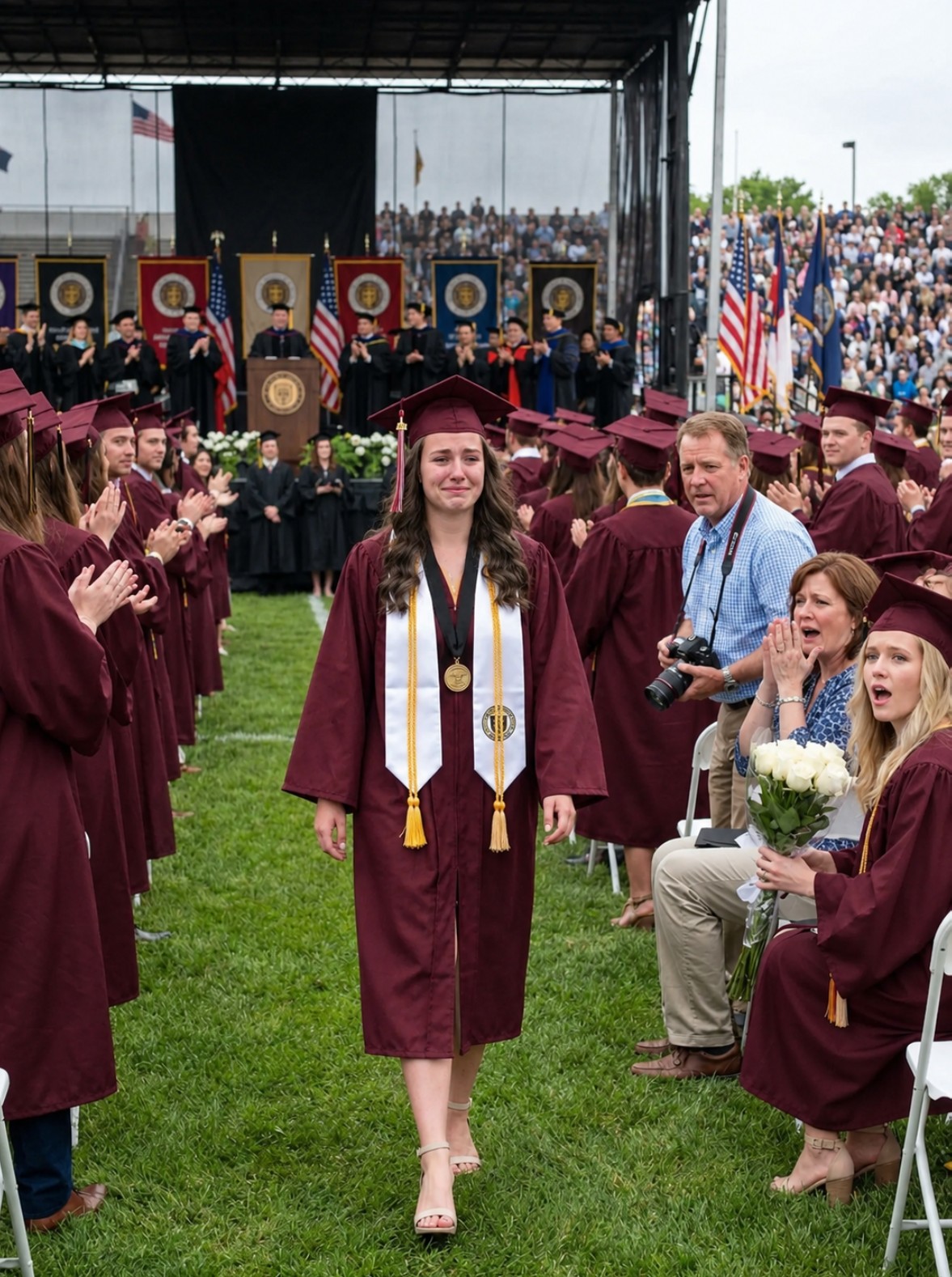
The next morning, the sky was bright blue.
The university stadium filled with thousands of people who had come to celebrate the graduates.
Families carried flowers, took photographs, and called out to students crossing the grounds in their gowns.
I walked into the stadium with my classmates.
My gold honors sash rested across my shoulders, and my graduation gown moved around my legs as I climbed the steps toward the seating area.
I spotted my parents in the front section.
My mother was holding a bouquet of roses.
My father had his camera ready.
An empty chair beside them appeared to be reserved for Brooke or one of her friends, although Brooke was sitting nearby with the other guests.
My parents were smiling proudly.
But they were looking toward the stage and the rows of graduates without knowing what was about to happen.
I took my seat and folded my hands in my lap.
The ceremony began with speeches from university officials.
Names were read.
Degrees were awarded.
The crowd applauded as graduates crossed the stage to receive their diplomas.
Eventually, the university president approached the microphone.
“And now,” she announced, “it is my pleasure to introduce the valedictorian of this graduating class.”
I stood.
My heart began pounding.
The president read my name.
“Maya Sullivan.”
The applause started immediately.
I began walking toward the stage.
Then I saw my parents.
My father had raised his camera to take a picture, but his hands slowly lowered as he realized what he was witnessing.
My mother’s hand flew to her mouth.
For the first time in my life, they were looking directly at me without comparing me to Brooke or measuring what I might be worth.
They were seeing what I had achieved.
I reached the podium and adjusted the microphone.
The stadium slowly fell silent.
I looked out at the crowd.
Then I looked toward the front row, where my parents sat frozen in their seats.
I began speaking.
“Four years ago, someone told me that I was not worth the investment.”
A few people shifted in their seats.
I continued.
“I was told that another person in my family had greater potential, better social skills, and a brighter future. I was told that investing in her education made financial sense, while investing in mine did not.”
I paused.
“I won’t tell you this story because I want sympathy. I tell it because I know there are people sitting in this stadium who have been made to feel invisible. People who have worked hard without recognition. People who have been overlooked because they did not have the right connections or the financial support that others took for granted.”
The crowd remained silent.
I could see students listening from the rows behind the faculty.
“Some of us begin our journeys with every advantage. We have families who pay our tuition, friends who open doors, and people who remind us that we are capable of great things.”
I took a breath.
“Others begin with almost nothing. They work before sunrise, study after exhausting shifts, and wonder how they will pay for the next semester. They may not have anyone waiting at the finish line to celebrate their success.”
My voice grew stronger.
“But the absence of applause does not mean the absence of potential.”
I looked across the stadium.
“Invisibility is not evidence of absence. Sometimes, your strength is forming in rooms where no one is clapping for you. Sometimes, the work that changes your life happens when nobody is watching.”
I thought of my tiny room at River Valley State.
I remembered the chair that rolled away from my desk, the instant noodles, the cold Thanksgiving evening, and the mornings when I had to force myself out of bed because exhaustion threatened to swallow me.
I remembered Brenda kneeling beside me on the café floor.
I remembered Professor Maxwell pushing the fellowship folder across his desk.
I remembered Dean Lowery telling me that I had earned my place.
None of those people had asked me to prove that I was worth helping before they offered me encouragement.
They had simply recognized that I was trying.
“And I want to leave you with one final thought,” I said. “Your worth is not determined by the people who fail to recognize it. Their inability to see your potential does not make that potential disappear.”
I looked toward the front row one final time.
“Keep working. Keep learning. Keep giving yourself the chance that someone else refused to give you. Because your future should never depend entirely on another person’s belief in you.”
I stepped away from the microphone.
For a brief moment, there was silence.
Then the stadium erupted.
People stood.
The applause spread through the crowd until it seemed to fill every corner of the stadium.
I saw students clapping, professors smiling, and strangers wiping tears from their eyes.
My classmates rose to their feet.
I stood at the podium, overwhelmed by the sound.
And in the front row, my parents remained seated for several long seconds.
My father held his camera loosely in his hands.
My mother was crying.
Neither of them seemed to know what to do.
For years, they had treated my success as something uncertain and my future as something that required no investment.
Now, thousands of people were standing to celebrate the daughter they had once dismissed.
I returned to my seat and listened to the remaining speeches, but my thoughts were elsewhere.
I had imagined this moment many times.
I had imagined my father regretting his decision.
I had imagined my mother finally understanding how deeply her silence had hurt me.
But the truth was that I felt no desire to celebrate their discomfort.
I was proud of what I had accomplished.
That was enough.
After the ceremony, graduates and families gathered at the reception area.
The air was filled with laughter, camera flashes, and the smell of flowers.
I was speaking with one of my professors when I noticed my parents approaching.
My mother still held the roses.
My father walked beside her with his hands in his pockets.
They looked older than I remembered.
Perhaps it was simply the weight of the moment.
Perhaps I was finally seeing them as imperfect people rather than the unquestionable authorities they had been throughout my childhood.
My father stopped in front of me.
For once, he seemed unsure of what to say.
“Maya,” he began.
I waited.
He looked down at the ground before lifting his eyes toward mine.
“I made a terrible mistake,” he said. “And I am so sorry for what I said to you.”
I studied his face.
I had waited years to hear those words.
But hearing them now did not erase the memory of that living room or the feeling of sitting alone with my college acceptance letter.
“It wasn’t a mistake, Dad,” I replied quietly. “It was a decision you made based on how you valued me.”
He swallowed.
“I thought I was being practical.”
“You were being practical about money,” I said. “But you were making a decision about your daughter. You decided that Brooke deserved your support because you believed she would give you a better return. You didn’t even give me the chance to show you what I could do.”
My father opened his mouth, then closed it again.
“I know,” he finally whispered.
My mother stepped forward.
Tears ran down her cheeks.
“I’m so proud of you, sweetheart,” she said. “You have no idea how proud I am.”
I looked at her.
A part of me wanted to accept those words without question.
Another part remembered the message on her phone.
I remembered her sitting silently in the living room while my father explained why I was not worth the money.
I remembered Thanksgiving, when she told me he was too busy carving the turkey to speak to me.
I remembered how relieved she looked whenever I insisted that I was managing.
“I’m glad you’re proud of me,” I said. “But I need you to understand something. Your pride is arriving now, after everyone else has applauded me. I needed your support when I had no awards, no fellowship, and no audience.”
My mother covered her mouth and began crying harder.
“I know,” she whispered. “I know, and I’m sorry.”
I took a slow breath.
I wasn’t ready to forgive everything in a single conversation.
And I didn’t owe anyone that kind of immediate forgiveness simply because they had finally recognized my success.
“I am moving to Philadelphia in two weeks to start a job as an analyst,” I told them. “I’m excited about it, and I’m going to build my own life. But I need some space from this family for a while.”
My mother looked frightened.
“Are you cutting us out of your life forever?”
“No,” I replied. “But I am setting boundaries. If you want a relationship with me, you will have to respect them.”
My father nodded slowly.
For once, he did not argue.
He did not tell me that I was being unreasonable or remind me that family was supposed to come first.
He simply stood there, holding the camera he had once intended to use to celebrate Brooke’s future.
I gave them a small nod and walked away.
My graduation day belonged to me.
I wasn’t going to spend the rest of it managing their guilt.
Part 5:
Two weeks later, I moved to Philadelphia.
My new apartment was small, but it was bright and clean. The windows overlooked a quiet street, and the kitchen had enough counter space for me to prepare meals without balancing everything on top of the refrigerator.
For the first time in years, I could wake up in the morning without immediately calculating how many hours I needed to work before I could afford to sleep.
I had a job as an analyst, a salary I could live on, and the beginning of a career that excited me.
I bought groceries without checking my bank account after every item.
I replaced the shoes I had worn through during university.
I purchased a proper desk and a comfortable chair that didn’t roll away from me.
These were ordinary things.
But after years of living with almost nothing, they felt extraordinary.
I could finally make plans without fearing that one unexpected expense would destroy everything.
I also began to understand that building a successful life was not the same as healing from the way I had been treated.
For a long time, I had believed that if I worked hard enough, achieved enough, and became successful enough, the pain would disappear.
It didn’t work that way.
Sometimes, I still thought about the living room.
I remembered my father’s calm voice and the way he had described my future as an investment that wasn’t worth making.
I remembered my mother’s silence.
I remembered the feeling of watching Brooke’s excitement while trying to understand why my own dreams had suddenly become less important.
Those memories did not vanish simply because I had a good job.
But they gradually became easier to carry.
I no longer needed to prove that my father had been wrong.
My life was already moving forward.
The letters and calls from my parents began to change over time.
At first, they were awkward.
My mother sent messages asking about my apartment and my new job. My father called occasionally to ask about work and whether I was settling into the city.
They sometimes slipped into old habits.
My father would offer advice I hadn’t requested, and my mother would try to smooth over uncomfortable subjects before we had fully discussed them.
When that happened, I reminded them of my boundaries.
“I want us to have a relationship,” I told them during one phone call. “But I can’t do that if we pretend the past never happened.”
My father was silent for a moment.
Then he said, “You’re right.”
It was a small response, but it mattered.
Over time, their apologies became more specific.
They stopped saying that they had only been trying to do what was best for us.
They stopped explaining that Brooke had needed more help because she was more outgoing or had greater social ambitions.
Instead, they began acknowledging what they had actually done.
My father admitted that he had judged our futures according to his own assumptions.
He had mistaken confidence for potential and quietness for a lack of promise.
He had assumed that Brooke’s social skills would make her more successful and that I would somehow manage without his support.
He had been wrong.
My mother admitted that she had known the decision was unfair but had been too afraid of confronting my father.
She had convinced herself that remaining silent was the easiest way to avoid conflict.
Now, she understood that her silence had also been a choice.
Neither apology erased what had happened.
But both were steps toward an honest relationship.
That winter, Brooke came to visit me in Philadelphia.
I was nervous before she arrived.
We had spent our entire childhood living beside each other while being treated so differently that it sometimes felt as though we had been assigned opposite roles.
She was the daughter who deserved investment.
I was the daughter who was expected to survive independently.
Even though I knew Brooke hadn’t made the decision about our tuition, I couldn’t pretend that her privileged position had never affected our relationship.
She had benefited from a system she had rarely been forced to question.
I wasn’t sure whether she understood that.
When she arrived, I took her to a café near my apartment.
We ordered coffee and found a table beside the window.
For a few minutes, we talked about ordinary things.
Her classes.
My job.
The weather.
The difficulties of finding decent coffee in unfamiliar places.
Eventually, Brooke placed her cup on the table and looked at me.
“I’ve been thinking about what happened,” she said.
I waited.
“I don’t think I understood how different our lives were.”
I looked down at my hands.
“We lived in the same house,” I said. “But we didn’t experience it the same way.”
She nodded slowly.
“I know.”
For a moment, she seemed to struggle with her words.
“At the time, I thought our parents were just helping us in different ways. They always told me you were independent, and I believed them.”
I took a breath.
“Being independent doesn’t mean you don’t need support. Sometimes it just means you’ve learned that asking for help won’t change anything.”
Brooke’s eyes filled with tears.
“I didn’t realize how much it cost you to be the quiet one,” she whispered.
The words stayed between us.
I had imagined hearing something like that for years.
But now that she was saying it, I didn’t feel the urge to list every unfair thing that had happened to me.
I didn’t need to make her suffer in order to make her understand.
“I’m glad we’re finally talking about it,” I replied.
She reached across the table and touched my hand.
“I’m sorry, Maya. I know I didn’t make the decision, but I benefited from it. And I should have asked more questions.”
I looked at my sister.
For the first time in a long time, I saw someone who was trying to understand me rather than someone whose life was being compared with mine.
“Thank you,” I said.
We spent the next few hours talking honestly about our childhood.
We discussed the car, the summer programs, the differences in how our parents responded to our problems, and the expectations they had placed on us.
Brooke admitted that she had sometimes felt pressure to be the perfect daughter because everyone expected her to succeed.
I listened.
Her experience did not erase mine, but I could finally acknowledge that she had carried expectations of her own.
We were not the same person.
We had never been the same person.
And we did not have to remain trapped in the roles our parents had assigned us.
When Brooke left that evening, we hugged outside the café.
It wasn’t a magical moment when every wound disappeared.
We still had years of resentment and misunderstanding to work through.
But it was a beginning.
My parents eventually came to Philadelphia as well.
We had dinner at a small restaurant near my apartment.
At first, the conversation was awkward.
My father asked about my work, my mother complimented the restaurant, and we discussed the weather as though we were strangers meeting for the first time.
Eventually, I decided that if we were going to rebuild our relationship, we needed to talk honestly.
“I don’t want to keep punishing you for the rest of our lives,” I told them. “But I also don’t want to pretend that everything was fine.”
My mother nodded.
“We understand.”
“I need you to understand that the hardest part wasn’t simply paying for college. It was knowing that you believed Brooke was worth investing in and I wasn’t.”
My father lowered his eyes.
“I thought I was making a rational decision,” he said. “I believed I was choosing the path that would give the best result.”
“But you weren’t investing in a business,” I replied. “You were raising two daughters.”
He nodded slowly.
“I know that now.”
I studied his face.
For years, I had wanted him to admit that he had been wrong.
Now, hearing him say it, I understood that an apology was only the beginning.
Trust would take time.
It would require consistent actions rather than a few emotional conversations.
My parents would have to learn to listen without immediately defending themselves. They would have to accept that my decisions belonged to me, even when they disagreed with them.
They would have to understand that I could love them while still refusing to let them control my life.
“I want us to have a relationship,” I said. “But it has to be different from the one we had before.”
My mother reached for my hand.
“We want that, too.”
My father looked at me for a long moment.
“I’m sorry, Maya,” he said. “Not just for what I said, but for making you feel as though you had to earn the right to be our daughter.”
That apology reached a place inside me that his earlier words had not.
I didn’t suddenly forget the years of hurt.
I didn’t pretend that one dinner could repair everything.
But I believed he was beginning to understand the real damage he had done.
And for the first time, I felt that there might be a way forward.
In the months that followed, we continued working on our relationship.
Sometimes, conversations went well.
Other times, old habits returned, and I had to remind them that I would not accept being treated as less important than my sister.
There were uncomfortable moments.
There were difficult phone calls.
There were times when my mother wanted everything to return to normal faster than I was ready for it to happen.
But I learned that boundaries were not punishments.
They were the conditions that allowed me to feel safe enough to remain connected.
I also learned that forgiveness did not mean pretending the past had been harmless.
I could forgive my parents without agreeing that their choices had been acceptable.
I could rebuild a relationship with Brooke without pretending we had experienced the same childhood.
And I could move forward without making my entire life a response to the way I had been treated.
For years, I had thought of my father’s decision as the moment that destroyed my future.
Now, I saw it differently.
That decision had revealed the limits of his vision.
He had believed that success could be predicted by confidence, social connections, and the appearance of potential.
He had assumed that the daughter who seemed more impressive would produce the better result.
He had failed to see that the quiet daughter sitting across from him was capable of extraordinary things.
But his failure to recognize my abilities had never meant those abilities did not exist.
I had been intelligent before the fellowship.
I had been determined before the awards.
I had been worthy of support before my name was announced at graduation.
Nothing I accomplished afterward created my worth.
It simply gave other people an opportunity to see what had always been there.
Today, I no longer wait for my parents’ permission to be successful.
I no longer measure myself against Brooke.
And I no longer believe that my value depends on what someone else is willing to give me.
I built my own future.
I earned my education.
I found people who recognized my potential when I had almost stopped believing in it myself.
Most importantly, I learned that being overlooked does not make you invisible forever.
Sometimes, the people who underestimate you are simply looking at the wrong things.
My father once believed that investing in me would bring him little return.
He could not have been more wrong.
But the greatest reward was not watching him regret his decision.
It was discovering that I could build a meaningful life without waiting for him to change his mind.
I am no longer the girl sitting alone on her bedroom floor, searching desperately for a way to pay for college.
I am the woman who learned to believe in herself when the people who should have believed in her refused to do so.
And I have finally understood something that I wish I had known all those years ago.
My worth was never something my father could calculate.
It was never something my mother could confirm through her approval or something my sister could diminish by receiving more.
I was worthy before I had a scholarship, before I stood on a stage, and before thousands of people applauded my name.
I was worthy when I was working at five in the morning.
I was worthy when I was eating instant noodles alone on Thanksgiving.
I was worthy when I had nothing but two worn suitcases, a notebook full of frightening numbers, and a dream I refused to abandon.
I had always been worthy.
I simply had to learn to see it for myself.
And now, no matter how much love or support my family may offer in the future, I will never again confuse their willingness to invest in me with the value of my life.
I have already invested in myself.
And the return has been greater than I ever imagined.
THE END.
