
Part 1:
The envelope arrived back at my apartment in San Francisco exactly three days after I had mailed it. I had sent it with so much hope, even though a small part of me had already expected the worst.
I recognized the heavy cream paper and the gold lettering immediately. I had chosen them carefully because I wanted my wedding invitation to feel like the foundation of a strong building, not just a simple request for someone to attend a ceremony.
But when I opened the envelope, my heart sank.
My invitation was gone. In its place was a jagged piece of notebook paper with my mother’s handwriting on it. I recognized that handwriting instantly. It was the same writing she had used on my school notes when I was a little girl.
Back then, I had thought her handwriting looked beautiful.
Now, the words written on that torn piece of paper felt colder than anything I had ever read.
“Do not bother because we will not be coming to this wedding.”
There was no greeting. No explanation. Not even a signature.
Just those words.
I stood in my kitchen, holding the note in one hand and the empty envelope in the other. As a structural engineer, I spent my days calculating exactly how much pressure a beam could withstand before it broke apart.
Standing there, I felt as if someone were performing the same calculation inside my chest. Every year of disappointment, every forgotten achievement, and every moment of rejection seemed to press down on me at once.
And for the first time in a long time, I felt my own foundation beginning to crack.
I reached into my work bag and pulled out my steel T-square. It was the only graduation gift I had ever received that meant anything to me, and I had bought it for myself because no one else had thought to give me a present.
I rubbed my thumb along its cold metal edge and thought about the Davis family back in Clearwater, Nebraska.
In our family, there had always been two daughters.
But only one of us had ever been treated like she truly belonged.
My sister, Kayla, was the golden child. She stayed close to home, married a local man named Cole, and had the kind of wedding our mother dreamed about for years. It was a huge church ceremony, complete with flowers, decorations, and enough guests to fill every pew.
My mother spent an entire year planning that wedding.
Kayla had beautiful blonde hair that seemed to catch the light wherever she went. Her laugh sounded like music, and she knew exactly how to charm the people around her.
Nobody ever called her a disappointment.
I was different.
I was the daughter who preferred physics books to fashion magazines. I would spend hours studying blueprints, solving equations, and trying to understand how buildings could stand tall against wind, rain, and earthquakes.
While Kayla dreamed about weddings and parties, I dreamed about designing structures that could survive almost anything.
I did not realize how differently my parents saw us until I was eleven years old.
That was the year our family planned a trip to a famous theme park.
I remember how excited Kayla was. She talked about the trip for weeks, especially about seeing the castle. My mother helped her pack her clothes, and my father checked the car while everyone discussed what rides they wanted to try.
I was excited, too.
For once, I thought we were going to do something together as a family.
The night before we were supposed to leave, my mother came into my bedroom and sat on the edge of my bed. She placed a hand on my knee and gave me a smile that did not reach her eyes.
“We only managed to get four tickets for the park, Maya, and you know how much Kayla has been looking forward to seeing the castle,” she said softly.
I stared at her, trying to understand what she was telling me.
There were five people in our family. My mother, my father, Kayla, me, and our younger brother, who was staying with our grandmother for part of the trip. Even without him, the explanation did not make sense to me.
I looked at my mother and asked the question I already feared the answer to.
“So I’m the one who stays behind with Grandma Rose while the rest of you go have fun?”
My mother nodded as if we were discussing something completely ordinary.
“You’re such a mature girl, Maya. I knew you would understand.”
Then she stood up, walked out of my room, and returned to packing Kayla’s bags.
I sat on my bed for a long time after she left.
I was only eleven, but something inside me had changed. I had begun to understand that love in our family did not always mean treating everyone equally. Sometimes, it meant deciding who mattered most and expecting the others to accept their place.
I spent that week with my grandmother, eating toast at her kitchen table and listening to her stories. She tried to make the time enjoyable, and I smiled whenever she took a picture of me.
But I knew what I was missing.
One afternoon, she took a photograph of me sitting on her porch in a cartoon T-shirt. I smiled for the camera because I did not want her to feel bad for me.
That photograph became the only record I had of that week.
Back home, Kayla had something very different. Her room held a thick leather album filled with pictures of our parents and her standing in front of the castle, wearing matching shirts and laughing together in the sunshine.
Whenever I saw those pictures, I wondered why there had never been enough room for me.
At first, I told myself that the trip had been an unfortunate mistake. Maybe the tickets had been difficult to get. Maybe my parents had simply made a bad decision.
I wanted to believe that because it was easier than accepting the truth.
But as I grew older, the pattern became impossible to ignore.
Whenever Kayla had a dance recital, both of our parents sat in the front row. My mother brought enormous bouquets of roses, and my father carried his camera so he could capture every moment.
They cheered for her as if she were performing on the biggest stage in the world.
When I won the state science fair and earned a place in the national rankings, I waited for the same excitement.
Instead, I received a short text message from my mother.
“That is nice, Maya”
There was not even a period at the end.
I knew she had probably sent it while helping Kayla choose a prom dress.
Still, I stared at those four words for a long time, hoping they might somehow become something more.
They never did.
When I received a full scholarship to the engineering program at a prestigious university, I thought that achievement might finally make my parents proud.
I had worked incredibly hard for that scholarship. I had spent countless nights studying, solving problems, and preparing applications while other teenagers went out with their friends.
The scholarship meant that I could attend university without asking my parents to pay for my education. It was my chance to build a future that belonged to me.
I brought the news home, expecting at least a little celebration.
My mother listened, then sat down at the kitchen table.
“A piece of paper will never keep you warm at night or provide you with a real family,” she told me.
I remember looking at her and wondering how she could make one of the happiest moments of my life feel like a failure.
I had earned a place at a university that would help me become the person I wanted to be, yet she made it sound as though I had chosen something worthless.
Kayla did not have to earn my parents’ approval. It seemed to follow her everywhere.
I had to work for every little bit of attention, and even then, I rarely received it.
Still, I kept trying.
I believed that if I built a successful life, created something beautiful, and became someone they could be proud of, they might eventually want to see the blueprints.
Maybe, I thought, one day they would understand me.
When I was sixteen, I took a job at a local diner. I worked double shifts for months, saving almost every dollar I earned.
My feet ached after long hours of standing, and sometimes I came home so tired that I could barely keep my eyes open. But I had a goal.
My mother loved a particular country singer. She often hummed the singer’s songs while working in the kitchen, and I thought it would be wonderful to surprise her with concert tickets for Mother’s Day.
I wanted to give her something she would remember.
When the day arrived, I handed her the tickets with a smile.
“I thought you would love these, Mom, since you always hum her songs in the kitchen,” I said.
For a moment, I thought she was pleased.
She looked at the tickets, then turned toward Kayla.
By the end of the conversation, my mother had decided to take my sister to the concert instead of the daughter who had worked for months to buy the tickets.
Later, when I asked her about it, she gave me an explanation I would never forget.
“You are the responsible one, Maya, so I knew you would understand why I needed to spend this time with your sister.”
Responsible.
That was the word my family always used for me.
It sounded like a compliment, but it was really a job description. It meant I was expected to carry the weight, accept the disappointment, and never complain about how heavy everything had become.
Kayla was allowed to need attention.
I was expected to need nothing.
By the time I graduated from high school, I had learned that waiting for my parents to change was like waiting for a broken bridge to repair itself.
I decided to leave Nebraska and build a life of my own.
The day after graduation, I packed two suitcases and prepared to move to San Francisco. I had eight hundred dollars, a place to stay, and a dream that seemed much bigger than the town I was leaving behind.
My father stood by the front door with his arms crossed as I carried my bags outside.
“Don’t come crawling back when you realize the city is too expensive for a girl like you,” he said.
I looked at him, waiting for him to say something else.
Maybe he would tell me to be careful. Maybe he would say he was proud of me. Maybe, for once, he would admit that he would miss me.
He said nothing more.
So I left.
During the ten years that followed, I never asked my parents for a single dime. I paid my own bills, worked through university, and built a career without their help.
I learned how to survive in a city where rent was expensive, competition was fierce, and nobody cared how difficult my childhood had been.
I became independent because I had no other choice.
But independence did not mean I had stopped wanting a family.
Even after everything, some part of me still hoped that one day my parents would look at the life I had built and finally see me.
That was why I sent the wedding invitation.
My name was Maya Davis, and I was about to marry the man I loved. I had chosen beautiful paper, elegant gold lettering, and a simple design that reflected everything I had worked so hard to become.
I knew there was almost no chance my parents would respond the way I wanted.
As an engineer, I should have known better than to test a bridge that had never carried even the smallest amount of weight.
But I mailed the invitation anyway.
Because somewhere inside me, the eleven-year-old girl who had been left behind with Grandma Rose was still hoping her parents would finally show up for the most important moment of her life.
Instead, the bridge collapsed.
A few hours after the envelope came back, my phone buzzed.
It was a message from Kayla.
She had sent me a photograph of my wedding invitation, shredded into tiny pieces and scattered across our parents’ kitchen table. Beside the scraps sat a half-empty cup of coffee.
My sister had taken the picture herself.
Underneath it, she had written:
“Mom says you shouldn’t embarrass yourself with such a fancy invitation, but the paper was actually quite nice, lol.”
I stared at the photograph.
The invitation I had chosen with so much care had been torn apart, and my sister thought the whole thing was funny.
That little “lol” hurt almost as much as my mother’s note.
It told me that Kayla was not simply staying out of the situation. She was enjoying it.
I tried to call my father, but the phone rang until it went to the same generic voicemail I had heard a thousand times before.
I did not leave a message.
I had no idea what to say to a man who had watched me leave home without ever telling me he was proud of me, and who now seemed perfectly willing to let me face another disappointment alone.
My apartment was quiet except for the traffic moving along the streets ten stories below my balcony.
I stood at the kitchen counter, looking at the torn envelope and the cruel little message on my phone.
I did not cry immediately.
Instead, I opened my laptop.
For the first time in my life, I stopped trying to figure out how to make my family love me.
I began thinking about what I needed to build next.
Part 2: The Life I Built Without Them
I arrived in San Francisco with eight hundred dollars, two suitcases, and a dream that was much bigger than the small Nebraska town I had left behind.
I had no wealthy parents to support me, no family connections to help me find a job, and no one waiting to catch me if I failed.
All I had was my determination.
Engineering school was difficult from the beginning. The workload was intense, the competition was fierce, and I often felt invisible in crowded lecture halls. Many of the students were men who seemed convinced that a woman had no business studying structural engineering.
One afternoon, a fellow student looked at my calculations and gave me a mocking smile.
“Who actually did your homework for you?” he asked.
I slowly raised my eyes from my notebook.
“I did the work myself because I’m better at calculus than anyone else in this room,” I replied without blinking.
He laughed, but I did not care.
I had spent my entire childhood being treated as though I were less important than my sister. I was not going to let a stranger make me feel small just because he could not accept that I belonged in the same classroom as him.
For four years, I studied harder than I had ever studied before. I spent long nights working through complicated equations, checking measurements, and learning everything I could about the forces that held buildings together.
There was something comforting about numbers.
A steel beam did not care about my family history. Concrete did not care whether I was my mother’s favorite daughter. An earthquake did not stop to ask whether I had received enough love as a child.
Materials followed the laws of physics.
If I calculated the forces correctly, chose the right materials, and designed the structure properly, the building would stand.
It was a kind of honesty I had rarely experienced at home.
I graduated at the top of my class.
When the ceremony ended, other students rushed toward their parents, who were waiting with flowers, cameras, and tears of pride. Families hugged each other while graduates posed for photographs.
I walked across the stage, accepted my diploma, and returned to my seat alone.
My parents had not come.
They had not even bothered to send a card.
After the ceremony, I went to a nearby shop and bought myself a high-quality steel T-square. I had used cheaper tools throughout university, but I wanted something that would last.
I held it in my hands and made myself a promise.
From now on, I would stop waiting for other people to recognize my worth.
I would build a life that stood on its own.
That autumn, a midsize engineering firm hired me. I threw myself into the work, determined to prove that I could handle projects other engineers considered too difficult.
I spent the next few years working on structures that needed careful assessment and reinforcement. Some buildings had suffered damage from earthquakes. Others had foundations weakened by shifting soil or years of neglect.
I learned how to recognize the smallest signs of failure before they became dangerous.
A hairline crack in concrete could reveal a much larger problem. A slight movement in a foundation could warn of a serious risk. Sometimes, the smallest detail was the one that mattered most.
I became very good at my job.
My colleagues learned that I checked my calculations carefully, asked difficult questions, and refused to sign off on work until I was satisfied that it was safe.
Eventually, I became known as an engineer who could make fragile structures withstand enormous pressure.
I could identify weaknesses in buildings and find ways to strengthen them.
Unfortunately, I still could not figure out how to repair my relationship with my parents.
I called home on every major holiday.
At Christmas, I asked my mother how she was doing. On Thanksgiving, I asked my father about the ranch. On birthdays, I tried to make conversations last longer than a few minutes.
But my mother always found a way to bring the conversation back to Kayla.
“Your sister has been doing so well with the house,” she would tell me. “And you should hear what the boys said at Sunday school last week. They were absolutely hilarious.”
I would listen, ask a few questions, and try to sound interested.
Sometimes, I even managed to forget that she had not asked me a single question about my own life.
Then her phone would ring.
“That’s your sister calling on the other line,” she would say. “I really need to check on her, honey. We’ll talk later.”
And just like that, the conversation would end.
My father was no better.
When I spoke to him, he usually gave me brief updates about the weather in Nebraska, the condition of the roads, or the cattle prices.
Our conversations sounded like the sort of small talk two strangers might exchange while waiting for a bus.
I sometimes wondered whether he knew anything about the projects I was working on, the buildings I had helped save, or the professional recognition I had earned.
I doubted it.
Still, I kept calling.
I was like a cantilevered beam, stretching out into empty space and relying entirely on my own internal strength to keep from falling.
I kept extending myself toward people who never seemed willing to reach back.
Then, one ordinary workday, I met someone who would change the way I understood family, love, and belonging.
His name was Liam Chen.
I was at a construction site in a busy part of San Francisco, conducting a seismic evaluation of a building. Liam was a cinematographer working on a documentary about urban growth, and his team had been given permission to film parts of the project.
He watched me examine the structure, take measurements, and discuss the building’s condition with the construction crew.
When I finished explaining something to one of the workers, Liam approached me with a camera hanging from his shoulder.
“Would you mind explaining what you’re doing in simple terms?” he asked. “Most people don’t understand how much work goes into keeping a building safe.”
I adjusted my hard hat and considered his question.
“I spend my life making sure the things people build don’t come crashing down on their heads,” I told him.
He laughed.
Not the mocking kind of laugh I had heard so often at school, but a warm, genuine laugh that made me smile before I could stop myself.
We talked for several minutes. He asked thoughtful questions about earthquakes, foundations, and the challenges of designing buildings in California.
For once, someone seemed genuinely interested in what I did.
He did not look at me as if I were strange for caring about equations and structural calculations. He listened as though my work mattered.
Before leaving, he asked whether I would be interested in getting coffee sometime.
I said yes.
Our first date was at a small noodle shop with steamed-up windows and tables crowded close together. The food was delicious, but what I remember most clearly is how easily I began talking to him.
I told him about growing up in Nebraska, about studying engineering, and about the complicated relationship I had with my family.
Eventually, I told him about the theme park trip.
I explained how excited I had been, how my mother had come into my bedroom the night before the trip, and how she had calmly informed me that I would be staying behind with Grandma Rose.
Liam stopped eating.
“So you were the one left behind on the porch while everyone else went to see the castle?” he asked quietly.
I nodded.
For years, I had told that story as if it were a funny little childhood disappointment. I had learned to describe painful things in a casual voice because I did not want people to think I was asking for sympathy.
But Liam did not laugh.
He did not tell me that I should be grateful to have had a grandmother who took care of me. He did not say that my parents had probably done their best.
He simply put down his chopsticks and looked at me.
“That must have hurt,” he said.
Those three words nearly broke my heart.
It was such a simple acknowledgment, yet I could barely remember the last time anyone had recognized my pain without immediately explaining why I should not feel it.
Liam did not try to fix my childhood. He did not make promises he could not keep.
He simply understood that something important had been missing from my life.
Over the following months, we grew closer.
I met his mother, Mei, and discovered that she was one of the most direct and caring people I had ever known.
The first time I visited her home, she prepared a large pot of spicy soup and placed a bowl in front of me before asking me several questions about my life.
She wanted to know where I grew up, what I did for work, and why my parents never visited me in California.
I gave her the usual excuse.
“They’re very busy with the ranch, Mrs. Chen,” I explained.
Mei looked at me for a moment.
She did not challenge my answer, but I had the feeling she could see straight through it.
“Well,” she said, pushing another dish toward me, “you should come back next Sunday. I’ll teach you how to make my favorite dumplings.”
I returned the following Sunday.
And the Sunday after that.
Before long, I had a place at her table. She remembered which foods I liked, asked about my projects, and wanted to know how my week had gone.
She did not treat my independence as a reason to leave me alone.
She seemed to understand that a person could be capable of taking care of herself and still need someone to care about her.
For the first time, I experienced what it felt like to be welcomed into a family without having to earn my place.
Then Liam proposed.
He chose the rooftop of a building I had helped save. We had been standing there near sunset, looking out over the city, when he turned toward me and took my hands.
He told me that he loved my determination, my curiosity, and the way I could find strength in situations that made other people give up.
Then he asked me to marry him.
I said yes before he had even finished asking the question.
As he slipped the ring onto my finger, I felt something I had not felt in years.
I felt safe.
The ground beneath my feet seemed solid, and for the first time, I could imagine a future that did not revolve around trying to win my parents’ approval.
We began planning our wedding.
I wanted something beautiful but meaningful. I chose a simple, elegant design and spent hours looking at venues and discussing details with Liam.
Eventually, I decided to send an invitation to my parents and Kayla.
I knew what they had done to me over the years. I knew how little interest they had shown in my achievements and how often they had made me feel like an outsider.
But a wedding seemed different.
It was a once-in-a-lifetime event, a chance for two families to come together and celebrate a new beginning.
I thought perhaps my parents would recognize the importance of the occasion. Maybe seeing me in a wedding dress would finally make them understand that their daughter had grown up and built a life of her own.
Maybe they would want to meet Liam.
Maybe they would want to be there for me.
When I showed the invitation to my friend Tasha, a senior engineer at my firm, she studied it carefully.
Tasha had known me for years. She understood how much I had struggled to build my career, and she had seen how hard I worked to maintain even a small connection with my family.
She watched me prepare the envelope before I took it to the mailbox.
“Are you sure you’re ready for whatever happens?” she asked.
I pressed the flap closed and looked at her.
“They’re my parents, Tasha,” I replied. “I have to give them one last chance to be the people I need them to be.”
She did not argue with me.
She simply gave me a worried look, as if she already knew what I was about to discover.
Three days later, my wedding invitation came back in pieces.
And with it came the answer I had spent thirty years trying not to hear.
Blood was not a load-bearing material.
No matter how much I wanted my family to support me, I could not build a stable life on a foundation that had never been there.
I had spent years trying to repair a structure that my parents had never intended to strengthen.
This time, I knew I had to stop.
But knowing something and accepting it were two very different things.
I still had one last phone call to make.
I called my father.
To my surprise, he answered.
“Maya,” he said, sounding tired before I had even spoken. “Your mother is very upset about this wedding.”
I waited.
“She’s upset because you’re planning such an expensive event while we’re struggling with cattle prices this year,” he continued. “You have to understand that we’re not exactly in the best financial position.”
I stared at the wall.
I had not asked my parents to pay for the wedding. I had not requested a gift, financial help, or even a contribution toward the flowers.
All I had done was send them an invitation.
“Are you actually telling me you can’t come because of the cattle prices?” I asked.
“It’s not that simple.”
“Then tell me what it is, Dad. Do you want to be there when I get married?”
There was a long silence.
I could hear faint background noise on his end of the line, but he did not answer.
Finally, he spoke.
“It’s complicated, Maya. You know I can’t just leave your mother here alone while she’s feeling so betrayed by your choices.”
I closed my eyes.
Betrayed by my choices.
I had worked for everything I owned. I had never asked them to pay my rent, support my education, or rescue me from a mistake.
I had simply chosen to live somewhere else and build a career.
Yet my father spoke as though my independence were an act of cruelty against the family.
“Okay, Dad,” I said quietly.
I hung up before he could offer another excuse.
For years, I had believed that my father was simply a quiet man who did not know how to express his feelings.
Now I understood that his silence was also a choice.
He had watched my mother favor Kayla. He had watched me leave home without support. He had watched me work for every achievement while my sister received praise for simply being herself.
And whenever I needed him to stand beside me, he found a reason to remain where he was.
“Complicated” was just another word for refusing to take my side.
My mother was even worse.
When she finally answered my call, she spoke in the polished, self-righteous voice she used at church committee meetings.
She sounded as though she were addressing a room full of people who had gathered to hear her explain why she was right.
“We are not coming to California to watch you marry a boy we don’t even know in a city that represents everything we hate,” she declared.
I held the phone tightly.
“He’s not just some boy, Mom. He’s the man I’m going to spend my life with.”
“You chose to move away from your family. You chose to build a life where we have no place. You cannot expect us to pretend that everything is wonderful now.”
“I never asked you to pretend anything. I asked you to come to my wedding.”
She let out a sharp breath.
“We’ll pray for your soul, Maya. Perhaps one day you’ll understand what you’ve done.”
Then she hung up.
I stood in the middle of my kitchen, staring at the phone.
A few hours later, Kayla called.
I almost did not answer, but some foolish part of me still hoped she might say something kind.
Instead, she launched straight into an accusation.
“You’re being incredibly selfish, Maya.”
I said nothing.
“Do you have any idea how much work I do around here? I’m the one who stays close to Mom and Dad. I’m the one who helps them. I’m the one who shows up when they need something.”
She paused, then continued.
“So don’t act like you’re the victim just because you’ve got a fancy job and live in California.”
I listened to her words and thought about all the years I had spent trying to earn a place in my own family.
Kayla had always been allowed to be the daughter who needed help, attention, and support. I had been expected to be the daughter who never needed anything.
Now she was using that same arrangement as proof that she deserved more than I did.
“I’m not going to argue with you, Kayla,” I finally said.
“Oh, of course not. You never want to admit when you’re wrong.”
I ended the call.
For once, I did not feel the need to explain myself.
I did not need to prove that I had worked hard, that I had paid my own way, or that I had never asked my parents for anything.
The calculations were finished.
The structure had collapsed, and no amount of effort on my part could change the result.
I walked into the kitchen, sat down on the floor, and finally allowed myself to feel everything I had been holding back.
My legs seemed to give out beneath me.
I pulled my knees toward my chest and tried to breathe, but the tears came anyway.
Liam found me there.
He did not ask me to explain what had happened. He already knew enough.
He lowered himself to the floor beside me and placed a hand on my shoulder.
For a while, neither of us spoke.
Then he leaned closer and whispered, “I’m not going to tell you it doesn’t matter, but I am going to tell you that I’m not leaving.”
I pressed my face into his shoulder and cried harder.
I had spent my entire life trying to convince people to stay.
For the first time, someone was telling me I did not have to convince him.
He was already there.
And he intended to remain.
Part 3: The Family That Chose Me
The next morning, I woke up feeling as though I had spent the night carrying a building on my shoulders.
My eyes were swollen, my head hurt, and I had barely slept. Liam was already in the kitchen, making coffee with a thermometer beside the kettle because he took his coffee almost as seriously as I took my engineering calculations.
I stood in the doorway for a moment, watching him.
Then I said the words I had been afraid to say the night before.
“I think I want to cancel the wedding.”
He turned off the kettle and looked at me.
“What?”
“I don’t see the point anymore. My parents aren’t coming. Kayla isn’t coming. I always imagined having my family there, and now I can’t stop thinking about the empty seats.”
I sat down at the kitchen table.
“I know I should be happy about marrying you, but every time I think about the wedding, all I can see is the fact that my own family doesn’t want to be there.”
Liam put down the thermometer and pulled out a chair.
He did not immediately tell me that I was being unreasonable. He did not insist that I should ignore my feelings or simply move on.
Instead, he looked me in the eyes and asked a question that stopped me cold.
“Is this because you don’t want to marry me, or because you’re letting their absence define your presence?”
I opened my mouth, but no words came out.
I wanted to tell him that he was wrong. I wanted to insist that I was simply being practical, that there was no reason to spend money on a wedding when the people I had wanted to share it with had rejected me.
But deep down, I knew he had touched the truth.
I still wanted to marry Liam.
I still wanted to stand beside him and promise to build a life together.
What I could not bear was the thought of celebrating something beautiful while carrying the pain of being unwanted by my parents.
I had spent so many years measuring my worth through their reactions that I no longer knew how to separate my happiness from their approval.
“I don’t know,” I finally admitted.
Liam reached across the table and took my hand.
“Then you don’t have to decide today,” he said. “You can be hurt. You can be angry. You can take your time. But don’t give them the power to decide whether we get to have a future together.”
I nodded, but his words did not immediately make everything better.
The next day, I went to work and tried to behave as though nothing had happened.
I answered emails, reviewed engineering plans, and attended meetings. I checked measurements and signed off on routine documents.
But my mind kept returning to my mother’s voice.
I heard her telling me that I had abandoned the family. I remembered my father’s silence and Kayla’s cruel message about the shredded invitation.
I was so distracted that I made a serious mistake in a soil classification report.
It was the kind of mistake I would normally have caught immediately.
Fortunately, Tasha reviewed the report before it was used for the next stage of the project. She spotted the error, corrected it, and came looking for me.
She found me staring at my computer screen.
“Maya, we need to talk,” she said.
I followed her into a private office, where she closed the door and sat on the edge of the desk.
“What’s going on with you? You almost never make mistakes like that.”
I looked down at my hands.
For a moment, I considered giving her some excuse about being tired or having too much work.
Then I remembered how exhausted I was from pretending that everything in my life was fine.
“My parents aren’t coming to my wedding,” I told her.
Tasha’s expression changed.
I explained what had happened, from the returned invitation to the phone calls and the accusations.
I told her about the theme park trip, the graduation ceremony, and the concert tickets I had bought for my mother when I was sixteen.
By the time I finished, I felt embarrassed by how much I had said.
“I don’t know why I still care so much,” I admitted. “I’m thirty years old. I have a career, a home, and a man who loves me. I should be able to get over this.”
Tasha shook her head.
“Why should you have to get over it just because you’re an adult?”
I looked at her.
She took a slow breath before continuing.
“My parents didn’t come to my citizenship ceremony because they said a piece of paper didn’t make me an American,” she told me.
I had never heard her talk about that before.
“I wanted them there so badly. I thought if they watched me take that oath, they might finally understand how much it meant to me. But they didn’t show up.”
She looked down at her hands.
“For a long time, I kept telling myself that maybe I hadn’t explained it properly. Maybe I should have called them again. Maybe I should have chosen a different date.”
She gave a small, sad smile.
“Eventually, I realized that I couldn’t make them care about something they had already decided wasn’t important.”
I listened quietly.
“Sometimes, Maya, home isn’t the place where you were born,” she continued. “Sometimes, home is the place where you’re actually welcome.”
I thought about the apartment I shared with Liam. I thought about Mei’s kitchen, where a bowl of soup and a place at the table were always waiting for me.
Then I thought about my childhood bedroom in Nebraska.
For years, I had called that house home simply because it was where I had grown up.
But the word suddenly felt different.
Perhaps home was not a place I had lost.
Perhaps it was something I had been building elsewhere all along.
That evening, I returned to my apartment and looked at the steel T-square resting on my desk.
It had been with me through university, my first engineering job, and countless difficult projects.
I had always thought of it as a symbol of my independence.
But that night, when I thought about the torn wedding invitation, I suddenly felt furious.
I was angry at my mother for making me feel unwanted. I was angry at my father for never standing up for me. I was angry at Kayla for laughing at my pain.
Most of all, I was angry at myself for spending so many years believing that if I worked hard enough, achieved enough, and asked for little enough, they might finally love me the way I wanted.
I picked up the T-square and threw it at the wall.
The metal struck the drywall with a sharp sound and stuck there at an angle, leaving a small hole around its edge.
For a second, I simply stared at it.
Then my knees buckled.
I sank to the floor and began to cry.
I cried for the eleven-year-old girl who had watched her family leave without her. I cried for the teenager who had worked double shifts to buy her mother a gift, only to watch her sister enjoy it instead.
I cried for the graduate who had walked across a stage without her parents, for the young engineer who had celebrated her achievements alone, and for the woman who had sent a beautiful invitation to people who responded by tearing it apart.
I cried because I had spent so long trying to be strong that I had forgotten I was allowed to be hurt.
And I cried because I finally understood that no achievement would ever force my parents to become the people I needed them to be.
They might never change.
I could spend another thirty years trying to earn their approval, but that would not make them love me differently.
I had to stop building my life around a foundation that would never support me.
Three days later, there was a knock at my apartment door.
When I opened it, Mei stood in the hallway carrying a giant pot of soup, several containers of side dishes, and a bag that looked heavy enough to contain an entire grocery store.
She stepped inside before I could properly greet her.
“Move aside, Maya. This soup is heavy, and I am not getting any younger,” she announced.
I almost laughed.
She placed everything on the kitchen counter and began arranging the containers.
“I heard what happened,” she said.
I looked down.
“I’m sorry Liam told you.”
“He didn’t tell me everything. I have eyes, Maya. I have watched you for years, and I know what it looks like when someone is trying very hard not to fall apart.”
She pulled out a chair and motioned for me to sit.
Then she told me a story I had never heard before.
“When I was young, I left my home with almost nothing,” she began. “I thought I could build a better life somewhere else. But my mother was furious with me. She believed I had rejected everything she had sacrificed for our family.”
Mei paused and looked at me.
“She told me I was dead to her.”
I stared at her.
For the first time, I understood that Mei knew something about family rejection that I had never imagined.
“What happened?” I asked.
“I didn’t see my mother for fourteen years,” she replied. “Fourteen years, Maya. I spent so much time thinking about what I would say if I ever saw her again. I imagined that she would apologize, that we would cry together, and that somehow everything would return to the way it had been before.”
She shook her head.
“By the time she finally came to visit me, I had already built a world she didn’t recognize. I had a home, a business, friends, and a son. I had become someone she had never expected me to be.”
Mei looked around my kitchen.
“Life does not stop while you wait for someone to change.”
She reached into her bag and pulled out a thick photo album.
Its cover was worn, and the pages had softened from years of use. She opened it and began showing me pictures of Liam as a little boy.
There he was, standing in front of a birthday cake with frosting on his nose. In another photograph, he was missing two front teeth and holding a toy car. There were pictures of family dinners, holidays, and ordinary afternoons that had become precious memories.
Mei also showed me photographs of her dry-cleaning shop, the small business she had built with hard work and determination.
I watched her turn the pages, feeling something warm and unfamiliar settle inside me.
These were not photographs of perfect people living perfect lives.
They were pictures of people who had shown up for one another.
People who had made memories, stayed connected, and built something that mattered.
Then Mei turned to the last page.
There was a photograph of me at a summer barbecue at her house.
I was sitting outside with Liam and several members of his family, laughing while holding a cob of corn. My hair was a mess, my face was bright with happiness, and I looked completely relaxed.
I had forgotten that someone had taken that picture.
Mei tapped it gently.
“You are already in our book, Maya,” she told me. “So stop looking for your name in a book that has been closed for a long time.”
I felt my throat tighten.
She leaned forward.
“You have spent so much of your life trying to prove that you deserve a place at your parents’ table. But look at this photograph. Look at your face. When was the last time you looked that happy in Nebraska?”
I could not answer.
“Family is not only about who shares your blood,” Mei continued. “It is also about who makes room for you. Who remembers you. Who notices when you are hurting. Who brings soup when you are too tired to stand.”
She pushed a bowl toward me.
“Now eat before it gets cold.”
I laughed through my tears.
And then I ate.
That evening, I told Liam that I wanted to go ahead with the wedding.
He looked at me carefully.
“Are you sure?”
I nodded.
“Yes. But I don’t want to do it to prove anything to my parents anymore. I don’t want to make them jealous or show them what they’re missing. I want to marry you because I love you.”
He smiled and kissed my forehead.
“Then that’s exactly what we’ll do.”
For the first time since the invitation had come back, I felt excited about our wedding again.
The empty seats no longer seemed like the most important part of the day.
Instead, I began thinking about the people who would actually be there.
Liam.
Mei.
Tasha.
The friends who had supported me, the colleagues who respected me, and the people who had become part of my life without asking me to prove that I deserved their affection.
I realized that I had spent years counting the people who were missing.
Now it was time to appreciate the people who had chosen to stay.
Part 4: The Wedding on the Edge of the Ocean
Once I had made my decision, the wedding planning began to feel different.
I stopped worrying about how my parents would react. I stopped imagining what they might say if they saw the photographs. I stopped wondering whether they would eventually regret refusing to come.
Instead, Liam and I focused on creating a day that reflected our relationship and the life we wanted to build together.
We had originally planned a modest ceremony, but an unexpected offer changed everything.
One of my clients, a wealthy man named Bernard, had hired my engineering firm to assess his mansion in Big Sur after a serious landslide threatened the property.
The house stood on a dramatic stretch of coastline, with steep cliffs overlooking the Pacific Ocean. The land was beautiful, but the slope beneath part of the property had become unstable after heavy rainfall.
Bernard was understandably worried.
I worked with the project team to investigate the ground conditions, assess the risks, and develop a plan to protect the structure. The work required careful analysis because even a beautiful house could become dangerous if the ground supporting it began to move.
After the necessary assessments and reinforcement work, we helped protect the mansion from further damage.
Bernard was grateful.
During a conversation several weeks later, he learned that Liam and I were struggling with our wedding plans because my parents had refused to attend.
He listened while I explained that we were going ahead with the ceremony, although we were still deciding on the location.
Then he surprised me.
“You made sure my house stayed on this cliff,” he said. “The least I can do is let you stand on that cliff to start your new life.”
I stared at him.
“What do you mean?”
“I mean that you can have your wedding at my estate in Big Sur. I’ll make the property available to you.”
I was speechless.
The estate was breathtaking, with sweeping ocean views, beautiful gardens, and dramatic cliffs that seemed to stretch endlessly along the coast.
It was far more luxurious than anything Liam and I had originally imagined.
But what moved me most was not the size of the property or its value.
It was the fact that someone who was not related to me had offered to do something so generous simply because he wanted me to be happy.
I thanked Bernard, and he waved away my gratitude.
“Consider it a small thank-you for the work you did,” he said. “Besides, I can’t think of a better place to begin a marriage than somewhere that reminds you how beautiful life can be.”
Liam and I accepted his offer.
We decided to keep the ceremony simple despite the extraordinary setting. I chose a silk wedding dress that was elegant without being overly decorated. I wanted to feel like myself rather than someone playing a part in a grand performance.
For the flowers, I made a decision that surprised some of our friends.
I wanted Nebraska wildflowers.
They reminded me of the place where I had grown up, but they also represented something important to me. I did not want to pretend that my childhood had never happened. I simply wanted to keep the parts of it that still held beauty.
The flowers would be my way of carrying something good from my past into my future without carrying the pain that had come with it.
As the wedding day approached, I found myself thinking about how much had changed.
For most of my life, I had imagined that my wedding would be the moment when my family finally recognized my worth.
I had pictured my father walking me down the aisle, my mother crying as she watched me exchange vows, and Kayla standing beside me as a sister who was genuinely happy for me.
I had believed that if I created a beautiful enough occasion, perhaps they would finally see me differently.
Now, those dreams were gone.
But something better had taken their place.
I was no longer waiting for permission to be happy.
On the morning of the wedding, I stood in front of the mirror and looked at myself in my silk dress.
For a moment, I remembered the little girl sitting on her grandmother’s porch while the rest of her family visited the theme park.
I wished I could reach back through time and tell her something.
I wished I could tell her that she would grow up to become an engineer, that she would design and protect buildings, and that she would learn to stand on her own.
I wished I could tell her that one day, she would meet a man who loved her without making her compete for his attention.
And I wished I could tell her that she would eventually find people who would make room for her at their table.
Most of all, I wanted to tell her that none of it would happen because she finally became good enough for the family that had rejected her.
It would happen because she stopped believing that their rejection defined her worth.
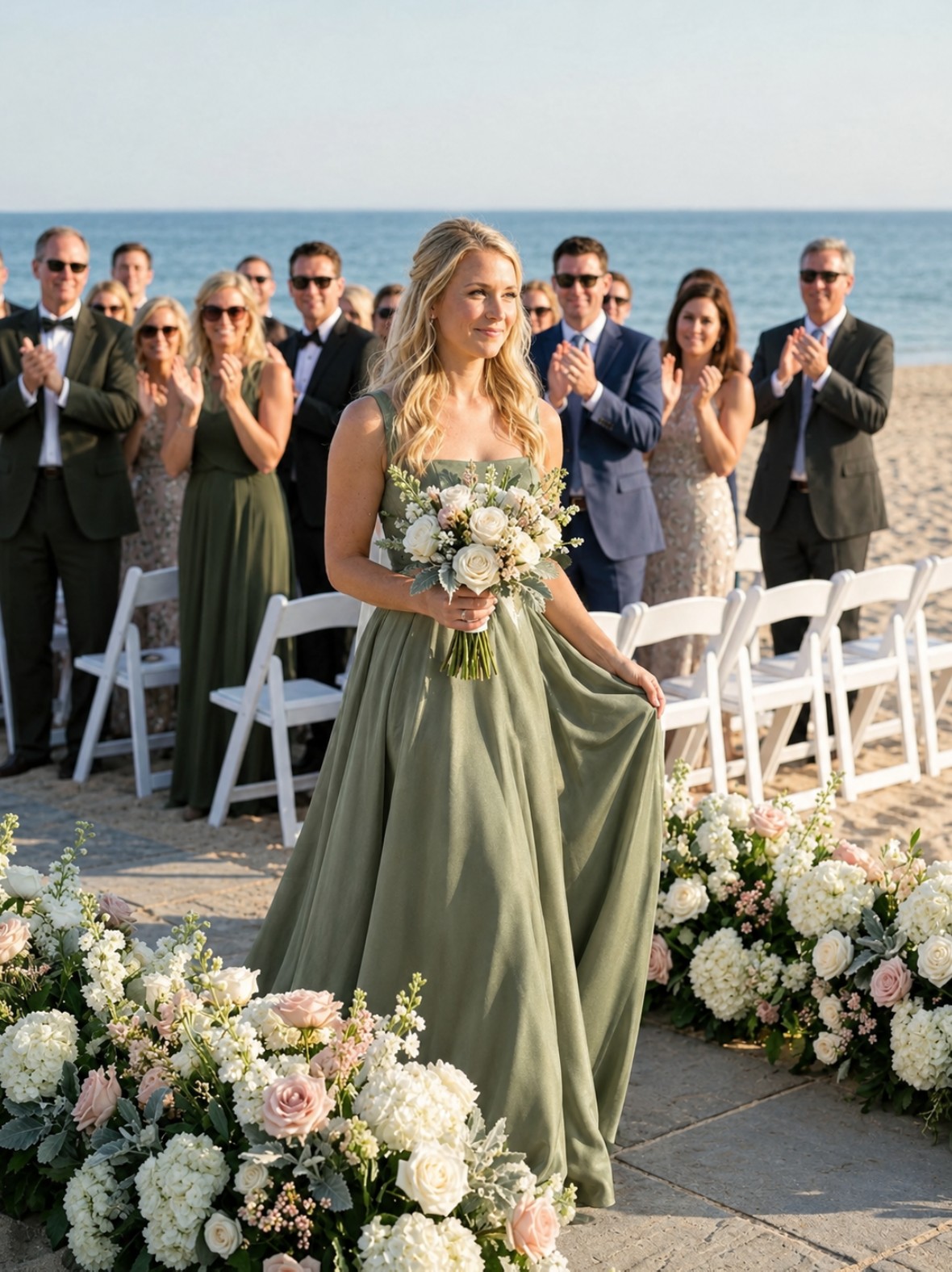
When the ceremony began, I walked down the aisle alone.
Some people might have seen that as a sad detail, but I did not.
I had spent my entire life waiting for someone to lead me toward a future I was already capable of building myself.
I did not need my father to walk beside me to prove that I deserved to be there.
I had brought myself through every difficult year, every lonely night, and every moment when giving up would have been easier.
As I walked toward Liam, I felt proud of the woman I had become.
The ocean stretched behind him, its waves crashing against the cliffs below. The breeze moved through the wildflowers, and the sunlight reflected off the water.
Liam stood waiting for me with tears in his eyes.
Mei sat among the guests, smiling so brightly that I could see her joy even from a distance. Tasha was there, too, along with friends and colleagues who had become an important part of my life.
These were the people who had listened when I spoke, who had celebrated my achievements, and who had stayed when I was hurting.
They were not there because they felt obligated to attend.
They were there because they wanted to be.
When I reached Liam, he took my hands.
For a moment, I forgot about Nebraska, the shredded invitation, and all the years I had spent hoping my parents would finally be proud of me.
I looked at the man in front of me and knew that I was exactly where I belonged.
Our vows were simple.
We promised to support each other, to listen even when conversations were difficult, and to build a life in which neither of us would have to earn the right to be loved.
When Liam kissed me, the people around us began to cheer.
I heard Mei laughing and Tasha clapping. Someone shouted congratulations, and I found myself laughing, too.
The sound of the ocean filled the spaces between the voices.
For the first time, my wedding day was not about the people who had refused to come.
It was about the people who had shown up.
A friend of Liam’s filmed the ceremony, capturing the ocean, the flowers, the guests, and the moment we exchanged our vows.
A few days later, the footage began spreading across the internet.
At first, Liam and I thought a few friends had shared the video because they liked the scenery. Then more people began watching it. Eventually, the story caught the attention of national news outlets.
The wedding became a widely shared story about a self-made woman who had overcome a difficult childhood and found her own family far from the place where she grew up.
People were moved by the image of a bride walking alone toward the man she loved, with the Pacific Ocean stretching behind them.
Some viewers focused on the beautiful setting. Others were touched by the wildflowers and the simple vows.
Many were drawn to the deeper story: a woman who had spent her life seeking approval from people who would not give it, only to discover that she did not need their permission to build a happy future.
I received messages from strangers who told me that my story reminded them of their own experiences.
Some had been rejected by parents. Others had been treated as less important than siblings. Some had spent decades trying to win the approval of family members who never seemed satisfied.
They told me that watching the wedding had made them feel less alone.
I did not expect any of that.
I had never set out to become a symbol of anything. I had simply wanted to marry the man I loved in a place that felt meaningful to us.
But the story had taken on a life of its own.
And while people across the country were watching the footage, something unexpected was happening back in Clearwater, Nebraska.
My parents were watching, too.
Part 5: The Phone Calls Came Too Late
My parents saw the wedding footage in their living room.
By then, the story had reached national news outlets, and the ceremony was being described as an inspiring example of a woman who had built her own life despite being rejected by her family.
For the first time, my parents were seeing a part of my life they had never bothered to understand.
They saw the oceanfront estate in Big Sur. They saw the guests, the flowers, and the elegant setting.
They heard people talk about my engineering career and the work I had done to establish myself in San Francisco.
They learned that the wedding had taken place at a forty-million-dollar estate.
And suddenly, my mother seemed very interested in her daughter’s life.
My phone began buzzing the next morning.
I was sitting at home with Liam, looking through photographs from the ceremony, when I noticed a string of missed calls.
Fourteen calls from my mother in one hour.
There were messages from my father, too. He had even left a missed call, something he almost never did.
I stared at the screen.
For years, I had waited for those calls.
I had waited for my mother to ask about my work, for my father to express interest in my life, and for Kayla to show genuine happiness for something I had accomplished.
Now, suddenly, they all seemed to want my attention.
I did not answer immediately.
A few minutes later, a voicemail arrived from my mother.
I pressed play.
“Maya, sweetheart, we saw the video of your wedding,” she began.
Her voice sounded different from the one I had heard during our last conversation. It was softer, almost affectionate.
“We had no idea it was going to be such a big deal. That estate was absolutely beautiful, and everything looked so wonderful.”
She paused.
Then she continued.
“If we had known it was going to be televised and that so many people would be watching, we would have come. You have to understand that we didn’t realize what you were planning.”
I sat very still.
She had not said she was sorry for tearing up my invitation.
She had not apologized for the years of neglect, the theme park trip, or the way she had treated my achievements as unimportant.
She had not acknowledged the pain caused by her decision to refuse my invitation.
Instead, she was telling me that she would have attended if she had known the wedding would be impressive enough to attract national attention.
Her next words confirmed what I already suspected.
“We really want to make things right, Maya. Your father and I think we should talk. We’re still your parents, and we don’t want this to come between us.”
I stopped the recording.
For a few seconds, I could not move.
Then I felt a strange calm settle over me.
I had spent so much of my life wondering what it would take to make my parents proud. I had believed that success might finally earn me the affection I had always wanted.
Now I had my answer.
My career had not been enough.
My independence had not been enough.
My wedding invitation had not been enough.
But a beautiful ceremony at a wealthy man’s estate, broadcast to thousands of strangers, had suddenly made me interesting.
They had not wanted to meet Liam when I invited them to a wedding.
They had not wanted to celebrate my happiness when they believed the occasion was ordinary.
They had refused to come when they thought I was simply a daughter who had moved away and built a life they did not understand.
Now that the world was paying attention, they wanted to be included.
I looked at Liam.
He had heard the voicemail playing from my phone.
“What are you thinking?” he asked gently.
I took a deep breath.
“I’m thinking that they still don’t understand.”
He reached for my hand.
I continued, trying to put the realization into words.
“They don’t regret missing my wedding. They regret missing an event that other people think is important. They’re not calling because they suddenly want to know me. They’re calling because they finally see something they want to be associated with.”
Liam did not interrupt.
I looked back at my phone.
For years, I had imagined how it would feel if my parents finally reached out because they missed me. I had pictured my mother telling me she was proud of me, my father asking about my work, and Kayla admitting that she had been cruel.
I had wanted them to recognize that they had hurt me.
But these calls were not what I had imagined.
They were not an apology.
They were an attempt to step into a story they had once refused to be part of.
I opened the messaging app on my phone.
My mother’s number was at the top of the screen, followed by my father’s and Kayla’s.
I thought about the photograph of my invitation torn into pieces on their kitchen table.
I thought about the note written on notebook paper, the short conversations, and the years of being told that I was responsible enough to understand why my sister deserved more.
I thought about the little girl who had stayed behind with Grandma Rose while everyone else went to see the castle.
She had spent years believing that if she could just become successful enough, her family would finally come back for her.
But no one was coming back for that little girl.
And I could not change the past by continuing to wait.
I typed two words.
“Too late.”
I sent the message to my mother, my father, and Kayla at the same time.
Then I blocked their numbers.
My hands were shaking slightly, but I did not regret what I had done.
I was not trying to punish them. I was not hoping that they would suddenly understand how much they had hurt me.
I was simply choosing not to reopen a door that had caused me so much pain.
For years, I had believed that keeping the family together was my responsibility. I had called on holidays, sent gifts, shared my achievements, and made excuses for their behavior.
I had convinced myself that being a good daughter meant never giving up on them.
But I finally understood something important.
I could love the idea of having a family without continuing to accept the way my actual family treated me.
I could acknowledge that they were my parents without allowing them to determine my worth.
And I could move forward without waiting for an apology that might never come.
That evening, I sat with Liam and Mei and looked through the wedding photographs.
There was one of Liam and me standing beneath the flowers, with the ocean behind us. Another showed Mei laughing with Tasha. In another, Liam was holding my hand while we listened to the waves.
I decided to put the photographs into a new album.
On the first page, I placed a picture of Liam and me standing together after the ceremony.
On the next page, I added a photograph of Mei, Tasha, and our friends celebrating with us.
Then I turned to the photograph of myself at Mei’s summer barbecue, the one she had shown me when I was at my lowest.
I placed it near the beginning of the album.
It reminded me that my place in this family had not begun on my wedding day. It had started years earlier, in ordinary moments when people had welcomed me without asking me to prove that I deserved it.
As I turned the pages, I felt something inside me settle.
I had spent my career making sure that buildings could withstand enormous pressure. I had learned how to recognize weak foundations, reinforce damaged structures, and identify the warning signs of collapse.
Now I had finally applied that same understanding to my own life.
A structure could not stand forever if its foundation was unsound.
And no amount of effort could make a damaged structure safe if the people responsible for repairing it refused to do their part.
I had tried for thirty years to strengthen my relationship with my parents.
I had carried the weight, accepted the disappointment, and kept extending myself toward people who never reached back.
But I was finished.
My new life was not going to be built around their absence.
It would be built around the people who chose to be present.
I looked at the wedding photographs one last time before closing the album.
For the first time, I did not feel like the daughter who had been left behind.
I felt like a woman who had finally found her place.
My family had not become what I once dreamed it would be.
But I had found something real, something strong, and something worth protecting.
I had found a home with Liam, Mei, Tasha, and the people who had stood beside me when I needed them most.
And I had finally learned that I did not have to keep building bridges toward people who were determined never to cross them.
My structure was complete.
THE END.
