
Part 1:
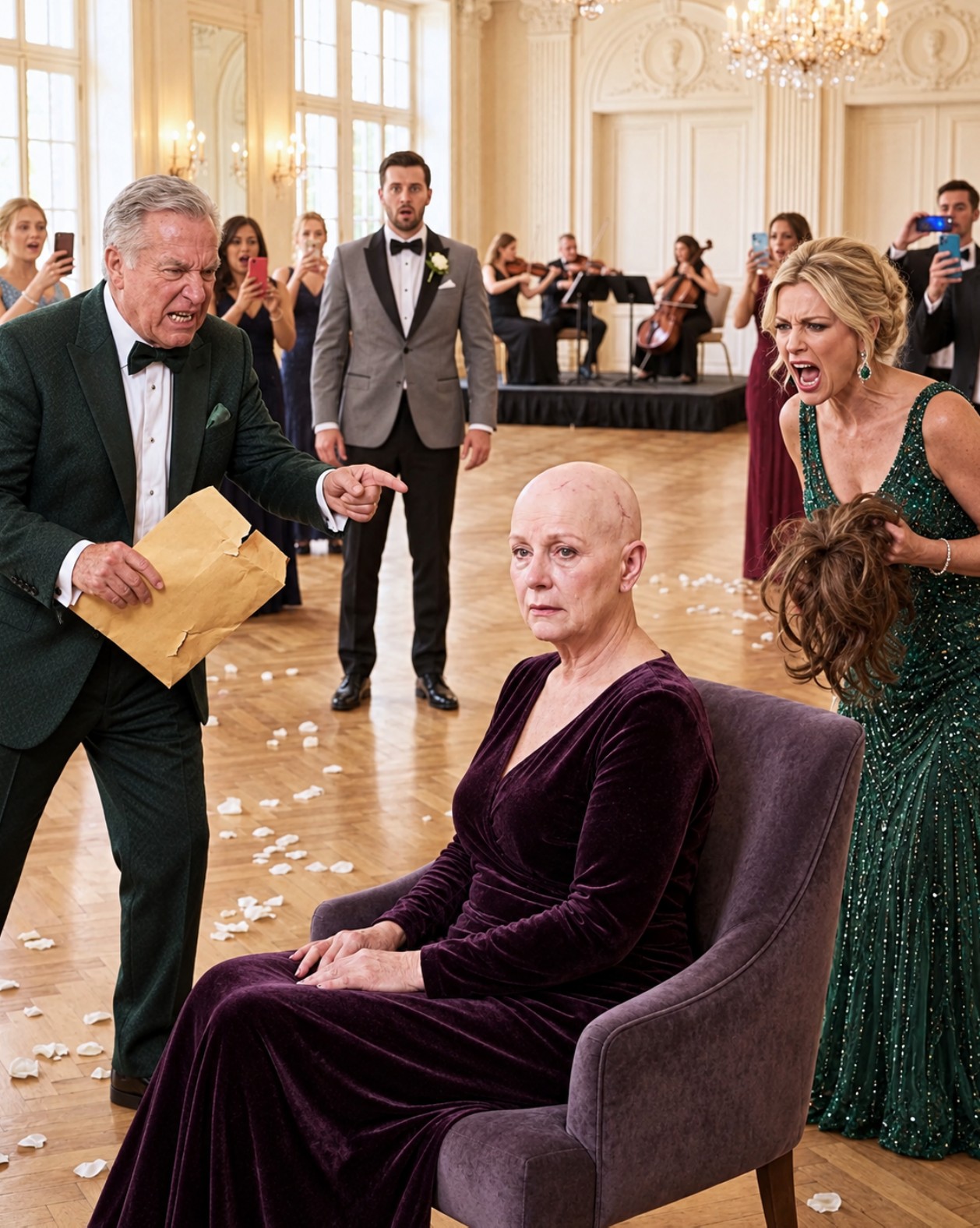
Vanessa ripped the dark brown wig off my wife’s head in the middle of our only son’s wedding reception.
She didn’t do it in a quiet hallway where nobody could see. She didn’t do it by accident after drinking too much champagne. No, she did it right there on the raised wooden stage, beneath the harsh white lights, inside a magnificent oceanfront estate in Newport, Rhode Island.
Hundreds of wealthy guests watched as the wig fell to the polished floor like something lifeless.
And there stood my wife, Elaine, frozen beneath the lights, surrounded by silk gowns, tailored suits, diamond necklaces, and people whose cruel smiles made my stomach turn.
For six months, Elaine had been fighting stage three ovarian cancer with every ounce of strength left in her body. Chemotherapy had taken her hair, weakened her legs, and left her exhausted after even the smallest tasks.
Yet she had done everything possible to look her best for our son’s wedding.
Now, in front of hundreds of strangers, the woman I had loved for nearly forty years was being treated like a joke.
What still haunts me most about that moment isn’t the laughter that spread through the room.
It isn’t the look on Vanessa’s face as she held my wife’s wig in her hand.
It’s the silence of my own son.
But to understand how a family can fall apart in front of hundreds of people, you need to know what happened before Elaine ever stepped onto that stage.
That afternoon, we arrived at the estate just as the ocean wind carried the salty smell of the Atlantic across the stone driveway.
The property looked as though it had been built to impress people who were already impossible to impress. Floor-to-ceiling glass walls faced the ocean. White orchids hung from elegant arches. Every table was covered with expensive Belgian linen, and crystal glasses were constantly refilled by servers who moved so quietly they were almost invisible.
I had served in the United States military for nearly forty years before retiring as a colonel. During my career, I had attended ceremonies at the Pentagon and Arlington National Cemetery. I had stood among generals, politicians, and powerful people who expected everyone around them to follow strict rules of behavior.
I knew how to handle myself in almost any situation.
But standing at my own son’s wedding, I felt strangely out of place.
Elaine walked beside me, resting her fingers lightly on my forearm.
Chemotherapy had affected her balance, and the treatment had damaged the nerves in her feet. Sometimes, she couldn’t feel the ground properly beneath her shoes. Still, she refused to lean on me as though she were helpless.
She moved carefully, proudly, and deliberately, taking one step at a time.
That morning, in the small bathroom of our hotel, she had spent nearly an hour fixing her wig.
She had brushed it, adjusted it, and checked it from every angle. Then she had started over because one side didn’t look quite right.
When I suggested that we sit somewhere quiet at the back of the reception, she shook her head.
“Robert, I don’t want Caleb worrying about me today,” she whispered. “This is his wedding. I want him to remember me being happy for him.”
The wig was dark brown, cut into a neat bob that looked almost exactly like the hair she had before chemotherapy took it away.
To anyone else, it was just an ordinary wig.
But I knew what it meant to her.
I knew how many mornings she had forced herself out of bed while dizzy and nauseated. I knew how often she had practiced walking across our bedroom with her chin held high, determined not to let her illness control every part of her life.
I knew how badly she wanted to look like herself when her son saw her on his wedding day.
That was Elaine.
Even when she was suffering, she worried more about other people’s feelings than her own.
She hated the thought of her pain becoming someone else’s burden.
When we reached the entrance, a young hostess holding a leather clipboard looked at my navy suit before letting her eyes move to Elaine’s modest blue dress.
“And you are?” she asked.
“Mitchell,” I replied. “The groom’s father.”
Her smile disappeared for a fraction of a second before returning.
“Of course, sir. Right this way.”
She led us toward the front row, but her manner made one thing clear. We were being seated there because we were Caleb’s parents, not because anyone was especially pleased to see us.
I glanced around the room.
Vanessa’s family had arrived in full force.
The men wore custom-made suits and expensive watches. The women wore silk dresses, glittering jewelry, and the kind of confident expressions that suggested they had never needed to ask anyone for permission to do anything.
Their laughter filled the room. They spoke loudly, moved confidently, and behaved as though the entire world had been designed for their comfort.
Vanessa stood near the stage in a white designer wedding gown that caught the light so brightly it almost hurt to look at.
When Caleb approached her, she wrapped her hand around his arm.
It didn’t look like a loving gesture. It looked possessive, as though she were showing off something expensive she had recently purchased.
Then Caleb noticed us.
For one brief moment, his eyes met Elaine’s.
He nodded.
That was it.
No hug. No smile. No rushing over to kiss his mother’s cheek. He didn’t even ask whether the journey had exhausted her.
Elaine slowly lowered herself into her chair and smoothed the fabric of her dress.
“It’s beautiful, Robert,” she whispered, looking toward the ocean.
I knew what she was doing.
She was trying to focus on the scenery instead of the cold welcome we had received from our own son.
Behind us, several women began talking in voices that were clearly loud enough for us to hear.
“I heard the groom’s mother has been very ill,” one woman said.
“Yes, I believe it’s cancer,” another replied. “Honestly, I’m surprised they allowed her to attend. Weddings like this need a certain atmosphere. It’s rather depressing, don’t you think?”
A few women laughed quietly.
I didn’t need to turn around to identify the speaker.
I recognized the voice of Diane, Vanessa’s mother.
Elaine had heard every word.
Her fingers tightened in her lap until her knuckles turned white. For a moment, I thought she might turn around and tell them exactly what she thought of their behavior.
Instead, she slowly relaxed her hands and touched the back of her wig.
“I’m fine, Robert,” she said softly, still looking out at the ocean.
I wanted to tell her that she had nothing to prove to those people.
I wanted to tell her that she was the strongest woman I had ever known and that no wig, expensive dress, or diamond necklace could make someone more beautiful than she was.
But I also knew Elaine.
She didn’t want a scene. Not today. Not at her son’s wedding.
Across the room, Vanessa leaned toward one of her bridesmaids and whispered something.
The bridesmaid looked directly at us.
Vanessa followed her gaze until her eyes settled on Elaine’s hair.
She stared for several seconds.
Then she smiled.
It wasn’t a friendly smile.
It was the smile of someone who had just discovered a weakness and was already thinking about how to use it.
I should have paid closer attention to that expression.
Perhaps I could have prevented what happened next.
But at the time, I still believed that even people who disliked us understood there were certain lines no decent person would cross.
I was wrong.
Part 2:
The wedding ceremony began about twenty minutes later.
A string quartet played near the garden while the guests settled into their velvet chairs. The ocean glittered in the afternoon sunlight, and a gentle breeze moved through the flowers arranged along the aisle.
Vanessa walked toward the altar as though she were royalty entering a courtroom where everyone had gathered to admire her.
Caleb stood beside the officiant, smiling nervously.
For a moment, I forgot everything that had happened earlier.
I watched my son waiting for his bride, and I remembered the little boy who used to run through our backyard with scraped knees and grass stains on his clothes.
I remembered teaching him to ride a bicycle, taking him fishing, and carrying him on my shoulders when he was too tired to walk.
I remembered Elaine sitting beside his bed when he was sick, staying awake through the night to make sure he was comfortable.
We had given him everything we could.
We hadn’t been perfect parents, but we had loved him with everything we had.
As Elaine watched him standing at the altar, her face softened.
She looked at him with so much tenderness that it nearly broke my heart.
For a few minutes, I could see the woman she had been before the hospital rooms, before the endless blood tests, before the nausea and exhaustion, and before every conversation with a doctor became a discussion about survival.
She wasn’t thinking about the women who had insulted her.
She wasn’t thinking about the cold welcome.
She was simply watching her son get married.
The vows were brief.
Caleb and Vanessa promised to love one another, support one another, and stand together through whatever life brought their way.
They exchanged rings, kissed, and received a round of applause.
Champagne appeared almost immediately.
Then the reception began.
The tables had been arranged across a wide teak balcony overlooking the Atlantic. As the sun began to set, the sky turned purple and gold, making the entire estate look like something from a magazine.
Everything appeared perfect.
The flowers were perfect. The food was perfect. The music was perfect.
But appearances can hide a great deal.
Vanessa and her family moved from table to table, greeting their wealthy friends and accepting compliments about the wedding.
Caleb followed them, always half a step behind, laughing loudly at their jokes and trying harder than ever to prove that he belonged among them.
Almost nobody approached Elaine.
A few guests offered brief greetings before moving away. Others nodded politely and then looked elsewhere, as though standing too close to a woman with cancer might somehow spoil their evening.
Every few minutes, Elaine raised a hand to the back of her neck to check her wig.
It wasn’t slipping.
I knew that gesture. She did it when she was exhausted and trying desperately not to show it.
I watched her carefully.
Her face had become paler, and the effort of sitting upright seemed to be wearing her down. She had already endured a long day, and the medication she took to manage the symptoms of her treatment often made her feel weak.
I leaned toward her.
“I’m going to talk to Caleb,” I said.
Elaine immediately touched my wrist.
“Robert, please. Don’t make things difficult for him today.”
Even now, she was protecting our son.
“He’s not a child anymore,” I replied quietly. “He can spare ten minutes for his mother.”
“I know. But it’s his wedding. Let him enjoy it.”
I looked at her for a moment, then gently squeezed her hand.
“I’ll only be a minute.”
I pushed back my chair and walked toward the bar, where Caleb was standing with three of Vanessa’s groomsmen.
They were drinking expensive whiskey and laughing as though the evening had been arranged entirely for their entertainment.
“Caleb,” I said.
He turned, looking surprised.
“Dad.”
“Your mother is exhausted,” I told him quietly. “Come sit with her for ten minutes. She would love to spend a little time with you.”
His eyes moved toward the men standing beside him.
“Dad, not now. I have to make the rounds. There are important people here, and I can’t just disappear.”
I stared at him.
“Important people?”
He shifted uncomfortably.
“You know what I mean. Vanessa’s family has a lot of friends here. I need to make a good impression.”
“Your mother is your family, Caleb. She should be one of your first obligations, not an inconvenience you squeeze into your schedule.”
Before he could answer, one of the groomsmen leaned closer.
His name was Chase, a smug young man who seemed to enjoy making comments at other people’s expense.
He held his whiskey glass up and glanced toward Elaine.
“Mr. Mitchell, your wife looks fine from here,” he said. “Honestly, she’s brave for showing up.”
Another man chuckled.
“I’m surprised she came at all. With all the hospital drama and everything, it kind of brings down the mood.”
The men exchanged amused looks.
I stood perfectly still.
I waited for Caleb to react.
I waited for him to straighten his shoulders, look Chase in the eye, and remind everyone that they were talking about the woman who had raised him.
I waited for him to say, “That’s my mother. Show her some respect.”
He could have said a hundred different things.
Instead, he looked down into his glass.
He said nothing.
Not a single word.
Something inside me went cold.
For nearly forty years, I had served in the military. I had watched men face fear, danger, and unbearable pressure. I had learned that a person’s character often revealed itself when doing the right thing became uncomfortable.
My son had just shown me something I never wanted to see.
He was willing to sacrifice his mother’s dignity to protect his place among people he wanted to impress.
I didn’t argue with him.
I didn’t threaten the groomsmen.
I simply turned and walked back to our table.
Elaine was sitting exactly where I had left her, her back straight and her hands folded neatly in her lap.
She looked up when I approached.
“Did you talk to him?” she asked.
“Yes.”
“Is he coming?”
I hesitated.
“Not right now.”
She lowered her eyes.
For a moment, I thought she might cry, but she simply nodded.
“That’s all right,” she whispered.
It wasn’t all right.
We both knew it.
But before I could say anything else, a sudden burst of feedback shrieked through the speakers.
Everyone turned toward the stage.
Vanessa was standing beneath the lights with a wireless microphone in her hand.
“Thank you all so much for being here to celebrate our love story!” she announced, smiling brightly.
The guests applauded.
“Family means everything to me,” she continued. “And I think it would be so touching if Caleb’s mother came up here and shared a few words with us.”
My stomach tightened.
That hadn’t been part of the schedule.
We had been told that only the best man and maid of honor would give speeches.
Nobody had mentioned that Elaine would be expected to stand in front of hundreds of people.
Every head in the room turned toward our table.
Elaine froze.
She looked at me, and I saw a flash of panic in her eyes.
She was exhausted. She was struggling to keep her balance. And she knew that climbing the three steps onto the stage would take more strength than most people could imagine.
Vanessa smiled even wider.
“I’m sure Mrs. Elaine has something very meaningful to say,” she added sweetly.
A few guests turned toward one another with amused expressions.
I leaned close to my wife.
“You don’t have to do this,” I whispered. “We can leave right now.”
Elaine swallowed.
Then she took a slow breath and straightened her shoulders.
“I can do it,” she whispered.
“Are you sure?”
She nodded.
“He’s my son, Robert. I want to say something nice to him.”
Even after everything, she still wanted to make the day special for Caleb.
She slowly rose from her chair.
I reached for her arm, but she shook her head gently.
“I can manage.”
She began walking toward the stage, taking careful steps across the polished floor.
The guests watched her approach.
Some looked curious. Others looked uncomfortable. A few whispered behind their hands.
Vanessa stood waiting beneath the lights, holding the microphone as though she were preparing to introduce the evening’s entertainment.
As Elaine reached the steps, Vanessa tilted her head.
Then she spoke into the microphone, making sure the people at the front tables could hear her.
“I’ve been wondering all day,” she said with a little laugh. “Doesn’t all that hair make you terribly hot in this ocean humidity?”
Several people snickered.
I felt my pulse pounding in my ears.
Elaine kept climbing.
She reached the top of the stage and stood beside Vanessa. The bright lights made her pale blue dress look almost white, and they revealed every sign of the illness she had fought so hard to conceal.
She looked fragile.
But she also looked braver than anyone else in that room.
She took the microphone with both hands to steady her trembling fingers.
For several seconds, she said nothing.
I could see her chest rising and falling as she gathered enough strength to speak.
Then she lifted her eyes toward the audience.
“Thank you,” she began softly, “for being here today.”
She paused, swallowing carefully.
“Caleb is my only child. I have prayed for this day since he was a little boy.”
Her voice trembled slightly, but she continued.
“I wish both of you peace, patience, and a life filled with love. I hope you will always remember to be kind to each other, especially when life becomes difficult.”
She looked at Caleb.
“I hope you will build a home where you both feel safe, loved, and respected.”
Her eyes filled with tears, but she managed a small smile.
“That’s all I wanted to say. I love you, Caleb.”
It was a simple, heartfelt speech.
There was no bitterness in it. No accusation. No attempt to embarrass anyone.
She had been given a chance to speak, and she had used it to wish her son a happy life.
A few guests applauded politely.
Elaine lowered the microphone and turned to leave.
For one brief moment, I thought it was over.
Then Vanessa reached for her arm.
“Oh, wait!” she exclaimed. “We should get a picture together!”
She moved closer, sliding one arm around Elaine’s shoulders and positioning them both toward the audience.
Elaine looked confused.
Vanessa continued smiling.
“It really is hot up here,” she said. “Let me just fix this for you.”
Her hand moved behind Elaine’s head.
I saw her fingers close around the wig.
Something about the movement made my stomach drop.
“Vanessa,” I called out.
But she had already begun pulling.
Part 3:
The wig came off in one sharp movement.
The adhesive tore free with a sickening sound, and Vanessa was left holding the dark brown hairpiece in her hand.
For a moment, the entire room went silent.
Elaine stood beneath the lights, exposed before hundreds of people.
Her scalp was almost bare. Only a few thin patches of gray hair remained, and red marks were visible where the wig’s lace had rubbed against her sensitive skin.
The hair she had spent nearly an hour arranging that morning was gone.
Every private detail of her suffering, every reminder of the brutal treatment she had endured for six months, was suddenly on display for strangers.
She didn’t scream.
She didn’t cover her head.
She didn’t even try to grab the wig back.
She simply stood still, as though her body had forgotten how to move.
I felt as if someone had driven a knife into my chest.
Then the laughter began.
It came first from Vanessa’s family table. A few drunken snorts turned into louder giggles, and within seconds, several people were laughing openly.
Vanessa threw her head back, holding the wig like a prize she had just won.
“Oh my gosh!” she exclaimed into the microphone. “I had no idea it would come off that easily!”
Her bridesmaids burst into laughter.
Someone in the crowd raised a phone and took a picture.
Another guest leaned toward a companion and whispered something that made them laugh even harder.
I couldn’t hear what they were saying.
I could barely hear anything over the roaring in my ears.
All I could see was my wife standing alone on that stage.
Elaine had endured chemotherapy, painful procedures, endless hospital visits, and the terrifying knowledge that her life might be shorter than we had hoped.
She had faced every one of those things with courage.
Yet now, the people who claimed to be celebrating love and family were laughing at her for losing her hair to cancer.
I turned toward Caleb.
He was standing near the dance floor, close enough to see everything.
His face had turned red.
His eyes moved from his mother to Vanessa, then toward the guests who were laughing.
I waited.
I waited for him to drop his glass and rush toward the stage.
I waited for him to tell Vanessa to give the wig back.
I waited for him to put his arm around Elaine and remind the entire room that she was his mother.
One step.
That was all it would have taken to change everything.
But Caleb didn’t move.
Instead, he lowered his eyes toward the floor and turned slightly away, as though he were embarrassed to be associated with what was happening.
In that moment, I understood something that hurt more than Vanessa’s cruelty.
My son had weighed the cost of defending his mother against the comfort of pleasing his new family.
And he had chosen comfort.
Vanessa looked around at the audience, still laughing.
“Honestly,” she said into the microphone, “the breezy look might be better for the weather!”
More laughter followed.
Then my chair scraped against the floor.
The sound cut through the room like a blade.
I stood.
I didn’t run.
I didn’t shout.
I didn’t threaten anyone.
I simply began walking toward the stage with the slow, steady steps of a man who had spent decades learning how to remain calm under pressure.
People moved out of my way.
Some stopped laughing as I passed. Others lowered their phones.
By the time I reached the steps, Vanessa’s smile had started to falter.
I climbed onto the stage and walked straight toward my wife.
I didn’t look at Vanessa.
I didn’t look at the guests.
I took off my suit jacket and gently draped it over Elaine’s shoulders. Then I carefully lifted the collar, shielding her head and neck from the harsh lights and the phones that were still pointed in her direction.
Elaine looked at me.
For the first time that evening, a tear rolled down her cheek.
“Can we go home, Robert?” she whispered.
“In a moment, my love,” I replied.
I wanted to take her away immediately.
But I also knew that if I walked off that stage without saying anything, the people who had just laughed at her might convince themselves that their behavior had been harmless.
They needed to understand exactly what they had done.
I turned toward Vanessa.
She took a small step backward.
“I think everyone is misunderstanding what happened,” she stammered. “I was only trying to help her. It was hot up here, and I thought—”
She stopped when she realized that nobody was laughing anymore.
I held out my hand.
“Give me what you stole from my wife.”
Her expression changed.
For a moment, she looked as though she might argue. Then her fingers trembled, and she handed me the wig.
I placed it carefully on a nearby table.
Only then did I take the microphone from her hand.
I looked out at the hundreds of faces staring back at me.
“I had no intention of speaking tonight,” I began.
My voice echoed through the estate.
“A man’s wedding day should belong to him. I came here to celebrate my son’s marriage, not to make a scene. But nearly forty years in uniform taught me something very important.”
I paused.
“Silence in the face of cruelty is not neutrality. It is permission.”
The room remained completely still.
My eyes found Caleb.
“Caleb.”
His head snapped up.
“I brought you a wedding gift tonight.”
I reached into the inside pocket of my shirt and pulled out a thick black envelope sealed with wax.
The guests in the front rows leaned forward.
Vanessa’s expression changed immediately.
Until that moment, she had probably assumed I was just an angry father who had embarrassed himself by defending his sick wife.
She had no idea what was inside that envelope.
“I prepared this gift six months ago,” I continued, “after your mother received her diagnosis.”
I broke the seal and removed the legal documents.
“Inside this envelope is the deed to a fully paid, four-bedroom coastal home on Cape Cod. Your mother and I bought the property years ago, hoping that one day we would be able to watch our grandchildren run across the sand.”
Whispers spread through the room.
I continued before anyone could interrupt.
“The house has no mortgage. It was meant to give you and your future family a secure place to begin your life together.”
Caleb stared at the papers in my hand.
Vanessa’s mouth fell open slightly.
“There is also an irrevocable trust fund associated with the gift,” I said. “Five million dollars.”
A wave of gasps swept through the audience.
“Under the original arrangements, the funds were scheduled to transfer into your name at midnight tonight.”
Vanessa turned toward Caleb so quickly that her earrings swung.
Diane, her mother, sat rigidly in her chair. The smug expression she had worn earlier had disappeared.
For the first time that evening, Vanessa’s family looked as though they were no longer certain of their place in the room.
“Five million?” someone whispered.
I ignored the reaction.
“That’s right. Five million dollars, along with a fully paid coastal home. Your mother and I worked for decades to make sure you would have a strong financial foundation.”
Caleb finally found his voice.
“Dad,” he said weakly. “Please. Not here.”
I raised one finger.
He fell silent.
“There is one more detail everyone should know,” I continued.
I looked around the room.
“Many of you have spent the evening praising the bride’s family for this beautiful celebration. You’ve admired the flowers, the champagne, the estate, and every expensive detail.”
Vanessa stiffened.
“But the bride’s family did not pay for this wedding.”
The room went silent.
I placed my hand gently on Elaine’s shoulder.
“This wedding was paid for from one account. The venue, the food, the flowers, the champagne, the decorations, and every other expense came from my wife’s savings.”
A few guests looked at one another in surprise.
Vanessa’s face began to lose its color.
Diane’s hand flew to her mouth.
“For thirty-five years, Elaine saved every spare dollar she could,” I continued. “She drove used cars. She worked overtime. She denied herself luxuries that other people considered ordinary. She did all of that because she wanted her only son to begin his married life without financial fear.”
I looked directly at Vanessa.
“She never expected a thank-you. She never asked for recognition. She simply wanted to give her son something wonderful.”
I paused, allowing my words to settle over the room.
“Perhaps that’s why her medical wig didn’t meet your family’s standard of elegance.”
Vanessa looked as though I had slapped her.
Her mouth opened, but nothing came out.
I turned back toward Caleb.
“I came here tonight intending to hand you the keys to your future. I thought I was giving a gift to a young man who understood what his parents had sacrificed for him.”
I looked down at the papers in my hand.
“But a man can learn a great deal in a few seconds.”
Caleb shook his head.
“Dad, please listen to me—”
“No. You will listen to me first.”
My voice wasn’t loud, but it was firm enough to stop him.
“Your mother has spent six months enduring poison in her veins. She has learned how to stand steadily on weakened legs. She has endured pain that most people in this room could never imagine.”
I glanced at Elaine.
“She put on that wig and walked into this room because she wanted her son to remember his wedding day as a happy occasion. She wanted to look like herself. She wanted to stand beside the people she loved without making anyone uncomfortable.”
My throat tightened, but I continued.
“And when your bride used her illness as entertainment, you did nothing.”
Caleb stared at me.
His lips moved, but no words came.
“You didn’t defend her. You didn’t ask Vanessa to stop. You didn’t even walk over to comfort your mother.”
I held up the documents one final time.
“So the trust will not transfer tonight. Or tomorrow.”
Vanessa made a small, startled sound.
It was remarkable how quickly her expression changed when the money she had apparently never known about was suddenly no longer within reach.
I folded the papers and slid them back into the envelope.
“I am not doing this because I want revenge,” I said. “I am doing it because money is a responsibility, not a reward for simply reaching adulthood.”
I looked at my son.
“An inheritance of this size requires maturity, judgment, and character. Tonight, you showed me that you still have some growing to do.”
I paused.
“A man who cannot defend the mother who gave him life has not yet shown me that he is ready to handle such a responsibility.”
I slipped the envelope into my pocket.
“Some things, Caleb, cannot be bought back once you allow them to burn.”
Then I dropped the microphone.
It struck the stage with a loud thud that echoed through the estate.
The reception was over, even though the band had not yet stopped playing.
Part 4:
I wrapped my arm around Elaine and guided her toward the steps.
She leaned against me, exhausted, but she kept her head held high.
Behind us, Vanessa stood motionless beneath the lights. Her hands trembled as she clutched the sides of her wedding gown.
For the first time since we had arrived, she seemed unable to find anything clever to say.
Caleb finally moved.
“Dad! Wait!”
He hurried toward us.
“You can’t just say all that and leave. We need to talk privately.”
I stopped and looked at him.
For a moment, I searched his face for the little boy I had once carried on my shoulders during family vacations.
I remembered him running through the shallow waves, laughing whenever the water splashed against his legs. I remembered how he used to reach for my hand whenever he felt uncertain.
But the man standing in front of me now was different.
He wasn’t asking about his mother’s health.
He wasn’t asking whether she was all right.
He wasn’t even asking whether we needed help getting home.
He was panicking about money, reputation, and the consequences of what had happened.
Elaine gently touched my arm.
“That’s enough, Robert,” she whispered. “Please. Take me home.”
I nodded.
We continued toward the exit.
The guests who had laughed at Elaine minutes earlier were now staring down at their plates or pretending to be deeply interested in their drinks.
A few looked ashamed.
Some whispered to one another, their voices much quieter than before.
Near the back of the room, I noticed several older men watching us. From the way they stood and the way they carried themselves, I suspected that some of them had served in the military.
They didn’t say anything.
They simply gave me quiet nods as we passed.
I returned their nods.
I didn’t need anyone’s approval, but I appreciated that at least a few people in that room understood the difference between strength and cruelty.
We were almost at the glass doors leading to the beach path when Caleb stepped in front of us.
“Dad, please,” he said.
Sweat had gathered beneath his collar.
“I’m sorry. I really am. Vanessa has a strange sense of humor. She sometimes goes too far, but she didn’t mean anything by it.”
I stared at him.
He continued quickly, as though he were afraid I might leave before he finished explaining himself.
“It was a joke. A terrible joke, yes, but you embarrassed everyone by making such a big scene. You’re overreacting.”
For a moment, I couldn’t believe what I was hearing.
His mother had just been humiliated in front of hundreds of people, and he was worried that I had embarrassed everyone by defending her.
“Overreacting?” I repeated.
Caleb swallowed.
“That’s not what I meant.”
“Your mother was standing under a spotlight, humiliated and alone. People were laughing at her. Someone was taking pictures. And you stood there watching.”
He looked down.
“No one asked you to start a fight,” I continued. “No one expected you to ruin your wedding. You didn’t need to make a speech. You didn’t need to argue with Vanessa.”
I stepped closer.
“All you had to do was walk three steps onto that stage and put your arm around your mother.”
Caleb’s shoulders dropped.
“That was all,” I said. “Three steps. One small act of courage. If you had done that, your life might look very different right now.”
He rubbed his forehead.
“I didn’t think fast enough,” he whispered.
I shook my head.
“That’s not the problem, Caleb. Sometimes people freeze when something unexpected happens. I understand that. But you had a choice once you realized what was happening. You could have helped her. You could have told Vanessa to stop. You could have stood beside your mother after the wig came off.”
I paused.
“Instead, you looked away.”
His eyes filled with tears.
“Dad, I’m sorry.”
For the first time that evening, I believed he might actually understand that something terrible had happened.
But understanding and apologizing were not the same as undoing it.
Elaine stepped forward before I could respond.
She lifted her frail hand and rested it gently on Caleb’s tuxedo lapel.
“You don’t need more excuses, sweetheart,” she said softly. “Go back to your bride.”
Caleb looked at her, his eyes wet.
“Mom, please. I swear I didn’t mean to hurt you.”
She studied his face for a moment.
Then she shook her head gently.
“Some betrayals don’t need many words to be understood.”
Her voice remained kind, almost tender.
That somehow made her words more powerful.
She wasn’t shouting at him. She wasn’t insulting him. She wasn’t demanding that he suffer.
She was simply telling him that his actions had changed something between them.
And he finally seemed to understand that.
Caleb stepped aside.
We walked past him and through the glass doors into the Newport night.
The sky above the Atlantic had turned a deep shade of blue, and the first stars were appearing overhead.
The warmth of the day had faded. A cold ocean wind swept across the estate grounds, carrying the clean, sharp smell of salt water.
Behind us, the mansion glowed with golden lights.
But nobody followed us.
We walked down the wooden boardwalk toward the beach in silence.
The wedding music began again somewhere behind us, but it sounded weak and distant beneath the crashing waves.
Elaine leaned against my arm as we walked.
I could feel how tired she was. Her steps had become slower, and every so often she paused to catch her breath.
I wanted to carry her to the car.
I wanted to take her home, tuck her into bed, and make sure she never had to think about that awful evening again.
But she kept walking.
She had spent six months fighting to keep control over her own life, and I knew she needed to make this journey on her own terms.
When we finally reached the sand, she stopped.
The beach was almost empty.
A few distant lights shimmered along the coastline, and the dark ocean stretched endlessly toward the horizon.
Elaine lifted her hands beneath my jacket and carefully removed the tiny metal clips that had been pressing against her scalp all day.
One by one, she dropped them into the sand.
I was still holding the wig.
She looked at it for a moment, then turned her face toward the water.
The wind brushed against her bare head.
She closed her eyes and took a deep breath.
“To be honest, Robert,” she murmured, a tired smile appearing on her face, “this feels so much better.”
I looked at her.
For the first time all evening, she seemed able to breathe freely.
There were no stage lights.
No phone cameras.
No wealthy women whispering insults behind champagne glasses.
No one watching her, judging her, or treating her illness as something shameful.
There was only the dark sea, the cold air, and the woman I loved standing beside me without the wig she had worn to protect herself from other people’s judgment.
She didn’t need to hide anything out there.
For a long time, we stood together and listened to the waves.
Eventually, Elaine slipped her hand into mine.
“Do you think we went too far?” she asked quietly.
I looked back toward the glowing mansion.
I remembered Vanessa laughing as she held the wig.
I remembered the guests who had joined her.
And I remembered my son standing near the dance floor, looking away while his mother suffered.
“No,” I answered. “We returned fire at exactly the right moment.”
Elaine let out a small, tired laugh.
Then her expression grew thoughtful.
“Caleb will understand someday,” she said. “The fog will clear.”
“I hope you’re right.”
She leaned her head against my shoulder.
“He isn’t evil, Robert. I don’t believe that. He lost himself chasing something shiny.”
I didn’t answer immediately.
Perhaps she was right.
Perhaps the little boy we had raised was still somewhere inside the man who had stood silently at the wedding.
Maybe ambition, embarrassment, and the desire to impress Vanessa’s family had slowly changed him.
Maybe he had become so focused on proving himself to other people that he had forgotten what truly mattered.
But whatever the reason, he was still responsible for his choices.
Love could explain a person’s mistakes.
It couldn’t erase the damage those mistakes caused.
I tightened my fingers around Elaine’s hand.
“I hope he finds his way back,” I said.
“So do I,” she replied.
We watched the last light disappear from the horizon.
The moon rose above the ocean, casting a silver path across the water.
Elaine lifted her face toward the sky.
“You know something?” she said.
“What is it?”
“Hair is not what makes a woman strong.”
I looked down at her.
In the moonlight, the faint marks on her scalp were visible beneath the soft shadows.
They were reminders of everything she had endured.
She gave my hand a gentle squeeze.
“It’s staying on your feet,” she said softly, “when everyone is waiting for you to collapse.”
For the first time that night, the tightness in my chest began to loosen.
I realized that I had spent the entire evening thinking about the people who had hurt her.
I had been thinking about Vanessa’s cruelty, the guests’ laughter, and Caleb’s silence.
But Elaine wasn’t thinking about revenge.
She wasn’t thinking about the money, the wedding, or the people who had humiliated her.
She was thinking about how much better it felt to stand beneath the open sky without hiding.
And somehow, that mattered more than anything I could have said on that stage.
Part 5:
We began walking slowly along the shoreline, moving farther away from the glowing mansion and the wreckage of the wedding reception.
The sand shifted beneath our shoes, and the cold water occasionally reached the edge of the beach before slipping away again.
Elaine held my hand tightly.
Every so often, she looked up at me and smiled.
It wasn’t the bright smile she had worn for the wedding photographs. It wasn’t the carefully practiced expression she had put on that morning while adjusting her wig in the hotel bathroom.
This smile was smaller.
It was tired, honest, and completely her own.
I thought about everything we had experienced together over the years.
We had lived through difficult deployments, long separations, financial worries, and the ordinary struggles that come with raising a child.
We had celebrated birthdays, anniversaries, graduations, and holidays.
We had watched our son grow from a helpless baby into a young man who seemed to have his entire future ahead of him.
And now, we were facing something neither of us had ever imagined.
Elaine’s cancer had changed our lives in ways I still struggled to understand.
It had made us think about time differently.
We no longer assumed there would always be another Christmas, another summer vacation, or another chance to say the things we had left unsaid.
Every ordinary day had become precious.
A quiet breakfast together.
A walk through the garden.
The sound of Elaine laughing at something silly on television.
Even the simple act of holding her hand while she fell asleep had taken on a meaning I could never have fully appreciated before her diagnosis.
That was why what happened at the wedding hurt so much.
Elaine had not asked for expensive gifts.
She had not demanded attention.
She hadn’t even asked our son to put his own happiness aside for her.
She had simply wanted to see him get married.
She had wanted to sit in the front row, listen to his vows, and watch him begin a new chapter of his life.
Instead, she had been forced to endure humiliation from the very people who should have been celebrating alongside her.
And yet, as we walked beneath the stars, she wasn’t broken.
She was tired, yes.
She was hurting.
But she was still here.
Still walking.
Still holding my hand.
I glanced at the wig I was carrying.
It looked strangely ordinary now.
Only a few hours earlier, Elaine had treated it as something precious. She had spent nearly an hour making sure it looked right because she wanted to feel confident in front of her son.
She had believed that if she looked like the woman Caleb remembered, perhaps nobody would focus on her illness.
But the truth was that the wig had never been what made her beautiful.
It had only been something she used to feel more comfortable in a world that too often judged people for things they could not control.
Without it, she was still Elaine.
The woman who had stood beside me for nearly forty years.
The woman who had sacrificed her own comfort to give our son a better life.
The woman who had faced a terrifying diagnosis without allowing fear to destroy her kindness.
The woman who had just been humiliated in front of hundreds of people and still found the strength to tell her son she loved him.
No wig could add to that.
And no cruel person could take it away.
I looked down at her.
“Are you sure you’re all right?” I asked.
She nodded.
“I’m tired. I won’t pretend otherwise. And what happened tonight hurt more than I want to admit.”
She paused, watching the waves roll toward the shore.
“But I don’t want to carry their cruelty home with me.”
I squeezed her hand.
“Then we won’t.”
She smiled faintly.
“We can’t control how other people treat us, Robert. But we can decide how much of their ugliness we allow into our lives.”
I thought about those words for a long time.
They were simple, but they carried a truth I had spent decades learning in a very different way.
During my years in the military, I had seen people respond to pressure with courage and others respond with selfishness.
I had seen good people make terrible decisions, and I had seen ordinary people perform extraordinary acts of kindness when nobody was watching.
I had learned that true character was rarely revealed by a person’s wealth, title, or appearance.
It was revealed by what they did when someone weaker needed their help.
That night, Vanessa had shown us who she was.
The guests who laughed had shown us who they were.
And Caleb, by doing nothing, had shown us something painful about himself.
But Elaine had shown us something else.
She had shown us that dignity did not depend on how other people treated you.
It depended on whether you allowed their behavior to determine your worth.
We continued walking until the mansion’s lights became little more than distant golden dots along the coast.
At some point, Elaine leaned more heavily against my arm.
I slowed down to match her pace.
“Would you like to sit for a moment?” I asked.
She nodded, and we found a quiet spot where the sand was firm enough to support us.
We sat side by side, listening to the waves.
For a while, neither of us spoke.
Then Elaine rested her head against my shoulder.
“Do you remember when Caleb was little and we took him to Cape Cod?” she asked.
“Of course.”
“He was terrified of the waves at first.”
I smiled.
“He thought the ocean was trying to chase him.”
“He kept running away, then coming back for another look.”
We both laughed softly.
For a few moments, I could almost see him again: a little boy with wet hair and sandy feet, running toward us with a grin on his face.
Elaine’s smile faded into something more thoughtful.
“I miss that boy sometimes.”
I knew exactly what she meant.
“So do I,” I said.
She looked out at the water.
“I hope he remembers who he used to be.”
“Perhaps he will.”
“And if he doesn’t?”
I turned toward her.
“Then we will still be all right.”
She studied my face.
I continued.
“We gave him our love. We gave him a home. We taught him what we believed was right. We cannot make every decision for him, and we cannot force him to become the man we hoped he would be.”
I took her hand.
“But we can decide what we are willing to accept. And we can make sure that the rest of our lives are filled with people who treat us with kindness.”
Elaine nodded slowly.
“That sounds peaceful.”
“It will be, my love.”
She rested her head against me again.
For the first time since we had arrived at the estate, neither of us felt the need to pretend.
We didn’t need to smile for photographs.
We didn’t need to reassure anyone that everything was fine.
We didn’t need to prove that we belonged among people who had mistaken money for importance.
We were simply two people sitting beside the ocean, holding hands after a painful night.
And that was enough.
Eventually, I helped Elaine stand.
We brushed the sand from our clothes and began making our way back toward the car.
The cold air had made her cheeks pink, and her steps seemed a little steadier now that we were away from the noise and pressure of the reception.
Before we reached the boardwalk, she stopped and turned toward the ocean one final time.
“Thank you,” she said.
I looked at her.
“For what?”
“For standing beside me.”
I felt my throat tighten.
“Elaine, there was never a question about that.”
She smiled.
“I know. But sometimes, when life becomes frightening, you need to hear the things you already know.”
I leaned down and kissed her forehead.
“Then let me say it clearly. I will stand beside you for as long as I can. Through every appointment, every difficult day, every setback, and every moment of uncertainty. You will never have to face this alone.”
Her eyes filled with tears.
She wrapped her arms around me, and I held her close.
We stayed that way for a long time.
The ocean moved behind us, endless and powerful.
Above us, the stars shone through the dark sky.
And somewhere beyond the beach, inside a mansion filled with expensive decorations and uncomfortable silence, our son’s wedding continued without us.
I didn’t know what would happen next.
I didn’t know whether Caleb would eventually understand the damage he had caused.
I didn’t know whether his marriage would survive the truth about the people he had chosen to please.
I didn’t even know what the next few months would bring for Elaine and me as we continued facing her illness.
But I knew one thing.
I would not allow that night to become the measure of my wife’s life.
Her life was so much bigger than a cruel joke at a wedding.
It was measured in the decades she had spent loving her family, the sacrifices she had made without asking for recognition, and the courage she had shown when life became unbearably difficult.
It was measured in every morning she had chosen to get out of bed, every hand she had held, every person she had comforted, and every time she had refused to let pain turn her into someone bitter.
That was the woman I loved.
That was the woman who had stood beside me through nearly forty years of military service, peace, illness, betrayal, and love.
And that was the woman who was still standing beside me that night.
As we walked away from the beach, I finally understood the real victory of the evening.
It wasn’t the speech.
It wasn’t Vanessa’s shocked expression.
It wasn’t the embarrassment of the wealthy guests who had laughed at my wife.
And it wasn’t the five million dollars still secured in the envelope inside my pocket.
The real victory was much simpler.
After everything we had endured, Elaine was still herself.
She was still kind.
She was still brave.
She was still capable of loving our son, even after he had failed her in the worst possible moment.
And she was still holding my hand.
I looked at her as the wind moved gently across the beach.
She gave my fingers another small squeeze.
Then we continued walking toward the car, slowly and quietly, leaving the glowing mansion behind us.
Whatever happened tomorrow, whatever choices Caleb made, and whatever challenges Elaine and I still had to face, we would face them together.
Because some things in life are worth far more than money.
Some things cannot be replaced by expensive houses, grand weddings, or impressive bank accounts.
And some kinds of strength cannot be measured by how much a person can endure without crying.
Sometimes, strength is simply getting back on your feet after the world has tried to knock you down.
Sometimes, it is refusing to let cruelty steal your dignity.
And sometimes, it is holding the hand of the person you love and continuing to walk forward, even when the future is uncertain.
That night, my wife taught me something I will never forget.
The people who laughed at her had mistaken her illness for weakness.
They had mistaken her quiet nature for helplessness.
They had mistaken her kindness for permission to treat her badly.
But they had been wrong about all three.
Elaine had lost her hair.
She had lost some of her strength.
She had lost the comfortable illusion that her son would always stand up for her.
But she had not lost herself.
And as I held her hand beneath the stars, I realized that no amount of money, no cruel joke, and no public humiliation could ever take away what mattered most.
The woman beside me was still standing.
And I was still there to hold her hand.
The End.
