
Part 1:
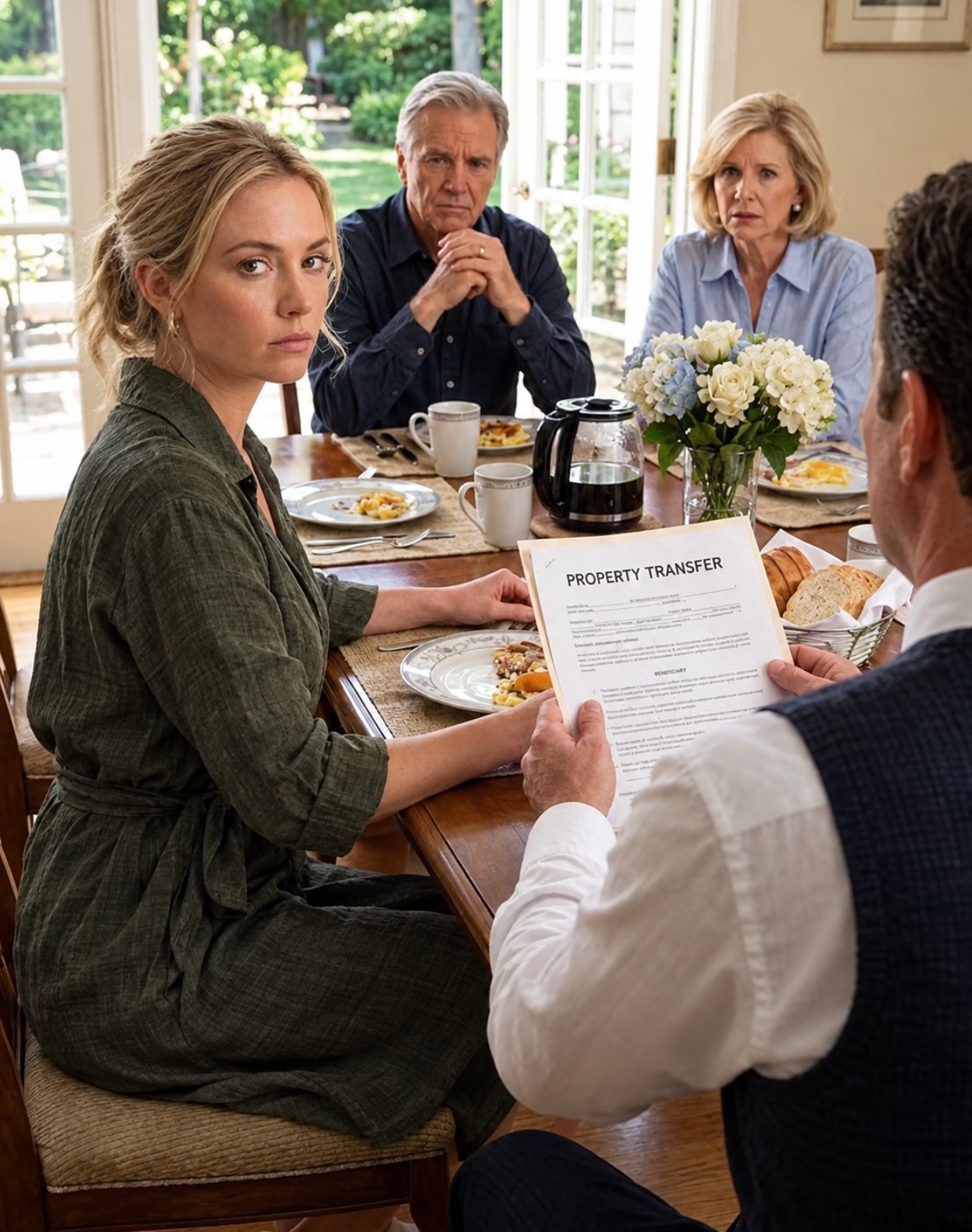
His parents sat behind him at the dining table, smiling so widely they could barely contain their excitement. They were already imagining all the ways they would spend the fortune they believed had just fallen into their laps.
What none of them knew was that I had prepared for this moment long before they ever walked through my door.
I was still wearing my ivory silk robe. My grandmother Elena’s diamond earrings still hung from my ears. And I was still innocent enough to believe that marriage meant safety, trust, and love.
Nathan gently kissed my forehead, pretending to be the loving husband I had once believed he was. Then he placed a thick folder beside my coffee cup as casually as if he were handing me the morning newspaper.
“Just sign here, Charlotte,” he said.
His mother, Diane, pushed the paperwork closer to me.
“It’s the practical thing to do,” she explained. “A wife’s assets should strengthen her husband’s family.”
I lowered my eyes to the documents.
Transfer of Ownership.
The words stared back at me from the first page.
My grandmother’s company.
A business worth nearly eight hundred million dollars, built on textile contracts, manufacturing patents, and commercial properties spread across Texas and North Carolina.
It was the company my grandmother had created after arriving in America from Honduras with nothing but a broken sewing machine and an unshakable determination never to give up.
She had started with almost nothing and built an empire with her own hands.
And now, my husband and his family wanted me to hand it over to them.
The company was something I had never fully discussed with Nathan. He knew my grandmother had been successful, but I had never revealed the true extent of her wealth or the full value of what she had left me.
I had my reasons for keeping those details private.
Slowly, I lifted my eyes from the documents.
“How did you find out about this?”
Nathan smiled, but something flickered behind his eyes. For the first time that morning, his confidence seemed to waver.
“Nobody likes secrets in a marriage,” he replied smoothly. “Marriage requires honesty.”
His father, Richard, burst into laughter from the other side of the table.
“Oh, don’t be so dramatic,” he said. “Nathan has business debts, and we have plans to expand our operations in Dallas. You’re part of this family now. What’s yours should help all of us.”
Diane reached across the table and placed her cold fingers over my hand.
“And honestly, sweetheart,” she added in a soft, almost motherly voice, “you don’t exactly seem like someone capable of running a corporation. Let the men handle it. You’ll be much happier that way.”
There it was.
The truth I had been refusing to see.
This had never been about love.
It had never been about partnership or building a future together.
It was about ownership.
They didn’t see me as a wife, a partner, or even a person with her own dreams.
They saw me as a doorway to a fortune.
And suddenly, every memory of my relationship with Nathan began to look different.
I remembered the night he proposed beneath the glowing lights of downtown Chicago after a summer storm. He had held my hands, looked into my eyes, and whispered that he loved how “quiet” I was.
At the time, I had taken it as a compliment.
Now, I understood what he had really meant.
He liked that I didn’t challenge him.
I remembered Diane calling me “sweet, but simple” whenever she introduced me to her friends.
I remembered Richard joking at dinner parties that it was “refreshing to meet a woman who doesn’t obsess over business.”
Everyone had laughed, including me.
I had worn understated dresses, smiled through their insults, and poured bourbon and coffee while they discussed money in front of me as though I were nothing more than a decorative piece of furniture.
I had allowed them to underestimate me.
I had let them believe I was harmless.
And I had done it because my grandmother had taught me something long before I ever met Nathan.
Her final lesson had been simple, but I had never forgotten it.
“Never show wolves where you hide the steel.”
Those words had stayed with me through every business meeting, every difficult negotiation, and every moment when someone mistook my quiet nature for weakness.
Now, sitting at my own dining table with my husband’s family plotting to take everything from me, I finally understood why she had insisted that I remember them.
Across the table, the notary cleared his throat nervously.
“Mrs. Bennett,” he said, avoiding my eyes, “if you could initial each page, we can proceed with the transfer.”
I looked at him.
Then I slowly corrected him.
“My name,” I said quietly, “is Charlotte Rivera.”
Nathan’s expression hardened.
“Not anymore.”
For a moment, neither of us moved.
Then I smiled faintly.
It was the first time since we had met that I saw genuine uncertainty cross his face.
He had expected tears, perhaps. Maybe an argument. He might even have expected me to beg him to reconsider.
Instead, I reached for the pen.
Diane’s eyes glittered with anticipation.
Richard leaned back in his chair, already wearing the satisfied expression of a man who believed victory was his.
Nathan watched me with a smug smile.
They thought the battle was over before it had even begun.
I uncapped the pen.
Then, instead of signing my name, I drew a long line straight across the signature block.
“No,” I said calmly.
The room fell completely silent.
Nathan shot to his feet so quickly that his chair scraped violently across the hardwood floor.
“You don’t understand what you’re refusing!”
I glanced at the coffee that had spilled across the white linen tablecloth when he stood up.
Then I looked back at him.
“I understand perfectly.”
Diane’s pleasant expression disappeared.
“Don’t embarrass yourself, Charlotte,” she snapped. “That company came from family money. You’re emotional, you’re young, and you clearly need guidance.”
I felt my fingers tighten around the pen.
“My grandmother scrubbed factory floors before she owned factories,” I replied. “She worked until her hands were sore, saved every dollar she could, and built that company from nothing. Don’t speak about things you never built.”
Richard scoffed.
“Sentimental nonsense. Everything has a price.”
Nathan leaned toward me, lowering his voice as if he wanted his next words to hurt more than a shout ever could.
“So do you.”
For one brief second, the words cut through me.
I had loved this man.
I had trusted him with my home, my heart, and my future. I had believed that the person sleeping beside me every night would protect me, not try to strip away everything my grandmother had spent her life building.
The pain was real.
But I refused to let it control me.
I took a slow breath and placed the pen on the table.
They mistook my silence for fear.
That was their first mistake.
And it would not be their last.
Part 2: The Trap They Never Saw Coming
By noon that same day, Nathan had frozen my access to the joint bank account he had insisted we open after our wedding.
He had presented the account as a symbol of trust, telling me that married couples should share their finances.
Now, he was using it as a weapon.
By two o’clock, Diane had started calling extended relatives, spreading stories that I was mentally unstable and incapable of making sensible decisions about money.
According to her, I had suddenly become unreasonable, refused to cooperate with my husband, and was putting the entire family at risk.
By four o’clock, Richard’s attorney had sent me an email claiming that Nathan had “marital rights” to review and manage my financial holdings.
I read the message twice.
Then I forwarded it to my own legal team.
They had made another mistake.
They had assumed that because I had kept my business affairs private, I had failed to protect them.
That evening, Nathan tossed my phone onto the dining table in front of me.
“You’ll sign tomorrow,” he said coldly. “And if you refuse, I’ll make sure everyone knows what kind of woman you really are.”
I looked up from the document I had been reading.
He continued without waiting for a response.
“I’ll tell everyone you married me for status. I’ll tell them you deliberately hid your assets from me. Do you really think a judge will like a dishonest wife?”
He smiled as though he had just delivered the perfect threat.
“People will believe me, Charlotte. You’re so quiet that nobody will even know what to think when I explain what you’ve done.”
I stared at him.
Then he gave me the same condescending smile I had seen countless times before.
“There’s my quiet little wife.”
I almost laughed.
Quiet little wife.
If only he knew.
For years, I had worked behind the scenes of my grandmother’s company. By the time I was twenty-seven, I had already helped oversee billion-dollar acquisition negotiations. I had sat across from investors who smiled politely while looking for ways to weaken our position.
I had negotiated with powerful executives who believed they could intimidate me simply by speaking louder.
I had learned how to recognize manipulation, how to read a contract carefully, and how to protect myself when someone tried to turn a business deal into a battle of wills.
Nathan had never bothered to learn any of that about me.
He had seen a quiet woman who preferred simple clothes and peaceful evenings.
He had mistaken my privacy for ignorance.
He had mistaken my patience for obedience.
And now he was pounding against a locked vault, convinced that shouting would somehow make it open.
Nathan wasn’t the brilliant predator he imagined himself to be.
He was a spoiled man who had finally found something he wanted badly enough to reveal his true character.
That night, he went to bed believing he had already won.
He fell asleep beside me with the confidence of a victorious king, completely unaware that the woman lying next to him had begun preparing his downfall.
I waited until his breathing became slow and steady.
Then I quietly slipped out of bed and walked into my dressing room.
Beneath the floor was a hidden compartment, concealed by a false panel. Inside lay an encrypted tablet I had kept separate from my everyday devices.
I had never expected to use it against my own husband.
But my grandmother had taught me to prepare for possibilities I hoped would never happen.
I opened the tablet and sent three messages.
The first went to Evelyn Ross, my lead corporate attorney. Evelyn had handled some of the company’s most sensitive legal matters for years. She understood our ownership structure, knew the protections surrounding my inheritance, and would never take action without checking the facts.
The second message went to Marcus Hale, a private investigator my grandmother had trusted for nearly twenty years. Marcus was discreet, experienced, and familiar with the kinds of financial schemes that wealthy families sometimes tried to hide behind respectable appearances.
The third message went to Judge Whitmore’s clerk through the proper legal channel. I attached a notarized copy of my prenuptial agreement and requested that the document be preserved as part of the appropriate legal record.
Nathan had signed that agreement before our wedding.
He had barely read it.
At the time, he had laughed and called it a romantic formality, assuring me that we would never need it because our marriage would be built on trust.
He had signed because he believed a quiet woman like me would never need to protect herself from him.
Now, that very agreement was about to become one of the most important documents in the entire case.
When I finished sending the messages, I sat quietly for a moment.
My hands were steady.
My heart, however, felt heavier than I expected.
I wasn’t preparing to fight a business rival.
I was preparing to confront the man I had married.
And although I knew I had to protect myself, a small part of me still wished that everything I had discovered could somehow be explained away.
But the messages had been sent.
There was no turning back.
The next morning, I dressed in pale blue and pinned my hair neatly into place.
When I walked into the dining room, Diane looked me up and down and smiled with obvious satisfaction.
“Good girl,” she said. “Ready to be reasonable?”
Nathan had invited the notary back.
Richard had brought a bottle of expensive French champagne, which sat chilling in a silver bucket beside the table.
They had even arranged the documents more carefully this time, placing the signature pages directly in front of my chair.
But there was something new among the papers.
Another transfer agreement.
This one would transfer all voting shares of my company directly into Nathan’s control.
I sat down without saying a word.
Then I began reading every page.
I checked the names, the dates, the clauses, and the language used to describe the transfer. I read the fine print, including the sections that appeared designed to make the transaction look like an ordinary marital arrangement.
The more I read, the clearer their intentions became.
This wasn’t a simple request for financial support.
They wanted control of the company.
They wanted the power to make decisions, direct operations, and influence the future of the business my grandmother had built.
They wanted to take an empire that had taken decades to create and place it in the hands of a man who had never earned it.
Finally, I lifted my eyes.
“This is fraud.”
Nathan laughed.
“No,” he replied. “This is marriage.”
The notary shifted uncomfortably in his chair and refused to look directly at me.
I studied him for a moment.
Then I noticed his cufflinks.
Silver initials.
R.B.
Richard Bennett.
I looked from the cufflinks to Richard’s face.
He had brought a notary who appeared to have a personal connection to him, yet this man was supposed to be acting as an impartial witness to a major transfer of ownership.
I didn’t know the full extent of their arrangement yet.
But I knew enough to recognize another warning sign.
The notary wasn’t as neutral as he wanted us to believe.
Perfect.
Another piece of evidence.
Another mistake they had made because they thought I would never bother to look closely.
I closed the folder.
Then I reached into my purse and removed a small black recorder.
I placed it gently in the center of the table.
It had been recording since the moment they entered the room.
Diane’s smile vanished.
Nathan stared at the device as though it were a dangerous animal that had suddenly appeared between us.
“What the hell is that?” he demanded.
I picked up the recorder and held it between my fingers.
“The exact moment this family destroyed itself,” I answered.
For the first time, nobody had anything to say.
They still didn’t understand the full meaning of my words.
Not yet.
But they were about to find out.
Part 3: Welcome to My Boardroom
Forty-eight hours later, I summoned Nathan, Diane, and Richard to the company’s corporate headquarters.
The building stood fifty stories above downtown Chicago, its glass walls reflecting the gray morning sky. From the street, it looked like a monument to everything my grandmother had built after arriving in America with almost nothing.
Inside, the marble floors gleamed beneath the lights, and the employees moved through the lobby with the quiet confidence of people who knew they belonged there.
This was more than a workplace.
It was the result of decades of hard work, difficult choices, and sacrifices that most people would never fully understand.
It was my grandmother’s legacy.
And I had no intention of allowing anyone to steal it.
Nathan arrived first.
He wore a perfectly tailored navy suit, an expensive watch, and the same arrogant smile he had worn when he believed he could take control of my company over breakfast.
He walked through the lobby as if he already owned the building.
Diane followed closely behind him, dressed in an elegant outfit and covered in gold jewelry. Her expensive perfume filled the air as she looked around with the satisfaction of someone imagining how she might redecorate an empire.
Richard came last, walking behind them while barking orders into his phone.
“Move the meeting to Thursday,” he said impatiently. “And tell them we’ll discuss the Dallas expansion once everything is finalized.”
He spoke as though the company already belonged to his family.
None of them seemed concerned about the possibility that things might not go according to plan.
Greedy people often make the same mistake.
They confuse silence with weakness.
They believe that if someone doesn’t immediately fight back, that person must be powerless.
I watched them cross the marble lobby from the security monitors in my office. Employees stepped aside respectfully as they passed, unaware of the battle taking place behind the scenes.
Nathan glanced around, taking in the polished floors, the high ceilings, and the impressive reception area.
I could almost imagine what he was thinking.
How much money the building was worth.
How much influence he would gain if he controlled the company.
How many doors would open for him once he could introduce himself as the man in charge.
He had no idea that he was walking into a meeting designed to expose everything he had done.
They were heading toward their own downfall.
The boardroom occupied the top floor of the building.
Its floor-to-ceiling windows overlooked the entire city, offering a sweeping view of Chicago’s skyline. A long conference table stretched across the center of the room, surrounded by leather chairs and neatly arranged folders.
Twelve executives sat waiting.
My legal team stood beside them, their expressions serious and focused.
Two forensic accountants had prepared a detailed review of the financial documents connected to the attempted transfer.
Marcus Hale stood near the windows with a file tucked beneath his arm.
And behind my chair hung a large portrait of my grandmother Elena.
She looked straight ahead with the same fierce expression she had worn in life, the look that had once made dishonest men sweat before they even opened their mouths.
I had always loved that portrait.
That morning, it felt as though she were watching over me.
Nathan entered the room first.
He took a few steps forward, then stopped.
For the first time since our wedding, his smile disappeared completely.
He looked at the executives, then at the lawyers, and finally at the folders arranged in front of the seats.
His eyes settled on me.
I was sitting at the head of the table.
“What is this?” he demanded.
I folded my hands calmly in front of me.
“Our first honest family discussion.”
Diane let out a nervous laugh.
“Oh, Charlotte. What is all this supposed to mean? Surely we could have handled this privately.”
Richard finally ended his phone call and slipped the device into his pocket.
His expression had changed, too.
He was still trying to appear confident, but his eyes kept moving around the room, searching for someone who might explain what was happening.
Evelyn Ross stepped forward.
She opened a thick folder and placed it on the table.
“Nathan Bennett, Diane Bennett, and Richard Bennett,” she began in a clear, measured voice, “you are hereby notified of a civil lawsuit involving allegations of coercion, fraud, conspiracy, financial manipulation, and attempted illegal seizure of corporate control.”
The silence that followed was almost unbelievable.
For several seconds, nobody moved.
Then Diane reacted.
“This is ridiculous!” she snapped. “You can’t possibly expect anyone to believe her!”
I didn’t answer.
I didn’t need to.
Marcus reached toward the recording equipment and pressed a button.
A moment later, Nathan’s voice filled the boardroom.
“You’ll sign tomorrow, or I’ll ruin you.”
The words echoed through the room.
Nathan went pale.
He looked toward the recorder, then at me, as though he couldn’t understand how the conversation he had used to intimidate me could now be playing in front of twelve executives and my legal team.
Before he could speak, another voice came through the speakers.
Richard’s voice.
“Everything has a price.”
Then Diane’s.
“You don’t seem capable of running a company.”
Each sentence landed like a hammer.
Nobody interrupted the recording.
Nobody laughed.
Nobody tried to explain that they had been joking.
The room remained silent as their own words exposed what they had truly believed about me.
Diane shook her head frantically.
“That proves nothing!” she protested. “Those conversations are being taken out of context!”
Evelyn remained completely calm.
“The recordings provide evidence relevant to the allegations in this case,” she replied. “They will be preserved and submitted through the proper legal channels. The evidence also gives us grounds to request a criminal investigation into the conduct surrounding the attempted transfer.”
Richard’s face tightened.
Nathan opened his mouth, but no words came out.
Then Marcus played the next recording.
This time, it was the notary speaking.
His confession described the money Richard had paid him, the instructions he had received to falsify dates, and the plans to manipulate the paperwork if I refused to sign.
As the recording continued, Richard’s face slowly lost its color.
He looked like a man watching his future collapse one brick at a time.
His fingers curled around the edge of the table.
“That is a lie,” he muttered.
Marcus closed the file in front of him.
“The payment records, communications, and documents have also been preserved,” he said. “The relevant evidence is ready for review by the appropriate authorities.”
Richard looked toward the door.
For the first time that morning, he seemed to understand that this wasn’t a family disagreement that could be settled with a few angry phone calls.
This was serious.
And he had helped create it.
Nathan suddenly lunged toward me.
“You planned this!” he shouted.
Before he could get close, two security officers stepped between us and stopped him.
His polished appearance had disappeared.
His face was red, his breathing was uneven, and his eyes were filled with the kind of desperation that comes when someone realizes that the control they believed they had is slipping away.
“You set me up!” he yelled again.
I looked directly into his eyes.
For a moment, I remembered the man who had kissed me beneath the lights of Chicago, the man who had promised to love me, protect me, and stand beside me for the rest of our lives.
I had once believed those promises.
Now, I could barely recognize the person standing in front of me.
“No,” I said softly. “You did this to yourself. I simply recorded it.”
Nathan struggled against the security officers, but they kept him away from the table.
Richard pointed at me with trembling fury.
“You manipulative little—”
Evelyn lifted her head sharply.
“I strongly advise you to choose your next words carefully, Mr. Bennett. This meeting is also being recorded.”
That warning changed the atmosphere immediately.
The three of them had entered the building believing they were the powerful ones.
They had expected me to be embarrassed, frightened, and desperate to protect my reputation.
Instead, they were standing in a room full of witnesses, facing a growing collection of evidence that could have serious consequences for all of them.
They were no longer acting like predators.
They were people beginning to understand that they could no longer control the situation.
Then I reached for the final folder.
I opened it and placed a document in the center of the table.
The prenuptial agreement.
The same agreement Nathan had signed before our wedding while laughing because he believed it was nothing more than a romantic formality.
I rested my hand on the document.
“Our prenuptial agreement,” I said calmly. “It clearly states that my inherited assets remain exclusively mine. It also contains an infidelity clause that, under the circumstances specified in the agreement, prevents a spouse from making certain financial claims.”
Nathan stopped moving.
For a moment, he seemed to forget how to breathe.
Diane slowly turned toward him.
“Infidelity?” she whispered.
Nathan didn’t answer.
Marcus reached into his file and removed a series of photographs.
He slid them across the table, one after another.
The first showed Nathan kissing my maid of honor.
The second showed him entering a hotel with another woman.
The third showed him embracing someone at a rooftop bar the night before our wedding.
The photographs had been collected as part of Marcus’s investigation and preserved with the other evidence.
Diane stared at them.
Her mouth fell open.
Richard looked from the photographs to his son, his expression changing from anger to disbelief.
Nathan remained frozen.
With every photograph, the confident man I had married seemed to grow smaller.
Weaker.
More ordinary.
He had spent so much time pretending to be powerful that I had once believed the performance.
Now, looking at him, I finally understood something I should have recognized much earlier.
I had never loved a powerful man.
I had loved an actor who was desperately pretending to be one.
I leaned back in my chair and looked at him for the last time.
“You were never really the husband you pretended to be,” I said quietly. “You were simply an interview candidate who failed probation.”
Nobody spoke.
Diane began to cry.
Richard demanded that his attorneys be contacted immediately.
Nathan sat frozen in his chair, humiliated and unable to find a single convincing word to defend himself.
The empire he had tried to steal was still standing.
And the people who had believed they could take it from me were finally facing the consequences of their own decisions.
Strangely, I felt no joy.
I had expected anger, perhaps satisfaction, or even a sense of victory.
Instead, I felt something I hadn’t experienced in months.
Peace.
It was the quiet relief that comes after surviving something that nearly destroys you.
I looked up at my grandmother’s portrait.
For the first time since the betrayal began, I felt as though I could breathe freely again.
Part 4: The Fall of the Bennett Family
The consequences came faster than any of them had expected.
Once the evidence began moving through the appropriate legal channels, the carefully maintained reputations of the Bennett family started to crumble.
The state bar opened a formal ethics investigation involving Nathan after discovering allegedly fraudulent legal communications sent from his office. The investigation examined whether he had misused his professional position or participated in improper attempts to influence the transfer of my assets.
For a man who had always relied on his polished image, the investigation was devastating.
He had spent years presenting himself as a successful, respectable professional.
Now, his own conduct was being examined by people who cared far more about evidence than appearances.
Richard’s investment firm suspended him pending financial audits.
The company began reviewing transactions, communications, and business arrangements that might have been connected to the attempted takeover.
He had always believed that money could solve almost any problem.
But money couldn’t make the documents disappear.
It couldn’t erase the recordings.
And it couldn’t force investigators to ignore evidence simply because he was wealthy.
Diane’s downfall was quieter, but it was no less painful for her.
As details of the allegations became public through court filings and press coverage, she began losing the social influence she had spent years building.
She had once enjoyed sitting on charity boards, attending exclusive events, and presenting herself as a woman whose family represented success and respectability.
Now, questions about the family’s conduct followed her wherever she went.
One by one, she lost her charity board positions.
The people who had once rushed to greet her at social events suddenly seemed to find other places to be.
Her invitations became less frequent.
Her phone calls went unanswered.
The woman who had once told me that I wasn’t capable of running a company discovered how quickly people could turn away when her own reputation came under scrutiny.
The notary suffered the most direct professional consequence.
After the evidence was reviewed, he lost his license permanently.
The man who had agreed to participate in a scheme involving fraudulent paperwork could no longer rely on his professional title to make others trust him.
And Nathan?
He had to face the consequences of a marriage he had treated as a business transaction.
Before the month ended, I filed for an annulment and began the legal process of ending our marriage.
I had no desire to spend the rest of my life fighting with a man who had already shown me exactly who he was.
I wanted my freedom.
I wanted my peace.
And I wanted to return my attention to the company my grandmother had spent her life building.
The legal proceedings took time, as they often do when large financial interests and allegations of misconduct are involved. There were documents to review, claims to challenge, and formal steps that had to be completed.
But the most important thing was already clear.
Nathan had failed to gain control of my company.
My inherited assets remained protected by the ownership structure and legal agreements my grandmother and I had put in place.
The company continued operating.
Our employees continued working.
And the business that had once been nothing more than a dream in my grandmother’s mind remained alive.
For the first time in months, I could focus on something other than defending myself from my own husband.
I could focus on the future.
Part 5: My Grandmother’s Greatest Lesson
Six months later, I returned to the manufacturing plant where my grandmother Elena’s journey had begun.
The moment I stepped inside, the familiar sounds surrounded me.
Machines hummed across the factory floor. Workers moved between stations, checking materials, organizing orders, and making sure every product met the company’s standards.
The air carried the familiar scent of fabric and machinery.
It was busy, loud, and full of life.
And to me, it felt more welcoming than any expensive mansion or luxurious office ever could.
My grandmother’s portrait still hung behind my office desk.
I had kept it there throughout the legal battle, partly because I wanted to feel that she was still beside me and partly because I needed a reminder of what truly mattered.
She had never built her company simply to become wealthy.
She had built it because she wanted to create something lasting, something that would give people opportunities she had once struggled to find for herself.
When she arrived in America from Honduras, she had almost nothing.
Her sewing machine was broken.
Her money was limited.
Her future was uncertain.
But she had refused to surrender.
She worked, saved, learned, and kept going until one small opportunity became another, and another, until she had built a business that supported families and employed people across multiple states.
She had taught me that wealth was not just about numbers on a balance sheet.
It was about what those numbers made possible.
It was about the people who depended on the company.
It was about the families who could pay their bills, send their children to school, and plan for a better future because someone had given them a chance.
That afternoon, I sat down with the company’s leadership team and signed a new profit-sharing agreement for every worker at the manufacturing plant.
The agreement was designed to give employees a more direct share in the company’s success, recognizing the people whose work kept the business running every day.
When the announcement was made, the reaction was immediate.
For a moment, the factory seemed to fall silent as the workers listened to the news.
Then someone began applauding.
Another person joined in.
Within seconds, the entire factory erupted into cheers and applause.
Some employees hugged one another.
Others wiped tears from their eyes.
A few came forward to thank me, their voices shaking with emotion.
One longtime worker approached me and took my hand.
“Your grandmother would be so proud of you,” she said.
I tried to smile, but my eyes filled with tears.
“I’m only trying to continue what she started,” I replied.
The woman shook her head gently.
“No,” she said. “You’re doing more than that. You’re making sure the people who helped build this company are remembered, too.”
Her words stayed with me long after she returned to her station.
I stood there for a moment, looking around the factory.
I thought about my grandmother working long hours when she had nothing.
I thought about the people who had believed in her when success was far from certain.
I thought about all the years of effort that had turned a broken sewing machine into an extraordinary legacy.
And I thought about Nathan.
For months, he had convinced himself that the greatest prize in my life was the money my grandmother had left me.
He had looked at the company and seen buildings, contracts, patents, and opportunities to enrich himself.
He had never understood the real value of what he was trying to steal.
It wasn’t just an empire.
It was a lifetime of sacrifice.
It was a promise to the people who had helped build it.
It was proof that someone who began with almost nothing could create something meaningful without surrendering her dignity.
As I stood among the workers, I finally understood what my grandmother had been trying to teach me all along.
Real power isn’t about destroying the people who try to steal from you.
It isn’t about humiliating your enemies or making them suffer simply because they hurt you.
Real power is about surviving their betrayal without allowing it to turn you into the same kind of person.
I could have spent the rest of my life consumed by anger.
I could have made revenge the center of everything I did.
But that would have given Nathan and his family something else they never deserved.
They would have taken more of my time, more of my energy, and more of the future I wanted to build.
Instead, I chose to protect what mattered.
I chose to preserve my grandmother’s legacy.
I chose to give the people who worked beside me a stronger stake in the future.
And I chose to move forward without carrying the weight of a marriage that had been built on deception.
Later that afternoon, I returned to my office.
Sunlight streamed through the windows, falling across my desk and illuminating my grandmother’s portrait.
I poured myself a cup of coffee and sat down.
For months, coffee had reminded me of that terrible morning when Nathan placed the transfer documents beside my cup and expected me to surrender everything.
Now, it reminded me of something else.
A new beginning.
I wrapped both hands around the warm cup and looked out toward the factory floor.
The company was still standing.
The workers were still building its future.
My grandmother’s dream was still alive.
And I was finally free to live my own life without pretending to be someone I wasn’t.
My name was still Charlotte Rivera.
The company was still mine.
And nobody would ever again convince me that being quiet meant being weak.
I took a slow sip of coffee as the sunlight spread across the room.
For the first time in a very long time, I felt completely at peace.
And I realized that peace tasted exactly like home.
The End.
