
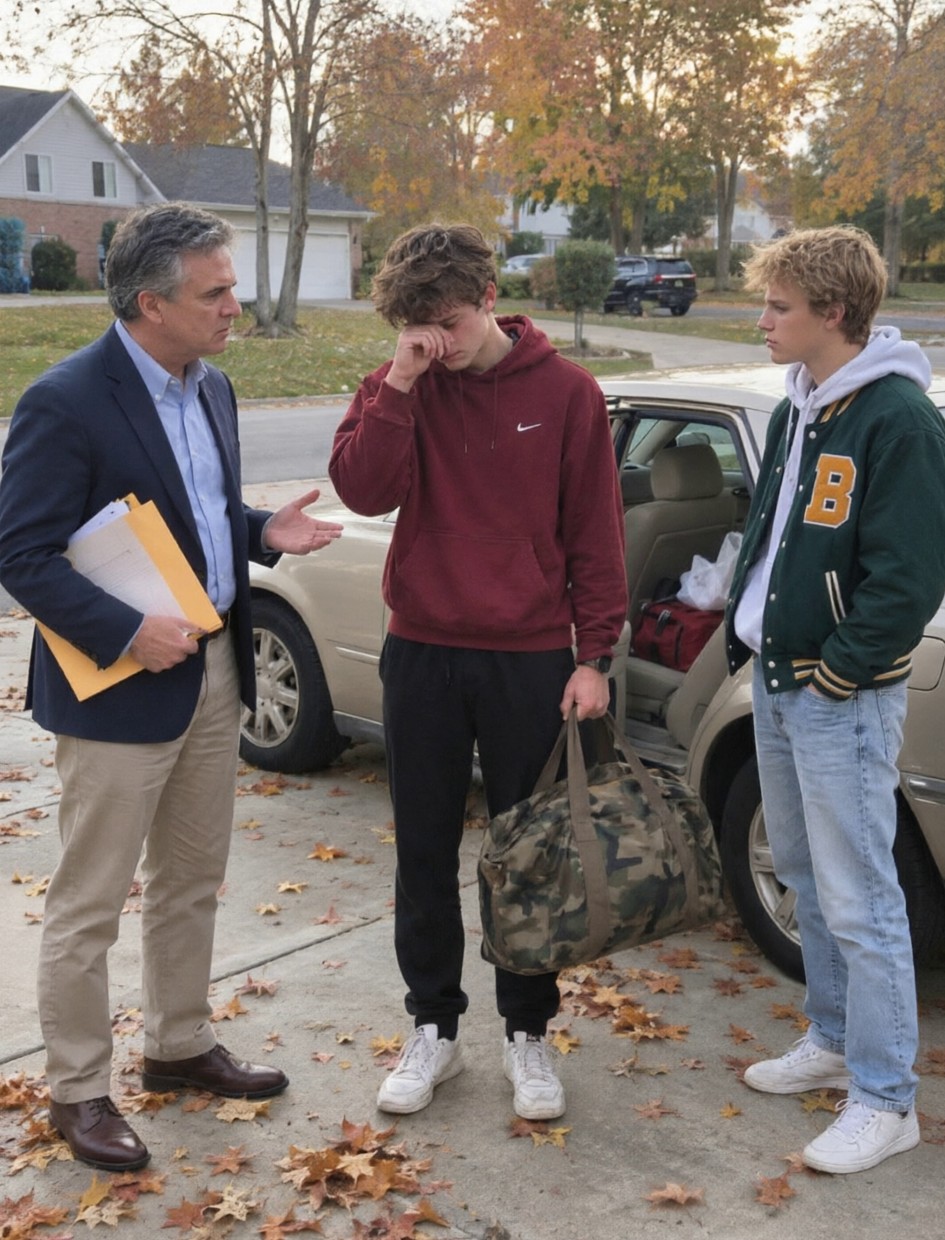
Nine nights later, my car broke down, and I was searching behind a restaurant for something to eat when a man in a suit walked up to me. “I’ve been looking everywhere for you.” He was representing the grandfather my father had always claimed died before I was born—and he was carrying an envelope that revealed the real reason my father had lied.
Part 1:
I turned eighteen on a Tuesday, and my family celebrated by telling me to leave.
There was no birthday cake waiting in the kitchen. No card, no gift, and not even a simple “Happy Birthday.” Instead, my father sat across from me at the breakfast table while his wife stirred sugar into her coffee. My stepbrother leaned back in his chair, looking strangely comfortable, as though he had been waiting for this moment.
“Sit down, Caleb,” Dad said.
I was already sitting, but I stayed quiet.
“You’re eighteen now. That makes you an adult, which means we’re done taking care of you. It’s time for you to move out.”
For a few seconds, I simply stared at him.
I thought he had to be joking. My high school graduation was still three months away. I had classes to attend, exams to pass, and no place to live.
“Where exactly am I supposed to go?” I asked. “I still have three months of school left.”
Dad shrugged as if I had asked him about the weather.
“You’ll figure something out.”
His wife gave me one of her gentle smiles. It was the kind of smile that never reached her eyes.
“We’ve already packed your things, Caleb,” she said. “Everything is ready for you.”
I turned toward the front door.
Three large plastic bags sat beside it.
That was everything I owned.
My clothes, my schoolbooks, my shoes, and a few personal belongings had been stuffed into those bags as though I were nothing more than unwanted rubbish.
Then I remembered something that made my stomach tighten.
My savings.
I had started working when I was fifteen. Over the past three years, I had taken grocery store shifts, washed dishes, worked weekends, and given up almost every chance to enjoy myself.
While other teenagers spent their money on games, movies, and new clothes, I saved mine.
I had managed to put away a little more than three thousand dollars. It wasn’t a fortune, but it was enough to help me get started after graduation.
That money was my safety net.
At least, I thought it was.
“Where’s my money?” I asked.
Dad didn’t even look uncomfortable.
“We used it.”
I felt as though someone had punched me in the chest.
“What do you mean, you used it?”
“Applications, fees, and things your brother needed,” he replied. “He has college expenses coming up. Consider your savings rent for living here.”
I looked at my stepbrother.
He didn’t say a word.
He simply sat there, looking as if none of this had anything to do with him.
“You took three thousand dollars that I earned myself?” I asked.
Dad’s expression hardened.
“Don’t start making a scene, Caleb. You’re an adult now. Adults pay their own way.”
I wanted to scream at him.
I wanted to ask how he could call himself a father while stealing the money his own son had worked so hard to save.
But I knew arguing wouldn’t change anything. He had already made his decision, and his wife had clearly helped him prepare for it.
They had taken my money, packed my belongings into three plastic bags, and decided that my eighteenth birthday was the perfect day to throw me out.
I picked up the bags and carried them outside.
My old sedan was parked in the driveway. It wasn’t much, but it was the one thing I still had.
I loaded the bags into the back seat, climbed behind the steering wheel, and stared at the house where I had grown up.
I promised myself I wouldn’t cry until I drove away.
I lasted about ten seconds.
The moment I closed the car door, the tears came. I pressed my hands against my face and cried until my chest hurt.
I had imagined turning eighteen so many times. I thought I would feel excited, hopeful, and ready to begin my adult life.
Instead, I was alone, homeless, and almost completely broke.
And I hadn’t even graduated from high school.
For the next nine days, my car became my bedroom, my closet, and the only place where I could have a little privacy.
I continued going to school because pretending everything was normal seemed easier than explaining the truth.
Every morning, I woke before sunrise and drove to school while I still had enough gas. I used the locker room showers to clean myself up, changed into my school clothes, and tried to look like any other teenager.
I wore the same jeans repeatedly.
I kept my head down whenever someone asked what I had done over the weekend.
I laughed at jokes with my classmates, even when my stomach was empty and I was wondering where I would sleep that night.
Nobody knew the truth.
Nobody knew that I was spending my nights in parking lots and on quiet side streets, hoping nobody would notice a teenager sleeping inside an aging sedan.
Food became a problem I had to solve every day.
I ate part of my school lunch and saved whatever I could for later. I counted every dollar before spending it. I avoided unnecessary trips because gasoline was becoming more expensive than I could afford.
I kept telling myself that if I could make it to graduation, I would find a job, rent a small room, and start rebuilding my life.
I just needed to survive a little longer.
But on the ninth day, everything became worse.
My gas tank was almost empty when my car began making strange noises. The engine sputtered, the dashboard lights flickered, and the vehicle finally stopped running.
I managed to steer it behind a row of restaurants, where I squeezed it into a space between dumpsters and delivery trucks.
I sat behind the steering wheel for nearly an hour, hoping the car would somehow start again.
It didn’t.
Eventually, hunger became stronger than my embarrassment.
I climbed out and walked behind one of the restaurants. I wasn’t looking for money. I wasn’t trying to steal anything.
I just hoped somebody might have thrown away some untouched bread, a few fries, or something else I could safely eat.
I hated myself for even having to think that way.
Then a voice behind me made my entire body freeze.
“Are you Caleb Vance?”
I slowly turned around.
A stranger stood a few feet away.
He looked completely out of place in that dirty alley. His suit was perfectly tailored, his shoes were spotless, and he carried a leather briefcase that probably cost more than my broken car.
I stared at him suspiciously.
“Who wants to know?”
Instead of answering immediately, he reached into his jacket and handed me a business card.
“Arthur Kingsley,” he said. “I’ve been searching for you.”
Nobody had ever said those words to me before.
Searching for me?
Why would a man dressed like that be looking for a broke teenager who was practically living behind a restaurant?
“What do you want?” I asked.
Arthur glanced toward my car, then back at me.
“I represent the estate of Edward Vance.”
The name meant nothing to me at first.
Then I realized what he had said.
“Edward Vance?”
“Your grandfather,” he replied.
I almost laughed.
“My grandfather died before I was born.”
Arthur’s expression became serious.
“That isn’t true, Caleb. Edward Vance died only a few weeks ago.”
I stopped breathing for a moment.
My father had told me my entire life that his father had died before I was born. There had never been birthday cards, photographs, phone calls, or family visits that gave me any reason to question that story.
As far as I knew, I had never had a grandfather.
Arthur opened his briefcase and removed a thick brown envelope.
“Your grandfather instructed us to find you as soon as possible.”
“Why?”
Arthur looked at my broken car and the three plastic bags visible through its windows.
Then he looked directly at me.
“Because he left everything to you.”
I stared at him.
“What?”
“Your grandfather’s house, his financial accounts, and his business interests. According to his will, those assets were not left to your father. They were left to you.”
I couldn’t understand what I was hearing.
Ten minutes earlier, I had been searching behind a restaurant for something to eat.
Now a stranger was telling me that I had inherited more money than I could imagine.
I should have felt relieved.
I should have been celebrating.
Instead, something about Arthur’s serious expression made me uneasy.
“But there’s a condition,” he said.
He reached into his briefcase and removed another document.
My full name was written across the front of the brown envelope.
Caleb Vance.
My hands suddenly felt cold.
“What condition?”
Arthur held the envelope toward me.
“Your grandfather left specific instructions for you.”
I reached for it, but before I could take it, Arthur looked straight into my eyes.
“And once you read them, Caleb, you’re going to understand why your father spent eighteen years making sure you believed your grandfather was dead.”
For the first time since my father had thrown me out, I felt something stronger than fear.
I felt the truth approaching.
And I had a feeling it would change everything.
Part 2: The Truth My Father Hid From Me
I stared at the brown envelope but didn’t open it immediately.
My mind was racing.
If my grandfather had been alive for most of my childhood, why had my father lied about him? Why had I never received a birthday card or even a simple letter? And why would a man I had never met leave his entire estate to me?
Arthur seemed to understand my confusion.
He didn’t pressure me to open the envelope. Instead, he began explaining the first truth my father had hidden from me.
“My grandfather wasn’t dead before I was born,” I said slowly, trying to make sense of it.
“No,” Arthur replied. “Edward Vance was alive for seventeen years of your life. He passed away six weeks ago.”
Seventeen years.
My grandfather had been alive throughout almost my entire childhood.
I had grown up believing he didn’t exist, while he had apparently known I was alive.
Arthur finally opened the envelope and removed an old photograph.
It showed a younger version of my father standing beside a silver-haired man in front of a large brick building.
My father looked much younger in the picture, but I recognized him immediately.
The older man stood straight, wearing a dark suit. He had serious eyes, a strong jaw, and a face that looked strangely familiar.
He had my dark eyes.
I turned the photograph over.
Three handwritten words appeared on the back.
My grandson Caleb.
I stared at the writing for a long time.
Someone had written those words years ago, and that someone had known I existed.
“Where did you get this?” I asked.
“It was among your grandfather’s personal belongings,” Arthur explained. “He kept it in his private study.”
I ran my thumb along the edge of the photograph.
“Why did my father lie to me?”
Arthur took a slow breath.
“Your father and your grandfather had a difficult relationship. Edward built his business through years of hard work, and he expected his family to understand the value of responsibility. Your father, however, believed he was entitled to his father’s money.”
“So they stopped talking?”
“Not exactly. Your grandfather refused to continue supporting him financially. The disagreement became bitter, and your father eventually chose to distance himself from Edward.”
I shook my head.
“That still doesn’t explain why he told me my grandfather was dead.”
Arthur opened another file.
“Six years ago, your father attempted to have himself recognized as Edward’s only surviving heir. He believed that, as Edward’s son, he should eventually inherit the business and the rest of the estate.”
“What happened?”
“Your grandfather refused to give him control. He had already begun reconsidering his plans for the inheritance.”
Arthur paused before giving me the answer.
“He decided that you would be his heir instead.”
I stared at him.
“Me?”
“Yes, Caleb. You.”
I couldn’t understand why a grandfather I had never met would trust me with everything he owned.
I was eighteen years old. I had no business experience, no money, and no idea how to manage a company.
My father, on the other hand, was a grown man who had spent years around the family business.
Why would Edward choose me?
Arthur’s answer made the situation even stranger.
“Your grandfather had been watching your life from a distance.”
I frowned.
“What does that mean?”
“It means he had information about you. He knew about your schoolwork, your part-time jobs, and the money you had been saving. He also tried to contact you several times.”
“Contact me?”
Arthur nodded.
“He sent letters, birthday cards, photographs, and invitations. He wanted to meet you, but he never received a response.”
I felt something tighten in my chest.
“I never received anything.”
“I know.”
Arthur opened another folder and placed its contents on the hood of my car.
Inside were copies of thirty-two letters, birthday cards, photographs, and invitations addressed to me over the years.
Some had been sent directly to our home. Others had been sent through my school in an attempt to reach me without involving my father.
Every envelope carried my name.
Some were birthday cards. Others contained invitations to visit my grandfather or simply asked how I was doing.
There were even photographs of buildings, gardens, and family possessions that Edward had apparently hoped to share with me.
I had never seen any of them.
Not one.
My hands began to shake as I examined the documents.
“Why didn’t I get these?”
Arthur’s face grew hard.
“Because your father intercepted them.”
I looked up sharply.
“What?”
“My grandfather eventually became concerned when you never responded. He hired a private investigator to find out why. The investigator discovered that your father had been taking the letters before you could see them.”
Arthur showed me several photographs.
In one, my father stood beside our mailbox, removing an envelope.
In another, he carried a stack of letters into the house.
A third showed him standing near a trash can with torn pieces of paper in his hand.
The investigator had documented the pattern over several years.
My father had intercepted the mail, destroyed the letters, and thrown away the birthday cards.
The dates stretched across much of my childhood.
I felt sick.
Suddenly, every birthday I had spent believing that nobody outside our household cared about me felt different.
I remembered the times I had wondered why other children talked about visiting their grandparents while I had nobody.
I remembered asking Dad once whether his father had any photographs of him as a child.
He had told me to stop asking questions about a dead man.
Now I understood why.
My grandfather hadn’t forgotten me.
He hadn’t abandoned me.
My father had made sure I believed he had.
I looked at the photographs again, unable to believe the man who had raised me could have done something so cruel.
“Did my grandfather know what my father was doing?”
“Yes,” Arthur replied. “Eventually, he discovered the truth. By then, he had already decided that you would inherit his estate.”
I swallowed hard.
“Then why didn’t he come and get me?”
Arthur didn’t answer immediately.
“Edward was a complicated man, Caleb. He believed that confronting your father directly could make the situation worse. He also hoped that, as you grew older, he might find a way to reach you without creating an even greater conflict.”
“But he never did.”
“No,” Arthur said quietly. “And he regretted that.”
For a moment, I couldn’t speak.
I had spent eighteen years thinking I wasn’t important enough for anyone to look for me.
Now I was learning that someone had been trying to reach me all along.
And my own father had stood between us.
Eventually, I forced myself to ask the question that mattered most.
“What is the condition attached to the inheritance?”
Arthur removed the final pages from the folder.
“These are the relevant sections of your grandfather’s will. I want you to read them carefully.”
I took the pages and studied the legal language.
According to Edward’s instructions, I was not allowed to access the inheritance immediately. I also could not use his financial accounts, stay in his properties, or receive financial assistance from the estate during the challenge period.
The condition required me to remain financially independent for thirty days after turning eighteen.
I couldn’t return to my father’s home for help, either.
If I completed the thirty days, I would become the owner of the estate and its associated business interests.
If I failed or voluntarily withdrew, the main estate would be transferred to a charitable trust, and I would receive only limited support under the alternative arrangement described in the will.
I looked up from the pages.
“So I’m supposed to survive exactly like this?”
Arthur glanced at my broken sedan.
“You’ve already survived nine days.”
I let out a bitter laugh.
“Barely.”
“I understand.”
“No, I don’t think you do,” I said. “I have almost no money. My car doesn’t work. I haven’t had a proper meal in days. I still have school, and I have nowhere to sleep.”
Arthur listened without interrupting.
For the first time, I wondered whether my grandfather’s plan had been as cruel as my father’s behavior.
Why should I have to prove anything to inherit what had been left to me?
I had never asked for millions of dollars. I had never asked to become the owner of a business.
All I had wanted was a chance to finish school and build a decent life.
Now I had a choice to make.
And whatever I decided, I knew one thing for certain.
I would never again trust someone simply because they claimed to know what was best for me.
Part 3: The Thirty-Day Challenge
The rain started falling in steady, icy sheets, bouncing off the asphalt and trickling down the rusted bumper of my broken sedan.
Arthur stood beneath a large black umbrella he had retrieved from his briefcase. The remaining documents were tucked beneath his arm.
He looked at me—wet, exhausted, and standing beside dumpsters with three plastic bags of belongings crammed into the back seat of a dead car.
Then he glanced at his watch.
“Your grandfather was a complex man, Caleb,” he said softly over the sound of the rain. “He built Vance Holdings from the ground up after growing up in poverty himself. He believed that unearned wealth could ruin people. In his experience, it made some men soft, entitled, and cruel.”
I folded my arms against the cold.
“And he thought I might turn out like my father?”
“He wanted to make sure that whoever inherited Vance Holdings understood the value of hard work.”
I shook my head in disbelief.
“So he decided to test me? I’ve been sleeping in my car for nine days! I was looking for food in a dumpster five minutes ago! Haven’t I been tested enough?”
Arthur remained calm.
“He didn’t arrange for your father to throw you out. The condition in the will was written two years ago, long before your eighteenth birthday. Your grandfather passed away six weeks ago. He could not have known that your father would choose to evict you on the very day you became an adult.”
That made me pause.
I had assumed the challenge was somehow connected to my father’s decision, but the timeline made it clear that Edward’s plan had been created well before my current situation began.
“Then what exactly did he want me to prove?” I asked.
“That you could survive for thirty days through your own efforts, without using his wealth or relying on your father. He wanted you to demonstrate that you understood the value of independence before gaining control of the business.”
I looked at the rain running down the windshield of my car.
“And if I don’t?”
“You will not receive control of the main estate. The business, the properties, and the controlling shares—valued at approximately forty million dollars—will be transferred to the charitable trust specified in the will.”
Forty million dollars.
The amount seemed impossible to comprehend.
A few minutes earlier, I would have considered fifty dollars for a tow truck and a hot meal a fortune.
Now I was being told that I could either complete the challenge and inherit a multimillion-dollar business or walk away and receive only limited support.
Arthur reached into his suit jacket and pulled out a small, heavy silver key and a simple black envelope.
“Your grandfather anticipated that the challenge might become difficult,” he explained. “He appointed me to administer it. My responsibility was to locate you on your eighteenth birthday, monitor your circumstances, and intervene only if your physical safety was in immediate danger.”
I stared at him.
“You’ve been watching me?”
“My investigator located you after your father forced you out. Since then, I have received regular reports. I know you’ve continued attending school. I know you’ve taken extra shifts where you could find them. I know you’ve been showering in the school locker room and studying by the dome light of your car.”
My face burned with embarrassment.
I hated the thought of someone watching me struggle.
But Arthur didn’t seem amused or judgmental. He simply looked serious.
Then he held out the black envelope.
“Your grandfather left you another option. If you sign this waiver now, the thirty-day condition will be canceled. You will receive a modest monthly allowance, a small apartment, and an entry-level clerical job at Vance Holdings.”
I looked at the envelope.
“That doesn’t sound terrible.”
“It isn’t. You would have a stable place to live, an income, and an opportunity to build a career. However, the main estate—the business, the properties, and the controlling shares worth approximately forty million dollars—would be placed into the charitable trust. You would never control them.”
I stared at the envelope for a long time.
Forty million dollars.
A safe apartment.
A steady paycheck.
A warm bed.
I could sign the paper, leave the rain behind, and stop worrying about where I would sleep. I could finish high school without wondering whether I would have enough money to eat.
Nobody would blame me for choosing that option.
I was exhausted, hungry, and tired of pretending I was fine.
But then I thought about my father.
I remembered him sitting at the kitchen table, telling me I was an adult while taking the three thousand dollars I had worked so hard to save.
I remembered the three plastic bags waiting beside the front door.
I remembered every night I had spent alone in my car, wondering why my own family had decided I was no longer worth caring for.
Then I remembered the photographs of my father destroying my grandfather’s letters.
For eighteen years, he had controlled what I knew about my family. He had taken away the chance to know my grandfather, and he had stolen the money that might have helped me survive after being thrown out.
I refused to let his choices decide the rest of my life.
If I gave up now, I would always wonder whether I had been capable of finishing what I started.
I looked Arthur in the eye and pushed the black envelope back toward his chest.
“I have twenty-one days left,” I said. “Tell me the exact rules.”
Arthur studied me for a moment.
Then his sharp, professional expression softened, and a faint smile appeared on his face.
“The rules are simple, Caleb. You cannot accept money from the Vance estate. You cannot borrow money from me or anyone associated with your grandfather. You cannot return to your father’s house or ask him for assistance. Until midnight on the thirtieth day, you must earn your own money to cover your food, shelter, and living expenses.”
“And you’ll be watching?”
“I will be verifying that you meet the conditions. I will not interfere with your efforts.”
I nodded toward my car.
“What about this? It needs repairs.”
“You earned the money that bought it, so it is your property. But I cannot pay to repair it for you.”
I took a deep breath.
My stomach growled loudly in the quiet alley, but for the first time in nine days, the cold inside my chest began to give way to something else.
Determination.
“Where do I sign?”
Arthur produced a single-page document.
I read it carefully before signing my name in firm, dark ink.
Caleb Vance.
Arthur took the document and placed it inside his briefcase.
“Good luck, Caleb,” he said, handing me his personal business card. “I will see you in twenty-one days. Or sooner, if you change your mind.”
He turned and walked toward a sleek black town car waiting at the end of the alley.
A moment later, the vehicle pulled away, leaving me alone in the rain.
I stood there for a few seconds, watching its taillights disappear.
Then I wiped the water from my face and turned toward the restaurant.
I had twenty-one days left.
And I wasn’t going to waste another minute feeling sorry for myself.
The first problem I needed to solve was my car.
I walked into the restaurant’s back kitchen, where the staff were preparing for the evening rush. I held up my school identification card and approached the head chef.
His name was Marcus. He was a broad-shouldered man with tired eyes, flour-stained clothes, and the kind of expression that suggested he had seen just about everything.
He looked up suspiciously as I approached.
Before he could tell me to leave, I spoke.
“I’m not looking for a handout, sir. My car broke down in your alley. It’s a 2008 Honda Accord. The transmission is still good, but I think the alternator has failed.”
Marcus glanced toward the back window.
“I noticed it sitting out there. What’s that got to do with me?”
“If you let me park it in the back corner of your lot for the next three weeks, I’ll wash your dishes, mop your floors, and take out the trash every night after school. I won’t charge you anything for those jobs. I just need somewhere safe to leave the car.”
Marcus studied me.
Then he looked at my soaked clothes and the exhausted expression on my face.
“You in trouble, kid?”
“No, sir,” I replied. “I’m finishing high school, and I’m trying to build a life for myself.”
He didn’t answer immediately.
Instead, he wiped his hands on his apron and looked toward the kitchen staff.
Finally, he pointed toward the dishwashing area.
“Shift starts at five. There’s a clean apron hanging on the hook. You can start tonight.”
I blinked.
“Really?”
“Don’t make me regret it,” he said. “And eat something from the serving line before you touch a plate. You look like you haven’t had a decent meal in a week.”
I swallowed hard.
“Thank you, sir.”
Marcus waved his hand dismissively.
“Save the thanks. The dishes aren’t going to wash themselves.”
That evening, I worked until my back hurt and my hands were red from hot water.
But when I finally finished, I sat down in the staff area and ate a hot meal.
For the first time in more than a week, I wasn’t eating scraps or calculating how long I could make a small amount of food last.
I had earned that meal.
And that made it taste better than anything I could remember.
Part 4: Three Weeks of Hard Work
The next three weeks became a blur of exhaustion, discipline, and survival.
My life turned into a strict routine. Every hour mattered, and every dollar had a purpose.
At 5:30 each morning, I woke up in the back seat of my dead sedan.
I had bought two wool blankets from a thrift store for four dollars using a little money Marcus had given me for my first shifts. They weren’t comfortable, but they kept me warm enough to sleep.
I folded the blankets, washed my face with bottled water, and prepared for another day.
Then I ran two miles to my high school.
I used the gym showers to clean myself up, changed into my cleanest clothes, and headed to class.
I had only a few pairs of jeans and shirts, so I washed what I could whenever I had access to a washing machine. I did my best to keep my clothes clean and presentable, even when I was exhausted.
I refused to let my circumstances destroy my education.
My teachers began noticing a change in me.
Before, I had sometimes been the quiet kid who struggled to stay awake during morning classes. Now I was focused and determined.
I finished my schoolwork during lunch, submitted assignments early, and worked hard to maintain my honors standing.
Whenever I felt myself getting tired, I reminded myself that graduation was only a few months away.
I wasn’t going to let my father take that away from me, too.
My afternoons were even harder.
From approximately 3:30 p.m. until 11:00 p.m., I worked at Marcus’s restaurant.
At first, I washed dishes and cleaned the kitchen. Soon, I was helping prepare vegetables, carrying heavy containers of ice, scrubbing cooking equipment, and hauling bags of trash to the back.
Some nights, the restaurant became so busy that the dishwashing area seemed endless.
Plates piled up faster than I could clean them. Pots were covered in grease, and pans came back from the kitchen with food stuck to their bottoms.
The hot water burned my fingers. Detergent dried out my skin. My muscles ached so badly that climbing into the back seat of my car at night became a challenge.
But I never complained.
Marcus quickly realized that I wasn’t the kind of worker who tried to avoid difficult jobs.
By the second week, he began paying me for the additional hours I worked beyond our original arrangement.
He didn’t make a big speech about it. One evening, he simply handed me an envelope and told me to count the money.
“You’ve been putting in the hours,” he said. “You deserve to be paid for them.”
I looked at the money in disbelief.
“Are you sure?”
Marcus gave me a stern look.
“I’m not running a charity, Caleb. You’re doing the work. I’m paying you. That’s how a job is supposed to work.”
I nodded, unable to hide my gratitude.
That money made a difference.
I paid my phone bill, bought basic toiletries, and purchased food when I needed something outside my meals at the restaurant.
Every spare dollar went into an envelope that I kept hidden inside my shoe.
I wanted to know exactly how much money I had earned, and I didn’t want to risk losing it.
I didn’t spend anything unless I absolutely had to.
I couldn’t afford unnecessary purchases, and I refused to borrow money from anyone connected to my grandfather.
The challenge was difficult, but the rules were clear.
I had to make it to the thirtieth day using my own work.
That was exactly what I intended to do.
I rarely slept more than four hours a night.
My muscles ached constantly. My hands became rough and calloused, and small burns from the hot dishwater left my fingers sore.
Some mornings, I struggled to get out of the car.
There were nights when I sat in the driver’s seat, staring at the rusted roof, wondering how much longer my body could handle the routine.
But I never seriously considered giving up.
Every time I thought about quitting, I remembered my father.
I remembered the way he had looked at me when he told me to leave.
I remembered how easily he had taken my savings, as though the money meant nothing because I was the one who had earned it.
And I remembered the letters my grandfather had sent.
For years, my father had tried to make me dependent on him while keeping me ignorant of the family I had never known.
Now I was learning to stand on my own.
I didn’t need my father’s approval.
I didn’t need him to tell me I was worth something.
I was proving my worth to myself every day.
The strange thing was that, despite the exhaustion and uncertainty, I felt happier than I had while living in my father’s house.
There, I had a roof over my head, but I never knew when it might be taken away. I depended on people who treated their control over me as a weapon.
Now I slept in a broken car and worked until my hands hurt, but every decision I made belonged to me.
Nobody could threaten to take away my home because I had earned my place there.
Nobody could use food as leverage because I was working for it myself.
I was learning what independence actually meant.
It wasn’t easy.
It wasn’t comfortable.
But it was mine.
As the days passed, I began counting down the hours until the end of the challenge.
I knew the inheritance would bring an entirely different set of problems. I would have to learn about business, understand legal documents, and make decisions that could affect the lives of many employees.
But I wasn’t thinking about that yet.
My immediate goal was simple.
Survive.
Finish school.
Keep working.
And reach midnight on the thirtieth day without asking anyone to save me.
Three days before my high school graduation, something happened that threatened to pull me back into the life I had fought so hard to escape.
My father showed up.
Part 5: My Father Came Looking for Me
It was a cold Thursday afternoon.
School had just let out, and I was crossing the parking lot on my way to Marcus’s restaurant when a silver SUV suddenly pulled up and blocked my path.
I stopped.
The driver’s door opened.
My father stepped out.
For a moment, I barely recognized him.
His hair was slightly disheveled, his eyes were bloodshot, and the arrogant expression he usually wore had disappeared.
He looked tired, worried, and angry all at once.
Behind him, his wife sat in the passenger seat. Her face was pale, and she stared out the window without saying anything.
My father closed the door and walked toward me.
“Caleb.”
I didn’t move.
He took another step.
“Where have you been?”
I kept my hands in my jacket pockets.
“What do you want, Dad?”
He looked around the parking lot as if he expected me to explain myself.
“You vanished! We’ve been looking all over town for you for two weeks!”
I stared at him.
For a moment, I couldn’t believe he had the nerve to say that.
“You threw me out,” I replied. “You packed my belongings into plastic bags, took my savings, and told me to figure things out for myself. Remember?”
My father swallowed hard.
Then he waved his hand dismissively, as though he could erase the entire event by refusing to take it seriously.
“That was just tough love, Caleb.”
I said nothing.
“You know how things get in a family,” he continued. “We were under a lot of stress. Your stepbrother needed help with his college tuition payments, and we were struggling financially. Things got out of hand.”
I looked at him in disbelief.
“You stole my money to pay for his college expenses.”
“Don’t call it stealing,” he snapped. “We were taking care of family responsibilities.”
“Those were my savings.”
He ignored me.
“Look, what’s done is done. Family is family. You’re my son, and I want you to come home. Get in the car.”
For a fraction of a second, I wondered whether he genuinely felt guilty.
Perhaps he had finally realized how badly he had treated me.
Perhaps he had spent the past few weeks thinking about what he had done.
Then I noticed something tucked into his coat pocket.
A white legal envelope.
It was the kind of envelope used for official documents, and it looked too important for an ordinary family conversation.
I looked back at my father.
“Who told you to look for me?”
He blinked.
“What?”
“Who told you where I was?”
“Nobody!” he answered too quickly. “I’m your father. I have every right to know where you are!”
I studied his face.
Then I asked the question that made his expression change.
“Arthur Kingsley called you, didn’t he?”
All the color drained from my father’s face.
For a moment, he stood completely still.
Then he looked away.
The lie had collapsed before he could even try to defend it.
“Caleb, listen to me,” he said, stepping closer. His voice dropped into an urgent whisper. “That old man—your grandfather—was out of his mind. He was a manipulator. He spent his entire life holding money over my head and treating me like garbage. And now he’s trying to control me from beyond the grave!”
I felt my anger rising, but I kept my voice steady.
“He tried to write to me thirty-two times.”
My father froze.
“You shredded every single letter,” I continued. “You stole my birthday cards. You made me believe he had died before I was born.”
His face twisted with anger.
“Because he was poison!” he shouted. “He wanted to turn you against me!”
I stared at him.
“He wanted to meet me.”
“He wanted to use you!” Dad yelled. “He left that entire business to a kid just to spite me! Do you have any idea what Vance Holdings is worth?”
“Forty million dollars, according to Arthur.”
My father looked as though I had struck him.
“Do you know what kind of legal nightmare I’ve been dealing with for the past three weeks?” he demanded. “I’ve had to speak with lawyers, deal with the estate, and fight to protect this family from your grandfather’s ridiculous decisions!”
I almost laughed.
“Protect the family? You threw me out and took my money.”
He stepped forward and grabbed my shoulder.
His fingers dug into my jacket.
“You’re my son, Caleb. You’re eighteen. You don’t know how to run a forty-million-dollar estate. You have no experience, no business knowledge, and no idea how the world works.”
I looked down at his hand.
Then I slowly raised my eyes to meet his.
“Let go of me.”
He tightened his grip.
“Listen to me. Sign the administration rights over to me. I’ll handle the business, sell the controlling shares if necessary, and split the money with you. We can all live like royalty. You’ll never have to work another day in your life!”
His voice became more desperate.
“I’m trying to protect you!”
I looked into his eyes.
For years, I had wanted my father to protect me.
I had wanted him to care whether I was safe, whether I had enough food, and whether I could finish school.
But standing there, with his hand gripping my shoulder and his mind focused entirely on the inheritance, I finally understood something.
He wasn’t trying to protect me.
He was trying to get his hands on the money.
He had spent his life waiting for someone else’s wealth to rescue him, and now he was willing to rob his own son to get it.
I reached down, took his wrist, and carefully pulled his fingers away from my jacket.
Then I stepped back.
“I’ve worked every single day for the past three weeks, Dad,” I said quietly.
He stared at me.
“I slept in a dead car behind a dumpster. I washed dishes for hours after school. I earned my food, my clothes, and the money in my pocket.”
I took another step away from him.
“And I earned something else.”
“What?” he demanded.
“My self-respect.”
His face turned red.
“Caleb, don’t be stupid! You can’t manage this on your own!”
I looked him straight in the eyes.
“I already am.”
He opened his mouth, but I continued before he could interrupt.
“The thirty days end tonight at midnight. And you’re not getting a single cent.”
For a moment, the parking lot seemed completely silent.
Then my father began shouting.
He called me ungrateful. He told me I was making a terrible mistake. He threatened to contest the will and promised that I would regret turning against him.
I didn’t respond.
I simply turned around and walked toward the restaurant.
He screamed my name across the parking lot, but I kept walking.
I didn’t look back.
His voice grew quieter as I moved farther away.
For the first time in my life, my father’s anger no longer controlled me.
He could shout.
He could threaten.
He could tell me I was making a mistake.
But he could no longer decide what happened to my life.
And he was never going to get the chance to take away my future again.
Part 6: Midnight Changed Everything
At 11:45 p.m. that night, I sat inside the quiet office of Marcus’s restaurant.
The kitchen had finally closed, and Marcus had gone home for the night. He had trusted me with the keys so I could finish cleaning up and lock the building when I was done.
I sat at the small wooden desk wearing a clean shirt.
Beside me lay my high school graduation application and an envelope containing eight hundred dollars in cash.
That money represented the work I had done over the past twenty-one days.
Every dollar had been earned through long shifts, aching muscles, and hours of hard work after school.
I counted it one last time, then placed it carefully back inside the envelope.
Eight hundred dollars.
It wasn’t much compared with the inheritance I was about to receive, but it meant something to me that no amount of money could replace.
I had earned it myself.
I checked the time.
11:52 p.m.
Eight minutes.
I leaned back in the chair and looked around the small office.
The room wasn’t impressive. The desk was scratched, the walls needed painting, and the old clock above the filing cabinet ticked loudly in the silence.
But this room represented the end of a chapter in my life.
For thirty days, I had survived without relying on my father or touching my grandfather’s money.
I had continued attending school, kept my job, and paid my own expenses.
I had made it.
At 11:59 p.m., headlights flashed through the front window.
A moment later, the restaurant’s front door opened.
Arthur Kingsley stepped inside.
He wore a crisp navy suit and carried his familiar leather briefcase. In his other hand was a bottle of sparkling water and two glasses.
He looked around the empty restaurant before walking toward my desk.
“Still here, I see,” he said.
“I told you I would be.”
Arthur smiled faintly and placed the bottle on the desk.
Then he checked his watch.
We waited in silence.
The second hand moved toward the twelve.
I felt my heart beating faster.
For thirty days, I had counted the hours, the shifts, and the money. I had lived with uncertainty, but I had never allowed myself to forget the goal.
Now the final seconds were passing.
At precisely midnight, Arthur closed his watch.
October 8.
The thirtieth day was complete.
He extended his hand across the desk.
“Congratulations, Mr. Vance. You have fully satisfied the conditions of your grandfather’s will.”
I stood and shook his hand firmly.
“As of midnight, you are the sole legal owner of Vance Holdings, the residential estate, and all associated liquid assets, subject to the terms of the estate documents.”
For a moment, I couldn’t speak.
The challenge was over.
I had done what I promised myself I would do.
“Thank you, Arthur,” I finally said.
He set his briefcase on the desk and opened it.
Inside were several thick folders containing legal documents, a set of brass keys to my grandfather’s home, and a sleek silver corporate card bearing my name.
Caleb Vance, Chairman.
I picked up the card and studied it.
My name looked strange printed beneath that title.
A few weeks earlier, I had been sleeping in a broken car and worrying about whether I could afford food.
Now I was the legal owner of a major business.
But Arthur wasn’t finished explaining what had happened while I was completing the challenge.
“Your father attempted to file an emergency injunction this afternoon,” he said.
I looked up.
“To stop the inheritance?”
“Correct. His attorney asked the court to freeze the transfer and prevent you from taking control of the estate.”
I felt my stomach tighten.
“What happened?”
Arthur’s expression became cold and confident.
“I presented the judge with the evidence collected by the private investigator. That included photographs showing your father destroying your grandfather’s correspondence, along with records documenting his interference with the letters sent to you.”
He opened another folder.
“We also provided the police report relating to the money taken from your savings and the circumstances surrounding your eviction. Marcus supplied a signed statement confirming your employment and the fact that you earned your living independently during the challenge.”
I stared at him.
“And the judge?”
“The judge dismissed your father’s petition with prejudice, meaning he cannot simply bring the same claim again. The court also warned him that further harassment or unauthorized interference with the estate could expose him to additional legal consequences.”
Arthur paused before adding another detail.
“My firm has also filed a civil claim seeking to recover the three thousand dollars your father took from your savings, together with any interest or other amounts recoverable under the law.”
I slowly leaned back in the chair.
For the first time in years, it felt as though I could finally take a full breath.
My father couldn’t simply walk into my life and demand everything I had worked for.
He couldn’t take my money, threaten me, or force me to surrender my future because he believed he deserved it more than I did.
The law was finally standing between us.
And this time, I had someone who understood what had happened and was prepared to help me protect my rights.
I looked at the documents spread across the desk.
The struggle was over, but I knew a different kind of challenge was beginning.
Owning a business wasn’t the same as washing dishes or finishing school.
I would have to learn how to manage employees, understand financial reports, and make decisions that affected far more people than myself.
I had a great deal to learn.
But I wasn’t afraid of hard work anymore.
I looked up at Arthur.
“What is the first thing on the schedule for Vance Holdings tomorrow?”
He smiled and placed a smooth gold fountain pen on top of the documents.
“Tomorrow morning at nine o’clock, you have your first board meeting. The executive team is eager to meet the young man who has demonstrated that the Vance legacy may be in capable hands.”
I picked up the pen.
“Tell them I’ll be there on time.”
Then I thought about Marcus.
He had given me a chance when I had nowhere else to go. He had allowed me to park my car behind his restaurant, offered me work, and made sure I had something to eat.
He hadn’t treated me like a charity case.
He had treated me like a person who deserved the opportunity to work.
I looked at Arthur.
“But before I do anything else, I want to pay Marcus for a brand-new commercial dishwasher for his kitchen. His old one has been struggling for weeks.”
Arthur raised his eyebrows slightly.
“That is a generous first expenditure.”
“It’s the least I can do. He helped me when I had nothing.”
Arthur bowed his head respectfully.
“A fitting first decision, sir.”
I smiled.
For the first time, the thought of having money didn’t make me feel frightened or guilty.
It made me think about what I could do with it.
Part 7: The Future My Father Tried to Steal
The next morning, I stood on the top floor of the Vance Holdings tower in downtown.
The sun was rising over the city, spreading golden light across the buildings and streets below.
I was wearing a tailored suit, holding a hot cup of coffee, and preparing for my first board meeting.
My high school finals were still scheduled for the following week.
I wasn’t about to abandon my education just because I had inherited a business. I had worked too hard to get this far, and graduating remained one of my most important goals.
I took a sip of coffee and looked out over the skyline.
The view was almost impossible to believe.
Somewhere in the city, people were waking up and preparing for ordinary days. They were getting ready for work, making breakfast, and worrying about bills.
A few weeks earlier, I had been one of those people, except that my worries had been much more immediate.
I had been trying to figure out where I could sleep without being disturbed.
Now I was standing in a building that belonged to me, preparing to meet the people who ran a multimillion-dollar company.
I reached into my pocket and pulled out the old photograph Arthur had given me.
It showed my grandfather standing in front of one of his first buildings, with my father beside him.
I turned it over.
The three handwritten words were still there.
My grandson Caleb.
I ran my thumb over the faded ink.
For years, I had believed my grandfather didn’t care about me. I had believed that I had no family beyond the people who lived in our house.
Now I knew the truth.
He had tried to reach me. He had sent letters, birthday cards, and invitations. He had wanted to know me, even though he had never managed to break through the wall my father had built between us.
I would never have the chance to sit across from him and ask why he had made certain decisions.
I would never hear his voice or learn everything he might have wanted to teach me.
That part of my inheritance was lost forever.
But I still had the photograph.
And I still had the opportunity he had left me.
My father had tried to give me a life built on lies, cruelty, and dependence.
He had wanted me to believe that I couldn’t survive without him, even while he took away the money I had earned and denied me the chance to know my own grandfather.
For a long time, I had believed that being his son meant I had to accept whatever he decided.
I no longer believed that.
My grandfather had given me an opportunity, but he hadn’t carried me through those thirty days.
He hadn’t washed the dishes, attended my classes, or worked the long shifts that left my hands aching.
He hadn’t earned the eight hundred dollars sitting in the envelope at Marcus’s restaurant.
I had done those things myself.
And that was what mattered most.
The inheritance would give me financial security, but it wouldn’t define who I was.
I wanted to finish school. I wanted to learn how to run Vance Holdings properly. I wanted to make sure the employees who depended on the company were treated fairly.
I also wanted to help people who were facing the same kind of hopelessness I had experienced.
I knew what it felt like to have nowhere to turn.
I knew what it felt like to be hungry, frightened, and ashamed to admit that you needed help.
If I could use some of my resources to give someone else a chance, I wanted to do it.
I looked down at the photograph one last time before placing it carefully back in my pocket.
Then I turned toward the conference room.
My first board meeting was about to begin.
I had a great deal to learn, and I knew that inheriting a company would not magically make me a good leader.
But I was ready to work.
My father had spent eighteen years trying to convince me that I wasn’t strong enough to stand on my own.
My grandfather had given me a chance to prove otherwise.
And the strength, the pride, and the future I carried into that room?
Those were things I had earned for myself.
For the first time in my life, I wasn’t walking away from my past in fear.
I was walking toward my future with my head held high.
The End.
