
I didn’t change anything. I walked down the aisle alone. But that night, in front of 200 guests, my husband pulled from his pocket the words my father never thought anyone would dare to read aloud.
Part 1:
My name is Maya Sterling, and I was thirty-one years old when I finally learned that some families don’t have to throw you out onto the street to make you feel like you never truly belonged.
Sometimes, all they have to do is leave two chairs empty.
My parents’ chairs.
They were placed directly in the front row of an elegant estate wedding venue in Napa Valley. Small olive branches decorated the backs, and neat placeholder cards clearly displayed their names:
Patricia Sterling.
Robert Sterling.
But nobody was sitting there.
When the ceremony music began, I took a slow, steady breath. I tightened my grip around my bouquet and started walking down the aisle.
Alone.
At the other end stood my fiancé, Julian Vance, waiting for me in a dark suit. Even from several yards away, I could see the tension in his jaw.
He knew how badly it hurt.
Everyone there knew.
The family feud had started three months earlier.
My younger sister, Chloe, was twenty-seven, and for as long as I could remember, she had been the sun around which my parents organized our entire family.
If Chloe was upset, everyone canceled their plans.
If Chloe needed money, somehow the money appeared.
If Chloe made a huge mistake, everyone was expected to understand and forgive her.
And whenever I dared to question any of it, my father always gave me the same answer.
“You’re the older sister, Maya. Be the adult.”
So perhaps I shouldn’t have been surprised when Chloe announced in our family group chat that she had booked a luxury retreat to Bali with four of her friends.
There was just one problem.
The trip was scheduled for the exact same week as my wedding.
At first, I honestly thought she was joking.
Our wedding date had been set for more than a year. We had already paid non-refundable deposits, hired the photographers, booked the band, chosen the caterer, and reserved hotel rooms for guests flying in from all over the country.
Chloe had known the date from the beginning.
She knew exactly when I was getting married.
Yet that same evening, my mother called me.
“We need to talk about the wedding,” she said.
Her tone immediately made me uneasy.
“What happened, Mom?”
“Chloe already paid for her Bali trip.”
I waited.
Surely there was more.
My mother let out a long sigh.
“We need you to change the wedding date.”
For a second, I actually laughed.
I thought she had to be joking.
“Mom, the wedding is three months away.”
“Exactly,” she replied smoothly. “There’s still enough time to move it.”
“No, there isn’t. We have signed contracts. We’ve paid deposits.”
“Money can be earned back, Maya.”
“Not all of it,” I said. “And this isn’t just about money.”
Then I heard my father’s voice in the background.
“Put me on speaker.”
A second later, his voice came through the phone.
It had that cold, controlled tone he always used whenever he had already made up his mind and had no intention of listening to anyone else.
“Maya, a real family knows how to make sacrifices for one another.”
I stared across the kitchen table at Julian.
He was listening to everything through the speakerphone.
“Fine,” I said. “Then Chloe can reschedule her vacation.”
Silence.
My father finally spoke.
“Don’t be childish.”
A sharp pain hit my chest.
“My wedding has been planned for over a year, Dad.”
“And your sister’s trip is important, too.”
“It’s a beach getaway with her friends!”
“It has major professional implications for her,” my father insisted.
Chloe worked as a social media content creator. According to my father, one of the women going on the trip had connections to major international hotel chains. He claimed the Bali retreat was an important networking opportunity for Chloe and could potentially lead to major business opportunities.
I swallowed hard.
“And me getting married isn’t important?”
“Don’t twist my words.”
My mother quickly joined the conversation.
“We’re just asking you to be a little flexible, Maya.”
I looked at Julian again.
His expression had changed.
He was no longer simply listening.
He was watching me.
“I am not changing my wedding date,” I said firmly.
My father answered almost immediately.
“Then we will not be attending.”
I froze.
“What?”
“You heard me.”
“Are you seriously saying you won’t come to your oldest daughter’s wedding because Chloe wants to go to Bali?”
“I’m telling you that stubborn decisions have consequences.”
I waited for my mother to stop him.
I waited for her to say that he was taking things too far.
She didn’t.
My father continued.
“Perhaps you need to learn a lesson about respect and humility.”
My voice became quieter.
“So you’re going to skip my wedding?”
“If you refuse to make a reasonable sacrifice for your sister, then yes.”
I looked down at my hands.
My mother spoke again.
“Think carefully about this, Maya.”
Then the call ended.
Just like that.
For the next twelve weeks, I held onto one small, pathetic piece of hope.
I kept telling myself they would change their minds.
They had to.
When I finalized the reception seating chart, I kept their seats.
When I gave the venue the final guest count, I included them.
When our wedding planner asked whether she should remove the two empty chairs from the front row, I immediately told her no.
“Leave them.”
Even on the morning of my wedding, I kept checking my phone every few minutes.
Nothing.
No text.
No call.
Not even a short message wishing me well.
My maid of honor, Sarah, helped zip up my wedding dress.
She looked at me through the mirror.
“You’re allowed to cry, Maya.”
“Later,” I whispered.
“Maya…”
“Later.”
I refused to give my parents another victory.
I refused to spend my wedding day crying because they had chosen not to come.
So I walked down the aisle toward Julian alone.
I said my vows.
I smiled for the photographer.
I hugged my aunts and uncles.
I cut the cake.
I danced.
I laughed.
And every time someone discreetly glanced toward those two empty chairs in the front row, I pretended not to notice.
Until dinner.
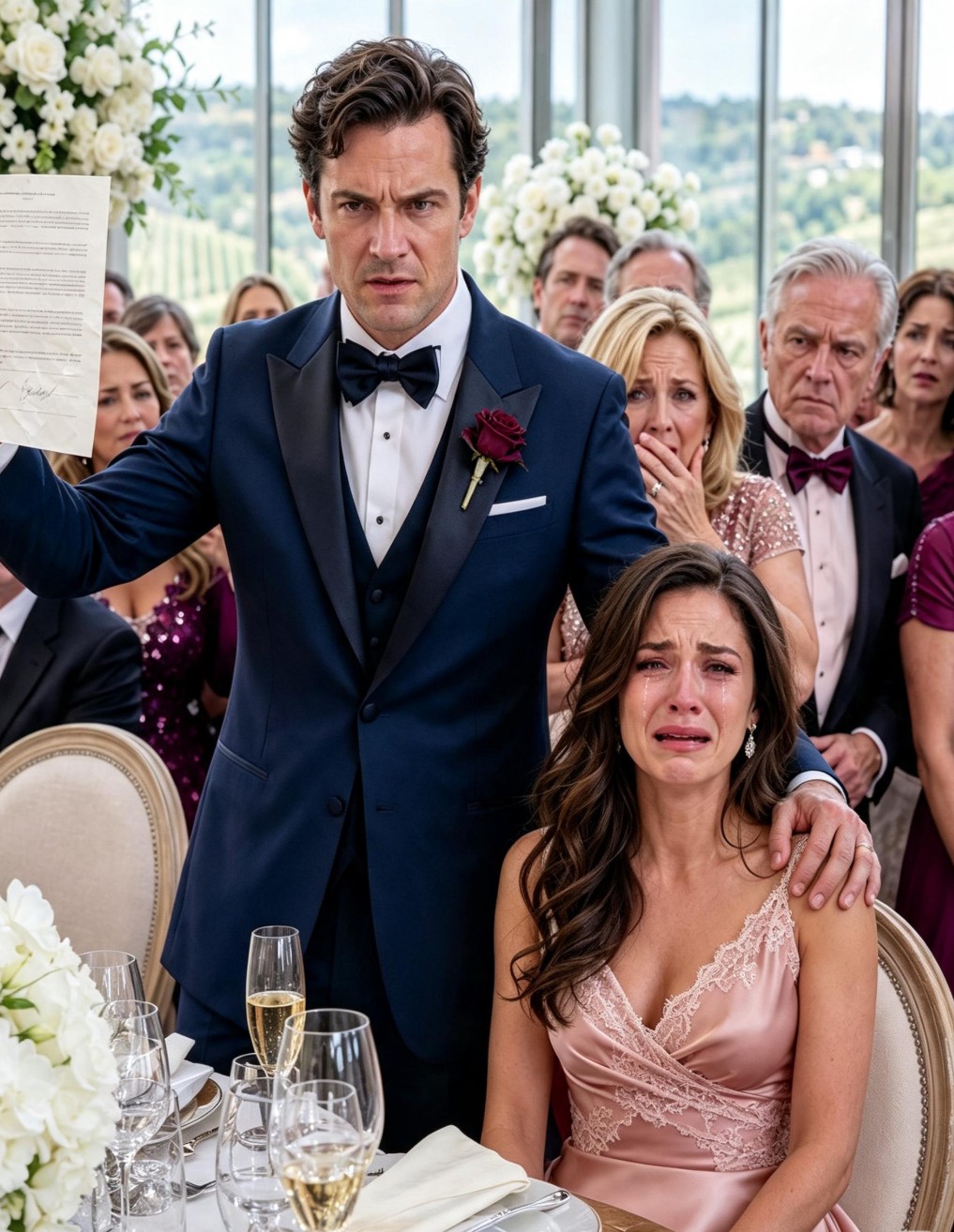
Julian rose from his chair at the head table and gently tapped his water glass with a fork.
The conversations around the ballroom slowly faded.
Everyone turned toward him.
I assumed he was going to give the usual groom’s speech.
A few words about our marriage.
A thank-you to the guests.
Something sweet and predictable.
Instead, Julian looked toward the two empty chairs.
Then he turned his eyes toward me.
“Since the people who were supposed to stand beside Maya tonight chose not to show up,” he said into the microphone, his voice carrying clearly across the ballroom, “I think everyone in this room deserves to know the real reason why.”
My heart seemed to stop.
Julian reached inside his suit jacket.
Then he pulled out a folded piece of paper.
And I immediately knew that whatever happened next was going to change everything.
Part 2:
Julian was not an impulsive man.
As a senior corporate litigation attorney in San Francisco, he had spent years learning how to sit across from angry, hostile opponents for hours without raising his voice or losing his temper.
So when he unfolded that piece of paper in front of two hundred wedding guests, I knew he had not made this decision on a whim.
A week before our wedding, he had asked me a question.
“Are you sure you want to let your parents walk away like this?”
I had looked at him and said yes.
I was exhausted.
Completely exhausted.
I was tired of competing for love that always seemed conditional.
Tired of being expected to understand everything.
Tired of always being the obedient daughter who was supposed to accept less without complaining.
I had specifically asked Julian not to get involved.
He had nodded.
But now I realized something.
He had agreed not to interfere.
He had never promised to remain silent.
“Five days ago, I received an email from Robert Sterling,” Julian said into the microphone.
Several people immediately looked toward the empty seats in the front row.
Julian unfolded the paper.
Then he began reading.
My father had written that I needed to learn that the entire world did not revolve around my personal schedule.
He wrote that Chloe’s networking trip had far more long-term financial and professional value than what he described as “an overly expensive, self-indulgent party.”
But the worst part came near the end.
My father had written that being publicly embarrassed by getting married without my parents there would finally teach me that I was no more important than my sister.
A wave of shocked gasps moved through the ballroom.
My eyes burned with tears.
Julian lowered the paper.
He looked at the guests.
“And that wasn’t the only message.”
He reached into his jacket again.
Then he pulled out a second sheet.
“This one came directly from Patricia Sterling.”
My stomach tightened.
My mother had contacted Julian herself.
In her message, she urged him to convince me to postpone the wedding.
She called my decision to continue with the ceremony a “dramatic, attention-seeking spectacle.”
She argued that Chloe would lose far more socially and professionally by missing her Bali trip than I would lose by getting married without my parents there.
My hands began trembling beneath the table.
I had known for my entire life that my parents preferred Chloe.
I had felt it.
I had lived with it.
But there was a huge difference between carrying that pain quietly inside yourself and hearing your parents’ cold words repeated aloud in front of two hundred people.
Julian folded the papers.
Then he walked toward me.
He placed one steady hand on my shoulder.
When he spoke again, his voice was calm, but there was strength behind every word.
“Maya has spent her entire life making herself smaller so her sister could take up more space.”
He looked around the room.
“Starting tonight, as long as I am standing beside her, no one will ever ask her to do that again.”
For several seconds, nobody moved.
The ballroom was completely silent.
Then my Aunt Evelyn stood.
She began clapping.
Sarah immediately stood beside her.
Then Julian’s parents rose.
Within seconds, everyone was on their feet.
The entire ballroom erupted into applause.
But this wasn’t the cheerful applause people usually gave during a wedding speech.
It was louder.
Stronger.
Almost fierce.
It felt like a verdict.
I looked around the room.
Family friends who had known my parents for twenty years were shaking their heads in disgust.
One of my cousins was wiping tears from her face.
My mother-in-law stood with her lips pressed tightly together, clearly furious on my behalf.
Then my phone began vibrating on the table beside my plate.
Mom.
The call stopped.
A second later, it rang again.
Dad.
Then again.
Dad.
Julian leaned down toward me.
“You don’t have to answer that.”
I stared at the glowing screen.
For the first time in thirty-one years, the fear of disappointing my father simply disappeared.
It was gone.
I picked up my phone.
Then I stood.
I walked straight toward the center of the ballroom.
Everyone watched me.
I turned on the speaker.
And answered the call right there in front of all two hundred guests.
Part 3:
“What the hell is Julian doing?!”
My father didn’t even say hello.
His furious voice exploded through the phone’s speaker and filled the silent ballroom.
“Hello, Dad,” I said calmly.
“Tell your husband to stop reading private communications out loud!” he shouted. “This is an absolute disgrace!”
For one second, I almost laughed.
Apparently, it had been perfectly acceptable for them to turn my wedding into a public lesson designed to humiliate me.
But the moment their own words were exposed, suddenly there was a problem.
“I have one question for you, Dad.”
“I don’t have time for your childish games, Maya!”
“Did you write those emails?”
Silence.
I waited.
“Maya…”
“Did you write them?”
He took a long breath.
“You’re taking everything completely out of context.”
That answer told me everything.
I no longer felt angry.
Instead, I felt something much stronger.
Clarity.
My father immediately began trying to explain himself.
He insisted that Chloe was building important professional relationships in Bali. He repeated that one of her friends had direct connections to major resort executives and claimed the trip could lead to deals worth hundreds of thousands of dollars for her brand.
According to him, I was allowing my emotions to control me.
“A wedding lasts a few hours, Maya,” he said firmly. “A major career opportunity can change the course of a lifetime.”
I looked around at all the people standing in the ballroom.
“Then maybe you should have married Chloe,” I said.
A nervous wave of laughter moved through the nearest tables.
My father’s voice immediately hardened.
“Do not be insolent with me.”
Then my mother spoke.
“Let me talk to her, Robert.”
I heard the phone change hands.
“Maya, sweetheart…”
Her voice was soft.
Almost painfully sweet.
And somehow, hearing her call me “sweetheart” made me feel worse than my father’s anger.
“Your guests don’t need to be dragged into our private family matters,” she said gently.
“Why not, Mom?”
“Because this is private.”
I looked around the ballroom.
Two hundred people were completely silent, listening.
“You and Dad decided to turn my wedding into a lesson for me.”
“That’s not what we were doing!”
“Dad wrote that leaving me alone at the altar would teach me humility.”
“He was upset when he wrote that!”
“And you wrote that Chloe had more to lose by missing her vacation than I did by getting married without my parents.”
Silence.
My mother had no immediate answer.
Then she changed tactics.
“Maya, please. Don’t destroy this family over a disagreement.”
There it was.
That phrase.
The one families like mine always used when someone finally stopped accepting the role they had been given.
I was allowed to be ignored.
I was allowed to be pushed aside.
I was allowed to be humiliated.
But the second I refused to quietly accept it, I was suddenly the person destroying the family.
I looked toward those two empty chairs in the front row.
For decades, I had tried to turn myself into the daughter my parents could love without effort.
I earned straight A’s.
I got into a good university.
I built a stable career.
I never asked for too much.
I never demanded too much.
I never wanted to be a burden.
Meanwhile, when Chloe turned eighteen, my parents threw her a huge, lavish birthday party.
When I turned thirty, they canceled our family dinner because Chloe had just gone through a breakup and supposedly needed emotional support.
When I bought my first condo, my father barely asked what neighborhood it was in.
When Chloe reached one hundred thousand followers on social media, my parents organized an entire dinner to celebrate her achievement.
There was always an explanation.
Always a reason.
Always some logical excuse for why Chloe deserved more attention.
And every time I felt hurt, I was told I was overreacting.
Until tonight.
“No,” I said.
My mother went quiet.
“What did you say?”
“I said no.”
My voice was so calm that even I was surprised by it.
“I’m not sweeping this under the rug. I’m not asking Julian to apologize to you. And I’m not going to pretend you missed my wedding because I was being difficult.”
“Maya, stop being so dramatic!”
“I’m not being dramatic, Mom.”
I looked at the empty chairs.
“I’m ending the drama.”
My father’s voice suddenly returned.
Sharp.
Threatening.
“If you hang up this phone right now, Maya, there will be serious consequences for your relationship with this family.”
When I was a child, those words would have terrified me.
They would have made me apologize immediately.
They would have made me beg for forgiveness.
But I was thirty-one years old.
I was standing in my wedding dress.
And behind me were two hundred people who had actually chosen to show up for me.
The threat had no power anymore.
“There are already consequences, Dad,” I said quietly.
I looked at the empty chairs one final time.
“Only this time, they’re yours.”
Then I ended the call.
The ballroom remained completely silent for a moment.
I handed the phone back to Julian.
I expected myself to start crying.
Instead, I walked toward the band’s microphone.
“I’m sorry for turning our wedding reception into an unexpected family therapy session,” I said with a small smile.
A few guests laughed warmly.
I took a deep breath.
“For many years, I believed that making my parents proud of me was the same thing as having a loving family.”
My voice shook slightly.
“Tonight, I finally realized it isn’t.”
I paused.
“Real family are the people who drove eight hours to be here tonight. They’re the friends who took time off work. They’re the relatives who booked flights from across the country. They’re my husband’s parents, who treated me like a daughter long before tonight made it official.”
My mother-in-law wiped a tear from her cheek.
I looked around the room.
“So thank you,” I said.
My voice grew stronger.
“Thank you for filling this room with love, even when a few people tried to make sure I would spend the entire night staring at empty chairs.”
Julian was the first person to stand.
Then his parents.
Then Sarah.
Then my aunts and uncles.
One table stood.
Then another.
Then another.
Until all two hundred guests were standing.
The applause that followed was deafening.
And that was when I finally cried.
Not because my parents weren’t there.
But because, for the first time, I could truly see the people who were.
Part 4:
Later that night, while the music played and guests filled the dance floor, I stepped outside toward the patio garden.
I needed a moment alone.
The air was cool, and the noise from the ballroom had faded into the background.
Then I heard someone behind me.
It was Aunt Evelyn.
She walked over slowly and stood beside me.
“I need to apologize to you, Maya,” she said softly.
I turned toward her.
“For what, Aunt Evelyn?”
She looked down at her hands.
“Because we all saw it.”
My throat tightened.
“What do you mean?”
“We all saw how differently they treated Chloe compared to you.”
I didn’t say anything.
Aunt Evelyn sighed.
“Your father always had some logical explanation for everything. Your mother always backed him up. And the rest of us kept telling ourselves it wasn’t our place to interfere in someone else’s household.”
I stared at her.
“So… everyone noticed?”
“Since you girls were little,” she said.
The words hurt.
But somehow, they also unlocked something inside me.
For years, I had wondered if I was imagining it.
Maybe I was too sensitive.
Maybe I was jealous.
Maybe I was exaggerating.
Maybe I was simply a difficult daughter who expected too much.
But I hadn’t imagined anything.
It had been real.
And other people had seen it, too.
Before the night ended, three more relatives came up to me and told me similar stories.
One of my cousins even reminded me about a Christmas many years earlier.
My parents had promised to pay for my college preparation courses.
But at the last minute, they took that money and used it to pay for an unexpected trip to New York for Chloe.
I had pretended it didn’t bother me.
I had always pretended.
Three weeks after my wedding, Chloe started posting photos from her Bali retreat on Instagram.
There were infinity pools.
Floating breakfasts.
Beautiful sunsets over the ocean.
Photos of Chloe practicing yoga on the beach.
One of her captions read:
“Protect your energy from people who don’t respect your boundaries.”
Normally, nobody outside our immediate family would have connected those posts to my wedding.
But several relatives immediately understood what she was referring to.
Some of them left sharp, pointed comments beneath her pictures.
Then a few family friends joined in.
Eventually, Chloe turned off the comments completely.
My parents called me eleven times over the next two days.
I didn’t answer once.
Finally, they sent me a four-page email.
According to them, Julian had manipulated me into turning a temporary family disagreement into an irreversible family rift.
They claimed the real problem was my deep, long-standing resentment toward Chloe.
They said I had allowed years of jealousy to poison my relationship with my parents and sister.
I read the entire email once.
Then I archived it.
I didn’t respond.
For the first time, I didn’t feel the need to defend myself.
I didn’t need to convince them that I was hurt.
I didn’t need them to understand.
Months passed.
Julian and I celebrated our first Christmas as a married couple with his family in Lake Tahoe.
Nobody asked me to change our plans for Chloe.
Nobody expected every family decision to revolve around her.
Nobody turned a simple holiday gathering into a test of loyalty.
Nobody suggested that being a good daughter meant accepting less than everyone else.
It was remarkably simple.
Almost effortless.
And somehow, that simplicity made tears sting my eyes.
Because I finally understood how much energy I had wasted trying to earn something that should have been given freely in a healthy family.
Six months after our wedding, Julian and I finally took our honeymoon trip to Hawaii.
One morning, before sunrise, we walked down to a quiet, secluded beach.
I wore a simple white sundress.
Julian wore a linen shirt.
There were no professional photographers.
No two hundred guests.
No expensive floral decorations.
No empty chairs.
Just the two of us.
Julian took both of my hands.
“Want to do it again?” he asked.
I smiled.
“Marry you?”
He smiled back.
“Exchange our vows again. But this time, without looking at any chairs.”
I laughed softly.
Then we renewed our vows as the tide rolled gently toward the shore.
When I finished speaking, Julian kissed me.
Then he pointed toward the horizon.
“Look,” he whispered.
I turned.
The sun was rising over the ocean, spreading brilliant golden light across the water.
And standing there beside the man I loved, I finally understood something I should have learned years earlier.
The people who truly love you don’t need to punish you to teach you humility.
They don’t use their absence as a weapon to force you to obey.
They don’t make you compete for affection.
And they don’t treat love like a prize you have to earn by constantly making yourself smaller.
I still have the seating chart from our wedding.
It’s stored inside a keepsake box with our photographs.
For a long time, I thought I would throw it away.
I thought it would always remind me of those two empty chairs.
I kept it anyway.
But not because I want to remember who was missing.
I kept it because those two empty chairs were surrounded by two hundred others that were filled.
Filled with people who came.
People who stayed.
People who clapped.
People who cried with me.
People who stood beside me when my own parents chose not to.
For most of my life, I had stared at the people who chose not to be there.
That night, I finally learned how to look at the people who were.
And once I did, the empty chairs stopped mattering.
They were never the most important part of the room.
The people standing beside me were.
The End.
