
Part 1:
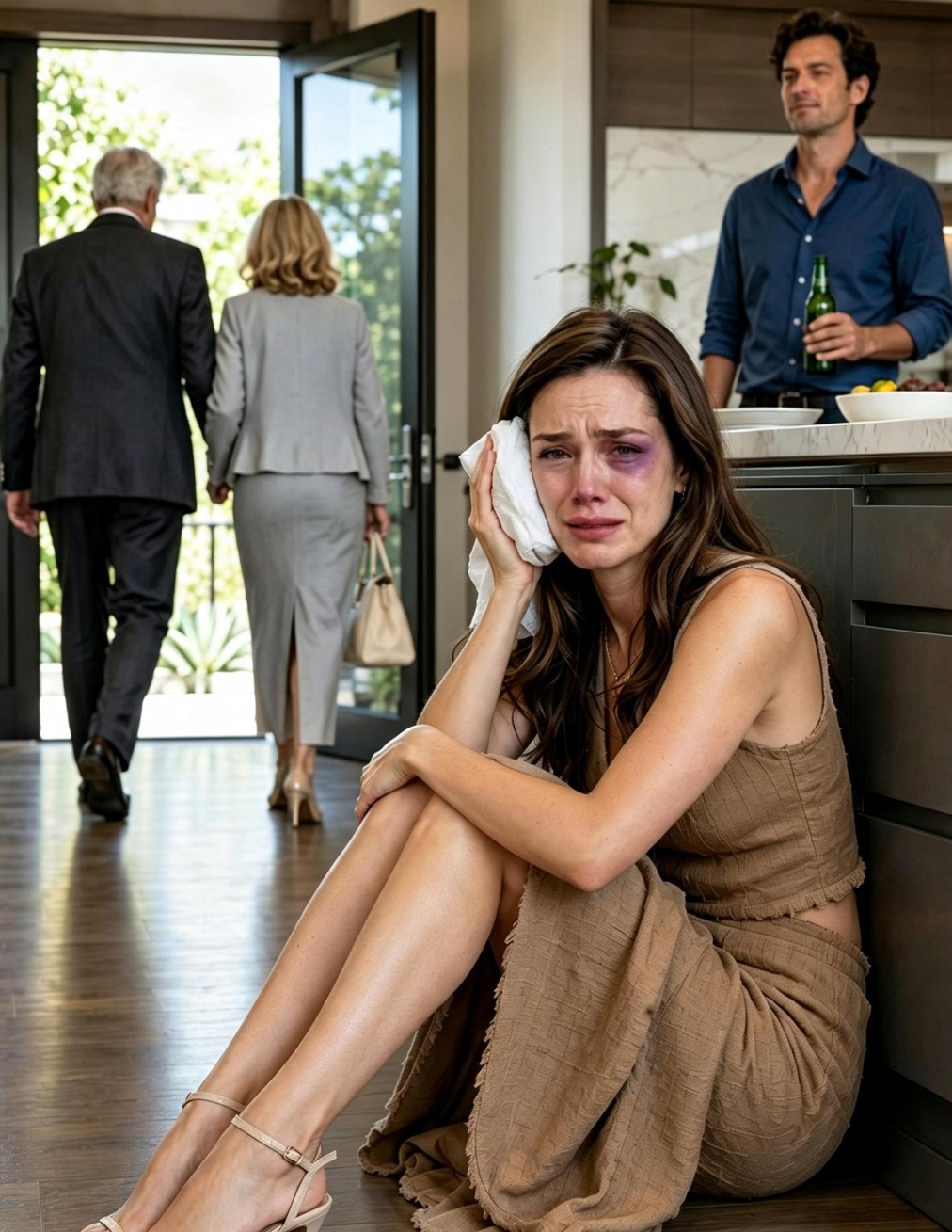
“Don’t drag us into your relationship problems, Chloe. You chose to marry him.”
That was all my father said after looking at the dark purple bruise beneath my eye.
My mother stood beside him, unable to meet my gaze.
They had arrived at our apartment in Minneapolis that Sunday evening carrying two heavy grocery bags, just as they did almost every Sunday. My mother had brought bread, fresh fruit, laundry soap, and a plastic container of chicken soup she had prepared that morning.
When I opened the front door, both of them stared directly at my face.
My mother froze.
My father simply frowned.
For one brief second, I honestly thought one of them would ask me what had happened.
Then heavy footsteps echoed down the hallway.
Brandon appeared, walking shirtless with an open beer can in his hand and a cold smile on his face.
“Just look at that,” Brandon mocked as he leaned against the wall. “The model family has finally arrived.”
My father immediately lowered his eyes to the floor.
My mother walked past me without saying a word and began placing the groceries on the kitchen counter.
Nobody asked a single question.
Nobody reached for a phone to call the police.
Nobody looked at me and said the words I desperately needed to hear.
Five minutes later, my parents walked out the front door and left me behind.
Brandon slammed the heavy door shut.
Then he burst into loud laughter.
“Did you see that?” he mocked as he walked past me. “Not even your own parents want to mess with you.”
He dropped onto the living room sofa and turned up the television.
I remained standing beside the kitchen counter, holding a damp towel against my bruised cheek while the television played loudly in the background.
The blow had happened only twenty minutes before my parents arrived.
My only mistake had been telling Brandon that I would no longer cover his growing gambling debts.
For several months, money had been disappearing from our joint checking account.
Five hundred dollars vanished one Friday.
Eight hundred disappeared the following week.
Then more than a thousand dollars was gone a short time later.
Brandon always had an excuse ready.
He claimed the money had gone toward gas, work expenses, or a temporary loan for his brother.
That routine finally ended when I checked our online bank statements and discovered direct transfers to online sportsbooks.
I confronted him in the kitchen.
He simply smiled and shrugged.
“It’s my money anyway,” Brandon said casually.
“You’re using my hard-earned salary too,” I replied, my voice beginning to shake. “I’m tired of you treating me like I’m something you bought at a store.”
He did not raise his voice.
He did not argue.
He simply stepped toward me and struck me across the face with his open hand.
I stumbled backward.
Then, as if nothing terrible had happened, he reached out and pulled me into a tight embrace.
“You know how to provoke me, sweetie,” Brandon whispered beside my ear. “You brought this on yourself.”
Those words hurt even more than the blow.
For years, I had believed him.
Whenever Brandon became violent, I convinced myself that somehow I had caused it. I thought if I chose my words more carefully, stayed quieter, or stopped challenging him, everything would become peaceful again.
That night, I locked myself inside the bathroom and cleaned the small cut on my lip.
I stared at myself in the mirror.
I was thirty-four years old.
I had a steady job.
I had my own savings.
I had a college degree.
Yet somehow, after all those achievements, I still felt like I needed Brandon’s permission just to cry.
I pulled out my phone and opened my chat with my college friend, Samantha.
My fingers hovered over the keyboard.
Then I typed three words.
“I am ready.”
I stared at the message.
I deleted it.
Then I typed the exact same words again.
This time, I pressed send.
I did not wait for her reply before putting my phone back into my pocket.
About half an hour later, I heard the faint click of the front door unlocking from outside.
Brandon was fast asleep on the sofa, an empty beer can resting on his chest.
I quietly opened the apartment door.
Samantha was standing in the hallway with a heavy black backpack and a thick folder in her hands.
She also carried the key to a small apartment we had secretly rented several weeks earlier.
She took one look at my bruised face.
She asked no questions.
She simply stepped inside.
We quietly locked ourselves inside the master bedroom.
Samantha unzipped her backpack.
Inside were packed clothes, legal documents, a USB drive, and a thick black notebook.
We had been preparing for this moment for four months.
The folder contained bank statements, screenshots, audio recordings, photographs of my previous injuries, medical records, and abusive text messages from Brandon.
It even contained a drafted request for protective measures that I had written but had never been brave enough to file.
While I packed my personal belongings into a small suitcase, heavy footsteps suddenly echoed in the hallway.
Brandon was awake.
He was walking toward the bedroom.
Before coming to the door, he had noticed the sealed envelope I had left on the table beside his empty beer can.
Inside were the initial divorce papers and a short note I had written earlier.
“This time, you need a lawyer, not another beer.”
The bedroom door suddenly burst open.
Brandon stood there with a bright red face.
“What the hell is the meaning of this?” he demanded.
I immediately raised my phone and pointed the camera toward him.
The recording was already running.
Samantha stood beside me and aimed her own phone at him.
Brandon looked at the packed suitcases on the bed.
Then he looked at the legal documents.
Finally, he looked at me.
For the first time since I had met him, I saw genuine fear flash across his face.
His expression hardened almost immediately.
He stepped backward, pulled the bedroom door shut, and turned the deadbolt.
I stared at the locked door.
For the first time, I understood that the man who had controlled me for years was finally afraid of what I might do next.
Part 2:
“Nobody leaves this house until you explain what you’re doing,” Brandon said slowly.
He was using the exact tone he always used in the seconds before completely losing control.
Samantha kept her phone raised, the camera pointed directly at him.
“We’re recording everything live,” she said firmly. “It’s being saved to a private cloud server.”
Brandon suddenly lunged forward and grabbed my right wrist.
“You’re my wife!” he shouted directly into my face.
“Let her go right now,” Samantha warned without flinching. “The recording is already safe, and the police will see everything.”
Brandon slowly loosened his grip and dropped his arm.
He did not stop because he suddenly understood what he had done.
He stopped because there were witnesses this time.
I took a slow step backward, creating distance between us.
“I also called emergency services before you came into this room,” I told him quietly.
Brandon burst into nervous laughter.
“And what are you going to tell them?” he mocked. “That we had a little argument? That your husband slapped you because you were acting hysterical?”
I tapped my phone screen.
An audio file opened from my private cloud folder.
Brandon’s own voice suddenly filled the room.
“Let’s see who actually believes you. I pay for this apartment, and you belong to me as long as you live here.”
Brandon went pale.
I opened another recording.
Then another.
His threats filled the bedroom.
His insults.
His screaming.
The sound of him pounding on the bathroom door while I hid inside months earlier.
I had not started recording him because I wanted revenge.
I started because he constantly made me question my own memory.
Every morning after an attack, Brandon would calmly tell me I had exaggerated everything.
He would say he had barely pushed me.
He would claim I had tripped over my own feet.
Sometimes he simply told me I was too sensitive.
One morning, I woke up with a painful, dark bruise behind my ear.
I had no idea how it had happened.
I took a clear photograph of it and saved it inside a hidden cloud folder named “Home Recipes.”
That photograph became my first solid piece of evidence.
After that, I started documenting everything.
More photographs followed.
Then medical records.
Bank statements.
Messages.
Audio recordings.
Dates.
Details.
Everything I had once been afraid to save became part of a carefully organized record.
Suddenly, blue police lights flashed across the windows of our apartment.
Brandon’s entire attitude changed.
He stopped screaming.
He straightened his shirt, adjusted his collar, and softened his voice.
“Chloe, please think about this carefully,” he pleaded. “We can fix all of our problems together.”
A few moments later, two police officers entered the apartment.
I showed them the bruise on my face.
I played the most recent recording.
Then I handed them the folder containing my evidence.
Brandon immediately stepped toward the officers.
“My wife is going through a terrible emotional crisis,” he explained smoothly. “Her friend is filling her head with nonsense.”
The lead officer looked at my bruised face and opened his notepad.
“Ma’am, did this man strike you today?” he asked.
“Yes,” I answered without hesitation.
“Do you want to file a formal criminal complaint against him tonight?”
For the first time in five years, I did not look at Brandon before answering.
I did not check his expression.
I did not worry about what he wanted me to say.
“Yes, I do.”
The officers arrested Brandon, and I was taken to the local police station to give my formal statement.
Samantha came with me and stayed nearby while I spent hours in a small interview room repeating exact dates, locations, and details of the abuse.
I handed over medical certificates, detailed bank statements, high-resolution photographs, audio recordings, and abusive text messages.
The USB drive contained an organized timeline of abuse stretching across almost two years.
An investigator who specialized in domestic abuse carefully reviewed the digital files.
“This file is extremely organized,” she said, looking up from the documents.
“I was terrified that nobody would believe me without proof,” I admitted quietly.
She looked at me for several seconds before returning to the paperwork.
Protective measures were put in place while the investigation into the physical assault continued.
By the time I walked out of the police station, dawn had arrived.
The cool morning air touched my face as I stepped outside.
Samantha was waiting beside her car.
We drove directly to the small apartment we had secretly rented in the nearby neighborhood of Saint Anthony.
It was modest.
The furniture was old.
The kitchen was so small that two people could barely move around in it at the same time.
But it was safe.
And, for the first time in years, it was mine.
The moment I closed the apartment door behind us, I sank onto the floor and began crying uncontrollably.
I was not crying over Brandon.
I was not crying over the ruined marriage.
I was crying because I had spent the entire night waiting for my mother to call.
My phone had remained completely silent.
Finally, I gathered enough courage to call her myself.
“Mom, I filed a formal police report against Brandon tonight,” I said.
A long silence followed.
“They arrested him after he hit me in our apartment,” I added.
Another painful pause followed before her voice finally came through.
“Chloe, marital problems should never be made public like this,” my mother whispered.
Something inside my chest seemed to break.
“Did you see my bruised face yesterday when you came over?” I asked.
“Yes,” she admitted.
“And you just turned around and walked out?”
She said nothing.
“Mom, why did you leave me there?”
Her answer came as barely more than a whisper.
“Your father said the two of you had to solve your own private problems together.”
I ended the call without saying another word.
That morning, I realized I had lost two things at the same time.
My husband.
And the comforting image I had carried of my parents for my entire life.
But Brandon was not finished trying to control me.
The very next day, a polished video appeared on his social media accounts.
He wore a crisp white shirt.
His hair was carefully styled.
He stared into the camera with a trembling voice.
“I would never deliberately hurt my wife,” Brandon claimed emotionally. “Chloe is going through a very difficult psychological period right now, and certain people are taking advantage of her vulnerability.”
Thousands of people quickly flooded the post with comments.
Some called me a heartless liar.
Others openly asked what I could possibly have done to make him lose control.
Samantha reached over and shut my laptop.
“Don’t read those comments,” she told me gently. “They’re only going to hurt you.”
I opened the laptop again.
Instead of returning to his social media page, I opened my email.
“I don’t intend to waste my time arguing with him online,” I said firmly.
Samantha looked at me.
“Then what are you going to do?”
I searched for a contact address I had saved months earlier.
Sarah Jenkins was an investigative journalist who specialized in domestic abuse and systemic institutional corruption.
I spent the early morning writing a detailed message to her.
I did not ask her to believe me simply because I told her my story.
Instead, I attached proof.
Audio recordings.
Court documents.
Photographs.
Bank transfer records.
Police documentation.
I ended the message with one final sentence:
“If I ever stop responding to your messages, please publish everything regardless.”
At 6:17 that morning, a reply appeared in my inbox.
“I have already verified a significant portion of your documents,” Sarah wrote. “We need to speak immediately.”
We arranged a video call shortly afterward.
For almost an hour, Sarah listened as I walked her through the entire timeline.
When I finished, she remained silent for several seconds.
Then she said something that changed everything.
“Chloe, Brandon did not start this abusive pattern with you.”
My hands suddenly felt cold against the desk.
“What do you mean?”
“There are at least two other women who experienced the same pattern,” Sarah explained.
“Ex-partners of his?”
Sarah nodded.
“And one of them has detailed financial records that match your bank transfers almost dollar for dollar.”
At that exact moment, my phone vibrated on the table.
An unknown number had sent me a text message.
“You made a massive mistake. Take everything back before I come fix this my own way.”
Sarah saw my expression change through the video call.
“Is that message from him?” she asked.
I lifted the phone and showed her the screen.
Sarah took a deep breath.
“Do not delete a single thing from your phone,” she instructed firmly. “Because if what these women have given me is authentic, the physical abuse is only one small part of what Brandon has been doing for years.”
I listened as Sarah explained more about the other women and their financial records.
That was when I realized my divorce was no longer just a personal battle.
It had become something much bigger.
Part 3:
The following Sunday morning, I walked into a quiet coffee shop in Bloomington to meet Jessica and Heather.
We did not look like three women connected by the same abusive man.
Jessica was forty years old and worked as an administrator. She arrived carrying a perfectly organized blue plastic binder.
Heather was thirty-seven and worked as a nurse. She had short hair and a quiet expression that made it seem as though she was apologizing simply for taking up space in the room.
Sarah Jenkins sat directly across from us.
“Before we start going through the documents,” Sarah said, “I want all of you to understand that nobody has to share anything they are not comfortable revealing.”
Jessica immediately placed her blue binder on the table.
“I want to share everything I have,” she said clearly.
She opened it.
Brandon had been her partner seven years earlier.
At the beginning, he had been charming, attentive, generous, and thoughtful.
Exactly the way he had been with me.
Then the possessiveness began.
He constantly searched her phone.
He insulted her.
He demanded money.
Eventually, the emotional abuse became physical violence.
Jessica had never reported the abuse to police at the time.
But she had saved every financial record.
“He forced me to sign several legal forms,” Jessica explained. “He told me they were simple applications for a personal loan. Months later, I discovered he had used my credit profile for unauthorized transactions and left me with thousands of dollars in tax debt.”
She placed bank statements, wire transfers, forged signatures, and printed copies of old emails across the table.
Heather took a deep breath.
“My situation was slightly different,” she said softly.
She had dated Brandon for a little more than a year.
When she finally tried to end the relationship, he began stalking her aggressively.
He appeared outside the hospital where she worked.
Sometimes he showed up in the middle of the night.
He sent fifty threatening messages in a single evening.
Once, he broke into her apartment and destroyed her personal belongings.
Heather had tried to report him to the police.
But the officers dismissed her claims.
“They literally asked me why I didn’t look scared enough in front of them,” Heather said quietly.
Sarah pressed her lips together and wrote something in her notebook.
I looked down at my own folder sitting on the wooden table.
For months, I had believed my story was simply a private failure.
Now I was sitting across from two women who had heard the same manipulative phrases I had heard.
“You’re completely crazy.”
“Nobody is ever going to believe you.”
“You provoked me into doing this.”
“You’re absolutely nothing without me.”
The words were almost identical.
And Brandon had used them years apart.
Jessica tapped a file on her phone.
“I have one more thing.”
She pressed play.
Brandon’s old voice came through the small speaker.
“I’m the one who decides when this relationship ends.”
My skin crawled.
The wording was almost identical to things he had said to me.
Sarah placed all three timelines side by side.
The dates revealed an even more disturbing pattern.
Brandon had started pursuing me only a few months after his harassment of Heather had ended.
Even while he was married to me, he continued contacting Jessica to get money from her through fake emergencies.
He told me he was helping his brother pay off debts.
He told Jessica he needed emergency money for a family member’s medical operation.
The stories were different.
The goal was the same.
Money.
Every dollar was being funneled into accounts connected to sports gambling and personal debts.
Jessica suddenly pointed at one of the names on my bank statements.
“That shell company belongs to a close friend of his,” she said. “He used it to hide where the money was really going.”
Sarah immediately wrote down the information.
This was no longer simply the testimony of three women who had dated the same abusive man.
There was now a documented financial and criminal pattern stretching back years.
Sarah spent the next two days carefully verifying every piece of evidence.
She asked each of us for clear permission to publish only information that could be supported by hard evidence.
Meanwhile, Brandon continued trying to control the story online.
He posted an old photograph from our wedding.
In the picture, I was smiling in my white lace dress.
“Nobody truly knows Chloe the way I do,” Brandon wrote beneath it.
A wave of anger rushed through me.
I wanted to write an angry response.
I wanted to tell everyone exactly who he was.
Then I remembered something Samantha had told me earlier.
“Don’t waste your energy arguing with someone who thrives on noise,” she had said. “Just give people undeniable facts.”
I logged into my cloud account.
I found a photograph I had taken six months after our wedding.
It showed a yellow hospital wristband around my arm.
That night, Brandon had thrown me down the stairs in our entryway.
Later, he told the doctor that I had simply lost my footing and fallen.
I posted the photograph online.
I added no caption.
Then I closed the application.
The next morning, at exactly 9:02, Sarah’s investigative report went live.
The headline avoided dramatic claims.
Sarah let the verified evidence speak for itself.
The article detailed the experiences of three women.
It explained the identical pattern of abuse.
It showed how documented evidence had failed to be connected by authorities for years.
It included verified audio clips, bank transfer records, timeline dates, screenshots of messages, and official filings.
By 10:00 that morning, Brandon’s employer released a public statement announcing that he had been suspended pending an internal investigation.
At 11:00, an investigator from the prosecutor’s office called my phone.
“Ms. Miller, we need you to come in so we can expand your statement and review new evidence that has been added to your case,” the investigator said.
I stared at the wall while holding the phone.
“Has new evidence come in?” I asked.
“Several other individuals have stepped forward with relevant records,” the investigator confirmed.
I did not need to ask who they were.
Jessica, Heather, and probably others had started turning over their files.
Over the next several hours, hundreds of messages began appearing in my inbox.
One woman wrote:
“I honestly thought that without photographs of my injuries, no court would ever believe me.”
Another wrote:
“My family also begged me to stay silent and endure it.”
Then I received a message containing only six words.
“Thank you. I am asking for help tomorrow.”
Those six words brought tears to my eyes.
That message meant more to me than thousands of shares or millions of views.
Because I knew exactly how terrifying it was to wait for someone else to open the door first.
Brandon released another video that evening.
His eyes were bloodshot.
“They’re trying to destroy my life,” he said tearfully. “I made mistakes in my marriage, but I’m not the monster they’re painting me to be.”
Years earlier, those words would have destroyed me.
They would have made me question myself.
They would have made me feel guilty.
But now I recognized the pattern.
Play the victim.
Minimize the damage.
Avoid the evidence.
A commenter wrote one sentence beneath his video.
“She didn’t destroy your reputation. She simply stopped protecting it for you.”
The comment quickly gained attention.
Over the following weeks, I returned to the police station several times to provide formal statements.
Jessica’s financial documents became part of an independent fraud investigation.
Heather resubmitted her detailed records regarding Brandon’s past stalking.
The legal process moved slowly.
There were court dates.
Forms.
Interviews.
Long hours of paperwork.
There were difficult days when I questioned whether I had made the right choices.
There were quiet nights when I woke suddenly, convinced I had heard Brandon’s keys turning in the apartment door.
One night, I called Samantha from my bed.
“I’m still so afraid,” I admitted in the darkness.
“I know you are,” Samantha replied softly.
“I really thought the fear would disappear the second I walked out of that apartment.”
Samantha was quiet for a moment.
“Physically leaving a house happens in one night,” she said gently. “Unlearning the fear takes much longer.”
She was right.
The hardest part had not been packing my bags.
It was realizing how many of Brandon’s controlling habits were still living inside my mind.
I caught myself asking for permission before making simple decisions in my own apartment.
I automatically kept the television volume low.
Whenever I dropped a glass in the kitchen, my body tensed as if I were waiting for someone to start screaming.
I began attending weekly therapy sessions to rediscover my own voice.
Then, one Thursday afternoon after a therapy session, my phone vibrated.
It was a message from my mother.
She wanted to meet and talk.
I agreed.
We arranged to meet at a small diner downtown.
When I arrived, I saw my father sitting beside her in the booth.
I stopped before reaching the table.
“If you came here to convince me to drop the legal charges, I’m turning around right now,” I said firmly.
My mother quickly shook her head.
My father looked down at his hands.
He looked years older than he had the last time I saw him.
“I read the full news report,” he said quietly when I sat down. “I listened to the audio recordings.”
“You also saw my bruised face that Sunday night,” I reminded him.
“Yes,” he admitted. “I saw it.”
“And you both walked out the door and left me there.”
My mother began crying silently.
But seeing her tears did not bring the relief I had once imagined.
“We genuinely believed getting involved would only make things worse for you,” my father said.
“No,” I corrected him. “You believed it was easier for you to look away.”
My father lifted his eyes toward me.
For the first time in my life, he did not argue.
He did not defend himself.
He did not make an excuse.
“You’re right,” he admitted quietly. “We failed you as parents, and I don’t know how to fix that.”
“Maybe you can’t fix it,” I answered honestly.
My mother reached across the table and tried to take my hand.
I gently pulled my arm away.
“I needed someone to tell me to come home that night,” I explained. “I didn’t need marriage advice. I just needed an open door.”
My mother covered her face as tears ran down her cheeks.
“Please forgive us, Chloe,” she sobbed.
For years, I had imagined hearing those words.
I had believed they would somehow make everything better.
They did not erase the past.
But they were a necessary beginning if our relationship was ever going to be rebuilt.
“I can’t promise everything will go back to normal,” I told them before leaving. “And if you ever tell me again that marital problems should stay at home, I will walk away for good.”
My father nodded.
“We understand,” he said.
We said goodbye without hugging.
As I walked toward the train station, I realized that forgiveness did not mean pretending the damage had never happened.
It meant giving people the chance to prove that they had truly learned from what they had done.
Part 4:
Two months later, I officially received the final divorce decree in the mail.
When I walked out of the courthouse, Samantha, Jessica, and Heather were waiting for me on the steps.
“Is it officially finished?” Samantha asked.
I lifted the envelope in my hand.
“It’s finished,” I confirmed.
There was no huge celebration.
No cheering crowd.
No dramatic moment.
Instead, there was a quiet sense of enormous relief.
We sat together on a nearby park bench, drinking hot coffee and talking about ordinary things.
Work.
Apartments.
Weekend plans.
For the first time in years, ordinary conversations felt like a luxury.
Our real victory was not watching Brandon face legal consequences.
Our real victory was getting back the freedom to live without fear controlling every decision we made.
Before we went our separate ways, Heather reached into her bag and pulled out a small soy candle.
She handed it to me.
“For your new windowsill,” she said with a warm smile.
I smiled and thanked her.
I returned to my new apartment in Northeast Minneapolis that evening.
It was modest.
Nothing about it was impressive.
But the lease had only my name on it.
The keys belonged to me.
And nobody could walk through that door without my permission.
I kicked off my shoes near the entrance, made myself a hot cup of tea, and placed the little candle on the windowsill.
Then I lit it.
The small flame flickered quietly.
I watched its reflection in the glass.
For a moment, I remembered the night I had left.
My bruised cheek.
My parents walking away.
Brandon laughing from the sofa.
I remembered how long I had believed being alone was the worst thing that could ever happen to me.
I had been completely wrong.
The worst thing was remaining trapped in a room full of people who saw your pain and chose to look away.
I still carried emotional scars.
The legal consequences for Brandon were still unfolding.
Some nights were still difficult.
But the silence inside my apartment felt different now.
It was no longer the frightened silence of a woman hiding from another attack.
It was peaceful.
Safe.
Mine.
I could finally breathe.
My phone screen lit up.
A message from Samantha appeared.
“Are you doing okay?”
I looked at the warm flame of the candle.
Then I typed back:
“Yes. I’m finally home.”
For years, I had believed strength meant enduring mistreatment for the sake of love, family, or appearances.
Now I understood something very different.
True bravery often meant refusing to endure another day of abuse.
It meant opening the door.
Gathering the evidence.
Making the call.
And finally telling the truth to people willing to listen.
I stood beside the window until the candle burned low.
I thought about the anonymous woman who had written to me weeks earlier.
She had said she was going to ask for help.
I hoped that somewhere behind another window, she had found her own open door too.
Physical bruises eventually fade from the skin.
But the deeper scars can take much longer.
And real family is not defined by a shared last name.
It is not defined by keeping up appearances.
It is proven when someone sees you hurting and chooses to stand beside you.
That night, for the first time in years, I did not feel like someone waiting to be rescued.
I felt like someone who had finally rescued herself.
THE END.
