
I married Thomas when I was only nineteen years old. We were just kids back then—two young people with more dreams than money.
Our first home was a tiny apartment with creaky floors, wobbly secondhand chairs, and a kitchen table that leaned slightly to one side. But none of that mattered to us. We were building a life together, and every small step forward felt like a victory.
Over the years, we slowly created the life we had always imagined. We bought a modest house. We saved what little money we could for retirement.
We followed all the quiet, ordinary steps people take when they want a safe and steady life.
I was proud of our marriage.
I used to tell people, “Thomas and I have always been honest with each other.”
Looking back now, I realize something painful.
I was a fool.
Thirty-nine years after our wedding day, I stood in the rain at the cemetery and watched them lower my husband’s coffin into the ground.
The doctor had told me it was a heart attack.
“It was quick,” he said gently.
At the wake, people leaned close and whispered the same words over and over.
“At least he didn’t suffer.”
I nodded every time someone said it. People think those words help, but they don’t. They’re like a thin blanket over a deep hole. They don’t soften the fall.
After forty years together, grief is quiet. It doesn’t scream or break things. Instead, it whispers constantly, reminding you that the chair across the table will always stay empty now.
Still, if you had asked me then, I would have told you something with complete confidence:
Thomas wasn’t a man with secrets.
He was kind, gentle, and predictable. The sort of man who remembered birthdays, paid bills on time, and always called if he was going to be late.
But there was one strange thing in our house.
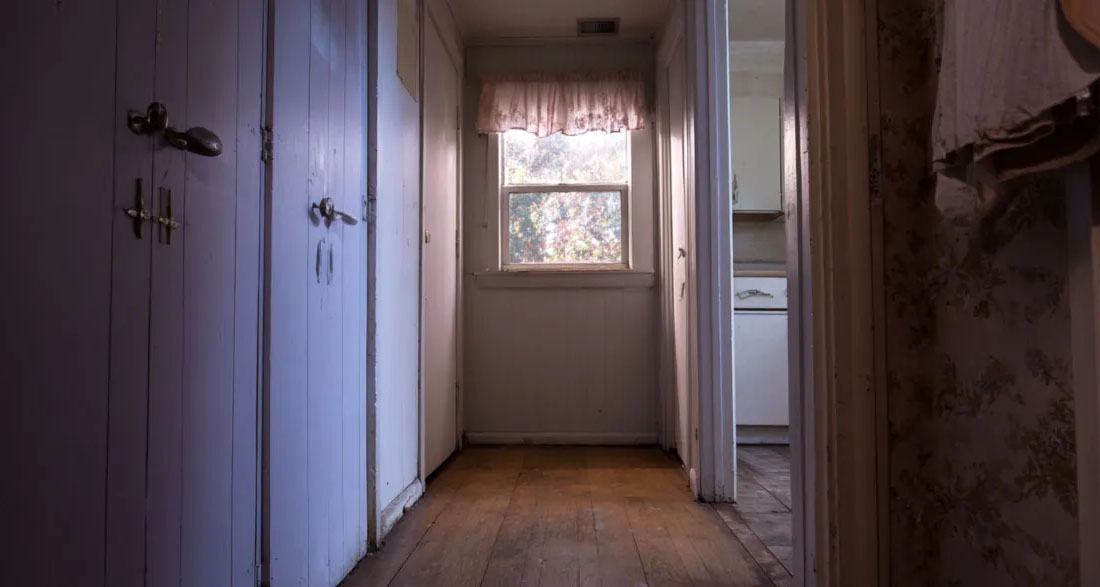
At the very end of our hallway was a closet.
And that closet was always locked.
Whenever I asked him what was inside, Thomas would smile calmly and say, “Just old paperwork, Margaret. Nothing interesting.”
And I believed him.
When you’re married that long, you learn to live with small mysteries. You trade curiosity for peace. You stop asking questions because you trust the person holding the key.
But once Thomas was gone, that locked door began to feel heavier every day.
After the funeral, I tried to keep myself busy. I sorted through his sweaters. I folded his Sunday church shirts. I placed his shoes neatly in boxes.
Yet every time I walked down the hallway toward the bedroom, my eyes drifted to that closet door.
At first, I told myself it would be wrong to open it.
“Whatever he kept in there was his,” I whispered to myself. “If he wanted it hidden, I should respect that.”
But the silence of the house made the questions louder.
Ten days after becoming a widow, I finally picked up the phone.
I called a locksmith.
When he arrived, he was a young man with a thick tool belt and a bored expression, like this was just another routine job.
I stood at the end of the hallway while he worked.
The sound of metal scraping against metal echoed through the house. Then suddenly—
Click.
The lock gave way.
The door slowly creaked open.
Inside the closet there were no skeletons. No shocking secrets hanging from hooks.
Just dust.
And boxes.
Several cardboard boxes sat stacked neatly on the floor, and on the top shelf rested a heavy metal strongbox.
The locksmith pointed at it.
“You want me to pop that open too?” he asked.
“Please,” I said quietly.
While he worked on the strongbox, I sat on the floor and pulled the first cardboard box toward me.
Inside were bundles of letters tied together with rough pieces of twine.
They looked old.
Very old.
I untied one bundle and pulled out a letter.
My hands started trembling as I read the first lines.
“Tom, the check came yesterday. Thank you. I didn’t know how I was going to cover the cleats and the league fee both this month.
He doesn’t know where the money comes from. I told him it’s from an old friend of his father’s. I hope that’s okay. He asks about you sometimes. — M.”
My heart skipped.
In that moment, a terrible thought crept into my mind.
Had my husband been living a secret life?
I grabbed the next letter.
“Tom, you don’t have to keep doing this. I know what it costs you to send the money.
But if you’re going to keep helping, we need to talk about how long we’re going to keep the truth from him. He’s not a little boy anymore. He deserves to know who you are to him. — Marilyn.”
I froze.
Thirty-nine years of marriage.
And the only explanation I could think of was that Thomas had another child. A child I had never known about.
I stared at the hallway walls and muttered under my breath, “I was nineteen when I married you… when did you even find the time?”
My hands shook as I kept digging through the envelopes.
Then I noticed something strange.
One of the letters had a return address from a state correctional facility.
A prison.
I ripped it open.
Inside, the handwriting was rough and uneven.
“Tommy, you shouldn’t be writing to me. Mom and Dad changed your name and moved you away to protect you from what I did. Don’t you get that?”
I blinked in confusion.
What was I reading?
From behind me, the locksmith called out, “Almost there!”
But I barely heard him.
I kept reading.
“I’m glad you reached out though. It gives me a chance to apologize. I should’ve been a better role model for you, Tommy. If I could go back, I’d be a better big brother. — Steve.”
Big brother?
Thomas had always told me he was an only child.
“How many lies were hidden in this closet?” I whispered to myself.
I grabbed another letter.
“Tommy, I heard from Marilyn. She came to see me. She’s pregnant. I don’t know what kind of father I can be from in here, but if that baby carries my last name, he deserves better than what I gave him. — Steve.”
Suddenly, the pieces started shifting.
Thomas wasn’t hiding a son.
He had been helping his nephew.
Just then, a loud metallic bang snapped me out of my thoughts.
The locksmith had forced the strongbox open.
Inside were old newspaper clippings, a worn leather catcher’s mitt, and a few scuffed baseballs.
The locksmith picked up one of the clippings and his eyes widened.
“Oh wow!” he said. “I know this guy!”
I crawled closer on my knees.
“My dad used to talk about him all the time,” the locksmith explained. “He said this guy had the best arm in the county. People used to fill the bleachers just to watch him pitch.”
He pointed to the picture of a young man in a baseball uniform standing confidently at the plate.
“Then he got into a bad wreck,” the locksmith continued. “The other driver died, and he went to prison. After that, people stopped talking to the family overnight.”
My chest tightened.
I studied the photo again.
Next to the baseball player stood a little boy.
That little boy was Thomas.
I reached deeper into the box and found a legal document.
It was a name-change form.
Thomas’s original last name was printed clearly on the paper.
And suddenly everything made sense.
Thomas hadn’t betrayed me.
He had been carrying a family secret his entire life.
After his older brother caused the accident, his parents had changed their last name and moved away to escape the shame. They had taken young Thomas with them and started a completely new life.
The locksmith packed up his tools and shook his head sadly.
“It’s a shame,” he said. “One bad night and your whole life is gone. Steve’s family disappeared after that. I heard he died alone in prison years later.”
After the locksmith left, the house felt incredibly quiet.
I sat on the hallway floor for hours, reading every letter in those boxes.
And slowly, I understood the truth.
Thomas had loved his brother.
But he had been taught to hide that love.
So he carried the burden alone.
He secretly helped his brother’s son grow up. He sent money. He made sure the boy could play sports and go to college.
And he never once asked for credit.
I whispered into the empty hallway, “Why did you think you had to carry this all by yourself?”
But the answer was already there in the letters.
Shame.
Thomas had been raised to believe this was something that must stay hidden.
Finally I stood up and said quietly, “Not anymore.”
I copied the return address from one of Marilyn’s letters.
Two days later, I gathered my courage and drove to the address.
It was a small, tidy house. A basketball hoop hung over the garage, and the lawn clearly needed mowing.
I knocked on the door.
A man in his thirties opened it.
And the moment I saw his face, my breath caught.
He had Thomas’s eyes.
“Can I help you?” he asked.
I hesitated.
“Are you Marilyn’s son?” I asked softly.
His eyes narrowed slightly. He glanced at the box in my arms.
“Who’s asking?”
I took a deep breath.
“My name is Margaret,” I said. “I was married to Thomas.”
The man froze.
“My Uncle Tom?” he said slowly.
“You knew about him?” I asked.
He nodded.
“Mom told me the truth when I turned eighteen,” he explained. “She said he didn’t want any credit. He just wanted to make sure I had a chance at a good life.”
I smiled sadly.
“That sounds exactly like him.”
The man chuckled softly.
“He actually came to my graduation,” he said. “He stood in the very back of the gym. After the ceremony he shook my hand and said he was an old friend of my father’s. I didn’t realize who he really was until Mom told me later.”
I held out the box.
“These belong to you,” I told him.
Inside were the baseball glove, the baseballs, the newspaper clippings, and the prison letters.
“Your uncle kept these all these years,” I continued. “He refused to let your father be forgotten. He loved his brother, even when he couldn’t say it out loud.”
The man carefully took the box. His fingers brushed the worn leather glove.
“Thank you,” he said quietly.
I shook my head.
“Don’t thank me,” I replied. “Thank your uncle. He’s the one who did all the hard work.”
When I returned home that evening, the hallway felt different.
Lighter somehow.
The closet door was still open.
For thirty-nine years I had walked past that locked door without asking questions. I thought it was trust.
But maybe it had also been fear.
Fear of discovering the man I loved wasn’t who I thought he was.
Now I understood something important.
My Thomas was an honorable man.
He had protected his family. He had helped a child who needed support. And he had done it quietly, without praise.
I wish he had told me the truth while he was alive.
But at least now, I could honor the family he left behind.
Because I finally understood something that took me almost forty years to learn:
Silence and shame are not the same thing.
