
Part 1:
“Are you really going to leave me here all alone with that?” I asked, staring down at the crumpled twenty-dollar bill my mother had shoved into my hand.
She did not even stop to look at me. Instead, she reached for the heavy brass handle of our front door as if she could not wait to get away.
It was a humid Thursday morning in our small apartment in Bakersfield, California. My mother, Lydia, was dragging two enormous suitcases toward the hallway. Her long fingernails gleamed with a fresh coat of bright red polish, and she wore sunglasses that were far too large for her face.
They looked completely out of place in the dim, dusty hallway of our apartment building. Her expensive perfume filled the air, the same perfume she always wore when she wanted to feel better than everyone else in our neighborhood.
I was only eleven years old, and I was still wearing my blue school uniform.
The day before, Mom had pulled me out of class early. She had smiled brightly and promised that we were going to spend some special mother-and-daughter time together before her big trip.
But there had been no special time together.
Instead, I had spent the entire evening watching her pack her belongings. She stayed up until well past midnight, tossing clothes into her suitcases while loud travel videos played on her phone.
I sat on our worn-out couch, pretending to watch cartoons, but my stomach felt tight and heavy with worry. Every time I tried to ask where she was going or how long she would be away, she shot me an annoyed look.
Now, standing in front of our open door, she acted as though leaving me behind was the most ordinary thing in the world.
“There’s instant soup, some canned beans, and a loaf of sliced bread in the pantry,” she said without turning around. “Make sure you don’t cause any trouble while I’m away.”
She pulled the zipper on her final suitcase and checked her reflection in the dark screen of her phone.
“How many days are you going to be gone?” I asked, my voice trembling.
“A few weeks,” she answered impatiently. “A wonderful opportunity came up, and I deserve this break. I’ve spent enough of my life doing things for other people.”
She talked excitedly about London, Paris, and Berlin, describing the beautiful places she planned to visit.
I did not really understand what those cities were like. I only understood one thing: they were far away, and she was planning to leave me behind in an apartment where the electricity was about to be shut off.
We had a neighbor who loved gossiping about everyone in the building. She never helped anybody without expecting something in return, so I knew I could not depend on her.
Before stepping into the hallway, Mom finally turned toward me. She reached out and adjusted the collar of my blouse with the fake sweetness she often used whenever she wanted to make me feel guilty for questioning her.
“Listen to me very carefully, Maya,” she whispered, looking directly into my eyes. “You must keep the door locked at all times, and you must not tell a single soul that I’m gone.”
“But—”
“No buts,” she interrupted.
“People can be abusive. They’ll try to take advantage of us if they find out the truth,” she warned. “And I absolutely will not have you getting me into trouble while I’m enjoying my vacation. Do you understand?”
I stared at her, struggling to understand how she could talk about protecting us while leaving me alone with almost no food and barely any money.
She leaned down and kissed my forehead.
“Be a good girl,” she said.
Then she grabbed the handles of her suitcases and dragged them down the hallway.
I remained frozen in the middle of the living room, listening to her footsteps grow fainter until I could no longer hear them.
The front door stayed open for a few seconds before I finally pushed it shut.
I turned the lock.
And just like that, I was alone.
For the first two days, I followed every instruction she had given me. I kept the door locked and carefully counted the food we had left.
I made small sandwiches from bread that was already beginning to go stale. I ate cold beans straight from the can because I did not want to waste anything by heating them. I drank tap water because the milk in the refrigerator had already gone sour.
Every bite reminded me that I had no idea when I would eat a proper meal again.
At night, I dragged a heavy wooden chair across the floor and wedged it against the front door. I knew it probably would not stop anyone who really wanted to get inside, but it made me feel a little safer.
The apartment seemed different without Mom. Every sound in the hallway made me jump. The pipes rattled, the neighbors argued, and footsteps echoed on the stairs.
I lay awake listening, imagining that someone might be standing outside our door, waiting for me to fall asleep.
Sometimes, I wanted to call for help. But whenever I thought about doing it, I heard Mom’s warning in my head.
*Don’t tell a single soul.*
I was afraid that if I disobeyed her, something terrible would happen to us both.
By the fourth day, the electricity finally went out, just as I had feared.
The refrigerator stopped humming. The little fan in the corner fell silent, and the lights went dark.
Suddenly, the apartment felt even smaller and more frightening.
I sat on the cold kitchen floor with the nine dollars and a few coins I had managed to save. I had already spent part of the money Mom gave me on a little food, and now I had to decide whether to buy candles or keep what remained for something to eat.
I counted the money three times, hoping I had somehow made a mistake.
I had not.
There was barely enough to buy anything useful.
By the sixth day, I could no longer stand being trapped inside the dark apartment. I was hungry, frightened, and exhausted from sleeping so badly.
So I decided to go to school.
I pulled on my favorite oversized sweatshirt, hoping it would hide how thin and shaky I had begun to feel. I did not want anyone to notice that something was wrong.
But my teacher noticed almost immediately.
Mrs. Patterson had always been kind to me. She was the sort of teacher who remembered when a student had a birthday or noticed when someone who usually talked a lot suddenly became quiet.
That morning, she watched me for a long time while explaining the lesson.
I kept my eyes on my desk, pretending to concentrate.
When the other students went outside for recess, she asked me to stay behind.
“Maya, is everything all right at home?” she asked gently.
I felt my heart begin to pound.
“Why wouldn’t it be?” I replied, trying to sound casual.
She pulled a chair beside my desk.
“You seem tired, sweetheart. And you’ve been looking unwell lately. Is your mother doing okay?”
I swallowed hard.
“Yes,” I said quickly. “She’s just working a lot of extra shifts right now.”
It was the lie I had practiced over and over in my head.
I thought I had convinced her.
But later that afternoon, while I was in the school bathroom, a sudden wave of dizziness swept over me.
The walls seemed to move. My knees weakened, and I barely had time to reach for the sink before I threw up the little bit of bread I had managed to eat that morning.
I sank to the floor, too weak to stand.
A few minutes later, Mrs. Patterson found me huddled near the bathroom wall.
“Maya!” she cried, rushing toward me. “Oh, sweetheart, look at me. Can you hear me?”
I nodded weakly, but I could no longer pretend that everything was fine.
For days, I had been trying to convince myself that I could survive until Mom came home. Now, sitting on that cold floor, I finally understood that I could not keep doing this alone.
Half an hour later, I was sitting in the school infirmary with a small box of apple juice in my hands.
Mrs. Patterson sat nearby while another staff member checked on me. Soon, a female police officer and a social worker entered the room.
The officer’s name tag read Riley.
She crouched in front of me so that we were at the same level.
“Hello, Maya. My name is Officer Riley,” she said softly. “You’re not in any trouble, sweetheart. Nobody is going to punish you for telling us what’s happening.”
I stared down at the apple juice.
“I just need you to tell me the truth so we can help you,” she continued.
For the first time since Mom had walked out of our apartment, I was more frightened of staying silent than I was of speaking up.
I did not explain everything neatly. I could barely get the words out. I told the story in broken sentences, stopping again and again as tears rolled down my cheeks.
I told them that Mom had gone to Europe and left me alone.
I explained that she had given me only twenty dollars and ordered me not to tell anyone she was gone.
I told them about the stale bread, the cold beans, the spoiled milk, and the electricity being shut off.
“We were running out of food, and the power went out days ago,” I whispered, wiping my eyes with my sleeve. “I’ve been sleeping with a chair pushed against the door because I’m scared of hearing footsteps on the stairs.”
Officer Riley listened without interrupting.
When I finished, she looked at the social worker standing beside her.
“Thank you for telling us, Maya,” she said. “You’ve done the right thing.”
Those words made me cry even harder.
I had spent six days believing that being a good daughter meant obeying my mother, even when her instructions left me frightened and hungry.
Now, for the first time, someone was telling me that I had done the right thing by asking for help.
And that was when everything began to change.
Part 2:
The social worker introduced herself as Ms. Jensen. She explained that she and Officer Riley needed to visit my apartment to see what conditions were like and determine what help I needed.
I stayed at school while they went to Bakersfield’s apartment building.
The wait felt endless.
I sat in the infirmary, holding the empty apple juice box in my hands. Mrs. Patterson brought me a sandwich, but I was too nervous to eat more than a few bites.
I kept imagining what would happen when Mom found out that I had told someone the truth.
Would she scream at me? Would she refuse to let me come home? Would she tell everyone that I was a terrible daughter?
Even after everything she had done, I was still afraid of disappointing her.
When Ms. Jensen and Officer Riley finally returned, their expressions had changed.
They no longer looked uncertain about what I had told them. Instead, they looked serious and deeply concerned.
Ms. Jensen sat beside me.
“We found very little in your apartment, Maya,” she explained. “There is almost no food in the cupboards, and we found a notice about the electricity being shut off posted on the kitchen wall.”
She paused before continuing.
“Your mother also appears to have taken nearly all of her personal belongings.”
I looked at her, confused.
“What do you mean? What’s wrong with Mom’s room?”
Officer Riley answered gently.
“Your mother’s room is almost entirely empty, Maya. She packed her clothes, her makeup, and her important documents before leaving.”
I stared at her.
I had known that Mom was taking suitcases. I had watched her pack them. But I had not realized how much thought she had put into preparing for a life away from me, even if only for a few weeks.
Officer Riley leaned forward.
“Your mother didn’t simply leave without thinking about what she was doing. From what we found, she planned this trip carefully.”
Her words struck me harder than the hunger in my stomach ever could.
Until that moment, a small part of my heart had continued making excuses for Mom.
Maybe she had been forced to leave. Maybe something unexpected had happened. Maybe she would come home early and apologize for everything.
I had even imagined her walking through the door, carrying bags of groceries and wrapping me in her arms.
But the truth was becoming impossible to ignore.
She had packed her best clothes, her makeup, her documents, and everything she needed for her trip. She had left me with a tiny amount of money and a few basic foods, then ordered me to hide her absence.
She had not forgotten me by accident.
She had made a choice.
And I was the one paying for it.
That evening, I did not return to the dark apartment.
The authorities arranged an emergency placement for me with a woman named Rosemary, who lived in a quiet neighborhood in Oildale, near Bakersfield.
Rosemary was a retired nurse who had spent years helping children and families. She opened her home to children who needed a safe place to stay during emergencies.
I had no idea what to expect.
I imagined a cold, unfamiliar house where I would be treated like a problem that needed to be managed. I worried that I would have to sleep in a strange bed, eat whatever I was given, and spend every day wishing I could go home.
But the moment I stepped through Rosemary’s front door, she gently placed a soft blanket around my shoulders.
“Come inside, sweetheart,” she said. “You must be exhausted.”
Her house smelled of clean laundry and freshly baked bread. The living room was warm, and a small lamp glowed beside a comfortable armchair.
It was nothing like my dark apartment.
Rosemary led me into the kitchen, where she had already prepared dinner.
“What would you like to eat tonight, Maya?” she asked with a kind smile.
I opened my mouth, but no words came out.
I had become so used to counting every piece of food that I did not know how to answer a simple question about dinner.
Rosemary seemed to understand.
She placed a bowl of hot chicken soup and a plate of fresh bread in front of me.
“There’s plenty, dear. Eat as much as you need.”
I looked at the steaming soup, then at the bread.
And suddenly, I burst into tears.
I cried so hard that I could barely breathe. Rosemary pulled a chair beside me and gently rubbed my back while I tried to calm down.
“You’re safe here,” she whispered. “You don’t have to be afraid of asking for food.”
Those words stayed with me for a long time.
For the first time in nearly a week, I ate a warm meal without worrying about whether I would have anything left for tomorrow.
For the next three weeks, the authorities worked to locate my mother and determine when she would return.
They quickly discovered that she was not missing and had not been caught in an emergency.
She was simply enjoying her vacation.
Mom had been posting pictures on her social media accounts from beautiful places in England and Italy. She smiled in front of famous fountains, posed outside elegant buildings, and sat in stylish cafés with expensive drinks on the tables.
She looked happier than I had seen her in years.
In one post, she wrote that she was finally choosing herself after spending so many years giving everything to other people.
I saw the photograph on Ms. Jensen’s phone during one of our meetings.
The picture showed Mom sitting at an outdoor café, wearing a fashionable outfit and holding a glass of red wine. She looked relaxed and carefree, as if she had not left an eleven-year-old child alone in an apartment without electricity.
I stared at the screen until my eyes began to burn.
While I had been trying to quiet my hunger with tap water, she had been enjoying expensive meals and drinks.
While I had been sleeping in the dark with a chair wedged against the door, she had been writing about freedom and self-love.
While I had been afraid that I might never see her again, she had been smiling for photographs.
A terrible sense of shame washed over me.
I wondered whether I had somehow failed to be the kind of daughter she wanted. Maybe if I had been quieter, easier to care for, or less demanding, she would have wanted me with her.
Rosemary noticed the expression on my face.
She took my hand and waited until I looked at her.
“Don’t confuse what you’re seeing with the truth about yourself, my dear,” she said firmly.
I lowered my eyes.
“But she looks so happy,” I whispered.
Rosemary squeezed my hand.
“Her happiness in a photograph doesn’t tell you what kind of person she is. And abandoning a child is never an act of self-love. That behavior has a much darker name.”
I knew what she meant, even though I was still too young to understand everything about neglect and responsibility.
For the first time, I began to realize that Mom’s choices were not proof that I was unlovable.
They were proof that she had failed to care for me.
Rosemary never forced me to hate my mother. She did not tell me what I should feel or demand that I stop missing her.
Instead, she allowed me to be angry one moment and sad the next.
Some evenings, I cried because I missed Mom’s voice, even though I was afraid of what she might say if she returned. Other times, I felt guilty for enjoying my meals and the warmth of Rosemary’s house.
Rosemary reminded me that feeling safe did not mean I had betrayed my mother.
“You’re allowed to be happy, Maya,” she told me. “You don’t have to suffer just because someone else made terrible choices.”
Slowly, I began to believe her.
Then, almost a month after Mom had left, the authorities finally had the chance to confront her in person.
She was coming home.
And she had absolutely no idea what was waiting for her.
Part 3:
My mother returned to Bakersfield almost a month after leaving me behind.
She did not call ahead to tell anyone she was coming home. She simply arrived at our apartment building with a new beige jacket, freshly dyed lighter hair, and a brand-new designer suitcase.
She looked refreshed and well-rested, as though she had just returned from the most wonderful trip of her life.
I later learned that she seemed to expect everything to be exactly as she had left it: a dusty apartment, a frightened daughter, and no one asking questions.
But while she had been traveling through Europe, the authorities had documented what happened to me. They had spoken to my teacher, inspected the apartment, and gathered information about her absence.
They knew that she had left me without proper care.
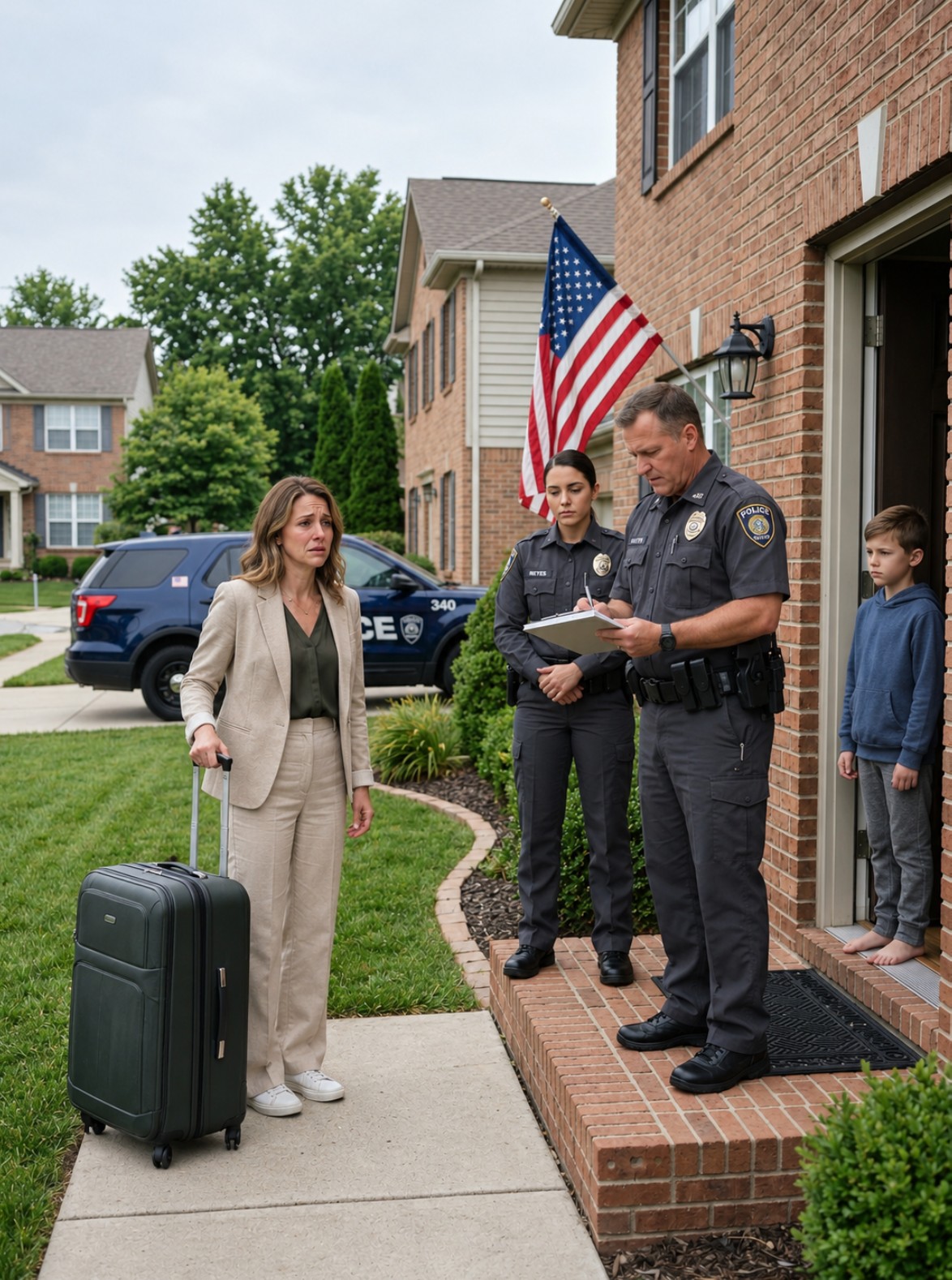
When Mom finally unlocked the apartment door, two police officers and a representative from the family services department were waiting inside.
The landlord was also standing in the hallway, watching the confrontation unfold.
The worst part of that moment was not the look of shock that spread across Mom’s face.
It was what she said first.
She did not ask where I was.
She did not ask whether I was safe or whether I had been eating properly.
She did not even call my name.
Instead, she clutched her shopping bags against her chest and glared at the officers with pure fury.
“Who the hell was the one who warned you people about this?” she shouted.
The landlord, who had been watching from the hallway, covered her mouth in disbelief.
Even she seemed shocked that Mom’s first concern was finding out who had reported her rather than learning what had happened to her daughter.
At that moment, there was no longer any doubt about where Mom’s priorities lay.
Officer Riley stepped forward.
“Lydia Hernandez, we need you to come with us. You’re being detained in connection with allegations of child abandonment and neglect.”
Mom recoiled as though someone had slapped her.
“What? You can’t be serious!” she shouted. “This is my apartment! What do you think you’re doing?”
The officers explained that the authorities had been investigating the circumstances surrounding her absence and that she needed to answer questions about leaving an eleven-year-old child alone without adequate food, electricity, or adult supervision.
At first, Mom denied everything.
“I never abandoned my daughter!” she insisted. “I was gone for a little while, that’s all!”
Then she began shouting about how unfair the world was to mothers.
She complained that nobody understood how much she had sacrificed throughout her life. She claimed that she had been exhausted, that she deserved a break, and that everyone was making a huge deal out of nothing.
Finally, she tried to laugh the whole thing off as if it were some ridiculous misunderstanding that could be fixed with a single phone call.
“Maya is a very mature girl for her age,” she said. “I left plenty of money for her. She knows how to take care of herself!”
The officers did not look convinced.
Mom continued talking, growing more desperate with every passing minute.
“A neighbor was supposed to check on her,” she claimed.
But when the officers asked for the neighbor’s name and details about the arrangement, she could not provide a convincing explanation.
There had been no reliable adult supervising me. No one had been checking whether I was eating, whether I was safe, or whether I needed medical attention.
The facts were already documented.
The authorities had records showing when Mom had left the country and when she had returned. My school had documented my physical condition and the fact that I had become ill from hunger and stress. The apartment inspection had revealed the lack of food and the notice about the electricity being shut off.
The landlord also confirmed that she had not seen anyone coming to check on me during the weeks Mom was away.
Even the little money I had saved was accounted for. I had kept the remaining dollars and coins in my backpack because, at the time, I believed they were my only protection against running out of food completely.
Nothing Mom said could change what had happened.
She had left me alone, and I had been forced to find help because I could no longer survive that way.
The officers took her in for questioning, and she spent that night in a jail cell while the case moved forward.
Meanwhile, at Rosemary’s house, I slept through the night without pushing a chair against my bedroom door.
For the first time in weeks, I was able to close my eyes without listening for footsteps in the hallway.
I did not know what would happen to Mom. I did not understand the legal system or what the authorities would decide about my future.
But I knew that someone was finally taking care of me.
And that was enough for that night.
The legal process that followed was long and exhausting.
There were interviews, mental health evaluations, meetings with social workers, and mountains of paperwork. Adults asked me to explain what had happened again and again, sometimes in ways that made me feel as though I were reliving those frightening days.
I tried to answer every question honestly, even when the memories hurt.
The authorities had to decide what would happen next, and my safety remained their main concern.
Throughout the process, I continued living with Rosemary.
At first, I thought of myself as a temporary guest in her home. I kept my belongings neatly packed, afraid that I might be told to leave at any moment.
I tried not to take up too much space. I apologized whenever I asked for something, even if it was something as simple as a glass of water.
Rosemary noticed.
One morning, she found me standing in the kitchen, carefully wrapping a slice of bread in a napkin.
“What are you doing, sweetheart?” she asked.
I froze.
“I was just saving this,” I explained. “In case there’s nothing to eat later.”
Rosemary’s expression softened.
She walked over and gently took the napkin from my hands.
“You don’t have to hide bread under your pillow anymore, Maya,” she told me. “There will be food tomorrow, and there will be food the day after that. You can trust me.”
I stared at her, unsure what to say.
She placed the bread back in the basket on the table.
“If you’re hungry, you can ask for another helping. You never have to feel guilty about eating in this house.”
Those words might have seemed ordinary to another child, but to me, they meant everything.
Rosemary taught me to sit at the breakfast table without rushing through my food. She reminded me that I did not have to finish everything immediately just because I was afraid there would be nothing left.
She made sure I knew where the snacks were kept and encouraged me to help myself whenever I was hungry.
Little by little, I stopped waking up in the middle of the night to check whether the refrigerator was still running.
I stopped counting every slice of bread.
And eventually, I stopped feeling guilty whenever I asked for something I needed.
Rosemary did more than provide me with a bed and meals. She made me feel that I belonged somewhere.
She listened when I wanted to talk about Mom and never made me feel foolish for missing her. She helped me get back into a routine with school and supported me through the meetings with the social workers.
Most importantly, she fought for my safety in ways my own mother never had.
As the weeks passed, Rosemary stopped treating me like a guest who might leave at any moment. She began treating me like a member of her family.
And for the first time in my life, I started to understand what it felt like to have an adult who cared about my well-being without expecting anything in return.
Part 4:
During the entire legal process, I saw my mother only twice.
The first meeting was a supervised visit arranged by the authorities. Rosemary accompanied me, and a social worker remained present throughout the visit.
Mom arrived looking miserable.
Her eyes were red, and she kept wiping her cheeks with a tissue. She seemed determined to make sure everyone understood how much she was suffering.
When she saw me, she immediately began crying.
“Maya, sweetheart, you have to understand,” she said, reaching toward me. “I have a right to live my own life, too.”
I sat quietly across from her.
She continued talking about how exhausted she had been before the trip. She complained that she had spent years sacrificing her happiness and that nobody seemed to care about what she needed.
“I was tired of putting everyone else first,” she sobbed. “I just wanted a little time for myself. Is that really so terrible?”
I listened to her, remembering the dark apartment, the spoiled milk, and the nine dollars I had counted on the kitchen floor.
She spoke as though I had somehow prevented her from being happy.
She did not seem to understand that taking a vacation was not the problem. The problem was that she had left an eleven-year-old child without a responsible adult to care for her.
For a long time, I could not find the courage to answer.
Part of me still wanted to comfort her. I had spent my entire childhood trying to keep her happy, even when doing so meant hiding my own fear.
But something inside me had changed.
I looked directly at her.
“Living your life didn’t have to mean letting me die alone in the dark,” I said.
My voice did not tremble.
Mom stopped crying.
For a moment, she simply stared at me, as if she had never expected me to speak to her that way.
I continued.
“I was scared every night. I didn’t know if I would have enough food. I didn’t know when you were coming back. You told me not to tell anyone, so I thought I had to handle everything by myself.”
My throat tightened, but I forced myself to finish.
“I was only eleven, Mom. I needed you.”
She looked away.
She did not apologize for leaving me alone. She did not ask how I had felt when the electricity went out or what it had been like to sleep with a chair against the door.
Instead, she sat silently until the social worker announced that the visit was over.
I left the room feeling sad, but I also felt something I had never experienced around my mother before.
I felt proud of myself.
I had finally told her the truth without apologizing for it.
The second time I saw Mom, she was no longer crying or pretending to be heartbroken.
She arrived looking cold and angry, as though I were the person who had caused all her problems.
The moment we sat down, she leaned toward me.
“The social workers have clearly turned you against your own mother,” she hissed.
I stared at her, unable to believe what I was hearing.
She continued in a low, bitter voice.
“You’ve humiliated me in front of the entire town. Everyone is talking about me. Do you have any idea what you’ve done to my life?”
I opened my mouth, but she did not give me a chance to respond.
“If you had just kept your mouth shut, none of this would have happened,” she snapped.
Her words cut deeply, but they also made something painfully clear.
Even now, after everything that had happened, she was not thinking about the fear I had endured. She was thinking about her reputation, her vacation, and the consequences she was facing.
She was angry that the truth had come out.
She was angry that people knew what she had done.
And she was angry that I had refused to keep protecting her secret.
I looked at her and realized that I could not make her understand how much she had hurt me.
No matter how carefully I explained it, she might never accept responsibility for her actions.
That was a difficult truth for an eleven-year-old girl to face.
For so long, I had believed that if I behaved well enough, Mom would eventually become the mother I needed. I had thought that if I stayed quiet, helped around the apartment, and never asked for too much, she would love me the way other mothers seemed to love their children.
But love was not something I could earn by making myself smaller.
And I could not make my mother change by accepting more pain.
When the meeting ended, I walked out without saying another word.
Rosemary was waiting for me.
She did not ask me to explain everything immediately. She simply took my hand and walked beside me.
That evening, I sat at her kitchen table while she prepared dinner. The house smelled of warm bread and roasted vegetables, and the ordinary sounds of someone cooking made me feel safe.
For the first time, I did not feel the need to pretend that I was fine.
“I don’t think she’s sorry,” I whispered.
Rosemary turned toward me.
“I’m sorry, sweetheart.”
“I think she’s only sorry that everyone knows what she did.”
Rosemary pulled out the chair beside mine and sat down.
“Sometimes people refuse to take responsibility for the harm they’ve caused,” she said gently. “That doesn’t mean the harm wasn’t real. And it doesn’t mean you did anything wrong by telling the truth.”
I stared at my hands.
“I wanted her to be happy,” I admitted. “I just didn’t want her to leave me.”
Rosemary wrapped an arm around my shoulders.
“You were a child, Maya. It was never your job to make your mother happy at the cost of your own safety.”
I leaned against her, allowing myself to cry.
That night, I finally began to understand that I could love my mother and still recognize that she had hurt me. I could miss her without pretending that what she had done was acceptable.
And I could stop trying to earn the care every child deserved.
Part 5:
Over the years, I have noticed that people tend to focus on the most shocking parts of my story.
They talk about the mother who traveled through Europe while her eleven-year-old daughter was left alone in a powerless apartment.
They talk about the police waiting when she returned, the confrontation in the hallway, and the scandal that spread through our neighborhood.
Some people are fascinated by the photographs she posted from England and Italy. Others want to know what happened during the investigation and whether she ever admitted what she had done.
Those details are part of my story, but they are not what I remember most.
The real story is about an eleven-year-old girl who finally learned that she did not have to suffer in silence.
It is about a teacher who noticed that something was wrong and refused to ignore the warning signs.
It is about a police officer and a social worker who listened when a frightened child finally found the courage to tell the truth.
And it is about a woman named Rosemary who welcomed a hungry, terrified girl into her home and placed a bowl of hot chicken soup in front of her.
Rosemary did not need to make grand promises to change my life. She simply showed up, day after day.
She made sure I had enough to eat. She helped me feel safe at night. She listened when I was sad, and she reminded me that I was allowed to ask for help.
Through her, I learned that care was not supposed to feel like a debt I had to repay.
I did not have to be perfectly behaved to deserve a meal.
I did not have to stay silent to deserve love.
And I did not have to protect an adult from the consequences of her own choices.
For a long time, I thought being a good daughter meant obeying my mother no matter what. I believed that keeping her secrets was part of loving her, even when those secrets were hurting me.
But I eventually learned that silence is not always a sign of loyalty.
Sometimes, silence only allows abuse and neglect to continue.
Speaking up does not make a child disobedient or ungrateful. Asking for help does not mean a child has failed to solve a problem on her own.
It means she understands that she deserves to be safe.
My mother left that Thursday morning believing I would somehow survive until she decided to return. She believed I would follow her instructions, keep quiet, and pretend that nothing had happened when she walked through the door again.
She expected me to remain the frightened little girl who was too afraid to question her.
But she was wrong.
I told the truth.
And because I did, people came to help me.
I cannot change what happened during those weeks in the dark apartment. I cannot erase the fear I felt when the electricity went out or the shame I experienced when I saw my mother smiling in photographs while I struggled to find enough food.
But those weeks no longer define my life.
What matters most is that I learned I was not alone, and I did not have to remain silent just because the person hurting me was my mother.
I learned that family is not simply about sharing a name or living under the same roof. It is also about responsibility, kindness, and the willingness to protect someone who depends on you.
Rosemary showed me that a person does not have to be related to you to care for you like family.
And Mrs. Patterson showed me that sometimes, all it takes to change a child’s life is one adult who pays attention and decides to act.
My mother left that day believing she could disappear for weeks and return without anyone questioning her.
She believed that the truth would remain hidden because she had ordered me to keep it secret.
But when she finally returned to Bakersfield, the truth was already waiting for her.
And this time, I was no longer standing alone in the dark.
THE END.
