
Part 1:
I am Jordan Casey, and I am twenty-two years old. I am about to graduate from the Wharton School at the University of Pennsylvania, one of the most prestigious business schools in the country. I should be feeling nothing but excitement and pride. After years of exhausting work, sleepless nights, and countless sacrifices, I am finally about to receive my degree.
But last week, when I called my parents to finalize the arrangements for my graduation, my father answered the phone with his usual cold and dismissive tone.
“Jordan, we simply cannot find the time to drive you to your graduation ceremony,” he said without the slightest hesitation. “You will have to take the Greyhound bus.”
I stood there in silence, waiting for him to explain himself.
Then he added something that made my stomach tighten.
“Your mother and I are busy finalizing the purchase of a brand-new Rolls-Royce for your sister.”
My younger sister, Kaylee, was only finishing high school. Yet my parents were preparing to buy her a luxury car while telling me, their eldest daughter, that they could not even make time to attend my college graduation.
The familiar pain of being treated as the less important child rose inside me once again. I had spent my entire life watching my parents give Kaylee everything she wanted while expecting me to achieve perfection without asking for anything in return.
But this time, something was different.
They had no idea what I had accomplished during the four years they had barely bothered to ask about. They had no idea that the daughter they were sending on a bus was about to walk across a stage as the founder and CEO of a billion-dollar company.
And they certainly had no idea that their decision would change our family forever.
Before I tell you what happened at my graduation, let me take you back to the beginning, when I first learned what it meant to live in my sister’s shadow.
I grew up in a massive estate in the suburbs of Maryland. My father, Franklin Casey, was the chief financial officer of a huge global corporation. He was stern, methodical, and demanding. He expected everyone around him to meet impossibly high standards, and he rarely showed emotion when someone succeeded.
My mother, Victoria, was a highly respected neurosurgeon at a prominent hospital in Baltimore. She was just as demanding as my father, although she expressed her disapproval in quieter, more subtle ways.
Together, they created a household where excellence was never celebrated. It was simply expected.
If I brought home perfect grades, they barely reacted. If I won an academic competition, they treated it as something I should have done anyway. I learned early that no achievement was ever enough to earn the kind of affection I desperately wanted from them.
When I was four years old, my younger sister, Kaylee, was born.
I still remember the afternoon my parents brought her home from the hospital. She had enormous blue eyes and tiny tufts of golden hair that seemed to glow whenever sunlight fell across her face.
Everyone was captivated by her.
From that moment onward, it felt as though the spotlight in our family had shifted permanently away from me and onto my little sister.
I went from being the child who received attention to the responsible older daughter who was expected to set a perfect example. I was supposed to be mature, patient, and understanding. Kaylee, on the other hand, was allowed to be a child.
At first, the favoritism appeared in small ways that I was too young to understand.
For my eighth birthday, my father gave me a leather-bound set of educational encyclopedias. He explained that they would help me develop my intelligence and prepare me for a successful future.
I thanked him because I had been taught to appreciate every gift.
Two months later, Kaylee turned four.
My parents organized a lavish princess-themed birthday celebration in our enormous backyard. They rented a pony that children could ride, decorated the entire garden, and invited dozens of guests. Kaylee wore a beautiful princess dress while everyone gathered around her, taking photographs and cheering.
I watched from the sidelines, trying to convince myself that the difference in our birthdays was understandable because she was younger.
But as the years passed, the gap between us became impossible to ignore.
Our family vacations always revolved around Kaylee’s wishes.
If she wanted to visit the theme parks in Orlando, we packed our bags and headed to Florida. If she wanted to spend a week at a luxury beach resort, my parents rearranged their schedules to make it happen.
Nobody asked what I wanted.
When I was twelve, I became fascinated by science. I spent hours reading about experiments, technology, and discoveries that could change the world. One summer, I learned about a prestigious science academy that offered an intensive program for talented students.
I was thrilled by the possibility of attending.
At dinner, I gathered my courage and told my mother that I wanted to spend the summer at the academy instead of going on our usual beach vacation.
She barely looked up from the designer swimwear she was packing for Kaylee.
“Perhaps we can look into that next year, Jordan,” she said, giving my head a brief, distracted pat.
I wanted to believe her.
I waited for the following summer, hoping she would remember our conversation. But when the time came, we went on another family vacation centered around Kaylee’s interests.
The science academy was never mentioned again.
I slowly learned that promises made to me could be forgotten, while even Kaylee’s smallest wishes seemed to become family priorities.
School was another place where the difference in our treatment became painfully clear.
I worked relentlessly to maintain a perfect grade point average. I joined academic clubs, competed in debate tournaments, and spent countless evenings studying subjects that challenged me.
Whenever I brought home a flawless report card, my parents offered little more than a brief nod.
“That is exactly what we expect from a girl with your opportunities,” my father would say.
There was never a celebration, never a special dinner, and rarely even a sincere compliment.
Kaylee’s experiences were very different.
When she brought home mediocre grades, my parents praised her for trying her best. If she improved slightly in social studies, my mother would tell her how proud she was. Even the smallest achievement could earn Kaylee an enthusiastic celebration.
By the time I entered high school, I had absorbed a painful lesson: I had to work twice as hard as my sister just to receive half the recognition she got for doing far less.
Still, I refused to give up.
I joined the competitive debate team, eventually became the editor of the school magazine, and enrolled in every advanced placement course available to me. Many nights, I studied until well past midnight, hoping that one day my parents would look at me with the same pride they showed when Kaylee landed a minor role in a local play.
But no matter how hard I worked, their attention always returned to her.
My relationship with Kaylee was complicated.
I never completely blamed her for the way our parents treated us. She was a child, just as I was, and she had grown up believing that the world would always bend to accommodate her.
Still, as we entered our teenage years, the distance between us grew.
Kaylee became accustomed to getting whatever she wanted without having to work for it or face the consequences of her mistakes.
When she turned sixteen, my parents bought her a brand-new luxury sedan. Not long afterward, she accidentally crashed it.
I expected my father to be furious. Instead, he replaced the damaged car with an even better model the very next afternoon.
I remembered that incident whenever I thought about my own request for help.
A few years earlier, I had asked my father for a small loan to buy a reliable used car so I could commute to my part-time job.
His response had been immediate.
“You need to learn the value of a dollar, Jordan. If you want a car, save up and buy one yourself.”
I had accepted his answer and worked harder to save money.
Kaylee had destroyed an expensive car and received an upgrade.
I had asked for help buying a modest used vehicle and been told to figure it out alone.
That was the difference between being the responsible daughter and being the favored one.
But the most painful memory of my childhood came during my senior year of high school.
I had been named valedictorian of my graduating class. The honor represented four years of discipline, sacrifice, and determination. I had earned the highest academic standing among my classmates, and I was scheduled to deliver a speech at the graduation ceremony.
For once, I allowed myself to feel excited.
The ceremony was scheduled for a Tuesday evening in late May. I imagined my parents sitting in the audience, listening as I spoke about perseverance and the importance of believing in yourself.
I pictured my mother smiling proudly and my father applauding as I stepped away from the podium.
A few days before the ceremony, I reminded them about the date during dinner.
My mother winced and glanced down at her calendar.
“Oh, Jordan, that is unfortunately the same night as the grand opening performance at Kaylee’s new dance studio,” she said.
I stared at her, waiting for her to explain how they could possibly miss such an important event in my life.
“Kaylee has been practicing her solo for months,” she continued. “Surely you understand why we need to be there for her big moment.”
I felt something inside me sink.
“But it’s my graduation,” I wanted to say. “I’m the valedictorian. I’ll be giving a speech.”
Instead, the words remained trapped in my throat.
“I understand, Mom,” I whispered.
I pushed the food around my plate and pretended that I was not hurt.
On the evening of my graduation, I attended the ceremony alone.
All around me, families filled the seats. Parents waved at their children, siblings took photographs, and grandparents wiped away tears as proud graduates walked across the stage.
I sat among them with nobody from my family beside me.
When my name was called, I walked to the podium and delivered my speech. I spoke about perseverance, hard work, and the importance of continuing forward even when life became difficult.
As I looked across the audience, I searched for two familiar faces.
They were not there.
My parents were miles away, watching Kaylee perform her dance solo.
That night, something changed inside me.
I had already received a partial scholarship to the University of Pennsylvania, which made attending the Wharton School possible. However, the scholarship did not cover all my expenses, especially the cost of living in Philadelphia.
My parents had vaguely suggested that they might help with some of my college costs. Until then, I had held on to a small hope that they would eventually support me.
But sitting alone after my own graduation, I finally accepted that I could not build my future around promises they might never keep.
I made a decision.
From that moment forward, I would never ask them for another cent.
During the summer before college, I worked three jobs to save enough money to get started.
In the early mornings, I worked as a barista, preparing coffee for customers rushing to work. In the afternoons, I served as an administrative assistant, handling paperwork and organizing schedules. In the evenings, I tutored local students who needed help with their schoolwork.
My days were exhausting, but I kept going.
Every dollar mattered. I saved as much as possible, avoided unnecessary purchases, and carefully calculated how much money I would need once I moved to Philadelphia.
By August, I had managed to build up enough savings to begin my new life.
I packed everything I owned into two large suitcases and prepared to leave home.
Surprisingly, my parents seemed genuinely startled when I declined their offer to drive me to campus.
“I’ve already arranged my transportation, and I have everything under control,” I told them as I wheeled my suitcases toward the front door of our mansion.
My mother watched me with a slightly concerned expression.
“Do you actually have enough money to support yourself for the entire semester, Jordan?” she asked.
I nodded.
“I’ve been saving all summer. I’ll manage.”
My father barely lifted his eyes from the financial section of his morning newspaper.
“College is an expensive undertaking,” he said. “Don’t waste your resources on frivolous things.”
That was the extent of his farewell.
No hug. No words of encouragement. No expression of pride that his daughter was about to attend one of the best business schools in the country.
Meanwhile, Kaylee was preparing to begin her freshman year of high school. My parents had bought her an entirely new designer wardrobe and the latest high-end laptop on the market.
The contrast between our lives was almost unbelievable.
Yet by then, I had stopped expecting anything different.
I closed the heavy front door behind me and walked away with two suitcases, a limited amount of savings, and a future that I would have to build myself.
I felt deeply sad, but beneath that sadness was something unexpected.
Freedom.
For the first time in my life, I was going somewhere my parents could not control every detail of my existence.
I was going to build a life that belonged entirely to me.
And I had no idea just how far that decision would take me.
Part 2:
My first semester at the University of Pennsylvania was a brutal introduction to independence.
While many of my classmates focused on their demanding coursework, campus activities, and social lives, I was constantly juggling a full academic schedule with three part-time jobs.
I worked at the campus library early in the morning, organizing books and helping students find the resources they needed. Between afternoon classes, I delivered food for a local bistro. On weekends, I worked as a retail associate at a high-end clothing store in the downtown district.
Sleep became a luxury.
Some nights, I studied until the early hours of the morning before getting a few hours of rest and heading straight back to work. My body was often exhausted, but I knew I could not afford to fall behind.
Despite coming from a wealthy family, I received no financial support from my parents.
My partial scholarship covered most of my tuition, but I was responsible for my housing, meals, books, transportation, and every other expense. I lived in one of the smallest dorm rooms on campus and ate cheap instant noodles far more often than I cared to admit.
There were days when I wondered how much longer I could keep going.
Then I met Maya Torres.
Maya was another business student who quickly became my closest friend. She came from a hardworking single-parent household in Arizona and was also holding down multiple jobs to pay her expenses.
We understood each other in a way that few other students could.
We knew what it meant to calculate the price of every meal, search for used textbooks, and turn down invitations because we could not afford them.
We began cooking inexpensive meals together in the communal kitchen and splitting the cost of textbooks whenever possible. When one of us was struggling, the other did whatever she could to help.
One night, we were sitting together in our dorm, highlighting sections of a used textbook, when Maya finally asked the question I had spent years trying to avoid.
“How can your parents justify not helping you at all when they clearly have the money?” she asked.
She shook her head in disbelief.
“Jordan, you work harder than almost anyone I know. It seems incredibly cruel that they leave you to struggle like this.”
I shrugged, trying to act as though the situation did not bother me.
“They believe in self-sufficiency,” I explained. “They say that struggling teaches me character and helps me learn how to stand on my own.”
Maya stared at me.
“That isn’t self-sufficiency,” she replied firmly. “It’s neglect when they can afford to buy your sister designer jewelry and brand-new cars while leaving you to worry about paying for food.”
Her words hit harder than I expected.
For years, I had defended my parents in my own mind. I had told myself that they were strict, that they were trying to prepare me for adulthood, and that I was simply too sensitive.
But Maya had no reason to make excuses for them.
Hearing someone else describe the situation so honestly forced me to confront a truth I had spent years avoiding.
My parents were not treating us equally.
And no amount of hard work on my part would make them change unless they wanted to change themselves.
During my sophomore year, I met Logan in an advanced macroeconomics course.
He was charming, intelligent, and came from a wealthy family in Connecticut. He had grown up with a very different understanding of money from mine.
We started dating, and for a while, I thought I had finally found someone who saw me for who I really was.
Logan was kind and generous. He often suggested expensive restaurants, offered to pay for our meals, and planned spontaneous weekend trips to the coast.
At first, his generosity felt wonderful.
But I struggled to accept it.
I had spent years teaching myself never to depend on anyone. Accepting help made me feel vulnerable, as though I were giving another person the power to disappoint me.
Even when I could barely afford my share of a dinner, I insisted on splitting the bill.
Logan grew increasingly frustrated.
“Just let me take care of the bill this time,” he would say whenever I reached for my wallet.
“I can pay for myself,” I would reply.
“Jordan, it’s dinner. I’m offering because I want to. Why do you have to make everything so difficult?”
He also struggled to understand why I refused to ask my parents for money.
“They’re wealthy,” he would point out. “Why not ask them for a small loan? You could make your life so much easier.”
I tried to explain the years of favoritism, the broken promises, and the constant feeling that I had to earn every scrap of affection.
But Logan had grown up in a family where financial support was a normal expression of love. He could not fully understand why accepting money from my parents felt more painful than working until I could barely keep my eyes open.
Our relationship eventually fell apart after eight months.
The final argument began when Logan surprised me with expensive plane tickets for a spring break trip.
He had arranged everything without consulting me, imagining that I would be thrilled.
Instead, I told him I could not go. I had already committed to working extra shifts during the holiday period, and I needed the money to cover my expenses.
He looked at me with disbelief.
“I planned this because I wanted us to spend time together,” he said. “Can’t you let yourself enjoy something for once?”
“I can’t afford to miss those shifts,” I explained. “I have bills to pay.”
“You could afford it if you stopped insisting on doing everything the hardest possible way.”
His words stung because they touched a wound he did not understand.
We argued until neither of us had anything left to say.
That night, we broke up in the rain.
I walked back alone, heartbroken and soaked, wondering why even the people who cared about me seemed unable to understand the choices I had made to survive.
The holiday seasons were especially difficult.
While most students returned home to celebrate with their families, I often stayed on campus to take extra shifts. I told myself that it was practical, but the truth was that spending the holidays alone made me feel more isolated than I wanted to admit.
During my first Thanksgiving away from home, I called my mother.
I was hoping for a warm conversation, perhaps a few questions about my classes or a simple expression of how much she missed me.
Instead, I heard the noise of a party in the background.
“We truly miss you here, Jordan,” my mother said.
For a moment, I felt hopeful.
Then she continued.
“We’re just about to sit down for a massive feast. And Kaylee made the most stunning floral centerpiece for the dining table.”
I could hear laughter and the unmistakable clinking of crystal glasses behind her.
It sounded like a perfect family celebration.
One I was not part of.
“I’m glad everything is going well,” I said quietly.
I stood alone in my dark dorm room, looking at the small meal I had prepared for myself.
“I should probably let you get back to dinner.”
“Yes, that would be a good idea,” she replied. “Call us again when you have some free time.”
Then she hung up.
I stared at my phone for several seconds before setting it down.
That Thanksgiving, I worked a double shift at a local diner, serving hot turkey dinners to other people’s happy families.
I smiled at customers, refilled their drinks, and carried plates to tables filled with laughter.
Nobody knew that the girl serving them dinner had spent the afternoon hoping her own mother might want to talk to her.
But I kept going.
I had no idea that the skills I was developing during those lonely years would eventually become the foundation of something extraordinary.
The turning point came during my junior year, when I enrolled in an innovative financial technology course.
Most of my professors were focused on lectures, assignments, and exams. They rarely noticed how exhausted I was or how hard I worked to keep up.
Professor Sarah Jenkins was different.
She was sharp, observant, and genuinely interested in her students’ ideas. When I submitted a detailed research paper analyzing emerging trends in digital payment security, she asked me to stay after class.
I assumed she wanted to discuss a mistake.
Instead, she held up my paper and smiled.
“This level of analysis is far beyond what I expect from an undergraduate student, Jordan,” she said. “Have you ever considered focusing on the intersection of blockchain technology and consumer finance?”
I hesitated before answering.
“I’ve thought about it, but I don’t know where to start.”
“Then let’s start by asking the right questions,” she replied.
That conversation marked the beginning of a mentorship that changed the direction of my life.
For the first time, an adult looked at me and saw more than a set of grades or a list of responsibilities. Professor Jenkins saw potential, and she was willing to help me develop it.
She recommended books, introduced me to industry professionals, and encouraged me to explore ideas that many traditional banking institutions still viewed with skepticism.
I became fascinated by the possibility of using digital technology to make financial transactions more transparent and secure.
I began spending hours in the campus computer lab, studying security protocols, learning to code, and researching ways to protect digital payments against fraud.
The more I learned, the more questions I wanted to answer.
Why were digital transactions still so complicated for ordinary consumers? Why did security measures often make financial applications harder to use? Could a platform combine the convenience of a traditional banking app with stronger protection for users?
By the end of my junior year, my academic interest had developed into a concrete business idea.
I wanted to build a platform that would make digital transactions simple, fast, and secure enough for everyday users.
Professor Jenkins encouraged me to pursue it.
“You’ve identified a genuine gap in the market,” she told me during one of our evening meetings. “If you can solve the technical challenges and build the right team, this could become a serious business.”
For the first time since arriving in Philadelphia, I felt something beyond the need to survive.
I felt a sense of purpose.
I was no longer working simply to pay my bills or prove that I could manage without my parents. I was building something because I believed it could make a difference.
And unlike the approval I had spent my childhood chasing, the future of this project would depend on my own decisions.
I could finally create something that belonged to me.
Part 3:
During the summer before my senior year, I devoted nearly every waking hour to developing the foundation of my business.
While some of my classmates secured internships at prestigious companies or traveled through Europe, I moved into a tiny apartment with Maya and focused on turning my idea into a working product.
We spent long nights writing code, researching competitors, and covering the walls with business plans, diagrams, and lists of problems we needed to solve.
The project gradually took shape under a name I had chosen carefully: ChainVault.
I envisioned it as a secure financial technology platform that would make digital transactions faster and easier without sacrificing security.
The idea was ambitious, but I believed in it.
When the business school announced its annual startup competition, I saw an opportunity to take the next step. The competition was highly competitive and offered substantial seed funding to the most promising student ventures.
Professor Jenkins encouraged me to enter.
“You have nothing to lose by putting your idea in front of people who can help you develop it,” she said.
I spent weeks refining my pitch deck, building functional prototypes, and preparing answers to every difficult question the judges might ask.
The night before the final presentation, I rehearsed my speech for Maya again and again.
After what felt like the hundredth run-through, she finally raised her hands in surrender.
“Jordan, you seriously need to sleep,” she said. “You know this material inside and out. You’re ready.”
I laughed nervously.
“What if I forget something?”
“Then you’ll answer the question and keep going. You’ve survived much worse than a presentation.”
The next day, more than one hundred student ventures competed for the top prize.
As I waited for the judges to announce the winner, my hands were cold and my heart pounded so loudly that I could barely hear the conversations around me.
Then the announcement came.
“First place goes to ChainVault!”
For a moment, I could not move.
Maya grabbed my arm and let out a joyful shout.
“Jordan! You did it!”
I walked to the stage in a daze, trying to understand what had just happened.
The prize included $50,000 in seed funding and dedicated office space in the university’s new innovation center.
It was more genuine support than I had ever received for anything in my life.
But the competition gave me something even more valuable than the money: visibility.
Soon, several angel investors began asking about ChainVault.
Among them was Christopher Banks, a successful technology entrepreneur who had built and sold several large software companies over the previous decade.
He invited me to a private lunch to discuss my business and my plans for the future.
I arrived with a notebook full of technical details and a carefully prepared presentation. I was determined to show him that ChainVault was more than an interesting student project.
After I finished explaining the platform, Christopher leaned back in his chair.
“I’m going to be direct with you because I value your time,” he said.
He paused before making his offer.
“I’ll give you two million dollars for the entire concept and its intellectual property. You can finish your degree without worrying about money, and I’ll take responsibility for growing the business.”
For a few seconds, I said nothing.
Two million dollars.
The amount could have transformed my life overnight. I could have paid off my student loans, moved into a comfortable apartment, and stopped working exhausting retail shifts just to cover my basic expenses.
For someone who had spent years counting every dollar, the offer was almost impossible to ignore.
But as tempting as it was, I could not bring myself to accept it.
“I am incredibly honored by your offer,” I finally said. “But I’m not ready to sell my vision. I want to build this company myself.”
Christopher studied me with an expression I could not quite read.
“Most students in your position would have accepted that amount without a second thought.”
I met his gaze.
“I’ve never had the luxury of making decisions based only on what is easiest.”
A small smile appeared on his face.
“I can see that.”
I left the meeting without a deal, wondering whether I had just made the biggest mistake of my life.
The following afternoon, Christopher called me again.
This time, his proposal was different.
“I’ve been thinking about our conversation,” he said. “I don’t want to buy ChainVault outright. I’d rather invest in what you’re building.”
He offered to invest $500,000 in exchange for a fifteen percent ownership stake in the company.
This was the opportunity I had been hoping for.
I would receive the funding needed to develop ChainVault without giving up control of my vision.
I accepted.
With Christopher’s investment, I was able to formally incorporate the company and hire a small team of talented developers.
Suddenly, my life became even more demanding.
I was still a full-time student with a heavy course load, but I was also the CEO of a growing technology startup.
I hired two gifted computer science students to work part-time as developers and brought in a graduate student to help with branding and marketing.
Our office was a cramped, windowless room in the university’s innovation center. We worked around small desks, tangled cables, and piles of notebooks, often coding until the early hours of the morning.
There were days when the pressure felt unbearable.
Three months after we began development, we discovered a serious flaw in our main security protocol. The problem was significant enough that we had to rewrite nearly half of our code.
Our planned beta launch was suddenly at risk.
I barely slept as the team worked around the clock to identify the problem and develop a reliable solution. We tested one version after another, trying to make sure the same weakness would not appear again.
Just when we thought we were getting back on track, one of our lead developers unexpectedly quit to accept a high-paying position at a major technology company.
His departure left us short-handed at the worst possible moment.
Meanwhile, our bank balance was shrinking rapidly, and we were still months away from having a product ready for the market.
One evening, after another exhausting day, I reached my breaking point.
I called Professor Jenkins, and the moment she answered, I began to cry.
“I think I’ve made a terrible mistake,” I admitted. “We’re running out of money, our launch is falling behind, and I don’t know if we can fix everything before it’s too late.”
She listened without interrupting.
Then she spoke in the calm, steady voice I had come to trust.
“Every successful entrepreneur faces moments when the future looks impossible. The question isn’t whether you’ll encounter problems. The question is what you’ll do when they arrive.”
I wiped my eyes.
“What if I can’t solve them?”
“Then you’ll learn something and try another approach. But first, you need to decide whether you’re going to push through this challenge or walk away from the company you’ve worked so hard to build.”
Her words were blunt, but they were exactly what I needed to hear.
I thought about all the nights I had studied while my friends slept. I thought about the jobs I had worked, the meals I had skipped, and the years I had spent trying to prove that I was capable of building a future for myself.
I had come too far to give up because the road had become difficult.
The next morning, I returned to the office with a different mindset.
I took on more of the complicated coding work myself and helped the remaining developers reorganize our priorities. Maya, who had no formal technical background, volunteered to handle administrative tasks on weekends so the rest of us could focus on the product.
She organized our records, coordinated schedules, followed up on outstanding tasks, and helped us keep track of every dollar.
We cut unnecessary expenses and concentrated on the features that mattered most.
Slowly, we began to recover.
The crisis that had nearly destroyed our momentum ended up making our team more disciplined and more focused.
Then, in March of my senior year, we finally achieved the breakthrough we had been chasing.
After months of testing and refinement, we perfected our proprietary security algorithm. It allowed digital transactions to be processed significantly faster while maintaining a high level of protection against attacks.
For the first time, our technology worked the way I had imagined it from the beginning.
We arranged a demonstration for Christopher.
As he watched the system process transactions in real time, his expression changed from professional curiosity to genuine excitement.
When the demonstration ended, he looked at me.
“This could change the landscape of the industry,” he said.
He immediately began discussing the next stage of our growth.
“How quickly can you prepare the documents for a Series A funding round? I want to introduce you to firms that can help take this to the next level.”
Through Christopher’s extensive network, we secured meetings with some of the country’s leading venture capital firms.
Our timing was fortunate. Interest in secure digital finance solutions was growing, and investors were increasingly looking for technology that could make online transactions safer and more efficient.
The next month was a whirlwind of presentations, financial reviews, negotiations, and late-night calls.
Every meeting brought new questions. Every investor wanted to understand the technology, the market, the risks, and our plans for expansion.
I answered as many questions as I could and relied on my team to explain the technical details that required their expertise.
Finally, the negotiations concluded.
ChainVault closed a $50 million funding round at a company valuation of $700 million.
I read the final figures several times before I fully understood what they meant.
The company I had developed in a cramped office with a small team was now valued at hundreds of millions of dollars.
The news spread quickly through the technology and finance communities.
But I deliberately kept a low profile. I gave no public interviews and made no grand announcements on social media.
Most importantly, I did not tell my family.
Part of me wanted to prove to myself that I could succeed without their approval or financial support.
Another part of me wanted to see what would happen when they finally discovered what I had built while they were busy focusing on Kaylee.
For once, I did not want to be the daughter who explained herself, asked for recognition, or hoped that her parents would finally notice her.
I wanted to let my accomplishments speak for themselves.
As graduation approached, ChainVault continued to grow.
Our team expanded to thirty full-time employees, and the company’s valuation climbed beyond the billion-dollar mark. ChainVault had officially become a unicorn, the term used for a privately held startup valued at more than $1 billion.
At twenty-two, I had become a paper billionaire because of my ownership stake in the company.
That did not mean I had a billion dollars sitting in my bank account. Most of my wealth existed in the value of my shares, and the company still had plenty of work ahead of it.
But the achievement was extraordinary.
I had built something valuable from an idea, a few lines of code, and an almost unreasonable determination to succeed.
And I had done it without asking my parents for a single dollar.
Despite everything happening with the company, I continued attending classes, completing my assignments, and preparing for graduation.
Only a handful of people knew the full story behind ChainVault’s success.
Professor Jenkins was one of them. She had watched my journey from the moment she first read my research paper, and she could barely hide her pride.
During one of our final meetings, she mentioned something that caught my attention.
“You should know that a major business magazine is preparing its annual list of influential young leaders,” she said. “Your name is being discussed.”
I laughed, unsure how to respond.
But after she left, I sat quietly for a while and allowed myself to feel something I had rarely experienced growing up.
Pride.
For years, I had believed that success would finally make my parents proud of me. I had imagined that one day I would achieve something so impressive that they would have no choice but to recognize my worth.
Now I was beginning to understand that I had been looking for validation in the wrong place.
I had already proved what I was capable of.
I had built a company worth more than a billion dollars while completing one of the most demanding business degrees in the country.
I had survived financial hardship, personal disappointment, and years of feeling invisible.
I no longer needed my parents to tell me that I was enough.
I was finally learning to believe it myself.
But as May drew closer, I discovered that a small part of me still wanted them to witness what I had achieved.
I was proud of my degree and the company I had built. Yet somewhere deep inside, the little girl who had sat alone at her high school graduation still hoped that her parents might finally show up for her.
Three weeks before the ceremony, I mailed formal invitations to my parents and Kaylee at our family home in Maryland.
I included the official graduation tickets and a handwritten note explaining how much it would mean to me if they attended.
Then I waited.
I checked my phone more often than I wanted to admit, hoping that one of them would call to say they were proud of me or that they had already made plans to attend.
For several days, nothing happened.
Then, on a Tuesday evening, as I was leaving the innovation center after another long day, my phone rang.
My father’s name appeared on the screen.
I felt that familiar flutter of anxiety in my chest.
Even after everything I had accomplished, a part of me still wanted his approval.
I answered.
“Hello, Dad. It’s good to hear from you.”
“Jordan, we received your graduation invitation in the mail yesterday,” he replied in his usual businesslike tone.
“Yes,” I said, trying to keep my voice casual. “I was hoping you and Mom would be able to come.”
I waited for him to congratulate me.
Instead, there was a long silence.
I could hear my mother speaking in the background.
“It’s Jordan,” my father told her before returning to the call.
Then he delivered the words I had been dreading.
“Unfortunately, we have a significant conflict that weekend that we simply cannot move.”
My heart sank.
“What kind of conflict?” I asked. “My graduation is on Saturday. Is there something else happening that weekend?”
“Kaylee has her high school graduation that same week, and we’ve arranged several major celebrations for her,” he explained. “We simply can’t make the trip to Philadelphia for your ceremony.”
I gripped my phone.
“Dad, Kaylee’s graduation is on Thursday. Mine is on Saturday. You could attend both if you wanted to.”
My voice trembled despite my efforts to remain calm.
He sounded irritated by my question.
“Well, we’re also taking Kaylee on a major shopping trip to Miami that weekend as part of her graduation present.”
I closed my eyes.
Then he added the sentence that would stay with me for the rest of my life.
“You’ll just have to take the bus to your ceremony, Jordan. Your mother and I are busy buying your sister a Rolls-Royce.”
For several seconds, I could not speak.
A Rolls-Royce.
For an eighteen-year-old girl who was finishing high school.
And my parents could not make time to attend the graduation of their twenty-two-year-old daughter, who had worked for four years to earn her degree.
“A Rolls-Royce for Kaylee?” I finally asked. “She’s only just finishing high school.”
“She has worked very hard in her own way,” my father replied defensively. “And she’s been accepted to the University of Miami. We want to reward her achievement.”
He continued as if his explanation settled the matter.
“You’ve always been the responsible one, Jordan. You know how to handle things yourself.”
I nearly laughed at the absurdity of it.
Of course I knew how to handle things myself.
They had spent my entire life making sure I had no other choice.
What my father did not mention was that Kaylee’s admission to the University of Miami had been helped by our family’s donor connections. Her grades were far from exceptional, yet my parents treated her acceptance as an extraordinary triumph.
Meanwhile, I had maintained a perfect 4.0 GPA, earned my place at Wharton, and built a company valued at more than a billion dollars.
And they still thought I could be dismissed with a few careless words.
“I see how it is,” I said quietly.
I ended the call before he could offer another excuse.
For several moments, I stood frozen on the sidewalk, staring at the screen of my phone while the city moved around me.
I had known my parents favored Kaylee. I had known they could be selfish and dismissive.
But even after all those years, a small part of me had hoped this time would be different.
Instead, they had found yet another way to remind me that I was expected to manage alone.
Ten minutes later, Maya found me standing in the same place.
She took one look at my face and immediately knew something was wrong.
“What happened?” she asked.
I swallowed hard.
“They’re buying Kaylee a Rolls-Royce,” I whispered. “And they told me to take the bus to my own graduation because they don’t have time to come.”
Maya stared at me in disbelief.
“They’re doing what?”
I repeated the story, struggling to keep my voice steady.
When I finished, she stepped closer and wrapped an arm around my shoulders.
“Jordan, listen to me,” she said firmly. “They don’t deserve to be there if they can’t even make an effort to show up for you.”
I looked down at the pavement.
“They’re my parents.”
“I know,” she replied softly. “And that makes it hurt even more. But you don’t have to keep begging them to treat you like you matter.”
She paused and squeezed my shoulder.
“We’re your family, too. The people who stood beside you when you had nothing. We’ll be cheering louder than anyone when you walk across that stage.”
Her words helped me breathe again.
For years, I had thought of family as something I had to earn by being good enough, successful enough, or useful enough.
Maya reminded me that real support did not work that way.
I decided I would take the bus to graduation, exactly as my father had suggested.
But I would do it for my own reasons.
I would arrive by public transportation, walk across the stage to receive my diploma, and then return to the office of a company I had built from nothing.
My parents could buy Kaylee the most expensive car in the world.
They could give her designer clothes, lavish parties, and every advantage money could provide.
But they could not take away what I had achieved.
And they could not decide my worth.
Two days before graduation, however, something happened that would change the entire situation.
I received an urgent email from the dean’s office at the Wharton School.
At first, I worried that there had been a problem with my graduation status. I immediately went to the office to find out what was happening.
Dean Lawrence welcomed me with a warm smile.
“Miss Casey, thank you for coming in on such short notice. I know this is a busy week for you.”
I sat down, wondering what could possibly require an urgent meeting so close to graduation.
He opened a folder on his desk.
“We’ve received a call from a major business publication regarding a feature story about your work with ChainVault,” he explained.
I felt my stomach tighten.
He continued with a broad smile.
“You’ve been recognized as the youngest self-made female billionaire in your field, and the publication is preparing to feature your achievement.”
I stared at him.
Although I knew how successful ChainVault had become, hearing the news stated so plainly still felt surreal.
Dean Lawrence leaned forward.
“With your permission, we’d like to acknowledge this extraordinary accomplishment during the graduation ceremony.”
My first instinct was to decline.
I had deliberately avoided public attention because I wanted to protect my privacy and give myself time to build the company without unnecessary distractions.
But then I thought about my parents.
I wondered whether they would actually attend after all. Perhaps Kaylee would insist on coming to see the ceremony, or perhaps my parents would change their minds at the last moment.
I could not know what they would do.
But I realized that I no longer needed to hide what I had accomplished simply because I was afraid of how they might react.
After a moment of consideration, I nodded.
“That would be acceptable, Dean. Thank you.”
I left his office with a strange feeling in my chest.
For years, I had dreamed of the day my parents would finally recognize my achievements.
Now that the moment was approaching, I was no longer sure I wanted their approval.
I only wanted to stand on that stage knowing that I had earned my place there.
And whatever happened next, nobody could take that away from me.
Part 4:
Graduation day finally arrived.
The sky was clear and blue, and a gentle breeze moved through the trees across the University of Pennsylvania campus. Students hurried between buildings in their graduation gowns, families gathered for photographs, and the entire campus seemed filled with excitement.
I stood in front of the mirror in my small apartment, adjusting my graduation cap and smoothing the fabric of my gown.
For a moment, I simply looked at myself.
Four years earlier, I had arrived in Philadelphia with two suitcases, limited savings, and no financial support from my wealthy parents. I had worked three jobs, struggled to pay my bills, endured heartbreak, and spent countless nights wondering whether I could keep going.
Now, I was about to graduate from Wharton while leading a company valued at more than a billion dollars.
I had done it.
And I had done it on my own terms.
I kept my original plan and boarded the city bus to the university that morning.
The bus was nearly empty. I took a window seat and watched the familiar streets pass by as I reflected on everything that had brought me to this moment.
I thought about Maya, who had stood beside me when I could barely afford my next meal. I thought about Professor Jenkins, who had recognized my potential when I was still an exhausted student sitting quietly in the back of her classroom.
I thought about Christopher Banks, who had believed in my business enough to invest in it.
And, inevitably, I thought about my parents.
A small part of me still wished they had chosen to be there for me without needing a reason beyond the fact that I was their daughter.
But I refused to let that wish ruin my day.
When I arrived on campus, I was greeted by a breathtaking sight. Rows of white chairs covered the grass, colorful banners hung from the historic buildings, and thousands of people were gathering to celebrate the graduating class.
I took a deep breath and headed toward the registration area.
That was when I spotted my parents.
Franklin and Victoria Casey stood together near the entrance, looking as polished and expensive as ever. My mother wore an elegant outfit, while my father looked as though he were attending an important corporate meeting.
Kaylee stood beside them, staring at her phone with an expression of complete boredom.
For a moment, I considered walking past them without saying anything.
Instead, I approached.
“Well, I see you decided to show up after all,” I said.
My mother turned toward me and immediately put on her familiar social smile. She leaned forward and gave me a brief, stiff hug.
“Jordan, darling. You look lovely,” she said.
My father adjusted his jacket.
“The traffic was better than we expected, so we decided to make the trip,” he explained.
He did not mention the Rolls-Royce.
He did not apologize for telling me to take the bus.
And neither of my parents asked how I had been doing.
Kaylee barely looked up from her phone.
“Hi, Jordan,” she said distractedly.
I nodded.
“Hi, Kaylee.”
Our awkward reunion ended when an announcement instructed the graduates to begin lining up for the processional.
I turned toward the other students, relieved to have a reason to walk away.
The ceremony began with traditional music and welcoming speeches. The faculty members took their seats, and the graduating students filed into the designated rows while their families watched from the audience.
I sat among my classmates, listening as the speakers reflected on our years of hard work and the opportunities waiting beyond graduation.
Soon, it was time for the diplomas to be awarded.
One by one, students were called to the stage. Families cheered, cameras flashed, and graduates shook hands with the faculty before returning to their seats.
I waited patiently for my turn.
Finally, Dean Lawrence stepped toward the microphone.
“Jordan Casey, graduating summa cum laude with the highest distinction in business.”
I rose from my seat and walked toward the stage.
My heart pounded as I climbed the steps. I shook Dean Lawrence’s hand and accepted my diploma, feeling the weight of four years of effort in that single moment.
I was ready to leave the stage when he gently signaled for me to remain beside him.
Then he turned toward the audience.
“Before Miss Casey returns to her seat, I have the privilege of sharing some extraordinary news about one of our graduates.”
I looked at him, surprised.
“As many of you may have heard, Miss Casey is the founder and CEO of ChainVault, a financial technology company that has recently surpassed a valuation of one billion dollars.”
A murmur spread through the crowd.
Dean Lawrence continued.
“At just twenty-two years old, she has become one of the youngest self-made female billionaires in the technology sector. Her achievements are an outstanding example of innovation, determination, and entrepreneurial leadership.”
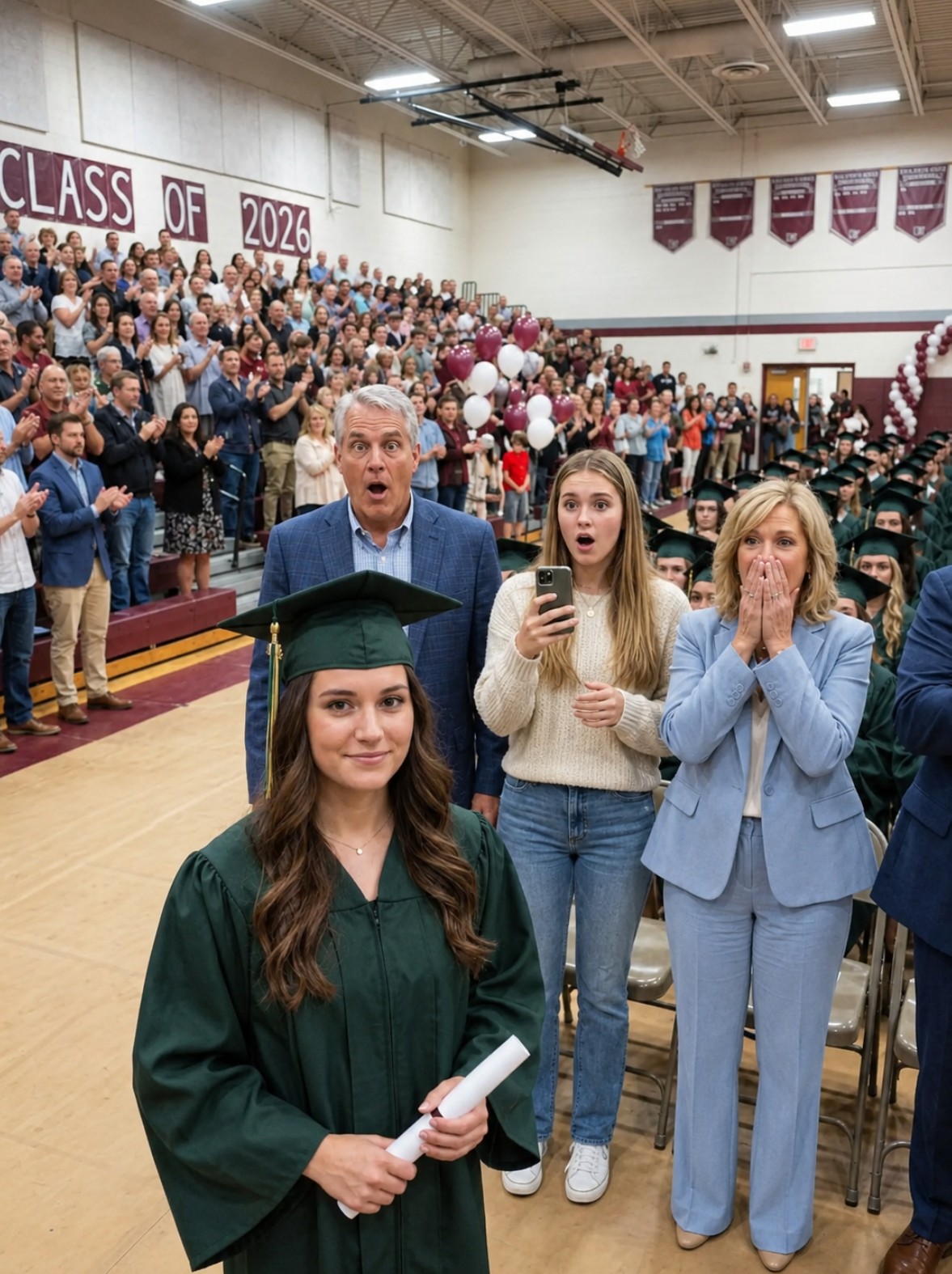
For a moment, the audience fell silent.
Then came the reaction.
Thousands of people began applauding. Some stood up, while others turned to the people beside them in disbelief. Excited conversations spread through the rows as the announcement sank in.
I stood on the stage, trying to take it all in.
Then I looked toward my family.
My father had dropped his graduation program onto the grass.
He was staring at me with his mouth slightly open, as though he had just discovered that the daughter he thought he knew was a complete stranger.
My mother sat perfectly still, one hand covering her mouth.
Her practiced smile had disappeared.
And Kaylee?
For once, my sister was no longer looking at her phone.
She stared at me with wide eyes and an open mouth, unable to hide her shock.
I could almost hear the questions forming in their minds.
How had Jordan done this?
When had she started a company?
Why hadn’t she told us?
How much money did she have?
But the question that mattered most was one I knew they would not ask themselves.
Why had we never bothered to find out?
I stepped toward the podium to deliver my graduation address.
As I looked out at the audience, I saw thousands of faces turned toward me. Some people were smiling, others were still whispering about the announcement, and many were applauding.
I took a breath and began.
“When I first came to this university, I believed success meant proving that I was capable of overcoming any obstacle. I thought that if I worked hard enough, achieved enough, and became successful enough, I would eventually have nothing left to prove.”
I paused, allowing the words to settle.
“But over the past four years, I’ve learned that success is not simply about what you accomplish. It’s also about what you discover about yourself along the way.”
I spoke about the challenges I had faced, the importance of perseverance, and the people who had supported me when the future seemed uncertain.
I did not mention my parents by name.
I did not describe the Rolls-Royce or the painful phone call that had nearly broken my heart.
Instead, I spoke about the difficult truth that sometimes the people you expect to support you most are not the ones who stand beside you when you need them.
“And sometimes,” I continued, “the hardest lesson is learning that you don’t need everyone’s approval to build a meaningful life. You need the courage to believe in yourself, even when the people around you cannot see what you are capable of.”
I looked toward the graduating students.
“Your future will not always unfold the way you expect. You will face rejection, disappointment, and moments when you question whether you’re good enough. When that happens, remember that other people’s inability to recognize your potential does not determine your worth.”
The audience grew quiet.
“Keep learning. Keep building. Keep moving forward. And when you finally achieve something extraordinary, remember the people who stood beside you when you had nothing to offer them except your friendship.”
I thought about Maya and Professor Jenkins.
I thought about the long nights in our cramped office and the moment ChainVault had finally worked as I had envisioned.
Then I smiled.
“Thank you, and congratulations to the entire graduating class.”
The audience erupted into thunderous applause.
I stepped away from the podium feeling lighter than I had in years.
For the first time, I was not thinking about whether my parents were proud of me.
I was proud of myself.
When the ceremony ended, I was immediately surrounded by classmates, professors, and people who wanted to congratulate me.
Maya pushed through the crowd and threw her arms around me.
“Jordan! You actually did it!” she exclaimed.
I laughed and hugged her tightly.
“We did it,” I corrected her. “I couldn’t have gotten through everything without you.”
She pulled back and looked at me with tears in her eyes.
“I’m so proud of you.”
Those simple words meant more to me than I could explain.
They were the words I had wanted to hear from my parents for as long as I could remember.
And now they were coming from someone who had actually witnessed my struggles.
Professor Jenkins soon joined us and hugged me.
“You should be incredibly proud of yourself,” she said. “You’ve accomplished something extraordinary, and you did it without losing sight of who you are.”
I thanked her, feeling a lump form in my throat.
Then I noticed movement through the crowd.
My parents were making their way toward me.
They looked completely different now. My father seemed unusually nervous, while my mother wore an expression that mixed astonishment with an eagerness I had rarely seen directed toward me.
They had finally found something about me that they considered worth pursuing.
“Jordan!” my father called.
He reached me and immediately tried to pull me into a hug.
I stepped back slightly.
He hesitated, lowering his arms.
“What on earth was that announcement?” he asked. “Why didn’t you tell us about your company?”
I looked at him calmly.
“You never asked.”
He blinked.
“What do you mean, we never asked?”
“When was the last time either of you asked me what I was working on? When was the last time you asked how I was paying my bills, whether I was doing well in school, or whether I needed anything?”
My father opened his mouth, but no answer came.
I continued.
“You called me last week to tell me that you couldn’t attend my graduation because you were buying Kaylee a Rolls-Royce. You told me to take the bus. Did you ask me about my life then?”
His face tightened.
“Jordan, that isn’t fair. We didn’t know you were running such a successful company.”
I gave a small, humorless laugh.
“Exactly. You didn’t know.”
My mother stepped forward, trying to smooth things over.
“Darling, we’re incredibly proud of you,” she said. “This is wonderful news. We had no idea you were doing all of this.”
She reached for my hand.
“We should all go out to dinner tonight. Somewhere special. Your father and I would love to celebrate this achievement properly.”
I gently withdrew my hand.
“Thank you, Mom, but I already have plans.”
Her smile faltered.
“Plans? With whom?”
“With the people who supported me during the last four years. The people who were there when I was struggling and didn’t have anything to offer them.”
I glanced toward Maya and Professor Jenkins, who were standing nearby.
“They’re the ones I want to celebrate with today.”
My father’s expression darkened.
“Jordan, we’re your parents. Surely we should be part of this celebration.”
I held his gaze.
“Being my parents doesn’t automatically mean you were there for me.”
The words hung between us.
For once, he had nothing to say.
Then, unexpectedly, Kaylee stepped forward.
She had been standing quietly behind our parents, listening to the entire conversation.
“Jordan,” she said softly.
I turned toward her.
She looked uncomfortable, and for the first time in years, I saw something in her expression that I had rarely seen before.
Regret.
“Can I come to your celebration?” she asked.
My parents immediately turned toward her.
“Kaylee, we’re all going to dinner together,” my mother reminded her.
But Kaylee shook her head.
“Actually, I don’t want to go shopping or celebrate my graduation again. I want to spend some time with Jordan.”
She looked at me.
“I’m tired of always being the center of attention for doing nothing.”
Her voice trembled slightly.
“I know I’ve benefited from the way Mom and Dad treat us differently. I didn’t really think about how much it hurt you. I just got used to everything being easy for me.”
She swallowed.
“I’m sorry, Jordan.”
I stared at my sister.
For years, I had wanted her to understand what it felt like to live in my shadow while watching her receive everything I had been denied.
I had imagined this moment many times, but I had never expected it to happen in the middle of my graduation celebration.
I could have turned away.
I could have told her that her apology had come too late.
But Kaylee was not my parents. She had grown up inside the same family, learning the same lessons, even though those lessons had benefited her far more than they had benefited me.
And now she was beginning to question them.
“You’re welcome to join us,” I told her.
Her face brightened with relief.
“Really?”
“Yes. But I want you to understand something. I’m not going to compete with you for our parents’ attention anymore, and I’m not going to pretend that the way they treated us was fair.”
She nodded.
“I understand.”
I turned toward my parents.
“You’re not invited to this celebration. I need some distance, and I’m not going to change my mind just because you’ve discovered that I’m successful.”
My mother looked as though I had slapped her.
“Jordan, how can you say that to us?”
I took a deep breath.
“Because I’m finally being honest about how I feel.”
My father stared at me, his expression caught somewhere between anger and disbelief.
For once, I did not feel the need to soften my words to protect his feelings.
I had spent my entire childhood trying to be the perfect daughter. I had worked myself to exhaustion, sacrificed my own happiness, and convinced myself that if I achieved enough, my parents would finally love me the way I wanted them to.
But I had learned something important.
I could not force them to change.
I could only decide what kind of life I wanted to live.
“Goodbye, Mom. Goodbye, Dad.”
Then I turned and walked away with Maya, Professor Jenkins, and Kaylee.
Behind me, my parents remained standing in the middle of the crowd, surrounded by the noise of a celebration they had expected to join.
For the first time in my life, I did not look back to see whether they were watching me.
I had nothing left to prove to them.
Part 5:
One year later, I sat in my new office overlooking the city, watching the sunlight reflect off the windows of the buildings below.
ChainVault had continued to grow, expanding its operations and strengthening its position in the financial technology industry. The company that had started as an idea in a cramped university office was now an international business with a talented team and ambitious plans for the future.
My days were still busy, and the responsibilities of running a growing company were greater than ever. There were new challenges, difficult decisions, and moments when I questioned whether I was doing enough.
But I no longer felt as though I needed to prove my worth through endless work.
I had learned to celebrate my achievements, accept help from people I trusted, and understand that my value as a person was not measured by the number of hours I worked or the amount of money I earned.
My relationship with Kaylee had also changed.
After graduation, she began questioning the life our parents had built around her. For the first time, she started thinking seriously about what she wanted for herself rather than simply accepting whatever they offered.
She eventually chose to pursue her own interests and distance herself from our parents’ expectations.
She also began working with my foundation, which supported initiatives designed to help young people from financially disadvantaged backgrounds access education, mentorship, and entrepreneurial opportunities.
Watching her take responsibility for her own future gave me hope.
We were still learning how to communicate honestly with each other, and there were moments when the past resurfaced. Some wounds could not be healed overnight.
But our relationship was becoming something real, built on honesty rather than competition.
One afternoon, Kaylee visited my office.
She stood by the window, looking down at the busy streets below.
“Do you ever think about what would have happened if Mom and Dad had supported you from the beginning?” she asked.
I considered the question.
“Sometimes,” I admitted. “I wonder whether things would have been easier. But I can’t change the past.”
She turned toward me.
“Do you hate them?”
I took a moment before answering.
“No. But I’ve stopped waiting for them to become the parents I always wanted.”
Kaylee lowered her eyes.
“I wish I had understood sooner.”
“So do I,” I replied gently. “But we can’t change who we were growing up. All we can do is decide who we want to be now.”
She nodded, and we continued talking about her work with the foundation.
That conversation reminded me how much my life had changed.
I had once believed that success meant reaching a point where my parents could no longer ignore me. I had imagined that wealth, recognition, and achievement would finally make them see my worth.
But the truth was much simpler.
I had been worthy of love and respect long before I built ChainVault.
I had been worthy when I was the little girl whose birthday gift was a set of encyclopedias while her sister rode a pony in the backyard.
I had been worthy when I sat alone at my high school graduation.
I had been worthy when I worked three jobs to pay for college, ate instant noodles to save money, and studied until sunrise because I refused to give up on my future.
My worth had never depended on what I could accomplish.
The company, the money, and the recognition were achievements I could be proud of, but they were not the things that made me deserving of respect.
That was something I had needed years to understand.
Today, I still work hard, and I remain deeply committed to building ChainVault into the best company it can become. I still face difficult decisions, and I still have days when the pressure feels overwhelming.
But I no longer measure my success by whether my parents approve of my choices.
I measure it by the opportunities I create, the people I help, the relationships I nurture, and the person I become when nobody is watching.
I have also learned that family is not always defined by the people who share your last name.
Sometimes, family is the friend who sits beside you when you have nothing. It is the professor who recognizes your potential and gives you the courage to pursue it. It is the person who celebrates your achievements without asking what they can gain from your success.
Those people taught me that genuine love does not have to be earned through perfection.
And perhaps the most important lesson of all was this: you do not need to spend your entire life trying to prove your worth to people who refuse to see it.
You can walk away from their expectations.
You can build something of your own.
And you can choose to surround yourself with people who appreciate you for who you are, not simply for what you accomplish.
My parents once told me to take the bus to my own graduation because they were too busy buying my sister a Rolls-Royce.
I took that bus.
I walked across the stage.
And I began the next chapter of my life surrounded by people who had supported me long before they knew how successful I would become.
That was the moment I finally understood that I had already won.
Not because I had become a billionaire.
Not because thousands of people applauded my name.
But because I had stopped allowing other people’s choices to determine how I felt about myself.
True success is not about how much money you make or how many people know your name. It is about building a life you are proud of, learning to value yourself, and finding the courage to walk away from anything that makes you believe you are worth less than you are.
THE END.
