
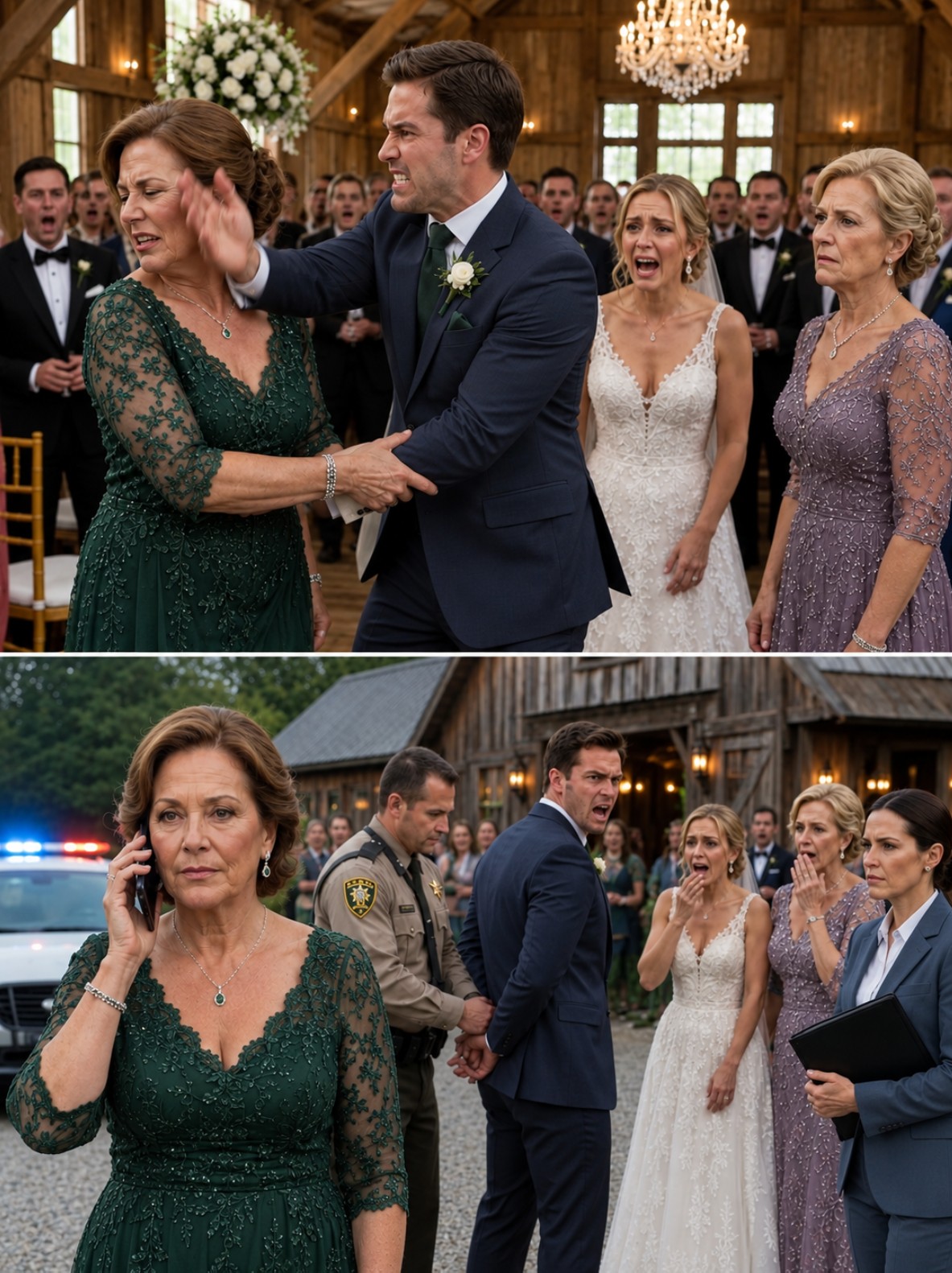
The slap rang through the wedding hall, louder than the music playing in the background.
For one horrifying second, all two hundred guests fell silent. Every eye turned toward me, and the looks on their faces made me feel as though I were the one who had ruined my daughter’s perfect wedding day.
My knees buckled beneath me.
I reached for the gift table to keep myself from falling. Champagne glasses rattled against one another, and someone near the dance floor gasped in shock.
Standing over me in his white tuxedo was my brand-new son-in-law, Carter Whitmore. He wore a satisfied smile, like a man who already believed he owned everything I had spent my entire life protecting.
“Don’t make a scene, Helen,” he said smoothly, speaking loudly enough for the nearest tables to hear. “Just hand over the farm keys.”
Beside him stood my daughter, Emily.
My baby girl.
Her face was pale beneath her bridal makeup, and her fingers trembled around the bouquet she had carried down the aisle only an hour earlier.
“Mom,” she whispered, her voice shaking. “Please… just give him the keys.”
Her words hurt far more than the slap.
The farm had belonged to my family for four generations. It was forty acres of apple orchards, cornfields, horse pasture, and the white farmhouse my late husband, Thomas, had rebuilt board by board after a devastating tornado destroyed much of it twenty years earlier.
That farm wasn’t just land to me. It held our memories, our sacrifices, and nearly every important moment of our lives.
Carter used to call it “worthless dirt.”
He had laughed at the old farmhouse, mocked the aging barns, and acted as though the fields were nothing more than a burden I stubbornly refused to abandon.
Then the county announced plans for a new highway extension nearby.
Suddenly, that same worthless dirt became valuable development land worth millions.
And Carter’s attitude changed overnight.
His mother, Vanessa Whitmore, lifted her champagne glass and gave me a thin, unpleasant smile.
“This drama is exhausting, Helen,” she announced. “You’re sixty-two years old and living alone. How much longer do you honestly think you can manage that place?”
A few guests laughed quietly.
Alone.
That was what they thought I was.
Just a widowed woman wearing sensible shoes and a navy dress. A quiet, churchgoing mother with dirt permanently trapped beneath her fingernails. Someone who spent her days tending apple trees and worrying about the weather.
Someone easy to pressure.
Easy to shame.
Easy to control.
Carter stepped closer and held out his hand as though I were a servant who had failed to follow an order.
“The keys,” he repeated. “You promised Emily a wedding gift.”
I looked him straight in the eyes.
“I promised her love,” I replied quietly.
His smile disappeared.
“Love doesn’t pay property taxes.”
“No,” I said slowly, tasting blood near the corner of my mouth. “But greed leaves fingerprints.”
Something flickered in his eyes.
For the first time that evening, his confidence seemed to weaken, even if only for a moment.
Vanessa leaned forward sharply.
“What exactly is that supposed to mean?”
I straightened carefully, ignoring the pain spreading across my cheek.
My heart wasn’t racing.
That surprised me more than anything.
It felt as though something inside me had gone completely still, like the air just before a tornado touches the ground.
Emily reached toward me desperately.
“Mom, please don’t ruin my wedding.”
I turned to face her.
And I really looked at her.
I remembered the little girl who used to chase chickens barefoot through the yard, laughing as they scattered in every direction. I remembered the teenager who learned to drive tractors sitting beside her father, her small hands gripping the steering wheel while Thomas patiently guided her.
I remembered the daughter who had once wrapped her arms around my waist and promised that nobody would ever come between us.
Where had that little girl gone?
For a moment, I wanted to reach for her, pull her close, and remind her that she didn’t have to be afraid of anyone.
But then I realized something that frightened me more than Carter’s slap.
He hadn’t simply manipulated my daughter.
He had trained her to fear disappointing him.
He had made her believe that keeping him happy was more important than standing up for her own mother.
And now, on her wedding day, she was asking me to surrender the home her father had worked so hard to save.
I turned back toward Carter.
“You made a very serious mistake,” I told him calmly.
He laughed in my face.
“No, Helen,” he replied. “You did.”
I didn’t argue.
I turned away and walked through the stunned crowd, past the flower arch, past the tables decorated with white roses, and past the photographer who had slowly lowered his camera as though he had just witnessed a crime.
Nobody tried to stop me.
Nobody asked if I was all right.
Outside, the cold October wind struck my burning cheek. I drew a deep breath and reached into my purse.
My hands were steady as I took out my phone.
Then I called the one man Carter Whitmore had never imagined I knew.
The call connected on the second ring.
“Sheriff Dalton?”
“It’s Helen,” I said quietly, looking through the reception hall windows at the guests still gathered inside. “It’s time.”
There was a brief silence.
Then his voice changed.
“He hit you?”
“Yes.”
“And demanded the property in front of witnesses?”
“In front of everyone.”
“I’m on my way.”
I ended the call and slipped my phone back into my purse.
For the first time that evening, I felt something other than pain.
Relief.
Carter had spent months believing I was a helpless old woman who could be pushed around until I finally surrendered.
He had no idea how much I knew.
And he had absolutely no idea what was coming.
Thirty seconds later, the reception doors burst open behind me.
“There she is,” Carter sneered.
He marched toward me, followed by two groomsmen who seemed to have appointed themselves his personal bodyguards.
“You think storming out makes you look dramatic?” he demanded. “You look unstable.”
I turned to face him.
“Then go back inside.”
“Not without those keys.”
I gave him a faint smile.
“You really don’t understand what’s happening here.”
His face tightened with anger.
“I understand perfectly. Your husband left you the farm. Emily inherits it after you die. I married Emily, so that land belongs to this family now.”
“No,” I replied evenly. “You married my daughter. You did not marry my property.”
His jaw clenched.
Before he could respond, Vanessa swept outside behind him, her silver satin dress shimmering beneath the entrance lights. Her expensive perfume seemed to arrive a moment before she did.
“Carter, stop wasting time arguing with her,” she said coldly. “She’s emotional.”
“She’s been emotional for months,” Carter muttered. “Ever since she started talking to lawyers.”
Emily stepped outside just in time to hear him.
She looked from Carter to me, confusion spreading across her face.
“Lawyers?” she whispered. “Mom… what lawyers?”
I held Carter’s gaze.
“The kind people hire after discovering forged signatures.”
Everything stopped.
For a moment, even Carter seemed unable to respond.
Then he laughed.
It was too quick, too loud, and too forced.
“There it is,” he scoffed. “Paranoid accusations. I knew you’d eventually start making things up.”
But Vanessa’s expression changed.
Only for half a second, but I saw it.
Her face lost its color, and her fingers tightened around the stem of her champagne glass.
That tiny reaction told me everything I needed to know.
Three months earlier, I had accidentally received a development proposal that was supposed to have gone to Carter.
At first, I thought it was just another offer from a company interested in buying land near the proposed highway extension.
Then I examined the documents more carefully.
The buyer’s name was hidden behind a shell company, making it difficult to determine who was actually behind the offer.
But the attached land map was unmistakable.
It showed my property.
Every boundary. Every field. Every section of the orchard.
The estimated closing date was listed clearly on the paperwork.
Two weeks after Emily’s wedding.
And my signature already appeared on the documents.
There was only one problem.
I had never signed them.
I sat at my kitchen table that night, spreading the papers across the same wooden surface where Thomas and I had paid our bills, planned our harvests, and raised our daughter.
I studied the signature again and again.
Someone had copied my name and expected me to accept it without a fight.
That was the moment everything changed.
Until then, I had spent months trying to convince Emily that something was wrong with Carter. I had shown her things that didn’t add up, asked questions about his sudden interest in the farm, and warned her not to sign anything without understanding it.
Every time, she defended him.
She told me I was suspicious, that I didn’t trust her judgment, and that I needed to accept the man she had chosen.
Eventually, I understood that arguing with her wasn’t helping.
So I stopped begging her to see the truth.
Instead, I began collecting evidence.
I saved bank notices that raised questions about financial transactions connected to the proposed sale. I preserved emails, property drafts, and other documents that showed how the deal was being arranged.
I also recovered deleted messages from the family tablet Emily used for recipes. Some of her messages had continued syncing to the device even after she thought they were gone.
One text from Carter to Vanessa remained burned into my memory.
Once the old woman hands over the keys, we push conservatorship if she fights.
Old woman.
That was what he called me when he thought I would never find out.
I had buried a husband.
I had survived droughts that nearly destroyed our harvests.
I had fought a meat company that poisoned our creek and threatened the health of our animals.
I had saved the farm from foreclosure twice, working until my back ached and my hands were raw.
I had spent decades doing whatever it took to protect the land my family had trusted me to preserve.
Meanwhile, Carter Whitmore had never repaired a fence in the rain.
He had never spent an entire night worrying about a sick animal or watched an entire season’s work disappear because of bad weather.
Yet he believed he could walk into my home, take my property, and decide what happened to the rest of my life.
Not anymore.
Inside the reception hall, the music finally stopped.
Guests were pressing against the windows now, watching us from behind the glass.
Carter noticed them and immediately changed his expression. His anger disappeared behind a mask of false concern.
“Helen,” he said in a smoother voice, “let’s not make this uglier than it needs to be. Give me the keys, apologize to Emily, and I won’t press charges for disrupting the wedding.”
I almost laughed.
He had just slapped me in front of two hundred people, and now he was threatening to press charges against me.
“You slapped me,” I said.
His expression barely changed.
“You lost your balance.”
Emily flinched.
I slowly turned toward her.
“Sweetheart,” I asked gently, “is that what he tells you love sounds like?”
Her lips parted, but no words came out.
For the first time that evening, she seemed unable to find an excuse for him.
Carter’s face darkened.
“Don’t manipulate her.”
“I don’t need to manipulate anyone,” I replied. “The truth speaks for itself.”
Then headlights swept across the gravel driveway.
A sheriff’s cruiser turned in through the entrance.
Another followed close behind.
Behind both vehicles came a black sedan.
Carter’s confident smile vanished.
Sheriff Roy Dalton stepped out of the first cruiser.
He was seventy years old, broad-shouldered, and had a face that looked as though it had been carved from stone. Age had slowed his movements slightly, but it hadn’t softened his eyes.
He had known my husband since they were boys.
Roy had seen Thomas and me through some of the hardest years of our lives. He knew what that farm meant to us, and he understood that I would never willingly surrender it to someone who had tried to steal it from me.
Then the woman in the black sedan stepped out, carrying a leather folder.
She wore a dark suit and had sharp, focused eyes.
Carter frowned at her.
“Who the hell is that?”
I wiped the blood from the corner of my mouth.
“My attorney,” I answered calmly.
Then I looked directly at him.
“And the reason you’re about to regret touching me.”
The guests began pouring out of the reception hall, gathering behind us in stunned silence.
Sheriff Dalton walked straight toward Carter.
“Keep your hands where I can see them, son.”
Carter forced a nervous laugh.
“Sheriff, this is just a family misunderstanding.”
Dalton glanced at my bruised cheek.
“That’s a pretty loud misunderstanding.”
My attorney, Rebecca Sloan, stepped forward and calmly opened her folder.
“Earlier today,” she announced, “my office filed an emergency injunction blocking any sale, transfer, or development agreement involving Hollow Creek Farm.”
Vanessa immediately stepped forward.
“You can’t do that!”
Rebecca barely glanced at her.
“We already did.”
Carter’s expression hardened.
“On what grounds?”
Rebecca opened the file and removed several documents.
“Forgery. Financial exploitation. Fraud conspiracy. Coercion. And assault.”
The words fell over the crowd like thunder.
Emily stared at Carter, her face filled with disbelief.
“Forgery?” she whispered.
Carter immediately turned toward her.
“Don’t start falling for your mother’s lies.”
Rebecca remained calm.
“The development agreement includes a forged signature belonging to Helen Carter. We had handwriting experts examine it this morning, and we also obtained the relevant notary records.”
Vanessa went completely pale.
For the first time, she looked genuinely frightened.
And suddenly, Carter seemed to understand the mistake that could destroy both of them.
The notary was Vanessa’s friend from her bridge club.
Rebecca continued, her voice steady.
“She has already given a statement confirming that Mrs. Whitmore brought her the documents personally.”
Vanessa’s mouth fell open.
“That woman is lying,” she hissed.
Sheriff Dalton gave a dark chuckle.
“She warned me you’d say exactly that.”
Behind Carter, the two groomsmen who had followed him outside began quietly stepping away.
They had arrived expecting an argument over a family dispute. Now they were watching the situation turn into something far more serious.
Rebecca wasn’t finished.
“We also have video evidence from tonight showing Mr. Whitmore publicly demanding property from my client and then physically assaulting her.”
Carter exploded.
“She provoked me!”
The words rang across the driveway.
That was the moment Emily finally moved.
She stepped directly between Carter and me, trembling so badly that her wedding dress rustled around her legs.
“You hit my mother.”
Carter stared at her as if he couldn’t believe she had dared to challenge him.
“After everything I’ve done for you?”
Emily’s eyes filled with tears.
She looked at the man she had married only hours earlier, the man she had trusted enough to build a future with, and seemed to be seeing him clearly for the first time.
“What exactly did you do?” she whispered. “Love me… or buy me?”
For a brief moment, Carter said nothing.
Then his expression twisted with anger.
His hand shot out and grabbed Emily’s wrist.
The deputies moved immediately.
One officer seized Carter and forced him backward, while another pulled Emily safely away from him.
Carter cursed and struggled against them.
“Get your hands off me! You have no idea who I am!”
But his protests didn’t stop the officers.
They brought his arms behind his back, and the handcuffs snapped shut around his wrists with a sharp metallic click.
The sound echoed through the cold night air.
To me, it was the sweetest sound I had heard all evening.
Vanessa tried to slip away while everyone was focused on her son.
Sheriff Dalton stepped into her path and stopped her with one arm.
“We’ll need you too, ma’am.”
She looked around desperately at the wedding guests, searching for someone willing to defend her.
But nobody moved.
Not one person stepped forward.
The same people who had laughed quietly when she mocked me now stood in silence, watching the consequences of her actions unfold.
Then Emily turned toward me.
Really turned toward me.
And suddenly, she wasn’t a bride standing in the middle of a ruined wedding anymore.
She was my little girl, the child who used to run into my bedroom after a nightmare and climb into my arms because she knew I would keep her safe.
“Mom,” she sobbed. “I’m so sorry.”
I opened my arms.
She collapsed against me, shaking as tears soaked into my dress.
I held her tightly, one hand resting against the back of her head.
Behind us, Carter continued screaming as the deputies escorted him toward the cruiser.
“You ruined my life!”
I kissed my daughter’s hair gently.
“No,” I said softly. “You ruined your own life the second you confused love with ownership.”
For a long moment, Emily clung to me without saying anything.
I didn’t tell her that I had warned her.
I didn’t remind her of every argument, every unanswered question, or every time she had chosen Carter’s word over mine.
She already knew.
And right then, she needed her mother more than she needed another lecture.
The wedding was over.
The marriage had barely begun, and already the truth had torn it apart.
But as I held my daughter beneath the cold October sky, I knew one thing with absolute certainty.
Hollow Creek Farm was not going to be stolen from me.
Not by Carter.
Not by Vanessa.
Not by anyone.
Six months later, the apple orchards bloomed white across Hollow Creek Farm.
Spring had returned, covering the branches with delicate blossoms and filling the air with the familiar scent of new growth.
Carter eventually pleaded guilty to assault and fraud charges.
The legal case exposed more of the scheme surrounding the proposed property sale, and the developers who had been drawn into the fraudulent deal sued Carter and Vanessa for their false representations.
Vanessa’s carefully maintained social standing began to collapse long before the court case was finished. The people she had spent years impressing no longer welcomed her as warmly as they once had.
Three months after the wedding, her family’s mansion appeared on the market under a foreclosure notice.
The woman who had once mocked me for living alone on a farm was now facing the loss of the life she had tried so hard to protect.
But I didn’t celebrate her troubles.
I had spent too many years working for what I had to waste my time rejoicing over someone else’s downfall.
My attention was elsewhere.
Emily came home in the spring.
At first, things between us were difficult. There were days when she barely spoke, and others when she cried over the choices she had made.
She struggled with the shame of having trusted Carter, especially when she thought about how she had treated me during those final months before the wedding.
I never pretended that everything could be repaired overnight.
Trust takes time, and the damage caused by manipulation doesn’t disappear simply because the person responsible is gone.
So we started with small things.
We repaired fences together, replacing broken posts and tightening loose wire along the pasture.
We planted tomatoes again in the garden beside the farmhouse, just as we had done when Emily was a child.
Some days, we worked quietly, each of us lost in our own thoughts.
Other days, we talked about everything that had happened.
We cried sometimes.
We laughed on other days.
And little by little, we began to find our way back to each other.
One evening, as the sun sank toward the horizon and painted the fields gold, Emily and I sat together on the farmhouse porch.
The air was warm, and a gentle breeze moved through the apple trees.
For a while, neither of us spoke.
Then Emily reached into her pocket and brought out the farm keys.
She turned them over in her palm, studying them as though they carried a weight far greater than the metal itself.
“Mom,” she whispered, “I don’t deserve these.”
I looked at her.
For a moment, I saw the little girl who had once followed her father through the fields, asking a thousand questions about the farm.
Then I saw the woman she was trying to become.
Someone who had made a terrible mistake but was finally willing to face it.
I reached over and gently closed her fingers around the keys.
“Not yet,” I told her softly. “But you’re finally learning what they mean.”
Emily looked down at her hand.
“I thought marrying Carter meant I was starting my own family,” she said quietly. “I didn’t realize how much I was letting him take away from the family I already had.”
I squeezed her hand.
“Starting a new life doesn’t mean you have to surrender the people who love you. And love should never require you to give up your dignity, your freedom, or your sense of right and wrong.”
She nodded, wiping a tear from her cheek.
“I’ll never let anyone make me choose like that again.”
“I hope you won’t,” I replied. “But what matters most is that you learn to recognize the difference between someone who loves you and someone who simply wants to own you.”
We sat together as the last sunlight disappeared beyond the fields.
The wind moved through the apple trees, making the branches sway gently, almost like applause.
For the first time in a very long time, I no longer felt as though I had to stand guard over every corner of my life.
The farm was safe.
My daughter was home.
And the future, though still uncertain, no longer frightened me the way it once had.
I had learned that being kind didn’t mean allowing people to use me. Being a mother didn’t mean accepting every betrayal without standing up for myself. And protecting the people I loved sometimes meant refusing to give them what they demanded.
Carter had believed that marrying my daughter gave him the right to control my land.
He had believed that a slap would frighten me into submission and that public humiliation would leave me too ashamed to fight back.
He had mistaken my quiet nature for weakness.
And that had been his greatest mistake.
I rested my head against the back of the porch chair and watched the moon rise over the orchard.
Home had always been more than a farmhouse or a stretch of valuable land. It was the place where my family had worked, laughed, struggled, and built a life together.
It was something worth protecting.
And now, at last, it felt safe again.
The end.
