
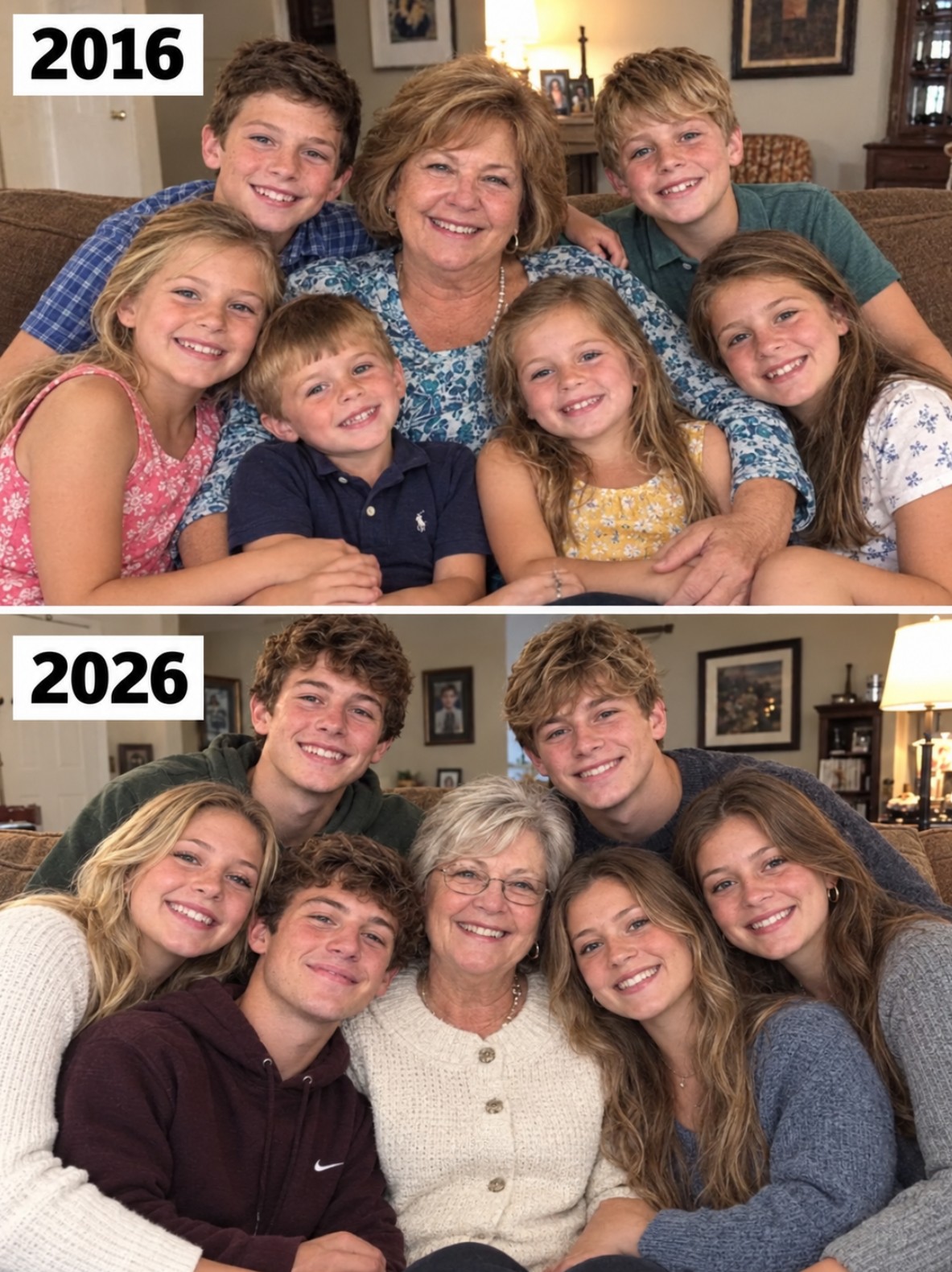
Part 1:
I was fifty-nine years old when my son and his wife died in a car accident.
In a single night, my entire world fell apart. I lost my son, his wife, and the future I had imagined for our family. But I also became responsible for seven children who had suddenly lost both their parents.
Overnight, I went from being a grandmother to becoming a mother all over again.
My heart was shattered, but I knew I couldn’t fall apart. Seven little children needed me, and I was all they had left.
There was no one else to turn to. It was just me and the kids.
Those first few years were the hardest of my life. The younger children woke up crying in the middle of the night, calling for their mother and asking when their father would come home. Sometimes, I would sit on the edge of their beds, holding them close while they sobbed against my shoulder.
I wanted to give them answers, but all I could do was tell them how much their parents had loved them.
During the day, I worked as much as I could. I took on extra jobs, stretched every dollar, and learned how to make one paycheck cover what should have been two parents’ incomes. I worried about groceries, electricity bills, school supplies, clothes, and everything else seven growing children needed.
Eventually, I had to admit that my own house was too small and too old to accommodate all of us. There simply wasn’t enough room.
So we moved into my son’s house, the place where he had lived with his wife and their seven children.
Walking through that front door was painful. Every room held memories of them. I could almost hear my son’s laughter in the kitchen and imagine his wife calling the children in from the backyard.
But the house was big enough for us, and the children needed a home where they could grow up together.
So I stayed.
Ten years passed.
Little by little, the children grew older. The nights filled with tears became less frequent, and our lives slowly settled into a new routine. There were birthdays, school events, arguments over chores, family dinners, and moments of laughter that reminded me we were still capable of being happy.
The pain never completely disappeared, though. There were days when I still missed my son so much that I had to stop whatever I was doing and sit down for a moment.
I never stopped wishing things had turned out differently.
By then, my seven grandchildren had become young people with their own personalities, dreams, and struggles. I had done everything I could to give them a stable life, even when I wasn’t sure how I would manage the next month.
But recently, my youngest granddaughter, Willa, had begun asking more questions about her parents.
She had been only four years old when they supposedly died, so she remembered very little about them. Most of what she knew came from old photographs, family stories, and the memories I shared with her.
Whenever she asked what had happened that night, I told her the truth as I understood it.
Her parents had gone out, and a terrible car accident had taken both their lives.
At least, that was what I had always believed.
Over the past few weeks, however, Willa had changed.
She became quieter and more distant. She stopped joining the others as often and spent hours alone in the basement, claiming she was sorting through old belongings.
At first, I didn’t worry too much. I assumed she was going through a difficult stage in her teenage years or trying to make sense of losing her parents at such a young age.
I thought she simply needed some time alone.
Then yesterday morning, everything changed.
I was in the kitchen making breakfast when Willa walked in carrying a dusty cardboard box. She placed it on the table carefully, as if it contained something fragile.
There was dust all over the lid, and the corners looked as though they had been sitting untouched for years.
“Sweetheart, what’s that?” I asked.
“I found it in the basement,” she replied. “It was hidden behind an old cabinet.”
I wiped my hands on a kitchen towel and looked at her.
“What’s inside?”
Instead of answering, Willa pulled out a chair and sat down across from me.
Then she looked straight into my eyes.
“Grandma, Mom and Dad didn’t die that night. I know what really happened.”
For a moment, I couldn’t even speak.
My hands began to shake, and I stared at her, wondering what had made her say something so frightening.
“Willa, honey, what are you talking about?”
“I’m not making this up,” she insisted. “You need to look inside the box.”
I wanted to believe she had misunderstood something. Children sometimes built strange explanations around painful memories, especially when they had grown up without their parents.
But there was something different about Willa’s expression.
She wasn’t confused.
She was angry.
And she looked as though she had discovered something that had changed the way she saw her entire life.
I finally reached for the box and lifted the lid.
Inside was a thick stack of documents, old envelopes, and bundles of cash.
At first, I didn’t understand what I was looking at.
Then I noticed the papers beneath the money.
My breath caught in my throat.
Because suddenly, I began to wonder whether the terrible story I had told myself for ten years was nothing more than a lie.
And if Willa was right, the truth about my son’s death was far worse than I could have imagined.
Part 2:
Willa was fourteen years old when she carried that dusty box into the kitchen and placed it on the table.
She sat across from me, her hands folded tightly in front of her.
“I found it behind the old cabinet in the basement,” she repeated. “Grandma, Mom and Dad didn’t die that night.”
I stared at her, struggling to understand what she was saying.
For weeks, I had watched her become more withdrawn as she searched through her parents’ old belongings. I had assumed she was having trouble accepting their deaths, and now I feared her grief had led her to believe something that wasn’t true.
“Willa…” I began gently. “I’ve told you what happened to your parents. I know it’s hard to accept, but—”
“Just look at it, Grandma!” she interrupted.
Her voice was sharper than I had ever heard it.
I stopped talking.
There was something in her expression that made it impossible to dismiss her words. She wasn’t asking me to imagine what might have happened. She wanted me to see something for myself.
I turned off the stove, leaving the pancakes unfinished, and sat down.
Then I lifted the lid.
The first thing I noticed was a thick stack of cash. The bills were held together with old rubber bands, and some of them looked as though they had been stored there for years.
I moved the money aside.
Underneath it were several plastic sleeves containing documents.
I picked up the first one, then the next.
My stomach tightened.
None of this made sense.
Suddenly, I remembered the last time I had seen my son, Gordon, and his wife, Renee.
They had brought all seven children to my house for what was supposed to be a summer visit. The children had been running around, shouting and laughing, while Gordon and Renee carried bags inside.
I had looked at the chaos and laughed.
“It feels like I’ve been invaded!” I had joked.
Gordon had grinned, leaned down, and kissed my cheek.
“You love it, Mom,” he had replied. “Just don’t send them back too spoiled.”
Renee had laughed, too.
At the time, it had seemed like an ordinary family moment. Nothing about their behavior suggested that I might never see them alive again.
But that very night, everything changed.
By midnight, the sheriff was standing at my front door.
I could still remember the look on his face when he told me that Gordon and Renee had been killed in a car accident.
I remembered asking him to repeat himself because I couldn’t understand the words.
I remembered sinking into a chair, feeling as though the floor had disappeared beneath me.
And I remembered the days that followed, when we arranged a closed-casket funeral because of the severity of the crash.
There had been no chance to say a proper goodbye. No final glimpse of their faces. Just the unbearable knowledge that they were supposedly gone forever.
After the funeral, I took responsibility for the children.
There had been no real decision to make. They needed someone, and I was their grandmother. I couldn’t imagine allowing them to face the world without a family member willing to care for them.
So I took them in.
I worked extra hours, worried about money, and went to bed exhausted almost every night. I learned how to stretch meals, repair old clothes, and put the children’s needs ahead of my own.
I gave up things I wanted because there were always seven other people who needed something more.
And I did it because I loved them.
Now, ten years later, I was sitting at my kitchen table staring at a box that threatened to turn every one of those memories upside down.
I closed the lid and stood up.
“Get your brothers and sisters into the living room,” I told Willa. “All of them. We’re going to look at this together.”
She didn’t argue. She hurried out of the kitchen, calling for everyone as she went.
I carried the box into the living room and placed it on the coffee table.
Within minutes, all seven grandchildren had gathered around me.
Callum, the oldest, sat forward on the couch. Josie stood near the armrest, while Reid and Felix squeezed into the remaining space. Marnie sat beside Willa, who hadn’t taken her eyes off the box.
They all looked worried.
“What’s going on, Grandma?” Callum asked.
“Willa found something in the basement,” I explained. “Something that may have a lot to do with what happened to your parents. You all deserve to see it.”
I opened the box again.
Josie’s eyes widened when she saw the cash.
“What on earth is that?”
“Money,” Reid said, leaning closer. “A lot of it.”
“We had money hidden in the basement?” he added, looking confused.
“Mom and Dad hid it,” Willa said firmly.
Everyone went quiet.
Callum reached for one of the bundles and began counting the bills.
I let him work for a moment before moving the remaining papers aside.
“It’s not just money,” I told them.
I pulled out a thin bundle of plastic sleeves and spread the documents across the table.
Inside were copies of all seven children’s birth certificates and Social Security cards.
Every single one of them.
The documents had been carefully collected and kept together, as if someone had wanted to make sure they could be carried away quickly.
At the very bottom of the box, I found a folded map.
When I opened it, I saw several routes marked in ink. The lines led away from our state and toward places farther across the country.
Willa leaned forward.
“See?” she said. “They were planning to leave. Mom and Dad didn’t die. They were going to disappear.”
The room erupted.
Everyone began talking at once, asking questions and trying to make sense of what we had found.
I raised my hand.
“One at a time,” I said firmly. “We need to be careful. We don’t know everything yet.”
“But look at the money!” Callum protested. “And our documents! Why would they have all this ready if they weren’t planning something?”
“I agree that it looks suspicious,” I replied. “But we still don’t have proof that your parents are alive. What we have is evidence that they may have been preparing to leave.”
“Preparing to leave without us?” Josie asked.
Her voice sounded small and frightened.
No one answered immediately.
I looked around the room at the children I had raised, and I could see the same question forming in every face.
Why would their parents prepare to disappear?
And why had they left behind so much money and so many important documents?
“There has to be more,” Marnie said suddenly. She stood up and looked at Willa. “Show us exactly where you found the box.”
Willa nodded.
We all went down to the basement together.
The room was crowded with old furniture, storage containers, boxes of children’s clothes, and things we had never found the time to sort through. I had spent years trying to keep the house running, and the basement had gradually become a place where we stored anything we weren’t ready to throw away.
The old cabinet stood against the far wall.
Willa pointed to the narrow space behind it.
“That’s where the box was.”
We began searching through everything nearby, moving boxes and checking old drawers. We looked behind shelves, underneath furniture, and inside containers filled with things that had belonged to Gordon and Renee.
Minutes passed.
Then more minutes.
Just when I thought we had found everything there was to find, Felix called out.
“Grandma? You need to see this!”
He was standing near the far wall, holding a thick folder.
I hurried over and took it from him.
The folder was old, and the papers inside had yellowed around the edges. I carried it beneath the bare lightbulb hanging from the ceiling and opened it.
My blood ran cold.
The folder was filled with bills, bank statements, collection notices, and final warnings about unpaid debts.
There were letters demanding payment and statements showing balances that had grown far beyond what my son and his wife could apparently manage.
I turned one page after another, struggling to take it all in.
I had gone through the belongings I could access after Gordon and Renee supposedly died. I had handled paperwork, dealt with the practical matters that followed their deaths, and tried to settle everything I could.
But I had never seen these documents.
They must have hidden them before that terrible night.
“They were in trouble,” I whispered.
Callum stood beside me, reading over my shoulder.
“How much trouble?”
“I don’t know yet,” I admitted. “But it looks like a lot.”
At the back of the folder, I found a single sheet of lined paper.
It contained a bank account number and routing information, written in neat handwriting that I immediately recognized as Renee’s.
Beneath the numbers, she had written a short message.
*Don’t touch anything else.*
I stared at those words for a long moment.
Why would Renee leave such a warning?
Was she afraid someone would discover the money? Was she worried about the debts? Or was there something else she didn’t want anyone to find?
Callum leaned over my shoulder.
“Does that mean there’s more money somewhere?”
I folded the paper carefully.
“There’s only one way to find out.”
That night, I barely slept.
I kept thinking about the box, the cash, the children’s documents, and the map. I remembered the sheriff coming to my door and the funeral that followed. I thought about all the years I had spent believing my son and his wife were dead.
What if none of it had happened the way I had been told?
The next morning, I took the account information and went to the bank.
I didn’t tell the children I was frightened, but I was.
If the account had been closed years earlier, perhaps we would have a small piece of the puzzle. If it had never existed, we would have to look for another explanation.
But if it was still active, I didn’t know what that would mean.
When I reached the counter, I explained that I needed help with an account belonging to my son.
“He passed away ten years ago,” I told the woman assisting me. “I found this account number among his belongings. I need to understand what it is and whether anything was left in it.”
I provided the account information and a copy of Gordon’s death certificate.
The employee typed the details into her computer.
At first, her expression was neutral.
Then she frowned and checked the screen again.
“Ma’am, are you certain this account number is correct?”
My stomach tightened.
“Yes. Why?”
She looked at me carefully.
“According to our records, this account is still active.”
I stared at her.
“Active? What does that mean?”
“It means the account has not been closed. And I can see that there has been recent activity.”
For a moment, I couldn’t hear anything around me.
Recent activity.
Those two words kept repeating in my head.
If Gordon was dead, who was using his account?
And if he wasn’t dead, where had he been for ten years?
I thanked the employee, gathered my papers, and left the bank in a daze.
The entire drive home, my hands gripped the steering wheel so tightly that my fingers hurt.
I had spent ten years raising seven children because I believed their parents had died.
Now I had to consider the possibility that those parents had been alive all along.
When I arrived home, all seven grandchildren were waiting in the hallway.
Callum stepped forward before I had even closed the door.
“Well? What did the bank say?”
I looked at their anxious faces.
Then I took a deep breath.
“The account is still active.”
Willa’s eyes filled with anger.
“I told you they were alive!”
Callum shook his head.
“Wait. There could be another explanation. Someone might have access to the account, or there could be a mistake.”
“There is no mistake!” Willa snapped. “The bank said there was recent activity! Who else would be using that account? And why were our documents in the box, but not theirs?”
Callum turned toward me.
His anger had faded, leaving something much more painful behind.
Desperation.
“If they planned to leave, why didn’t they take us? They had our birth certificates and Social Security cards. They had money. They had a map. Everything was ready.”
“Maybe something changed,” Josie whispered.
“Maybe they realized it would be too difficult to disappear with seven children,” Felix said quietly.
Willa looked at him.
“So they left us behind?”
No one answered.
Her face hardened, and I could see the hurt beneath her anger.
She had been four years old when her parents supposedly died. She had grown up with only fragments of memories, photographs, and stories about them.
Now she was being forced to consider something far worse than losing them in an accident.
The possibility that they had chosen to leave her.
And her six siblings.
I was furious. I was frightened. More than anything, I felt betrayed by a truth I still didn’t fully understand.
But I knew we couldn’t spend the rest of our lives guessing.
“Since there is a chance your parents are alive,” I said, “I think we should ask them what happened.”
Callum looked at me.
“How are we supposed to do that if we don’t know where they are?”
I glanced down at the bank papers in my hand.
“We make them come to us.”
Part 3:
The next day, I returned to the bank.
This time, I asked to speak with the branch manager.
When he came out to meet me, I explained what I had discovered and told him why the account’s recent activity concerned me.
I didn’t want to accuse anyone without proof. But I needed answers, and I needed to know whether there was a way to bring whoever was using that account out of hiding.
“I want to begin the process of closing this account,” I told him.
The manager looked surprised.
“Are you certain? Depending on how the account is set up, closing it could trigger notices or alerts for anyone who currently has access to it.”
I looked him directly in the eyes.
“Good.”
He studied my face for a moment, perhaps realizing that this was not an ordinary banking request.
I showed him the documents I had kept from the time I handled Gordon’s affairs ten years earlier. I explained what we had found in the basement and why I believed someone might be using the account.
He reviewed the paperwork and explained the steps that could legally be taken. After confirming what authority I had, he helped me begin the closure process.
I knew it was possible that nothing would happen.
Perhaps the person using the account would ignore the notice. Perhaps the bank would be unable to reach anyone. Perhaps the account’s activity had an innocent explanation after all.
But I had to try.
If Gordon and Renee were alive, I wanted them to know that someone had discovered their secret.
And if they were truly dead, I needed to find out who had been using their account.
For the next three days, I waited.
Every time the phone rang, I wondered whether it was connected to the bank. Whenever a car slowed down outside the house, I found myself looking through the window.
I didn’t tell the children how nervous I was. They had already been through enough.
But I couldn’t stop thinking about the possibility that the people who had abandoned them might soon appear at our door.
Then, three days later, someone knocked.
I was in the hallway when I heard it.
At first, I thought it might be a neighbor. I walked toward the front door and opened it without expecting anything unusual.
Then I saw the man standing on my porch.
He looked older than I remembered. His face was thinner, his hair had changed, and there were deep lines around his eyes that hadn’t been there ten years earlier.
But I recognized him immediately.
It was Gordon.
My son.
The man I had buried in my heart a decade earlier.
Renee stood half a step behind him. She was thinner, too, and her eyes darted nervously between me and the inside of the house.
For several seconds, I couldn’t move.
I had imagined seeing my son again countless times over the years, usually in dreams where I woke up crying because he was gone.
But he was standing right in front of me.
Alive.
I felt as though the world had tilted beneath my feet.
“So it’s true,” I finally whispered. “You’re alive.”
Gordon opened his mouth, but no words came out.
Behind me, I could hear movement in the hallway.
All seven grandchildren had heard the knock and gathered nearby. They were standing just out of sight, watching and listening.
Gordon’s eyes moved past me.
When he saw them, his face changed.
For the first time, he seemed to understand that this was not going to be a private conversation between a mother and her son.
These were his children.
The children he had supposedly left behind forever.
Callum stepped forward.
He was no longer the little boy who had lost his parents ten years earlier. He was a young man who had spent years helping me keep the family together.
And now he was looking at his father for the first time in a decade.
“Where have you been?” Callum demanded. “Why did you leave us? We found the box in the basement. We found the money, our documents, and the map. We know you were planning something.”
Gordon and Renee exchanged a nervous look.
“We can explain,” Gordon said.
Renee took a small step forward.
“We wanted to take you all with us,” she said. “We really did. We had a plan.”
Willa let out a bitter laugh.
“A plan? You had ten years to explain yourselves!”
Renee flinched.
Gordon rubbed his forehead and looked at me.
“We had to leave in a hurry that day,” he said. “Everything was falling apart. We didn’t even have time to go back for the money.”
I stared at him.
“You didn’t have time to go back for the money, but you had time to leave seven children behind?”
His face tightened.
“Mom, you don’t understand.”
“Then help me understand, Gordon. Because I spent ten years believing you were dead. I raised your children alone. I worked myself to exhaustion to feed them and keep a roof over their heads. I buried you without being able to say goodbye.”
My voice began to shake.
“And now you’re standing here telling me you didn’t have time to come back for your money?”
Gordon looked away.
“It wasn’t that simple.”
“Then tell us what happened,” Callum demanded.
Gordon took a deep breath.
“We were drowning in debt. We had creditors calling constantly, collection notices arriving every week, and people demanding money we didn’t have. I thought if we could get away and start over somewhere else, we could rebuild our lives.”
“And the plan was to come back for us?” Josie asked.
“Yes,” Gordon replied quickly. “That was always the plan.”
Josie stared at him in disbelief.
“When? After another ten years?”
Gordon’s expression hardened.
“You don’t know what we were dealing with.”
“No,” Josie said. “We don’t. Because you weren’t here to tell us.”
Renee began to cry quietly.
“We never stopped loving you,” she whispered. “We thought about you every day.”
Willa stepped forward.
“Then why didn’t you come back?”
Renee looked at her youngest daughter, but she couldn’t seem to find an answer.
Gordon turned toward me again.
“Mom, please. We need your help.”
Something about the way he said those words made my stomach tighten.
“What kind of help?”
He hesitated.
Then he looked directly at me.
“You need to reactivate the account. We need that money to get back on our feet.”
For a moment, I couldn’t believe what I was hearing.
They had appeared after ten years of silence. They had stood in front of their children without offering a convincing explanation for their disappearance.
And before they had even begun to answer for what they had done, they were asking me for money.
Money they believed was still waiting for them.
I looked at Gordon, searching his face for the son I remembered. I wanted to find some sign that the boy I had raised was still there beneath the years of secrecy and fear.
But all I could see was a man who had come back because he needed something.
Before I could respond, Willa spoke.
“No!”
Her voice cut through the hallway.
Everyone turned toward her.
“You left us. You let us believe you were dead. You let Grandma raise seven children while you disappeared. You had ten years to come back and tell us the truth, and you only showed up when you needed money.”
Renee covered her mouth with one hand.
Gordon stared at his daughter.
I crossed my arms.
“I agree with Willa.”
Gordon spread his hands in frustration.
“You don’t understand what it was like! We were desperate. We thought we could fix everything if we just got away.”
“Then explain it,” Callum said. “Explain why leaving your children behind was the only answer you could find.”
Gordon took another breath.
“We were in serious financial trouble. The debts were growing, and we were terrified of what would happen if we stayed. I thought we could disappear, get established somewhere else, and eventually come back for you.”
“Eventually?” Marnie repeated.
He nodded.
“We never intended for it to last this long.”
“Ten years isn’t a little while,” Felix said quietly.
Gordon looked down.
“The plan was always to return,” he repeated.
Josie shook her head.
“You keep saying that, but what does it even mean? Were you going to come back when we were grown? When Grandma was too old to look after us? When you finally needed something from us?”
“That’s not fair,” Renee whispered.
“Fair?” Callum snapped. “You want to talk about fair?”
He stepped closer to the doorway.
“Grandma was almost sixty when you disappeared. She was supposed to be enjoying her life, not working herself to the bone to raise seven children. She had to pay for our food, our clothes, our school supplies, and everything else. She stayed up with us when we cried for you. She helped us when we were sick. She showed up for every birthday and every school event.”
His voice cracked, but he continued.
“You left us to deal with all of that while you were somewhere else, living your lives.”
Gordon opened his mouth, but Callum didn’t let him interrupt.
“Grandma didn’t have to take us in. She could have said she was too old or couldn’t afford it. She could have let the authorities decide where we went. But she didn’t. She chose us every single day.”
He turned toward me briefly, then looked back at his father.
“You chose yourselves.”
The words seemed to hit Gordon harder than anything else anyone had said.
For a moment, he stood completely still.
Then I remembered the papers I had left on the hall table.
I walked over, picked them up, and returned to the doorway.
“The account is closed,” I told him.
His face went pale.
“What?”
“The account has been closed. I moved the money into the children’s college fund, along with the cash we found in the basement.”
I had made sure the money was handled through the proper process before transferring it. Whatever Gordon and Renee had intended to do with it, I was no longer willing to let those funds become another way for them to escape responsibility.
Gordon stared at me as if I had just told him I had destroyed his life.
“No! You can’t do that!”
“I already did.”
“Mom, that money was ours!”
“Was it?” I asked. “Because from where I’m standing, it looks like money you left behind while your children needed you.”
He stepped forward, panic replacing the anger on his face.
“How are we supposed to survive now? You have to be reasonable!”
That response told me more than any explanation could have.
Even after everything that had happened, even after seeing the children he had abandoned, Gordon was still thinking about what he had lost.
Not what they had lost.
Not what I had sacrificed.
Only the money.
Callum moved to stand beside me.
“You put yourselves first for ten years,” he said. “Grandma never did. She took care of all seven of us when you wouldn’t. And now you’re here demanding money as if we owe you something.”
Gordon’s mouth opened, but he couldn’t seem to form an answer.
Renee wiped her eyes.
“We did love you,” she whispered.
Marnie, who had remained quiet for most of the confrontation, finally spoke.
“Then you should have acted like it.”
Her words were simple, but they filled the silence.
Josie nodded.
“Grandma worked herself to the bone for us. She gave us a home and made sure we never had to wonder whether someone would be there for us. You can’t expect us to believe you spent ten years trying to find a way back when you couldn’t even come back to tell us the truth.”
Gordon looked at his children one by one.
For the first time, he seemed to realize that they were no longer little kids who would run into his arms simply because he had returned.
They had grown up.
They had learned what love looked like by watching their grandmother.
And now they were judging him by the same standard.
Silence settled over the hallway.
I had imagined this moment so many times over the years. In some of those imagined conversations, I screamed at Gordon for what he had done. In others, I cried and begged him to explain why he had left us.
Sometimes, I imagined falling into his arms and discovering that there had been some terrible misunderstanding.
But standing in front of him now, I felt none of the triumph I had expected.
I felt empty.
This was my son. I had loved him before he could speak. I had held him when he was sick, watched him grow up, and believed I knew the kind of man he would become.
Now I was looking at someone who had made a decision that had hurt eight people for ten years.
I could accept that he had been frightened. I could understand that debt and desperation could push people into making terrible choices.
But I could not pretend that those choices had not destroyed lives.
Perhaps Gordon and Renee had once intended to return for their children. Perhaps they had truly believed they would find a way to rebuild their lives and bring the family back together.
But intentions meant very little after ten years of absence.
At some point, returning had stopped being their priority.
And now they were standing at my door because the money they had left behind was no longer available to them.
I looked at Gordon one last time.
“You should leave,” I said quietly.
He stared at me.
“Mom…”
“No, Gordon. Not today. I don’t know if I’ll ever be able to understand what you did, and I certainly can’t forgive you simply because you’ve finally shown up.”
His shoulders dropped.
Renee stood beside him with tears running down her cheeks. She looked toward the grandchildren, perhaps hoping one of them would say something that might change the outcome.
But no one moved.
No one stepped forward.
No one offered to comfort her.
Gordon gave me one final look, then turned away and walked down the porch steps.
Renee lingered for a moment longer.
“I’m sorry,” she whispered.
I wanted to ask her whether she was sorry for leaving the children or sorry because the money was gone.
But I didn’t.
She lowered her eyes and followed Gordon.
I watched them walk away until they disappeared from view.
Then I closed the front door.
For several seconds, I stood there with my hand on the doorknob, unable to move.
I had spent ten years believing I had lost my son forever. Now I knew he had been alive, and somehow that truth hurt in a completely different way.
Behind me, I heard someone begin to cry.
I turned around.
All seven grandchildren were standing together in the hallway. Their faces were filled with shock, anger, and grief. They had just learned that the story they had grown up believing was not the truth.
They had lost their parents once in the story they were told.
Now they had to face the reality of being abandoned by them.
I opened my arms.
That was all it took.
The children came toward me, one after another, until all seven of them were wrapped around me in a tight group hug.
Callum held on to my shoulder. Josie pressed her face against me. Willa buried her head against my chest, crying so hard that her whole body shook.
I held them as tightly as I could.
“I’m here,” I whispered. “I’m not going anywhere.”
I repeated those words until their breathing began to settle.
We were all hurting. We had discovered a truth that would take a long time to understand, and there would be difficult days ahead.
But we still had one another.
For ten years, I had given those children everything I could because I believed their parents were gone and someone had to make sure they were loved.
Now I understood that my greatest achievement had never been the money I earned, the bills I paid, or the years of hard work I had endured.
It was the family we had built together.
Gordon and Renee had left their children behind, but they had not destroyed the bond between us.
We would have to find a way to heal from what we had learned. We would have to decide what forgiveness meant, whether reconciliation was possible, and what kind of relationship, if any, we wanted with the people who had abandoned us.
Those answers would not come overnight.
For now, all that mattered was that we were together.
I had spent ten years making sure those seven children never had to face the world alone.
And I would keep doing it for as long as they needed me.
We had survived the loss we thought we understood. Now we would face the truth we had only just discovered.
Together.
The End.
